From Surf Wiki (app.surf) — the open knowledge base
Phosphine oxides
Class of chemical compounds
Class of chemical compounds
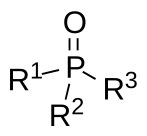
Phosphine oxides are phosphorus compounds with the formula OPX3. When X = alkyl or aryl, these are organophosphine oxides. Triphenylphosphine oxide is an example. An inorganic phosphine oxide is phosphoryl chloride (POCl3). The parent phosphine oxide (H3PO) remains rare and obscure.
Structure and bonding
Tertiary phosphine oxides
:[[File:R3POresSt.svg|thumb|Principal resonance structures for phosphine oxides|left|220px]] Tertiary phosphine oxides are the most commonly encountered phosphine oxides. With the formula R3PO, they are tetrahedral compounds. They are usually prepared by oxidation of tertiary phosphines. The P-O bond is short and polar. According to molecular orbital theory, the short P–O bond is attributed to the donation of the lone pair electrons from oxygen p-orbitals to the antibonding phosphorus-carbon bonds.{{cite journal
Secondary phosphine oxides
Secondary phosphine oxides (SPOs), formally derived from secondary phosphines (R2PH), are again tetrahedral at phosphorus. One commercially available example of a secondary phosphine oxide is diphenylphosphine oxide. SPOs are used in the formulation of catalysts for cross coupling reactions.
Unlike tertiary phosphine oxides, SPOs often undergo further oxidation, which enriches their chemistry: :R2P(O)H + H2O2 → R2P(O)OH + H2O These reactions are preceded by tautomerization to the phosphinous acid (R2POH): :
Primary phosphine oxides
Primary phosphine oxides, formally oxidized derivatives of primary phosphines, are again tetrahedral at phosphorus. With four different substituents (O, OH, H, R) they are chiral. The primary phosphine oxides subject to tautomerization, which leads to racemization, and further oxidation, analogous to the behavior of SPOs. Additionally, primary phosphine oxides are susceptible to disproportionation to the phosphinic acid and the primary phosphine: : :2RP(O)H2 → RP(O)(H)OH + 2RPH2
Syntheses
Phosphine oxide are typically produced by oxidation of organophosphines. The oxygen in air is often sufficiently oxidizing to fully convert trialkylphosphines to their oxides at room temperature: :R3P + 1/2 O2 → R3PO This conversion is usually undesirable. In order to suppress this reaction, air-free techniques are often employed when handling say, trimethylphosphine.
Less basic phosphines, such as methyldiphenylphosphine are converted to their oxides with hydrogen peroxide: : PMePh2 + H2O2 → OPMePh2 + H2O
Phosphine oxides are generated as a by-product of the Wittig reaction: :R3PCR'2 + R"2CO → R3PO + R'2C=CR"2 Another albeit unconventional route to phosphine oxides is the thermolysis of phosphonium hydroxides: :[PPh4]Cl + NaOH → Ph3PO + NaCl + PhH
The hydrolysis of phosphorus(V) dihalides also affords the oxide: :R3PCl2 + H2O → R3PO + 2 HCl A special nonoxidative route is applicable secondary phosphine oxides, which arise by the hydrolysis of the chlorophosphine. An example is the hydrolysis of chlorodiphenylphosphine to give diphenylphosphine oxide: :Ph2PCl + H2O → Ph2P(O)H + HCl
Reactions
Transition metal complexes of phosphine oxides are numerous.
Some phosphine oxides are well-known photoinitiators in photopolymer chemistry. UV/LED exposure induces a type I Norrish fission to free radicals, which then polymerize in a radical chain. An example is 2,4,6trimethylbenzoyldiphenylphosphine oxide, which absorbs around 380-410nm (near UV).
Deoxygenation
Phosphine oxide deoxygenation has been extensively developed because many useful reactions convert stoichiometric tertiary phosphines to the corresponding oxides. Regenerating the tertiary phosphines requires cheap oxophilic reagents, and can retain or invert chirality at P, depending on the reductant.
Industrial deoxygenation usually occurs in two steps. Phosgene or equivalents first produce chlorotriphenylphosphonium chloride, which is then reduced separately.
In the laboratory, phosphine oxides are usually reduced with silicon derivatives, typically inexpensive trichlorosilane. Trichlorosilane and triethylamine reduce phosphine oxides with inversion, whereas the reaction proceeds with retention absent the base:{{cite journal :HSiCl3 + Et3N ⇋ SiCl3− + Et3NH+ :R3PO + Et3NH+ ⇋ R3POH+ + Et3N :SiCl3− + R3POH+ → PR3 + HOSiCl3 Other perchloropolysilanes, e.g. hexachlorodisilane (Si2Cl6) or Si3Cl8, can reduce phosphine oxides and generally give higher yields: :R3PO + Si2Cl6 → R3P + Si2OCl6 :2 R3PO + Si3Cl8 → 2 R3P + Si3O2Cl8
Boranes and alanes also deoxygenate phosphine oxides. Phosphoric acid diesters ((RO)2PO2H) catalyze deoxygenation with hydrosilanes.
Use
Phosphine oxides are ligands in various applications of homogeneous catalysis. In coordination chemistry, they are known to have labilizing effects to CO ligands cis to it in organometallic reactions. The cis effect describes this process.
References
References
- D. E. C. Corbridge "Phosphorus: An Outline of its Chemistry, Biochemistry, and Technology" 5th Edition Elsevier: Amsterdam 1995. {{ISBN. 0-444-89307-5.
- (1994). "No d Orbitals but Walsh Diagrams and Maybe Banana Bonds: Chemical Bonding in Phosphines, Phosphine Oxides, and Phosphonium Ylides". Chemical Reviews.
- In fact, the N-O bonds in amine oxides are more likely to be closer to double bonds than are those of the P-O bonds in phosphine oxides; see e.g. https://pubs.rsc.org/en/content/articlelanding/2015/sc/c5sc02076j#:~:text=Quantitative%20analysis%20of%20known%20species%20of%20general%20formulae,high%20degree%20of%20covalent%20rather%20than%20ionic%20bonding.
- (2019). "Coordination Chemistry and Catalysis with Secondary Phosphine oxides". Catalysis Science & Technology.
- (2007). "Catalytic Arylations with Challenging Substrates: From Air-Stable HASPO Preligands to Indole Syntheses and C-H-Bond Functionalizations". Synlett.
- (2021). "A Stable Primary Phosphane Oxide and Its Heavier Congeners". Chemistry – A European Journal.
- (1977). "Inorganic Syntheses".
- W. B. McCormack. (1973). "3-Methyl-1-Phenylphospholene oxide".
- "Boosting the cure of phosphine oxide photoinitiators".
- (2013). "Organophosphorus Catalysis to Bypass Phosphine Oxide Waste". ChemSusChem.
- (2019). "Reduction of phosphine oxides to phosphines". Tetrahedron Letters.
- (2012). "Highly Chemoselective Metal-Free Reduction of Phosphine Oxides to Phosphines". Journal of the American Chemical Society.
This article was imported from Wikipedia and is available under the Creative Commons Attribution-ShareAlike 4.0 License. Content has been adapted to SurfDoc format. Original contributors can be found on the article history page.
Ask Mako anything about Phosphine oxides — get instant answers, deeper analysis, and related topics.
Research with MakoFree with your Surf account
Create a free account to save articles, ask Mako questions, and organize your research.
Sign up freeThis content may have been generated or modified by AI. CloudSurf Software LLC is not responsible for the accuracy, completeness, or reliability of AI-generated content. Always verify important information from primary sources.
Report