From Surf Wiki (app.surf) — the open knowledge base
Phosphide
Compound containing the P3– ion or its equivalent
Compound containing the P3– ion or its equivalent
In chemistry, a phosphide is a compound containing the ion or its equivalent. Many different phosphides are known, with widely differing structures. Most commonly encountered on the binary phosphides, i.e. those materials consisting only of phosphorus and a less electronegative element. Numerous are polyphosphides, which are solids consisting of anionic chains or clusters of phosphorus. Phosphides are known with the majority of less electronegative elements with the exception of Hg, Pb, Sb, Bi, Te, and Po. Finally, some phosphides are molecular.
Binary phosphides
Binary phosphides include phosphorus and one other element. An example of a group 1 phosphide is sodium phosphide (). Other notable examples include aluminium phosphide () and calcium phosphide (), which are used as pesticides, exploiting their tendency to release toxic phosphine upon hydrolysis. Magnesium phosphide () also is moisture sensitive. Indium phosphide () and gallium phosphide () are used as a semi-conductors, often in combination of related arsenides. Copper phosphide () illustrates a rare stoichiometry for a phosphide. These species are insoluble in all solvents - they are 3-dimensional solid state polymers. For those with electropositive metals, the materials hydrolyze: :
Polyphosphides


Polyphosphides contain bonds. The simplest polyphosphides would be derivatives of . The free anions are rarely encountered because they are so basic. Most members follow the octet rule.
Well studied polyphosphides are derivatives of . This Zintl cluster anion is obtained with diverse alkali metal derivatives.
The nomenclature for polyphosphides can be deceptive. As confirmed by X-ray crystallography tin triphosphide and germanium triphosphide are not triphosphides, but hexaphosphides. They consist of ruffled cyclo- subunits. Another example of deceptive nomenclature is "thorium pentaphosphide", which consists of a polymeric polyphosphide related to Hittorf's phosphorus.
Several polyphosphides contain the cluster ions and polymeric chain anions (e.g. the helical ion) and complex sheet or 3-D anions. The range of structures is extensive. Potassium has nine phosphides: , , , , , , , , . Eight mono- and polyphosphides of nickel also exist: (, , , , , , , ).
Two polyphosphide ions, found in and found in , are radical anions with an odd number of valence electrons.
Preparation of phosphide and polyphosphide materials
There are many ways to prepare phosphide compounds. One common way involves heating a metal and red phosphorus (P) under inert atmospheric conditions or vacuum. In principle, all metal phosphides and polyphosphides can be synthesized from elemental phosphorus and the respective metal element in stoichiometric forms. However, the synthesis is complicated due to several problems. The exothermic reactions are often explosive due to local overheating. Oxidized metals, or even just an oxidized layer on the exterior of the metal, causes extreme and unacceptably high temperatures for beginning phosphorination. Hydrothermal reactions to generate nickel phosphides have produced pure and well crystallized nickel phosphide compounds, and . These compounds were synthesized through a solid-liquid reaction between and red phosphorus at 200 °C for 24 and 48 hours, respectively.
Metal phosphides are also produced by reaction of tris(trimethylsilyl)phosphine with metal halides. In this method, the halide is liberated as the volatile trimethylsilyl chloride.
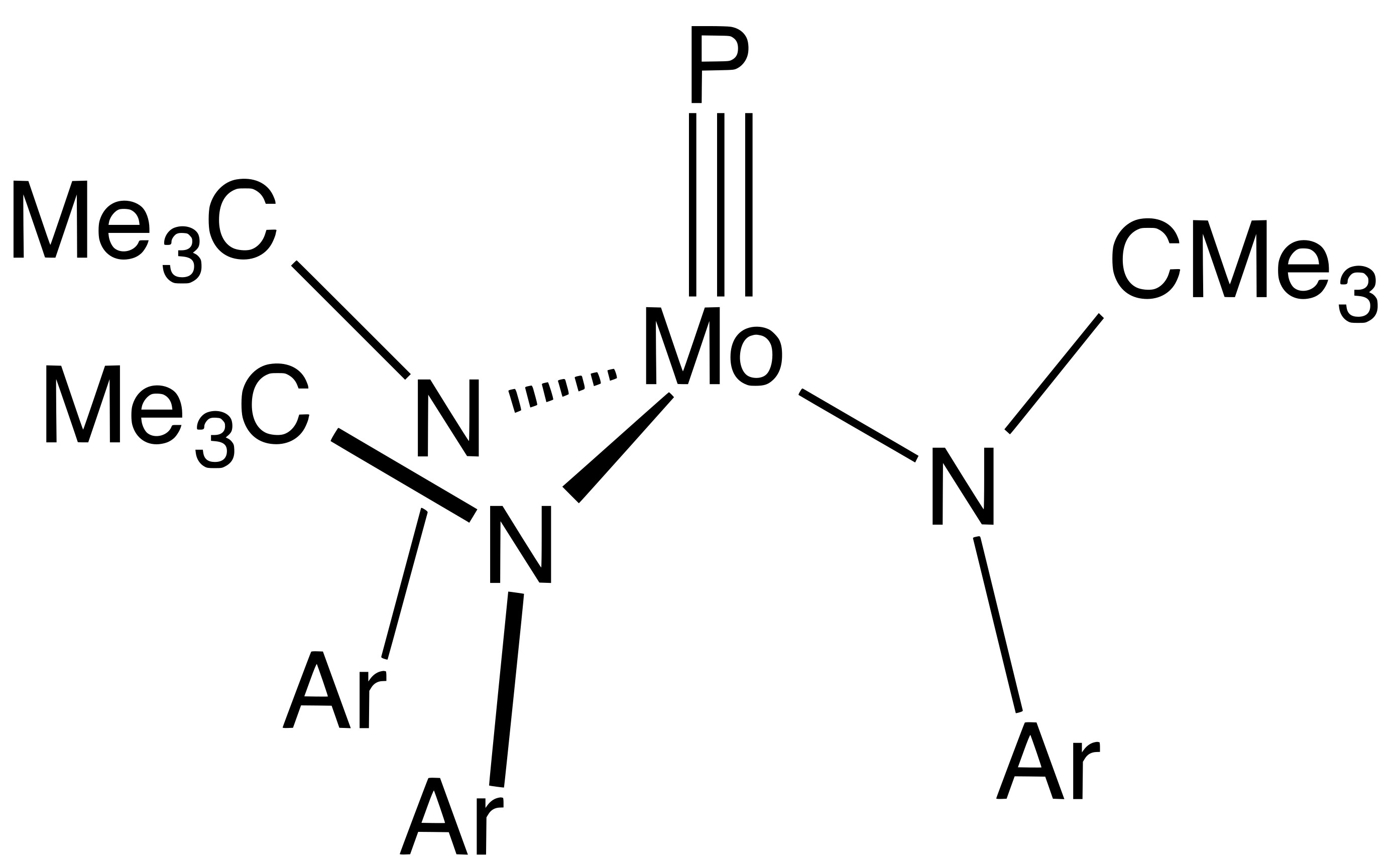
Molecular phosphides
Compounds with triple bonds between a metal and phosphorus are rare. The main examples have the formula , where R is a bulky organic substituent.
Organic phosphides
Many organophosphides are known. Common examples have the formula where R is an organic substituent and M is a metal. One example is lithium diphenylphosphide.
Natural examples
The mineral schreibersite is common in some meteorites.
References
References
- {{Greenwood&Earnshaw
- Von Schnering, H.G. and Hönle , W. (1994) "Phosphides - Solid-state Chemistry" in ''Encyclopedia of Inorganic Chemistry''. R. Bruce King (ed.). John Wiley & Sons {{ISBN. 0-471-93620-0
- (2003). "Chemical vapour deposition of group Vb metal phosphide thin films". Journal of Materials Chemistry.
- (1987). "Zur Chemie und Strukturchemie von Phosphiden und Polyphosphiden. 44. Tricäsiumheptaphosphid Cs3P7: Darstellung, Struktur und Eigenschaften". Zeitschrift für Anorganische und Allgemeine Chemie.
- (1 November 1972). "The crystal structure of SnP3 and a note on the crystal structure of GeP3". [[Journal of Solid State Chemistry]].
- (1971). "The Crystal Structure of TlP5". Acta Chemica Scandinavica.
- (1987). "Phosphides and Polyphosphides of the Transition Metals". Phosphorus and Sulfur and the Related Elements.
- (1988). "Bridging Chasms with Phosphides". Chemical Reviews.
- (2010). "A simple mild hydrothermal route for the synthesis of nickel phosphide powders". Ceramics International.
- (March 14, 2016). "Facile Conversion of Red Phosphorus into Soluble Polyphosphide Anions by Reaction with Potassium Ethoxide". Angewandte Chemie International Edition.
- (2010). "Early-Transition-Metal-Mediated Activation and Transformation of White Phosphorus". Chemical Reviews.
This article was imported from Wikipedia and is available under the Creative Commons Attribution-ShareAlike 4.0 License. Content has been adapted to SurfDoc format. Original contributors can be found on the article history page.
Ask Mako anything about Phosphide — get instant answers, deeper analysis, and related topics.
Research with MakoFree with your Surf account
Create a free account to save articles, ask Mako questions, and organize your research.
Sign up freeThis content may have been generated or modified by AI. CloudSurf Software LLC is not responsible for the accuracy, completeness, or reliability of AI-generated content. Always verify important information from primary sources.
Report