From Surf Wiki (app.surf) — the open knowledge base
Phenyltropane
Class of chemical compounds
Class of chemical compounds
Phenyltropanes (PTs) were originally developed to reduce cocaine addiction and dependency.{{Cite journal
Uses
Addiction
The phenyltropane compounds were initially discovered by R. Clarke et al. during research to try and dissociate the stimulant properties of cocaine from its abuse and dependence liability.{{Cite journal
It was later shown that WIN 35065-2 and WIN 34,428 are mostly dopamine selective reuptake inhibitors with some residual actions at the norepinephrine transporter (NET) and serotonin transporter (SERT). The neurotransmitter dopamine is a key candidate for explanation of reinforcing actions drugs.{{Cite journal
Animal studies on monkeys and rats have tried to assess the self-administration propensity of phenyltropane analogs alongside cocaine. Frequently the analogs are administered prior to the start of a session to see if they can suppress cocaine lever responding. Most of the analogs behave in ways that might be considered typical for a DRI. In particular, they tend to stimulate locomotor activity, and cause nonselective reductions in cocaine intake relative to food.{{Cite journal
Nevertheless, a slow onset, long-duration agonist seems like a reasonable approach. Phenyltropanes are widely used in animal studies of drug addiction as they share the stimulant properties and reinforcing effects of cocaine, but with higher potency, less non-specific binding which avoids the cardiotoxicity associated with cocaine.{{Cite journal
The more greatly attested habit creating methamphetamine is more serotonergic than the lesser reinforcing amphetamine. While most modern research suggests that 5-HT is negatively correlated with the addiction forming potential of psychostimulants, this is not saying that SRI properties cannot be considered beneficial. In fact, the above was proven by Rothman for releasing agents under the PAL-287 program of related molecules. What was somewhat interesting is that although the reason for the lack of reinforcement of RTI-112 is now well established, closely related RTI-111 was able to behave in ways that might be typical for a nonselective SNDRI such as cocaine. The role of the NET is not completely deleterious. In a recent paper by Rothman on transporter substrates, he establishes that for releasers that are amphetamine-like, discrimination stimulus is more accurately dictated by NE release than DA release. This argument does not mitigate a case against the importance of DA, but is suggestive that catecholamine in general is important. the exact ratio being 50:50 in the case of methylphenidate.
Desipramine and atomoxetine are not reliably self-administered though, whereas most selective DRIs are. SSRIs are not self-administered either. Hence, it should be borne in mind that these neurotransmitters are unlikely to be involved in the addiction forming properties of cocaine and related stimulants. Nevertheless, they are still behaviorally active and will contribute to the effects that such drugs elicit in their users.
Promiscuity among transporters is worth bearing in mind. Monoamine transporters can transport neurotransmitters other than their "native" neurotransmitter.{{Cite journal
Weeding out SERT and NET affinity is desirable in the context that these molecular targets are less relevant to the goals of the treatment program, which is to reduce cocaine intake. It can be clearly seen that RTI-336 has fewer metabolically labile sites than cocaine, and therefore has a longer duration span.
Binding ligands
These compounds are primarily used in scientific research, as their high binding affinity for monoamine transporters, and the wide range of radiolabelled phenyltropane compounds available with different binding specificities makes them very useful for mapping the distribution of the various monoamine transporters in the brain.
Other uses
Some phenyltropane derivatives have also been researched for medical use in the treatment of conditions such as Parkinson's disease{{Cite journal| first1 = B. K. | first2 = M. A. | first3 = M. | first4 = Z. | first5 = J. | first6 = C. | first7 = P. C. | first8 = D. R. | first9 = E.
Structure-activity relationships
Transporter selectivity
Compounds are known with a pronounced selectivity for each MAT – dopamine, noradrenaline{{Cite journal
Phenyltropane-based "SNDRI's" are another possibility.
Isomers study
All of the tables and graphs shown beneath is from an article published by FIC, et al. 2004.{{Cite journal
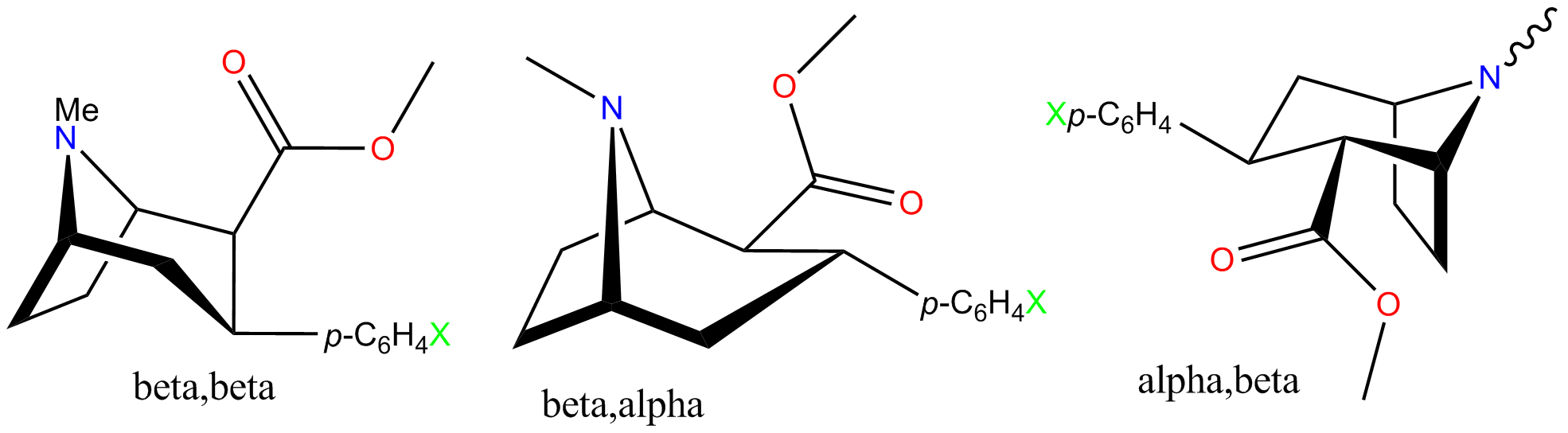
MAT binding affinities
| RTI | X | [3H]CFT | [3H]Nisoxetine | [3H]Paroxetine | N | S | N/D | S/D |
|---|---|---|---|---|---|---|---|---|
| — | H | 23 ± 5 | 920 ± 70 (550 ± 44) | 1960 ± 61 (178 ± 5.5) | 1.7 | 11 | 40 | 85.2 |
| — | F | 13.9 ± 2.0 | 835 ± 45 (503 ± 27) | 692 ± 27 (63 ± 2.5) | 1.7 | 11 | 60.1 | 49.8 |
| 31 | Cl | 1.1 ± 0.1 | 37 ± 2.1 (22 ± 1.3) | 44.5 ± 1.3 (4.0 ± 0.12) | 1.7 | 11 | 33.6 | 40.5 |
| 32 | Me | 1.7 ± 0.3 | 60 ± 0.53 (36 ± 0.32) | 240 ± 27 (23 ± 2.5) | 1.7 | 10 | 35.3 | 141 |
| 51 | Br | 1.7 ± 0.2 | 37.4 ± 5.2 (23 ± 3.1) | 10.6 ± 0.24 (0.96 ± 0.02) | 1.6 | 11 | 22 | 6.24 |
| 55 | I | 1.3 ± 0.01 | 36 ± 2.7 (22 ± 1.6) | 4.21 ± 0.30 (0.38 ± 0.03) | 1.6 | 11 | 27.7 | 3.24 |
| 2a | H | 101 ± 16 | 541 ± 69 (271 ± 34) | 5700 ± 720 (518 ± 66) | 2.0 | 11 | 5.36 | 56.4 |
| 2b | F | 21.0 ± 0.5 | 1200 ± 90 (741 ± 55) | 5060 ± 490 (460 ± 44) | 1.6 | 11 | 57.1 | 241 |
| 2c | Cl | 3.1 ± 0.6 | 5.14 ± 1.08 (3.1 ± 0.60) | 53 ± 3 (4.8 ± 0.26) | 1.7 | 11 | 1.66 | 17.1 |
| 2f | Me | 10.2 ± 0.8 | 270 ± 24 (160 ± 14) | 4250 ± 420 (390 ± 38) | 1.7 | 11 | 26.5 | 417 |
| 549 | Br | 1.7 ± 0.4 | 32.4 ± 3.5 (16.2 ± 1.7) | 84 ± 13.5 (20.6 ± 3.3) | 2.0 | 4.1 | 19.1 | 49.4 |
| 352 | I | 2.9 ± 0.2 | 52.4 ± 4.9 (32 ± 2.0) | 64.9 ± 1.97 (5.9 ± 0.18) | 1.6 | 11 | 18.1 | 22.4 |
| 3a | H | 670 ± 90 | 10000 | 10000 | — | |||
| 3b | F | 325 ± 8 | 7200 ± 810 (4340 ± 480) | 10000 | 1.7 | — | ||
| 3c | Cl | 25.0 ± 5 | 444 ± 29 (222 ± 15) | 1450 ± 160 (356 ± 40) | 2.0 | 4.1 | 17.8 | 58.0 |
| 3f | Me | 207 ± 21 | 2230 ± 380 (1120 ± 190) | 10000 | 2.0 | — | ||
| 3d | Br | 15.7 ± 0.9 | 272 ± 25 (136 ± 15) | 570 ± 80 (140 ± 20) | 2.0 | 4.1 | 17.3 | 36.3 |
| 3e | I | 22.7 ± 0.9 | 760 ± 49 (458 ± 30) | 66.3 ± 1.8 (6.0 ± 0.16) | 1.7 | 11 | 33.5 | 2.92 |
LMA, D.D. and G.B.
See also:{{Cite journal| first1 = S. | doi-access = free
References
References
- "The methyl has to be at the other O, and ''trans''" does not put the methyl group somewhere else in the molecule: the ester group is oriented more outward leading to a less congestion around the methyl group. A second benefit to this orientation is freeing the nitrogen atom to form hydrogen bonding or even accept a proton to form a better soluble positive charged ion.
- "TROPANE-2-CARBOXYLATES AND DERIVATIVES".
- (2002). "Serotonergic attenuation of the reinforcing and neurochemical effects of cocaine in squirrel monkeys". Journal of Pharmacology and Experimental Therapeutics.
- (November 2002). "Atomoxetine increases extracellular levels of norepinephrine and dopamine in prefrontal cortex of rat: a potential mechanism for efficacy in attention deficit/hyperactivity disorder". Neuropsychopharmacology.
This article was imported from Wikipedia and is available under the Creative Commons Attribution-ShareAlike 4.0 License. Content has been adapted to SurfDoc format. Original contributors can be found on the article history page.
Ask Mako anything about Phenyltropane — get instant answers, deeper analysis, and related topics.
Research with MakoFree with your Surf account
Create a free account to save articles, ask Mako questions, and organize your research.
Sign up freeThis content may have been generated or modified by AI. CloudSurf Software LLC is not responsible for the accuracy, completeness, or reliability of AI-generated content. Always verify important information from primary sources.
Report