From Surf Wiki (app.surf) — the open knowledge base
Pheasant
Bird in family Phasianidae

Bird in family Phasianidae
the animal
common pheasant Male
- Pucrasia
- Phasianini
- Polyplectron
- Argusianina
- Lerwini
- Lophophorini
- Meleagridini
- Tetraonini
- Rhizotherini
- Perdix
- Coturnicini
- Gallini
- Pavonina
- Galloperdix
- Haematortyx
- Tropicoperdix
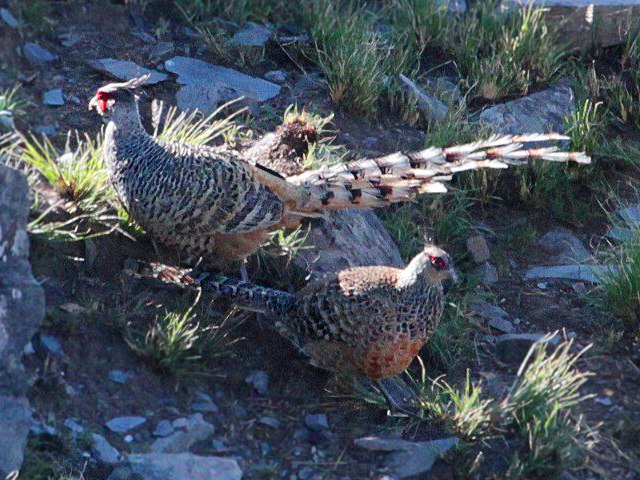
Pheasants ( ) are birds of several genera within the family Phasianidae in the order Galliformes. Although they can be found all over the world in introduced (and captive) populations, the pheasant genera's native range is restricted to Eurasia. The classification "pheasant" is paraphyletic, as birds referred to as pheasants are included within both the subfamilies Phasianinae and Pavoninae, and in many cases are more closely related to smaller phasianids, grouse, and turkey (formerly classified in Perdicinae, Tetraoninae, and Meleagridinae) than to other pheasants.
Pheasants are characterised by strong sexual dimorphism, males being highly decorated with bright colours and adornments such as wattles. Males are usually larger than females and have longer tails. Males play no part in rearing the young.
A pheasant's call or cry can be recognised by the fact that it sounds like a rusty sink valve being turned.
Pheasants eat mostly seeds, grains, roots, and berries, while in the summer they take advantage of insects, fresh green shoots, spiders, earthworms, and snails. However, as an introduced species, in the UK they are a threat to endangered native adders.
The best-known is the common pheasant, which is widespread throughout the world, in introduced feral populations and in farm operations. Various other pheasant species are popular in aviaries, such as the golden pheasant (Chrysolophus pictus).
Etymology
According to the Oxford English Dictionary, the word "pheasant" ultimately comes from Phasis, the ancient name of the Rioni River in Georgia. It passed from Greek to Latin to French (spelled with an initial "f") then to English, appearing for the first time in English around 1299.
Species in taxonomic order
This list is ordered to show presumed relationships between species.
- Subfamily Phasianinae
- Tribe Ithaginini
- Blood pheasant (genus Ithaginis)
- Blood pheasant (I. cruentus)
- Blood pheasant (genus Ithaginis)
- Tribe Pucrasiini
- Koklass (genus Pucrasia)
- Koklass pheasant (P. macrolopha)
- Koklass (genus Pucrasia)
- Tribe Phasianini
- Long-tailed pheasants (genus Syrmaticus)
- Reeves's pheasant (S. reevesi)
- Elliot's pheasant (S. ellioti)
- Mrs. Hume's pheasant (S. humiae)
- Mikado pheasant (S. mikado)
- Copper pheasant (S. soemmerringi)
- Ruffed pheasants (genus Chrysolophus)
- Golden pheasant (C. pictus)
- Lady Amherst's pheasant (C. amherstiae)
- Typical pheasants (genus Phasianus)
- Green pheasant (P. versicolor)
- Common pheasant (P. colchicus)
- Caucasus pheasants, Phasianus colchicus colchicus group
- White-winged pheasants, Phasianus colchicus chrysomelas/principalis group
- Prince of Wales pheasant, Phasianus colchicus principalis
- Mongolian ring-necked pheasants or white-winged ring-necked pheasants, Phasianus colchicus mongolicus group
- Tarim pheasants, Phasianus colchicus tarimensis group
- Chinese ring-necked pheasants, Phasianus colchicus torquatus group
- Taiwan pheasant, Phasianus colchicus formosanus
- Long-tailed pheasants (genus Syrmaticus)
- Cheer pheasant (genus Catreus)
- Cheer pheasant (C. wallichi)
- Gallopheasants (genus Lophura)
- Kalij pheasant (L. leucomelanos)
- White-crested kalij pheasant (L. l. hamiltoni)
- Nepal kalij pheasant (L. l. leucomelanos)
- Black-backed kalij pheasant (L. l. melanota)
- Black kalij pheasant (L. l. moffitti)
- Black-breasted kalij pheasant (L. l. lathami)
- William's kalij pheasant (L. l. williamsi)
- Oates' kalij pheasant (L. l. oatesi)
- Crawfurd's kalij pheasant (L. l. crawfurdi)
- Lineated kalij pheasant (L. l. lineata)
- Silver pheasant (L. nycthemera)
- (L. n. lewisi)
- (L. n. annamensis)
- (L. n. engelbachi)
- (L. n. beli)
- (L. n. berliozi)
- (L. n. rufripes)
- (L. n. ripponi)
- (L. n. occidentalis)
- (L. n. beaulieui)
- (L. n. fokiensis)
- (L. n. whiteheadi)
- (L. n. omeiensis)
- (L. n. rongjiangensis) [intraspecific taxonomy is shaky at best] --
- Imperial pheasant (L. imperialis)
- Edwards's pheasant (L. edwardsi)
- Vietnamese pheasant (L. hatinhensis)
- Swinhoe's pheasant (L. swinhoii)
- Salvadori's pheasant (L. inornata)
- Hoogerwerf's pheasant (L. i. hoogerwerfi)
- Malayan crestless fireback (L. erythrophthalma)
- Bornean crestless fireback (L. pyronota)
- Bornean crested fireback (L. ignita)
- Lesser Bornean crested fireback (L. i. ignita)
- Greater Bornean crested fireback (L. i. nobilis)
- Malayan crested fireback (L. rufa)
- Siamese fireback (L. diardi)
- Bulwer's pheasant (L. bulweri)
- Kalij pheasant (L. leucomelanos)
- Eared pheasants (genus Crossoptilon)
- White eared pheasant (C. crossoptilon)
- Tibetan eared pheasant (C. harmani)
- Brown eared pheasant (C. mantchuricum)
- Blue eared pheasant (C. auritum)
- Tribe Ithaginini
- Subfamily Pavoninae
- Tribe Pavonini
- Crested argus (genus Rheinardia)
- Vietnamese crested argus (R. ocellata)
- Malayan crested argus (R. nigrescens)
- Great argus (genus Argusianus)
- Great argus (A. argus)
- Crested argus (genus Rheinardia)
- Tribe Polyprectronini
- Peacock-pheasants (genus Polyplectron)
- Bronze-tailed peacock-pheasant (P. chalcurum)
- Mountain peacock-pheasant (P. inopinatum)
- Germain's peacock-pheasant (P. germaini)
- Grey peacock-pheasant (P. bicalcaratum
- Hainan peacock-pheasant (Polyplectron katsumatae)
- Malayan peacock-pheasant (P. malacense)
- Bornean peacock-pheasant (P. schleiermacheri)
- Palawan peacock-pheasant (P. emphanum)
- Peacock-pheasants (genus Polyplectron)
- Tribe Pavonini
Previous classifications{{Anchor|Euplocamus}}
Euplocamus and Gennceus are older names more or less corresponding to the current Lophura.
- Euplocamus was used, for example, by Hume and Marshall in their Game Birds of India, Burmah and Ceylon (1879–1881).
- Gennceus, was used, for example, by Frank Finn in Indian Sporting Birds (1915) and Game Birds of India and Asia (1911?).
These old genera were used for:
| Vernacular | Hume & Marshall | Finn: Sporting Birds | Finn: Game Birds | Contemporary |
|---|---|---|---|---|
| Vieillot's crested fireback | *E. vielloti* | *Lophura rufa* (sic) | *L. ignita rufa* | |
| Black-backed kalij | *E. melanonotus* | *G. melanonotus* | *L. leucomelanos melanota* | |
| Common or white-crested kalij | *E. albocristatus* | *G. albocristatus* | *L. leucomelanos hamiltoni* | |
| Nepal kalij | *E. leucomelanus* | *G. leucomelanus* | *L. leucomelanos leucomelanos* | |
| Purple, Horsfield's or black-breasted kalij | *E. horsfieldi* | *G. horsfieldi* | *L. leucomelanos lathami* | |
| Lineated kalij | *E. lineatus* | *G. lineatus* also: Burmese silver pheasant | *L. leucomelanos lineata* | |
| Anderson's silver pheasant | ? | *G. andersoni*, considered hybrid of *L. nycthemera* and *L. l. lineata* | *L. nycthemera andersoni* (invalid) | |
| Crawfurd's silver pheasant (or Crawford's? ) | *E. andersoni* | considered a further cross of Anderson's and *L. l. lineata* | ? | |
| Crawfurd's kalij (same as C.'s silver pheasant?) | ? | *G. andersoni* | *L. leucomelanos crawfurdi* | |
| Cuvier's kalij | ? | *G. cuvieri* | ? | |
| Oates's kalij | ? | *G. oatesi* | *L. leucomelanos oatesi* | |
| Whitehead's silver pheasant | ? | *G. whiteheadi* | ? | |
| Swinhoe's kalij | ? | *G. swinhoii* | *L. swinhoii* |
References
Bibliography
- Beebe, William. 1918-22. A Monograph of the Pheasants. 1st edition in 4 volumes: H. F. Witherby, London. Reprint: 1990, Dover Publications.(4 volumes bound as 2). and . Republished as: Pheasants: Their Lives and Homes. 2 vols. 1926. Single volume edition: New York Zoological Society, 1936.)
- Green-Armytage, Stephen. 2002. *Extraordinary Pheasants.*Harry N. Abrams, Inc., New York. Book .
- Madge and McGowan, Pheasants, Partridges and Grouse
References
- (2021-05-01). "A phylogenomic supermatrix of Galliformes (Landfowl) reveals biased branch lengths". Molecular Phylogenetics and Evolution.
- Nicolas Milton. (1 Oct 2020). "Game birds 'could wipe out adders in most of Britain within 12 years'". Guardian newspapers.
- (2020). "Ecological Consequences of Gamebird Releasing and Management on Lowland Shoots in England: A Review by Rapid Evidence Assessment for Natural England and the British Association of Shooting and Conservation". Natural England Evidence Review.
- {{Cite OED. pheasant
This article was imported from Wikipedia and is available under the Creative Commons Attribution-ShareAlike 4.0 License. Content has been adapted to SurfDoc format. Original contributors can be found on the article history page.
Ask Mako anything about Pheasant — get instant answers, deeper analysis, and related topics.
Research with MakoFree with your Surf account
Create a free account to save articles, ask Mako questions, and organize your research.
Sign up freeThis content may have been generated or modified by AI. CloudSurf Software LLC is not responsible for the accuracy, completeness, or reliability of AI-generated content. Always verify important information from primary sources.
Report