From Surf Wiki (app.surf) — the open knowledge base
Petrenko-Kritschenko piperidone synthesis

The Petrenko-Kritschenko reaction is a classic multicomponent-name reaction that is closely related to the Robinson–Schöpf tropinone synthesis, but was published 12 years earlier.
Classic reaction
In the original publication diethyl-α-ketoglurate, a derivative of acetonedicarboxylic acid, is used in combination with ammonia and benzaldehyde. The relative stereochemistry was not elucidated in the original publication, structural analysis using X-rays or NMR was not available in these days. In the absence of ammonia or ammonium salts a 4-oxotetrahydropyran is formed.
In contrast to the Robinson synthesis, it does not employ dialdehydes like succinaldehyde or glutaraldehyde but simpler aldehydes like benzaldehyde. Therefore, the product of the reaction is not a bicyclic structure (see tropinone and pseudopelletierine) but a 4-piperidone. The synthesis of tropinone can be seen as a variation of the Petrenko-Kritschenko reaction in which the two aldehyde functions are covalently linked in a single molecule. Apart from the Hantzsch synthesis the Petrenko-Kritschenko reaction is one of the few examples in which a symmetric pyridine precursor can be obtained in a multicomponent ring-condensation reaction followed by an oxidation. The oxidation by chromium trioxide in acetic acid leads to a symmetrically substituted 4-pyridone, decarboxylation yields the 3,5-unsubstituted derivative.
Modern variants
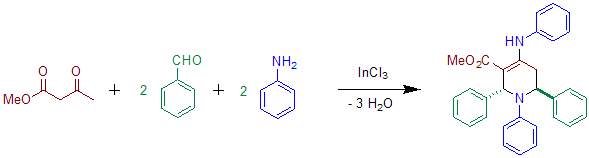
Acetoacetate can be used instead of diethyl-α-ketoglurate in the presence of indium salts. The use of aniline has also been reported in the original Publication. The product of this reaction shows transoid configuration of the phenyl groups at C-2 and C-6.
Natural product synthesis
The reaction has been used to prepare precoccinellin, an alkaloid found in certain ladybugs.

Applications to coordination chemistry
When benzaldehyde is substituted with 2-pyridinecarboxaldehyde the reaction can be used to prepare precursors for bispidone-ligands. Essentially this method is based on two subsequent Petrenko-Kritschenko reactions. These ligands can be used to prepare compounds containing high-valent iron, that are able to oxidize cyclohexane in the presence of hydrogen peroxide.

References
References
- Jie-Jack Li; "Name reactions in heterocyclic chemistry"; 2005 John Wiley & Sons; {{ISBN. 0-471-30215-5; pp313
- P. Petrenko-Kritschenko "Über die Kondensation des Acetondicarbonsäureesters mit Aldehyden, Ammoniak und Aminen" Journal für Praktische Chemie Volume 85, Issue 1, pages 1–37, 20 May 1912; {{doi. 10.1002/prac.19110850101
- P. Petrenko-Kritschenko "Über Tetrahydropyronverbindungen" Journal für Praktische Chemie; Volume 60, Issue 1, pages 140–158, 27 December 1899; {{doi. 10.1002/prac.18990600114
- Clarke, Paul A.; Zaytzev, Andrey V.; Whitwood, Adrian C. "Pot, atom and step economic (PASE) synthesis of highly functionalized piperidines: a five-component condensation" Tetrahedron Letters Volume 48, Issue 30, 23 July 2007, Pages 5209–5212; {{doi. 10.1016/j.tetlet.2007.05.141
- Comba, Peter; Kerscher, Marion; Merz, Michael; Müller, Vera; Pritzkow, Hans; Remenyi, Rainer; Schiek, Wolfgang; Xiong, Yun "Structural Variation in Transition-Metal Bispidine Compounds" Chemistry – A European Journal Volume 8, Issue 24, pages 5750–5760, 16 December 2002; {{doi. 10.1002/1521-3765(20021216)8:24<5750::AID-CHEM5750>3.0.CO;2-P
This article was imported from Wikipedia and is available under the Creative Commons Attribution-ShareAlike 4.0 License. Content has been adapted to SurfDoc format. Original contributors can be found on the article history page.
Ask Mako anything about Petrenko-Kritschenko piperidone synthesis — get instant answers, deeper analysis, and related topics.
Research with MakoFree with your Surf account
Create a free account to save articles, ask Mako questions, and organize your research.
Sign up freeThis content may have been generated or modified by AI. CloudSurf Software LLC is not responsible for the accuracy, completeness, or reliability of AI-generated content. Always verify important information from primary sources.
Report