From Surf Wiki (app.surf) — the open knowledge base
Petrarch
Italian scholar and poet (1304–1374)

Italian scholar and poet (1304–1374)
| Field | Value |
|---|---|
| name | Francis Petrarch |
| image | File:Altichiero, ritratto di Francesco Petrarca.jpg |
| caption | Portrait by Altichiero, |
| birth_name | Francesco di Petracco |
| birth_date | |
| birth_place | Comune of Arezzo |
| death_date | |
| death_place | Arquà, Padua |
| resting_place | Arquà Petrarca |
| occupation | |
| language | |
| nationality | Aretine |
| education | |
| period | Early Renaissance |
| genres | |
| subjects | |
| movement | |
| notable_works | |
| awards | Poet laureate of Rome, 1341 |
| children | Giovanni (1337–1361) |
| Francesca (born in 1343) | |
| parents | Ser Petracco (father) |
| Eletta Canigiani (mother) | |
| relatives | Gherardo Petracco (brother) |
| Giovanni Boccaccio (friend) |
Francesca (born in 1343) Eletta Canigiani (mother) Giovanni Boccaccio (friend)
Francis Petrarch (; 20 July 1304 – 19 July 1374; ; modern ), born Francesco di Petracco, was a scholar from Arezzo and poet of the early Italian Renaissance, as well as one of the earliest humanists.
Petrarch's rediscovery of Cicero's letters is often credited with initiating the 14th-century Italian Renaissance and the founding of Renaissance humanism. In the 16th century, Pietro Bembo created the model for the modern Italian language based on Petrarch's works, as well as those of Giovanni Boccaccio, and, to a lesser extent, Dante Alighieri. Petrarch was later endorsed as a model for Italian style by the Accademia della Crusca.
Petrarch's sonnets were admired and imitated throughout Europe during the Renaissance and became a model for lyrical poetry. He is also known for being the first to develop the concept of the "Dark Ages".
Biography
Youth and early career
Petrarch was born in the Tuscan city Arezzo on 20 July 1304. He was the son of Ser Petracco (a diminutive nickname for Pietro) and his wife Eletta Canigiani. Petrarch's birth name was Francesco di Petracco ("Francesco [son] of Petracco"), which he Latinized to Franciscus Petrarcha. His younger brother Gherardo (Gerard Petrarch) was born in Incisa in Val d'Arno in 1307. Dante Alighieri was a friend of his father.
Petrarch spent his early childhood in the village of Incisa, near Florence. He spent much of his early life at Avignon and nearby Carpentras, where his family moved to follow Pope Clement V, who moved there in 1309 to begin the Avignon Papacy. Petrarch studied law at the University of Montpellier (1316–20) and Bologna (1320–26) with a lifelong friend and schoolmate, Guido Sette, future archbishop of Genoa. Because his father was in the legal profession (a notary), he insisted that Petrarch and his brother also study law. Petrarch, however, was primarily interested in writing and studying Latin literature and considered these seven years wasted. Petrarch became so distracted by his non-legal interests that his father once threw his books into a fire, which he later lamented. Additionally, he proclaimed that through legal manipulation his guardians robbed him of his small property inheritance in Florence, which only reinforced his dislike for the legal system. He protested, "I couldn't face making a merchandise of my mind", since he viewed the legal system as the art of selling justice.
Petrarch was a prolific letter writer and counted Boccaccio among the notable friends with whom he regularly corresponded. After the death of their parents, Petrarch and his brother Gherardo went back to Avignon in 1326, where he worked in numerous clerical offices. This work gave him much time to devote to his writing. With his first large-scale work, Africa, an epic poem in Latin about the great Roman general Scipio Africanus, Petrarch emerged as a European celebrity. On 8 April 1341, he became the second poet laureate since classical antiquity and was crowned by Roman Senatori Giordano Orsini and Orso dell'Anguillara on the sacred soil of Rome's Capitoline hill.
He traveled widely in Europe, served as an ambassador, and has been called "the first tourist" because he traveled for pleasure such as his ascent of Mont Ventoux. During his travels, he collected crumbling Latin manuscripts and was a prime mover in the recovery of knowledge from writers of Rome and Greece. He encouraged and advised Leontius Pilatus's translation of Homer from a manuscript purchased by Boccaccio, although he was severely critical of the result. Petrarch had acquired a copy, which he did not entrust to Leontius, but he knew no Greek; Petrarch said of himself, "Homer was dumb to him, while he was deaf to Homer". In 1345 he personally discovered a collection of Cicero's letters not previously known to have existed, the collection Epistulae ad Atticum, in the Chapter Library (Biblioteca Capitolare) of Verona Cathedral.
Disdaining what he believed to be the ignorance of the era in which he lived, Petrarch is credited with creating the concept of a historical "Dark Ages", which most modern scholars now find inaccurate and misleading.
Mount Ventoux
Main article: Ascent of Mont Ventoux

Petrarch recounts that on 26 April 1336, with his brother and two servants, he climbed to the top of Mont Ventoux (1912 m, a feat which he undertook for recreation rather than necessity. The exploit is described in a famous letter addressed to his friend and confessor, the monk Dionigi di Borgo San Sepolcro, composed some time after the fact. In it, Petrarch claimed to have been inspired by Philip V of Macedon's ascent of Mount Haemo and that an aged peasant had told him that nobody had ascended Ventoux before or after himself, 50 years earlier, and warned him against attempting to do so. The nineteenth-century Swiss historian Jacob Burckhardt noted that Jean Buridan had climbed the same mountain a few years before, and ascents accomplished during the Middle Ages have been recorded, including that of Anno II, Archbishop of Cologne.
Scholars note that Petrarch's letter to Dionigi displays a strikingly "modern" attitude of aesthetic gratification in the grandeur of the scenery and is still often cited in books and journals devoted to the sport of mountaineering. In Petrarch, this attitude is coupled with an aspiration for a virtuous Christian life, and on reaching the summit, he took from his pocket a volume by his beloved mentor, Saint Augustine, that he always carried with him.
For pleasure alone he climbed Mont Ventoux, which rises to more than six thousand feet, beyond Vaucluse. It was no great feat, of course; but he was the first recorded Alpinist of modern times, the first to climb a mountain merely for the delight of looking from its top. (Or almost the first; for in a high pasture he met an old shepherd, who said that fifty years before he had attained the summit, and had got nothing from it save toil and repentance and torn clothing.) Petrarch was dazed and stirred by the view of the Alps, the mountains around Lyons, the Rhone, the Bay of Marseilles. He took Augustine's *Confessions* from his pocket and reflected that his climb was merely an allegory of aspiration toward a better life.
As the book fell open, Petrarch's eyes were immediately drawn to the following words:
Petrarch's response was to turn from the outer world of nature to the inner world of "soul":
James Hillman argues that this rediscovery of the inner world is the real significance of the Ventoux event. The Renaissance begins not with the ascent of Mont Ventoux but with the subsequent descent—the "return [...] to the valley of soul", as Hillman puts it.
Later years
Petrarch spent the later part of his life journeying through northern Italy and southern France as an international scholar and poet-diplomat. His career in the Church did not allow him to marry, but he is believed to have fathered two children by a woman (or women) unknown to posterity. A son, Giovanni, was born in 1337, and a daughter, Francesca, was born in 1343. He later legitimized both.
For a number of years in the 1340s and 1350s he lived in a small house at Fontaine-de-Vaucluse east of Avignon in France.
Giovanni died of the plague in 1361. In the same year Petrarch was named canon in Monselice near Padua. Francesca married Francescuolo da Brossano (who was later named executor of Petrarch's will) that same year. In 1362, shortly after the birth of a daughter, Eletta (the same name as Petrarch's mother), they joined Petrarch in Venice to flee the plague then ravaging parts of Europe. A second grandchild, Francesco, was born in 1366, but died before his second birthday. Francesca and her family lived with Petrarch in Venice for five years from 1362 to 1367 at Palazzo Molina; although Petrarch continued to travel in those years. Between 1361 and 1369 the younger Boccaccio paid the older Petrarch two visits. The first was in Venice, the second was in Padua.
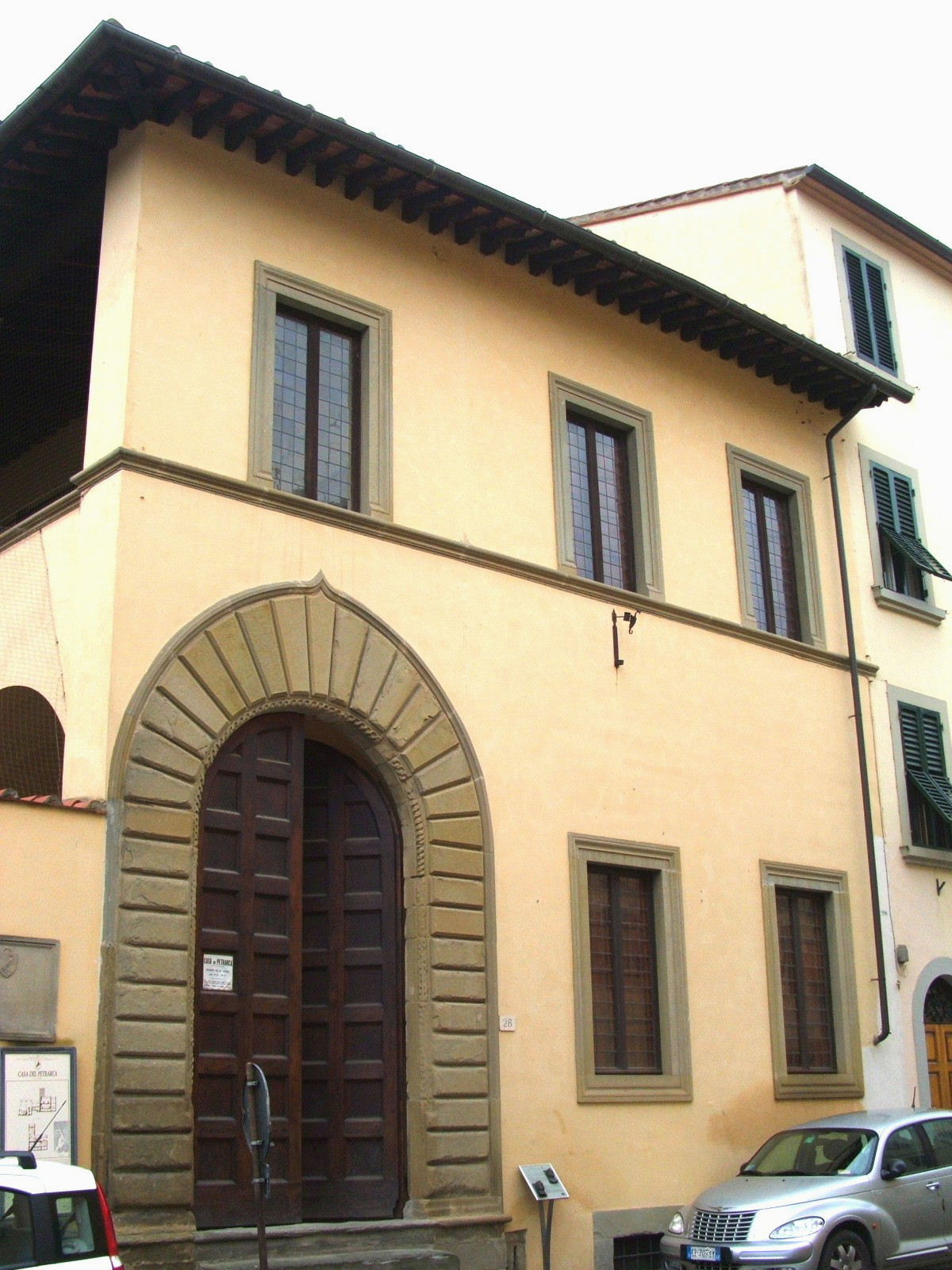
About 1368 Petrarch and Francesca (with her family) moved to the small town of Arquà in the Euganean Hills near Padua, where he passed his remaining years in religious contemplation. He died in his house in Arquà on 18/19 July 1374. The house now hosts a permanent exhibition of Petrarch's works and curiosities, including the famous tomb of an embalmed cat long believed to be Petrarch's (although there is no evidence Petrarch actually had a cat). On the marble slab, there is a Latin inscription written by Antonio Quarenghi:
| Original Latin | English translation |
|---|
Petrarch's will (dated 4 April 1370) leaves fifty florins to Boccaccio "to buy a warm winter dressing gown"; various legacies (a horse, a silver cup, a lute, a Madonna) to his brother and his friends; his house in Vaucluse to its caretaker; money for Masses offered for his soul, and money for the poor; and the bulk of his estate to his son-in-law, Francescuolo da Brossano, who is to give half of it to "the person to whom, as he knows, I wish it to go"; presumably his daughter, Francesca, Brossano's wife. The will mentions neither the property in Arquà nor his library; Petrarch's library of notable manuscripts was already promised to Venice, in exchange for the Palazzo Molina. This arrangement was probably cancelled when he moved to Padua, the enemy of Venice, in 1368. The library was seized by the da Carrara lords of Padua, and his books and manuscripts are now widely scattered over Europe. Nevertheless, the Biblioteca Marciana traditionally claimed this bequest as its founding, although it was in fact founded by Cardinal Bessarion in 1468.
Works

Petrarch is best known for his Italian poetry, notably the Rerum vulgarium fragmenta ("Fragments of Vernacular Matters"), a collection of 366 lyric poems in various genres also known as 'canzoniere' ('songbook'), and I trionfi ("The Triumphs"), a six-part narrative poem of Dantean inspiration. However, Petrarch was an enthusiastic Latin scholar and did most of his writing in this language. His Latin writings include scholarly works, introspective essays, letters, and more poetry. Among them are Secretum ("My Secret Book"), an intensely personal, imaginary dialogue with a figure inspired by Augustine of Hippo; De Viris Illustribus ("On Famous Men"), a series of moral biographies; Rerum Memorandarum Libri, an incomplete treatise on the cardinal virtues; De Otio Religiosorum ("On Religious Leisure") and De vita solitaria ("On the Solitary Life"), which praise the contemplative life; De Remediis Utriusque Fortunae ("Remedies for Fortune Fair and Foul"), a self-help book which remained popular for hundreds of years; Itinerarium ("Petrarch's Guide to the Holy Land"); invectives against opponents such as doctors, scholastics, and the French; the Carmen Bucolicum, a collection of 12 pastoral poems; and the unfinished epic Africa. He translated seven psalms, a collection known as the Penitential Psalms.
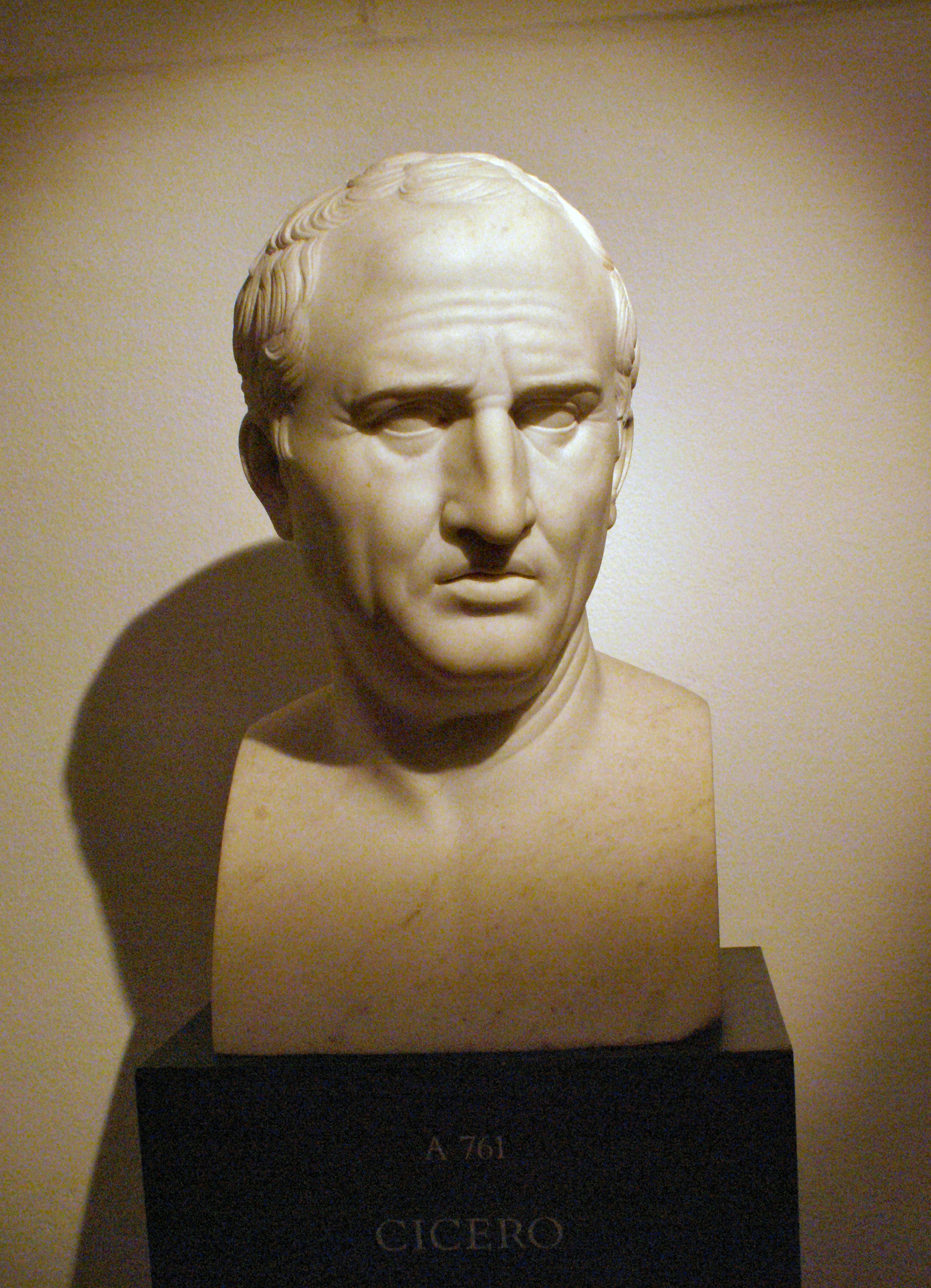
Petrarch collected his letters into four major sets of books called
- Familiares or Rerum familiarum liber ("Letters on Familiar Matters")
- Liber sine nomine
- Disperse
- Seniles ("Letters of Old Age") and
- Metricae The first and the fourth are available in English translation. The plan for his letters was suggested to him by knowledge of Cicero's letters. These were published "without names" to protect the recipients, all of whom had close relationships to Petrarch. The recipients of these letters included Philippe de Cabassoles, bishop of Cavaillon; Ildebrandino Conti, bishop of Padua; Cola di Rienzo, tribune of Rome; Francesco Nelli, priest of the Prior of the Church of the Holy Apostles in Florence; and Niccolò di Capoccia, a cardinal and priest of Saint Vitalis. His "Letter to Posterity" (the last letter in Seniles) gives an autobiography and a synopsis of his philosophy in life. It was originally written in Latin and was completed in 1371 or 1372—the first such autobiography in a thousand years (since Saint Augustine).
While Petrarch's poetry was set to music frequently after his death, especially by Italian madrigal composers of the Renaissance in the 16th century, only one musical setting composed during Petrarch's lifetime survives. This is Non al suo amante by Jacopo da Bologna, written around 1350.
Laura and poetry
On 6 April 1327, after Petrarch gave up his vocation as a priest, the sight of a woman called "Laura" in the church of Sainte-Claire d'Avignon in 1327, awoke in him a lasting passion, celebrated in the Rerum vulgarium fragmenta ("Fragments of Vernacular Matters"). Laura may have been Laura de Noves, the wife of Count Hugues de Sade (an ancestor of the Marquis de Sade). There is little definite information in Petrarch's work concerning Laura, except that she is lovely to look at, fair-haired, with a modest, dignified bearing. Laura and Petrarch had little or no personal contact. According to his "Secretum", she refused him because she was already married. He channeled his feelings into love poems that were exclamatory rather than persuasive, and wrote prose that showed his contempt for men who pursue women. Upon her death in 1348, the poet found that his grief was as difficult to live with as was his former despair. Later, in his "Letter to Posterity", Petrarch wrote: "In my younger days I struggled constantly with an overwhelming but pure love affair—my only one, and I would have struggled with it longer had not premature death, bitter but salutary for me, extinguished the cooling flames. I certainly wish I could say that I have always been entirely free from desires of the flesh, but I would be lying if I did".
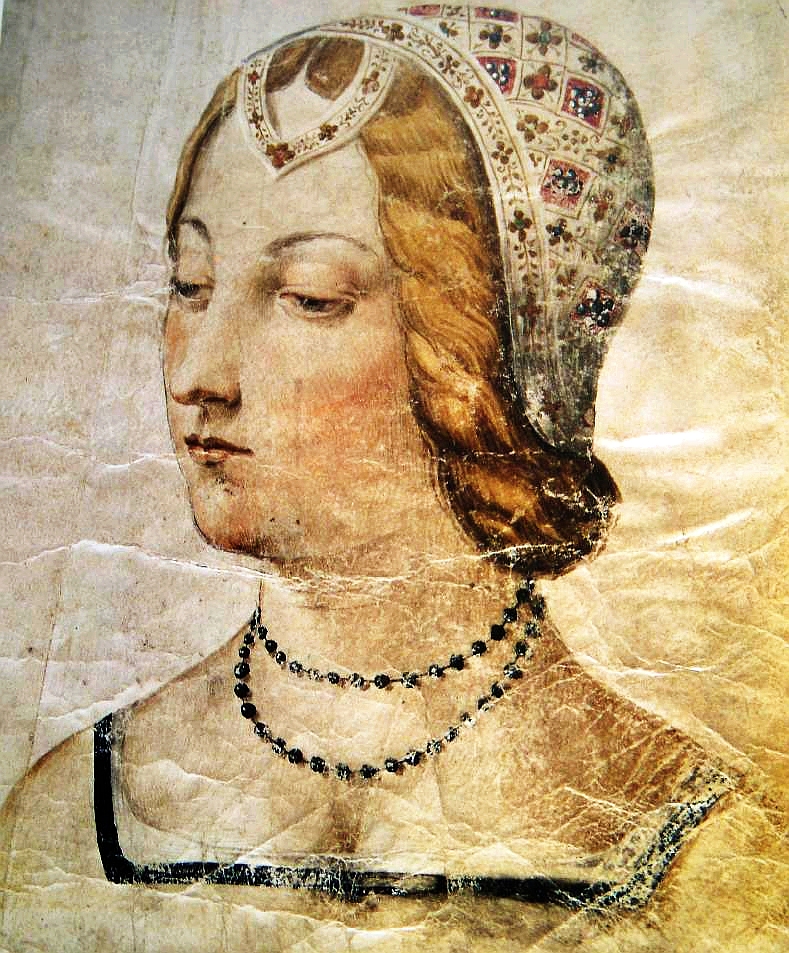
While it is possible she was an idealized or pseudonymous character—particularly since the name "Laura" has a linguistic connection to the poetic "laurels" Petrarch coveted—Petrarch himself always denied it. His frequent use of l'aura is also remarkable: for example, the line "Erano i capei d'oro a l'aura sparsi" may mean both "her hair was all over Laura's body" and "the wind (l'aura) blew through her hair". There is psychological realism in the description of Laura, although Petrarch draws heavily on conventionalised descriptions of love and lovers from troubadour songs and other literature of courtly love. Her presence causes him unspeakable joy, but his unrequited love creates unendurable desires, inner conflicts between the ardent lover and the mystic Christian, making it impossible to reconcile the two. Petrarch's quest for love leads to hopelessness and irreconcilable anguish, as he expresses in the series of paradoxes in Rima 134 "Pace non trovo, et non ò da far guerra;/e temo, et spero; et ardo, et son un ghiaccio": "I find no peace, and yet I make no war:/and fear, and hope: and burn, and I am ice".
Laura is unreachable and evanescent – descriptions of her are evocative yet fragmentary. Francesco de Sanctis praises the powerful music of his verse in his Storia della letteratura italiana. Gianfranco Contini, in a famous essay ("Preliminari sulla lingua del Petrarca". Petrarca, Canzoniere. Turin, Einaudi, 1964), has described Petrarch's language in terms of "unilinguismo" (contrasted with Dantean "plurilinguismo").
Sonnet 227
| Original Italian | English translation by A.S. Kline |
|---|
Dante
Petrarch is very different from Dante and his Divina Commedia. In spite of the metaphysical subject, the Commedia is deeply rooted in the cultural and social milieu of turn-of-the-century Florence: Dante's rise to power (1300) and exile (1302); his political passions call for a "violent" use of language, where he uses all the registers, from low and trivial to sublime and philosophical. Petrarch confessed to Boccaccio that he had never read the Commedia, remarks Contini, wondering whether this was true or Petrarch wanted to distance himself from Dante. Dante's language evolves as he grows old, from the courtly love of his early stilnovistic Rime and Vita nuova to the Convivio and Divina Commedia, where Beatrice is sanctified as the goddess of philosophy—the philosophy announced by the Donna Gentile at the death of Beatrice.
In contrast, Petrarch's thought and style are relatively uniform throughout his life—he spent much of it revising the songs and sonnets of the Canzoniere rather than moving to new subjects or poetry. Here, poetry alone provides a consolation for personal grief, much less philosophy or politics (as in Dante), for Petrarch fights within himself (sensuality versus mysticism, profane versus Christian literature), not against anything outside of himself. The strong moral and political convictions which had inspired Dante belong to the Middle Ages and the libertarian spirit of the commune; Petrarch's moral dilemmas, his refusal to take a stand in politics, his reclusive life point to a different direction, or time. The free commune, the place that had made Dante an eminent politician and scholar, was being dismantled: the signoria was taking its place. Humanism and its spirit of empirical inquiry, however, were making progress—but the papacy (especially after Avignon) and the empire (Henry VII, the last hope of the white Guelphs, died near Siena in 1313) had lost much of their original prestige.
Petrarch polished and perfected the sonnet form inherited from Giacomo da Lentini and which Dante widely used in his Vita nuova to popularise the new courtly love of the Dolce Stil Novo. The tercet benefits from Dante's terza rima (compare the Divina Commedia), the quatrains prefer the ABBA–ABBA to the ABAB–ABAB scheme of the Sicilians. The imperfect rhymes of u with closed o and i with closed e (inherited from Guittone's mistaken rendering of Sicilian verse) are excluded, but the rhyme of open and closed o is kept. Finally, Petrarch's enjambment creates longer semantic units by connecting one line to the following. The vast majority (317) of Petrarch's 366 poems collected in the Canzoniere (dedicated to Laura) were sonnets, and the Petrarchan sonnet still bears his name.
Philosophy

A highly introspective man, Petrarch helped shape the nascent humanist movement as many of the internal conflicts and musings expressed in his writings were embraced by Renaissance humanist philosophers and argued continually for the next 200 years. For example, he struggled with the proper relation between the active and contemplative life, and tended to emphasize the importance of solitude and study. In a clear disagreement with Dante, in 1346 Petrarch argued in De vita solitaria that Pope Celestine V's refusal of the papacy in 1294 was a virtuous example of solitary life. Later the politician and thinker Leonardo Bruni (1370–1444) argued for the active life, or "civic humanism". As a result, a number of political, military, and religious leaders during the Renaissance were inculcated with the notion that their pursuit of personal fulfillment should be grounded in classical example and philosophical contemplation.
Petrarchism
Petrarchism was a 16th-century literary movement of Petrarch's style by Italian, French, Spanish and English followers (partially coincident with Mannerism), who regarded his collection of poetry Il Canzoniere as a canonical text. Among them, the names are listed in order of precedence: Pietro Bembo, Michelangelo, Mellin de Saint-Gelais, Vittoria Colonna, Clément Marot, Garcilaso de la Vega, Giovanni della Casa, Thomas Wyatt, Henry Howard, Joachim du Bellay, Edmund Spenser, and Philip Sidney. Thus, in Pietro Bembo's book Prose of the Vernacular Tongue (1525) Petrarch is the model of verse composition.
Legacy
.JPG)
Petrarch's influence is evident in the works of Serafino Ciminelli from Aquila (1466–1500) and in the works of Marin Držić (1508–1567) from Dubrovnik.
The Romantic composer Franz Liszt set three of Petrarch's Sonnets (47, 104, and 123) to music for voice, Tre sonetti del Petrarca, which he later would transcribe for solo piano for inclusion in the suite Années de Pèlerinage. Liszt also set a poem by Victor Hugo, "Oh! quand je dors" in which Petrarch and Laura are invoked as the epitome of erotic love.
While in Avignon in 1991, Modernist composer Elliott Carter completed his solo flute piece Scrivo in Vento which is in part inspired by and structured by Petrarch's Sonnet 212, Beato in sogno. It was premiered on Petrarch's 687th birthday. In 2004, Finnish composer Kaija Saariaho crafted a miniature for solo piccolo flute titled Dolce tormento, in which the flutist whispers fragments of Petrarch's Sonnet 132 into the instrument.
In November 2003, it was announced that pathological anatomists would be exhuming Petrarch's body from his casket in Arquà Petrarca, to verify 19th-century reports that he had stood 1.83 meters (about six feet), which would have been tall for his period. The team from the University of Padua also hoped to reconstruct his cranium to generate a computerized image of his features to coincide with his 700th birthday. The tomb had been opened previously in 1873 by Professor Giovanni Canestrini, also of Padua University. When the tomb was opened, the skull was discovered in fragments and a DNA test revealed that the skull was not Petrarch's, prompting calls for the return of Petrarch's skull.
The researchers are fairly certain that the body in the tomb is Petrarch's due to the fact that the skeleton bears evidence of injuries mentioned by Petrarch in his writings, including a kick from a donkey when he was 42.
Numismatics
He is credited with being the first and most famous aficionado of numismatics. He described visiting Rome and asking peasants to bring him ancient coins they would find in the soil which he would buy from them, and writes of his delight at being able to identify the names and features of Roman emperors.
Works in English translation
- Africa, vol. 1–4, translated by Erik Z. D. Ellis (thesis; Baylor University, 2007).
- Bucolicum Carmen, translated by Thomas G. Bergin (Yale University Press, 1974).
- The Canzoniere; or, Rerum vulgarium fragmenta, translated by Mark Musa (Indiana University Press, 1996).
- Invectives, translated by David Marsh (Harvard University Press, 2008).
- Itinerarium: A Proposed Route for a Pilgrimage from Genoa to the Holy Land, translated by H. James Shey (Binghamton, New York: Global Academic Publishers, 2004).
- Letters on Familiar Matters (Rerum familiarium libri), vol. 1 (bkk. 1–8), vol. 2 (bkk. 9–16), vol. 3 (bkk. 17–24), translated by Aldo S. Bernardo (New York: Italica Press, 2005).
- Letters of Old Age (Rerum senilium libri), vol. 1 (bkk. 1–9), vol. 2 (bkk. 10–18), translated by Aldo S. Bernardo, Saul Levin, & Reta A. Bernardo (New York: Italica Press, 2005).
- The Life of Solitude, translated by Jacob Zeitlin (1924); revised edition by Scott H. Moore (Baylor University Press 2023).
- My Secret Book (Secretum), translated by Nicholas Mann (Harvard University Press, 2016).
- On Religious Leisure (De otio religioso), translated by Susan S. Schearer (New York: Italica Press, 2002).
- Penitential Psalms and Prayers, translated by Demetrio S. Yocum (University of Notre Dame Press, 2024).
- Remedies for Fortune Fair and Foul, translated by Conrad H. Rawski (Indiana University Press, 1991).
- The Revolution of Cola di Rienzo, translated by Mario E. Cosenza; 3rd revised edition by Ronald G. Musto (New York: Italica Press, 1996).
- Selected Letters, vol. 1 & 2, translated by Elaine Fantham (Harvard University Press, 2017). ,
Notes
References
- Bartlett, Kenneth R. (1992). The Civilization of the Italian Renaissance; a Source Book. Lexington: D.C. Heath and Company.
- Bishop, Morris (1961). "Petrarch." In J. H. Plumb (Ed.), Renaissance Profiles, pp. 1–17. New York: Harper & Row. .
- Hanawalt, A. Barbara (1998). The Middle Ages: An Illustrated History pp. 131–132 New York: Oxford University Press
- Kallendorf, Craig. "The Historical Petrarch," The American Historical Review, Vol. 101, No. 1 (Feb. 1996): 130–141.
References
- (2015). "Petrarca, Francesco". Istituto dell'Enciclopedia Italiana.
- link. (2012-10-25 of Carol Quillen's ''Rereading the Renaissance''.)
- In the [http://it.wikisource.org/wiki/Prose_della_volgar_lingua/Libro_primo/XIX Prose della volgar lingua], Bembo proposes Petrarch and Boccaccio as models of Italian style, while expressing reservations about emulating Dante's usage.
- [https://www.jstor.org/stable/2707236 Renaissance or Prenaissance], ''Journal of the History of Ideas'', Vol. 4, No. 1. (Jan. 1943), pp. 69–74; [[Theodor Ernst Mommsen. Theodore E. Mommsen]], "Petrarch's Conception of the 'Dark Ages'" ''Speculum'' '''17'''.2 (April 1942: 226–242); [[JSTOR]] link to a collection of several letters in the same issue.
- [[J.H. Plumb]], ''The Italian Renaissance'', 1961; Chapter XI by Morris Bishop "Petrarch", pp. 161–175; New York, [[American Heritage Publishing]], {{ISBN. 0-618-12738-0
- (2002). "Petrarch and His World". Indiana University Press.
- after [[Albertino Mussato]] who was the first to be so crowned according to Robert Weiss, The Renaissance Discovery of Classical Antiquity (Oxford, 1973)
- Plumb, p. 164
- Pietrangeli (1981), p. 32
- (2009). "Petrarch: A Critical Guide to the Complete Works". University of Chicago Press.
- NSA Family Encyclopedia, ''Petrarch, Francesco'', Vol. 11, p. 240, Standard Education Corp. 1992
- [[Morris Bishop. Bishop, Morris]] ''Petrarch and his World'', p. 92, Indiana University Press 1963, {{ISBN. 0-8046-1730-9
- Vittore Branca, ''Boccaccio; The Man and His Works'', tr. Richard Monges, pp. 113–118
- "''Ep. Fam.'' 18.2 §9".
- "History – Biblioteca Capitolare Verona".
- Snyder, Christopher A.. (1998). "An Age of Tyrants: Britain and the Britons A.D. 400–600". Pennsylvania State University Press.
- Verdun, Kathleen. (2004). "[[Dictionary of the Middle Ages]]". Charles Scribner.
- Raico, Ralph. (30 November 2006). "The European Miracle".
- [[Marjorie Hope Nicolson. Nicolson, Marjorie Hope]]; ''Mountain Gloom and Mountain Glory: The Development of the Aesthetics of the Infinite'' (1997), p. 49; {{ISBN. 0-295-97577-6
- Burckhardt, Jacob. ''[https://archive.org/details/civilisationren02middgoog The Civilisation of the Period of the Renaissance in Italy]'' (1860). Translated by S.G.C. Middlemore. [[Swan Sonnenschein]] (1904), pp. 301–302.
- [[Lynn Thorndike]], [https://www.jstor.org/stable/2707236 Renaissance or Prenaissance], ''Journal of the History of Ideas'', Vol. 4, No. 1. (Jan. 1943), pp. 69–74. [[JSTOR]] link to a collection of several letters in the same issue.
- Such as [[J.H. Plumb]], in his book ''The Italian Renaissance''
- [http://petrarch.petersadlon.com/read_letters.html?s=pet17.html Familiares 4.1] translated by Morris Bishop, quoted in Plumb.
- (1993). "Petrarch at the Peak of Fame". PMLA.
- McLaughlin, Edward Tompkins; ''Studies in Medieval Life and Literature'', p. 6, New York: G.P. Putnam's Sons, 1894
- Plumb, J.H.. (1961). "The Horizon Book of the Renaissance". American Heritage.
- Hillman, James. (1977). "Revisioning Psychology". Harper & Row.
- Plumb, p. 165
- "(Not?) Petrarch's Cat".
- (21 February 1852). "The Last Lay of Petrarch's Cat". Notes and Queries.
- Bishop, pp. 360, 366. Francesca and the quotes from there;{{Clarify. (May 2009 Bishop adds that the dressing-gown was a piece of tact: "fifty florins would have bought twenty dressing-gowns".)
- {{cite EB1911
- [http://www.italicapress.com/index186.html Francesco Petrarch, ''On Religious Leisure (De otio religioso),''] edited & translated by Susan S. Schearer, introduction by Ronald G. Witt (New York: Italica Press, 2002).
- Sturm-Maddox, Sara. (2010). "Petrarch's Laurels". Pennsylvania State UP.
- "I Tatti Renaissance Library/Forthcoming and Published Volumes". Hup.harvard.edu.
- ''[http://www.italicapress.com/index260.html Letters on Familiar Matters] (Rerum familiarium libri)'', translated by Aldo S. Bernardo, 3 vols.' and ''[http://www.italicapress.com/index262.html Letters of Old Age] (Rerum senilium libri)'', translated by Aldo S. Bernardo, Saul Levin & Reta A. Bernardo, 2 vols.
- [http://history.hanover.edu/texts/petrarch/pet01.html Petrarch's Letter to Posterity] (1909 English translation, with notes, by [[James Harvey Robinson]])
- Wilkins Ernest H. (1964). "On the Evolution of Petrarch's Letter to Posterity". Speculum.
- Plumb, p. 173
- 6 April 1327 is often thought to be [[Good Friday]] based on poems 3 and 211 of Petrarch's ''Rerum vulgarium fragmenta'', but that date fell on Monday in 1327. The apparent explanation is that Petrarch was not referring to the variable date of Good Friday but to the date fixed by the death of Christ in absolute time, which at the time was thought to be April 6 (Mark Musa, ''Petrarch's Canzoniere'', Indiana University Press, 1996, p. 522).
- "Petrarch (1304–1374). The Complete Canzoniere: 123–183".
- "Canzoniere (Rerum vulgarium fragmenta)/Aura che quelle chiome bionde et crespe".
- "Petrarch (1304–1374) – the Complete Canzoniere: 184–244".
- "Il metodo di lavoro di Wilkins e la tradizione manoscritta dei Rerum vulgarium fragmenta - Archived copy".
- Pulsoni, Carlo. (2009). "Il metodo di lavoro di Wilkins e la tradizione manoscritta dei Rerum vulgarium fragmenta". Giornale Italiano di Filologia.
- "The Oregon Petrarch Open Book – "Petrarch is again in sight"".
- "Movements : Poetry through the Ages".
- See for example [[Rudolf Pfeiffer]], ''History of Classical Scholarship 1300–1850'', Oxford University Press, 1976, p. 1; Gilbert Highet, ''The Classical Tradition,'' Oxford University Press, 1949, p. 81–88.
- [[Famous First Facts]] International, H.W. Wilson Company, New York 2000, {{ISBN. 0-8242-0958-3, p. 303, item 4567.
- (2006). "The Uses of History in Early Modern England". Huntington Library.
- William J. Kennedy. (2004). "The Site of Petrarchism Early Modern National Sentiment in Italy, France, and England". Johns Hopkins University Press.
- (2020). "Petrarch's 'Triumphi' in the British Isles". Modern Humanities Research Association.
- (2020). "The Early Modern English Sonnet". Manchester University Press.
- Abigail Brundin. (2016). "Vittoria Colonna and the Spiritual Poetics of the Italian Reformation". Taylor & Francis.
- Petrarca, Francesco. (1879). "De vita Solitaria". Gaetano Romagnoli.
- (August 18, 2016). "Edizioni Ghibli, Il Rinascimento e Petrarca". edizionighibli.com.
- (1980). "Petrarch and Petrarchism: the English and French Traditions". Manchester University Press; Barnes & Noble.
- (January 1985). "The Petrarchan Context of Spenser's ''Amoretti''". PMLA.
- (2012). ["The Princeton Encyclopedia of Poetry and Poetics"]({{Google books). Princeton University Press.
- Encyclopedia of the Renaissance: Class-Furió Ceriol, Vol. 2, p. 106, Paul F. Grendler, Renaissance Society of America, Scribner's published in association with the Renaissance Society of America, 1999. {{ISBN. 978-0-684-80509-2
- [http://www.patriciaspencerflute.com/images/CarterInterviewFQ.pdf Spencer, Patricia (2008) "Regarding ''Scrivo in Vento'': A Conversation with Elliott Carter"] {{Webarchive. link. (2016-03-04 ''Flutest Quarterly'' summer.)
- "Dolce Tormento {{!}} Kaija Saariaho".
- (2016-03-31). "Kaija Saariaho's Let the Wind Speak".
- (November 2007). "Genetic analysis of the skeletal remains attributed to Francesco Petrarch". Forensic Sci. Int..
- "UPF.edu".
- Cunnally, John. (1999). "Images of the Illustrious: The Numismatic Presence in the Renaissance". Princeton University Press.

This article was imported from Wikipedia and is available under the Creative Commons Attribution-ShareAlike 4.0 License. Content has been adapted to SurfDoc format. Original contributors can be found on the article history page.
Ask Mako anything about Petrarch — get instant answers, deeper analysis, and related topics.
Research with MakoFree with your Surf account
Create a free account to save articles, ask Mako questions, and organize your research.
Sign up freeThis content may have been generated or modified by AI. CloudSurf Software LLC is not responsible for the accuracy, completeness, or reliability of AI-generated content. Always verify important information from primary sources.
Report