From Surf Wiki (app.surf) — the open knowledge base
Pesticide formulation
Constituents of pesticides
Constituents of pesticides
The biological activity of a pesticide, be it chemical or biological in nature, is determined by its active ingredient (AI - also called the active substance). Pesticide products very rarely consist of the pure active ingredient. The AI is usually formulated with other materials (adjuvents and co-formulants) and this is the product as sold, but it may be further diluted in use. Formulations improve the properties of a chemical for handling, storage, application and may substantially influence effectiveness and safety.
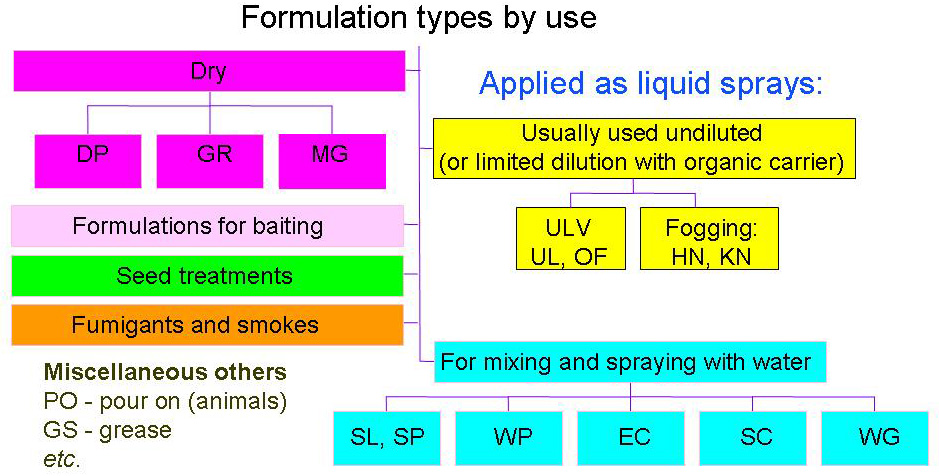
Formulation types are categorised into two-letter international formulation codes: (e.g. GR: granules), which must be used when registering a new pesticide product. Croplife maintains this list, which in the 7th update (2017) contains 65 formulation codes and 29 codes which are no longer used.
Water-miscible formulations
By far the most frequently used products are formulations for mixing with water then applying as sprays. Water miscible formulation types include:
- EC Emulsifiable concentrate
- SL Soluble (liquid) concentrate
- SP Soluble powder
- WP Wettable powder
Newer formulations with less use of hazardous solvents include:
- SC Suspension concentrate
- CS Capsule suspensions
- WG Water dispersible granules
Other formulations
Other common formulations include granules (GR) and dusts (DP), although for improved safety the latter have been replaced by microgranules (MG e.g. for rice farmers in Japan). Specialist formulations are available for ultra-low volume spraying, fogging, fumigation, etc. Very occasionally, some pesticides (e.g. malathion) may be sold as technical material (TC - which is mostly AI, but also contains small quantities of, usually non-active, by-products of the manufacturing process; TGAC - "technical grade active constituent" means the same.).
A particularly efficient form of pesticide dose transfer is seed treatment and specific formulations have been developed for this purpose. A number of pesticide bait formulations are available for rodent pest control, etc.
References
References
- Knowles, DA (1998) ''Chemistry and technology of agricultural formulations''. Kluwer Academic, London
- Hazra, Dipak Kumar. (2019). "Role of pesticide formulations for sustainable crop protection and environment management: A review". Journal of Pharmacognosy and Phytochemistry.
- (2022). "Manual on the development and use of FAO and WHO specifications for chemical pesticides". FAO and WHO.
- (March 2017). "Catalogue of pesticide formulation types and international coding system. TECHNICAL MONOGRAPH n° 2".
This article was imported from Wikipedia and is available under the Creative Commons Attribution-ShareAlike 4.0 License. Content has been adapted to SurfDoc format. Original contributors can be found on the article history page.
Ask Mako anything about Pesticide formulation — get instant answers, deeper analysis, and related topics.
Research with MakoFree with your Surf account
Create a free account to save articles, ask Mako questions, and organize your research.
Sign up freeThis content may have been generated or modified by AI. CloudSurf Software LLC is not responsible for the accuracy, completeness, or reliability of AI-generated content. Always verify important information from primary sources.
Report