From Surf Wiki (app.surf) — the open knowledge base
Peruvian Army
Land warfare branch of Peru's armed forces
Land warfare branch of Peru's armed forces
| Field | Value | |||
|---|---|---|---|---|
| unit_name | Peruvian Army | |||
| native_name | Ejército del Perú | |||
| image | [[File:Emblem of the Peruvian Army.svg | 200px]] | ||
| image_size | 250 | |||
| start_date | 18 August 1821 | |||
| country | Peru | |||
| type | Army | |||
| size | 92,500 (2021) active | |||
| motto | Hasta quemar el último cartucho () | |||
| colors | Red and white | |||
| march | "Himno del Ejército del Perú" | |||
| battles | ||||
| anniversaries | December 9, Army Day | |||
| June 7, Battle of Arica and National Flag Day | ||||
| website | https://www.gob.pe/ejercito | |||
| commander1 | Insignia of the President of Peru.svg President José Jerí | |||
| commander1_label | Commander-in-chief | |||
| commander2 | Flag for the Minister of Defense (Peru).svg Cesar peche | |||
| commander2_label | Minister of Defence | |||
| commander3 | Rank flag for the Chief of the Joint Command (Peru).svg Army General Manuel Gómez de la Torre | |||
| commander3_label | Chief of the Joint Command | |||
| commander4 | [[File:Peru-Army-OF-9.svg | 25px]] Army General Walter Córdova Alemán | ||
| commander4_label | Commanding General of the Army | |||
| commander5 | [[File:Peru-Army-OF-8.svg | 25px]] Divisional general David Ojeda Parra | ||
| commander5_label | Chief of the General Staff of the Army | |||
| notable_commanders | {{plainlist | |||
| <!-- Insignia --> | identification_symbol | [[File:Flag of the Peruvian Army.svg | border | 125px]] |
| identification_symbol_label | Flag |
- Wars of Independence
- War in Peru
- 1st Iquicha War
- War in Ecuador
- War in Bolivia
- War in Peru
- Territorial disputes of Peru
- Conflict with Bolivia
- War of 1828
- War of 1841–1842
- Angulo Expedition
- Hercelles Expedition
- Manuripi conflict
- Conflict with Brazil
- Conflict with Colombia
- War of 1828–1829
- Conflict of 1911
- War of 1932–1933
- Conflict with Ecuador
- War of 1857–1860
- Conflict of 1903
- Conflict of 1904
- War of 1941
- Cenepa incident
- Paquisha War
- Cenepa War
- Conflict with Spain
- Conflict with Bolivia
- Peruvian Civil Wars
- War of 1834
- War of 1835–1836
- War of 1836–1839
- 2nd Iquicha War
- War of 1843–1844
- War of 1856–1858
- War of 1884–1885
- War of 1894–1895
- Insurrection of 1896
- Insurrection of 1932
- War of 1980–2000
- War of the Pacific June 7, Battle of Arica and National Flag Day
- José de San Martín (founding Commanding General)
- José de La Mar
- Agustín Gamarra
- Ramón Castilla
- Francisco Bolognesi
- Andrés Avelino Cáceres
- Eloy Gaspar Ureta The Peruvian Army (, abbreviated EP) is the branch of the Peruvian Armed Forces tasked with safeguarding the independence, sovereignty and integrity of national territory on land through military force. Additional missions include assistance in safeguarding internal security, conducting disaster relief operations and participating in international peacekeeping operations. It celebrates the anniversary of the Battle of Ayacucho (1824) on December 9.
History
Military traditions in Peruvian territory go back to prehispanic times, ranging from small armed bands to the large armies assembled by the Inca Empire. After the Spanish conquest, small garrisons were kept at strategic locations but no standing army existed until the Bourbon reforms of the 18th century. The main purpose of this force was the defense of the Viceroyalty from pirates and corsairs as well as internal rebellions.
Independence
The Ejército del Perú was officially established on August 18, 1821, when the government of general José de San Martín established the Legión Peruana de la Guardia (Peruvian Guard Legion), although some militia units had been formed before. Peruvian troops were key participants in the final campaign against Spanish rule in South America, under the leadership of general Simón Bolívar, which ended victoriously in the battles of Junín and Ayacucho in 1824.
19th century
After the War of Independence the strong position of the Army and the lack of solid political institutions meant that every Peruvian president until 1872 held some military rank. The Ejército del Perú also had a major role in the definition of national borders by participating in several wars against neighbor countries. This included a conflict against Gran Colombia (1828-1829) where naval victories were obtained and the blockade of Guayaquil but had setbacks in Tarqui, after that an armistice is signed where it is indicated that it remains in statu quo, the Great Colombia dissolves months later product of the war with Peru, the wars of the Peru-Bolivian Confederation (1836-1839), two military invasions to Bolivia and the subsequent expulsion of Bolivian troops from Peruvian soil (1828 and 1841) and a successful occupation of Ecuador (1858-1860). Starting in 1842, increased state revenues from guano. Exports allowed the expansion and modernization of the Army, as well as the consolidation of its political power. These improvements were an important factor in the defeat of a Spanish naval expedition at the Battle of Callao (1866). However, continuous overspending and a growing public debt led to a chronic fiscal crisis in the 1870s which severely affected defense budgets. The consequent lack of military preparedness combined with bad leadership were major causes of Peru's defeat against Chile in the War of the Pacific (1879–1883). The reconstruction of the Army started slowly after the war due to a general lack of funds. A major turning point in this process was the arrival in 1896 of a French Military Mission contracted by president Nicolás de Piérola. By 1900 the peacetime strength of the army was evaluated at six infantry battalions (nearly 2,000 soldiers), two regiments and four squadrons and cavalry (between six and seven hundred soldiers), and one artillery regiment (just over 500 soldiers) for a total of 3,075 personnel. A military school was reportedly operating in the Chorrillos District of Lima and French officers were continuing to assist in the army's reorganization.
20th century
During the early years of the 20th century the Peruvian Army underwent a series of reforms under the guidance of the French Military Mission which operated in the periods 1896–1914, 1919–1924 and 1932–1939. Changes included the streamlining of the General Staff, the establishment of the Escuela Superior de Guerra (War College) in 1904, the creation of four military regions (North, Center, South and Orient) in 1905 and a general professionalization of the military career. Improvements such as these were fundamental for the good performance of the Army in the border skirmishes with Colombia (Colombian troops are expelled from the territory of La Pedrera in 1911 and the Peruvian Colombian war in 1933) and a victorious war against Ecuador (1941).
Even though the Peruvian Army was not involved in World War II, this conflict had a significant effect in its development, mainly through the replacement of French military influence by that of the United States. A US military mission started operations in 1945 followed by an influx of surplus American military equipment delivered as military aid or sold at a very low cost.
Washington also established itself as the leader of continental defense through the creation of the Inter-American Defense Board in 1942 and the signing of the Inter-American Treaty of Reciprocal Assistance in 1947. A parallel development was the founding in 1950 of the Centro de Altos Estudios Militares (CAEM, Center of High Military Studies) for the formation of officers in the major problems of the nation beyond those related to its military defense.
The Peruvian Army was the main protagonist of the Gobierno Revolucionario de las Fuerzas Armadas (Revolutionary Government of the Armed Forces), an institutionalized military government that ruled the country between 1968 and 1980. During this period, defense expenditures underwent exponential growth allowing a rapid expansion of the Armed Forces and an unprecedented level of weapon acquisitions. In the early 1970s, US influence over the Army was replaced by a massive influx of Soviet training and equipment, including T-55 tanks, the BM-21 Grad, AK series rifles and the BTR series APCs plus a new Soviet-styled national military strategy of regaining the lost southern provinces which were now part of Chile. Political power returned to the civilians in the 1980s, but the rise of the terrorist insurgent group Sendero Luminoso (Shining Path) prompted the deployment of several Army units in a counter-insurgency role. Human rights violations associated with this intervention and a sharp decrease in the defense budget due to a general economic crisis caused serious problems for the Army morale and readiness as well as a strain on civil-military relations.
In 1981 during the government of Belaúnde Terry, the Paquisha war broke out where 3 infiltrated bases from Ecuador were detected in Peruvian territory on the source of the Comaina River, ending with the eviction and bombardment of Ecuadorian bases.
The presidency of Alberto Fujimori (1990–2000) saw the Army regain protagonism in the public scene, but its increased political power led to some cases of corruption. The internal conflict ceased for the most part after the capture in 1992 of Abimael Guzmán, leader of the terrorist group Shining Path, but a brief border war with Ecuador broke out in 1995. During this period, women were incorporated into the Army first as conscripts in 1993 and then as officers in 1997. Army commandos had an important participation in operation Chavín de Huantar which put an end to the Japanese embassy hostage crisis. In 1999, one year after the signing of a peace treaty with Ecuador conscription was abolished and replaced by a voluntary military service for both genders.
21st century
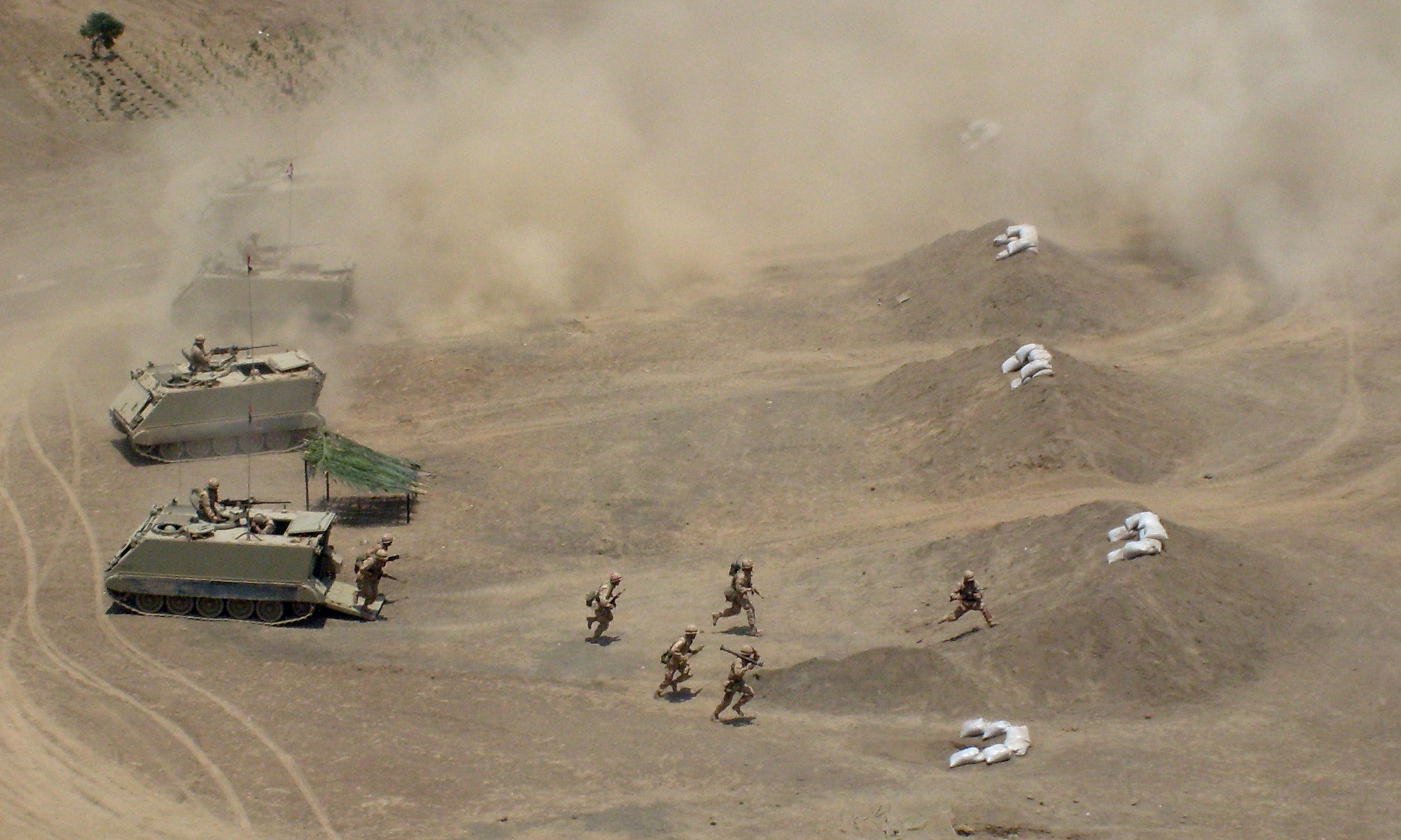
The downfall of the Alberto Fujimori regime left the Peruvian Army in a difficult state, with some of its senior officers compromised in scandals of corruption and human rights violations. Several reforms were undertaken during the presidencies of Valentín Paniagua (2000–2001) and Alejandro Toledo (2001–2006), among them the prosecution of criminal cases related to the military, the reorganization of the military rank system and an increased civilian supervision through a revamped Ministry of Defense. The outcome of this and other initiatives is a major factor of order, major preparation, new equipment and development of the Ejército del Perú. G-3 America (G3 and Associates International Corporation) facilitated the incorporation of new technology to eliminate or reduce terrorism. They have been working tenaciously in getting the right equipment for the Armed Forces while working with the US State Department and US companies to accomplish it.
The Ollanta Humalla administration has also had the Army engaged in training members of Peru's indigenous peoples for the duties of national defense as well as, through the BECA 18 program, helping to reduce poverty while teaching the youth of the values of national service. His term also saw the revival of the Army's modernization process with the arrival of the Type 81 MRL, pushing its BM-21s into retirement.
The Peruvian Ministry of Defence has awarded a US$67 million contract to General Dynamics Land Systems-Canada for 32 Light Armoured Vehicles (LAVs) for the Peruvian Marines. The contract was signed through the Canadian Commercial Corporation, a Crown corporation of the Government of Canada. In 2016, the Defense Security Cooperation Agency of the United States made a determination to approve a possible Foreign Military Sale to Peru of 178 reconditioned Stryker infantry carrier vehicles. In 2023, amidst the 2022 Russian invasion of Ukraine, the United States was reported to be pushing Central and South American countries with large quantities of Russian equipment to provide them to Ukraine, by either donating them or exchanging them for U.S. military equipment. Analysts report that Peru is a likely candidate, due to their large quantities of Russian equipment.
Organization
The current Commanding General of the Peruvian Army is General Oswaldo Martín Calle Talledo. Land forces are subordinated to the Ministry of Defense and ultimately to the President as Commander-in-Chief of the Armed Forces. They are organized as follows:
- Comandancia General del Ejército (Army General Command)
- Estado Mayor General del Ejército (Army General Staff)
- Inspectoría General del Ejército (Army General Inspectorate)
- Secretaría General del Ejército (Army General Secretariat)
Operational units are assigned to one of the following military regions, which are directly subordinate to the Army General Command through the Ground Operations Command.
[[1st Army Division (Peru)|1st Army Division]]

North Military Region and 1st Division, formerly known as the Northern Army Detachment. Headquartered at Piura.
- 1st Cavalry Brigade (Sullana)
- 1st Infantry Brigade (Tumbes)
- 7th Infantry Brigade (Lambayeque)
- 32nd Infantry Brigade (Trujillo)
- 6th Jungle Brigade (El Milagro)
- 9th Armored Brigade
[[2nd Army Division (Peru)|2nd Army Division]]

Central/North Central Military Region and 2nd Division, headquartered at Lima.
- 18th armoured warfare|Armored Brigade (Lima)
- 2nd Infantry Brigade (Ayacucho)
- 1st Special Forces Brigade (Lima)
- 3rd Special Forces Brigade (Tarapoto)
- 1st Army Aviation Brigade (Callao)
- "Mariscal Domingo Nieto" Cavalry Regiment Escort (Lima)
- Guard Brigade of the Army "Peruvian Guard Legion" (Lima)
- 1st Mechanized Cavalry Regiment "Hussars of Junín" (Lima)
- 1st Mechanized Infantry Battalion Peruvian Legion of the Guard
- 1st Artillery Battery (Separate)
- 1st Combined Arms Brigade
- 21st Infantry Brigade (Reserve)
[[3rd Army Division (Peru)|3rd Army Division]]
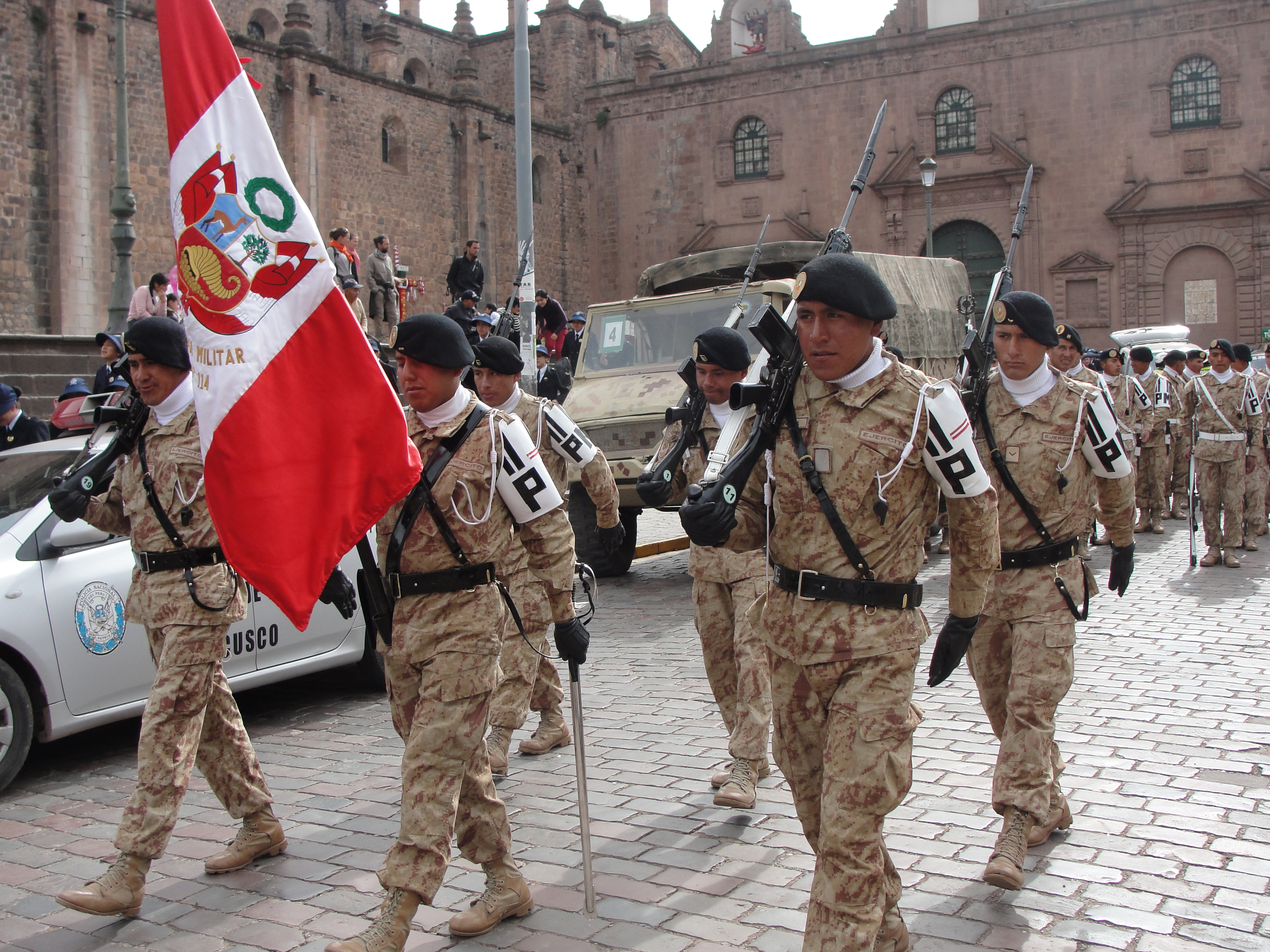
South Military Region and 3rd division, headquartered at Arequipa.
- 3rd Armored Brigade (Moquegua)
- 6th Armored Brigade
- 3rd Cavalry Brigade (Tacna)
- 4th Mountain Brigade (Puno)
- 5th Mountain Brigade (Cuzco)
- 6th Special Forces Brigade
- 3rd Divisional Communications Brigade
- 3rd Divisional Air Defense Artillery
[[4th Army Division (Peru)|4th Army Division]]
4th (South Central) Military Region and Division.
- 2nd Infantry Brigade
- 31st Infantry Brigade
- 32nd Engineering Brigade
- 33rd Infantry Brigade
[[5th Army Division (Peru)|5th Army Division]]
Eastern Military Region and 5th Division, headquartered at Iquitos.
- 5th Jungle Brigade (Iquitos)
- 35th Jungle Brigade
- 115th Logistics Brigade
Personnel

| Personnel (as of 2001) |
|---|
| Commissioned Officers |
| Non-commissioned officers |
| Cadets |
| NCO in training |
| Enlisted |
| Civilians |
| Total |
Ranks
Main article: Military ranks of Peru
- Ranks of the officers, sub-officers and others enlisted of the Army.
;Officers
;Enlisted
Equipment
Heroes and Patrons
- Patron of the Army: Francisco Bolognesi Cervantes
- Patron of the Infantry branch: Andrés A. Cáceres Dorregaray
- Patron of the Cavalry branch: Ramón Castilla y Marquezado
- Patron of the Artillery branch: José Joaquín Inclán Gonzáles Vigil
- Patron of the Engineering branch: Pedro Ruiz Gallo
- Patron of the Communications branch: José Olaya
- Patron of the Legal Service: Mariano Melgar
- Patron of the Health Service: José Casimiro Ulloa Bucello
- Patron of the War Material Service: Leoncio Prado Gutiérrez
- Patron of the Intendancy Service: Pedro Muñiz Sevilla
Anthem of the Army
References
Sources
- Basadre, Jorge, Historia de la República del Perú. Editorial Universitaria, 1983.
- Cobas, Efraín, Las Fuerzas Armadas Peruanas en el Siglo XXI. CESLA, 2003.
- Cruz, César, "Latin America Air Forces Survey – Peru". Air Forces Monthly 220: 77–78 (July 2006).
- International Institute for Strategic Studies, The Military Balance 2000–2001. IISS, 2000.
- Mejía, Lewis and César Cruz, "La Aviación del Ejército del Perú". Defensa 290: 42–48 (June 2002).
- Ministerio de Defensa del Perú, Libro blanco de la defensa nacional. https://web.archive.org/web/20050206062343/http://www.mindef.gob.pe/lb_2005/index.htm
- Rial, Juan, Los militares tras el fin del régimen de Fujimori-Montesinos. https://web.archive.org/web/20070927210407/http://www.resdal.org/art-rial.htm
- Tecnología Militar, N°1/2006
- Marchessini, Alejo, "Plan Bolognesi: Actualidad y Futuro del Ejército del Peru". Defensa 347 (March 2007).
- Aircraft information files Brightstar publishing File 344 sheet 4
References
- (2020-08-18). "Ejército del Perú anunció que la fecha oficial de su creación fue el 18 de agosto de 1821". [[El Comercio (Peru).
- "Himno del Ejército del Perú".
- "David Guillermo Ojeda Parra - Jefe del Estado Mayor General del Ejército".
- (1900). "The Statesman's Year Book: Statistical and Historical Annual of the States of the World for the Year 1900". MacMillan.
- Nathan Gain. (July 25, 2014). "General Dynamics Awarded $67Mn by the Peruvian Ministry of Defence for Light Armoured Vehicles".
- "Government of Peru – Reconditioned Stryker Infantry Carrier Vehicles | Defense Security Cooperation Agency".
- "US Pushing Central, South American Countries to Give Ukraine Quick Military Boost".
- "I División de Ejército".
- "II División de Ejército".
- "III División de Ejército".
- "IV División de Ejército".
- "V División de Ejército".
- "RESDAL - Artículos destacados - los militares tras el fin del régimen de Fujimori-Montesinos".
- [https://web.archive.org/web/20090508052549/http://www.ejercito.mil.pe/index.php?option=com_content&view=article&id=93&Itemid=39 Grados Militares ]
This article was imported from Wikipedia and is available under the Creative Commons Attribution-ShareAlike 4.0 License. Content has been adapted to SurfDoc format. Original contributors can be found on the article history page.
Ask Mako anything about Peruvian Army — get instant answers, deeper analysis, and related topics.
Research with MakoFree with your Surf account
Create a free account to save articles, ask Mako questions, and organize your research.
Sign up freeThis content may have been generated or modified by AI. CloudSurf Software LLC is not responsible for the accuracy, completeness, or reliability of AI-generated content. Always verify important information from primary sources.
Report