From Surf Wiki (app.surf) — the open knowledge base
Pelican
Genus of large water birds with a throat pouch
Genus of large water birds with a throat pouch
Possible an early origin based on molecular clock
Pelicans (genus Pelecanus) are a genus of large water birds that make up the family Pelecanidae. They are characterized by a long beak and a large throat pouch used for catching prey and draining water from the scooped-up contents before swallowing. They have predominantly pale plumage, except for the brown and Peruvian pelicans. The bills, pouches, and bare facial skin of all pelicans become brightly coloured before the breeding season.
The eight living pelican species have a patchy, seasonally-dependent yet global distribution, ranging latitudinally from the tropics to the temperate zone. Pelicans are absent from interior Amazonian South America, from polar regions and the open ocean; at least one species is known to migrate to the inland desert of Australia's Red Centre, after heavy rains create temporary lakes. White pelicans are also observed at the American state of Utah's Great Salt Lake, for example, some 600 miles (965 km) from the nearest coastline (the Pacific West Coast). They have also been seen hundreds of miles inland in North America, having flown northwards along the Mississippi River and other large waterways.
Long thought to be related to frigatebirds, cormorants, tropicbirds, and gannets and boobies, pelicans instead are most closely related to the shoebill and hamerkop storks (although these two birds are not actually true storks), and are placed in the order Pelecaniformes. Ibises, spoonbills, herons, and bitterns have been classified in the same order. Fossil evidence of pelicans dates back at least 36 million years to the remains of a tibiotarsus recovered from late Eocene strata of Egypt that bears striking similarity to modern species of pelican. They are thought to have evolved in the Old World and spread into the Americas; this is reflected in the relationships within the genus as the eight species divide into Old World and New World lineages. This hypothesis is supported by fossil evidence from the oldest pelican taxa.
Pelicans will frequent inland waterways but are most known for residing along maritime and coastal zones, where they feed principally on fish in their large throat pouches, diving into the water and catching them at/near the water's surface. They can adapt to varying degrees of water salinity, from freshwater and brackish to—most commonly—seawater. They are gregarious birds, travelling in flocks, hunting cooperatively, and breeding colonially. Four white-plumaged species tend to nest on the ground, and four brown or grey-plumaged species nest mainly in trees. The relationship between pelicans and people has often been contentious. The birds have been persecuted because of their perceived competition with commercial and recreational fishing. Their populations have fallen through habitat destruction, disturbance, and environmental pollution, and three species are of conservation concern. They also have a long history of cultural significance in mythology, and in Christian and heraldic iconography.
Taxonomy and systematics
Etymology
The name comes from the Ancient Greek word pelekan (πελεκάν), which is itself derived from the word pelekys (πέλεκυς) meaning "axe". In classical times, the word was applied to both the pelican and the woodpecker.
Taxonomy history
Main article: Pelecaniformes#Systematics and evolution
The genus Pelecanus was first formally described by Carl Linnaeus in his landmark 1758 10th edition of Systema Naturae. He described the distinguishing characteristics as a straight bill hooked at the tip, linear nostrils, a bare face, and fully webbed feet. This early definition included frigatebirds, cormorants, and sulids, as well as pelicans. The family Pelecanidae was later introduced (as Pelicanea) by the French polymath Constantine Samuel Rafinesque in 1815.
Order and related taxa
Pelicans give their name to the Pelecaniformes, an order which has undergone significant revision. Tropicbirds (now Phaethontiformes), darters, cormorants, gannets, boobies, and frigatebirds (now Suliformes), all traditional members of the order, have since been removed from Pelecaniformes. In their place, herons, ibises, spoonbills, the hamerkop, and the shoebill have now been added into the Pelecaniformes.
Phylogenetic relationships
Molecular data support a close relationship between pelicans, shoebills (Balaeniceps rex), and hamerkops (Scopus umbretta). Together, they form a distinct clade within Pelecaniformes, although their precise evolutionary relationships remain under study.
| {{Clade | style=font-size:90% | label1= | 1={{Clade | 1=Suliformes | label2=Pelecaniformes | 2={{Clade | label1= | 1={{Clade | 1=Herons (Ardeidae) | Ibises and spoonbills]] (Threskiornithidae) | label2= | 2={{Clade | label1= | 1={{Clade | 1=Hamerkop (*Scopus umbretta*) | 2=Shoebill (*Balaeniceps rex*) | 2=Pelicans (*Pelecanus*) | align = right | direction = vertical | header = Closest living relatives | width =150 | image1 = Hammerkopf2.jpg | alt1 = Head of a hamerkop | caption1 = Hamerkop | image2 = Balaeniceps rex -Ueno Zoo, Tokyo, Japan -upper body-8a.jpg | alt2 = Head of a shoebill | caption2 = Shoebill |
|---|
Evolution and fossil record
The oldest known pelican fossil is Eopelecanus aegyptiacus, a tibiotarsus from the late Eocene (Priabonian) the Birket Qarun Formation in the Wadi El Hitan in Egypt (~36 million years ago). It shows striking similarities with modern species.
Later fossils from the Early Miocene found at Luberon, France, include Pelecanus sp. and Miopelecanus gracilis. Both fossils show a beak nearly morphologically identical to that of present-day pelicans. This remarkable stasis in pelican beak morphology may reflect strong functional constraints. Their specialized fish-eating beak has likely remained optimal over millions of years, with changes potentially reducing feeding efficiency. Some have also suggested that constraints imposed by flight may have limited the skeletal evolution of pelicans.
Notable fossil species (sorted by region and age) include:
- Europe: P. fraasi, Lydekker, 1891; P. intermedius, Frass,1870; P. gracilis, Milne-Edwards, 1863; P. odessanus, Widhalm, 1886
- North America: P. halieus, Wetmore, 1933; P. schreiberi, Olson, 1999
- Asia: P. cautleyi, Davies, 1880; P. sivalensis, Davies, 1880
- South America: P. paranensis, Noriega et al., 2023
- Australia: P. cadimurka, Rich & van Tets, 1981; P. tirarensis, Miller, 1966
Controversial and dubious fossil assignments
- Protopelicanus (Late Eocene) – Once considered a possible early pelecaniform, this bird might instead belong to the Pelagornithidae (pseudotooth birds) or another unrelated aquatic lineage. It is not generally accepted as a member of Pelecanidae.
- Liptornis (Miocene) – Originally described as a pelican, this genus is now considered a nomen dubium, based on fragmentary material that lacks sufficient diagnostic features.
Extant species and phylogeny
Species overview
cladogram={{clade|style=line-height:75%
Genetic analyses using mitochondrial and nuclear DNA have revealed a different picture of pelican relationships. These studies support the existence of two major clades: a New World clade, comprising the American white, brown, and Peruvian pelicans, and an Old World clade that includes the Dalmatian, pink-backed, spot-billed, Australian, and great white pelicans. This phylogeny suggests that pelicans evolved in the Old World and later colonized the Americas. Furthermore, it indicates that nesting behavior is more strongly influenced by body size than by genetic lineage.
List of living species
| Living species of *Pelecanus* | Common and binomial names | Image | Description | Range and status | ||||||||||||
|---|---|---|---|---|---|---|---|---|---|---|---|---|---|---|---|---|
| American white pelican | ||||||||||||||||
| *Pelecanus erythrorhynchos* | ||||||||||||||||
| Gmelin, 1789 | [[File:Mikebaird - American White Pelican (Pelecanus erythrorhynchos ) (bird) in Mo (by).jpg | 185px | center | alt=American white pelican]] | Length 1.3 –, wingspan 2.44 –, weight 5 –. Plumage almost entirely white, except for black primary and secondary remiges only visible in flight. | Monotypic. Breeds in inland Canada and United States, wintering in southern United States, Mexico and Central America. Status: least concern. | ||||||||||
| Brown pelican | ||||||||||||||||
| *Pelecanus occidentalis* | ||||||||||||||||
| Linnaeus, 1766 | [[File:Pelecanus Occidentalis KW 1.JPG | 185px | center | alt=Brown pelican]] | Length up to 1.4 m, wingspan 2 –, weight 3.6 –. Smallest pelican; distinguished by brown plumage; feeds by plunge-diving. | author=BirdLife International | date=2018 | title=*Pelecanus occidentalis* | volume=2018 | article-number=e.T22733989A132663224 | doi=10.2305/IUCN.UK.2018-2.RLTS.T22733989A132663224.en | access-date=11 November 2021}} | ||||
| Peruvian pelican | ||||||||||||||||
| *Pelecanus thagus* | ||||||||||||||||
| Molina, 1782 | [[File:Pelícano en Pucusana.JPG | 185px | center | alt=Peruvian pelican]] | Length up to 1.52 m, wingspan 2.48 m, average weight 7 kg. Dark with a white stripe from the crown down the sides of the neck. | author1=Sibley, Charles Gald | author2=Monroe, Burt Leavelle | title = Distribution and Taxonomy of Birds of the World | url = https://books.google.com/books?id=Wk-vyrNVAccC | access-date = 29 June 2012 | year = 1990 | publisher = Yale University Press | isbn = 0-300-04969-2 | pages = 314–15}} Status: near threatened. | ||
| Great white pelican | ||||||||||||||||
| *Pelecanus onocrotalus* | ||||||||||||||||
| Linnaeus, [1758](10th-edition-of-systema-naturae) | [[File:Whitepelican edit shadowlift edit.jpg | 185px | center | alt=Great white pelican]] | Length 1.40 –, wingspan 2.45 –, weight 10 –. Plumage white, with pink facial patch and legs. | author=BirdLife International | date=2018 | title=*Pelecanus onocrotalus* | volume=2018 | article-number=e.T22697590A132595920 | doi=10.2305/IUCN.UK.2018-2.RLTS.T22697590A132595920.en | access-date=11 November 2021}} | ||||
| Australian pelican | ||||||||||||||||
| *Pelecanus conspicillatus* | ||||||||||||||||
| Temminck, 1824 | [[File:Pelecanus conspicillatus -Australia -8.jpg | 185px | center | alt=Australian pelican]] | Length 1.60 –, wingspan 2.3 –, weight 4 –. Predominantly white with black along primaries and very large, pale pink bill. | author=BirdLife International | date=2016 | title=*Pelecanus conspicillatus* | volume=2016 | article-number=e.T22697608A93623945 | doi=10.2305/IUCN.UK.2016-3.RLTS.T22697608A93623945.en | access-date=11 November 2021}} | ||||
| Pink-backed pelican | ||||||||||||||||
| *Pelecanus rufescens* | ||||||||||||||||
| Gmelin, 1789 | [[File:Pink-backed Pelican - Naivasha - Kenya 50276 (15205474549).jpg | 185px | center | alt=Pink-backed pelican]] | Length 1.25 –, wingspan 2.65 –, weight 3.9 –. Grey and white plumage, occasionally pinkish on the back, with a yellow upper mandible and grey pouch. | last = Langrand | first = Olivier | title = Guide to the Birds of Madagascar | url = https://books.google.com/books?id=VYVqhOqS2WEC | access-date = 29 June 2012 | year = 1990 | publisher = Yale University Press | location = New Haven, Connecticut | isbn = 0-300-04310-4 | page = 96}} Status: least concern. | |
| Dalmatian pelican | ||||||||||||||||
| *Pelecanus crispus* | ||||||||||||||||
| Bruch, 1832 | [[File:Dalmatian Pelican RWD2.jpg | 185px | center | alt=Dalmatian pelican]] | Length 1.60 –, wingspan 2.70 –, weight 10 –. | Monotypic. South-eastern Europe to India and China. Status: near threatened. | ||||||||||
| Spot-billed pelican | ||||||||||||||||
| *Pelecanus philippensis* | ||||||||||||||||
| Gmelin, 1789 | [[File:Spot-billed pelican-02.jpg | 185px | center | alt=Spot-billed pelican]] | Length 1.27 –, wingspan 2.5 m, weight c. 5 kg. Mainly grey-white all over, with a grey hindneck crest in breeding season, pinkish rump and spotted bill pouch. | Monotypic. Southern Asia from southern Pakistan across India east to Indonesia; extinct in the Philippines and possibly eastern China. Status: near threatened. |
Description
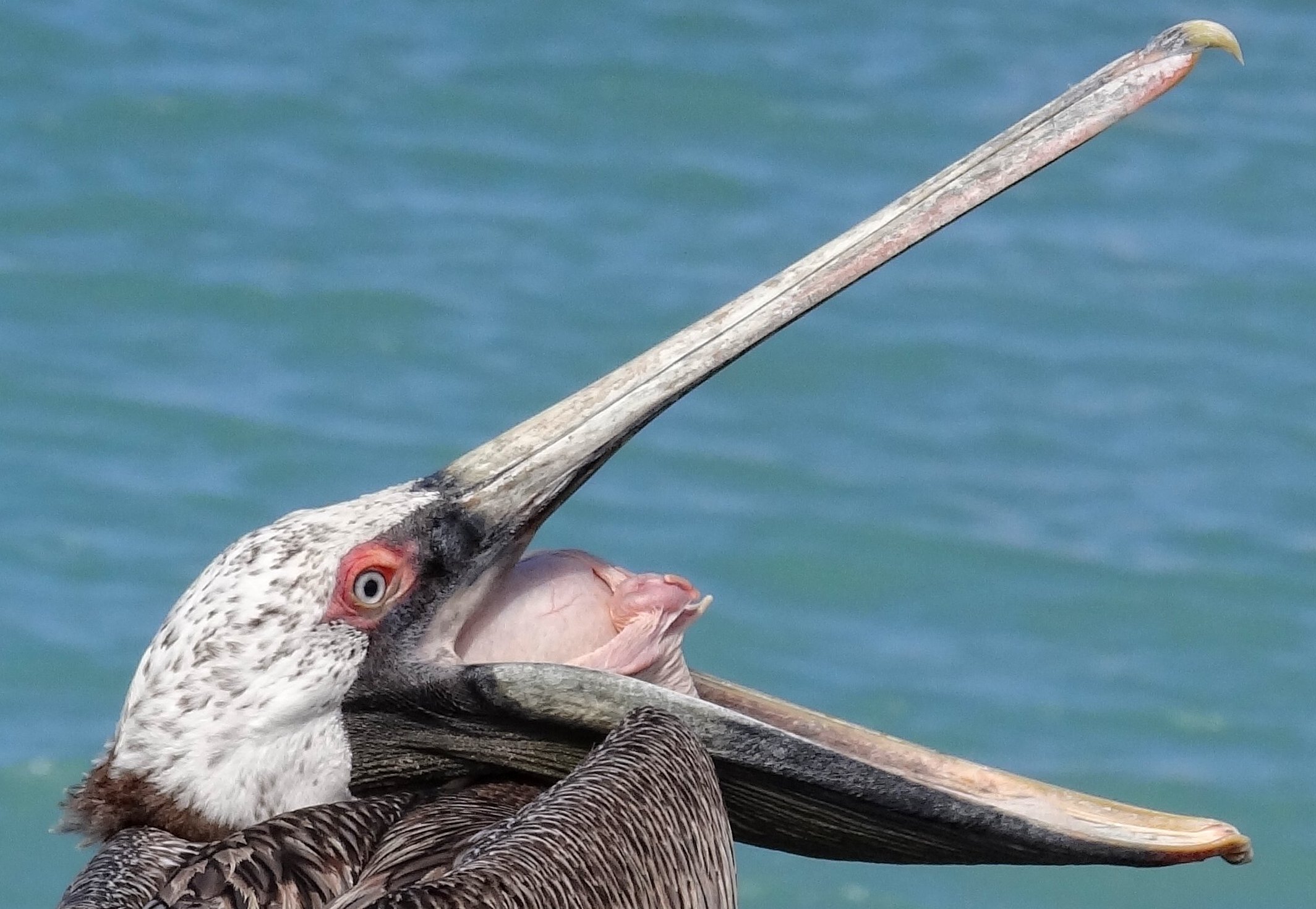

Pelicans are very large birds with very long bills characterised by a downcurved hook at the end of the upper mandible, and the attachment of a huge gular pouch to the lower. The slender rami of the lower bill and the flexible tongue muscles form the pouch into a basket for catching fish, and sometimes rainwater, They have a long neck and short stout legs with large, fully webbed feet. Although they are among the heaviest of flying birds, they are relatively light for their apparent bulk because of air pockets in the skeleton and beneath the skin, enabling them to float high in the water.
Males are generally larger than females and have longer bills. the longest of any bird.
Pelicans have mainly light-coloured plumage, the exceptions being the brown and Peruvian pelicans. The plumage of immature pelicans is darker than that of adults. Newly hatched chicks are naked and pink, darkening to grey or black after four to 14 days, then developing a covering of white or grey down.
Air sacs
Anatomical dissections of two brown pelicans in 1939 showed that pelicans have a network of air sacs under their skin situated across the ventral surface including the throat, breast, and undersides of the wings, as well as having air sacs in their bones. The air sacs are connected to the airways of the respiratory system, and the pelican can keep its air sacs inflated by closing its glottis, but how air sacs are inflated is not clear. The air sacs serve to keep the pelican remarkably buoyant in the water and may also cushion the impact of the pelican's body on the water surface when they dive from flight into water to catch fish. Superficial air sacs may also help to round body contours (especially over the abdomen, where surface protuberances may be caused by viscera changing size and position) to enable the overlying feathers to form more effective heat insulation and also to enable feathers to be held in position for good aerodynamics.
Distribution and habitat
Modern pelicans are found on all continents except Antarctica. They primarily inhabit warm regions, although breeding ranges extend to latitudes of 45° South (Australian pelicans in Tasmania) and 60° North (American white pelicans in western Canada). Birds of inland and coastal waters, they are absent from polar regions, the deep ocean, oceanic islands (except the Galapagos), and inland South America, as well as from the eastern coast of South America from the mouth of the Amazon River southwards. although their scarcity and isolated occurrence suggests that these remains may have merely been vagrants from Australia (much as is the case today).
Behaviour and ecology
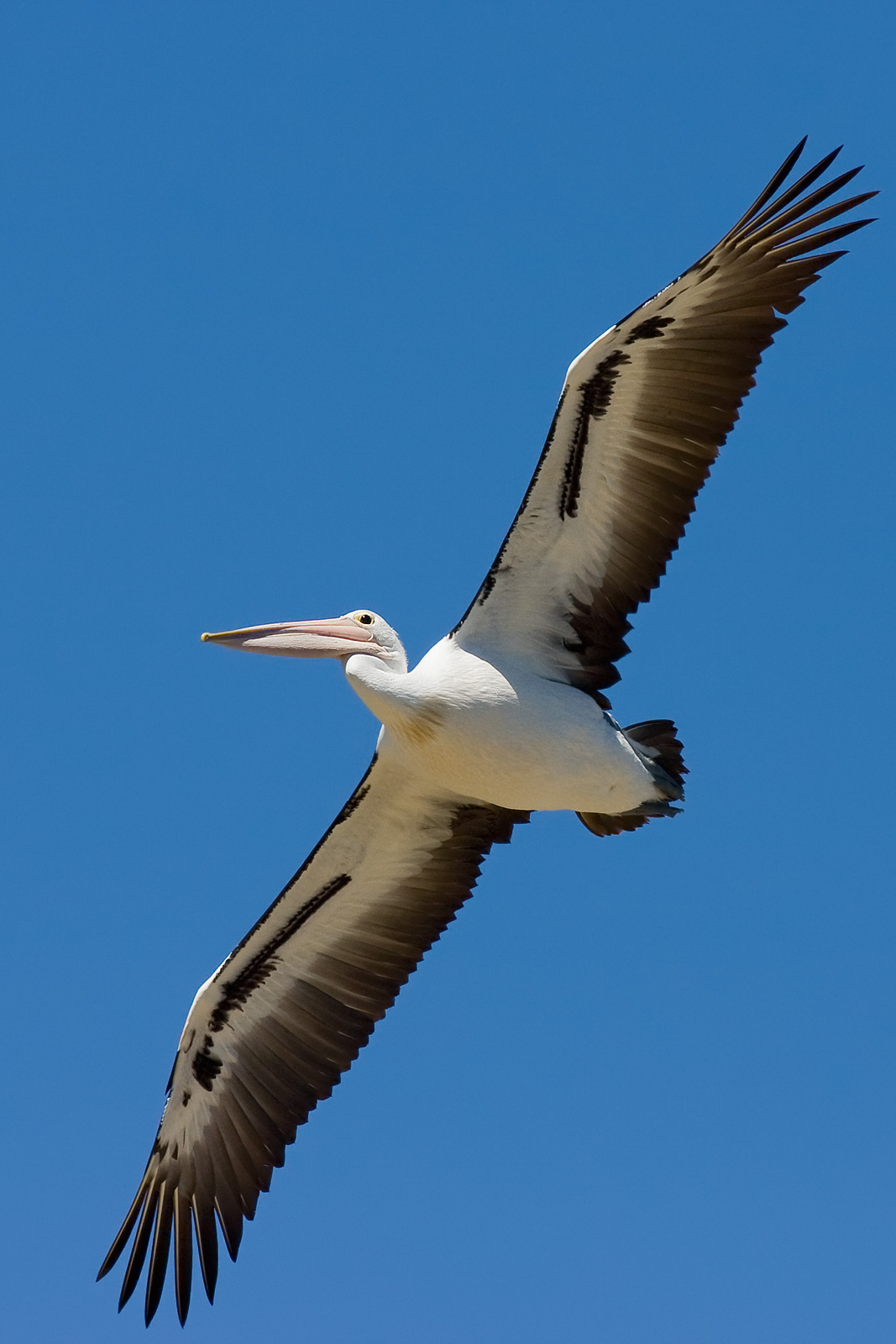
Pelicans swim well with their strong legs and their webbed feet. They rub the backs of their heads on their preen glands to pick up an oily secretion, which they transfer to their plumage to waterproof it. Holding their wings only loosely against their bodies, pelicans float with relatively little of their bodies below the water surface. They dissipate excess heat by gular flutter – rippling the skin of the throat and pouch with the bill open to promote evaporative cooling. They roost and loaf communally on beaches, sandbanks, and in shallow water.
A fibrous layer deep in the breast muscles can hold the wings rigidly horizontal for gliding and soaring. Thus, they use thermals for soaring to heights of 3,000 m (10,000 ft) or more, Hence, substantial energy is saved while flying.
Adult pelicans rely on visual displays and behaviour to communicate, particularly using their wings and bills. Agonistic behaviour consists of thrusting and snapping at opponents with their bills, or lifting and waving their wings in a threatening manner. Adult pelicans grunt when at the colony, but are generally silent elsewhere or outside breeding season. Conversely, colonies are noisy, as chicks vocalise extensively.
Breeding and lifespan
Pelicans are gregarious and nest colonially. Pairs are monogamous for a single season, but the pair bond extends only to the nesting area; mates are independent away from the nest. The ground-nesting (white) species have a complex communal courtship involving a group of males chasing a single female in the air, on land, or in the water while pointing, gaping, and thrusting their bills at each other. They can finish the process in a day. The tree-nesting species have a simpler process in which perched males advertise for females. The location of the breeding colony is constrained by the availability of an ample supply of fish to eat, although pelicans can use thermals to soar and commute for hundreds of kilometres daily to fetch food.
The Australian pelican has two reproductive strategies depending on the local degree of environmental predictability. Colonies of tens or hundreds, rarely thousands, of birds breed regularly on small coastal and subcoastal islands where food is seasonally or permanently available. In arid inland Australia, especially in the endorheic Lake Eyre basin, pelicans breed opportunistically in very large numbers of up to 50,000 pairs, when irregular major floods, which may be many years apart, fill ephemeral salt lakes and provide large amounts of food for several months before drying out again.
In all species, copulation takes place at the nest site; it begins shortly after pairing and continues for three to ten days before egg-laying. The male brings the nesting material, in ground-nesting species (which may not build a nest) sometimes in the pouch, and in tree-nesting species crosswise in the bill. The female then heaps the material up to form a simple structure.
The eggs are oval, white, and coarsely textured. Sometimes before, but especially after being fed the pelican chick may seem to "throw a tantrum" by loudly vocalizing and dragging itself around in a circle by one wing and leg, striking its head on the ground or anything nearby and the tantrums sometimes end in what looks like a seizure that results in the chick falling briefly unconscious; the reason is not clearly known, but a common belief is that it is to draw attention to itself and away from any siblings who are waiting to be fed.
Parents of ground-nesting species sometimes drag older young around roughly by the head before feeding them. From about 25 days old, the young of these species gather in "pods" or "crèches" of up to 100 birds in which parents recognise and feed only their own offspring. By six to eight weeks, they wander around, occasionally swimming, and may practise communal feeding. Young of all species fledge ten to 12 weeks after hatching. They may remain with their parents afterwards, but are now seldom or never fed. They are mature at three or four years old. Overall breeding success is highly variable. Pelicans live for 15 to 25 years in the wild, although one reached an age of 54 years in captivity.
Feeding
The diet of pelicans usually consists of fish, but occasionally amphibians, turtles, crustaceans, insects, birds, and mammals are also eaten. The size of the preferred prey fish varies depending on pelican species and location. For example, in Africa, the pink-backed pelican generally takes fish ranging in size from fry up to 400 g and the great white pelican prefers somewhat larger fish, up to 600 g, but in Europe, the latter species has been recorded taking fish up to 1850 g. In deep water, white pelicans often fish alone. Nearer the shore, several encircle schools of small fish or form a line to drive them into the shallows, beating their wings on the water surface and then scooping up the prey. Although all pelican species may feed in groups or alone, the Dalmatian, pink-backed, and spot-billed pelicans are the only ones to prefer solitary feeding. When fishing in groups, all pelican species have been known to work together to catch their prey, and Dalmatian pelicans may even cooperate with great cormorants.
Large fish are caught with the bill-tip, then tossed up in the air to be caught and slid into the gullet head-first. A gull will sometimes stand on the pelican's head, peck it to distraction, and grab a fish from the open bill. Pelicans in their turn sometimes snatch prey from other waterbirds.
The brown pelican usually plunge-dives head-first for its prey, from a height as great as 10-20 m, especially for anchovies and menhaden. The Australian and American white pelicans may feed by low plunge-dives landing feet-first and then scooping up the prey with the beak, but they—as well as the remaining pelican species—primarily feed while swimming on the water. Aquatic prey is most commonly taken at or near the water surface. and "anything from insects and small crustaceans to ducks and small dogs". Food is not stored in a pelican's throat pouch, contrary to popular folklore.
Pelicans may also eat birds. In southern Africa, eggs and chicks of the Cape cormorant are an important food source for great white pelicans. Several other bird species have been recorded in the diet of this pelican in South Africa, including Cape gannet chicks on Malgas Island as well as crowned cormorants, kelp gulls, greater crested terns, and African penguins on Dassen Island and elsewhere. The Australian pelican, which is particularly willing to take a wide range of prey items, has been recorded feeding on young Australian white ibis, and young and adult grey teals and silver gulls. Brown pelicans have been reported preying on young common murres in California and the eggs and nestlings of cattle egrets and nestling great egrets in Baja California, Mexico. Peruvian pelicans in Chile have been recorded feeding on nestlings of imperial shags, juvenile Peruvian diving petrels, and grey gulls. Cannibalism of chicks of their own species is known from the Australian, brown, and Peruvian pelicans. Non-native great white pelicans have been observed swallowing city pigeons in St. James's Park in London, England.
Status and conservation
Populations
Globally, pelican populations are adversely affected by these main factors: declining supplies of fish through overfishing or water pollution, destruction of habitat, direct effects of human activity such as disturbance at nesting colonies, hunting and culling, entanglement in fishing lines and hooks, and the presence of pollutants such as DDT and endrin. Most species' populations are more or less stable, although three are classified by the IUCN as being at risk. All species breed readily in zoos, which is potentially useful for conservation management.
The combined population of brown and Peruvian pelicans is estimated at 650,000 birds, with around 250,000 in the United States and Caribbean, and 400,000 in Peru.{{efn|The US government has not accepted the elevation of the two taxa into separate species. Numbers of brown pelican plummeted in the 1950s and 1960s, largely as a consequence of environmental DDT pollution, and the species was listed as endangered in the US in 1970. With restrictions on DDT use in the US from 1972, its population has recovered, and it was delisted in 2009.
The Peruvian pelican is listed as near threatened because, although the population is estimated by BirdLife International to exceed 500,000 mature individuals, and is possibly increasing, it has been much higher in the past. It declined dramatically during the 1998 El Niño event and could experience similar declines in the future. Conservation needs include regular monitoring throughout the range to determine population trends, particularly after El Niño years, restricting human access to important breeding colonies, and assessing interactions with fisheries.
The spot-billed pelican has an estimated population between 13,000 and 18,000 and is considered to be near threatened in the IUCN Red List of Threatened Species. Numbers declined substantially during the 20th century, one crucial factor being the eradication of the important Sittaung valley breeding colony in Burma through deforestation and the loss of feeding sites. The chief threats it faces are from habitat loss and human disturbance, but populations have mostly stabilised following increased protection in India and Cambodia.
The pink-backed pelican has a large population ranging over much of sub-Saharan Africa. In the absence of substantial threats or evidence of declines across its range, its conservation status is assessed as being of least concern. Regional threats include the drainage of wetlands and increasing disturbance in southern Africa. The species is susceptible to bioaccumulation of toxins and the destruction of nesting trees by logging.
The American white pelican has increased in numbers, However, whether its numbers have been affected by exposure to pesticides is unclear, as it has also lost habitat through wetland drainage and competition with recreational use of lakes and rivers.
Great white pelicans range over a large area of Africa and southern Asia. The overall trend in numbers is uncertain, with a mix of regional populations that are increasing, declining, stable, or unknown, but no evidence has been found of rapid overall decline, and the status of the species is assessed as being of least concern. Threats include the drainage of wetlands, persecution and sport hunting, disturbance at the breeding colonies, and contamination by pesticides and heavy metals.
The Dalmatian pelican has a population estimated at between 10,000 and 20,000 following massive declines in the 19th and 20th centuries. The main ongoing threats include hunting, especially in eastern Asia, disturbance, coastal development, collision with overhead power lines, and the over-exploitation of fish stocks. It is listed as near threatened by the IUCN Red List of Threatened Species as the population trend is downwards, especially in Mongolia, where it is nearly extinct. However, several European colonies are increasing in size and the largest colony for the species, at the Small Prespa Lake in Greece, has reached about 1,400 breeding pairs following conservation measures.
Widespread across Australia, Overall population numbers fluctuate widely and erratically depending on wetland conditions and breeding success across the continent. The species is assessed as being of least concern.
Culling and disturbance
Pelicans have been persecuted by humans for their perceived competition for fish, despite the fact that their diet overlaps little with fish caught by people.
Great white pelicans on Dyer Island, in the Western Cape region of South Africa, were culled during the 19th century because their predation of the eggs and chicks of guano-producing seabirds was seen to threaten the livelihood of the guano collectors. More recently, such predation at South African seabird colonies has impacted on the conservation of threatened seabird populations, especially crowned cormorants, Cape cormorants, and bank cormorants. This has led to suggestions that pelican numbers should be controlled at vulnerable colonies.
Apart from habitat destruction and deliberate, targeted persecution, pelicans are vulnerable to disturbance at their breeding colonies by birdwatchers, photographers, and other curious visitors. Human presence alone can cause the birds to accidentally displace or destroy their eggs, leave hatchlings exposed to predators and adverse weather, or even abandon their colonies completely.
Poisoning and pollution
DDT pollution in the environment was a major cause of decline of brown pelican populations in North America in the 1950s and 1960s. It entered the oceanic food web, contaminating and accumulating in several species, including one of the pelican's primary food fish – the northern anchovy. Its metabolite DDE is a reproductive toxicant in pelicans and many other birds, causing eggshell thinning and weakening, and consequent breeding failure through the eggs being accidentally crushed by brooding birds. Since an effective ban on the use of DDT was implemented in the US in 1972, the eggshells of breeding brown pelicans there have thickened and their populations have largely recovered.
In the late 1960s, following the major decline in brown pelican numbers in Louisiana from DDT poisoning, 500 pelicans were imported from Florida to augment and re-establish the population; over 300 subsequently died in April and May 1975 from poisoning by the pesticide endrin. About 14,000 pelicans, including 7,500 American white pelicans, perished from botulism after eating fish from the Salton Sea in 1990.
As waterbirds that feed on fish, pelicans are highly susceptible to oil spills, both directly by being oiled and by the impact on their food resources. A 2007 report to the California Fish and Game Commission estimated that during the previous 20 years, some 500–1,000 brown pelicans had been affected by oil spills in California.
Where pelicans interact with fishers, through either sharing the same waters or scavenging for fishing refuse, they are especially vulnerable to being hooked and entangled in both active and discarded fishing lines. Fish hooks are swallowed or catch in the skin of the pouch or webbed feet, and strong monofilament fishing line can become wound around bill, wings, or legs, resulting in crippling, starvation, and often death. Local rescue organisations have been established in North America and Australia by volunteers to treat and rehabilitate injured pelicans and other wildlife.
Parasites and disease
As with other bird families, pelicans are susceptible to a variety of parasites. Avian malaria is carried by the mosquito Culex pipiens, and high densities of these biting insects may force pelican colonies to be abandoned. Leeches may attach to the vent or sometimes the inside of the pouch. A study of the parasites of the American white pelican found 75 different species, including tapeworms, flukes, flies, fleas, ticks, and nematodes.
The brown pelican has a similarly extensive range of parasites. The nematodes Contracaecum multipapillatum and C. mexicanum and the trematode Ribeiroia ondatrae have caused illness and mortality in the Puerto Rican population, possibly endangering the pelican on this island.
Many pelican parasites are found in other bird groups, but several lice are very host-specific.
In May 2012, hundreds of Peruvian pelicans were reported to have perished in Peru from a combination of starvation and roundworm infestation.
Symbolism and cultural significance
The pelican has played a prominent symbolic role in human cultures across time and geography. From ancient Egypt to Indigenous Australia, and from Christian allegory to modern logos and mascots, pelicans have been interpreted as emblems of protection, sacrifice, care, and transformation. Their distinctive appearance and behaviors have inspired myths, religious symbolism, heraldic devices, institutional emblems, and even the naming of other animal species. This section explores the rich and varied ways in which pelicans have been woven into spiritual, national, artistic, and popular narratives around the world.[[File:Breeding pelicans. Wall fragment from the Sun Temple of Nyuserre Ini at Abu Gurob, Egypt. c. 2430 BCE. Neues Museum, Berlin.jpg|thumb|Breeding pelicans. Wall fragment from the [[Sun Temple of Userkaf|Sun Temple of Nyuserre Ini]] at Abu Gurob, Egypt. . Neues Museum, Berlin]]
Ancient and indigenous beliefs
The pelican (henet in Egyptian) was associated in Ancient Egypt with death and the afterlife. It was depicted in art on the walls of tombs, and figured in funerary texts, as a protective symbol against snakes. Henet was also referred to in the Pyramid Texts as the "mother of the king" and thus seen as a goddess. References in nonroyal funerary papyri show that the pelican was believed to possess the ability to prophesy safe passage in the underworld for someone who had died.
In Jewish dietary law, pelican is not considered kosher (fit for consumption), as it is a type of seabird and therefore considered an unclean animal.
An origin myth from the Murri people of Queensland, cited by Andrew Lang, describes how the Australian pelican acquired its black and white plumage. The story tells that the pelican was once a black bird. During a flood, he made a canoe to save drowning people. He fell in love with a woman and decided to save her, but she and her friends tricked him and escaped. The pelican consequently began preparing to go to war against them by daubing himself with white clay as war paint. Before he had finished, another pelican, on seeing such a strange piebald creature, killed him with its beak, and all such pelicans have been black and white ever since.
The Moche people of ancient Peru worshipped nature. They placed emphasis on animals and often depicted pelicans in their art.
Christian symbolism

Myth of self-sacrifice
The Physiologus, a didactic Christian text from the 3rd or 4th century, claims that pelicans kill their young when they grow and strike their parents in the face, but then the mother laments them for three days, after which she strikes her side and brings them back to life with her blood. The Physiologus explains this as mirroring the pain inflicted on God by people's idolatry, and the self-sacrifice of Jesus on the cross which redeems the sinful (see the blood and water gushing from the wound in his side). This text was widely copied, translated, and sometimes closely paraphrased during the Middle Ages, for instance by 13th-century authors Guillaume le Clerc and Bartholomaeus Anglicus.
The self-sacrificial characterization of the pelican was reinforced by widely read medieval bestiaries. The device of "a pelican in her piety" or "a pelican vulning (from Latin vulnerō, "I wound, I injure, I hurt") herself" was used in religious iconography and heraldry.
The legends of self-wounding and the provision of blood occur across cultures. For example, an Indian folktale depicts a pelican that killed her young by rough treatment, but was then so contrite that she resurrected them with her own blood. Such legends may have arisen because of the impression a pelican sometimes gives that it is stabbing itself with its bill. In reality, it often presses this onto its chest to fully empty the pouch. Another possible derivation is the tendency of the bird to rest with its bill on its breast; the Dalmatian pelican has a blood-red pouch in the early breeding season and this may have contributed to the myth.
Religious art and literature
In a newer, also medieval version of the European myth, the pelican was thought to be particularly attentive to her young, to the point of providing them with blood by wounding her own breast when no other food was available. As a result, the pelican came to symbolise the Passion of Jesus and the Eucharist, supplementing the image of the lamb and the flag. This mythical characteristic is referenced in the hymn "Adoro te devote" ("Humbly We Adore Thee"), where in the penultimate verse, Saint Thomas Aquinas describes Christ as the loving divine pelican, one drop of whose blood can save the world. Similarly, the 1678 Christian allegorical novel The Pilgrim's Progress describes how "the pelican pierce[s] her own breast with her bill … to nourish her young ones with her blood, and thereby to show that Christ the blessed so loveth his young, his people, as to save them from death by his blood."
The pelican is featured in many Christian artworks, especially in Europe. For example, the first (1611) edition of the King James Bible contains a depiction of a pelican feeding her young in an oval panel at the bottom of the title page. The "pelican in her piety" appears in the 1686 reredos by Grinling Gibbons in the church of St Mary Abchurch in the City of London. Earlier medieval examples of the motif appear in painted murals, for example, the mural in the parish church of Belchamp Walter, Essex (c. 1350).
Elizabeth I and the Church
Elizabeth I of England adopted the symbol, portraying herself as the "mother of the Church of England". A portrait of her called the Pelican Portrait was painted around 1573, probably by Nicholas Hilliard.
Heraldry and symbolism
Heraldic imagery
Pelicans have featured extensively in heraldry, generally using the Christian symbolism of the pelican as a caring and self-sacrificing parent. Heraldic images featuring a "pelican vulning" refers to a pelican injuring herself, while a "pelican in her piety" refers to a female pelican feeding her young with her own blood. The King of Portugal John II adopted the pelican as is own personal sygil while he was Infante, evoking the Christian symbology to equate the sacrifice of his blood to feed the nation. The pelican as a symbol also became synonymous with the increasing charity efforts of the Santas Casas da Misericórdia during his reign and the reconstruction of the Hospital das Caldas da Rainha and the Hospital Real de Todos-os-Santos, which were mainly patronaged by his wife D. Leonor.
Public symbols
The heraldic pelican also ended up as a pub name and image, though sometimes with the image of the ship Golden Hind. Sir Francis Drake's famous ship was initially called Pelican, and adorned the British halfpenny coin.
Emblems and logos in institutions
Educational institutions
Pelicans are widely used as emblems by educational institutions, especially universities. In Louisiana, the bird adorns the seals of Louisiana State University, Tulane University, Louisiana Tech University, the University of Louisiana at Lafayette, Loyola University New Orleans, Southeastern Louisiana University, and Southern University. The seal of the Packer Collegiate Institute, depicting a pelican feeding her young, has been in use since 1885. The medical faculties of Charles University in Prague also have a pelican as their emblem, invoking the bird's long-standing association with self-sacrifice in Christian symbolism.
The image became also linked to the medieval religious feast of Corpus Christi. The universities of Oxford and Cambridge each have colleges named for the religious festival nearest the dates of their establishment, and both Corpus Christi College, Cambridge, and Corpus Christi College, Oxford, feature pelicans on their coats of arms.
Sports teams
In sports, the pelican serves as a mascot and logo for various teams and university athletics. It is the mascot of the New Orleans Pelicans NBA team, the Lahti Pelicans ice hockey team, Tulane University, and the University of the West Indies.
Commercial and nonprofit organizations
The pelican has also been used as a corporate emblem. The logo of the renowned German stationery company Pelikan was inspired by the family coat of arms of Günther Wagner, the company's former owner. He based the trademark on the heraldic image from his coat of arms, originally depicting a pelican feeding three chicks in a nest—later changed to four after the birth of his fourth child. While Wagner modified the original shield shape, the nurturing pelican motif remained central to the brand's visual identity.
Commercially, the pelican has been adopted as a corporate symbol in banking, publishing, and healthcare. A white pelican logo is used by the Portuguese bank Montepio Geral, The name and image were also employed by Pelican Books, an imprint of nonfiction titles published by Penguin Books. In the context of blood donation, where the pelican's symbolism of self-giving is especially resonant, the Irish Blood Transfusion Service features a pelican in its logo and operated for many years from Pelican House in Dublin. Similarly, Sanquin, the nonprofit organization responsible for blood supply in the Netherlands, uses a stylized pelican in its logo, continuing this humanitarian association.[[File:Flag of Louisiana.svg|thumb|[[Flag of Louisiana|Flag of the US state of Louisiana]]|left]][[File:Albanien2.jpg|thumb|Pelican on the Albanian 1 [[Albanian lek|lek]] coin.|left]]
National and regional symbols
As a cultural symbol of nations and states, the pelican holds prominent status. The great white pelican is the national bird of Romania. The brown pelican is the national bird of three Caribbean countries—Saint Kitts and Nevis, Barbados, and Sint Maarten—and features on their coats of arms. A Dalmatian pelican is also depicted on the reverse of the Albanian 1 lek coin, issued in 1996. In the United States, it is the state bird of Louisiana, which is colloquially known as the Pelican State; the bird appears on both the state flag and state seal.
Alcatraz Island was given its name by the Spanish because of the large numbers of brown pelicans nesting there. The word alcatraz is itself derived from the Arabic al-caduos, a term used for a water-carrying vessel and likened to the pouch of the pelican. The English name albatross is also derived by corruption of the Spanish word.
Namesakes in nature
Archaeidae, a family of spiders, are known as 'pelican spiders'. The name refers to their unusually elongated jaws and necks used to catch their prey, which give them a profile similar to that of a pelican. They are found in Madagascar, South Africa, and Australia.
Literature and humor
The pelican is the subject of a popular limerick originally composed by Dixon Lanier Merritt in 1910 with several variations by other authors. The original version ran:
:A wonderful bird is the pelican, :His bill will hold more than his belican, :He can take in his beak :Food enough for a week, :But I'm damned if I see how the helican.}}
Notes
References
Cited texts
References
- (2021-01-02). "The earliest recorded fossil pelican, recovered from the late Eocene of Wadi Al-Hitan, Egypt". Journal of Vertebrate Paleontology.
- (2020). "An unbiased molecular approach using 3'UTRs resolves the avian family-level tree of life.". Molecular Biology and Evolution.
- (2013). "The phylogenetic relationships of the extant pelicans inferred from DNA sequence data". Molecular Phylogenetics and Evolution.
- Jobling, James A.. (2010). "The Helm Dictionary of Scientific Bird Names". Christopher Helm.
- Partridge, Eric. (1983). "Origins: a Short Etymological Dictionary of Modern English". Greenwich House.
- (1989). "Pelican". Clarendon Press.
- Linnaeus, C.. (1758). "Systema Naturae per Regna Tria Naturae Editio Decima". Lars Salvius.
- Rafinesque, Constantine Samuel. (1815). "Analyse de la nature ou, Tableau de l'univers et des corps organisés". Self-published.
- Bock, Walter J.. (1994). "History and Nomenclature of Avian Family-Group Names". American Museum of Natural History.
- Smith, N.D.. (2010). "Phylogenetic Analysis of Pelecaniformes (Aves) Based on Osteological Data: Implications for Waterbird Phylogeny and Fossil Calibration Studies". PLOS ONE.
- (2007). "Avian higher-level phylogeny: Well-supported clades and what we can learn from a phylogenetic analysis of 2954 morphological characters". Journal of Zoological Systematics and Evolutionary Research.
- (2008). "A Phylogenomic Study of Birds Reveals Their Evolutionary History". Science.
- (2011). "The Earliest Known Pelican Reveals 30 Million Years of Evolutionary Stasis in Beak Morphology". Journal of Ornithology.
- Lydekker, Richard. (1891). "Catalogue of the Fossil Birds in the British Museum (Natural History)". British Museum.
- Widhalm, J.. (1886). "Die Fossilen Vogel-Knochen der Odessaer-Steppen-Kalk-Steinbrüche an der Neuen Slobodka bei Odessa". Schriften der Neurussische Gesellschaft der Naturforscher zu Odessa.
- Wetmore, A.. (1933). "Pliocene Bird Remains from Idaho". Smithsonian Miscellaneous Collections.
- Olson, Storrs L.. (1999). "A New Species of Pelican (Aves: Pelecanidae) from the Lower Pliocene of North Carolina and Florida". Proceedings of the Biological Society of Washington.
- (2023-05-09). "A new pelican (Aves: Pelecanidae) from the Upper Miocene of Argentina: new clues about the origin of the New World lineages". Journal of Vertebrate Paleontology.
- (1981). "The Fossil Pelicans of Australia". Records of the South Australian Museum (Adelaide).
- Miller, A.H.. (1966). "The Fossil Pelicans of Australia". Memoirs of the Queensland Museum.
- Mlikovsky, Jiri. (1995). "Nomenclatural and Taxonomic Status of Fossil Birds Described by H. G. L. Reichenbach in 1852". Courier Forschungsinstitut Senckenberg.
- Olson, Storrs L.. (1985). "Faunal Turnover in South American Fossil Avifaunas: the Insufficiencies of the Fossil Record". Evolution.
- (1990). "Handbook of Australian, New Zealand and Antarctic Birds. Volume 1, Ratites to Ducks". Oxford University Press.
- (14 December 2011). "Zoological Nomenclature Resource: Pelecaniformes (Version 2.003)". zoonomen.net.
- Nellis, David W.. (2001). "Common Coastal Birds of Florida & the Caribbean". Pineapple Press.
- Elliott (1992), p. 310
- BirdLife International. (2016). "''Pelecanus erythrorhynchos''".
- (November 2009). "Brown Pelican". US Fish & Wildlife Service.
- (1992). "A Guide to the Birds of Panama: With Costa Rica, Nicaragua, and Honduras". Princeton University Press.
- BirdLife International. (2018). "''Pelecanus occidentalis''".
- Chester, Sharon R.. (2008). "A Wildlife Guide to Chile: Continental Chile, Chilean Antarctica, Easter Island, Juan Fernández Archipelago". Princeton University Press.
- Austermühle, Stefan. (17 October 2010). "Peruvian Pelican". Mundo Azul.
- (1990). "Distribution and Taxonomy of Birds of the World". Yale University Press.
- BirdLife International. (2018). "''Pelecanus thagus''".
- (1998). "The Birds of the Western Palearctic concise edition (2 volumes)". Oxford University Press.
- Mullarney, Killian. (1999). "Collins Bird Guide". Collins.
- (January 2000). "Australian Pelican". Unique Australian Animals.
- Elliott (1992), p. 309
- BirdLife International. (2017). "''Pelecanus rufescens''".
- Bruch, Carl Friedrich. (1832). "Ornithologische Mittheilungen". Isis von Oken.
- (2010). "The Handbook of Bird Identification: For Europe and the Western Palearctic". A&C Black.
- Brazil, Mark. (2009). "Birds of East Asia". A&C Black.
- "Brown Pelican breeding and nesting habits". M. Timothy O'Keefe.
- Beebe, C. William. (1965). "The Bird, its Form and Function". Dover Publications.
- Elliott (1992), p. 290.
- Keith, James O.. (2005). "An Overview of the American White Pelican". Waterbirds.
- (2010). "Marine Biology: A Derivative of the Encyclopedia of Ocean Sciences". Academic Press.
- Richardson, Frank. (1939). "Functional Aspects of the Pneumatic System of the California Brown Pelican". The Condor.
- Bumstead, Pat. (2001). "Canadian Feathers: a Loon-atics Guide to Anting, Mimicry and Dump-nesting". Simply Wild Publications.
- Nelson, J. Bryan. (2003). "Firefly Encyclopedia of Birds". Firefly Books.
- (2002). "New fossil records of pelicans (Aves: Pelecanidae) from New Zealand". Tuhinga: Records of the Museum of New Zealand te PapaTongarewa.
- Thomas, Bob. (2 June 2011). "Bird Flight Over Water". Center for Environmental Communication, Loyola University.
- Hainsworth, F. Reed. (1988). "Induced Drag Savings From Ground Effect and Formation Flight in Brown Pelicans". Journal of Experimental Biology.
- Khanna, D.R.. (2005). "Biology of Birds". Discovery Publishing House.
- Terrill, Ceiridwen. (2007). "Unnatural Landscapes: Tracking Invasive Species". University of Arizona Press.
- Dunne, Pete. (2006). "Pete Dunne's Essential Field Guide Companion". Houghton Mifflin Harcourt.
- Davidson, Ian. (2006). "Southern African Birds: A Photographic Guide". Struik.
- (1977). "Breeding Behaviour and Ecology of the Australian Pelican, ''Pelecanus Conspicillatus'', in New South Wales". Wildlife Research.
- Reid, Julian. (28 April 2010). "Mysteries of the Australian pelican". Australian Geographic.
- (1998). "Encyclopedia of Birds". Facts on File.
- (25 October 2006). "Pelican Swallows Pigeon in Park". BBC News.
- Clarke, James. (30 October 2006). "Pelican's Pigeon Meal not so Rare". BBC News.
- Elliott (1992), p. 295-298, 309–311
- (11 November 2010). "Pelican ''Pelecanus''". National Geographic.
- Freeman, Shanna. (24 November 2008). "Does a Pelican's Bill Hold More Than its Belly Can?". HowStuffWorks, Inc..
- Jaramillo, A.. (2009). "Humboldt Current seabirding in Chile". Neotropical Birding.
- Walker, Matt. (5 November 2009). "Pelicans Filmed Gobbling Gannets". BBC.
- (2010). "Breeding Seabirds at Dassen Island, South Africa: Chances of Surviving Great White Pelican Predation". Endangered Species Research.
- (2008). "Cannibalism in the Australian Pelican (''Pelecanus conspicillatus'') and Australian White Ibis (''Threskiornis molucca'')". Waterbirds: The International Journal of Waterbird Biology.
- Mora, Miguel A.. (1989). "Predation by a Brown Pelican at a Mixed Species Heronry". [[Condor (journal).
- (2016). "Presence of the Peruvian Pelican Pelicanus thagus in seabird colonies of Chilean Patagonia". Marine Ornithology.
- (2012). "Fledgling Peruvian Pelicans (''Pelecanus thagus'') attack and consume younger unrelated conspecifics". Wilson Journal of Ornithology.
- (1984). "Status of the Pelecanidae". Biological Conservation.
- "Brown Pelican". National Audubon Society.
- Fish and Wildlife Service, Department of the Interior. (17 November 2009). "Endangered and Threatened Wildlife and Plants; Removal of the Brown Pelican (''Pelecanus occidentalis'') From the Federal List of Endangered and Threatened Wildlife". Federal Register.
- Cappiello, Dina. (12 November 2009). "Brown pelicans off endangered species list". San Francisco Chronicle.
- "Peruvian Pelican". BirdLife International.
- "Spot-billed Pelican". BirdLife International.
- BirdLife International. (2017). "''Pelecanus philippensis''".
- "Pink-backed Pelican". BirdLife International.
- (2005). "Recent Population Status of the American White Pelican: A Continental Perspective". USDA National Wildlife Research Center – Staff Publications..
- "Great White Pelican". BirdLife International.
- "Dalmatian Pelican". BirdLife International.
- BirdLife International. (2017). "''Pelecanus crispus''".
- "Australian Pelican". BirdLife International.
- "Code of Practice for the Protection of the Dalmatian Pelican". Life Natura Program.
- Gunderson, Dan. (16 May 2012). "Loving 'em to death". MPR News.
- (2007). "Status Review of California Brown Pelican". U.S. Environmental Protection Agency, Office of Planning and Evaluation.
- Anon. (1980). "National accomplishments in pollution control, 1970–1980: some case histories". U.S. Environmental Protection Agency, Office of Planning and Evaluation.
- (1988). "DDT and Birds". Stanford University.
- Ermis, Julius. (29 April 1982). "Bird species regroup with residue decline". The Victoria Advocate: Julius Ermis' Outdoors.
- (April 2011). "A Deadly Toll". Center for Biological Diversity.
- "The Brown Pelican Crisis". Santa Barbara Wildlife Care Network.
- "Quick Reference for Rescuing Hooked Pelicans". University of Florida.
- (2004). "The Impact of Recreational Fishing on Estuarine Birdlife on the Far North Coast of New South Wales". Australian Seabird Rescue.
- Rothschild, Miriam. (1953). "Fleas, Flukes and Cuckoos. A Study of Bird Parasites". Collins.
- Dyer, William G.. (2002). "Helminth and Arthropod Parasites of the Brown Pelican, ''Pelecanus occidentalis'', in Puerto Rico, with a Compilation of all Metazoan Parasites Reported from this Host in the Western Hemisphere". Avian Pathology.
- Overstreet, Robin M.. (2005). "Parasites of the American White Pelican". Gulf and Caribbean Research.
- (4 May 2012). "Pelícanos en La Libertad murieron por desnutrición y parasitosis". Peru.com, 4 May 2012.
- (2018-01-11). "A review of the Madagascan pelican spiders of the genera Eriauchenius O. Pickard-Cambridge, 1881 and Madagascarchaea gen. n. (Araneae, Archaeidae)". ZooKeys.
- "The Brand Pelikan".
- Hart, George. (2005). "The Routledge Dictionary of Egyptian Gods And Goddesses". Routledge.
- "Old Testament (King James Version) – Book of Leviticus (also included in Jewish Torah)". Bible Gateway.
- "Old Testament (King James Version) – Book of Deuteronomy (also included in Jewish Torah)". Bible Gateway.
- Lang, Andrew. (2005). "Myth, Ritual & Religion, Volume 1". Cosimo Inc..
- Benson, Elizabeth (1972) ''The Mochica: A Culture of Peru'' New York: Praeger Press.
- (1997). "The Spirit of Ancient Peru:Treasures from the Larco Museum". [[Thames and Hudson]].
- Stracke, Richard. (2018). "The Pelican Symbol".
- Gauding, Madonna. (2009). "The Signs and Symbols Bible: The Definitive Guide to Mysterious Markings". Sterling Publishing Company.
- (2005). "The Oxford Dictionary of the Christian Church". [[Oxford University Press]].
- McGrath, Alister E.. (2012). "In the beginning: the story of the King James Bible and how it changed a nation, a language and a culture". Anchor Books, a Division of Random House, Inc..
- [[United States Conference of Catholic Bishops]]. (2007). "Catholic Household Blessings & Prayers". USCCB.
- Bunyan, John. (1678). "The Pilgrim's Progress from This World, to That Which Is to Come". Pocket Books.
- "The Pelican in its Piety at ''Painted Churches'' online catalog. Anne Marschall".
- (1998). "'Queen Elizabeth I: The Pelican Portrait', called Nicholas Hilliard (c. 1573)". National Museums Liverpool.
- (24 November 2003). "The Symbolism of the Pelican".
- (1894). "A Glossary of Terms Used in Heraldry". J. Parker.
- Silva, Priscilla. (2007). "Entre Príncipe Perfeito e Rei Pelicano - os Caminhos da Memória e da propaganda política através do estudo da imagem de D. João II (século XV)". Universidade Federal Flaminense.
- Rothwell, David. (2006). "Dictionary of Pub Names". Wordsworth Editions.
- Sugden, John. (2012). "Sir Francis Drake". Random House.
- "Middle School Handbook". packer.edu.
- (2012). "First Faculty of Medicine". Charles University in Prague.
- (2011). "College Crest". Corpus Christi College, Cambridge University.
- "Corpus Christi". Corpus Christi College, Oxford.
- "Pelicans Home {{!}} Official Site of the New Orleans Pelicans {{!}} Pelicans.com".
- "Lahden Pelicans".
- "Down Memory Lane {{!}} Tulanian".
- (2010-07-10). "The Pelican (the UWI Mascot)".
- "Montepio institutional". Montepio.
- "Irish Blood Transfusion Service". IBTS.
- "The Story of Sanquin".
- "National Birds". Eupedia.
- "Pelican Craft Centre: Overview". Barbados Investment and Development Corporation.
- "National Symbols: The Coat of Arms". St Christopher National Trust.
- (2016). "The World Factbook 2016–17". Government Printing Office.
- (2009). "Albanian coins in issue in 1995, 1996 and 2000". Bank of Albania.
- Skeat, Walter W.. (1888). "An etymological dictionary of the English Language". Oxford University Press.
- Grant, Martin L.. (1951). "The Origin of the Common Names of Birds". BIOS.
- Laney, Rex. (1958). "The case of the pelican limerick". Louisiana Conservationist.
- Knowles, Elizabeth. (1999). "The Oxford Dictionary of Quotations". Oxford University Press.
This article was imported from Wikipedia and is available under the Creative Commons Attribution-ShareAlike 4.0 License. Content has been adapted to SurfDoc format. Original contributors can be found on the article history page.
Ask Mako anything about Pelican — get instant answers, deeper analysis, and related topics.
Research with MakoFree with your Surf account
Create a free account to save articles, ask Mako questions, and organize your research.
Sign up freeThis content may have been generated or modified by AI. CloudSurf Software LLC is not responsible for the accuracy, completeness, or reliability of AI-generated content. Always verify important information from primary sources.
Report