From Surf Wiki (app.surf) — the open knowledge base
Peking University
Public university in Beijing, China

Public university in Beijing, China
| Field | Value |
|---|---|
| name | Peking University |
| native_name | zh-hans |
| native_name_lang | zh-Hans |
| image_name | Peking University seal.svg |
| image_upright | .7 |
| established | |
| type | Public |
| head_label | Party Secretary |
| head | He Guangcai |
| president | Gong Qihuang |
| academic_staff | 13,061 |
| students | 49,821 |
| undergrad | 16,746 |
| postgrad | 17,120 |
| doctoral | 15,955 |
| city | Haidian, Beijing |
| country | China |
| campus | 274 ha |
| coordinates | |
| caption | Seal |
| former_names | Imperial University of Peking |
| colours | Red |
| website | |
| logo_upright | .5 |
| affiliations | C9, IARU, AALAU, AEARU, APRU, BESETOHA, BHUA |
| module | {{infobox Chinese |
| child | yes |
| t | 北京大學 |
| s | 北京大学 |
| p | Běijīng Dàxué |
| tp | Běi-jing Dà-syué |
| xej | |
| w | |
| mi | |
| bpmf | ㄅㄟˇ ㄐㄧㄥ ㄉㄚˋ ㄒㄩㄝˊ |
| j | bak1 ging1 daai6 hok6 |
| y | Bākgīng Daaihhohk |
| ci | |
| altname | Abbreviation |
| c2 | 北大 |
| p2 | Běidà |
| tp2 | Běi-dà |
| xej2 | |
| w2 | |
| mi2 | |
| bpmf2 | ㄅㄟˇ ㄉㄚˋ |
| order | st}} |
Peking University (PKU) is a public university in Haidian, Beijing, China. It is affiliated with and funded by the Ministry of Education of China. The university is part of Project 211, Project 985, and the Double First-Class Construction. It is also a member in the C9 League.
Founded in 1898 as the Imperial University of Peking by royal charter from the Guangxu Emperor, it is the second-oldest university in China after Tianjin University (established in 1895). In May 1912, the government of the Republic of China ordered the Imperial University of Peking to be renamed Peking University. Then Peking University merged with Yenching University during the nationwide restructuring of universities and academic departments in 1952. In April 2000, the Beijing Medical University merged with the Peking University.
Peking University has eight faculties, namely Sciences, Informatics, Engineering, Humanities, Social Sciences, Economics and Management, Interdisciplinary as well as Health Science. It consists of 55 schools and departments, 24 research entities, and six affiliated hospitals. By 2024, Peking University's staff included 54 academicians of the Chinese Academy of Sciences, 16 academicians of the Chinese Academy of Engineering and 20 members of the World Academy of Sciences.
History
Establishment
Following China's defeat in the Sino-Japanese War, intellectuals – including Kang Youwei, Liang Qichao, and Yan Fu – called for reforms to the country's education system. In June 1896, Minister Li Duanfen proposed to create a university in the capital. On 11 June 1898, the Guangxu Emperor, as part of the Hundred Days' Reform, authorised the creation of the Imperial University of Peking (). The Imperial University was formally established on 3 July 1898 when the emperor approved the royal charter written by Liang. Minister Sun Jianai was charged with the implementation. IUP served as the country's foremost institute for higher learning, but also as its highest educational authority. William Alexander Parsons Martin was appointed as the first president. Most of the reforms were abolished when the conservative Empress Dowager Cixi seized power on 21 September. The university survived with altered objectives and reduced scope. It opened on 31 December with 160 students, instead of the planned 500.
Following the Xinhai Revolution, the Imperial University of Peking was renamed "Government University of Peking" in 1912 and then "National University of Peking" in 1919 ().
Early Republic of China period (1916–1927)
The noted scholar Cai Yuanpei was appointed president on 26 December 1917. He helped transform Peking University into the country's largest institution of higher learning, with 14 departments and an enrollment of more than 2,000 students. President Cai, inspired by the German model of academic freedom, introduced faculty governance and democratic management to the university. Cai recruited an intellectually diverse faculty that included some of the most prominent figures in the progressive New Culture Movement, including Hu Shih, Liu Bannong, Ma Yinchu, Li Dazhao, Chen Duxiu, Lu Xun and Liang Shuming. Meanwhile, leading conservatives Gu Hongming and Huang Kan also taught at the university. A firm supporter for freedom of thought, Cai advocated for educational independence and resigned several times protesting the government's policy and interference.

.jpg)
World War Two (1938–1946)
During the Second World War, Peking University staff joined Tsinghua University and Nankai University staff in establishing the National Southwestern Associated University. Based in Kunming, Yunnan, this institution saw a period of high productivity that would shape the course of Chinese intellectual history and its reconstruction post-war.
21st century (2001–present)
In October 2015, Peking University alumnus and Professor Tu Youyou was awarded the Nobel Prize in Physiology or Medicine for her discovery of artemisinin. Having saved millions of lives, artemisinin has made significant contributions to global health in regard to the fight against malaria.
On 20 February 2017, the university officially signed a contract with the Open University to establish the Oxford Campus of Peking University HSBC Business School, Peking University Oxford Center and Shenzhen Oxford Innovation Center.
On 29 June 2020, the Sino-Russian Mathematics Center was established. The Sino-Russian Mathematics Center is led by Peking University and Moscow State University, and jointly constructed by relevant domestic units and other Russian universities and research institutes such as St. Petersburg University, relying on the "Double First-class" construction alliance in mathematics.
On 2 April 2021, Peking University Nanchang Innovation Research Institute was inaugurated.
On 15 July 2021, Peking University School of Integrated Circuitswas inaugurated.
On 6 September 2021, the new Changping campus of Peking University was officially opened, welcoming the first batch of teachers and students. On 30 September, Peking University Lanyuan Centre was officially launched. The first dean of Lanyuan Centre is Ke Yang, Professor of Peking University School of Clinical Oncology and a foreign academician of the American Academy of Medical Sciences. In October, Peking University officially announced the establishment of Peking University School of Computer Science, which means the computer major of Peking University was officially upgraded from a department to a school. Yang Fuqing, Academician of the Chinese Academy of Sciences, served as the honorary president.
In 2022, Peking University and Lancet established a commission on healthy aging in China. The Commission's purpose is to re-focus the debate on aging not just on the risks of China's aging population but on opportunities by "unleashing the intellectual and vocational capacities of the older population and the whole of Chinese society."
In June 2022, the International University Sports Federation (FISU) released the first series of "Healthy Campus" list. Peking University, as the only Chinese university that has obtained platinum certification from the International University Sports Federation, participated in 4 projects and became the only representative from China among 130 projects worldwide.
In March 2025, PKU split its former Faculty of Information and Engineering into two new faculties—Faculty of Informatics and Faculty of Engineering, with the latter having added two newly established schools—School of Advanced Manufacturing and Robotics and School of Mechanics and Engineering Science.
Campus

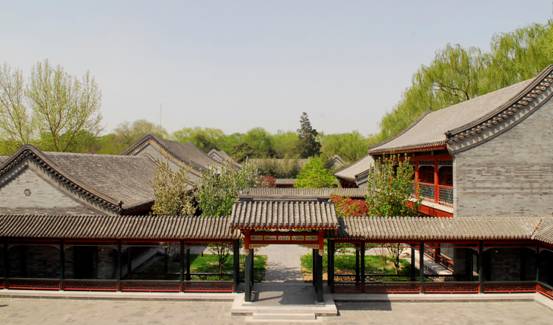
The university campus is on the former site of Qing dynasty imperial gardens and it retains traditional Chinese-style landscaping, including traditional houses, gardens, pagodas, and notable historical buildings and structures. American architect and art historian Talbot Hamlin designed some of the university's buildings constructed during the 1919 to 1922 period. There are several gates that lead into campus — East, West and South gates, with the West Gate being the most well known for the painted murals on its ceiling. Weiming Lake is in the north of the campus and is surrounded by walking paths and small gardens. The university hosts many museums, such as the Museum of University History and the Arthur M. Sackler Museum of Art and Archaeology. Notable items in these museums include funerary objects that were excavated in Beijing and date back thousands of years from the graves of royals of the Warring States period. There are ritual pottery vessels as well as elaborate pieces of jewelry on display. There are also human bones set up in the traditional burial style of that period.
Beyond its main campus, Peking University Health Science Center (PKUHSC) is on Xueyuan Road where the country's most distinguished colleges are, and is a fitting site for academics and research.
During the Third Front construction, Peking University opened a branch in Hanzhong, Shaanxi.
In 2001, Peking University's Shenzhen campus, the Shenzhen Graduate School, opened its doors. The campus is located in the northwest part of Shenzhen City.
File:Winter in Peking University Winter in 2013.jpeg|Peking University during winter. The campus is situated on a former imperial garden. File:北大的秋天.jpg|Peking University during the autumn File:10 Peking University.jpg|The College of Architecture and Landscape File:北京大学,未名湖畔,博雅塔.jpg|Boya Pagoda File:The Lee Shau Kee Humanities Buildings 1.jpg|The Humanities Buildings File:PekingUniversitycampus1.jpg|A stone bridge inside the campus File:Building, Peking University, 2011042204.jpg|A gymnasium building File:Peking University West Gate.jpg|Peking University West Gate File:PekingUniversityPic11.jpg|Peking University's Main Library File:Weiming lake peking university.jpg|Weiming Lake occupies the central part of the campus of Peking University File:北京慈济寺遗址 2021-06-18.jpg|The old site of the Ciji Temple at the Weiming Lake File:PKUsciencebuilding.jpg|Peking University's Science Teaching Building File:School of International Studies, Peking University 20120715.jpg|School of International Studies File:College of Chemistry and Molecular Engineering.jpg|College of Chemistry and Molecular Engineering File:北大的春天.jpg|Peking University during the spring File:北京大學島亭.jpg|The Daoting, a pavilion on the university campus File:School of Archaeology and Museology .jpg|School of Archaeology and Museology File:Arthur M. Sackler Museum, Peking University.JPG|Arthur M. Sackler Museum of Arts and Archaeology File:Department of History .jpg|Department of History File:School of Life Sciences.jpg|School of Life Sciences File:Beijing International Center for Mathematical Research.jpg|Beijing International Center for Mathematical Research File:Department of Chinese Language and Literature.jpg|Department of Chinese Language and Literature
Academics
Peking University consists of 55 schools and departments, with 137 majors for undergraduates, 59 Master's degree programs, and 59 doctoral programs. In addition to basic research, the university also conducts applied research.
At present, Peking University has 420 research institutions, including 7 State Key Laboratories, 5 National Engineering Research Centers, and 1 National Laboratory. With 8 million holdings, the university library is the largest of its kind in Asia.
Peking University, the Georgia Institute of Technology, and Emory University jointly administer the Wallace H. Coulter Department of Biomedical Engineering.
Over the past century, some Peking University alumni have become presidents of other major Chinese universities, including former Tsinghua President Luo Jialun, Renmin University President Yuan Baohua, Zhejiang University President Qian Sanqiang, Fudan University President Zhang Zhirang, Nankai University President Teng Weizao, Chinese University of Science and Technology President Guan Weiyan and many others.
Rankings and reputation
General rankings
Several rankings have placed Peking University among the top universities in mainland China. In 2025, QS Asia University Rankings has put it at the top among all Asian universities.
The 2025 QS Rankings ranked Peking University 14th in the world and first in Asia. As of 2025, the Times Higher Education World University Rankings has ranked Peking University 13th in the world and 2nd in Asia, with its teaching and research environment indicators placing 9th and 6th in the world respectively.
The 2023 QS Rankings ranked Peking University 12th in the world and first in Asia. , the Times Higher Education World University Rankings ranked Peking University 13th in the world, with its teaching and research environment indicators placed at 9th and 7th in the world respectively. Peking University was also ranked 15th in the world and 1st in the Asia-Pacific in The Three University Missions Ranking. The Academic Ranking of World Universities, also known as the "Shanghai Ranking", placed Peking University 23rd in the world and 2nd in the Asia-Pacific. As of 2025, the U.S. News & World Report ranked Peking University 25th in the world, 3rd in the Asia-Pacific and 2nd in China.
In the Times Higher Education Global Employability University Ranking 2025, an annual ranking of university graduates' employability, Peking University was ranked 11th in the world and 2nd in Asia. In 2025, it ranked 11th in world reputation, according to the THE, and 22 of its subjects ranked in the top 1% in the world, according to Essential Science Indicators, which is an analytics database developed by the British-American company Clarivate that identifies top-performing research and emerging trends within the Web of Science Core Collection. It has also been leading the chart of Times Higher Education BRICS & Emerging Economies since its inception in 2014.
Research Performance
The 2024 CWTS Leiden Ranking ranked Peking University at 13th in the world based on their publications for the time period 2019–2022. For the high quality of research in natural science and health science, Peking University ranked 5th among the leading institutions, and 4th among the leading universities globally in the Nature Index 2025 Research Leaders by Nature Research. In 2024, it ranked 7th among the universities around the world by SCImago Institutions Rankings. In November 2024, Clarivate Analytics ranked Peking University 12th in the world for the most Highly Cited Researchers.
Subjects Rankings
| Subject | Global | National | =22 | 1 | 33 | 2 | =42 | 1 | 17 | 2 | 18 | 1 |
|---|---|---|---|---|---|---|---|---|---|---|---|---|
| Linguistics | ||||||||||||
| Archaeology | ||||||||||||
| Architecture and Built Environment | ||||||||||||
| Art and Design | ||||||||||||
| Classics and Ancient History | ||||||||||||
| English Language and Literature | ||||||||||||
| History | ||||||||||||
| Modern Languages | ||||||||||||
| Performing Arts | ||||||||||||
| Philosophy | ||||||||||||
| Engineering – Chemical | ||||||||||||
| Computer Science and Information Systems | ||||||||||||
| Engineering – Electrical and Electronic | ||||||||||||
| Engineering – Mechanical | ||||||||||||
| Agriculture and Forestry | ||||||||||||
| Anatomy and Physiology | ||||||||||||
| Biological Sciences | ||||||||||||
| Dentistry | ||||||||||||
| Medicine | ||||||||||||
| Nursing | ||||||||||||
| Pharmacy and Pharmacology | ||||||||||||
| Psychology | ||||||||||||
| Chemistry | ||||||||||||
| Earth and Marine Sciences | ||||||||||||
| Environmental Sciences | ||||||||||||
| Geography | ||||||||||||
| Geology | ||||||||||||
| Geophysics | ||||||||||||
| Materials Sciences | ||||||||||||
| Mathematics | ||||||||||||
| Physics and Astronomy | ||||||||||||
| Accounting and Finance | ||||||||||||
| Anthropology | ||||||||||||
| Business and Management Studies | ||||||||||||
| Communication and Media Studies | ||||||||||||
| Economics and Econometrics | ||||||||||||
| Education and Training | ||||||||||||
| Law and Legal Studies | ||||||||||||
| Library and Information Management | ||||||||||||
| Politics | ||||||||||||
| Social Policy and Administration | ||||||||||||
| Sociology | ||||||||||||
| Sports–Related Subjects | ||||||||||||
| Statistics and Operational Research |
| Subject | Global | National |
|---|---|---|
| Arts & humanities | ||
| Business & economics | ||
| Clinical & health | ||
| Computer science | ||
| Education | ||
| Engineering | ||
| Life sciences | ||
| Physical sciences | ||
| Psychology | ||
| Social sciences |
| Subject | Global | National | Natural Sciences | Engineering | Life Sciences | Medical Sciences | Social Sciences |
|---|---|---|---|---|---|---|---|
| Mathematics | |||||||
| Physics | |||||||
| Chemistry | |||||||
| Earth Sciences | |||||||
| Geography | |||||||
| Ecology | |||||||
| Atmospheric Science | |||||||
| Electrical & Electronic Engineering | |||||||
| Automation & Control | |||||||
| Telecommunication Engineering | |||||||
| Biomedical Engineering | |||||||
| Computer Science & Engineering | |||||||
| Materials Science & Engineering | |||||||
| Nanoscience & Nanotechnology | |||||||
| Energy Science & Engineering | |||||||
| Environmental Science & Engineering | |||||||
| Water Resources | |||||||
| Biotechnology | |||||||
| Aerospace Engineering | |||||||
| Transportation Science & Technology | |||||||
| Remote Sensing | |||||||
| Metallurgical Engineering | |||||||
| Biological Sciences | |||||||
| Human Biological Sciences | |||||||
| Agricultural Sciences | |||||||
| Clinical Medicine | |||||||
| Public Health | |||||||
| Dentistry & Oral Sciences | |||||||
| Nursing | |||||||
| Medical Technology | |||||||
| Pharmacy & Pharmaceutical Sciences | |||||||
| Economics | |||||||
| Statistics | |||||||
| Political Sciences | |||||||
| Sociology | |||||||
| Education | |||||||
| Psychology | |||||||
| Business Administration | |||||||
| Finance | |||||||
| Management | |||||||
| Public Administration | |||||||
| Library & Information Science |
List of schools
| School for AI Science |
|---|
Library
On 24 October 2018, Peking University Library, the largest library among Asian universities, held the opening ceremony of the 120th anniversary at the Yingjie Overseas Exchange Center.
National School of Development
The National School of Development (formerly China Center for Economic Research) is ranked amongst the top five most influential think tanks in China.
In 1998, Justin Yifu Lin et al. jointly founded the Beijing International MBA at Peking University (BiMBA), which is ranked among the top six MBA programs by Quacquarelli Symonds in its TopMBA ranking of the best MBA programs in Asia Pacific for the year 2014–2015. BiMBA has also been ranked as the second most valuable full-time MBA in China by Forbes (after CEIBS) and among Asia's best business schools by Bloomberg Business.
Shenzhen Graduate School
Main article: Peking University Shenzhen Graduate School

Peking University Shenzhen Graduate School is a satellite campus of Peking University located in Shenzhen, Guangdong. It was founded in September 2001 in collaboration with the Shenzhen Municipal Government and is located in University Town of Shenzhen along with Tsinghua University Shenzhen International Graduate School and Harbin Institute of Technology (Shenzhen) campus. Dr. Wen Hai, a renowned economist in China and the vice-president of Peking University is the present chancellor of PKU Shenzhen. The graduate school houses several research schools including, Peking University HSBC Business School and Peking University School of Transnational Law.
On 29 August 2016, Peking University signed a strategic agreement with the Shenzhen Municipal Government to further develop its Shenzhen Graduate School, the university plans build a brand new campus near the existed graduate school and open undergraduate programs.
International cooperation
Every year, there are approximately 7,000 international students studying at Peking University.
Peking University offers dual degree programs at the bachelor's, master's, and doctoral levels with the renowned Waseda University (早稲田大学) in Northeast Asia. It is one of the most engaged partners with Waseda, having established a strong cooperative relationship of the highest level. This partnership began with an academic agreement in 1982, enhancing dual degree programs and joint research initiatives since 2003. Under the PKU-Waseda project, each year, the university selects undergraduates to spend their third year studying at Waseda University in Japan, and then they return to Peking University for their fourth year. Simultaneously, Waseda University sends numerous students to Peking University as exchange students. Upon graduation, students receive two bachelor's degrees, one from each university. Additionally, joint master's student training programs and dual doctoral degree programs with Waseda University are also in operation. The comprehensive collaboration of offering dual degrees at all bachelor's, master's, and doctoral levels, as seen in the Peking-Waseda partnership, is rare on a global scale.
The dormitories for international students at the main campus are located at Shaoyuan Garden (勺园) and Zhongguanyuan Global Village (中关新园). Its international students are made up of students from most countries in the world including most of Western Europe, North America, and South America, Asia, Australia and many countries in Africa. In 2005, Peking University and Cornell University signed an agreement formally establishing the China and Asia-Pacific Studies major at Cornell, which requires students to spend a semester studying at Peking University while working at internships. In 2006, PKU launched a joint undergraduate program with Yale University in which students will spend a semester overseas, living and studying together with the host institute's students. PKU's School of International Studies also launched joint degree programs with London School of Economics, Paris School of International Affairs, Seoul National University, and the University of Tokyo. PKU also has a longstanding relationship with Stanford University which operates a joint research center and base for Stanford students and scholars at the Stanford Center at Peking University, located in the Lee Jung Sen Building. The Peking University HSBC Business School has joint degree programs with University of Hong Kong and Chinese University of Hong Kong. The university has maintained a partnership with the Freie Universität Berlin since 1981 and the Higher School of Economics since 2015, and in 2019, became a partner of Washington University in St. Louis through the McDonnell International Scholars Academy.
Global excellence strategy
On the 121st founding anniversary, Peking University unveiled the "Global Excellence Strategy", an international blueprint aiming to enhance Peking University's global presence during the "Fourth Industrial Revolution". The "Global Excellence Strategy" aims to strengthen international cooperation, overcome development barriers, gather global resources, and stimulate collegial relationships. The Global Excellence Strategy is based upon the English word "CLOUDS", representing the "cloud era" of the "Fourth Industrial Revolution". Each letter stands for a corresponding word, namely creativity, leadership, openness, uniqueness, diversity and shaping.
Art research
Peking University has participated in many joint art-research projects, such as the Center for the Art of East Asia (CAEA) with the University of Chicago, and Department of Digital Art and Design with UNESCO.
Notable people
Main article: List of Peking University people

Notable alumni
Notable alumni include the current chairman of the Standing Committee of the National People's Congress and the third-ranking member of the CCP Politburo Standing Committee Zhao Leji. Other alumni in politics include former premier of China Li Keqiang, former vice premier of China Hu Chunhua, former minister of Education, Chen Baosheng; current Chief Executive of Macao, Sam Hou Fai; former minister of Natural resources, Wang Guanghua; current Minister of the United Front Work Department, Shi Taifeng, former Governor of the Central Bank of China, Yi Gang, former Interpol-president, Meng Hongwei, and former minister of commerce and Communist Party Secretary of Chongqing, Bo Xilai.
Notable alumni in the sciences include Nobel laureate Tu Youyou, who for her work in discovering artemisinin and dihydroartemisinin used to treat malaria, was awarded the Nobel Prize in Physiology or Medicine jointly with William C. Campbell and Satoshi Ōmura; nuclear physicists and contributors to Chinese nuclear weapons program Qian Sanqiang and Deng Jiaxian, and "father of the Chinese hydrogen bomb" physicist Yu Min, nuclear physicist Zhu Guangya, particle physicist and discoverer of the partial conservation of the axial current, Zhou Guangzhao; mathematician and MacArthur Fellow Yitang Zhang, neurosurgeon Wang Zhongcheng, pulmonologist and recipient of the Medal of the Republic, Zhong Nanshan, and chief economist of the World Bank, Justin Yifu Lin.
Notable alumni in the humanities and arts include author Lu Xun, philosopher and essayist Hu Shih, polymath Lin Yutang, philosopher Liang Shuming, Zhang Shenfu, Qing-dynasty educator Gu Hongming, anthropologist Fei Xiaotong, translator Li Bulou, computer scientist Wang Xuan, and author Jin Yong. Notable international alumni include emeritus professor and linguist Michael Halliday, author Julia Ebner, and philosopher Professor Li Chenyang.
Notable alumni in business include co-founder and CEO of Baidu, billionaire Robin Li, and cryptocurrency entrepreneur Justin Sun.
Other notable alumni include chess grandmaster, four-time Women's World Chess Champion, and Rhodes Scholar Hou Yifan. File:Gu hongming.jpg|Gu Hongming, translator and educator. File:LuXun1930.jpg|Lu Xun, leading figure of modern Chinese literature. File:Hu Shih 1960.jpg|Hu Shih, influential Chinese philosopher and essayist. File:Portrait of Lin Yutang LCCN2004663768.jpg|Lin Yutang, Chinese writer, linguist, inventor, and translator. File:Liang Shuming2.jpg|Liang Shuming, philosopher. File:Deng Jiaxian 1949.jpg|Nuclear physicist and key contributor to the Chinese nuclear weapon program Deng Jiaxian. File:Fei Xiaotong 01.jpg|Fei Xiaotong, sociologist and anthropologist. File:钱三强何泽慧.jpg|Nuclear physicist and leading organizer of the Chinese nuclear weapon program, Qian Sanqiang. File:Li Keqiang-19052015.png|Former Premier of China, Li Keqiang (LLB, PhD) File:Tu Youyou 5056-2015.jpg|Nobel laureate Tu Youyou, pharmaceutical chemist and educator, recipient of the 2015 Nobel Prize in Physiology or Medicine. File:Robin Li at the Web 2.0 Summit 2010 (cropped).jpg|Co-founder and CEO of Baidu, billionaire Robin Li (BSc, Information Management, 1991) File:Hou Yifan (29762728494) (cropped).jpg|Four-time Women's World Chess Champion, Hou Yifan (BA, International Relations, 2018) File:Ding Liren 1, Candidates Tournament 2018.jpg|World Chess Champion and highest-rated Chinese chess player in history, Ding Liren (BA, Law) File:Yitang Zhang.jpg|Mathematician and MacArthur Fellow Yitang Zhang (BA 1982, MA 1984)
Notable academics and staff
Peking University has benefited from the services of notable academics and staff. These include founder of the People's Republic of China Mao Zedong who worked as a library staff at the university, as first claimed in Edward Snow's Red Star Over China. Although Mao audited classes while working at PKU, he was not a formally enrolled student and did not graduate from the university.
The university's second president was educator, politician, and revolutionary Cai Yuanpei, who was the first to bring European university concept to China after a stint at Free University of Berlin and fought for the school to be named "Beijing Daxue". Cai equally protected the freedom of expression of his staff and students, allowing a plethora of influential journals, including New Youth and New Tide. Peking University students participated heavily in the May Fourth Movement, spurned and sometimes also held back by staff from the time.
More recently, the university has been home to influential economist Michael Pettis.
Notes
References
References
- (31 December 2024). "北京大学 2024 年基本数据".
- "About PKU, General Information". Peking University.
- "History Peking University". Peking University.
- Peking University. "From Imperial University of Peking to Peking University in the Early Years of Republic of China".
- (2 May 2011). "[Anniversary Special] "In the beginning was the word"".
- https://www.xsg.pku.edu.cn/century.html
- https://www.pku.edu.cn/detail/905.html
- Goldman, René. (1961). "Peking University Today". The China Quarterly.
- (2022). "Everyday Lives in China's Cold War Military Industrial Complex: Voices from the Shanghai Small Third Front, 1964–1988". [[Palgrave MacMillan]].
- (2015). "The discovery of artemisinin and Nobel Prize in Physiology or Medicine". US National Library of Medicine National Institutes of Health.
- (28 February 2017). "PHBS opening a campus in UK: a turning point for China's higher education". Peking University HSBC Business School.
- (3 December 2021). "Chinese, Russian universities hold virtual meeting on coopereation".
- "中俄数学中心".
- (3 April 2021). "北京大学南昌创新研究院揭牌 刘强邱水平共同揭牌 万广明主持仪式".
- (16 July 2021). "Peking University joins country's wave to create new semiconductor schools".
- Peking University. (29 September 2021). "Lanyuan Centre {{!}} Empowering Women through Educatio".
- "Overview".
- "Academia Related to both China and Software Engineering".
- (2 July 2024). "The Idea of China: Chinese Thinkers on Power, Progress, and People". [[European Council on Foreign Relations]].
- (27 May 2022). ""Healthy" universities honoured by FISU".
- https://baijiahao.baidu.com/s?id=1827440495978327607&wfr=baike
- "Talbot F. Hamlin (1889–1956)".
- "Arthur M. Sackler Museum of Art & Archaeology".
- "A destination to be explored".
- (2022). "Mao and Markets: The Communist Roots of Chinese Enterprise". [[Yale University Press]].
- (December 2018). "北京大学2018年基本数据". 北京大学.
- https://www.pku.edu.cn/research_agency.html
- Harvard News Office. "Harvard Gazette: Summers visits People's Republic of China".
- "Georgia Tech / Emory / Peking University BME PhD Program".
- "Centers, Institutes, & Partners | Emory University | Atlanta GA".
- [http://club.cn.yahoo.com/bbs/threadview/1100055843_2__pn1.html Club Yahoo!] {{dead link. (March 2018)
- (17 June 2025). "2025–2026 Best Global Universities Rankings".
- (5 June 2024). "QS World University Rankings 2025".
- (9 October 2024). "Peking University".
- "QS Asia University Rankings 2025 – Overall".
- "ARWU World University Rankings 2025 – Academic Ranking of World Universities 2025 – Top 1000 universities – Shanghai Ranking – 2025".
- "BRICS 2019".
- (13 February 2024). "World Reputation Rankings 2023".
- (15 October 2021). "THE Emerging University Rankings 2022".
- "Best universities for graduate jobs: Global Employability University Ranking 2025".
- "ARWU World University Rankings 2024 – Academic Ranking of World Universities 2024 – Top 1000 universities – Shanghai Ranking – 2024".
- www.sicas.cn. "University in China.Best Universities in China". sicas.cn.
- "QS World University Rankings 2023: Top Global Universities".
- (2025-10-07). "QS Asia University Rankings 2025 - Overall".
- (2025-10-07). "QS World University Rankings 2026: Top global universities".
- (2025-10-07). "QS Asia University Rankings 2025 - Overall".
- "World University Rankings 2026".
- "Peking University".
- (4 October 2024). "World University Rankings".
- "俄2020年国际大学排名出炉!中国122所高校入围,仅次于美国排名第二".
- "ShanghaiRanking's Academic Ranking of World Universities".
- "Peking University".
- (2024-11-14). "Best universities for graduate jobs: Global Employability University Ranking 2025".
- (2025-02-04). "World Reputation Rankings".
- Studies (CWTS), Centre for Science and Technology. "CWTS Leiden Ranking".
- "2025 Research Leaders: Leading institutions {{!}} Nature Index".
- "University Rankings 2024".
- (13 November 2024). "Highly Cited Researchers – Analysis – 2024 {{!}} Clarivate".
- "QS World University Rankings by Subject 2024".
- "World University Rankings by subject".
- "ShanghaiRanking's Global Ranking of Academic Subjects 2023".
- "北京大学信息科学技术学院".
- "北京大学计算机科学技术研究所".
- "Department of Philosophy and Religious Studies, Peking University".
- "Peking University International Hospital, Beijing".
- "[120th Anniversary of PKU Library] PKU Library celebrates her 120th anniversary".
- "China Network– Peking University's National School of Development: The Brains behind China's growth".
- "National School of Development ranks in top five Think Tanks for Highest Professional Influence_Peking University".
- "The Top 10 Business Schools in Asia-Pacific 2014/15". TopMBA.com.
- (26 April 2010). "China's Best Business Schools". Forbes.
- "Asia's Top Business Schools". Businessweek.com.
- (6 December 2005). "Keeping the Bar High at BiMBA". Businessweek.com.
- "Peking University Shenzhen Graduate School – Peking University Shenzhen Graduate School".
- "Schools – Peking University Shenzhen Graduate School".
- "北京大学将建深圳校区 拓展本科和医学教育".
- "北京大学简介". PKU Office of International Relations.
- "日本早稻田大学校长受聘北大名誉教授-中国教育".
- "北京大学-早稻田大学-康师傅控股有限公司三方合作签约仪式在北大举行-北京大学教育基金会".
- "2023–2024年第二期北大-早大合作研究交流会在我院成功举办".
- "Waseda and Peking University jointly publish a book on international studies in Asia-Pacific".
- "Rawlings heads to China to sign partnership agreement and deliver keynote address at economic summit in Beijing – Cornell Chronicle".
- "Launching China and Asia-Pacific Studies, a 'revolutionary' new undergraduate major – Cornell Chronicle".
- "China and Asia-Pacific Studies".
- "Peking University – Yale University Joint Undergraduate Program in Beijing – Yale College".
- "People's Daily Online – Yale, Beida students live and study together".
- (26 May 2014). "Dual Degree – Peking University – Sciences Po PSIA".
- "FSI | SCPKU – SCPKU Home Page".
- "Peking University".
- "McDonnell International Scholars Academy".
- (18 June 2019). "Peking University unveils "Global Excellence Strategy"". PKU News.
- "Center for the Art of East Asia". [[University of Chicago]].
- [https://web.archive.org/web/20081208222334/http://portal.unesco.org/culture/fr/ev.php-URL_ID%3D24317%26URL_DO%3DDO_PRINTPAGE%26URL_SECTION%3D201.html Culture: Peking University, Department of Digital Art and Design] [[UNESCO]].
- "Peking University, Department of Digital Art and Design".
- (2017). "Hu Chunhua – Member of Political Bureau of CPC Central Committee".
- FlorCruz, Jaime. (8 August 2012). "China's Bo Xilai: From rising star to scandal".
- Wong, Edward. (10 January 2014). "New Detail Emerges About Bo Xilai's Downfall".
- "The Nobel Prize in Physiology or Medicine 2015: Tu Youyou".
- (2 October 2014). "Yitang Zhang's Spectacular Mathematical Journey – Ideas {{!}} Institute for Advanced Study".
- Colville, Alex. (22 June 2020). "Zhong Nanshan, the doctor who led China through COVID-19 and SARS".
- (22 September 2017). "Justin Yifu Lin".
- "Hu Shih {{!}} Chinese leader and scholar".
- Kao, Ernest. (2013). "Martial arts novelist Louis Cha earns doctorate from Peking University, say reports".
- (16 May 2018). "Linguist who changed the way languages are taught".
- "Julia Ebner".
- "Chenyang Li {{!}} Nanyang Technological University - Academia.edu".
- "Robin Li, Co-Founder, Chairman and CEO, Baidu".
- (24 July 2019). "Warren Buffett's 28-Year-Old Power Lunch Guest Is a Fraud, Say Those Close to Him".
- "Yifan Hou – Rhodes Trust".
- "Mao Zedong {{!}} Peking University Library".
- "Cai Yuanpei {{!}} Chinese educator".
This article was imported from Wikipedia and is available under the Creative Commons Attribution-ShareAlike 4.0 License. Content has been adapted to SurfDoc format. Original contributors can be found on the article history page.
Ask Mako anything about Peking University — get instant answers, deeper analysis, and related topics.
Research with MakoFree with your Surf account
Create a free account to save articles, ask Mako questions, and organize your research.
Sign up freeThis content may have been generated or modified by AI. CloudSurf Software LLC is not responsible for the accuracy, completeness, or reliability of AI-generated content. Always verify important information from primary sources.
Report