From Surf Wiki (app.surf) — the open knowledge base
Pegasus 3
American satellite
American satellite
| Field | Value |
|---|---|
| name | Pegasus 3 |
| image | Pegasus satellite.jpg |
| image_caption | A Pegasus satellite in orbit |
| operator | NASA |
| COSPAR_ID | 1965-060A |
| mission_duration | 1 year (design) |
| 3 years (achieved) | |
| spacecraft_type | Pegasus |
| manufacturer | Fairchild Hiller |
| launch_mass | 10323 kg |
| payload_mass | 1450 kg |
| launch_date | UTC |
| launch_rocket | Saturn I SA-10 |
| launch_site | Cape Canaveral LC-37B |
| disposal_type | Decommissioned |
| deactivated | |
| decay_date | 4 August 1969 |
| orbit_epoch | 3 September 1965 |
| orbit_reference | Geocentric |
| orbit_regime | Low Earth |
| orbit_periapsis | 516 km |
| orbit_apoapsis | 536 km |
| orbit_inclination | 28.8 degrees |
| orbit_period | 95.15 minutes |
| apsis | gee |
| programme | Apollo micrometeoroid investigation |
| previous_mission | Pegasus 2 |
3 years (achieved)
Pegasus 3 or III, also known as Pegasus C before launch, was an American satellite which was launched in 1965 to study micrometeoroid impacts in Low Earth orbit. It was the last of three Pegasus satellites to be launched, the previous two having been launched earlier the same year. It was manufactured by Fairchild Hiller, and operated by NASA.
Spacecraft
Pegasus 3 was a Pegasus spacecraft, consisting of 1450 kg of instruments, attached to the S-IV upper stage of the carrier rocket which had placed it into orbit. It had a total mass of 10323 kg, and was equipped with two sets of micrometeoroid detection panels, and a radio for tracking and returning data. The panels were 29 m long, and equipped with 116 individual detectors.
Launch
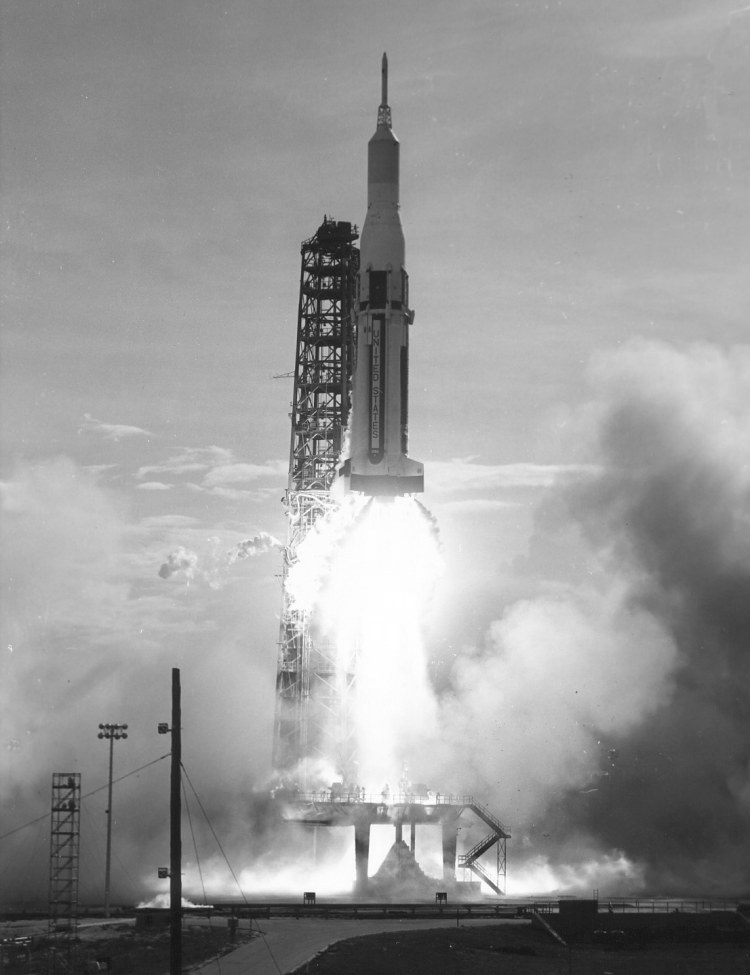
Pegasus 3 was launched atop a Saturn I rocket, serial number SA-10, flying from Launch Complex 37B at the Cape Kennedy Air Force Station. The launch occurred at 13:00:00 UTC on 30 July 1965. Following launch, Pegasus 3 was given the COSPAR designation 1965-060A, whilst NORAD assigned it the Satellite Catalog Number 01467.
Pegasus 3 was a secondary payload on the carrier rocket, which was carrying a boilerplate Apollo spacecraft, Apollo 105 or BP-9A, as part of a series of configuration tests for the Apollo program. The Apollo boilerplate acted as a payload fairing for the Pegasus spacecraft, which was stored inside what would have been the Service Module of a functional spacecraft. Upon reaching orbit, the boilerplate Command and Service modules were jettisoned.
Operations
Pegasus 3 was operated in a low Earth orbit. On 3 September 1965 it was catalogued as being in an orbit with a perigee of 516 km and an apogee of 536 km, inclined at 51.6 degrees to the equator and with a period of 95.15 minutes. Once in orbit, the panels were deployed to detect micrometeoroid impacts. Experiment results were returned to Earth by radio. The spacecraft operated until 29 August 1968, and subsequently remained in orbit until it decayed and reentered the atmosphere on 4 August 1969. It had originally only been expected to operate for 720 days.
References
References
- Krebs, Gunter. "Pegasus 1, 2, 3". Gunter's Space Page.
- "World Civil Satellites 1957-2006". Space Security Index.
- Wade, Mark. "Pegasus".
- McDowell, Jonathan. "Launch List". Jonathan's Space Page.
- McDowell, Jonathan. "Launch Log". Jonathan's Space Page.
- "Pegasus 3". US National Space Science Data Center.
- McDowell, Jonathan. "Satellite Catalog". Jonathan's Space Page.
This article was imported from Wikipedia and is available under the Creative Commons Attribution-ShareAlike 4.0 License. Content has been adapted to SurfDoc format. Original contributors can be found on the article history page.
Ask Mako anything about Pegasus 3 — get instant answers, deeper analysis, and related topics.
Research with MakoFree with your Surf account
Create a free account to save articles, ask Mako questions, and organize your research.
Sign up freeThis content may have been generated or modified by AI. CloudSurf Software LLC is not responsible for the accuracy, completeness, or reliability of AI-generated content. Always verify important information from primary sources.
Report