From Surf Wiki (app.surf) — the open knowledge base
Peganum harmala
Plant species in the family
Plant species in the family
| P. harmala var. grandifiorum | | P. harmala var. harmala | | P. harmala var. stenophyllum | | Harmala multifida | All. | Harmala peganum | Crantz | Harmala syriaca | Bubani | Mesembryanthemum caspicum | S.G.Gmel. | Peganon harmalum | (L.) St.-Lag. | Peganum dauricum | Pall. | Peganum harmala var. garamantum | Maire | Peganum harmala var. rothschildianum | (Buxb.) Maire | Peganum rothschildianum | Buxb.
Peganum harmala, commonly called wild rue, Syrian rue, or harmel (among other similar pronunciations and spellings), is a perennial, herbaceous plant, with a woody underground rootstock, of the family Nitrariaceae, usually growing in saline soils in temperate desert and Mediterranean regions. Its common English-language name came about because of a resemblance to rue (to which it is not related). Its seeds contain a high concentration (at least 5.9% by weight) of diverse beta-carboline alkaloids.
It has deep roots and a strong smell, finely divided leaves, white flowers rich in alkaloids, and small seed capsules containing numerous dark, oily seeds. It is native to a vast region across North Africa, southern and eastern Europe, the Middle East, Central Asia, and parts of South and East Asia, and has been introduced to countries like South Africa, Mexico, France. It grows in dry, often saline or disturbed habitats, thriving from sea level to high elevations, is pollinated mainly by insects (especially honey bees), disperses seeds mostly by dispersal vectors or human activity, and hosts a specialized beetle (Thamnurgus pegani) proposed for its biological control.
Some scholars have associated it with the sacred plant called soma or haoma in ancient Indo-Iranian texts and it has been described under various names by classical and medieval sources, with archaeological evidence suggesting its ritual use dating back to at least the 2nd century BCE. It was first described and illustrated in the 16th century by Rembert Dodoens and later classified by botanists such as Gaspard Bauhin and Carl Linnaeus. It has several recognized varieties distinguished by morphological traits and geographic distribution, with lectotype designations refined over time to clarify its taxonomy.
In the United States, it is banned or regulated as a noxious weed in several states requiring eradication, while internationally, possession and sale of the plant or its psychoactive alkaloids are illegal or controlled in several countries, including France, Finland, Canada, and Australia. It is used as a dye, incense, and in traditional medicine. It is also toxic to livestock and difficult to eradicate.
Etymology
Rue for the perennial evergreen shrub was first used in 14th century English, deriving from Old French rue (13c.) and the Latin ruta.
Espand is derived from Middle Persian pal, which is thought, along with the English word spinach, to be ultimately derived from Proto-Iranian ***spanta-, 'holy' (compare Avestan , spəṇta, 'holy', and Middle Persian pal, 'holy'), itself thought to be ultimately derived from Proto-Indo-European ***ḱwen-.
Common names
It is known by many names across regions and languages—including "African rue" in North America, "harmel" in India and North Africa, "espand" in Persian, and other local names in Pashto, Urdu, Turkish, Chinese, Spanish, French, and ancient Aramaic, reflecting its wide cultural and geographic significance.
It is known as اسپند in Persian, which is transliterated as fa, but may also be pronounced or transliterated as fa, fa, fa, fa, fa, fa, or fa depending on source or dialect. The Persian word اسپند is also the name of the last month of the year, approximately March, in the traditional Persian calendar.
African rue is a common name.
Harmel is a name used in India, and Morocco.
It is known as ps in Pashto. In Urdu it is known as ur, ur, or ur. In Turkish it is known as üzerlik. In Chinese it is 驼驼蒿, zh, or 骆驼蓬, zh.
In Spain, it is called hármala, alharma or gamarza, In French, it is known as harmal.
In classical antiquity, it was known in Aramaic as šabbārā (, ). In later Eastern Aramaic languages, it was also borrowed from the Middle Persian as spendā.
Description
Habitus
It is a perennial, herbaceous, suffrutescent, hemicryptophyte plant, which dies off in the winter, but regrows from the rootstock the following spring. It can grow to about 0.8 m tall, but normally it is about 0.3 m tall. The entire plant is hairless (glabrous). Plants are bad tasting and smell foul when crushed.
Stems
Numerous erect to spreading stems grow from the crown of the root-stock in the spring, these branch in a corymbose fashion.
Roots
The roots of the plant can reach a depth of up to 6.1 m, if the soil where it is growing is very dry. The roots can grow to 2 cm thick.
Leaves
The leaves are alternate, sessile, and have bristly, 1.5-2.5 mm long stipules at the base. The leaf blade is dissected/forked twice or more into three to five thin, linear to lanceolate-linear, greyish lobes. The forks are irregular. The lobes have smooth margins, are 3-5 cm long and 1-5 mm broad, and end in points.

Flowers
It blooms with solitary flowers between April and October in Pakistan, The flowers are white or yellowish white, and has 3 locules and ends in an 8-10mm long style, the ending 6mm of which are triangular or 3-keeled in cross-section. The ovary is surrounded by a nectary which is glabrous and has five lobes in a regular pattern.
The flowers produce only a tiny amount of nectar. The nectar is rich in hexose sugars. It contains a relatively small concentration of amino acids among which there is an especially high amount of the glutamic acid, tyrosine and proline, the last of which can be tasted by, and is favoured by, many insects. It also contains (four) alkaloids, in relatively high concentration compared to the flowers of other species, among them the toxins harmalol and harmine. The proportions and concentrations of the alkaloids in the nectar are different than in the other organs of the plant, indicating an adaptive reason for their presence.
Pollen
P. harmala has smallish, tricolpate pollen grains with a rugulate-reticulate surface. The exine has a sexine which is thicker than the nexine. These grains are well distinguishable from pollen of related plants (Nitraria) in Pakistan.
.jpg)
Fruit
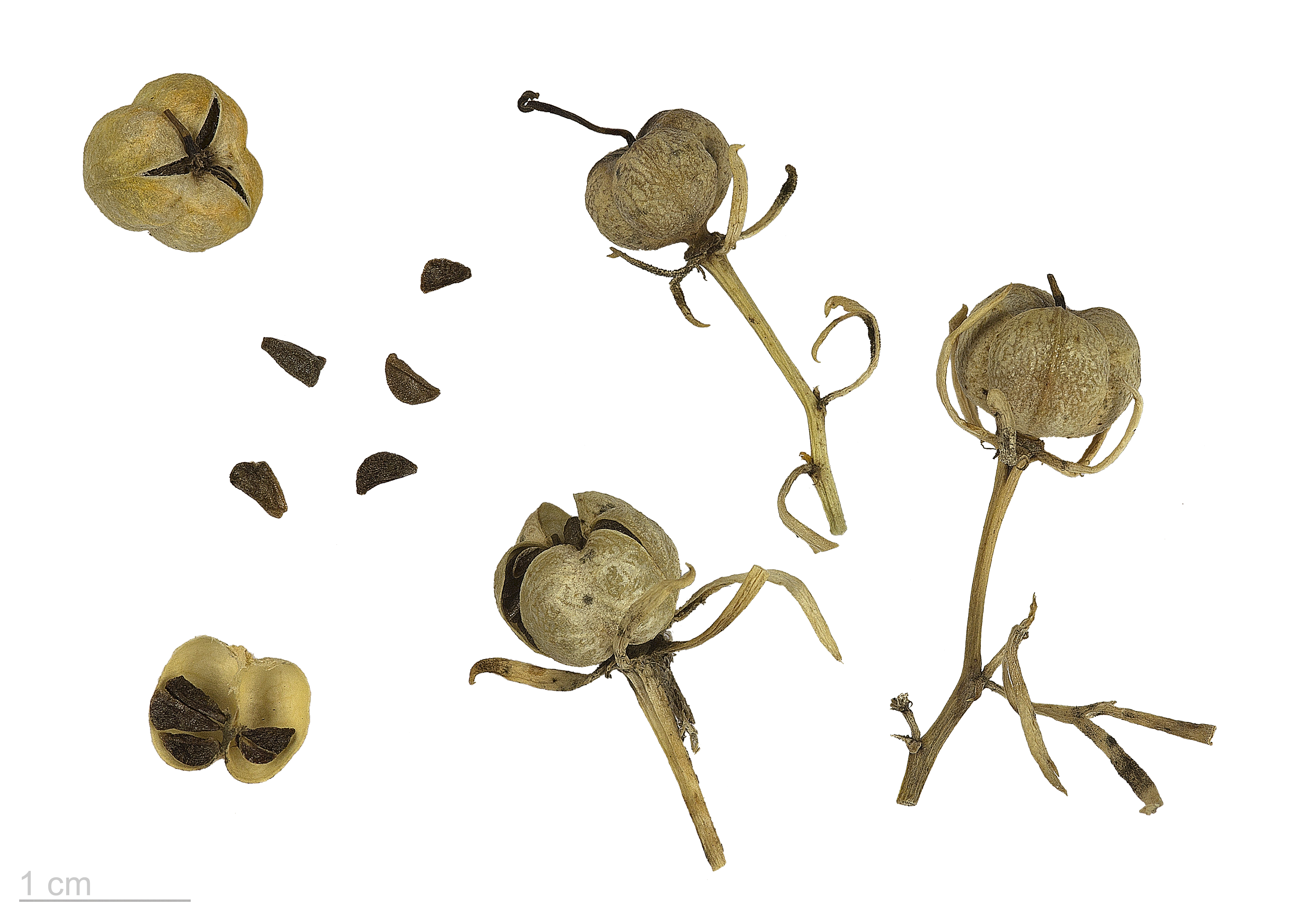
The plant fruits between July and November in China. which measures about 6–10(−15) mm in diameter, These seed capsules have three chambers and carry more than 50 seeds. The end of the fruit is usually somewhat sunken inwards and retains a persistent style.

Seeds
The seeds are colored dark brown to blackish-brown, slightly curved, triangular, about 2 mm long with an irregular surface. The endosperm is oily.
Cytology
The cells have 24 chromosomes (2n), although sometimes 22 have been found.
Distribution
Native
Peganum harmala is native to a wide area stretching from Morocco in north Africa and Spain and Italy in Europe, north to Serbia, Romania (possibly), Dagestan, Kazakhstan, south to Mauritania (possibly), Yemen, Saudi Arabia, Kuwait and Pakistan In Zhob district, and east to western Mongolia, northern China and possibly Bangladesh. parts of Israel, eastern and central Anatolia (Turkey), and Morocco.
In Africa it is known from Morocco, Algeria, Tunisia, Libya, and Egypt. It likely does not occur in Mauritania. In Morocco it is quite common and occurs throughout the country, excepting Western Sahara. In Libya it is found in the maritime zone, especially around Bengazi, and is not abundant. In Egypt it grows in the Sinai, and been rarely collected on the mid-west of the Mediterranean coast.
In Europe it is native to Spain, Corsica (disputed), much of Russia, Serbia, Moldova, Ukraine (especially in Crimea), Romania (possibly introduced), Bulgaria, Greece (including Crete and the Cyclades), Cyprus, Turkey (Thrace) and southern Italy (including Sardinia, but not Sicily). It also is native to the Caucasus: Armenia, Azerbaijan, and Georgia.
In Turkey it is found both in Thrace and across most of Anatolia, but is absent from the northern Black Sea coast. It is abundant in some regions of south and central Anatolia.
In Israel it is most commonly found around the Dead Sea, in the Judean mountains and desert, in the Negev and its surrounding areas, including areas in Jordan and Saudi Arabia, being rare or very rare in the northern mountains, Galilee, coastal areas and the Arava valley.
It grows in drier parts of the northern half of India but is possibly only native to the Kashmir and Ladakh regions.
The distribution in China is in dispute. The 2008 Flora of China considers it to be native to northern China in the provinces of Gansu, western Hebei, western Inner Mongolia, Ningxia, Qinghai, northern Shanxi, Tibet and Xinjiang. The 2017 Species Catalogue of China considers it to be restricted to Inner Mongolia, Ningxia and Gansu.
Adventive distribution
It has been added to the lists of the Global Register of Introduced and Invasive Species for the countries of South Africa, Mexico, France and Ukraine, although it is not reported as having a negative impact in any of these countries. One database has it occurring as a non-native in Hungary.
In France it is considered a former accidental introduction once uncommonly found on the Côte d'Azur along the Mediterranean coast. It has very rarely been found elsewhere in France in the past. According to the Flora Europaea there is a native population on Corsica, however, according to Tela Botanica it does not occur on the island, either as a native or not.
It was first planted in the United States in 1928 in New Mexico by a farmer wanting to manufacture a dye called "Turkish red" from its seeds. "Because it is so drought tolerant, African rue can displace the native saltbushes and grasses growing in the salt-desert shrub lands of the Western U.S."
Although the distribution in New Mexico and Texas would suggest it has spread to parts of northern Mexico,
Habitat and ecology
It grows in dry areas in the United States. It can be considered a halophyte.
In Kashmir and Ladakh it is known from elevations of 300–2400 metres (1000' to 7900'), in China 400–3600 metres (1300' to 12,000'), in Turkey 0–1500 metres (0' to 5000'), and in Spain 0–1200 metres (0' to 4000').
In China it grows in slightly saline sands near oases and dry grasslands in desert areas.
In Spain it can be found in abandoned fields, rubbish tips, stony slopes, along the verges of roads, ploughed and worked earth, as well as in disturbed, saline scrubland.
In Morocco it is said to grow in steppes, arid coasts, dry uncultivated fields and amongst ruins. In Israel it is a common dominant plant along with Anabasis syriaca and Haloxylon scoparium in a low semi-shrubby steppe ecosystem which during dry years is almost devoid of plant cover, growing on saline, loess-derived soils. In rainy times Leontice leontopetalum and Ixiolirion tataricum appear here. It also grows in Israel in semi-steppe shrublands, Mediterranean woodlands and shrublands, and deserts. It is often found with Euphorbia virgata in the foothills of Mount Ararat, Iğdır Province, Turkey.
The flowers are pollinated by insects. The floral morphology, nectar amount and composition – high in hexane sugars, presence of toxic alkaloids and high proline content together suggest pollination by short-tongued bees (see pollination syndrome).
Regarding seed dispersal it is considered a barochore.
A species of tiny, hairy beetle, Thamnurgus pegani, has been found inhabiting stems of P. harmala in Turkey and elsewhere. It feeds only on P. harmala. When the aerial parts of the plant begin to die off in the autumn, the adult beetles retreat to overwinter in the soil underneath the root-crown, or in old larval tunnels in the dead stems; emerging in the spring (May in Turkey), the females bore small holes in the now shooting stems of the plant, in which they lay their eggs. The hatched larvae bore inward toward the pith. The beetles somehow infect the surrounding tissue in the tunnels with a fungus, Fusarium oxysporum. The infected plant tissue turns blackish and is then used by the adult beetles and their larvae as a food source, until they are ready to pupate within the stem tunnels. It has been proposed as a candidate for using in biological control of P. harmala, as a relative of it, T. euphorbiae, has been approved for use against invasive Euphorbia in the United States.
History
Main article: Botanical identity of soma–haoma
As the plant is popular in Persian cultural traditions, and is a hallucinogen, the linguists David Flattery and Martin Schwartz wrote a book in 1989 in which they theorised that the plant is the Avestan haoma mentioned in Zoroastrianism. The transcribed word haoma is thought to be likely related to the Vedic word soma; these names refer to a magical, purportedly entheogenic plant/drink that is mentioned in ancient Indo-Iranian texts but whose exact identity has been lost to history.
This plant was first described in a recognisable manner under the name πήγανον ἄγριον (grc) by Dioscorides, who mentions it is called μῶλυ (moly) in parts of Anatolia (although Dioscorides distinguishes the 'real' μῶλυ as another, bulbaceous plant). Galen later describes the plant under the name μῶλυ, following Dioscorides by mentioning numerous other names it was known by: ἄρμολα, armola (harmala), πήγανον ἄγριον and in Syria βησασᾶ, besasa (besasa). For much of the subsequent history of Europe Galen was seen as the pinnacle of human medical knowledge. As such, during the early Middle Ages, the herb was known as moly or herba immolum.
The 12th century Arab agriculturist Ibn al-'Awwam from Seville, Spain, wrote that the seeds were used in the baking of bread; the fumes being used to facilitate fermentation and help with the taste (he usually quotes older authors).
By the mid-16th century, Dodoens relates how apothecaries sold the plant under the name harmel as a type of extra-strength rue.
Traces of Peganum harmala, and Nymphaea nouchali var. caerulea were identified in an Egyptian ritual Bes-vase, of the 2nd century BCE.
Taxonomy
Rembert Dodoens in 1553, illustrated and described the plant (republished 1583 with better illustration, calling it Harmala, and basing his work on Galen and Dioscorides).
In 1596, Gaspard Bauhin had his Phytopinax published in which he attempted to list all plants known in an ordered manner. He judges Ruta sylvestris Dioscorides to be a type of Hypericum. Later, in his Pinax Theatri Botanici of 1623, he attempts to sort the synonymy in all the previously published names by the botanists from earlier in history. In this work, he sorts Ruta into five species, distinguishing this plant from the others by its three-locular fruit, large white flowers and being only known as a wild plant (as opposed to cultivated). He considers his 'Ruta sylvestris flore magno albo' (=Peganum harmala) to be (not all writers named in the following): Tabernaemontanus', Dodoens' and Clusius' Harmala; Matthias de l'Obel's Harmala syriaca; Andreas Cæsalpinus' and Conrad Gesner's (in his report on Ottoman plants) Harmel; Pietro Andrea Mattioli's and Clusius' (in another work) Ruta sylvestris Harmala; Valerius Cordus' (in his Annotations on Dioscorides), Gesner's (in his Hortus), and Aloysius Anguillara's Ruta sylvestris; and Castore Durante's and Joachim Camerarius the Younger's Ruta sylvestris secunda.
In 1753, Carl Linnaeus named the species Peganum harmala. He cites this species as based on Bauhin's Pinax Theatri Botanici of 1623, and Stirpium Historiae Pemptades Sex of 1583 by Rembert Dodoens.
Type
In 1954, Brian Laurence Burtt and Patricia Lewis designated 'Cult. in Horto Upsaliensi (Linn!)' as the lectotype for the species. This lectotype appeared to be two sheets (621.1 and 621.2) in the Linnean Herbarium, not being part of a single gathering, and hence ICBN Art. 9.15 (Vienna Code) did not apply. In 1993, Mohammed Nabil El Hadidi designated 'Clifford Herbarium 206, Peganum no. 1', stored at the British Museum of Natural History, as the lectotype for P. harmala.
Infraspecific variability
Peganum harmala var. garamantum – P. harmala var. garamantum was originally described by René Maire in 1953 in his Flore de l'Afrique du Nord. It was still recognised as occurring in Tunisia as of 2010 (along with var. typicum), although the distinction is not recognised in other works.
Peganum harmala var. grandiflorum – El Hadidi described P. harmala var. grandiflorum in 1972 for the Flora Iranica based on herbarium material collected by H. Bobek in Tal Shahdad in Kerman Province, Iran in 1956, and said the variety grew in both Iran and Afghanistan. It was subsequently collected only once more, at least as recorded in the GBIF, in 1980 in Spain near the bank of the Ebro river approximately halfway downriver to the sea from Zaragosa. It is not mentioned in the Flora Iberica.
Peganum harmala var. multisecta – First described by Karl Maximovich in 1889 from Qinghai. Sometimes incorrectly spelled var. multisectum. Occurs in Dzungaria, Hexi, Qaidam Basin, Ordos and the Altai regions in China and Mongolia. Others consider it a synonym of the nominate form.
Peganum harmala var. rothschildianum – Originally described by cactus specialist Franz Buxbaum in 1927 as P. rothschildianum from northern Africa. Subsumed as a variety by René Maire in 1953. Not recognised for Tunisia, nor elsewhere.
Peganum harmala var. stenophyllum – This variety is still accepted by some authorities, although it is not recognised in the Flora of Pakistan. Iraq, Afghanistan, Pakistan, India, Tajikistan, and the northern Caucasus. In India it is found in Kashmir, Punjab, Haryana, Rajasthan, Uttar Pradesh, Gujarat, Maharashtra and Karnataka. It can be distinguished from the nominate form by having finer leaves with more narrow lobes, shorter sepals and broader-shaped seed capsules.
Legal issues
In the United States, it is considered an invasive, noxious weed in the following states: Arizona (prohibited noxious weed), California (A listed noxious weed), Colorado (A listed noxious weed), Nevada (noxious weed), New Mexico (class B noxious weed), and Oregon (A designated weed, under quarantine). This may require land owners to exterminate infestations on their land or be fined, and allows access to government grants to buy herbicides to do so. It is illegal to sell plants of this species in the states listed above. Since 2005, with caveats, the cultivation, possession or sale of this species is also illegal in Louisiana.
Since 2005, the possession of the seeds, the plant itself, and the alkaloids harmine and harmaline, which it contains, is illegal in France. In Finland, the plant is officially listed as a medicinal plant, which means one would require a doctors prescription to acquire it. In Canada, harmaline is illegal. In Australia, harmala alkaloids are illegal.
Uses
Weed and livestock poisoning
In some regions, it is a common weed. Infestations can be invasive and very difficult to exterminate. Leaves and seeds are considered poisonous due to the β-carbolines such as: harmalol, harman harmaline, harmine, and quinazoline derivatives they contain. Side effects after ingestion can manifest themselves as hallucinations, neurosensory syndromes, bradycardia, nausea, vomiting.
Control is possible only with powerful herbicides. Manually uprooting the plants is near impossible and there are no methods of biological control currently awaiting approval. The rootstock contains starches that help the plant survive being defoliated and is thick and grows very deep, and the crown of the plant is safe below the surface.
Dyes
A red dye, "Turkey red", from the seeds (but usually obtained from madder) is often used in western Asia to dye carpets. It is also used to dye wool. When the seeds are extracted with water, a yellow fluorescent dye is obtained. If they are extracted with alcohol, a red dye is obtained. According to one source, for a time the traditional Ottoman fez was dyed with the extract from this plant.
Traditional medicine and superstitions
In Iran and neighbouring countries such as Turkey and Azerbaijan, dried capsules from the plant are strung and hung in homes or vehicles to protect against the evil eye. It is widely used for protection against Djinn in Morocco (see Légey "Essai de Folklore marocain", 1926).
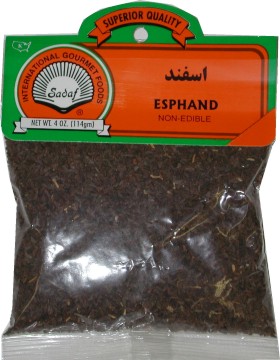
Esfand (called isband in Kashmiri) is traditionally burnt in Kashmiri weddings to create an auspicious atmosphere. It is also used on other ceremonial and festive occasions, as well as in households, for its fragrant smoke and to ward off negative energies.
Burning esfand seeds is also common in Persian cultures for warding off the evil eye, as in Persian weddings.

In Yemen, the Jewish custom of old was to bleach wheaten flour on Passover, in order to produce a clean and white unleavened bread. This was done by spreading whole wheat kernels upon a floor, and then spreading stratified layers of African rue (Peganum harmala) leaves upon the wheat kernels; a layer of wheat followed by a layer of Wild rue, which process was repeated until all wheat had been covered over with the astringent leaves of this plant. The wheat was left in this state for a few days, until the outer kernels of the wheat were bleached by the astringent vapors emitted by the wild rue. Afterwards, the wheat was taken up and sifted, to rid them of the residue of leaves. They were then ground into flour, which left a clean and white batch of flour.

Peganum harmala has been used as an analgesic, emmenagogue, and abortifacient agent.
In a certain region of India, the root was applied to kill body lice.
It is also used as an anthelmintic (to expel parasitic worms). Reportedly, the ancient Greeks used the powdered seeds to get rid of tapeworms and to treat recurring fevers (possibly malaria).
As related in Des Cruydboeks of 1554 by Rembert Dodoens, in Europe, this plant was considered to be a wild type of rue and identical in medicinal uses -the identity of the two plants and their Ancient Greek and Roman uses had merged, though it was considered stronger, even dangerously so. It could be bought under the name harmel in the apothecaries, and was also known as 'wild' or 'mountain' rue. It could be used for a few dozen ailments, such as to treat woman of their natural disease when the leaves were used in only water, or when the juice were drunk with wine and the leaves pressed against the wound it could cure bites and stings from rabid dogs, scorpions, bees and wasps and the like. From supposedly Pliny, he relates how those covered in the sap, or having eaten it sober, would be immune to poison for a day, as well as to poisonous beasts. Other cures were for 'drying' sperm, 'purifying' woman after childbirth, curing earache, getting rid of spots and blemishes on the skin, and soothing bumps and pain caused by hitting something, among many others. All the cures call for either juice or the leaves; none call for the seeds.
Entheogenic use
Peganum harmala seeds have been used as a substitute for Banisteriopsis caapi in ayahuasca analogs, as they contain monoamine oxidase inhibitors that enable DMT to be orally active. It has also been used in Changa, a DMT-infused smoking blend.
Alkaloids
Seed alkaloids
Total harmala alkaloids were at least 5.9% of dried weight, in one study.
| Beta-carboline | Content | 1-hydroxy-7-methoxy-β-carboline | 2-aldehyde-tetrahydroharmine | 3-hydroxylated harmine | 6-methoxytetrahydro-1-norharmanone | 8-hydroxy-harmine | Acetylnorharmine | Desoxypeganine | Dihydroruine | Dipegene | Harmalacidine (HMC) | Harmalacinine | Harmalanine | Harmalicine | Harmalidine | Harmaline (dihydroharmine, DHH, harmidine) | Harmalol | Harmane (harman) | Harmic acid | Harmic acid methyl ester | Harmine (banisterine, telepathinec, yageine) | Harmine N-oxide | Harmol | Isoharmine | Isopeganine | Norharman | Norharmine (tetrahydro-beta-carboline) | Pegaharmine A | Pegaharmine B | Pegaharmine C | Pegaharmine D | Pegaharmine E | Pegaharmine F | Pegaharmine G | Pegaharmine H | Pegaharmine I | Pegaharmine J | Pegaharmine K | Peganine A | Peganine B | Peganumal A | Peganumal B | Peganumine A | Peganumine B | Ruine | Tetrahydroharman | Tetrahydroharmine (THH, leptaflorine) | Tetrahydroharmol | Tetrahydronorharman | |||||||||
|---|---|---|---|---|---|---|---|---|---|---|---|---|---|---|---|---|---|---|---|---|---|---|---|---|---|---|---|---|---|---|---|---|---|---|---|---|---|---|---|---|---|---|---|---|---|---|---|---|---|---|---|---|---|---|---|---|---|---|
| 0.25%–0.79%–5.6% | ||||||||||||||||||||||||||||||||||||||||||||||||||||||||||
| 0.6%–3.90% | ||||||||||||||||||||||||||||||||||||||||||||||||||||||||||
| vauthors=Hemmateenejad B, Abbaspour A, Maghami H, Miri R, Panjehshahin MR | title=Partial least squares-based multivariate spectral calibration method for simultaneous determination of beta-carboline derivatives in Peganum harmala seed extracts | journal=Anal. Chim. Acta | volume=575 | issue=2 | pages=290–9 | date=August 2006 | pmid=17723604 | doi=10.1016/j.aca.2006.05.093 | bibcode=2006AcAC..575..290H }} | |||||||||||||||||||||||||||||||||||||||||||||||||
| vauthors=Pulpati H, Biradar YS, Rajani M | title=High-performance thin-layer chromatography densitometric method for the quantification of harmine, harmaline, vasicine, and vasicinone in Peganum harmala | journal=J AOAC Int | volume=91 | issue=5 | pages=1179–85 | year=2008 | doi=10.1093/jaoac/91.5.1179 | pmid=18980138 | doi-access=free}}–1.84% | |||||||||||||||||||||||||||||||||||||||||||||||||
| The coatings of the seeds are said to contain large amounts of harmine. | ||||||||||||||||||||||||||||||||||||||||||||||||||||||||||
| 0.1% |
References
References
- "''Peganum harmala'' L.".
- "''Peganum harmala'' var. ''harmala''".
- {{GRIN
- '''African rue''', '''esfand''' or '''espand''',Mahmoud Omidsalar [http://www.iranicaonline.org/articles/esfand Esfand: a common weed found in Persia, Central Asia, and the adjacent areas] Encyclopædia Iranica Vol. VIII, Fasc. 6, pp. 583–584. Originally published: 15 December 1998. Online version last updated 19 January 2012
- (2024-11-13). "Multianalytical investigation reveals psychotropic substances in a ptolemaic Egyptian vase". Scientific Reports.
- (2025). "Rue". Online Etymology Dictionary.
- MacKenzie, David Neil. (1971). "A concise Pahlavi dictionary". Oxford University Press.
- (1892). "A Comprehensive Persian-English Dictionary".
- Steingass, Francis Joseph. (1892). "A Comprehensive Persian–English dictionary". Routledge & K. Paul.
- Jahanshiri, Ali. (2019). "Months and Seasons – Persian Vocabulary". Ali Jahanshiri.
- Price, Massoume. (15 April 1999). "Filling the shells – Names of Persian months and their forgotten meanings". The Iranian.
- Kleinman, Russ. "Vascular Plants of the Gila Wilderness". Western New Mexico University Department of Natural Sciences & the Dale A. Zimmerman Herbarium.
- (17 January 2008). "PLANTS Profile for ''Peganum harmala'' (harmal peganum) / USDA PLANTS". US Department of Agriculture.
- Flattery, D.S. & Schwartz, M. (1989). Historical and geographical availability of Harmel. Table 1: Some names for ''Geganum harmala'' L. [https://books.google.com/books?id=INtzYGQOlFoC&pg=PA42 ''Haoma and Harmaline: The Botanical Identity of the Indo-Iranian Sacred Hallucinogen "Soma" and its Legacy in Religion, Language, and Middle Eastern Folklore'': 42]; University of California Publications, Near Eastern Studies Volume 21.
- Ghafoor, Abdul. (1974). "Flora of Pakistan, Vol. 76 Zygophyllaceae". Missouri Botanical Garden Press and the University of Karachi.
- (2007). "Biology and damage of Thamnurgus pegani Eggers (Coleoptera: Scolytidae) feeding on Peganum Harmala L. in Eastern Turkey". Proceedings of the Entomological Society of Washington.
- . (2017). ["Species Catalogue of China, Plants"](http://www.chinaplantspecies.org/). *Science Press*.
- (18 April 2008). "Flora of China, Vol. 11". Science Press.
- (2015). "Flora iberica, Vol. IX". Real Jardín Botánico.
- . (2019). ["eFlore"](https://www.tela-botanica.org/bdtfx-nn-48199-synthese).
- "Klein Dictionary, שַׁבָּר 1".
- (2019). "Peganum harmala L. – Flora of Israel Online". Avinoam Danin.
- . ["Peganum harmala – harmal"](https://www.flowersofindia.net/catalog/slides/Harmal.html).
- . (2014). ["Botanical Survey of India, ''Peganum harmala'' var. ''harmala''"](https://efloraindia.nic.in/efloraindia/taxonList.action?id=2854&type=5). *Government of India, Ministry of Environment and Forest & Climate Change*.
- . (2014). ["Botanical Survey of India, ''Peganum harmala'' var. ''stenophyllum''"](http://efloraindia.nic.in/efloraindia/taxonList.action?id=2856&type=5). *Government of India, Ministry of Environment and Forest & Climate Change*.
- (1932). "Catalogue des plantes du Maroc. Tome deuxiéme. Dicotylédones Archichalamydées". Imprimerie Minerva.
- (2006). "Pollen Flora of Pakistan –XLIX. Zygophyllaceae". Pakistan Journal of Botany.
- "Lycaeum > Leda > ''Peganum harmala''". leda.lycaeum.org.
- . (2019). ["Peganum harmala L."](http://www.tropicos.org/Name/34600013). *Missouri Botanical Garden*.
- (December 1989). "Abortifacient potential for the epigeal parts of Peganum harmala". Journal of Ethnopharmacology.
- . (2012). ["CJB – African plant database – Detail"](https://www.ville-ge.ch/musinfo/bd/cjb/africa/details.php?langue=an&id=149099). *Conservatoire et Jardin botaniques & South African National Biodiversity Institute*.
- . (2017). ["Peganum harmala L."](https://www.gbif.org/species/3189912). *GBIF Secretariat*.
- (December 2007). "Traveling Plants and Cultures, The Ethnobiology and Ethnopharmacy of Migrations". Berghahn.
- (2010). "Catalogue synonymique commenté de la Flore de Tunisie". République Tunisienne, Ministère de l’Environnement et du Développement Durable, Banque Nationale de Gènes.
- Pampanini, Renato. (1930). "Prodromo della flora Cirenaica". Ministero delle Colonie (Tipografia Valbonesi).
- . (2012). ["Anthos. Sistema de información sobre las plantas de España"](http://www.anthos.es/). *Ministerio de Agricultura, Alimentación y Medio Ambiente, y Real Jardín Botánico*.
- (1956). "Glossary of Indian Medicinal Plants". Council of Scientific and Industrial Research.
- . (7 October 2020). ["Plants of Southern Africa"](http://newposa.sanbi.org/sanbi/Explore). *[[South African National Biodiversity Institute]]*.
- . ["Peganum harmala"](http://swbiodiversity.org/seinet/taxa/index.php?taxon=Peganum+harmala&formsubmit=Search+Terms).
- (2004). "The alien flowering plants of Mexico". Diversity and Distributions.
- Fall, Patricia L.. (1 January 1990). "Man's Role in the Shaping of the Eastern Mediterranean Landscape, Proceedings of the Symposium on the Impact of Ancient Man on the Landscape of the E Med Region & the Near East, Groningen, March 1989". Balkema.
- (1989). "Haoma and Harmaline: The Botanical Identity of the Indo-Iranian Sacred Hallucinogen "Soma" and its Legacy in Religion, Language, and Middle Eastern Folklore". University of California Press.
- Karel van der Torn, ed., "Haoma," ''Dictionary of Deities and Demons in the Bible.'' (New York: E.J. Brill, 1995), 730.
- Zergi, Nóra. (2010). "Pietas non-sola Romana – Studia memoriae Stephani Borzsák dedicata". Typotex Kiadó – Eötvös Collegium.
- ibn al-Awwam, Abu Zakariya. (1864). "Kitab al fallah – le livre de l'Agriculture". A. Franck.
- Dodoens, Rembert. (1554). "Des Cruydboeks". J. van der Loe..
- (2024-11-13). "Multianalytical investigation reveals psychotropic substances in a Ptolemaic Egyptian vase". Scientific Reports.
- Dodoens, Rembert. (1553). "Trium priorum de stirpium historia commentariorum imagines ad vivum expressae". Jean de Loë.
- Dodoens, Rembert. (1583). "Stirpium historiae pemptades sex, sive libri XXX". Christophori Plantini.
- Bauhin, Gaspard. (1596). "Phytopinax, seu, Enumeratio plantarum ab herbariis nostro seculo descriptarum". Sebastianum Henricpetri.
- Bauhin, Gaspard. (1671). "Caspari Bauhini Pinax Theatri botanici, sive Index in Theophrasti, Dioscoridis, Plinii et botanicorum qui à seculo scripserunt opera". Impensis Joannis Regis.
- Linnaeus, Carl. (1753). "Species Plantarum 2". Lars Salvius.
- (1954). "On the Flora of Kuweit: III". Kew Bulletin.
- ICBN ''Vienna Code'' [https://www.iapt-taxon.org/icbn/frameset/0013Ch2Sec2a009.htm#9.15. Art. 9.15]; What this means is that the first authors who designated a lectotype do not have to be followed because their lectotype was not part of a single gathering.
- El Hadidi, M.N. (1993). in: Jarvis, C.E., Barrie, F.R., Allan, D.M. & Reveal, J.L., ''A List of Linnaean generic names and their types''. ''Regnum Vegetabile'' '''127''': 74
- [https://www.nhm.ac.uk/our-science/data/linnaean-typification/search/detail.dsml?ID=656700 ''Peganum harmala''] in: ''The Linnaean Plant Name Typification Project'', Natural History Museum, London
- . (2015). ["IPNI Plant Name Details"](http://www.ipni.org/ipni/idPlantNameSearch.do?id=892832-1). *Royal Botanic Gardens Kew, Harvard University Herbaria, and Australian National Herbarium*.
- . (2017). ["Peganum harmala var. grandiflorum Hadidi"](https://www.gbif.org/species/7630913). *GBIF Secretariat*.
- . (2017). ["Peganum harmala var. multisecta Maxim"](https://www.gbif.org/species/8018551). *GBIF Secretariat*.
- Maximovich, Carl Johann. (1889). "Flora tangutica sive Enumeratio plantarum regionis Tangut (Amdo) provinciae Kansu, nec non-Tibetiae praesertim orientaliborealis atque Tsaidam". Academiae imperialis scientiarum petropolitanae.
- "Peganum harmala var. multisectum Maxim. — The Plant List".
- . (2019). ["Peganum multisectum (Maxim.) Bobrov"](http://www.tropicos.org/Name/50126120). *Missouri Botanical Garden*.
- . (2017). ["Catalogue of Life China 2017 Annual Checklist"](http://www.cncdiversitas.org/en/node/2546). *Biodiversity Committee, Chinese Academy of Sciences*.
- "''Peganum harmala'' var. ''stenophyllum'' Boiss.". Catalogue of Life.
- Alexanian, Kev. (2007–2014). "AFRICAN RUE, Now That's What I Call A Weed!". Central Oregonian.
- Alexanian, Kev. (2007–2014). "CROOK COUNTY'S NOXIOUS WEED LIST, How We Got This Way". Central Oregonian.
- Alexanian, Kev. (2007–2014). "GRANTS A GO-GO, Got Weeds? There May Be Financial Help on the Horizon". Central Oregonian.
- Bruneton, J.. (2009). "Pharmacognosie, Phytochimie, Plantes médicinales". Lavoisier.
- (19 September 2019). "Controlled Drugs and Substances Act (S.C 1996, c.19)".
- "ODA : Oregon Noxious Weed Profiles : Oregon Noxious Weeds : State of Oregon".
- (December 2023). "Foliar epidermal and trichome micromorphological diversity among poisonous plants and their taxonomic significance". [[Folia Horticulturae]].
- Mabberley, D.J.. (2008). "Mabberley's Plant-book: A Portable Dictionary of Plants, Their Classifications, and Uses". Cambridge University Press.
- "Mordants". fortlewis.edu.
- "Compilation: Peganum harmala". ITHAKA.
- "Herb Dictionary: apsand seed".
- "Esphand Against the Evil Eye in Zoroastrian Magic".
- "Kashmiri Rituals".
- [[Yiḥyah Salaḥ]], Questions & Responsa ''Pe'ulath Ṣadiq'', vol. I, ''responsum'' # 171, Jerusalem 1979; ''ibid''., vol. III, ''responsum'' # 13 (Hebrew)
- (February 2008). "Evaluation of the analgesic effect of alkaloid extract of Peganum harmala L.: possible mechanisms involved". J Ethnopharmacol.
- Monsef, Hamid Reza. (19 February 2004). "Antinociceptive effects of ''Peganum harmala'' L. alkaloid extract on mouse formalin test". J Pharm Pharm Sci.
- "MAPS – Pharmahuasca: On Phenethylamines and Potentiation".
- (December 1980). "Absorption and distribution of vasicine a novel uterotonic". Planta Medica.
- Panda H. (November 2023). "Herbs Cultivation and Medicinal Uses }}{{Dead link". National Institute of Industrial Research.
- (2011). "Psychedelic Shamanism, Updated Edition: The Cultivation, Preparation, and Shamanic Use of Psychotropic Plants". North Atlantic Books.
- (August 2006). "Partial least squares-based multivariate spectral calibration method for simultaneous determination of beta-carboline derivatives in ''Peganum harmala'' seed extracts". Anal. Chim. Acta.
- (2008). "High-performance thin-layer chromatography densitometric method for the quantification of harmine, harmaline, vasicine, and vasicinone in ''Peganum harmala''". J AOAC Int.
- (March 2010). "beta-Carboline alkaloids in ''Peganum harmala'' and inhibition of human monoamine oxidase (MAO)". Food Chem. Toxicol..
- "''African rue or Harmel''". cdfa.ca.gov.
This article was imported from Wikipedia and is available under the Creative Commons Attribution-ShareAlike 4.0 License. Content has been adapted to SurfDoc format. Original contributors can be found on the article history page.
Ask Mako anything about Peganum harmala — get instant answers, deeper analysis, and related topics.
Research with MakoFree with your Surf account
Create a free account to save articles, ask Mako questions, and organize your research.
Sign up freeThis content may have been generated or modified by AI. CloudSurf Software LLC is not responsible for the accuracy, completeness, or reliability of AI-generated content. Always verify important information from primary sources.
Report