From Surf Wiki (app.surf) — the open knowledge base
Pe (Semitic letter)
Seventeenth letter of the Semitic scripts
Seventeenth letter of the Semitic scripts
the Semitic letter
Pe is the seventeenth letter of the Semitic abjads, including Arabic fāʾ , Aramaic pē 𐡐, Hebrew pē , Phoenician pē 𐤐, and Syriac pē ܦ. (in abjadi order). It is related to the Ancient North Arabian 𐪐, South Arabian 𐩰, and Ge'ez ፈ. The original sound value is a voiceless bilabial plosive and it retains this value in most Semitic languages, except for Arabic, where the sound changed into the voiceless labiodental fricative , carrying with it the pronunciation of the letter. However, the sound in Arabic is used in loanwords with the letter pe as an alternative. Under the Persian influence, many Arabic dialects in the Persian Gulf, as well as in Egypt and in some of the Maghreb under the Ottoman influence uses the letter pe to represent the sound which is missing in Modern Standard Arabic. Not to be confused with the Turned g. The Phoenician letter gave rise to the Greek Pi (Π), Latin P, Glagolitic Ⱂ, and Cyrillic П.
Origins
Pe is usually assumed to come from a pictogram of a "mouth" (as in Hebrew פֶּה (pe), Arabic, فا fah). D21
Arabic fāʾ
In the process of developing from Proto-Semitic, Proto-Semitic became Arabic , and this is reflected in the use of the letter representing in other Semitic languages for in Arabic.
Examples on usage in Modern Standard Arabic:
- ar (فَـ ) is a multi-function prefix most commonly equivalent to "so" or "so that." For example: نَكْتُب ar ("we write") → فَنَكْتُب ar ("so we write").
Maghrebi variant
In Maghrebi scripts, the i'ajami dot in ar has traditionally been written underneath (ڢ). Once the prevalent style, it is now mostly used in countries of the Maghreb in ceremonial situations or for writing Qur'an, with the exception of Libya and Algeria, which adopted the Mashriqi form (dot above). When the letter is isolated or word-final, it may sometimes become unpointed.
| Isolated | Final | Medial | Initial |
|---|---|---|---|
| Position in word: | |||
| Form of letter: |
The Maghrebi alphabet, to write ar (ق), a letter that resembles ar (ف) in the initial and medial forms is used, but it is really a ar with a single dot (ڧ).
Central Asian variant
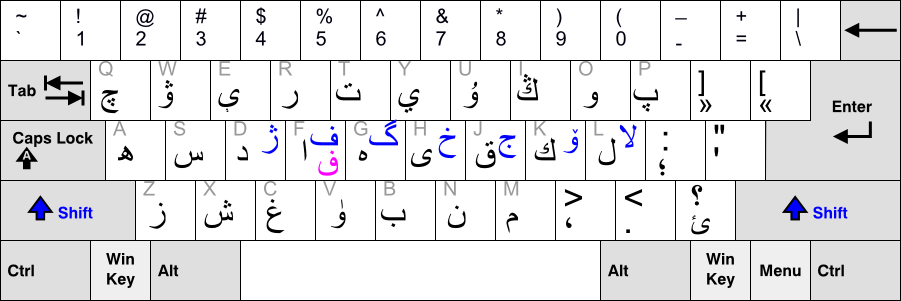
In the Arabic orthographies of Uyghur, Kazakh and Kyrgyz, the letter ar has a descender in the final and isolated positions, much like the Maghrebi version of ar. Theoretically this shape could be approximated by using , but in practice is used in databases of these languages, and most commercial fonts for these languages give the codepoint of the usual Arabic ar a shape like ڧ.
When the Uyghur keyboard layout for Microsoft Windows was first added in Windows Vista and Windows Server 2008, the key combination resulted in . The Uyghur keyboard layout in Windows 7 and Windows Server 2008 R2 changed that key combination to give . On the newer systems, the old keyboard layout is still available under the name Uyghur (Legacy).
Diacriticized Arabic versions
Normally, the letter ف ar renders sound, but may also be used some names and loanwords where it can render , might be arabized as in accordance to its spelling, e.g., يُونِيلِفِر (Unilever). It may be used interchangeably with the modified letter ڤ - ar (with 3 dots above) in this case. The letter fāʾ with three dots above is no longer used in Persian, as the -sound changed to , e.g. archaic زڤان زبان 'language'
The character is mapped in Unicode under position U+06A4.
Maghrebi variant
The Maghrebi style, used in Northwestern Africa, the dots moved underneath (Unicode U+06A5), because it is based on the other style of ar ():
Other similar letters
| Code point | Isolated | Final | Medial | Initial | Unicode character name (or descriptive synonyms used in the JoiningType and JoiningGroup datatables) | ||
|---|---|---|---|---|---|---|---|
| [U+0641](f) | style="text-align:left" | **ARABIC LETTER FEH** | |||||
| [U+06A1](f) | style="text-align:left" | ARABIC LETTER DOTLESS FEH | |||||
| [U+06A2](f) | style="text-align:left" | ARABIC LETTER FEH WITH DOT MOVED BELOW | |||||
| [U+06A3](f) | style="text-align:left" | ARABIC LETTER FEH WITH DOT BELOW | |||||
| [U+06A4](v) | style="text-align:left" | ARABIC LETTER FEH WITH 3 DOTS ABOVE = VEH | |||||
| [U+06A5](f) | style="text-align:left" | ARABIC LETTER FEH WITH 3 DOTS BELOW = MAGHRIBI VEH | |||||
| U+06A6 | style="text-align:left" | ARABIC LETTER FEH WITH 4 DOTS ABOVE = PEHEH | |||||
| [U+0760](p) | style="text-align:left" | ARABIC LETTER FEH WITH 2 DOTS BELOW | |||||
| [U+0761](v) | style="text-align:left" | ARABIC LETTER FEH WITH 3 DOTS POINTING UPWARDS BELOW | |||||
| U+08A4 | style="text-align:left" | ARABIC LETTER FEH WITH DOT BELOW AND THREE DOTS ABOVE | |||||
| [U+08BB](f) | style="text-align:left" | ARABIC LETTER AFRICAN FEH |
Hebrew pe
The Hebrew spelling is פֵּא. It is also romanized pei or pey, especially when used in Yiddish.
| position in word | Various print fonts | Cursive | ||||||||
|---|---|---|---|---|---|---|---|---|---|---|
| Hebrew | Rashi | |||||||||
| script | Serif | Sans-serif | Monospaced | |||||||
| non final | פ | פ | פ | [[File:Hebrew letter Pe handwriting.svg | class=skin-invert-image | 28px]] | [[File:Pe-nonfinal (Rashi-script - Hebrew letter).svg | class=skin-invert-image | 40px]] | |
| final | ף | ף | ף | [[File:Hebrew letter Pe-final handwriting.svg | class=skin-invert-image | 24px]] | [[File:Pe-final (Rashi-script - Hebrew letter).svg | class=skin-invert-image | 40px]] |
Variations on written form/pronunciation
Main article: Modern Hebrew phonology, Hebrew alphabet#Ancient Hebrew
The letter Pe is one of the six letters which can receive a Dagesh Kal. The six are Bet, Gimel, Daleth, Kaph, Pe, and Tav.
Variant forms of Pe/Fe

A notable variation on the letter Pe is the Pe Kefulah (Doubled Pe), also known as the Pei Lefufah (Wrapped Pe). The Pe Kefulah is written as a small Pe scribed within a larger Pe. This atypical letter appears in Torah scrolls (most often Yemenite Torahs but is also present in Sephardic and Ashkenazi Torahs), manuscripts, and some modern printed Hebrew Bibles. When the Pe is written in the form of a Doubled Pe, this adds a layer of deeper meaning to the Biblical text. This letter variation can appear on the final and non-final forms of the Pe.
There are two orthographic variants of this letter which indicate a different pronunciation:
| Name | Symbol | IPA | Transliteration | as in the English word |
|---|---|---|---|---|
| Pe | p | pan | ||
| Fe | f | fan |
Pe with the dagesh
When the Pe has a "dot" in its center, known as a dagesh, it represents a voiceless bilabial plosive, . There are various rules in Hebrew grammar that stipulate when and why a dagesh is used.
Fe
When Pe appears without the dagesh dot in its center (פ), then it usually represents a voiceless labiodental fricative .
Final form of Pe/Fe
At the end of words, the letter's written form changes to a Pe/Fe Sophit (Final Pe/Fe): ף.
When a word in modern Hebrew borrowed from another language ends with , the non-final form is used (e.g. פִילִיפ "Philip"), while borrowings ending in still use the Pe Sofit (e.g. כֵּיף "fun", from Arabic). This is because native Hebrew words, which always use the final form at the end, cannot end in .
Significance
In gematria, Pe represents the number 80. Its final form represents 800 but this is rarely used, Tav written twice (400+400) being used instead.
Syriac pe
Character encodings
|05E4|name1=Hebrew Letter Pe |05E3|name2=Hebrew Letter Final Pe |0641|name3=Arabic Letter Feh |0726|name4=Syriac Letter Pe |0810|name5=Samaritan Letter Pi
|10394|name1=Ugaritic Letter Pu |10850|name2=Imperial Aramaic Letter Pe |10910|name3=Phoenician Letter Pe
References
References
- Schenker, Alexander M.. (1995). "The Dawn of Slavic: An Introduction to Slavic Philology". [[Yale University Press]].
- "Strong's #6310 - פֶּה - Old Testament Hebrew Lexical Dictionary".
- "Request for glyph changes and annotations for Kazakh, Kyrgyz, and Uyghur".
- "U+0641 information for Uyghur, Kazakh and Kyrgyz".
- "Uyghur (Legacy) Keyboard".
- "Uyghur Keyboard".
- "PERSIAN LANGUAGE i. Early New Persian". Iranica Online.
- Daniels, Peter T.. (1996). "The World's Writing Systems". Oxford University Press.
- Kahn, Lily. (2013). "Colloquial Yiddish: The Complete Course for Beginners". Routledge.
- Yeivin, Israel. (1985). "Introduction to the Tiberian Masorah". SBL Press.
- (2019). "Teaching Otiot Meshunot from Scribal Biblical Hebrew Texts". Hebrew Higher Education.
This article was imported from Wikipedia and is available under the Creative Commons Attribution-ShareAlike 4.0 License. Content has been adapted to SurfDoc format. Original contributors can be found on the article history page.
Ask Mako anything about Pe (Semitic letter) — get instant answers, deeper analysis, and related topics.
Research with MakoFree with your Surf account
Create a free account to save articles, ask Mako questions, and organize your research.
Sign up freeThis content may have been generated or modified by AI. CloudSurf Software LLC is not responsible for the accuracy, completeness, or reliability of AI-generated content. Always verify important information from primary sources.
Report