From Surf Wiki (app.surf) — the open knowledge base
Pavonazzo marble
Whitish marble from Docimium, Turkey
Whitish marble from Docimium, Turkey
Pavonazzo marble, also known as Pavonazzetto, Docimaean marble or Synnadic marble, is a whitish marble originally from Docimium, or modern İscehisar, Turkey.
Etymology
The name derives from the Italian word for peacock (pavone).
History
Ancient world
Pavonazzetto was not widely or extensively used before the Roman period; there is no evidence of it in circulation before the last two decades BC. The marble has been used in Rome since the Augustan age, when large-scale quarrying began at Docimium, and columns of it were used in the House of Augustus, as well as in the Temple of Mars Ultor, which also had pavonazzo floor tiles in the cella. Pavonazzetto statues of kneeling Phrygian barbarians existed in the Basilica Aemilia and Horti Sallustiani. Giant statue groups carved from Docimaean marble were discovered at Tiberius's Villa in Sperlonga.
Docimian Pavonazzetto was extensively used in major building projects both within Rome and the rest of the empire. Pavonazzetto was used on the most eye catching places such as, columns, wall and floor veneer and wall reliefs. Other marbles from all corners of the empire were used in combination; whenever Pavonazzetto was used as floor cover, it was usually in combination with other decorative marbles, however, the Pavonazzetto being a primarily white marble, it gave buildings a freshening white color.
Docimian marble was also preferred for sarcophagi sculpting, many emperors preferring this marble for its high value and majestic looks. As a result, some of the greatest masterpieces were made from this material, including the sarcophagi of Eudocia, Heraclius and many more.
Later Use
Docimaean Pavonazzo was later used for the Memoria Petri, the tomb of Saint Peter, in the influential Baroque Revival style historic buildings the Church of St. Ignatius Loyola, in New York City, and Belfast City Hall in Belfast, Northern Ireland.
List of buildings with Pavonazzo marble
Buildings in Rome
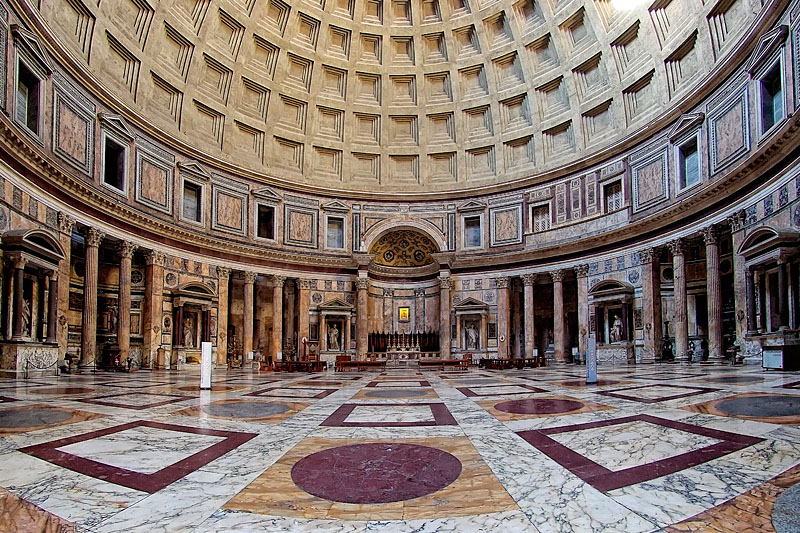
- The Pantheon contains Docimian Pavonazzetto as floor pavement along with other marble types. The dominant white color is the Pavonazzetto, also some of the interior main columns and pilasters are made from Docimian marble.
- Forum of Augustus{{cite book|author=Kathleen S.Lamp |title=A City of Marble, University of South Carolina|url=https://books.google.com/books?id=Vf7DBwAAQBAJ&q=pavonazzetto
- Forum of Trajan (floor and 184 column shafts)
- Temple of Mars Ultor (floor)
- Temple of Apollo Sosianus (floor)
- Basilica Aemilia (20 statues)
- Basilica Julia (floor and some columns)
- Basilica Ulpia (some of the columns)
- Basilica of San Paolo fuori le Mura (24 columns, destroyed by fire in 1823)
- The eight statues on the Arch of Constantine
- Baths of Caracalla (some of the columns and wall veneer)
Buildings outside of Rome
- The Hagia Sophia has Docimian marble as veneer on the aisles and galleries.
- Saint Peter's Basilica, as veneer.
- Leptis Magna, former limestone columns were replaced with Pavonazzetto.
- Library of Celsus, the columns on the famous wall.
- Ancient City of Sagalassos, as wall and floor covering, 40 tons of veneer were recovered.
- Temple of Zeus and Hera in Greece, 100 columns and wall.
References
References
- Strabo. "Geography".
- Erica Highes. (2013). "Meaning and λόγος: Proceedings from the Early Professional Interdisciplinary". University of Liverpool.
- Elise A. Friedland. (2015). "The Oxford Handbook of Roman Sculpture".
- Matthias Bruno, et al. “The Docimium Marble Sculptures of the Grotto of Tiberius at Sperlonga.” ''American Journal of Archaeology'', vol. 119, no. 3, 2015, pp. 375–394.
- Donato Attanasio. (2006). "The Isotopic Signature of Classical Marbles".
- Anthony Grafton. (2010). "Classical Tradition, Harvard University".
- William Lloyd Macdonald. (2002). "The Pantheon, Harvard University".
- J. Clayton Fant. (1989). "Cavum Antrum Phrygia".
- Gaynor Aaltonen. (2008). "The History of Architecture".
- James E. Packer. (2001). "The Forum of Trajan in Rome".
- Ben Russell. (2013). "The Economics of Roman Stone Trade, Oxford University".
- John W. Stamper. (2005). "The Architecture of Roman Temples, Cambridge University".
- John W. Stamper. (2005). "The Architecture of Roman Temples, Cambridge University".
- Max Schvoerer. (1999). "ASMOSIA 4, University of Bordeaux".
- Gilbert J. Gorski. (2015). "The Roman Forum, Cambridge University".
- Gregor Kalas. (2015). "Restoration of The Roman Forum in Late Antiquity, University of Texas".
- J. Clayton Fant. (1989). "Cavum antrum Phrygia".
- L. Richardson. (1992). "A New Topographical Dictionary of Ancient Rome, The Johns Hopkins University".
- Lawrence Nees. (2015). "Perspective on Early Islamic Art in Jerusalem".
- (2014). "The Economics of the Roman Stone Trade, Oxford University".
- Janet DeLaine. (1997). "The Baths of Caracalla".
- Dante Giuliano Bartoli. (2008). "Marble Transport in the Time of the Severans, Texas University".
- Nadine Schibille. (2014). "Hagia Sophia and the Byzantine Aesthetic Experience, University of Sussex".
- Keith Miller. (2011). "St. Peter's, Harvard University".
- Ben Russell. (2014). "The Economic of the Roman Stone Trade, Oxford University".
- Barbara E. Borg. (2015). "A Companion to Roman Art".
- Abu Jaber. "QuarryScapes, Geological Survey of Norway".
- Marc Waelkens. (2000). "Sagalassos Five, Leuven University".
- Pausanias. "Book 1 Attica 16-29, Athens".
This article was imported from Wikipedia and is available under the Creative Commons Attribution-ShareAlike 4.0 License. Content has been adapted to SurfDoc format. Original contributors can be found on the article history page.
Ask Mako anything about Pavonazzo marble — get instant answers, deeper analysis, and related topics.
Research with MakoFree with your Surf account
Create a free account to save articles, ask Mako questions, and organize your research.
Sign up freeThis content may have been generated or modified by AI. CloudSurf Software LLC is not responsible for the accuracy, completeness, or reliability of AI-generated content. Always verify important information from primary sources.
Report