From Surf Wiki (app.surf) — the open knowledge base
Pastitsio
Greek baked pasta dish

Greek baked pasta dish
| Field | Value |
|---|---|
| name | Pastitsio |
| image | File:Pastitsio homemade.jpg |
| image_size | 250px |
| country | Greece |
| region | Ionian Islands |
| course | Main |
| main_ingredient | Ground beef, béchamel sauce |
Pastitsio (, pastítsio) is a baked pasta dish with ground meat and béchamel sauce, which came from the Ionian Islands to Greece. Variations of the dish are found in other countries near the Mediterranean Sea.
Name and origin
Pastitsio takes its name from the Venetian pasticcio, a large family of baked savory pies that may be based on meat, fish, or pasta, with many documented recipes from the early 16th century, and continuing to modern times. Italian versions include a pastry crust; some include béchamel.
The word pasticcio is attested by the 16th century as "any manner of pastie or pye" and comes from the vulgar Latin word pastīcium derived from pasta, and means "pie", and has developed the figurative meanings of "a mess", "a tough situation", or a pastiche.
The name of an Italian version, lasagna, made with flat noodles, comes from Latin lasanum, "cooking pot".
An Egyptian version of it is called macarona bil-bechamel ( ). In the Albanian-speaking regions of the Balkans, the dish is called pastiçe, deriving from pasticcio. It is, however, often meatless and made with an egg and cheese mixture instead of béchamel. Pastitsio is also found on the island of Cyprus, where Greek Cypriots refer to it as makaronia tou fournou (Greek: μακαρόνια του φούρνου), whilst Turkish Cypriots refer to it as fırında makarna. Both names translate to "macaroni in the oven".
Greece
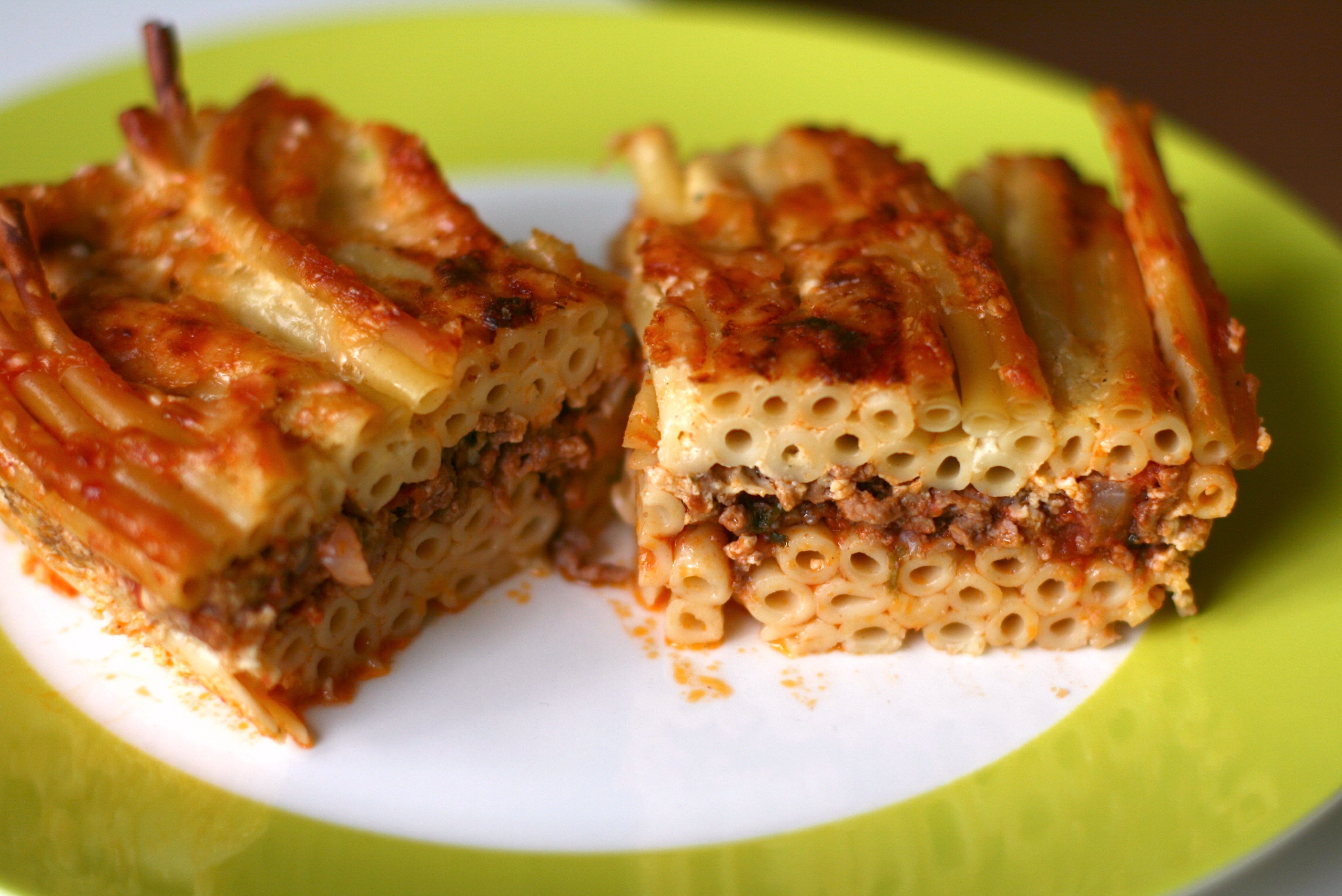
Nikolaos Tselementes, a French-trained Greek chef of the early 20th century, popularized the variant au gratin with béchamel. Other versions with a filling of pasta, liver, meat, eggs, and cheese (similar to most Italian pasticcio recipes), which were wrapped in pastry are forgotten.
Tselementes' published version is now ubiquitous—has a bottom layer that is bucatini or other tubular pasta, with cheese or egg as a binder and a middle layer of ground beef (or a mix of ground beef and ground pork) with tomato sauce, cinnamon and cloves. The top layer is a béchamel or a Mornay sauce, with other spices like nutmeg or allspice added. Grated goat cheese is often sprinkled on top. Pastitsio is a common dish, and is often served as a main course, with a salad.
Egypt
The Egyptian version is called مكرونة بالبشاميل macarona bil-bechamel in Egyptian Arabic, i.e. "macaroni with béchamel". The dish is typically made with penne or macaroni pasta, a minced-meat sauce with tomato and onion, and a white sauce often enriched with Rumi cheese. Egg or cheese (cheddar and mozzarella) may also be baked on top. The dish was introduced to Egypt by Greek and Italian immigrants in the 19th century.
Malta
In Malta, timpana (the name probably derived from timballo) is made by tossing parboiled macaroni in a tomato sauce containing a small amount of minced beef or corned beef, bound with a mixture of raw egg and grated cheese. Hard-boiled eggs are sometimes added. The macaroni is then enclosed in a pastry case or lid before being baked. A similar dish without the pastry casing is imqarrun.
References
Sources
References
- [[Bartolomeo Scappi]], ''Opera'', 1570, [https://books.google.com/books?id=xgFUAAAAcAAJ&q=pasticcio ''passim'']: 43 recipes
- Accademia Italiana della Cucina, ''La Cucina: The Regional Cooking of Italy'', pp. 310–313
- Pellegrino Artusi, ''La scienza in cucina e l'arte di mangiar bene'', 1983 reprint, first edition 1891: 10 recipes
- Vincenzo Buonassisi, ''Piccolo Codice della Pasta'', Rizzoli 1973: 11 recipes
- Vincenzo Buonassisi, ''Il Nuovo Codice della Pasta'', Rizzoli 1985 {{isbn. 8817110388: 41 recipes
- Touring Club Italiano, ''Guida all'Italia Gastronomica'', 1931: 2 recipes; 1984 edition: 3 recipes
- Luigi Carnacina, Luigi Veronelli, ''La cucina rustica regionale'' = ''La buona vera cucina italiana'', Rizzoli, 1966: 3 recipes
- Στοΐλη, Μελίσσα. (September 25, 2012). "Το αυθεντικό παστίτσιο". Το Βήμα ([[To Vima]]).
- [[John Florio]], ''A Worlde of Wordes: Or Most copious and exact Dictionarie in Italian and English'', London, 1598 [https://books.google.com/books?id=YdFaAAAAcAAJ&q=%22pasticcio%22 p. 261]
- "Pasticcio". Treccani.
- ''Oxford Paravia Italian Dictionary'', 2001, {{ISBN. 0-19-860437-8
- Aglaia Kremezi, "Nikolas Tselementes", ''Cooks and Other People'', Proceedings of the Oxford Symposium on Food and Cookery, [https://play.google.com/books/reader?id=lpOqTUucwhUC&printsec=frontcover&pg=GBS.PA168 p. 168]
- (7 May 2016). "Food and Communication: Proceedings of the Oxford Symposium on Food and Cookery 2015". Oxford Symposium.
- (2000). "Malta". [[Marshall Cavendish]].
- (19 August 2013). "Maltese Timpana".
This article was imported from Wikipedia and is available under the Creative Commons Attribution-ShareAlike 4.0 License. Content has been adapted to SurfDoc format. Original contributors can be found on the article history page.
Ask Mako anything about Pastitsio — get instant answers, deeper analysis, and related topics.
Research with MakoFree with your Surf account
Create a free account to save articles, ask Mako questions, and organize your research.
Sign up freeThis content may have been generated or modified by AI. CloudSurf Software LLC is not responsible for the accuracy, completeness, or reliability of AI-generated content. Always verify important information from primary sources.
Report