From Surf Wiki (app.surf) — the open knowledge base
Pashto
Eastern Iranian language
Eastern Iranian language
| Field | Value |
|---|---|
| name | Pashto |
| nativename | پښتو |
| ps | |
| pronunciation | , , , |
| states | Afghanistan |
| Pakistan | |
| ethnicity | Pashtuns |
| speakers | L1: million |
| date | 2017–2023 |
| ref | |
| speakers2 | L2: million (2022) |
| speakers_label | Speakers |
| familycolor | Indo-European |
| fam2 | Indo-Iranian |
| fam3 | Iranian |
| fam4 | Southeastern |
| fam5 | Pashto-Wanetsi |
| dialects | Pashto dialects |
| stand1 | Central Pashto |
| stand2 | Northern Pashto |
| stand3 | Southern Pashto |
| script | Pashto alphabet |
| nation | Afghanistan |
| agency | |
| iso1 | ps |
| iso1comment | – Pashto, Pushto |
| iso2 | pus |
| iso2comment | – Pushto, Pashto |
| iso3 | pus |
| iso3comment | – Pashto, Pushto |
| lc1 | pst |
| ld1 | Central Pashto |
| lc2 | pbu |
| ld2 | Northern Pashto |
| lc3 | pbt |
| ld3 | Southern Pashto |
| lc4 | wne |
| ld4 | Wanetsi |
| lingua | 58-ABD-a |
| image | Pashto.svg |
| imagecaption | The word Pax̌tó written in the Pashto alphabet |
| map | Map of Pashto-speaking areas in Afghanistan and Pakistan.svg |
| mapalt | A map of Pashto-speaking areas |
| mapcaption | Areas in Afghanistan and Pakistan where Pashto is: |
| notice | IPA |
| imagescale | 0.5 |
| glotto | pash1269 |
| glottoname | Pashto |
ps Pakistan
Pashto{{efn|Sometimes spelled "Pushtu" or "Pushto" ; , ) is an eastern Iranian language in the Indo-European language family, natively spoken in northwestern Pakistan and southern and eastern Afghanistan. It has official status in Afghanistan. It is known in historical Persian literature as Afghani ().
Spoken as a native language mostly by ethnic Pashtuns, it is one of the two official languages of Afghanistan alongside Dari, and it is spoken as the second-largest provincial language in Pakistan, spoken mainly in Khyber Pakhtunkhwa and the northern districts of Balochistan. Likewise, it is the primary language of the Pashtun diaspora around the world. The total number of Pashto-speakers is at least 40 million, although some estimates place it as high as 60 million. Pashto is "one of the primary markers of ethnic identity" amongst Pashtuns.
Geographic distribution
A national language of Afghanistan, Pashto is primarily spoken in the east, south, and southwest, but also in some northern and western parts of the country. The exact number of speakers is unavailable, but different estimates show that Pashto is the mother tongue of 45–60% of the total population of Afghanistan.
In Pakistan, Pashto is spoken by 18.1% of its population, mainly in the northwestern province of Khyber Pakhtunkhwa and northern districts of Balochistan province. It is also spoken in parts of Mianwali and Attock districts of the Punjab province, areas of Gilgit-Baltistan and in Islamabad. Pashto speakers are found in other major cities of Pakistan, most notably Karachi, Sindh, which may have the largest Pashtun population of any city in the world.
Other communities of Pashto speakers are found in India, Tajikistan, and northeastern Iran (primarily in South Khorasan Province to the east of Qaen, near the Afghan border). In India most ethnic Pashtun (Pathan) peoples speak the geographically native Hindi-Urdu language rather than Pashto, but there are small numbers of Pashto speakers, such as the Sheen Khalai in Rajasthan, and the Pathan community in the city of Kolkata, often nicknamed the Kabuliwala ("people of Kabul"). Pashtun diaspora communities in other countries around the world speak Pashto, especially the sizable communities in the United Arab Emirates and Saudi Arabia.
Afghanistan
Pashto is one of the two official languages of Afghanistan, along with Dari Persian. Since the early 18th century, the monarchs of Afghanistan have been ethnic Pashtuns (except for Habibullāh Kalakāni in 1929). was more widely used in government institutions, while the Pashtun tribes spoke Pashto as their native tongue. King Amanullah Khan began promoting Pashto during his reign (1926–1929) as a marker of ethnic identity and as a symbol of "official nationalism" after the Third Anglo-Afghan War in 1919, which restored Afghan control over their foreign policy. and the inauguration of the Kabul University in 1932 as well as the formation of the Pashto Academy (Pashto Tolana) in 1937. Muhammad Na'im Khan, the minister of education between 1938 and 1946, inaugurated the formal policy of promoting Pashto as Afghanistan's national language, leading to the commission and publication of Pashto textbooks. The Pashto Tolana was later incorporated into the Academy of Sciences Afghanistan in line with Soviet model following the Saur Revolution in 1978.
Although officially supporting the use of Pashto, the Afghan elite regarded Persian as a "sophisticated language and a symbol of cultured upbringing". King Zahir Shah (reigning 1933–1973) thus followed suit after his father Nadir Khan had decreed in 1933 that officials were to study and utilize both Persian and Pashto. In 1936 a royal decree of Zahir Shah formally granted Pashto the status of an official language, with full rights to use in all aspects of government and education – despite the fact that the ethnically Pashtun royal family and bureaucrats mostly spoke Persian. Thus Pashto became a national language, a symbol for Pashtun nationalism.
The constitutional assembly reaffirmed the status of Pashto as an official language in 1964 when Afghan Persian was officially renamed to Dari. The lyrics of the national anthem of Afghanistan are in Pashto.
Pakistan
In British India, prior to the creation of Pakistan by the British government, the 1920s saw the blossoming of Pashto language in the then NWFP: Abdul Ghafar Khan in 1921 established the Anjuman-e- Islah al-Afaghina (Society for the Reformation of Afghans) to promote Pashto as an extension of Pashtun culture; around 80,000 people attended the Society's annual meeting in 1927. In 1955, Pashtun intellectuals including Abdul Qadir formed the Pashto Academy Peshawar on the model of Pashto Tolana formed in Afghanistan. In 1974, the Department of Pashto was established in the University of Balochistan for the promotion of Pashto.
In Pakistan, Pashto is the first language of around % of its population (per the 2023 census). However, Urdu and English are the two official languages of Pakistan. Pashto has no official status at the federal level. On a provincial level, Pashto is the regional language of Khyber Pakhtunkhwa and north Balochistan. Yet, the primary medium of education in government schools in Pakistan is Urdu.
The lack of importance given to Pashto and its neglect has caused growing resentment amongst Pashtuns. It is noted that Pashto is taught poorly in schools in Pakistan. Moreover, in government schools material is not provided for in the Pashto dialect of that locality, Pashto being a dialectically rich language. Further, researchers have observed that Pashtun students are unable to fully comprehend educational material in Urdu.
Professor Tariq Rahman states:{{Blockquote|"The government of Pakistan, faced with irredentist claims from Afghanistan on its territory, also discouraged the Pashto Movement and eventually allowed its use in peripheral domains only after the Pakhtun elite had been co-opted by the ruling elite...Thus, even though there is still an active desire among some Pakhtun activists to use Pashto in the domains of power, it is more of a symbol of Pakhtun identity than one of nationalism."|Tariq Rahman|The Pashto language and identity-formation in Pakistan|source=}}Robert Nicols states:
Although Pashto used as a medium of instruction in schools for Pashtun students results in better understanding and comprehension for students when compared to using Urdu, still the government of Pakistan has only introduced Pashto at the primary levels in state-run schools. Taimur Khan remarks: "the dominant Urdu language squeezes and denies any space for Pashto language in the official and formal capacity. In this contact zone, Pashto language exists but in a subordinate and unofficial capacity".
History
Some linguists have argued that Pashto is descended from Avestan or a variety very similar to it, while others have attempted to place it closer to Bactrian. However, neither position is universally agreed upon. What scholars do agree on is the fact that Pashto is an Eastern Iranian language sharing characteristics with Eastern Middle Iranian languages such as Bactrian, Khwarezmian and Sogdian.
Compare with other Eastern Iranian Languages and Old Avestan:
| *"I am seeing you"* | Pashto | **زۀ تا وينم** | |||||||
|---|---|---|---|---|---|---|---|---|---|
| **Zə tā winə́m** | Old Avestan | Ossetian | Ormuri | Yidgha | Munji | Shughni | Wakhi | ||
| Azə̄m θβā vaēnamī | |||||||||
| ӕз дӕ уынын | |||||||||
| /ɐz dɐ wənən/ | |||||||||
| از بو تو ځُنِم | |||||||||
| Az bū tū dzunim | |||||||||
| Zo vtō vīnəm əstə (tə) | |||||||||
| Zə ftō wīnəm | |||||||||
| Uz tu winum | |||||||||
| Wuz tau winəm |
Strabo, who lived between 64 BC and 24 CE, explains that the tribes inhabiting the lands west of the Indus River were part of Ariana. This was around the time when the area inhabited by the Pashtuns was governed by the Greco-Bactrian Kingdom. From the 3rd century CE onward, they are mostly referred to by the name Afghan (Abgan).
Abdul Hai Habibi believed that the earliest modern Pashto work dates back to Amir Kror Suri of the early Ghurid period in the 8th century, and they use the writings found in Pata Khazana. Pə́ṭa Xazāná (پټه خزانه) is a Pashto manuscript claimed to be written by Mohammad Hotak under the patronage of the Pashtun emperor Hussain Hotak in Kandahar; containing an anthology of Pashto poets. However, its authenticity is disputed by scholars such as David Neil MacKenzie and Lucia Serena Loi. Nile Green comments in this regard:
antiquity of Afghanistan's Pashto culture."|title=Afghan History Through Afghan Eyes}}
From the 16th century, Pashto poetry become very popular among the Pashtuns. Some of those who wrote in Pashto are Bayazid Pir Roshan (a major inventor of the Pashto alphabet), Khushal Khan Khattak, Rahman Baba, Nazo Tokhi, and Ahmad Shah Durrani, founder of the modern state of Afghanistan or the Durrani Empire. The Pashtun literary tradition grew in the backdrop to weakening Pashtun power following Mughal rule: Khushal Khan Khattak used Pashto poetry to rally for Pashtun unity and Pir Bayazid as an expedient means to spread his message to the Pashtun masses.
For instance Khushal Khattak laments in :
Were but the Afghans, in intellect, a little discreet. If the different tribes would but support each other, Kings would have to bow down in prostration before them"|title=Selections from the Poetry of the Afghans|author=Khushal Khan Khattak|source=}}
Grammar
Main article: Pashto grammar
Pashto is a subject–object–verb (SOV) language with split ergativity. In Pashto, this means that the verb agrees with the subject in transitive and intransitive sentences in non-past, non-completed clauses, but when a completed action is reported in any of the past tenses, the verb agrees with the subject if it is intransitive, but with the object if it is transitive. Verbs are inflected for present, simple past, past progressive, present perfect, and past perfect tenses. There is also an inflection for the subjunctive mood.
Nouns and adjectives are inflected for two genders (masculine and feminine), two numbers (singular and plural), and four cases (direct, oblique, ablative, and vocative). The possessor precedes the possessed in the genitive construction, and adjectives come before the nouns they modify.
Unlike most other Indo-Iranian languages, Pashto uses all three types of adpositions—prepositions, postpositions, and circumpositions.
Phonology
Main article: Pashto phonology
Vowels
| Front | Central | Back | Close | Mid | Open |
|---|
Consonants
| Labial | Dental/ | ||||||||||||
|---|---|---|---|---|---|---|---|---|---|---|---|---|---|
| alveolar | Post- | ||||||||||||
| alveolar | Retroflex | Palatal | Velar | Uvular | Glottal | Nasal | Plosive | Affricate | Fricative | Approximant | Rhotic | ||
| () | |||||||||||||
| () | |||||||||||||
| * |
*The retroflex rhotic or lateral, tends to be a lateral flap [] at the beginning of a syllable or other prosodic unit, and a regular flap [] or approximant [] elsewhere.
Vocabulary
In Pashto, most of the native elements of the lexicon are related to other Eastern Iranian languages. As noted by Josef Elfenbein, "Loanwords have been traced in Pashto as far back as the third century B.C., and include words from Greek and probably Old Persian". For instance, Georg Morgenstierne notes the Pashto word مېچن ps i.e. a hand-mill as being derived from the Ancient Greek word μηχανή (grc, i.e. a device). Post-7th century borrowings came primarily from Persian and Hindi-Urdu, with Arabic words being borrowed through Persian, but sometimes directly. Modern speech borrows words from English, French, and German.
However, a remarkably large number of words are unique to Pashto.
Here is an exemplary list of Pure Pashto and borrowings:
| Pashto | Persian Loan | Arabic Loan | Meaning |
|---|---|---|---|
| **ps** | خدمت | ||
| fa | خدمة | ||
| ar | service | ||
| **ps** | کوشش | ||
| fa | effort/try | ||
| , | |||
| **ps** | دوست | ||
| fa | friend | ||
| ***naṛә́i*** | جهان | ||
| fa | دنيا | ||
| ar | world | ||
| **ps** | گرم | ||
| fa | hot | ||
| **ps** | ضرورة | ||
| ar | need | ||
| **ps** | اميد | ||
| fa | hope | ||
| **ps** | باره | ||
| ar | about | ||
| ***bolә́la*** | قصيدة | ||
| ar | an ode |
Due to the incursion of Persian and Persianized-Arabic in modern speech, linguistic purism of Pashto is advocated to prevent its own vocabulary from dying out.
Classical vocabulary
There is a lot of old vocabulary that has been replaced by borrowings e.g. پلاز plâz 'throne' with تخت takht, from Persian. Or the word يګانګي yagānagí meaning 'uniqueness' used by Pir Roshan Bayazid. Such classical vocabulary is being reintroduced to modern Pashto. Some words also survive in dialects like ناوې پلاز 'the bride-room'.
Example from Khayr al-Bayān:
: {{nq|{{lang|ps|2= ... بې يګانګئ بې قرارئ وي او په بدخوئ کښې وي په ګناهان : Transliteration: ... be-yagānagə́i, be-kararə́i wi aw pə badxwə́i kx̌e wi pə gunāhā́n : Translation: "... without singularity/uniqueness, without calmness and by bad-attitude are on sin ."
Writing system
Main article: Pashto alphabet
Pashto employs the Pashto alphabet, a modified form of the Perso-Arabic alphabet or Arabic script. In the 16th century, Bayazid Pir Roshan introduced 13 new letters to the Pashto alphabet. The alphabet was further modified over the years.
The Pashto alphabet consists of 45 to 46 letters and 4 diacritic marks. Latin Pashto is also used. In Latin transliteration, stress is represented by the following markers over vowels: ә́, á, ā́, ú, ó, í and é. The following table (read from left to right) gives the letters' isolated forms, along with possible Latin equivalents and typical IPA values:
| ps | م}} |
|---|---|
| m | |
| ps | ن}} |
| n | |
| ps | ڼ}} |
| ṇ | |
| ps | ں}} |
| ̃ , ń | |
| ps | و}} |
| w, u, o | |
| ps | ه}} |
| h, a | |
| ps | ۀ}} |
| ə | |
| ps | ي}} |
| y, i | |
| ps | ې}} |
| e | |
| ps | ی}} |
| ay, y | |
| ps | ۍ}} |
| əi | |
| ps | ئ}} |
| əi, y | |
Dialects
Main article: Pashto dialects
Pashto dialects are divided into two categories, the "soft" southern grouping of Paṣ̌tō, and the "hard" northern grouping of Pax̌tō (Pakhtu). Each group is further divided into a number of dialects. The Southern dialect of Tareeno is the most distinctive Pashto dialect.1. Southern variety :*Abdaili or Kandahar dialect (or South Western dialect) :*Kakar dialect (or South Eastern dialect) :*Shirani dialect :*Mandokhel dialect :*Marwat-Bettani dialect :*Southern Karlani group ::*Khattak dialect ::*Wazirwola dialect :::*Dawarwola dialect :::*Masidwola dialect ::*Banisi (Banu) dialect
- Northern variety :*Central Ghilji dialect (or North Western dialect) :*Yusapzai and Momand dialect (or North Eastern dialect) :*Northern Karlani group ::*Wardak dialect ::*Taniwola dialect ::*Mangal tribe dialect ::*Khosti dialect ::*Zadran dialect ::*Bangash-Orakzai-Turi-Zazi dialect ::*Afridi dialect ::*Khogyani dialect
3.** Tareeno Dialect**
Literary Pashto
Literary Pashto is the artificial variety of Pashto that is used at times as literary register of Pashto. It is said to be based on the North Western dialect, spoken in the central Ghilji region. Literary Pashto's vocabulary, also derives from other dialects.
Criticism
There is no actual Pashto that can be identified as "Standard" Pashto, as Colye remarks: According to David MacKenzie, there is no real need to develop a "Standard" Pashto:
Literature
Main article: Pashto literature and poetry
Pashto-speakers have long had a tradition of oral literature, including proverbs, stories, and poems. Written Pashto literature saw a rise in development in the 17th century mostly due to poets like Khushal Khan Khattak (1613–1689), who, along with Rahman Baba (1650–1715), is widely regarded as among the greatest Pashto poets. From the time of Ahmad Shah Durrani (1722–1772), Pashto has been the language of the court. The first Pashto teaching text was written during the period of Ahmad Shah Durrani by Pir Mohammad Kakar with the title of Maʿrifat al-Afghānī ("The Knowledge of Afghani [Pashto]"). After that, the first grammar book of Pashto verbs was written in 1805 under the title of Riyāż al-Maḥabbah ("Training in Affection") through the patronage of Nawab Mahabat Khan, son of Hafiz Rahmat Khan, chief of the Barech. Nawabullah Yar Khan, another son of Hafiz Rahmat Khan, in 1808 wrote a book of Pashto words entitled ʿAjāyib al-Lughāt ("Wonders of Languages").
Poetry example
An excerpt from the Kalām of Rahman Baba:
زۀ رحمٰن پۀ خپله ګرم يم چې مين يم
چې دا نور ټوپن مې بولي ګرم په څۀ
Pronunciation: {{ipa|[zə raˈmɑn pə ˈxpəl.a ɡram jəm t͡ʃe maˈjan jəm
t͡ʃe dɑ nor ʈoˈpən me boˈli ɡram pə t͡sə]}}
Transliteration: {{Transliteration|ps|Zə Rahmā́n pə xpə́la gram yəm če mayán yəm
Če dā nor ṭopə́n me bolí gram pə tsə}}
Translation: "I Rahman, myself am guilty that I am a lover,
On what does this other universe call me guilty."
Proverbs
Pashto also has a rich heritage of proverbs (Pashto matalúna, sg. matál). An example of a proverb:
Transliteration: Obә́ pə ḍāng nə beléẓ̌i
Translation: "One cannot divide water by [hitting it with] a pole."
Phrases
Greeting phrases
| Greeting | Pashto | Transliteration | Literal meaning |
|---|---|---|---|
| Hello | stә́ṛay mә́ še | ||
| stә́ṛe mә́ še | May you not be tired | ||
| stә́ṛi mә́ šəi | May you not be tired [said to people] | ||
| pə xair rā́ğle | With goodness (you) came | ||
| Thank you | manә́na | Acceptance [from the verb ] | |
| Goodbye | pə mә́kha de x̌á | On your front be good | |
| xwdā́i pāmā́n | From: [With/On God's security] |
Colors
List of colors
|| sur/sra [red] || šin / šna [green] || kinaxí [purple] || tor/tóra [black] ||šin / šna [blue] || spin/spína [white] || naswārí [brown] || žeṛ/žéṛa [yellow] || čuṇyā́ [violet] || xәṛ/xə́ṛa [grey]
List of colors borrowed from neighbouring languages
- **** nārәnjí – orange from [Persian]
- **** gulābí – pink from [Hindustani, originally Persian]
- **** nilí – indigo from [Persian, ultimately Sanskrit]]
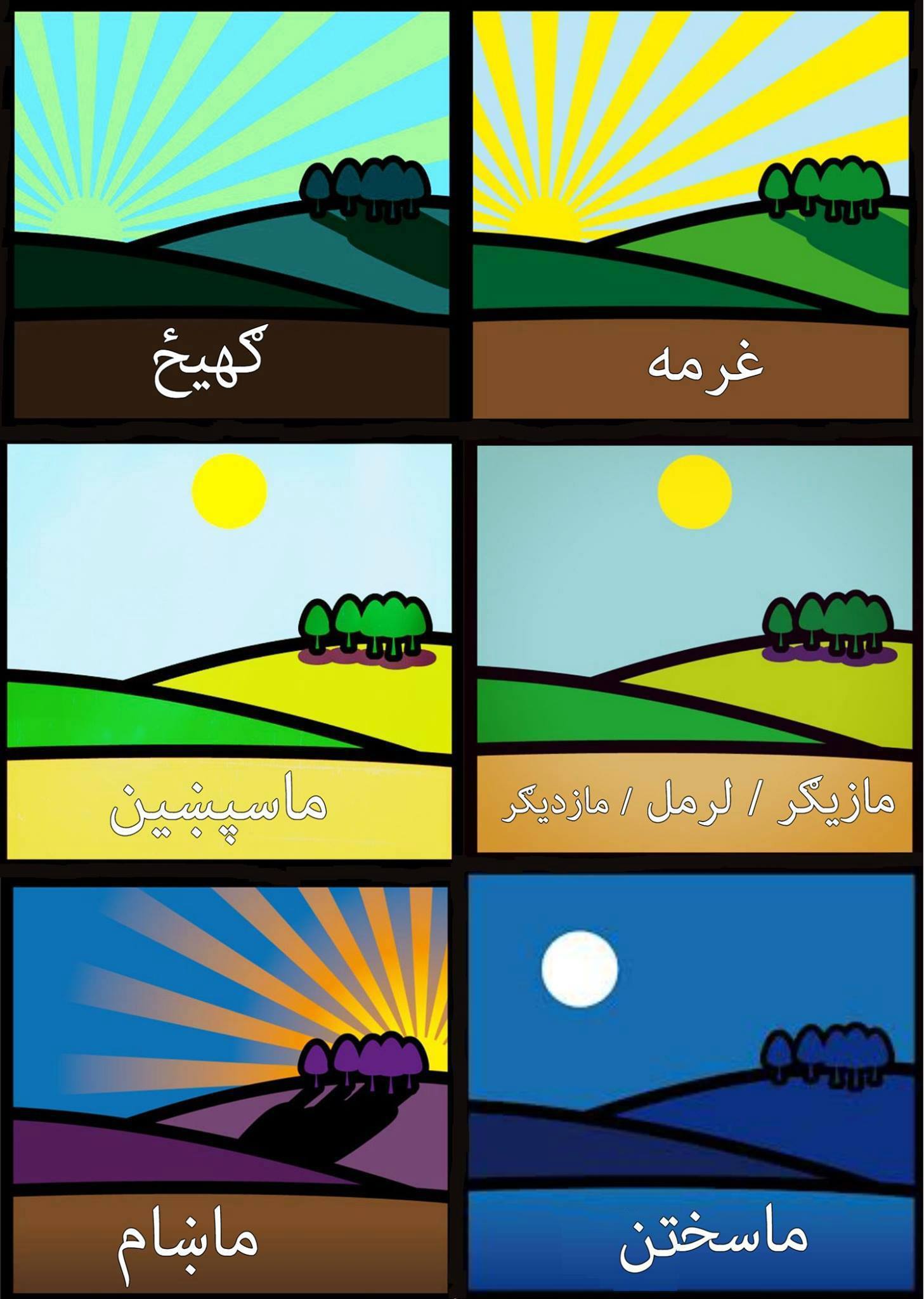
Times of the day
| Time | Pashto | Transliteration | IPA |
|---|---|---|---|
| Morning | gahíź | ||
| Noon | ğarmá | ||
| Afternoon | māspasx̌ín | Kandahar: | |
| Yusapzai: | |||
| Bannuchi: | |||
| Marwat: | |||
| Later afternoon | māzdigár | ||
| māzigár | |||
| Evening | māx̌ā́m | Kandahari: | |
| Wardak: | |||
| Yusapzai: | |||
| Wazirwola: | |||
| Marwat: | |||
| Late evening | māsxután | ||
Months
Pashtuns use the Vikrami calendar in Pakistan, and the Solar Hijri calendar in Afghanistan. Below are the terms designated for the Vikrami months:
| # | Vikrami month | Pashto | Pashto |
|---|---|---|---|
| [Karlāṇí dialects] | Gregorian | ||
| months | |||
| 1 | Chaitra | ||
| četә́r | |||
| četә́r | March–April | ||
| 2 | Vaisākha | ||
| sāk | |||
| wasyók | April–May | ||
| 3 | Jyeshta | ||
| jeṭ | |||
| žeṭ | May–June | ||
| 4 | Āshāda | ||
| hāṛ | |||
| awóṛ | June–July | ||
| 5 | Shraavana | ||
| sāwә́ṇ | |||
| wā́sa | July–August | ||
| 6 | Bhādra | ||
| badrú | |||
| bā́dri | August–September | ||
| 7 | Ashwina | ||
| āsú | |||
| ássi | September–October | ||
| 8 | Kartika | ||
| kātә́i / kāták | |||
| kā́tye | October–November | ||
| 9 | Mārgasirsa | ||
| (Agrahayana) | |||
| mangә́r | |||
| mā́ngər | November–December | ||
| 10 | Pausha | ||
| čilá | |||
| po | December–January | ||
| 11 | Māgha | ||
| bә́la čilá | |||
| kunzә́la | January–February | ||
| 12 | Phālguna | ||
| pāgáṇ | |||
| arbә́ša | February–March |
Notes
References
Bibliography
References
- "Population by Mother Tongue, Sex and Rural/Urban–2023". [[Pakistan Bureau Statistics]].
- (6 April 2010). "Concise Encyclopedia of Languages of the World". Elsevier.
- {{e28. ps
- "Pashto (less commonly Pushtu)". Merriam-Webster, Incorporated.
- "Pashto (also Pushtu)". Houghton Mifflin Harcourt Publishing Company.
- "Pashto (also Pushtu)". Oxford University Press.
- "Pashto (also Pushto or Pushtu)". Oxford University Press.
- (2004). "Article Sixteen of the 2004 Constitution of Afghanistan".
- [[Constitution of Afghanistan]] – [http://www.servat.unibe.ch/icl/af00000_.html ''Chapter 1 The State, Article 16 (Languages) and Article 20 (Anthem)'']
- (2003). "Afghanistan: The land". Crabtree Publishing Company.
- {{ELL2. Pashto. D. Septfonds
- (2009). "A Grammar of Pashto a Descriptive Study of the Dialect of Kandahar, Afghanistan". Ishi Press International.
- Hakala, Walter. (2011-12-09). "Language Policy and Language Conflict in Afghanistan and Its Neighbors: The Changing Politics of Language Choice". Brill.
- "Pashto language". Encyclopædia Britannica.
- "Languages: Afghanistan". The World Factbook.
- (2009). "Concise encyclopedia of languages of the world". Elsevie.
- "Pashto". [[University of California, Los Angeles]].
- Kieffer, Ch. M.. (1982). "Encyclopædia Iranica".
- Sharmeen Obaid-Chinoy. (17 July 2009). "Karachi's Invisible Enemy". PBS.
- (24 August 2009). "In a city of ethnic friction, more tinder". The National.
- (28 August 2010). "Columnists {{pipe}} The Pakhtun in Karachi".
- link. (9 December 2012, thefridaytimes)
- Lieven, Anatol. (2021-05-04). "An Afghan Tragedy: The Pashtuns, the Taliban and the State". Survival.
- (2000). "Pashto, Southern". Ethnologue: Languages of the World, 14th edition.
- "Languages of Iran". Ethnologue: Languages of the World.
- (3 February 2018). "Tattooed 'blue-skinned' Hindu Pushtuns look back at their roots". The Hindu.
- (23 May 2015). "The 'Kabuliwala' Afghans of Kolkata". BBC News.
- (8 August 2018). "Hindu Pashtuns: How One Granddaughter Uncovered India's Forgotten Links to Afghanistan".
- "Languages of United Arab Emirates". Ethnologue: Languages of the World.
- Modarresi, Yahya: "Iran, Afghanistan and Tadjikistan, 1911–1916." In: ''Sociolinguistics'', Vol. 3, Part. 3. Ulrich Ammon, Norbert Dittmar, Klaus J. Mattheier, Peter Trudgill (eds.). Berlin, De Gryuter: 2006. p. 1915. {{ISBN
- Persian, the literary language of the royal court,Lorenz, Manfred. "Die Herausbildung moderner iranischer Literatursprachen." In: ''Zeitschrift für Phonetik, Sprachwissenschaft und Kommunikationsforschung'', Vol. 36. Akademie der Wissenschaften der DDR. Akademie Verlag, Berlin: 1983. P. 184ff.
- (2013). "Afghanistan in Ink: Literature Between Diaspora and Nation". Hurst.
- (2013). "Afghanistan in Ink: Literature Between Diaspora and Nation". Hurst.
- Tariq Rahman. "Pashto Language & Identity Formation in Pakistan." ''Contemporary South Asia'', July 1995, Vol 4, Issue 2, p151-20.
- István Fodor, Claude Hagège. ''Reform of Languages''. Buske, 1983. P. 105ff.
- Campbell, George L.: ''Concise Compendium of the world's languages''. London: Routledge 1999.
- Hussain, Rizwan. ''Pakistan and the emergence of Islamic militancy in Afghanistan''. Burlington, Ashgate: 2005. [https://books.google.com/books?id=TRW_M_xybyYC p. 63.]
- [[Louis Dupree (professor). Dupree, Louis]]: "Language and Politics in Afghanistan." In: ''Contributions to Asian Studies''. Vol. 11/1978. p. 131–141. E. J. Brill, Leiden 1978. p. 131.
- Spooner, Bryan: "Are we teaching Persian?" In: ''Persian Studies in North America: Studies in Honor of Mohammad Ali Jazayery''. Mehdi Marashi (ed.). Bethesda, Iranbooks: 1994. p. 1983.
- (2013). "Afghanistan in Ink: Literature Between Diaspora and Nation". Hurst.
- (2003). "Fighting Words: Language Policy and Ethnic Relations in Asia". MIT Press.
- "Department of Pashto".
- Septfonds, D. 2006. Pashto. In: Concise encyclopedia of languages of the world. 845 – 848. Keith Brown / Sarah Ogilvie (eds.). Elsevier, Oxford: 2009.
- Rahman, Tariq. (2004). "Education in Pakistan a Survey". Lexington Books.
- Rahim, Bushra. (28 September 2014). "Will change in medium of instruction improve education in KP?". dawn.com.
- Daniel Hallberg. (1992). "Sociolinguistic Survey of Northern Pakistan". Quaid-i-Azam University & Summer Institute of Linguistics.
- (22 July 2014). "د کرښې پرغاړه (په پاکستان کې د مورنیو ژبو حیثیت)". mashaalradio.org.
- Hywel Coleman. (2010). "Teaching and learning in Pakistan: the role of language in education". [[British Council]], Pakistan.
- Mohmand, Mureeb. (27 April 2014). "The decline of Pashto". The Express Tribune.
- Carter, Lynn. "Socio-Economic Profile of Kurram Agency". Planning and Development Department, Peshawar, NWFP.
- Carter and Raza. "Socio-Economic Profile of South Waziristan Agency". Planning and Development Department, Peshawar, NWFP.
- Hallberg, Daniel. "Sociolinguistic Survey of Northern Pakistan". National Institute of Pakistan Studies Quaid-i-Azam University and Summer Institute of Linguisitics.
- Rahman, Tariq. (July 1995). "The Pashto language and identity-formation in Pakistan". Contemporary South Asia.
- (2011-12-09). "Language Policy and Language Conflict in Afghanistan and Its Neighbors: The Changing Politics of Language Choice". Brill.
- Khan, M. Taimur S.. (2016). "Pakistanizing Pashtun: The linguistic and cultural disruption and re-invention of Pashtun". American University.
- Khan, M. Taimur S.. (2016). "Pakistanizing Pashtun: The linguistic and cultural disruption and re-invention of Pashtun". American University.
- Darmesteter, James. (1890). "Chants populaires des Afghans".
- Henning (1960), p. 47. "Bactrian thus 'occupies an intermediary position between Pashto and Yidgha-Munji on the one hand, Sogdian, Choresmian, and Parthian on the other: it is thus in its natural and rightful place in Bactria'."
- (1997). "The Hidden Treasure: A Biography of Pas̲htoon Poets".
- (2009). "The world's major languages". Routledge.
- "AFGHANISTAN vi. Paṧto". Encyclopaedia Iranica.
- Beekes, Robert Stephen Paul. (1988). "A Grammar of Gatha-Avestan". BRILL.
- "Avestan grammar help: Azə̄m θβąm vaēnami?".
- Efimov, V. A.. (2011). "The Ormuri Language in Past and Present". Forum for Language Initiatives.
- Morgenstierne, Georg. (1938). "Indo-iranian Frontier Languages, by Georg Morgenstiern. Vol. II. Iranian Pamir Languages (yidgha-munji, Sanglechi-ishkashmi and Wakhi).". W. Nygaard.
- "In this video, the Pashtun... – Pashtun Studies Network".
- (2 May 2021). "Can Eastern Iranics Understand Each Other?".
- (1969). "Afghan and Afghanistan". alamahabibi.com.
- "History of Afghanistan". Encyclopædia Britannica.
- (2002). "Afghanistan – a country without a state?". IKO.
- (1921). "Events Of The Year 910 (1525)". [[Packard Humanities Institute]].
- "Pata Khazana".
- David Neil MacKenzie: David N. Mackenzie: ''The Development of the Pashto Script''. In: Shirin Akiner (Editor): ''Languages and Scripts of Central Asia''. School of Oriental and African Studies, Univ. of London, London 1997, {{ISBN. 978-0-7286-0272-4.p. 142
- Lucia Serena Loi: ''Il tesoro nascosto degli Afghani''. Il Cavaliere azzurro, Bologna 1987, p. 33
- (2016). "Afghan History Through Afghan Eyes". Oxford University Press.
- (2013). "Afghanistan in Ink: Literature Between Diaspora and Nation". Hurst.
- Raverty, Henry G.. (2015). "Selections from the Poetry of the Afghans: From the Sixteenth to the Nineteenth Century, Literally Translated from the Original Pushto, with Notices of the Different Authors, and Remarks on the Mystic Doctrine and Poetry of the Sūfis". Cosmo Publications.
- Emeneau, M. B. (1962) "Bilingualism and Structural Borrowing" ''Proceedings of the American Philosophical Society'' 106(5): pp. 430–442, p. 441
- D.N. MacKenzie, 1990, "Pashto", in Bernard Comrie, ed, ''The major languages of South Asia, the Middle East and Africa'', p. 103
- Herbert Penzl, 1965, ''A reader of Pashto'', p 7
- Kaye, Alan S.. (1997-06-30). "Phonologies of Asia and Africa: (including the Caucasus)". Eisenbrauns.
- Morgenstierne, Georg. (2003). "A New Etymological Vocabulary of Pashto". Reichert.
- John R. Perry, "Lexical Areas and Semantic Fields of Arabic" in Éva Ágnes Csató, Eva Agnes Csato, Bo Isaksson, Carina Jahani, ''Linguistic convergence and areal diffusion: case studies from Iranian, Semitic and Turkic'', Routledge, 2005. p. 97: "It is generally understood that the bulk of the Arabic vocabulary in the central, contiguous Iranian, Turkic and Indic languages was originally borrowed into literary Persian between the ninth and thirteenth centuries"
- Vladimir Kushev. (1997). "Areal Lexical Contacts of the Afghan (Pashto) Language (Based on the Texts of the XVI-XVIII Centuries)". Iran and the Caucasus.
- (1937). "Census of India, 1931, Volume 17, Part 2". [[Times of India]].
- Herbert Penzl. (January–March 1961). "Western Loanwords in Modern Pashto". [[Journal of the American Oriental Society]].
- (13 June 2013). "Language Issues in Comparative Education: Inclusive Teaching and Learning in Non-Dominant Languages and Cultures". Springer Science & Business Media.
- Ehsan M Entezar. (2008). "Afghanistan 101: Understanding Afghan Culture". Xlibris Corporation.
- (December 2025). "Qamosona.com".
- (13 June 2013). "Language Issues in Comparative Education: Inclusive Teaching and Learning in Non-Dominant Languages and Cultures". Springer Science & Business Media.
- [http://www.hewad.com/mohammadgul/ Muhammad Gul Khan Momand] {{Webarchive. link. (28 January 2021 , Hewād Afghanistan)
- "پلاز – Pashto English Dictionary 2015 [Ahmad Wali Achakzai]".
- Pata Khanaza by M. Hotak (1762–1763), translated by K. Habibi page 21, [http://alamahabibi.net/English_Articles/E_Pata_Khazana__Pashto-Eng.pdf Alama Habibi Portal.]
- Habibi, Khushal. (1997). "The Hidden Treasure: A Biography of Pas̲htoon Poets". University Press of America.
- "يګانګي - Pashto English Dictionary 2015 [Ahmad Wali Achakzai]".
- Faqir, Faqir Muhammad. (2014). "The Neologism of Bayazid Ansari". Pashto.
- Pashtoon, Zeeya A.. (2009). "Pashto–English Dictionary". Dunwoody Press.
- Momand, Qalandar. "Daryab Pashto Glossary".
- Hladczuk, John. (1992). "International Handbook of Reading Education". Greenwood Publishing Group.
- (2011). "Pashto Grammar". AuthorHouse.
- [[BGN/PCGN romanization]]
- "Romanization system for Pashto".
- "NGA: Standardization Policies". nga.mil.
- (2003). "South Asian Folklore: An Encyclopedia : Afghanistan, India, Nepal, Pakistan, Sri Lanka". Taylor & Francis.
- Coyle, Dennis Walter. (2014-01-01). "Placing Wardak Among Pashto Varieties". University of North Dakota.
- MacKenzie, D. N.. (1959). "A Standard Pashto". Bulletin of the School of Oriental and African Studies, University of London.
- Zellem, Edward. (2014). "Mataluna: 151 Afghan Pashto Proverbs". Cultures Direct Press.
- Bartlotti, Leonard and Raj Wali Shah Khattak, eds. (2006). ''Rohi Mataluna: Pashto Proverbs'', (revised and expanded edition). First edition by Mohammad Nawaz Tair and Thomas C. Edwards, eds. Peshawar, Pakistan: Interlit and Pashto Academy, Peshawar University.
- Jazab, Yousaf Khan. "An Ethno-Linguistic Study of the Karlanri Varieties of Pashto". Pashto Academy, University of Peshawar.
- Christopher John Fuller. (2004). "The Camphor Flame: Popular Hinduism and Society in India". Princeton University Press.
This article was imported from Wikipedia and is available under the Creative Commons Attribution-ShareAlike 4.0 License. Content has been adapted to SurfDoc format. Original contributors can be found on the article history page.
Ask Mako anything about Pashto — get instant answers, deeper analysis, and related topics.
Research with MakoFree with your Surf account
Create a free account to save articles, ask Mako questions, and organize your research.
Sign up freeThis content may have been generated or modified by AI. CloudSurf Software LLC is not responsible for the accuracy, completeness, or reliability of AI-generated content. Always verify important information from primary sources.
Report