From Surf Wiki (app.surf) — the open knowledge base
Pareidolia
Perception of meaningful patterns or images in random or vague stimuli
Perception of meaningful patterns or images in random or vague stimuli
Common examples include perceived images of animals, faces, or objects in cloud formations; seeing faces in inanimate objects; or lunar pareidolia like the Man in the Moon or the Moon rabbit. The concept of pareidolia may extend to include hidden messages in recorded music played in reverse or at higher- or lower-than-normal speeds, and hearing voices (mainly indistinct) or music in random noise, such as that produced by air conditioners or by fans. Face pareidolia has also been demonstrated in rhesus macaques.
Etymology
The word derives from the Greek words pará (παρά, "beside, alongside, instead [of]") and the noun eídōlon (εἴδωλον, "image, form, shape").
Karl Ludwig Kahlbaum introduced the German term Pareidolie in his 1866 paper "Die Sinnesdelierien" ("On Delusion of the Senses"). When Kahlbaum's paper was reviewed the following year (1867) in The Journal of Mental Science, Volume 13, Pareidolie was translated into English as "pareidolia", and noted to be synonymous with the terms "...changing hallucination, partial hallucination, [and] perception of secondary images."
Link to other conditions
Pareidolia correlates with age and is frequent among patients with Parkinson's disease and dementia with Lewy bodies.
Several case studies report intrusive pareidolia as a symptom presentation in Obsessive Compulsive Disorder.
Explanations
Pareidolia can cause people to interpret random images, or patterns of light and shadow, as faces. A 2009 magnetoencephalography study found that objects perceived as faces evoke an early (165 ms) activation of the fusiform face area at a time and location similar to that evoked by faces, whereas other common objects do not evoke such activation. This activation is similar to a slightly faster time (130 ms) that is seen for images of real faces. The authors suggest that face perception evoked by face-like objects is a relatively early process, and not a late cognitive reinterpretation phenomenon.
A functional magnetic resonance imaging (fMRI) study in 2011 similarly showed that repeated presentation of novel visual shapes that were interpreted as meaningful led to decreased fMRI responses for real objects. These results indicate that the interpretation of ambiguous stimuli depends upon processes similar to those elicited by known objects.
Pareidolia was found to affect brain function and brain waves. In a 2022 study, EEG records show that responses in the frontal and occipitotemporal cortexes begin prior to when one recognizes faces and later, when they are not recognized. By displaying these proactive brain waves, scientists can then have a basis for data rather than relying on self-reported sightings.
These studies help to explain why people generally identify a few lines and a circle as a "face" so quickly and without hesitation. Cognitive processes are activated by the "face-like" object which alerts the observer to both the emotional state and identity of the subject, even before the conscious mind begins to process or even receive the information. A "stick figure face", despite its simplicity, can convey mood information, and be drawn to indicate emotions such as happiness or anger. This robust and subtle capability is hypothesized to be the result of natural selection favoring people most able to quickly identify the mental state, for example, of threatening people, thus providing the individual an opportunity to flee or attack preemptively. This ability, though highly specialized for the processing and recognition of human emotions, also functions to determine the demeanor of wildlife.
Pareidolia and creative thinking
Pareidolia plays a significant role in creative cognition, enabling artists and viewers to perceive novel forms and meanings in ambiguous stimuli. Joanne Lee highlights that this phenomenon has been harnessed in artistic practices for centuries (Da Vinci for example). The phenomenon was particularly important to surrealism, where artists like Salvador Dali, influenced by André Breton, embraced pareidolic ambiguity to challenge rationalist perceptions and provoke new ways of seeing.
Examples
Mimetoliths

A mimetolithic pattern is a pattern created on rocks that may come to mimic recognizable forms through the random processes of formation, weathering and erosion. Many examples exist, from the Old Man of the Mountain (a face-like profile in a cliff) to Iztaccíhuatl, a range in Mexico whose name is Nahuatl for "White (like salt) woman", reflecting the four individual snow-capped peaks which depict the head, chest, knees and feet of a sleeping female when seen from east or west.
A well-known example is the Face on Mars, a rock formation on Mars that resembled a human face in certain satellite photos. Most mimetoliths are much larger than the subjects they resemble, such as a cliff profile that looks like a human face.
Picture jaspers exhibit combinations of patterns, such as banding from flow or depositional patterns (from water or wind), or dendritic or color variations, resulting in what appear to be miniature scenes on a cut section, which is then used for jewelry.
Chert nodules, concretions, or pebbles may in certain cases be mistakenly identified as skeletal remains, egg fossils, or other antiquities of organic origin by amateur enthusiasts.
In the late 1970s and early 1980s, Japanese researcher Chonosuke Okamura self-published a series of reports titled Original Report of the Okamura Fossil Laboratory, in which he described tiny inclusions in polished limestone from the Silurian period (425 mya) as being preserved fossil remains of tiny humans, gorillas, dogs, dragons, dinosaurs and other organisms, all of them only millimeters long, leading him to claim, "There have been no changes in the bodies of mankind since the Silurian period... except for a growth in stature from 3.5 mm to 1,700 mm." Okamura's research earned him an Ig Nobel Prize (a parody of the Nobel Prize) in biodiversity in 1996.
Some sources describe various mimetolithic features on Pluto, including a heart-shaped region.
Clouds
Seeing shapes in cloud patterns is another example of this phenomenon. Rogowitz and Voss (1990) showed a relationship between seeing shapes in cloud patterns and fractal dimension. They varied the fractal dimension of the boundary contour from 1.2 to 1.8, and found that the lower the fractal dimension, the more likely people were to report seeing nameable shapes of animals, faces, and fantasy creatures. From above, pareidolia may be perceived in satellite imagery of tropical cyclones. Notably hurricanes Matthew and Milton gained much attention for resembling a human face or skull when viewed from the side.
Mars canals
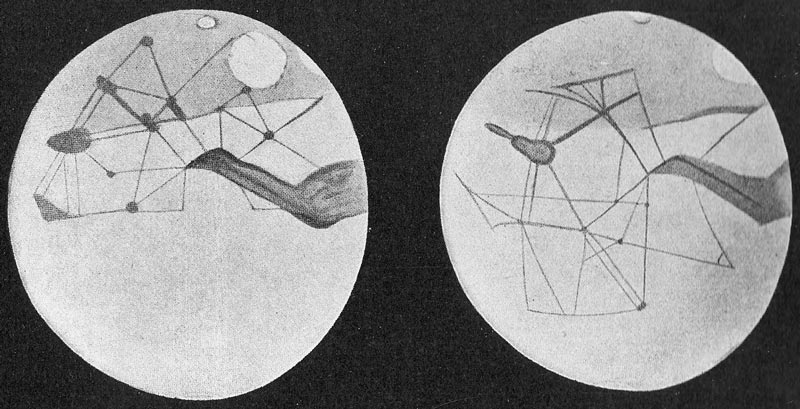
Main article: Martian canals
A notable example of pareidolia occurred in 1877, when observers using telescopes to view the surface of Mars thought that they saw faint straight lines, which were then interpreted by some as canals. It was theorized that the canals were possibly created by sentient beings. This created a sensation. In the next few years better photographic techniques and stronger telescopes were developed and applied, which resulted in new images in which the faint lines disappeared, and the canal theory was debunked as an example of pareidolia.
Lunar surface
.png)
Many cultures recognize pareidolic images in the disc of the full moon, including the human face known as the Man in the Moon in many Northern Hemisphere cultures and the Moon rabbit in East Asian and indigenous American cultures. Other cultures see a walking figure carrying a wide burden on their back, including in Germanic tradition, Haida mythology, and Latvian mythology.
Projective tests
The Rorschach inkblot test uses pareidolia in an attempt to gain insight into a person's mental state. The Rorschach is a projective test that elicits thoughts or feelings of respondents that are "projected" onto the ambiguous inkblot images. Rorschach inkblots have low-fractal-dimension boundary contours, which may elicit general shape-naming behaviors, serving as vehicles for projected meanings.
Banknotes
Owing to the way designs are engraved and printed, occurrences of pareidolia have occasionally been reported in banknotes.
One example is the 1954 Canadian Landscape Canadian dollar banknote series, known among collectors as the "Devil's Head" variety of the initial print runs. The obverse of the notes features what appears to be an exaggerated grinning face, formed from patterns in the hair of Queen Elizabeth II. The phenomenon generated enough attention for revised designs to be issued in 1956, which removed the effect.
Literature
Renaissance authors have shown a particular interest in pareidolia. In William Shakespeare's play Hamlet, for example, Prince Hamlet points at the sky and "demonstrates" his supposed madness in this exchange with Polonius:
:{{dialogue |Hamlet|Do you see yonder cloud that's almost in the shape of a camel? |Polonius|By th'Mass and 'tis, like a camel indeed. |Hamlet|Methinks it is a weasel. |Polonius|It is backed like a weasel. |Hamlet|Or a whale. |Polonius|Very like a whale.}}
Nathaniel Hawthorne wrote a short story called "The Great Stone Face" in which a face seen in the side of a mountain (based on the real-life The Old Man of the Mountain) is revered by a village.
Art
Renaissance artists often used pareidolia in paintings and drawings: Andrea Mantegna, Leonardo da Vinci, Giotto, Hans Holbein, Giuseppe Arcimboldo, and many more have shown images—often human faces—that due to pareidolia appear in objects or clouds.
In his notebooks, Leonardo da Vinci wrote of pareidolia as a device for painters, writing:
Salem, a 1908 painting by Sydney Curnow Vosper, gained notoriety due to a rumour that it contained a hidden face, that of the devil. This led many commentators to visualize a demonic face depicted in the shawl of the main figure, despite the artist's denial that any faces had deliberately been painted into the shawl.
Surrealist artists such as Salvador Dalí would intentionally use pareidolia in their works, often in the form of a hidden face.
Architecture
thumb|upright|Illusory woman in the Niğde Alaaddin Mosque portal Two 13th-century edifices in Turkey display architectural use of shadows of stone carvings at the entrance. Outright pictures are avoided in Islam but tessellations and calligraphic pictures were allowed, so designed "accidental" silhouettes of carved stone tessellations became a creative escape.
- Niğde Alaaddin Mosque in Niğde, Turkey (1223), with its "mukarnas" art where the shadows of three-dimensional ornamentation with stone masonry around the entrance form a chiaroscuro drawing of a woman's face with a crown and long hair appearing at a specific time, at some specific days of the year.
- Divriği Great Mosque and Hospital in Sivas, Turkey (1229), shows shadows of the three-dimensional ornaments of both entrances of the mosque part, to cast a giant shadow of a praying man that changes pose as the sun moves, as if to illustrate what the purpose of the building is. Another detail is the difference in the impressions of the clothing of the two shadow-men indicating two different styles, possibly to tell who is to enter through which door.
Religion
There have been many instances of perceptions of religious imagery and themes, especially the faces of religious figures, in ordinary phenomena. Many involve images of Jesus, the Virgin Mary, the word Allah, or other religious phenomena: in September 2007 in Singapore, for example, a callus on a tree resembled a monkey, leading believers to pay homage to the "Monkey god" (either Sun Wukong or Hanuman) in the monkey tree phenomenon.
Publicity surrounding sightings of religious figures and other surprising images in ordinary objects has spawned a market for such items on online auctions like eBay. One famous instance was a grilled cheese sandwich with the face of the Virgin Mary. This was parodied in the Glee episode "Grilled Cheesus".
During the September 11 attacks, television viewers supposedly saw the face of Satan in clouds of smoke billowing out of the World Trade Center after it was struck by the airplane. Another example of face recognition pareidolia originated in the fire at Notre Dame Cathedral, when a few observers claimed to see Jesus in the flames.
While attempting to validate the imprint of a crucified man on the Shroud of Turin as Jesus, a variety of objects have been described as being visible on the linen. These objects include a number of plant species, a coin with Roman numerals, and multiple insect species. In an experimental setting using a picture of plain linen cloth, participants who had been told that there could possibly be visible words in the cloth, collectively saw 2 religious words. Those told that the cloth was of some religious importance saw 12 religious words, and those who were also told that it was of religious importance, but also given suggestions of possible religious words, saw 37 religious words. The researchers posit that the reason the Shroud has been said to have so many different symbols and objects is because it was already deemed to have the imprint of Jesus prior to the search for symbols and other imprints in the cloth, and therefore it was simply pareidolia at work.
Computer vision
Pareidolia can occur in computer vision, specifically in image recognition programs, in which vague clues can spuriously detect images or features. In the case of an artificial neural network, higher-level features correspond to more recognizable features, and enhancing these features brings out what the computer sees. These examples of pareidolia reflect the training set of images that the network has "seen" previously.
Striking visuals can be produced in this way, notably in the DeepDream software, which falsely detects and then exaggerates features such as eyes and faces in any image. The features can be further exaggerated by creating a feedback loop where the output is used as the input for the network. (The adjacent image was created by iterating the loop 50 times.) Additionally the output can be modified such as slightly zooming in to create an animation of the images perspective flying through the surrealistic imagery.
{{Anchor|Speech}}Auditory
In 1971 Konstantīns Raudive wrote Breakthrough, detailing what he believed was the discovery of electronic voice phenomena (EVP). EVP has been described as auditory pareidolia. Allegations of backmasking in popular music, in which a listener claims a message has been recorded backward onto a track meant to be played forward, have also been described as auditory pareidolia. In 1995, the psychologist Diana Deutsch invented an algorithm for producing phantom words and phrases with the sounds coming from two stereo loudspeakers, one to the listener's left and the other to his right, producing a phase offset in time between the speakers. After listening for a while, phantom words and phrases suddenly emerge, and these often appear to reflect what is on the listener's mind.
Deliberate practical use
Medical education, radiology images
Medical educators sometimes teach medical students and resident physicians (doctors in training) to use pareidolia and patternicity to learn to recognize human anatomy on radiology imaging studies.
Examples include assessing radiographs (X-ray images) of the human vertebral spine. Patrick Foye, M.D., professor of physical medicine and rehabilitation at Rutgers University, New Jersey Medical School, has written that pareidolia is used to teach medical trainees to assess for spinal fractures and spinal malignancies (cancers). When viewing spinal radiographs, normal bony anatomic structures resemble the face of an owl. (The spinal pedicles resemble an owl's eyes and the spinous process resembles an owl's beak.) But when cancer erodes the bony spinal pedicle, the radiographic appearance changes such that now that eye of the owl seems missing or closed, which is called the "winking owl sign". Another common pattern is a "Scottie dog sign" on a spinal X-ray.
In 2021, Foye again published in the medical literature on this topic, in a medical journal article called "Baby Yoda: Pareidolia and Patternicity in Sacral MRI and CT Scans". Here, he introduced a novel way of visualizing the sacrum when viewing MRI magnetic resonance imaging and CT scans (computed tomography scans). He noted that in certain image slices the human sacral anatomy resembles the face of "Baby Yoda" (also called Grogu), a fictional character from the television show The Mandalorian. Sacral openings for exiting nerves (sacral foramina) resemble Baby Yoda's eyes, while the sacral canal resembles Baby Yoda's mouth.
In popular culture
In January 2017, an anonymous user placed an eBay auction of a Cheeto that looked like the gorilla Harambe. Bidding began at , but the Cheeto was eventually sold for .
Starting from 2021, an Internet meme emerged around the online game Among Us, where users presented everyday items such as dogs, statues, garbage cans, big toes, and pictures of the Boomerang Nebula that looked like the game's "crewmate" protagonists. In May 2021, an eBay user named Tav listed a Chicken McNugget shaped like a crewmate from Among Us for online auction. The Chicken McNugget was sold for to an anonymous buyer.
References
References
- "pareidolia". [[Oxford University Press]].
- {{cite Merriam-Webster. pareidolia
- Jaekel, Philip. (2017-01-29). "Why we hear voices in random noise". Nautilus.
- (2017). "Face Pareidolia in the Rhesus Monkey". Current Biology.
- Rosen, Rebecca J.. (August 7, 2012). "Pareidolia: A Bizarre Bug of the Human Mind Emerges in Computers". [[The Atlantic]].
- Kahlbaum, Karl Ludwig. (1866). "Die Sinnesdelirien". Allgemeine Zeitschrift für Psychiatrie und psychisch-gerichtliche Medizin.
- [https://books.google.com/books?id=IM06AQAAMAAJ&dq=%22pareidolia%22&pg=PA238] Sibbald, M.D. [https://books.google.com/books?id=IM06AQAAMAAJ&dq=%22pareidolia%22&pg=PA238 "Report on the Progress of Psychological Medicine; German Psychological Literature"], ''The Journal of Mental Science'', Volume 13. 1867. p. 238
- (2021). "Pareidolia in Parkinson's Disease and Multiple System Atrophy". Parkinson's Disease.
- (2008). "Pareidolias in obsessive-compulsive disorder: Neglected symptoms that may respond to serotonin reuptake inhibitors". Neurocase.
- Sagan, Carl. (1995). "The Demon-Haunted World – Science as a Candle in the Dark". Random House.
- (2009). "Early (M170) activation of face-specific cortex by face-like objects". NeuroReport.
- (2012). "The Potato Chip Really Does Look Like Elvis! Neural Hallmarks of Conceptual Processing Associated with Finding Novel Shapes Subjectively Meaningful". Cerebral Cortex.
- (2022). ""I Spy with my Little Eye, Something that is a Face…": A Brain Network for Illusory Face Detection". Cerebral Cortex.
- Svoboda, Elizabeth. (2007-02-13). "Facial Recognition – Brain – Faces, Faces Everywhere". The New York Times.
- "Dog Tips – Emotions in Canines and Humans". Partnership for Animal Welfare.
- (2024-12-24). "Divergent Perception: Framing Creative Cognition Through the Lens of Sensory Flexibility". The Journal of Creative Behavior.
- Lee, Joanne. (2016). "I See Faces: popular pareidolia and the proliferation of meaning. In Materiality and Popular Culture". Routledge.
- Breton, André. (1978). "What is surrealism? selected writings". Monad.
- Spamer, E.. "Chonosuke Okamura, Visionary". Academy of Natural Sciences.
- Berenbaum, May. (2009). "The earwig's tail: a modern bestiary of multi-legged legends". Harvard University Press.
- Abrahams, Marc. (2004-03-16). "Tiny tall tales: Marc Abrahams uncovers the minute, but astonishing, evidence of our fossilised past". The Guardian.
- (2002). "Science's most wanted: the top 10 book of outrageous innovators, deadly disasters, and shocking discoveries". Brassey's.
- Miller, Ross. (2015-07-14). "Pluto the dog can, like, totally be seen on Pluto the dwarf planet".
- (9 February 2020). "Pluto's icy heart makes winds blow {{!}} EarthSky.org".
- Gary. (2015-07-15). "Pluto annotated (by xkcd)".
- (1990-10-01). "<title>Shape perception and low-dimension fractal boundary contours</title>". SPIE.
- (9 October 2024). "Hurricane Milton Satellite Image Shows 'Creepy' Skull Shape".
- 9781466511156 p. 3
- Lane, K. Maria. ''Geographies of Mars: Seeing and Knowing the Red Planet.'' University of Chicago Press (2011). p. 52-63. {{ISBN. 9780226470788
- Harley, Timothy (1885). ''[https://archive.org/details/moonlore00harl Moon Lore]'', London; Swan Sonnenschein, Le Bas & Lowry. p. 21.
- 1441963421.
- 1578636256.
- (2012). "The Aztecs". John Wiley & Sons.
- [https://archive.org/details/curiousmythsofmi00bariuoft/page/190 Baring-Gould, Sabine. "The Man in the Moon", ''Curious Myths of the Middle Ages'', London. Rivington's, 1877, p. 190]{{PD-notice
- (c. 1884). "The Hydah mission, Queen Charlotte's Islands. An account of the mission and people, with a descriptive letter from the Rev. Charles Harrison".
- Šmits, Pēteris. (1936). "Latvian folktales and legends (Latviešu pasakas un teikas) Vol. 13". Valters un Rapa.
- "1954 series".
- Shakespeare, William. ''Hamlet.'' 3.3.367-73
- Raber, Karen. ''Shakespeare and Posthumanist Theory''. Arden Shakespeare (2018) pp. 80–1 {{ISBN. 978-1474234436
- Hawthorne, Nathaniel. (1850). "The Great Stone Face".
- Raber, Karen. ''Shakespeare and Posthumanist Theory''. Arden Shakespeare (2018) pp. 81–2 {{ISBN. 978-1474234436
- Da Vinci, Leonardo. (1923). "Note-Books Arranged And Rendered Into English". Empire State Book Co.
- (15 October 2010). "Nostalgic image still fascinates, a hundred years on". Media Wales Ltd.
- (29 June 2013). "Salem painting memories on show at Gwynedd Museum". BBC.
- (2011). "Niğde Alaaddin Camii 'nin Kapısındaki Kadın Silüetinin Sırrı?". Nevşehir Kentrehberim.
- "Camiler, ALÂEDDİN CAMİ". [[Kültür ve Turizm Bakanlığı]].
- (2013). "HISTORICAL MONUMENTS OF NIGDE". World Heritage Academy.
- (14 July 2014). "DİVRİĞİ ULU CAMİİ'NDE 'NAMAZ KILAN İNSAN' SİLÜETİ". Haberler.
- (1989). "Anomalistic Psychology: A Study of Magical Thinking". [[Lawrence Erlbaum Associates]].
- Schweber, Nate. (July 23, 2012). "In New Jersey, a Knot in a Tree Trunk Draws the Faithful and the Skeptical". [[The New York Times]].
- Ibrahim, Yahaya. (2 January 2011). "In Maiduguri, a tree with engraved name of God turns spot to a Mecca of sorts". [[Sunday Trust]].
- Ng, Hui Hui. (13 September 2007). "Monkey See, Monkey Do?". [[The New Paper]].
- (23 November 2004). "'Virgin Mary' toast fetches $28,000". [[BBC]].
- Emery, David. (2 September 2018). "Does the Devil's Face Appear in the Smoke on 9/11?". [[ThoughtCo.]].
- Moye, David. (April 17, 2019). "People Claim To See Jesus In Flames Engulfing Notre Dame Cathedral". [[Huffington Post]].
- (July 2016). "Believing is Seeing: A Perspective on Perceiving Images of Objects on the Shroud of Turin". Archive for the Psychology of Religion.
- (December 2015). "Effects of Contextual Information on Seeing Pareidolic Religious Inscriptions on an Artifact: Implications for the Shroud of Turin". Perception.
- Chalup, Stephan K., Kenny Hong, and Michael J. Ostwald. "[https://www.researchgate.net/profile/Stephan_Chalup/publication/228735838_Simulating_Pareidolia_of_Faces_for_Architectural_Image_Analysis/links/0fcfd511b3ff280efe000000/Simulating-Pareidolia-of-Faces-for-Architectural-Image-Analysis.pdf Simulating pareidolia of faces for architectural image analysis]." brain 26.91 (2010): 100.
- (1985). "Subliminal messages: Between the devil and the media". American Psychologist.
- (1995). "Musical Illusions and Paradoxes". Philomel Records.
- (2003). "Phantom Words and Other Curiosities". Philomel Records.
- (July 2014). "Musculoskeletal pareidolia in medical education.". The Clinical Teacher.
- Hacking, Craig. (28 October 2020). "Scottie dog sign (spine)".
- (February 2021). "Baby Yoda: Pareidolia and Patternicity in Sacral MRI and CT Scans.". PM&R: The Journal of Injury, Function, and Rehabilitation.
- (20 February 2021). "Baby Yoda: Pareidolia and Patternicity in Sacral MRI and CT Scans {{!}} Tailbone Doctor".
- (8 February 2017). "Burbank man sells Harambe-shaped Cheeto for nearly $100K on eBay". KABC Television LLC.
- (18 April 2021). "Among Us Everywhere: Things That Look Like Among Us Crewmates".
- (8 February 2022). "The Coldest Spot in Space Looks Like an Among Us Crewmate".
- Kooser, Amanda. (2021-06-03). "McDonald's chicken nugget shaped like Among Us crewmate fetching $100,000 on eBay". [[Red Ventures]].
- Carroll, Robert Todd. (June 2001). "pareidolia". skepdic.com.
This article was imported from Wikipedia and is available under the Creative Commons Attribution-ShareAlike 4.0 License. Content has been adapted to SurfDoc format. Original contributors can be found on the article history page.
Ask Mako anything about Pareidolia — get instant answers, deeper analysis, and related topics.
Research with MakoFree with your Surf account
Create a free account to save articles, ask Mako questions, and organize your research.
Sign up freeThis content may have been generated or modified by AI. CloudSurf Software LLC is not responsible for the accuracy, completeness, or reliability of AI-generated content. Always verify important information from primary sources.
Report