From Surf Wiki (app.surf) — the open knowledge base
Pardon my French
English phrase disguising profanity as words from the French language
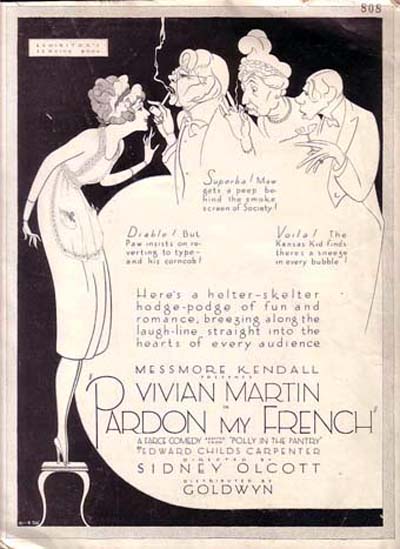
English phrase disguising profanity as words from the French language
the phrase
"Pardon my French" or "excuse my French" is an English expression that commonly precedes the usage of profanity in a sentence. It is intended to ascribe profane words as a natural component of the French language rather than of the English language, playing on the stereotype of Gallic sophistication, although it can be used ironically.
Usage
One source suggests that the phrase "derives from a literal usage of the exclamation. In the 19th century, when English people used French expressions in conversation they often apologized for it—presumably because many of their listeners (then as now) wouldn't be familiar with the language." The definition cites an example from The Lady's Magazine, 1830:
"Excuse my French" appears in an 1895 edition of Harper's Weekly, where an American tourist, when asked about the architecture of Europe, says "Palaces be durned! Excuse my French." The phrase "pardon my French" is recorded in the 1930s and may be a result of English-speaking troops returning from the First World War.
The phrase has been used in broadcast television and family films, where less offensive words are preceded by "pardon my French" to intensify their effect without violating censorship or rating guidelines. An example is in the 1986 movie Ferris Bueller's Day Off; Cameron Frye (Alan Ruck) says, "Pardon my French, but you’re an asshole" on a phone call with Edward Rooney (Jeffrey Jones).
Related expressions
Several euphemisms exist in both English and French to ascribe culturally unacceptable or sensitive matters to another culture.
- "To take a French leave" (to depart a party or other gathering without taking polite leave of one's host) is referenced in French as filer à l'anglaise (lit. "leave English-style").
- "French letter" (now a somewhat archaic reference to a condom) is rendered in French as capote anglaise ("English hood" or "English cap").
- In 16th-century England, genital herpes was called the "French disease" and "French-sick" was a term for syphilis; while in contemporary France, it was called le Mal de Naples (the Neapolitan disease) after the syphilis outbreak in 1494/1495, when French troops were besieging Naples (see history of syphilis).
- "French kiss" (A kiss with tongue-to-tongue interaction is referred to in French as un baiser or une pelle (a colloquialism which literally means "a shovel").
Notes
References
References
- Frances White, [https://www.historyanswers.co.uk/people-politics/why-do-we-say-excuse-my-french/ Why do we say "Excuse my French"?] on ''historyanswers.co.uk'', 11 March 2015
- [http://www.phrases.org.uk/meanings/130800.html Phrases.org.uk: "Excuse my French"]
- (1895). "Harper's New Monthly Magazine". Harper & Brothers.
- (7 August 2008). "Allen's Dictionary of English Phrases". Penguin Adult.
- Melissa, [http://www.todayifoundout.com/index.php/2013/10/tradition-saying-pardon-french-saying-swear-words-started/ How the Tradition of Saying "Pardon My French" After Saying Swear Words Started], on ''todayifoundout.com'', October 8, 2013
- Geraldine Jones, [http://www.everywordcounts.co.uk/popular-european-sayings/ "Excuse my French!" and other popular European sayings], on ''everywordcounts.co.uk'', May 14, 2016
- Matt Soniak, [http://mentalfloss.com/article/12866/why-do-we-say-%E2%80%9Cpardon-my-french%E2%80%9D-when-we-curse Why Do We Say "Pardon My French" When We Curse?], on ''mentalfloss.com'', October 26, 2012
- [https://www.thelocal.fr/20160819/french-things-that-arent-actually-french Twelve 'French' things that aren't actually French at all], on ''thelocal.fr'', 19 August 2016
This article was imported from Wikipedia and is available under the Creative Commons Attribution-ShareAlike 4.0 License. Content has been adapted to SurfDoc format. Original contributors can be found on the article history page.
Ask Mako anything about Pardon my French — get instant answers, deeper analysis, and related topics.
Research with MakoFree with your Surf account
Create a free account to save articles, ask Mako questions, and organize your research.
Sign up freeThis content may have been generated or modified by AI. CloudSurf Software LLC is not responsible for the accuracy, completeness, or reliability of AI-generated content. Always verify important information from primary sources.
Report