From Surf Wiki (app.surf) — the open knowledge base
Palestine (region)
Geographic region in West Asia

Geographic region in West Asia
| Field | Value | |||
|---|---|---|---|---|
| conventional_long_name | Palestine | |||
| native_name | {{small | |||
| {{efn-lr | The term פָּלֶשְׂתִּינָה he is sometimes used in secular historical contexts to refer to the land when it was under European (chiefly Roman and especially British) control. | |||
| image_map | Historical boundaries of Palestine (plain).svg | |||
| map_width | 250px | |||
| map_caption | ||||
| {{legend | border | darkred solid | white | Borders of Mandatory Palestine}} |
| {{legend | border | blue dotted 2px | white | Borders between Israel and Palestine (West Bank and Gaza Strip) which largely follow the Green Line}} |
| map2_width | 220px | |||
| largest_city | Jerusalem | |||
| membership_type | Countries | |||
| membership | Israel | |||
| Palestine | ||||
| Jordan | ||||
| languages_type | Languages | |||
| languages | Arabic, Hebrew | |||
| ethnic_groups | Arabs, Jews, Samaritans |
{{efn-lr|The term פָּלֶשְׂתִּינָה he is sometimes used in secular historical contexts to refer to the land when it was under European (chiefly Roman and especially British) control. The term פָלַסְטִין he is used after 1948 in the context of Arab national aspirations in Palestine, and nowadays chiefly refers to the State of Palestine. Similarly to he, it may be used in secular historiographical context to refer to the land during periods of Arab and/or Muslim rule, but this is rare.}}}} Palestine Jordan
The region of Palestine, also known as historic Palestine or land of Palestine, is a geographical area in West Asia. It generally encompasses the area inhabited by the modern states of Israel and Palestine, though over history it has also been used to refer to an area both smaller and larger. Other names for part or all of this region include Canaan, the Promised Land, the Land of Israel, the Holy Land, and Judea.
The earliest written record referring to Palestine as a geographical region is in the Histories of Herodotus in the 5th century BCE, which calls the area Palaistine, referring to the territory previously held by Philistia, a state that existed in that area from the 12th to the 7th century BCE. The Roman Empire conquered the region in 63 BCE and appointed client kings to rule over it until Rome began directly ruling over the region and established a predominately-Jewish province named "Judaea" in 6 CE. The Roman Empire killed the vast majority of Jews in Judaea to suppress the Bar Kokhba revolt during 132-136 CE; shortly after the revolt, the Romans expelled and enslaved nearly all of the remaining Jews in the historical Judah region centered on Jerusalem, depopulating that area. Roman authorities renamed the province of Judaea to "Syria Palaestina" in c. 135 CE to punish Jews for the Bar Kokhba Revolt and permanently sever ties between Jews and the province. In 390, during the Byzantine period, the region was split into the provinces of Palaestina Prima, Palaestina Secunda, and Palaestina Salutaris. Following the Muslim conquest of the Levant in the 630s, the military district of Jund Filastin was established. While Palestine's boundaries have changed throughout history, it has generally comprised the southern portion of the wider Syria or Levant region.
As the birthplace of Judaism and Christianity, Palestine has been a crossroads for religion, culture, commerce, and politics. In the Bronze Age, it was home to Canaanite city-states; and the later Iron Age saw the emergence of Israel and Judah. It has since come under the sway of various empires, including the Neo-Assyrian, the Neo-Babylonian, the Achaemenid Persian, the Macedonian (of Alexander the Great), and the Ptolemaic and Seleucid empires. The brief Hasmonean dynasty ended with its gradual incorporation into the Roman Empire, and later the Byzantine Empire, during which Palestine became a center of Christianity. In the 7th century, Palestine was conquered by the Muslim Rashidun Caliphate, ending Byzantine rule in the region; Rashidun rule was succeeded by the Umayyad, Abbasid, and Fatimid caliphates. Following the collapse of the Kingdom of Jerusalem, which had been established through the Crusades, the population of Palestine became predominantly Muslim. In the 13th century, it became part of the Mamluk Sultanate, and after 1516, spent four centuries as part of the Ottoman Empire.
During World War I, Palestine was occupied by the United Kingdom as part of the Sinai and Palestine campaign. Between 1919 and 1922, the League of Nations created the Mandate for Palestine, which came under British administration as Mandatory Palestine through the 1940s. Tensions between Jews and Arabs escalated into the 1947–1949 Palestine war, which ended with the establishment of Israel on most of the territory, and neighboring Jordan and Egypt controlling the West Bank and the Gaza Strip, respectively. The 1967 Six-Day War saw Israel's occupation of both territories, which has been among the core issues of the ongoing Israeli–Palestinian conflict.
Etymology
Modern archaeology has identified 12 ancient inscriptions from Egyptian and Assyrian records recording likely cognates of Hebrew Pelesheth. The term "Peleset" (transliterated from hieroglyphs as P-r-s-t) is found in five inscriptions referring to a neighboring people or land starting from during the Twentieth dynasty of Egypt. The first known mention is at the temple at Medinet Habu which refers to the Peleset among those who fought with Egypt in Ramesses III's reign, and the last known is 300 years later on Padiiset's Statue. Seven known Assyrian inscriptions refer to the region of "Palashtu" or "Pilistu", beginning with Adad-nirari III in the Nimrud Slab in through to a treaty made by Esarhaddon more than a century later. Neither the Egyptian nor the Assyrian sources provided clear regional boundaries for the term.
The first clear use of the term Palestine to refer to the entire area between Phoenicia and Egypt was in 5th century BCE ancient Greece, when Herodotus wrote in The Histories of a "district of Syria, called Palaistínē" (), which included the Judean mountains and the Jordan Rift Valley. Approximately a century later, Aristotle used a similar definition for the region in Meteorology, in which he included the Dead Sea. Later Greek writers such as Polemon and Pausanias also used the term to refer to the same region, which was followed by Roman writers such as Ovid, Tibullus, Pomponius Mela, Pliny the Elder, Dio Chrysostom, Statius, Plutarch as well as Romano-Jewish writers Philo of Alexandria and Josephus.
Many classical-era sources referred to the inland region inhabited by Jews as Judea, distinguishing it from the Philistine coastal area. The Roman Empire conquered the region and in 6 CE established a predominately-Jewish province named "Judaea." The Roman Empire killed the vast majority of Jews in Judaea to suppress the Bar Kokhba Revolt during 132-136 CE; shortly after the revolt, the Romans expelled and enslaved nearly all of the remaining Jews in Judaea, depopulating the region. Roman authorities renamed the province of Judaea to "Syria Palaestina" in c. 135 CE to punish Jews for the Bar Kokhba Revolt and permanently sever ties between Jews and the province. This was the only case where the Roman Empire renamed a province specifically in response to a rebellion. There is circumstantial evidence linking Hadrian with the name change, but the precise date is not certain.
Palestina or Palestine is generally accepted to be a cognate of the biblical name Peleshet (פלשת Pəlésheth, usually transliterated as Philistia). The term and its derivates are used more than 250 times in Masoretic-derived versions of the Hebrew Bible, of which 10 uses are in the Torah, with undefined boundaries, and almost 200 of the remaining references are in the Book of Judges and the Books of Samuel. The term is rarely used in the Septuagint, which used a transliteration Land of Phylistieim (Γῆ τῶν Φυλιστιείμ), different from the contemporary Greek place name Palaistínē (Παλαιστίνη). It is also theorized to be the portmanteau of the Greek word for the Philistines and palaistês, which means "wrestler/rival/adversary". This aligns with the Greek practice of punning place names, since the latter is part of the etymological meaning for Israel.
The Septuagint instead used the term "allophuloi" (άλλόφυλοι, "other nations") throughout the Books of Judges and Samuel, such that the term "Philistines" has been interpreted to mean "non-Israelites of the Promised Land" when used in the context of Samson, Saul and David, and Rabbinic sources explain that these peoples were different from the Philistines of the Book of Genesis.
During the Byzantine period, the region of Palestine within Syria Palaestina was subdivided into Palaestina Prima and Secunda, and an area of land including the Negev and Sinai became Palaestina Salutaris. Following the Muslim conquest, place names that were in use by the Byzantine administration generally continued to be used in Arabic. The use of the name "Palestine" became common in Early Modern English, was used in English and Arabic during the Mutasarrifate of Jerusalem and was revived as an official place name with the British Mandate for Palestine.
Some other terms that have been used to refer to all or part of this land include Canaan, Land of Israel (Eretz Yisrael or Ha'aretz), the Promised Land, the region of Syria, the Holy Land, Iudaea Province, Judea, Coele-Syria, "Israel HaShlema", Kingdom of Israel, Kingdom of Jerusalem, Zion, Retenu (Ancient Egyptian), Southern Syria, Southern Levant and Syria Palaestina.
History
Main article: History of Palestine
Overview
Main article: Time periods in the Palestine region
Situated at a strategic location between Egypt, Syria and Arabia, and the birthplace of Judaism and Christianity, the region has a long and tumultuous history as a crossroads for religion, culture, commerce, and politics. The region has been controlled by numerous peoples, including ancient Egyptians, Canaanites, Israelites, Assyrians, Babylonians, Achaemenids, ancient Greeks, Romans, Parthians, Sasanians, Byzantines, the Arab Rashidun, Umayyad, Abbasid and Fatimid caliphates, Crusaders, Ayyubids, Mamluks, Mongols, Ottomans, the British, and modern Israelis and Palestinians.
Ancient period
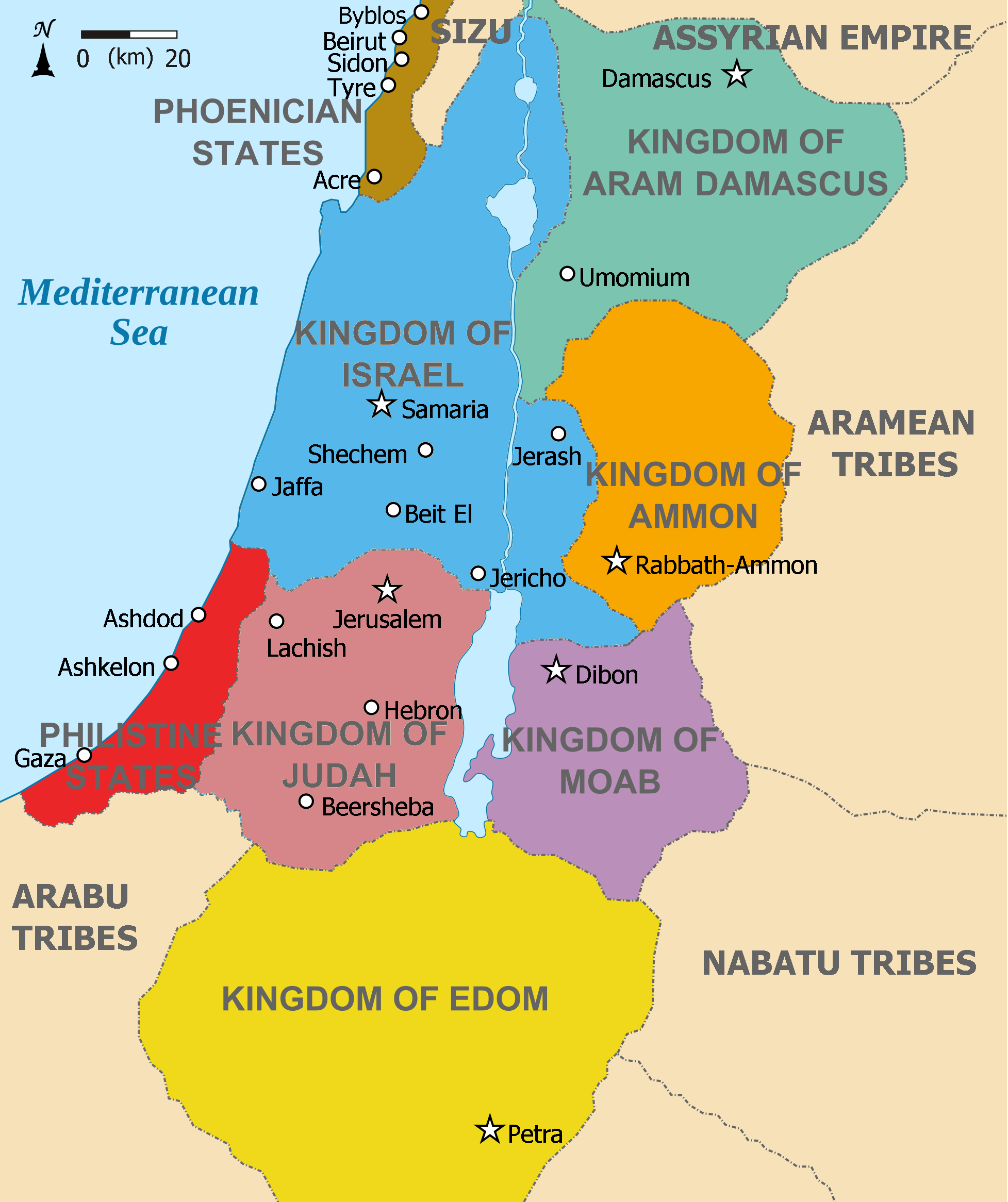
The region was among the earliest in the world to see human habitation, agricultural communities and civilization. In the late 4th millennium BCE, during the Early Bronze Age, there were areas of permanent Egyptian settlement in the southern Levant; land beyond these areas was inhabited by the Egyptians seasonally. The area of permanent settlement included Tell es-Sakan on the Mediterranean coast, which is the oldest known fortified Egyptian settlement and was likely the administrative centre of the region. During the Bronze Age, independent Canaanite city-states were established, and were influenced by the surrounding civilizations of ancient Egypt, Mesopotamia, Phoenicia, Minoan Crete, and Syria. Between 1550 and 1400BCE, the Canaanite cities became vassals to the Egyptian New Kingdom who held power until the 1178BCE Battle of Djahy (Canaan) during the wider Bronze Age collapse.
Three cities listed in the Egyptian Onomasticon of Amenope (c. 1100 BCE) - Gaza, Isdud (Ashdod) and Asqalan - are mentioned in association with a people named as Peleshet (Philistines). This is the first indication for the emergence of the Philistine pentapolis, five city-states each ruled by a king, and that for some 550 years, exercised some independence, even when subjected to overarching and alternating Egyptian or Assyrian imperial rule.
It is theorized that Israelites emerged from a dramatic social transformation that took place in the people of the central hill country of Canaan around 1200BCE, with no signs of violent invasion or even of peaceful infiltration of a clearly defined ethnic group from elsewhere. During the Iron Age, two related kingdoms, Israel and Judah emerge. The Kingdom of Israel emerged as an important local power by the 10th century BCE before falling to the Neo-Assyrian Empire in 722BCE. Israel's southern neighbor, the Kingdom of Judah, emerged in the 8th or 9th century BCE and later became a client state of first the Neo-Assyrian and then the Neo-Babylonian Empire before a revolt against the latter led to its destruction in 586BCE.
The region of Palestine as a whole became part of the Neo-Assyrian Empire from which was itself replaced by the Neo-Babylonian Empire in . In 587/6BCE, Jerusalem was besieged and destroyed by the second Babylonian king, Nebuchadnezzar II, who subsequently exiled the Judeans to Babylon. The Kingdom of Judah was then annexed as a Babylonian province. The Philistines were also exiled. The defeat of Judah was recorded by the Babylonians.
In 539BCE, the Babylonian empire was conquered by the Achaemenid Empire. According to the Hebrew Bible and implications from the Cyrus Cylinder, the exiled Jews were eventually allowed to return to Jerusalem. The returned population in Judah were allowed to self-rule under Persian governance, and some parts of the fallen kingdom became a Persian province known as Yehud. Except Yehud, at least another four Persian provinces existed in the region: Samaria, Gaza, Ashdod, and Ascalon, in addition to the Phoenician city states in the north and the Arabian tribes in the south. During the same period, the Edomites migrated from Transjordan to the southern parts of Judea, which became known as Idumaea. The Qedarites were the dominant Arab tribe; their territory ran from the Hejaz in the south to the Negev in the north through the period of Persian and Hellenistic dominion.
Classical antiquity
In the 330s BCE, Macedonian ruler Alexander the Great conquered the region, which changed hands several times during the wars of the Diadochi and later Syrian Wars. It ultimately fell to the Seleucid Empire between 219 and 200BCE. During that period, the region became heavily hellenized, building tensions between Greeks and locals.
In 167BCE, the Maccabean Revolt erupted, leading to the establishment of an independent Hasmonean Kingdom in Judea. From 110BCE, the Hasmoneans extended their authority over much of Palestine, including Samaria, Galilee, Iturea, Perea, and Idumea. The Jewish control over the wider region resulted in it also becoming known as Judaea, a term that had previously only referred to the smaller region of the Judaean Mountains. During the same period, the Edomites fully assimilated.
Between 73 and 63BCE, the Roman Republic extended its influence into the region in the Third Mithridatic War. Pompey conquered Judea in 63BCE, splitting the former Hasmonean Kingdom into five districts. In around 40BCE, the Parthians conquered Palestine, deposed the Roman ally Hyrcanus II, and installed a puppet ruler of the Hasmonean line known as Antigonus II. By 37BCE, the Parthians withdrew from Palestine.
Palestine is generally considered the "Cradle of Christianity". Christianity, a religion based on the life and teachings of Jesus of Nazareth, arose as a messianic sect from within Second Temple Judaism. The three-year Ministry of Jesus, culminating in his crucifixion, is estimated to have occurred from 28 to 30CE, although the historicity of Jesus is disputed by a minority of scholars.

In the first and second centuries CE, the province of Judea became the site of two large-scale Jewish revolts against Rome. During the First Jewish-Roman War, which lasted from 66 to 73CE, the Romans razed Jerusalem and destroyed the Second Temple. In Masada, Jewish zealots reportedly preferred to commit suicide than endure Roman captivity. In 132CE, another Jewish rebellion erupted. The Bar Kokhba revolt took three years to put down, incurred massive costs on both the Romans and the Jews, and desolated much of Judea. The center of Jewish life in Palestine moved to the Galilee. After the revolt, the Romans enacted a few punitive measures, including restrictions on Jewish religion and practice, and forbade Jews from inhabiting the area surrounding Jerusalem. The city was rebuilt as a Roman colony called Aelia Capitolina. Around this time, the Roman authorities renamed the province of Judaea as Syria Palaestina. Some scholars contend that this was intended to sever the symbolic and historical connection between the Jewish people and the land. Other interpretations have also been proposed.
Between 259 and 272, the region fell under the rule of Odaenathus as King of the Palmyrene Empire. Following the victory of Christian emperor Constantine in the Civil wars of the Tetrarchy, the Christianization of the Roman Empire began, and in 326, Constantine's mother Saint Helena visited Jerusalem and began the construction of churches and shrines. Palestine became a center of Christianity, attracting numerous monks and religious scholars. The Samaritan Revolts during this period caused their near extinction. In 614CE, Palestine was annexed by another Persian dynasty; the Sassanids, until returning to Byzantine control in 628CE.
Early Muslim period
Palestine was conquered by the Rashidun Caliphate, beginning in 634CE. In 636, the Battle of Yarmouk during the Muslim conquest of the Levant marked the start of Muslim hegemony over the region, which became known as the military district of Jund Filastin within the province of Bilâd al-Shâm (Greater Syria). In 661, with the Assassination of Ali, Muawiyah I became the Caliph of the Islamic world after being crowned in Jerusalem. The Dome of the Rock, completed in 691, was the world's first great work of Islamic architecture.
The majority of the population was Christian and was to remain so until the conquest of Saladin in 1187. The Muslim conquest apparently had little impact on social and administrative continuities for several decades. The word 'Arab' at the time referred predominantly to Bedouin nomads, though Arab settlement is attested in the Judean highlands and near Jerusalem by the 5th century, and some tribes had converted to Christianity. The local population engaged in farming, which was considered demeaning, and were called Nabaț, referring to Aramaic-speaking villagers. A ḥadīth, brought in the name of a Muslim freedman who settled in Palestine, ordered the Muslim Arabs not to settle in the villages, "for he who abides in villages it is as if he abides in graves".
The Umayyads, who had spurred a strong economic resurgence in the area, were replaced by the Abbasids in 750. Ramla became the administrative centre for the following centuries, while Tiberias became a thriving centre of Muslim scholarship. From 878, Palestine was ruled from Egypt by semi-autonomous rulers for almost a century, beginning with the Turkish freeman Ahmad ibn Tulun, for whom both Jews and Christians prayed when he lay dying and ending with the Ikhshidid rulers. Reverence for Jerusalem increased during this period, with many of the Egyptian rulers choosing to be buried there. However, the later period became characterized by persecution of Christians as the threat from Byzantium grew. The Fatimids, with a predominantly Berber army, conquered the region in 970, a date that marks the beginning of a period of unceasing warfare between numerous enemies, which destroyed Palestine, and in particular, devastating its Jewish population. Between 1071 and 1073, Palestine was captured by the Great Seljuq Empire, only to be recaptured by the Fatimids in 1098.
Crusader/Ayyubid period
The Fatimids again lost the region to the Crusaders in 1099. The Crusaders set up the Kingdom of Jerusalem (1099–1291). Their control of Jerusalem and most of Palestine lasted almost a century until their defeat by Saladin's forces in 1187, after which most of Palestine was controlled by the Ayyubids, except for the years 1229–1244 when Jerusalem and other areas were retaken by the Second Kingdom of Jerusalem, by then ruled from Acre (1191–1291), but, despite seven further crusades, the Franks were no longer a significant power in the region. The Fourth Crusade, which did not reach Palestine, led directly to the decline of the Byzantine Empire, dramatically reducing Christian influence throughout the region.
Mamluk period
The Mamluk Sultanate was created in Egypt as an indirect result of the Seventh Crusade. The Mongol Empire reached Palestine for the first time in 1260, beginning with the Mongol raids into Palestine under Nestorian Christian general Kitbuqa, and reaching an apex at the pivotal Battle of Ain Jalut, where they were pushed back by the Mamluks.
Ottoman period
In 1486, hostilities broke out between the Mamluks and the Ottoman Empire in a battle for control over western Asia, and the Ottomans conquered Palestine in 1516. Between the mid-16th and 17th centuries, a close-knit alliance of three local dynasties, the Ridwans of Gaza, the Turabays of al-Lajjun and the Farrukhs of Nablus, governed Palestine on behalf of the Porte (imperial Ottoman government).
In the 18th century, the Zaydani clan under the leadership of Daher al-Umar ruled large parts of Palestine autonomously until the Ottomans were able to defeat them in their Galilee strongholds in 1775–76. Daher had turned the port city of Acre into a major regional power, partly fueled by his monopolization of the cotton and olive oil trade from Palestine to Europe. Acre's regional dominance was further elevated under Daher's successor Ahmad Pasha al-Jazzar at the expense of Damascus.
In 1830, on the eve of Muhammad Ali's invasion, the Porte transferred control of the sanjaks of Jerusalem and Nablus to Abdullah Pasha, the governor of Acre. According to Silverburg, in regional and cultural terms this move was important for creating an Arab Palestine detached from greater Syria (bilad al-Sham). According to Pappe, it was an attempt to reinforce the Syrian front in face of Muhammad Ali's invasion. Two years later, Palestine was conquered by Muhammad Ali's Egypt, but Egyptian rule was challenged in 1834 by a countrywide popular uprising against conscription and other measures considered intrusive by the population. Its suppression devastated many of Palestine's villages and major towns.
In 1840, Britain intervened and returned control of the Levant to the Ottomans in return for further capitulations. The death of Aqil Agha marked the last local challenge to Ottoman centralization in Palestine, and beginning in the 1860s, Palestine underwent an acceleration in its socio-economic development, due to its incorporation into the global, and particularly European, economic pattern of growth. The beneficiaries of this process were Arabic-speaking Muslims and Christians who emerged as a new layer within the Arab elite. In the southern coastal plain, Palestinian villagers developed distinctive methods of cultivating sandy dunefields (rimāl) known as mawāṣī. These sunken-garden systems supported vineyards, figs, olives, and vegetables, and by the Late Ottoman period had transformed formerly marginal landscapes into productive agricultural zones.
From 1880 large-scale Jewish immigration began, almost entirely from Europe, based on an explicitly Zionist ideology. There was also a revival of the Hebrew language and culture.
Christian Zionism in the United Kingdom preceded its spread within the Jewish community. The government of Great Britain publicly supported it during World War I with the Balfour Declaration of 1917.
British Mandate period
Main article: Mandatory Palestine
| image-width=220
The British began their Sinai and Palestine Campaign in 1915. The war reached southern Palestine in 1917, progressing to Gaza and around Jerusalem by the end of the year. The British secured Jerusalem in December 1917. They moved into the Jordan valley in 1918 and a campaign by the Entente into northern Palestine led to victory at Megiddo in September.
The British were formally awarded the mandate to govern the region in 1922. The Arab Palestinians rioted in 1920, 1921, 1929, and revolted in 1936. In 1947, following World War II and The Holocaust, the British Government announced its desire to terminate the Mandate, and the United Nations General Assembly adopted in November 1947 a Resolution 181(II) recommending partition into an Arab state, a Jewish state and the Special International Regime for the City of Jerusalem. A civil war began immediately after the Resolution's adoption. The State of Israel was declared in May 1948.
Arab–Israeli conflict
In the 1948 Arab–Israeli War, Israel captured and incorporated a further 26% of the Mandate territory, Jordan captured the regions of Judea and Samaria, renaming it the "West Bank", while the Gaza Strip was captured by Egypt. Following the 1948 Palestinian expulsion and flight, also known as al-Nakba, the 700,000 Palestinians who fled or were driven from their homes were not allowed to return following the Lausanne Conference of 1949.
In the course of the Six-Day War in June 1967, Israel captured the rest of Mandate Palestine from Jordan and Egypt, and began a policy of establishing Jewish settlements in those territories. From 1987 to 1993, the First Palestinian Intifada against Israel took place, which included the Declaration of the State of Palestine in 1988 and ended with the 1993 Oslo Peace Accords and the creation of the Palestinian National Authority.
In 2000, the Second Intifada (also called al-Aqsa Intifada) began, and Israel built a separation barrier. In the 2005 Israeli disengagement from Gaza, Israel withdrew all settlers and military presence from the Gaza Strip, but maintained military control of numerous aspects of the territory including its borders, air space and coast. Israel's ongoing military occupation of the Gaza Strip, the West Bank and East Jerusalem continues to be the world's longest military occupation in modern times.
In 2008 Palestinian hikaye was inscribed to UNESCO's list of intangible cultural heritage; the first of four listings reflecting the significance of Palestinian culture globally.
In November 2012, the status of Palestinian delegation in the United Nations was upgraded to non-member observer state as the State of Palestine.
Boundaries
Pre-modern period
The boundaries of Palestine have varied throughout history. The Jordan Rift Valley (comprising Wadi Arabah, the Dead Sea and River Jordan) has at times formed a political and administrative frontier, even within empires that have controlled both territories. At other times, such as during certain periods during the Hasmonean and Crusader states for example, as well as during the biblical period, territories on both sides of the river formed part of the same administrative unit. During the Arab Caliphate period, parts of southern Lebanon and the northern highland areas of Palestine and Jordan were administered as Jund al-Urdun, while the southern parts of the latter two formed part of Jund Dimashq, which during the 9th century was attached to the administrative unit of Jund Filastin.
The boundaries of the area and the ethnic nature of the people referred to by Herodotus in the 5th century BCE as Palaestina vary according to context. Sometimes, he uses it to refer to the coast north of Mount Carmel. Elsewhere, distinguishing the Syrians in Palestine from the Phoenicians, he refers to their land as extending down all the coast from Phoenicia to Egypt. Pliny, writing in Latin in the 1st century CE, describes a region of Syria that was "formerly called Palaestina" among the areas of the Eastern Mediterranean.
Since the Byzantine Period, the Byzantine borders of Palaestina (I and II, also known as Palaestina Prima, "First Palestine", and Palaestina Secunda, "Second Palestine"), have served as a name for the geographic area between the Jordan River and the Mediterranean Sea. Under Arab rule, Filastin (or Jund Filastin) was used administratively to refer to what was under the Byzantines Palaestina Secunda (comprising Judaea and Samaria), while Palaestina Prima (comprising the Galilee region) was renamed Urdunn ("Jordan" or Jund al-Urdunn).
Modern period

Nineteenth-century sources refer to Palestine as extending from the sea to the caravan route, presumably the Hejaz-Damascus route east of the Jordan River valley. Others refer to it as extending from the sea to the desert. Prior to the Allied Powers victory in World War I and the partitioning of the Ottoman Empire, which created the British mandate in the Levant, most of the northern area of what is today Jordan formed part of the Ottoman Vilayet of Damascus (Syria), while the southern part of Jordan was part of the Vilayet of Hejaz. What later became Mandatory Palestine was in late Ottoman times divided between the Vilayet of Beirut (Lebanon) and the Sanjak of Jerusalem. The Zionist Organization provided its definition of the boundaries of Palestine in a statement to the Paris Peace Conference in 1919.
The British administered Mandatory Palestine after World War I, having promised to establish a homeland for the Jewish people. The modern definition of the region follows the boundaries of that entity, which were fixed in the North and East in 1920–23 by the British Mandate for Palestine (including the Transjordan memorandum) and the Paulet–Newcombe Agreement, and on the South by following the 1906 Turco-Egyptian boundary agreement.
Current usage
The region of Palestine is the eponym for the Palestinian people and the culture of Palestine, both of which are defined as relating to the whole historical region, usually defined as the localities within the border of Mandatory Palestine. The 1968 Palestinian National Covenant described Palestine as the "homeland of the Arab Palestinian people", with "the boundaries it had during the British Mandate".
However, since the 1988 Palestinian Declaration of Independence, the term State of Palestine refers only to the West Bank and the Gaza Strip. This discrepancy was described by the Palestinian president Mahmoud Abbas as a negotiated concession in a September 2011 speech to the United Nations: "... we agreed to establish the State of Palestine on only 22% of the territory of historical Palestine – on all the Palestinian Territory occupied by Israel in 1967."
The term Palestine is also sometimes used in a limited sense to refer to the parts of the Palestinian territories currently under the administrative control of the Palestinian National Authority, a quasi-governmental entity which governs parts of the State of Palestine under the terms of the Oslo Accords.
Administration
Demographics
Main article: Demographic history of Palestine
Early demographics
| Year | Jews | Christians | Muslims | Total |
|---|---|---|---|---|
| First half 1st century CE | Majority | – | – | ~2,500 |
| 5th century | Minority | Majority | – | 1st C |
| End 12th century | Minority | Minority | Majority | 225 |
| 14th century before Black Death | Minority | Minority | Majority | 225 |
| 14th century after Black Death | Minority | Minority | Majority | 150 |
| Historical population table compiled by Sergio DellaPergola. Figures in thousands. |
Estimating the population of Palestine in antiquity relies on two methods – censuses and writings made at the times, and the scientific method based on excavations and statistical methods that consider the number of settlements at the particular age, area of each settlement, density factor for each settlement.
The Bar Kokhba revolt in the 2nd century CE saw a major shift in the population of Palestine. The sheer scale and scope of the overall destruction has been described by Dio Cassius in his Roman History, where he notes that Roman war operations in the country had left some 580,000 Jews dead, with many more dying of hunger and disease, while 50 of their most important outposts and 985 of their most famous villages were razed to the ground. "Thus," writes Dio Cassius, "nearly the whole of Judaea was made desolate."
According to Israeli archaeologists Magen Broshi and Yigal Shiloh, the population of ancient Palestine did not exceed one million. By 300CE, Christianity had spread so significantly that Jews comprised only a quarter of the population.
Late Ottoman and British Mandate periods
In a study of Ottoman registers of the early Ottoman rule of Palestine, Bernard Lewis reports:[T]he first half century of Ottoman rule brought a sharp increase in population. The towns grew rapidly, villages became larger and more numerous, and there was an extensive development of agriculture, industry, and trade. The two last were certainly helped to no small extent by the influx of Spanish and other Western Jews.From the mass of detail in the registers, it is possible to extract something like a general picture of the economic life of the country in that period. Out of a total population of about 300,000 souls, between a fifth and a quarter lived in the six towns of Jerusalem, Gaza, Safed, Nablus, Ramle, and Hebron. The remainder consisted mainly of peasants, living in villages of varying size, and engaged in agriculture. Their main food-crops were wheat and barley in that order, supplemented by leguminous pulses, olives, fruit, and vegetables. In and around most of the towns there was a considerable number of vineyards, orchards, and vegetable gardens.
| Year | Jews | Christians | Muslims | Total |
|---|---|---|---|---|
| 1533–1539 | 5 | 6 | 145 | 157 |
| 1690–1691 | 2 | 11 | 219 | 232 |
| 1800 | 7 | 22 | 246 | 275 |
| 1890 | 43 | 57 | 432 | 532 |
| 1914 | 94 | 70 | 525 | 689 |
| 1922 | 84 | 71 | 589 | 752 |
| 1931 | 175 | 89 | 760 | 1,033 |
| 1947 | 630 | 143 | 1,181 | 1,970 |
| Historical population table compiled by Sergio DellaPergola. Figures in thousands. |
According to Alexander Scholch, the population of Palestine in 1850 was about 350,000 inhabitants, 30% of whom lived in 13 towns; roughly 85% were Muslims, 11% were Christians and 4% Jews.
According to Ottoman statistics studied by Justin McCarthy, the population of Palestine in the early 19th century was 350,000, in 1860 it was 411,000 and in 1900 about 600,000 of whom 94% were Arabs. In 1914 Palestine had a population of 657,000 Muslim Arabs, 81,000 Christian Arabs, and 59,000 Jews. McCarthy estimates the non-Jewish population of Palestine at 452,789 in 1882; 737,389 in 1914; 725,507 in 1922; 880,746 in 1931; and 1,339,763 in 1946.
In 1920, the League of Nations' Interim Report on the Civil Administration of Palestine described the 700,000 people living in Palestine as follows:{{blockquote|Of these, 235,000 live in the larger towns, 465,000 in the smaller towns and villages. Four-fifths of the whole population are Moslems. A small proportion of these are Bedouin Arabs; the remainder, although they speak Arabic and are termed Arabs, are largely of mixed race. Some 77,000 of the population are Christians, in large majority belonging to the Orthodox Church, and speaking Arabic. The minority are members of the Latin or of the Uniate Greek Catholic Church, or—a small number—are Protestants.
The Jewish element of the population numbers 76,000. Almost all have entered Palestine during the last 40 years. Prior to 1850, there were in the country only a handful of Jews. In the following 30 years, a few hundreds came to Palestine. Most of them were animated by religious motives; they came to pray and to die in the Holy Land, and to be buried in its soil. After the persecutions in Russia forty years ago, the movement of the Jews to Palestine assumed larger proportions.}}
Current demographics
According to the Israel Central Bureau of Statistics, , the total population of Israel was 8.5million people, of which 75% were Jews, 21% Arabs, and 4% "others". Of the Jewish group, 76% were Sabras (born in Israel); the rest were olim (immigrants)—16% from Europe, the former Soviet republics, and the Americas, and 8% from Asia and Africa, including the Arab countries.
According to the Palestinian Central Bureau of Statistics evaluations, in 2015 the Palestinian population of the West Bank was approximately 2.9million and that of the Gaza Strip was 1.8million.
Both Israeli and Palestinian statistics include Arab residents of East Jerusalem in their reports. According to these estimates the total population in the region of Palestine, as defined as Israel and the Palestinian territories, stands approximately 12.8million.
Flora and fauna
Main article: Biodiversity in Israel and Palestine
Flora distribution
The World Geographical Scheme for Recording Plant Distributions is widely used in recording the distribution of plants. The scheme uses the code "PAL" to refer to the region of Palestine – a Level 3 area. The WGSRPD's Palestine is further divided into Israel (PAL-IS), including the Palestinian territories, and Jordan (PAL-JO), so is larger than some other definitions of "Palestine". Flora Palaestina used essentially the same geographical area, but included the Golan Heights.
Birds
Main article: List of birds of Palestine
Notes
Citations
Bibliography
- {{Cite book| title = The Transformation of Palestine | editor-last = Abu-Lughod | editor-first = Ibrahim
- {{cite book | editor-last = Pappé | editor-first = Ilan
- {{cite book | editor1-last = Greenbaum | editor1-first = Charles W. | editor2-last = Veerman | editor2-first = Philip E. | editor3-last = Bacon-Shnoor | editor3-first = Naomi | chapter-url = https://books.google.com/books?id=9FTxoncXDwwC&pg=PA242
- {{cite book
- {{cite book
- {{citation
- {{cite news | author-link = Perry Anderson | access-date = 13 March 2015 | archive-date = 1 October 2018 | archive-url = https://web.archive.org/web/20181001124430/https://newleftreview.org/article/download_pdf?id=2330 | url-status = dead
- {{Cite book| title = The Claim of Dispossession
- {{cite book
- {{Cite book| title = The Population of Israel | author-link = Roberto Bachi
- {{Cite book| chapter = Early Sedentism in the Near East: A Bumpy Ride to Village Life | editor-last = Kuijt | editor-first = Ian
- {{cite book | editor1-last = Daly | editor1-first = Martin W. | editor2-last = Petry | editor2-first = Carl F. | chapter-url = https://books.google.com/books?id=Wk4X_d1sTjYC&pg=PA86
- {{Cite journal | title = Where was Palestine? pre-World War I perception
- {{cite book
- {{cite book
- {{cite book | author-link = James Henry Breasted
- {{cite journal | title = The Population of Western Palestine in the Roman-Byzantine Period
- {{cite book| title = A New Introduction to Islam | edition = 2nd
- {{cite book | url-status = dead | archive-url = https://web.archive.org/web/20160125135239/http://www.nhm.ac.uk/hosted_sites/tdwg/TDWG_geo2.pdf | archive-date = 25 January 2016
- {{cite book
- {{cite book
- {{Cite journal | title = Josephus and Population Numbers in First-century Palestine
- {{Cite book
- {{Cite book| title = Greco-Roman Culture and the Galilee of Jesus
- {{Cite book| title = Firearms: a Global History to 1700
- {{cite book
- {{cite book
- {{cite web | url-status = live | archive-url = https://web.archive.org/web/20141030154541/https://www.britishmuseum.org/explore/highlights/highlight_objects/me/c/cuneiform_nebuchadnezzar_ii.aspx | access-date = 30 October 2014 | archive-date = 30 October 2014
- {{citation | author-link = Sergio DellaPergola | url-status = dead | archive-url = https://web.archive.org/web/20161202023038/http://archive.iussp.org/Brazil2001/s60/S64_02_dellapergola.pdf | archive-date = 2 December 2016
- {{Cite book |chapter=The frontier of Egypt in the Early Bronze Age: preliminary soundings at Tell es-Sakan (Gaza Strip) |title=Archaeological Perspectives on the Transmission and Transformation of Culture in the Eastern Mediterranean |editor-first=Joanne |editor-last=Clarke |jstor-access=free
- {{Cite book| title = Rediscovering Palestine: merchants and peasants in Jabal Nablus 1700–1900
- {{citation| title = Canaanites and Philistines
- {{cite web | url-status = dead | archive-url = https://web.archive.org/web/20190505195611/https://www.livius.org/cg-cm/chronicles/abc5/jerusalem.html | access-date = 20 January 2019 | archive-date = 5 May 2019
- {{cite journal | url-access = subscription
- {{Cite book| title = Forged: writing in the name of God
- {{cite encyclopedia| title = Encyclopedia of Prehistory, Vol. 8: South and Southwest Asia | editor1-last = Ember | editor1-first = Melvin | editor1-link = Melvin Ember | editor2-last = Peregrine | editor2-first = Peter Neal | editor2-link = Peter N. Peregrine
- {{cite book | chapter-url = https://books.google.com/books?id=nNDpPqeDjo0C&pg=PA139
- {{Cite book| title = Dead Sea Scrolls and the Hasmonean State | author-link = Hanan Eshel
- {{cite book | editor-last = Katz | editor-first = Steven T.
- {{cite web | access-date = 4 September 2016 | archive-date = 8 June 2014 | archive-url = https://web.archive.org/web/20140608204943/http://www.pcbs.gov.ps/Portals/_Rainbow/Documents/gover_e.htm | url-status = dead
- {{cite book| title = The Negev: The Challenge of a Desert
- {{Cite book
- {{Cite book| title = Palestine and the Palestinians | edition = 2nd
- {{cite journal | title = Some Observations on the Name of Palestine
- {{cite book | author-link = Louis Feldman | orig-year = First published 1990 | chapter-url = https://books.google.com/books?id=pACJYw0bg3QC&pg=PA553
- {{Cite book| title = The Quest for the Historical Israel
- {{Cite book| title = The Bible Unearthed: Archaeology's New Vision of Ancient Israel and the Origin of Its Sacred Texts
- {{cite book | editor-last = Efthymiadis | editor-first = Stephanos | chapter-url = https://books.google.com/books?id=_MQEQOWFrAMC&pg=PA215
- {{cite news
- {{cite book
- {{Cite book| title = Jewish-Transjordanian Relations 1921–48: alliance of bars sinister
- {{cite news | access-date = 13 August 2015
- {{Cite journal | title = Palestine and Other Territorial Concepts in the 17th Century
- {{cite book
- {{cite book | author-link = Moshe Gil
- {{cite book | editor-last = Kushner | editor-first = David | chapter-url = https://books.google.com/books?id=XgRDT9wMUhYC&pg=PA188
- {{Cite book| title = Ottoman Palestine: 1800–1914: studies in economic and social history | editor-last = Gilbar | editor-first = Gad G.
- {{Cite book| title = The Routledge Atlas of the Arab-Israeli Conflict | author-link = Martin Gilbert
- {{cite book
- {{cite book
- {{cite book
- {{Cite book
- {{Cite book| title = Großer Atlas zur Weltgeschichte | edition = 2nd | trans-title = Atlas of World History
- {{Cite book
- {{Cite book| title = A Comparative Study of Thirty City-state Cultures: an investigation | editor-last = Hansen | editor-first = Mogens Herman
- {{Cite book| title = The Origins and Spread of Agriculture and Pastoralism in Eurasia
- {{Cite book| title = The Jewish People in Classical Antiquity: from Alexander to Bar Kochba
- {{cite book | author-link = Herodotus | editor-last = Rawlinson | editor-first = George | editor-link = George Rawlinson
- {{Cite web
- {{Cite book| title = Allenby and British Strategy in the Middle East, 1917–1919
- {{Cite book| title = Palestine Papers 1917–1922
- {{cite journal | title = Palestine and Israel
- {{citation
- {{cite web | access-date = 4 September 2016
- {{cite book | author-link1 = David Jobling | editor-last = Brett | editor-first = Mark G. | chapter-url = https://books.google.com/books?id=RfFRhC4FpZkC&pg=PA404
- {{Cite book| title = Religions of the Ancient World: a guide
- {{cite book
- {{Cite book
- {{Cite book| title = Studies on Ottoman Social and Political History
- {{cite book| title = Dilemmas of Attachment: Identity and Belonging among Palestinian Christians
- {{Cite book| title = Palestinian Identity. The Construction of Modern National Consciousness | author-link = Rashid Khalidi
- {{cite book | author-link = Rashid Khalidi | orig-year = 1st ed. 2001 | editor1-last = Rogan | editor1-first = Eugene L. | editor2-last = Shlaim | editor2-first = Avi | chapter-url = https://books.google.com/books?id=h3EOJGiBBpQC&pg=PR5
- {{Cite book| title = Biblical Peoples and Ethnicity: An Archaeological Study of Egyptians, Canaanites, Philistines and Early Israel 1300–1100 BC
- {{Cite book| title = Palestinians: The Making of a People
- {{cite book | author1-link = Baruch Kimmerling | author2-link = Joel S. Migdal
- {{Cite book
- {{citation
- {{Cite book| title = The Legal Aspects of the Palestine Problem with Special Regard to the Question of Jerusalem | author-link = Hans Köchler
- {{cite book
- {{cite journal | author-link = David Kretzmer
- {{Cite book| title = Fatah and the Politics of Violence: the institutionalization of a popular Struggle
- {{Cite book
- {{Cite journal | title = The Religion of Idumea and Its Relationship to Early Judaism | doi-access = free
- {{cite book
- {{cite journal | title = Studies in the Ottoman Archives—I
- {{Cite book| title = Islam in History: ideas, people and events in the Middle East | author-link = Bernard Lewis
- {{Cite journal | title = Features of the demography of Palestine
- {{Cite journal | title = The United Kingdom and the Beginning of the Mandates System, 1919–1922
- {{Cite EB1911 | author1-link = R. A. Stewart Macalister | author2-link = Stanley Arthur Cook | editor-last = Chisholm | editor-first = Hugh
- {{cite book
- {{cite book | author-link = Saree Makdisi
- {{Cite book | editor-last = Ben-Sasson | editor-first = Haim Hillel
- {{Cite book| title = The Arabs and Zionism Before World War I
- {{Cite book| title = Protection, conservation and valorisation of Palestinian Cultural Patrimony | author-link = Fabio Maniscalco
- {{Cite book
- {{cite book | author-link = Nur Masalha
- {{cite book| title = The Population of Palestine
- {{cite book | editor-last = Metz | editor-first = Helen Chapin | editor-link = Helen Chapin Metz
- {{Cite book| title = The Divided Economy of Mandatory Palestine
- {{cite book
- {{Cite book| title = Mercer Dictionary of the Bible
- {{cite news | url-status = live | archive-url = https://web.archive.org/web/20121207082503/http://www.israelnationalnews.com/News/News.aspx/162844 | access-date = 8 June 2014 | archive-date = 7 December 2012
- {{cite book | author-link = Benny Morris | orig-year = First published 1999
- {{cite book| chapter = Jews in Iran | editor-last = Yarshater | editor-first = Ehsan
- {{Cite book| chapter = The Christian Communities, religion, politics and church-state relations in Jerusalem: an historical survey
- {{citation
- {{cite news | access-date = 29 November 2012
- {{cite book | author-link = Ilan Pappé | chapter-url = https://books.google.com/books?id=zAJZCKAwtPMC&pg=PR5
- {{cite book | author-link = Ilan Pappe
- {{Cite book| title = Land and Economy in Ancient Palestine
- {{cite book
- {{cite web | access-date = 4 September 2016
- {{Cite book| title = The Emergence of the Palestinian-Arab National Movement, 1918–1929
- {{Cite book| chapter = Bitter Lives: Israel in and out of Egypt | editor-last = Coogan | editor-first = Michael D.
- {{Cite book| title = Physical geography of the Holy Land
- {{Cite book| title = Frontiers of the State in the Late Ottoman Empire: Transjordan, 1850–1921
- {{Cite book
- {{Cite book| title = Lithics After the Stone Age: a handbook of stone tools from the Levant
- {{Cite book| title = A History of Israel: from the rise of Zionism to our time | edition = 2nd | author-link = Howard Sachar
- {{cite book | author-link = Edward Said
- {{cite book| title = Blaming the Victims: spurious scholarship and the Palestinian Question | author1-link = Edward Said
- {{cite book
- {{cite book| title = The Modern History of Jordan
- {{cite book | editor1-last = Schmitt | editor1-first = M.N. | editor2-last = Arimatsu | editor2-first = Louise | editor3-last = McCormack | editor3-first = Tim | chapter-url = https://books.google.com/books?id=hYiIWVlpFzEC&pg=PA429
- {{cite book
- {{Cite book
- {{Cite book| title = Tel Aviv: From Dream to City
- {{Cite book| chapter = Population Characteristics of Jerusalem and Hebron Regions According to Ottoman Census of 1905 | editor-last = Gilbar | editor-first = Gar G
- {{cite journal | title = The Demographic Development of Palestine 1850–1882
- {{cite book | author-link = Eberhard Schrader
- {{cite book | editor-first = John J. | editor-last = Collins | editor2-first = J.G. | editor2-last = Manning
- {{cite book | author-link = Iain Scobbie | editor-last = Wilmshurst | editor-first = Elizabeth
- {{cite book | author-link = Tom Segev | orig-year = Original in 2000 | chapter-url = https://books.google.com/books?id=XvT8CWv2DakC&pg=PA127
- {{cite book| title = A History of the Crusades | editor-last = Setton | editor-first = Kenneth
- {{Cite book| title = Palestine: a Guide
- {{cite book| title = Israel a history, translated from Hebrew by Anthony Berris
- {{Cite book
- {{cite journal | title = The Population of Iron Age Palestine in the Light of a Sample Analysis of Urban Plans, Areas, and Population Density
- {{Cite book| title = Reshaping Palestine: from Muhammad Ali to the British Mandate, 1831–1922
- {{Cite book| chapter = Diplomatic Recognition of States in statu nascendi: The Case of Palestine | editor-last = Silverburg | editor-first = Sanford R.
- {{cite book| title = Palestine in Late Antiquity
- {{cite book | author-link = Morton Smith | chapter-url = https://books.google.com/books?id=MA-4VX5gWS4C&pg=PA210
- {{cite news | archive-url = https://web.archive.org/web/20130110025703/http://news.yahoo.com/state-palestine-name-change-shows-limitations-200641448.html | archive-date = 10 January 2013
- {{cite journal
- {{cite book
- {{Cite web | access-date = 28 February 2022
- {{cite book
- {{cite book | editor1-last = Tucker | editor1-first = Spencer C. | editor1-link = Spencer C. Tucker | editor2-last = Roberts | editor2-first = Priscilla
- {{cite news | access-date = 22 January 2013
- {{cite book| title = The True Herod | author-link = Géza Vermes
- {{Cite book| chapter = Production, exchange and regional trade in the Islamic Wast Mediterranean: old structures, new systems? | editor1-last = Hansen | editor1-first = Inge Lyse | editor2-last = Wickham | editor2-first = Chris
- {{cite book
- {{Cite book| chapter = The Nabataeans in History (Before AD 106) | editor-last = Politis | editor-first = Konstantinos D
- {{cite book
- {{cite book | author-link = Mahmoud Yazbak
- {{citation| title = An Ottoman century: the district of Jerusalem in the 1600s
References
- Publishing, Britannica Educational. (1 October 2010). "Historic Palestine, Israel, and the Emerging Palestinian Autonomous Areas". Britannica Educational Publishing.
- (7 November 2017). "From Shared Life to Co-Resistance in Historic Palestine". Rowman & Littlefield.
- Domínguez de Olazábal, Itxaso. (3 October 2022). "On Indigenous Refusal against Externally-Imposed Frameworks in Historic Palestine". Millennium: Journal of International Studies.
- Bosworth, Edmund. (1986-01-01). "The land of Palestine in the late Ottoman period as mirrored in Western guide books". British Journal of Middle Eastern Studies.
- Farag, Joseph R.. (2021-05-04). "Beyond the land of Palestine: deserts, shores, seas". Middle Eastern Literatures.
- Edgley, Thomas. (1710). "A Sermon, Preach'd at Exon, May 10th, 1710. Before an Assembly of the United Ministers of Devon and Cornwall: Publish'd at the Request of Many of the Auditory". Jos. Bliss.
- Zissu, Boaz. (2018). "Jews and Christians in the First and Second Centuries: The Interbellum 70‒132 CE". BRILL.
- Jones, A.H.M.. (1971). "The Cities of the Eastern Roman Provinces". Oxford.
- Applebaum, Shimon. (1989). "Judaea in Hellenistic and Roman Times". Brill.
- (2004). "Teaching about Genocide: Issues, Approaches, and Resources". [[Greenwich, CT]]: [[Information Age Publishing]] / [[Leeds]]: [[Emerald Publishing Limited]].
- (2025-06-17). "The Forgotten History of the Term "Palestine" {{!}} Hudson Institute".
- Lehmann, Clayton Miles. (Summer 1998). "Palestine: History: 135–337: Syria Palaestina and the Tetrarchy". University of South Dakota.
- Magness, Jodi. (2013). "The Archaeology of the Holy Land: From the Destruction of Solomon's Temple to the Muslim Conquest". Cambridge University Press.
- Louis H. Feldman, whose view differs from that of Robinson, thinks that Josephus, when referring to ''Palestine'', had in mind only the coastal region, writing: "Writers on geography in the first century [CE] clearly differentiate Judaea from Palestine. ...{{spacesJewish writers, notably [[Philo]] and [[Josephus]], with few exceptions refer to the land as ''Judaea'', reserving the name ''Palestine'' for the coastal area occupied [formerly] by the Philistines." (END QUOTE). See: p. 1 in: {{harv. Feldman. 1990
- Eshel, Hanan. (2006). "The Bar Kochba Revolt, 132–135". Cambridge University Press.
- {{harvnb. Eck. 1999
- Robinson, 1865, p.15: "Palestine, or Palestina, now the most common name for the Holy Land, occurs three times in the English version of the Old Testament; and is there put for the [[Hebrew]] name פלשת, elsewhere rendered Philistia. As thus used, it refers strictly and only to the country of the [[Philistines]], in the southwest corner of the land. So, too, in the Greek form, Παλαςτίνη, it is used by [[Josephus]]. But both Josephus and [[Philo]] apply the name to the whole land of the Hebrews; and Greek and Roman writers employed it in the like extent."
- Beloe, W.. (1821). "Herodotus, Vol.II".
- "Palestine and Israel", David M. Jacobson, ''Bulletin of the American Schools of Oriental Research'', No. 313 (February 1999), pp. 65–74; "The Southern and Eastern Borders of Abar-Nahara," Steven S. Tuell, ''Bulletin of the American Schools of Oriental Research'', No. 284 (November 1991), pp. 51–57; "Herodotus' Description of the East Mediterranean Coast", Anson F. Rainey, ''Bulletin of the American Schools of Oriental Research'', No. 321 (February 2001), pp. 57–63; [http://classics.mit.edu/Herodotus/history.mb.txt Herodotus, ''Histories'']
- {{harvnb. Drews. 1998. grc. Παλαιστίνοι, and the toponym פְּלִשְׁתִּ as Παλαιστίνη. Instead, they avoided the toponym altogether, turning it into an ethnonym. As for the ethnonym, they chose sometimes to transliterate it (incorrectly aspirating the initial letter, perhaps to compensate for their inability to aspirate the sigma) as {{lang. grc. φυλιστιιμ, a word that looked exotic rather than familiar, and more often to translate it as ά{{lang. grc. άλλόφυλοι. Jerome followed the LXX's lead in eradicating the names, 'Palestine' and 'Palestinians', from his Old Testament, a practice adopted in most modern translations of the Bible."
- {{harvnb. Drews. 1998. grc. άλλόφυλοι is significant here. Not a proper name at all, allophyloi is a generic term, meaning something like 'people of other stock'. If we assume, as I think we must, that with their word allophyloi the translators of the LXX tried to convey in Greek what p'lištîm had conveyed in Hebrew, we must conclude that for the worshippers of Yahweh p'lištîm and b'nê yiśrā'ēl were mutually exclusive terms, p'lištîm (or allophyloi) being tantamount to 'non-Judaeans of the Promised Land' when used in a context of the third century BCE, and to 'non-Israelites of the Promised Land' when used in a context of Samson, Saul and David. Unlike an ethnonym, the noun פְּלִשְׁתִּים normally appeared without a definite article."
- Marshall Cavendish, 2007, p. 559.
- {{harvnb. Tamari. 2011
- Assaf Yasur-Landau. (2014). "The Philistines and Aegean Migration at the End of the Late Bronze Age". Cambridge University Press.
- (2000). "A Comparative Study of Thirty City-state Cultures: An Investigation". Kgl. Danske Videnskabernes Selskab.
- David F. Graf, 'Petra and the Nabataeans in the Early Hellenistic Period: the literary and archaeological evidence,' in Michel Mouton, Stephan G. Schmid (eds.), [https://books.google.com/books?id=bpWGAgAAQBAJ&pg=PA48 ''Men on the Rocks: The Formation of Nabataean Petra''], Logos Verlag Berlin GmbH, 2013 pp.35–55 pp.47–48: 'the Idumean texts indicate that a large portion of the community in southern Palestine were Arabs, many of whom have names similar to those in the "Nabataean" onomasticon of later periods.' (p.47).
- "Founded in the years 22-10 or 9 B.C. by Herod the Great, close to the ruins of a small Phoenician naval station named Strato's Tower (Stratonos Pyrgos, Turns Stratonis), which flourished during the 3d to 1st c. B.C. This small harbor was situated on the N part of the site. Herod dedicated the new town and its port (''limen Sebastos'') to [[Caesar Augustus]]. During the Early Roman period Caesarea was the seat of the Roman procurators of the province of Judea. Vespasian, proclaimed emperor at Caesarea, raised it to the rank of Colonia Prima Flavia Augusta, and later Alexander Severus raised it to the rank of Metropolis Provinciae Syriae Palestinae." A. Negev, "CAESAREA MARITIMA Palestine, Israel" in: Richard Stillwell et al. (eds.), ''The Princeton Encyclopedia of Classical Sites'' (1976).
- Ben-Sasson, p.226, "The name Judea no longer referred only to{{spaces..."
- {{harvnb. Schäfer. 2003. Meyers. Chancey. 2012
- Eshel, Hanan. (2006). "The Bar Kochba Revolt, 132–135". Cambridge University Press.
- Greatrex-Lieu (2002), II, 196
- Brown, 2011, p. 122: 'the first great Islamic architectural achievement.'
- O'Mahony, 2003, p. 14: 'Before the Muslim conquest, the population of Palestine was overwhelmingly Christian, albeit with a sizeable Jewish community.'
- [[Christopher Tyerman]], ''God's War: A New History of the Crusades'' (Penguin: 2006), pp. 201–202
- (2024). "Ḥamāma: The Palestinian Countryside in Bloom (1750–1948)". Journal of Islamic Archaeology.
- (2025). "Vines Among the Dunes: Sand/Dune Agriculture in Rimāl Isdūd/Ashdod-Yam during the Late Ottoman and British Mandate Periods". Contemporary Levant.
- (30 November 2020). "Żeby nie zapomnieć {{!}} Tygodnik Powszechny".
- Rivoal, Isabelle. (1 January 2001). "Susan Slyomovics, The Object of Memory. Arabs and Jews Narrate the Palestinian Village". L'Homme. Revue française d'anthropologie.
- [[Pliny the Elder. Pliny]], ''[[Natural History (Pliny). Natural History]]'' V.66 and 68.
- ''Dio's Roman History'' (trans. Earnest Cary), vol. 8 (books 61–70), [[Loeb Classical Library]]: London 1925, pp. [https://archive.org/stream/diosromanhistory08cassuoft#page/448/mode/2up 449]–[https://archive.org/stream/diosromanhistory08cassuoft#page/450/mode/2up 451]
- (2015). "Flora Palaestina". The Israel Academy of Sciences and Humanities.
This article was imported from Wikipedia and is available under the Creative Commons Attribution-ShareAlike 4.0 License. Content has been adapted to SurfDoc format. Original contributors can be found on the article history page.
Ask Mako anything about Palestine (region) — get instant answers, deeper analysis, and related topics.
Research with MakoFree with your Surf account
Create a free account to save articles, ask Mako questions, and organize your research.
Sign up freeThis content may have been generated or modified by AI. CloudSurf Software LLC is not responsible for the accuracy, completeness, or reliability of AI-generated content. Always verify important information from primary sources.
Report