From Surf Wiki (app.surf) — the open knowledge base
Palearctic realm
Biogeographic realm covering most of Eurasia

Biogeographic realm covering most of Eurasia
The Palearctic (or Palaearctic) is the world's largest biogeographic realm. Confined almost entirely to the Eastern Hemisphere, it stretches across Europe and Asia, north of the foothills of the Himalayas, and North Africa.
The realm consists of several bioregions: the Mediterranean Basin; North Africa; North Arabia; Western, Central, South and East Asia. The Palaearctic realm also has numerous rivers and lakes, forming several freshwater ecoregions.
Both the eastern and westernmost extremes of the Paleartic span into the Western Hemisphere, including Cape Dezhnyov in Chukotka Autonomous Okrug to the east and Iceland to the west. The term was first used in the 19th century, and is still in use as the basis for zoogeographic classification.
History
In an 1858 paper for the Proceedings of the Linnean Society, British zoologist Philip Sclater first identified six terrestrial zoogeographic realms of the world: Palaearctic, Aethiopian/Afrotropic, Indian/Indomalayan, Australasian, Nearctic, and Neotropical. The six indicated general groupings of fauna, based on shared biogeography and large-scale geographic barriers to migration.
Alfred Wallace adopted Sclater's scheme for his book The Geographical Distribution of Animals, published in 1876. This is the same scheme that persists today, with relatively minor revisions, and the addition of two more realms: Oceania and the Antarctic.
Major ecological regions
The Palearctic realm includes mostly boreal/subarctic-climate and temperate-climate ecoregions, which stretch from western Europe to the Bering Sea.
Euro-Siberian region
The boreal and temperate Euro-Siberian region is the Palearctic's largest biogeographic region, which transitions from tundra in the northern reaches of Russia and Scandinavia to the vast taiga, the boreal coniferous forests which run across the continent. South of the taiga is a belt of temperate broadleaf and mixed forests and temperate coniferous forests. This vast Euro-Siberian region is characterized by many shared plant and animal species, and has many affinities with the temperate and boreal regions of the Nearctic realm of North America. Eurasia and North America were often connected by the Bering land bridge, and have very similar mammal and bird fauna, with many Eurasian species having moved into North America, and fewer North American species having moved into Eurasia. Many zoologists consider the Palearctic and Nearctic to be a single Holarctic realm. The Palearctic and Nearctic also share many plant species, which botanists call the Arcto-Tertiary Geoflora.
Mediterranean Basin
Main article: Mediterranean Basin
The lands bordering the Mediterranean Sea in southern Europe, north Africa, and western Asia are home to the Mediterranean Basin ecoregions, which together constitute the world's largest and most diverse mediterranean climate region of the world, with generally mild, rainy winters and hot, dry summers. The Mediterranean basin's mosaic of Mediterranean forests, woodlands, and scrub are home to 13,000 endemic species. The Mediterranean basin is also one of the world's most endangered biogeographic regions; only 4% of the region's original vegetation remains, and human activities, including overgrazing, deforestation, and conversion of lands for pasture, agriculture, and urbanization, have degraded much of the region. Formerly the region was mostly covered with forests and woodlands, but heavy human use has reduced much of the region to the sclerophyll shrublands known as chaparral, matorral, maquis, or garrigue. Conservation International has designated the Mediterranean basin as one of the world's biodiversity hotspots.
Sahara and Arabian deserts
A great belt of deserts, including the Atlantic coastal desert, Sahara Desert, and Arabian Desert, separates the Palearctic and Afrotropic ecoregions. This scheme includes these desert ecoregions in the palearctic realm; other biogeographers identify the realm boundary as the transition zone between the desert ecoregions and the Mediterranean basin ecoregions to the north, which places the deserts in the Afrotropic, while others place the boundary through the middle of the desert.
Western and Central Asia
The Caucasus mountains, which run between the Black Sea and the Caspian Sea, are a particularly rich mix of coniferous, broadleaf, and mixed forests, and include the temperate rain forests of the Euxine-Colchic deciduous forests ecoregion.
Central Asia and the Iranian plateau are home to dry steppe grasslands and desert basins, with montane forests, woodlands, and grasslands in the region's high mountains and plateaux. In southern Asia the boundary of the Palearctic is largely altitudinal. The middle altitude foothills of the Himalaya between about 2000–2500 m form the boundary between the Palearctic and Indomalaya ecoregions.
East Asia
China, Korea and Japan are more humid and temperate than adjacent Siberia and Central Asia, and are home to rich temperate coniferous, broadleaf, and mixed forests, which are now mostly limited to mountainous areas, as the densely populated lowlands and river basins have been converted to intensive agricultural and urban use. East Asia's temperate forests are rich in biodiversity, with 185 tree genera compared to 53 in Europe and 99 in Eastern North America. East Asia lost fewer tree genera during the ice ages than other temperate forest regions, and retained 96 percent of the tree genera in the Pliocene fossil record while Europe retained only 27 percent. In the subtropical region of southern China and southern edge of the Himalayas, the Palearctic temperate forests transition to the subtropical and tropical forests of Indomalaya, creating a rich and diverse mix of plant and animal species. The mountains of southwest China are also designated as a biodiversity hotspot. In Southeastern Asia, high mountain ranges form tongues of Palearctic flora and fauna in northern Indochina and southern China. Isolated small outposts (sky islands) occur as far south as central Myanmar (on Nat Ma Taung, 3050 m), northernmost Vietnam (on Fan Si Pan, 3140 m) and the high mountains of Taiwan.
Freshwater
The realm contains several important freshwater ecoregions as well, including the heavily developed rivers of Europe, the rivers of Russia, which flow into the Arctic, Baltic, Black, and Caspian seas, Siberia's Lake Baikal, the oldest and deepest lake on the planet, and Japan's ancient Lake Biwa.
Flora and fauna
One bird family, the accentors (Prunellidae), is endemic to the Palearctic region. The Holarctic has four other endemic bird families: the divers or loons (Gaviidae), grouse (Tetraoninae), auks (Alcidae), and waxwings (Bombycillidae).
There are no endemic mammal orders in the region, but several families are endemic: Calomyscidae (mouse-like hamsters), Prolagidae, and Ailuridae (red pandas). Several mammal species originated in the Palearctic and spread to the Nearctic during the Ice Age, including the brown bear (Ursus arctos, known in North America as the grizzly), red deer (Cervus elaphus) in Europe and the closely related elk (Cervus canadensis) in far eastern Siberia, American bison (Bison bison), and reindeer (Rangifer tarandus, known in North America as the caribou).
Megafaunal extinctions
Several large Palearctic animals became extinct from the end of the Pleistocene into historic times, including Irish elk (Megaloceros giganteus), aurochs (Bos primigenius), woolly rhinoceros (Coelodonta antiquitatis), woolly mammoth (Mammuthus primigenius), North African elephant (Loxodonta africana pharaoensis), Chinese elephant (Elephas maximus rubridens), cave bear (Ursus spelaeus), Straight tusked elephant (Palaeoloxodon antiquus) and European lion (Panthera leo europaea).
Palearctic terrestrial ecoregions
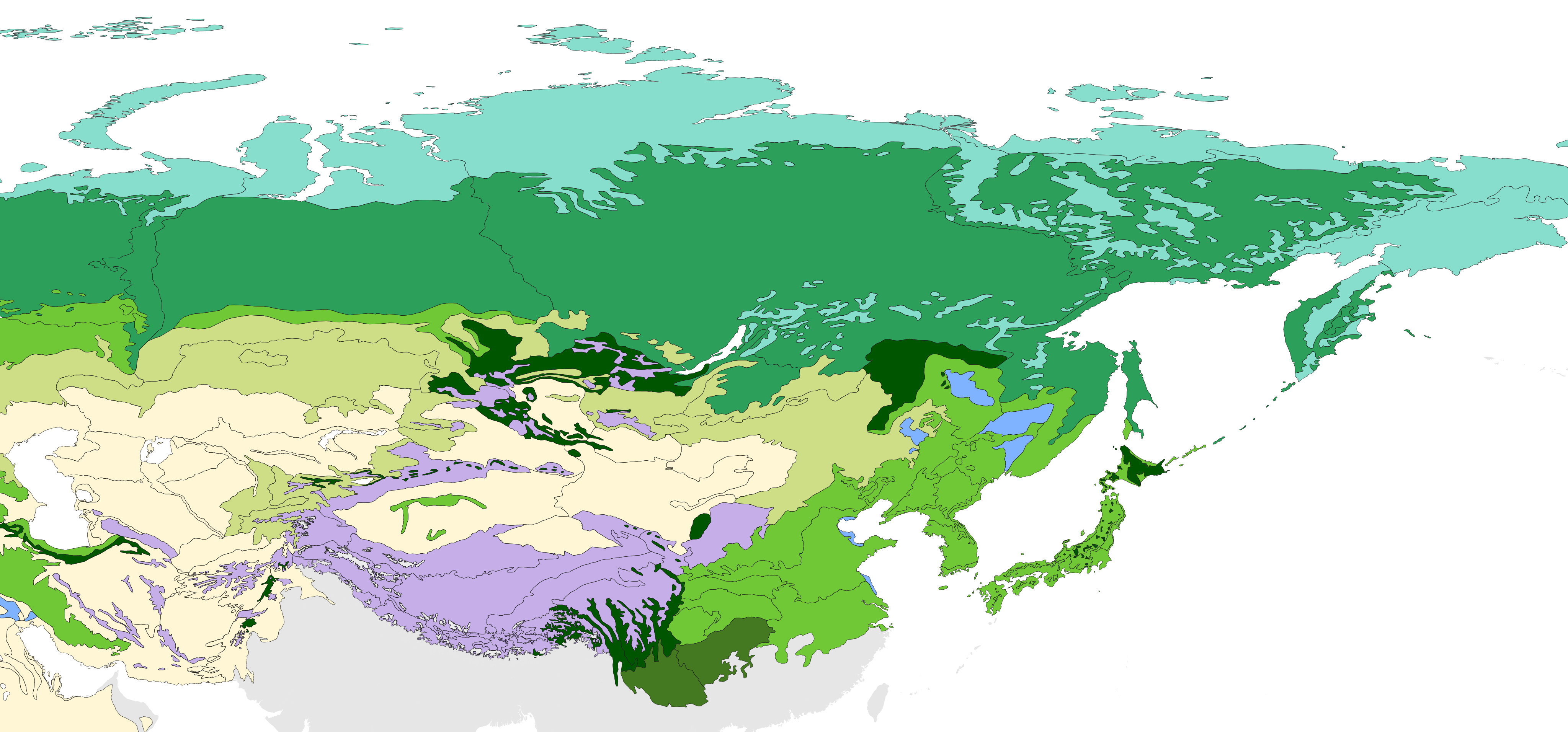

]]
| Palearctic temperate broadleaf and mixed forests |
|---|
| Apennine deciduous montane forests |
| Atlantic mixed forests |
| Azores temperate mixed forests |
| Balkan mixed forests |
| Baltic mixed forests |
| Cantabrian mixed forests |
| Caspian Hyrcanian mixed forests |
| Caucasus mixed forests |
| Celtic broadleaf forests |
| Central Anatolian deciduous forests |
| Central China loess plateau mixed forests |
| Central European mixed forests |
| Central Korean deciduous forests |
| Changbai Mountains mixed forests |
| Changjiang Plain evergreen forests |
| Crimean Submediterranean forest complex |
| Daba Mountains evergreen forests |
| Dinaric Mountains mixed forests |
| East European forest steppe |
| Eastern Anatolian deciduous forests |
| English Lowlands beech forests |
| Euxine–Colchic deciduous forests |
| Hokkaido deciduous forests |
| Huang He Plain mixed forests |
| Madeira evergreen forests |
| Manchurian mixed forests |
| Nihonkai evergreen forests |
| Nihonkai montane deciduous forests |
| North Atlantic moist mixed forests |
| Northeast China Plain deciduous forests |
| Pannonian mixed forests |
| Po Basin mixed forests |
| Pyrenees conifer and mixed forests |
| Qin Ling Mountains deciduous forests |
| Rodope montane mixed forests |
| Sarmatic mixed forests |
| Sichuan Basin evergreen broadleaf forests |
| South Sakhalin–Kurile mixed forests |
| Southern Korea evergreen forests |
| Taiheiyo evergreen forests |
| Taiheiyo montane deciduous forests |
| Tarim Basin deciduous forests and steppe |
| Ussuri broadleaf and mixed forests |
| West Siberian broadleaf and mixed forests |
| Western European broadleaf forests |
| Zagros Mountains forest steppe |
| Palearctic deserts and xeric shrublands |
|---|
| Afghan Mountains semi-desert |
| Alashan Plateau semi-desert |
| Arabian Desert |
| Atlantic coastal desert |
| Azerbaijan shrub desert and steppe |
| Badghyz and Karabil semi-desert |
| Baluchistan xeric woodlands |
| Caspian lowland desert |
| Central Afghan Mountains xeric woodlands |
| Central Asian northern desert |
| Central Asian riparian woodlands |
| Central Asian southern desert |
| Central Persian desert basins |
| Eastern Gobi desert steppe |
| Gobi Lakes Valley desert steppe |
| Great Lakes Basin desert steppe |
| Junggar Basin semi-desert |
| Kazakh semi-desert |
| Kopet Dag semi-desert |
| Mesopotamian shrub desert |
| North Saharan steppe and woodlands |
| Paropamisus xeric woodlands |
| Persian Gulf desert and semi-desert |
| Qaidam Basin semi-desert |
| Red Sea coastal desert |
| Red Sea Nubo–Sindian tropical desert and semi-desert |
| Registan–North Pakistan sandy desert |
| Sahara desert |
| South Iran Nubo–Sindian desert and semi-desert |
| South Saharan steppe and woodlands |
| Taklimakan desert |
| Tibesti–Jebel Uweinat montane xeric woodlands |
| West Saharan montane xeric woodlands |
References
Sources
- Amorosi, T. "Contributions to the zooarchaeology of Iceland: some preliminary notes" in The Anthropology of Iceland (eds. E.P. Durrenberger & G. Pálsson). Iowa City: University of Iowa Press, pp. 203–227, 1989.
- Buckland, P.C., et al. "Holt in Eyjafjasveit, Iceland: a paleoecological study of the impact of Landnám" in Acta Archaeologica 61: pp. 252–271. 1991.
- Edmund Burke III, "The Transformation of the middle Eastern Environment, 1500 B.C.E.–2000 C.E." in The Environment and World History, ed. Edmund Burke III and Kenneth Pomeranz. Berkeley: University of California Press. 2009, 82–84.
References
- Sclater, Philip Lutley. (1858). "On the general geographical distribution of the members of the class Aves". Zoological Journal of the Linnean Society.
- Latham, R.E. & Ricklefs, R.E. (1993a). Continental comparison of temperate-zone tree species richness. In: ''Species Diversity in Ecological Communities: Historical and Geographical Perspectives'' (eds Ricklefs, R.E. & Schluter, D.). The University of Chicago Press, Chicago, pp. 294–314.
- Olson, D. M., Dinerstein, E., Wikramanayake, E. D., Burgess, N. D., Powell, G. V. N., Underwood, E. C., D'Amico, J. A., Itoua, I., Strand, H. E., Morrison, J. C., Loucks, C. J., Allnutt, T. F., Ricketts, T. H., Kura, Y., Lamoreux, J. F., Wettengel, W. W., Hedao, P., Kassem, K. R. (2001). Terrestrial ecoregions of the world: a new map of life on Earth. ''Bioscience'' 51(11):933–938, [http://wolfweb.unr.edu/~ldyer/classes/396/olsonetal.pdf] {{Webarchive. link. (2012-09-17.)
- Eric Dinerstein, David Olson, et al. (2017). An Ecoregion-Based Approach to Protecting Half the Terrestrial Realm, BioScience, Volume 67, Issue 6, June 2017, Pages 534–545 [https://doi.org/10.1093/biosci/bix014]
This article was imported from Wikipedia and is available under the Creative Commons Attribution-ShareAlike 4.0 License. Content has been adapted to SurfDoc format. Original contributors can be found on the article history page.
Ask Mako anything about Palearctic realm — get instant answers, deeper analysis, and related topics.
Research with MakoFree with your Surf account
Create a free account to save articles, ask Mako questions, and organize your research.
Sign up freeThis content may have been generated or modified by AI. CloudSurf Software LLC is not responsible for the accuracy, completeness, or reliability of AI-generated content. Always verify important information from primary sources.
Report