From Surf Wiki (app.surf) — the open knowledge base
Outer Space Treaty
Basis of international space law
Basis of international space law
| Field | Value |
|---|---|
| name | Outer Space Treaty |
| long_name | Treaty on Principles Governing the Activities of States in the Exploration and Use of Outer Space, including the Moon and Other Celestial Bodies |
| image | Outer Space Treaty parties.svg |
| caption | |
| image_width | 350px |
| date_signed | 27 January 1967 |
| location_signed | London, Moscow and Washington, D.C. |
| date_effective | |
| condition_effective | 5 ratifications, including the depositary Governments |
| parties | 118 |
| depositor | Governments of the United Kingdom of Great Britain and Northern Ireland, the Union of Soviet Socialist Republics and the United States of America |
| languages | English, French, Russian, Spanish, Chinese and Arabic |
| wikisource | Outer Space Treaty of 1967 |
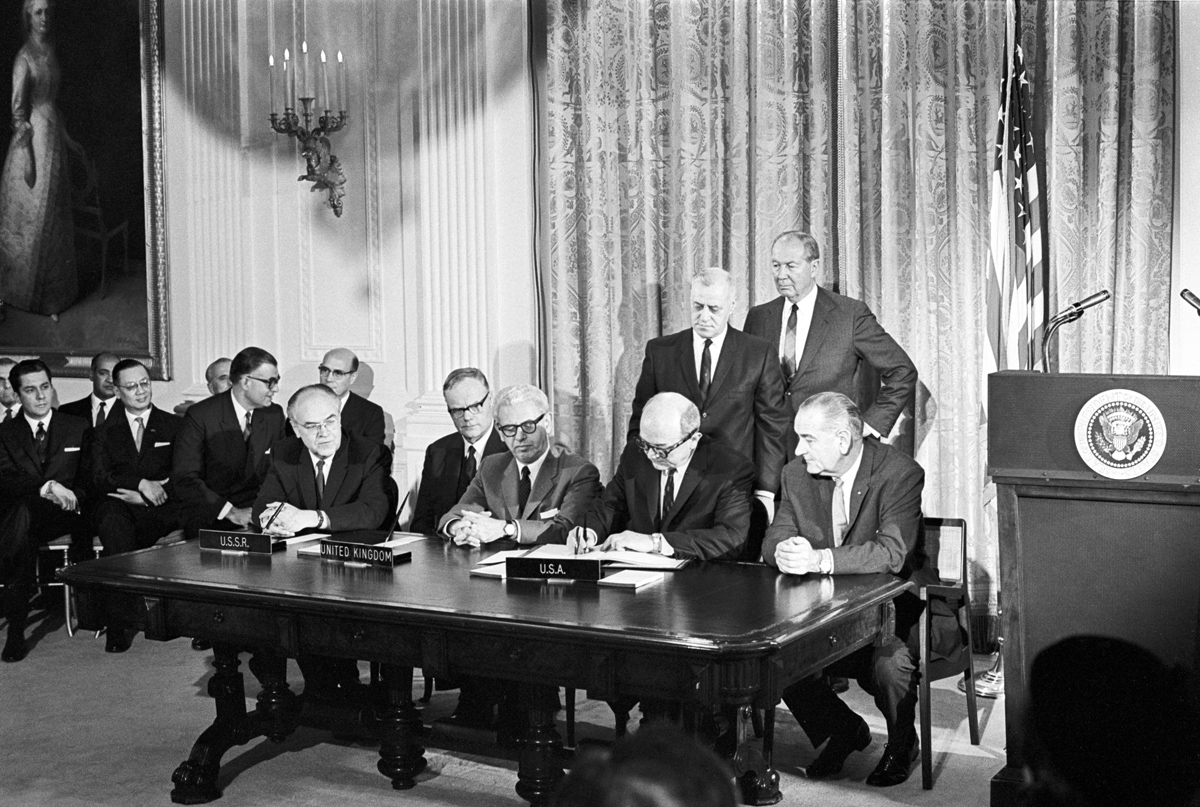
The Outer Space Treaty, formally called the Treaty on Principles Governing the Activities of States in the Exploration and Use of Outer Space, including the Moon and Other Celestial Bodies, is a multilateral treaty that forms the basis of international space law.
Negotiated and drafted under the auspices of the United Nations, it was opened for signature in the United States, the United Kingdom, and the Soviet Union on 27 January 1967, entering into force on 10 October 1967. , 118 countries are parties to the treaty—including all major spacefaring nations—and another 20 are signatories.
Key provisions of the treaty include prohibiting nuclear weapons in space; limiting the use of the Moon and all other celestial bodies to peaceful purposes; establishing that space shall be freely explored and used by all nations; and precluding any country from claiming sovereignty over outer space or any celestial body. Although it forbids establishing military bases, testing weapons and conducting military maneuvers on celestial bodies, the treaty does not expressly ban all military activities in space, nor the establishment of military space forces or the placement of conventional weapons in space.
The OST also declares that space is an area for free use and exploration by all and "shall be the province of all mankind". Drawing heavily from the Antarctic Treaty of 1961, the Outer Space Treaty likewise focuses on regulating certain activities and preventing unrestricted competition that were thought might lead to conflict at that time. Consequently, it is largely silent or ambiguous on newly developed space activities such as lunar and asteroid mining.
OST was at the heart of a 'network' of inter-state treaties and strategic power negotiations to achieve the best available conditions for nuclear weapons world security.
OST was the most important link in the chain of international legal arrangements for space from the late 1950s to the mid-1980s. The OST was followed by four additional agreements, with varied levels of accession: the safe return of astronauts who land in a foreign country (1967); liability for damages caused by spacecraft (1972); the registration of space vehicles (1976); and rules for activities on the Moon (1979). As the first and most foundational legal instrument of space law, the Outer Space Treaty and its broader principles of promoting the civil and peaceful use of space continue to underpin multilateral initiatives in space, such as the International Space Station and the Artemis Program.
History
The Outer Space Treaty was spurred by the development of intercontinental ballistic missiles (ICBMs) in the 1950s, which could reach targets through outer space. The Soviet Union's launch of Sputnik, the first artificial satellite, in October 1957, followed by a subsequent arms race with the United States, hastened proposals to prohibit the use of outer space for military purposes. On 17 October 1963, the U.N. General Assembly unanimously adopted a resolution prohibiting the introduction of weapons of mass destruction in outer space. Various proposals for an arms control treaty governing outer space were debated during a General Assembly session in December 1966, culminating in the drafting and adoption of the Outer Space Treaty the following January.
Provisions
The Outer Space Treaty represents the basic legal framework of international space law. According to the U.N. Office for Outer Space Affairs (UNOOSA), the core principles of the treaty are:
- the exploration and use of outer space shall be carried out for the benefit and in the interests of all countries and shall be the province of all mankind;
- outer space shall be free for exploration and use by all states;
- outer space is not subject to national appropriation by claim of sovereignty, by means of use or occupation, or by any other means;
- states shall not place nuclear weapons or other weapons of mass destruction in orbit or on celestial bodies or station them in outer space in any other manner;
- the Moon and other celestial bodies shall be used exclusively for peaceful purposes; prohibits their use for testing weapons of any kind, conducting military maneuvers, or establishing military bases, installations, and fortifications
- astronauts shall be regarded as the envoys of mankind;
- states shall be responsible for national space activities whether carried out by governmental or non-governmental entities;
- states shall be liable for damage caused by their space objects; and
- states shall avoid harmful contamination of space and celestial bodies.
Among its principles, it bars states party to the treaty from placing weapons of mass destruction in Earth orbit, installing them on the Moon or any other celestial body, or otherwise stationing them in outer space. It specifically limits the use of the Moon and other celestial bodies to peaceful purposes, and expressly prohibits their use for testing weapons of any kind, conducting military maneuvers, or establishing military bases, installations, and fortifications (Article IV). However, the treaty does not prohibit the placement of conventional weapons in orbit, and thus some highly destructive attack tactics, such as kinetic bombardment, are still potentially allowable. In addition, the treaty explicitly allows the use of military personnel and resources to support peaceful uses of space, mirroring a common practice permitted by the Antarctic Treaty regarding that continent. The treaty also states that the exploration of outer space shall be done to benefit all countries and that space shall be free for exploration and use by all the states.
Article II of the treaty explicitly forbids any government from "appropriating" a celestial body such as the Moon or a planet, whether by declaration, use, occupation, or "any other means". However, the state that launches a space object, such as a satellite or space station, retains jurisdiction and control over that object; by extension, a state is also liable for damages caused by its space object.
Responsibility for activities in space
Article VI of the Outer Space Treaty deals with international responsibility, stating that "the activities of non-governmental entities in outer space, including the Moon and other celestial bodies, shall require authorization and continuing supervision by the appropriate State Party to the Treaty" and that States Party shall bear international responsibility for national space activities whether carried out by governmental or non-governmental entities.
As a result of discussions arising from Project West Ford in 1963, a consultation clause was included in Article IX of the Outer Space Treaty: "A State Party to the Treaty which has reason to believe that an activity or experiment planned by another State Party in outer space, including the Moon and other celestial bodies, would cause potentially harmful interference with activities in the peaceful exploration and use of outer space, including the Moon and other celestial bodies, may request consultation concerning the activity or experiment."
Applicability in the 21st century
Being primarily an arms control treaty for the peaceful use of outer space, the Outer Space Treaty offers limited and ambiguous regulations to newer space activities such as lunar and asteroid mining. It is therefore debated whether the extraction of resources falls within the prohibitive language of appropriation, or whether the use of such resources encompasses the commercial use and exploitation.
Seeking clearer guidelines, private U.S. companies lobbied the U.S. government, which in 2015 introduced the U.S. Commercial Space Launch Competitiveness Act of 2015 legalizing space mining. Similar national legislation to legalize the appropriation of extraterrestrial resources are now being introduced by other countries, including Luxembourg, Japan, China, India, and Russia. In addition, the U.S. has led the creation of a series of bilateral agreements known as the Artemis Accords that seek to clarify a number of issues related to the Outer Space Treaty, including the use of space resources. This has created some controversy regarding legal claims over the mining of celestial bodies for profit.
1976 Bogota Declaration
The "Declaration of the First Meeting of Equatorial Countries", also known as the "Bogota Declaration", was one of the few attempts to challenge the Outer Space Treaty. It was promulgated in 1976 by eight equatorial countries to assert sovereignty over those portions of the geostationary orbit that continuously lie over the signatory nations' territory. These claims did not receive wider international support or recognition, and were subsequently abandoned.
Influence on space law
As the first international legal instrument concerning space, the Outer Space Treaty is considered the "cornerstone" of space law. It was also the first major achievement of the United Nations in this area of law, following the adoption of the first U.N. General Assembly resolution on space in 1958, and the first meeting of the U.N. Committee on the Peaceful Uses of Outer Space (COPUOS) the subsequent year.
Within roughly a decade of the treaty's entry into force, several other treaties were brokered by the U.N. to further develop the legal framework for activities in space:
- Rescue Agreement (1968)
- Space Liability Convention (1972)
- Registration Convention (1976)
- Moon Treaty (1979) With the exception of the Moon Treaty, to which only 18 nations are party, all other treaties on space law have been ratified by most major space-faring nations (namely those capable of orbital spaceflight). COPUOS coordinates these treaties and other questions of space jurisdiction, aided by the U.N. Office for Outer Space Affairs.
List of parties
The Outer Space Treaty was opened for signature in the United States, the United Kingdom, and the Soviet Union on 27 January 1967, and entered into force on 10 October 1967. As of October 2025, 118 countries are parties to the treaty, while another 20 have signed the treaty but have not completed ratification.
Multiple dates indicate the different days in which states submitted their signature or deposition, which varied by location: (L) for London, (M) for Moscow, and (W) for Washington, D.C. Also indicated is whether the state became a party by way of signature and subsequent ratification, by accession to the treaty after it had closed for signature, or by succession of states after separation from some other party to the treaty.
| url=https://www.gov.uk/government/publications/treaty-on-principles-governing-the-activities-of-states-in-the-exploration-and-use-of-outer-space-including-the-moon-and-other-celestial-bodies-lond | archive-url=http://webarchive.nationalarchives.gov.uk/20130104161243/http://www.fco.gov.uk/resources/en/pdf/3706546/3892723/TrPrinciplesOuterSpace | archive-date=4 January 2013 | title=TREATY ON PRINCIPLES GOVERNING THE ACTIVITIES OF STATES IN THE EXPLORATION AND USE OF OUTER SPACE, INCLUDING THE MOON AND OTHER CELESTIAL BODIES | access-date=28 February 2015 | publisher=Foreign and Commonwealth Office}} |
|---|---|---|---|---|---|
| Signed | Deposited | Method | |||
| Afghanistan | {{plainlist | {{plainlist | Ratification | ||
| Algeria | (W) | Accession | |||
| Antigua and Barbuda | {{plainlist | Succession from United Kingdom | |||
| Argentina | {{plainlist | (M, W) | Ratification | ||
| Armenia | (M) | Accession | |||
| Australia | (W) | (L, M, W) | Ratification | ||
| Austria | (L, M, W) | (L, M, W) | Ratification | ||
| Azerbaijan | (L) | Accession | |||
| Bahamas | {{plainlist | Succession from United Kingdom | |||
| Bahrain | (M) | Accession | |||
| Bangladesh | {{plainlist | Accession | |||
| Barbados | (W) | Accession | |||
| Belarus | (M) | (M) | Ratification | ||
| Belgium | {{plainlist | {{plainlist | Ratification | ||
| Benin | {{plainlist | Accession | |||
| Bosnia and Herzegovina | (L) | Accession | |||
| Brazil | {{plainlist | (L, M, W) | Ratification | ||
| Bulgaria | (L, M, W) | {{plainlist | Ratification | ||
| Burkina Faso | (W) | (W) | Ratification | ||
| Canada | (L, M, W) | (L, M, W) | Ratification | ||
| Chile | {{plainlist | (W) | Ratification | ||
| China | {{plainlist | Accession | |||
| Colombia | (W) | {{plainlist | Ratification | ||
| Croatia | (W) | Accession | |||
| Cuba | (M) | Accession | |||
| Cyprus | {{plainlist | {{plainlist | Ratification | ||
| Czech Republic | {{plainlist | Succession from Czechoslovakia | |||
| Denmark | (L, M, W) | (L, M, W) | Ratification | ||
| Dominican Republic | (W) | (W) | Ratification | ||
| Ecuador | {{plainlist | (W) | Ratification | ||
| Egypt | (M, W) | {{plainlist | Ratification | ||
| El Salvador | (W) | (W) | Ratification | ||
| Equatorial Guinea | (M) | Accession | |||
| Estonia | (M) | Accession | |||
| Fiji | {{plainlist | Succession from United Kingdom | |||
| Finland | (L, M, W) | (L, M, W) | Ratification | ||
| France | (L, M, W) | (L, M, W) | Ratification | ||
| Germany | (L, M, W) | (L, W) | Ratification | ||
| Greece | (W) | (L) | Ratification | ||
| Guinea-Bissau | (M) | Accession | |||
| Hungary | (L, M, W) | (L, M, W) | Ratification | ||
| Iceland | (L, M, W) | (L, M, W) | Ratification | ||
| India | (L, M, W) | (L, M, W) | Ratification | ||
| Indonesia | {{plainlist | (L) | Ratification | ||
| Iraq | {{plainlist | {{plainlist | Ratification | ||
| Ireland | (L, W) | {{plainlist | Ratification | ||
| Israel | (L, M, W) | {{plainlist | Ratification | ||
| Italy | (L, M, W) | (L, M, W) | Ratification | ||
| Jamaica | (L, M, W) | {{plainlist | Ratification | ||
| Japan | (L, M, W) | (L, M, W) | Ratification | ||
| Kazakhstan | (M) | Accession | |||
| Kenya | (L) | Accession | |||
| North Korea | (M) | Accession | |||
| South Korea | (W) | (W) | Ratification | ||
| Kuwait | {{plainlist | Accession | |||
| Laos | {{plainlist | {{plainlist | Ratification | ||
| Latvia | (W) | Accession | |||
| Lebanon | (L, M, W) | {{plainlist | Ratification | ||
| Libya | (W) | Accession | |||
| Lithuania | (W) | Accession | |||
| Luxembourg | {{plainlist | (L, M, W) | Ratification | ||
| Madagascar | (W) | Accession | |||
| Malaysia | {{plainlist | (W) | Ratification | ||
| Mali | (M) | Accession | |||
| Malta | (L) | Accession | |||
| Mauritius | {{plainlist | Succession from United Kingdom | |||
| Mexico | (L, M, W) | (L, M, W) | Ratification | ||
| Mongolia | (M) | (M) | Ratification | ||
| Morocco | {{plainlist | Accession | |||
| Myanmar | (L, M, W) | (L, M, W) | Ratification | ||
| Nepal | {{plainlist | {{plainlist | Ratification | ||
| Netherlands | (L, M, W) | (L, M, W) | Ratification | ||
| New Zealand | (L, M, W) | (L, M, W) | Ratification | ||
| Nicaragua | {{plainlist | {{plainlist | Ratification | ||
| Niger | (W) | {{plainlist | Ratification | ||
| Nigeria | (L) | Accession | |||
| Norway | (L, M, W) | (L, M, W) | Ratification | ||
| Oman | (L) | Accession | |||
| Pakistan | (L, M, W) | (L, M, W) | Ratification | ||
| Panama | (W) | (W) | Ratification | ||
| Papua New Guinea | {{plainlist | Succession from Australia | |||
| Paraguay | (L) | Accession | |||
| Peru | (W) | {{plainlist | Ratification | ||
| Poland | (L, M, W) | (L, M, W) | Ratification | ||
| Portugal | (L) | Accession | |||
| Qatar | (W) | Accession | |||
| Romania | (L, M, W) | (L, M, W) | Ratification | ||
| Russia | (L, M, W) | (L, M, W) | Ratification as the Soviet Union | ||
| Saint Vincent and the Grenadines | (L) | Succession from United Kingdom | |||
| San Marino | {{plainlist | {{plainlist | Ratification | ||
| Saudi Arabia | (W) | Accession | |||
| Seychelles | (L) | Accession | |||
| Sierra Leone | {{plainlist | {{plainlist | Ratification | ||
| Singapore | (L, M, W) | Accession | |||
| Slovakia | {{plainlist | Succession from Czechoslovakia | |||
| Slovenia | (L) | Accession | |||
| South Africa | (W) | {{plainlist | Ratification | ||
| Spain | {{plainlist | Accession | |||
| Sri Lanka | (L) | (L, M, W) | Ratification | ||
| Sweden | (L, M, W) | (L, M, W) | Ratification | ||
| Switzerland | {{plainlist | (L, M, W) | Ratification | ||
| Syria | (M) | Accession | |||
| Thailand | (L, M, W) | {{plainlist | Ratification | ||
| Togo | (W) | (W) | Ratification | ||
| Tonga | {{plainlist | Succession from United Kingdom | |||
| Tunisia | {{plainlist | {{plainlist | Ratification | ||
| Turkey | (L, M, W) | (L, M, W) | Ratification | ||
| Uganda | (W) | Accession | |||
| Ukraine | (M) | (M) | Ratification | ||
| United Arab Emirates | (W) | Accession | |||
| United Kingdom | (L, M, W) | (L, M, W) | Ratification | ||
| United States | (L, M, W) | (L, M, W) | Ratification | ||
| Uruguay | {{plainlist | (W) | Ratification | ||
| Uzbekistan | (M) | Accession | |||
| Venezuela | (W) | (W) | Ratification | ||
| Vietnam | (M) | Accession | |||
| Yemen | (M) | Accession | |||
| Zambia | {{plainlist | Accession |
Partially recognized state abiding by treaty
The Republic of China (Taiwan), which is currently recognized by , ratified the treaty prior to the United Nations General Assembly's vote to transfer China's seat to the People's Republic of China (PRC) in 1971. When the PRC subsequently ratified the treaty, they described the Republic of China's (ROC) ratification as "illegal". The ROC has committed itself to continue to adhere to the requirements of the treaty, and the United States has declared that it still considers the ROC to be "bound by its obligations".
| State | Signed | Deposited | Method |
|---|---|---|---|
| Republic of China | Ratification |
States that have signed but not ratified
20 states have signed but not ratified the treaty.
| State | Signed | |
|---|---|---|
| Bolivia | (W) | |
| Botswana | (W) | |
| Burundi | (W) | |
| Cameroon | (W) | |
| Central African Republic | (W) | |
| Democratic Republic of the Congo | {{plainlist | |
| Ethiopia | {{plainlist | |
| Gambia | (L) | |
| Ghana | {{plainlist | |
| Guyana | (W) | |
| Haiti | (W) | |
| Holy See | (L) | |
| Honduras | (W) | |
| Iran | (L) | |
| Jordan | (W) | |
| Lesotho | (W) | |
| Philippines | {{plainlist | |
| Rwanda | (W) | |
| Somalia | (W) | |
| Trinidad and Tobago | {{plainlist |
List of non-parties
The remaining UN member states and United Nations General Assembly observer states which have neither ratified nor signed the Outer Space Treaty are:
- Albania
- Andorra
- Angola
- Belize
- Bhutan
- Brunei
- Cambodia
- Cape Verde
- Chad
- Comoros
- Republic of the Congo
- Costa Rica
- Djibouti
- Dominica
- East Timor
- Eritrea
- Eswatini
- Gabon
- Georgia
- Grenada
- Guatemala
- Guinea
- Ivory Coast
- Kiribati
- Kyrgyzstan
- Liberia
- Liechtenstein
- Malawi
- Maldives
- Marshall Islands
- Mauritania
- Federated States of Micronesia
- Moldova
- Monaco
- Montenegro
- Mozambique
- Namibia
- Nauru
- North Macedonia
- Palau
- Palestine
- Saint Kitts and Nevis
- Saint Lucia
- Samoa
- São Tomé and Príncipe
- Senegal
- Serbia
- Solomon Islands
- South Sudan
- Sudan
- Suriname
- Tajikistan
- Tanzania
- Turkmenistan
- Tuvalu
- Vanuatu
- Zimbabwe
References
References
- "Treaty on Principles Governing the Activities of States in the Exploration and Use of Outer Space, including the Moon and Other Celestial Bodies". [[United Nations Office for Disarmament Affairs]].
- In addition, the [[Taiwan. Republic of China in Taiwan]], which is currently recognized by {{numrec. ROC. UN member states, ratified the treaty prior to the [[United Nations General Assembly]]'s [[United Nations General Assembly Resolution 2758. vote to transfer China's seat]] to the [[People's Republic of China]] (PRC) in 1971.
- Shakouri Hassanabadi, Babak. (30 July 2018). "Space Force and international space law".
- Irish, Adam. (13 September 2018). "The Legality of a U.S. Space Force". OpinioJuris.
- [https://www.orfonline.org/research/if-space-is-the-province-of-mankind-who-owns-its-resources-47561/ If space is ‘the province of mankind’, who owns its resources?] Senjuti Mallick and Rajeswari Pillai Rajagopalan. ''The Observer Research Foundation''. 24 January 2019. Quote 1: "The Outer Space Treaty (OST) of 1967, considered the global foundation of the outer space legal regime, […] has been insufficient and ambiguous in providing clear regulations to newer space activities such as asteroid mining." *Quote2: "Although the OST does not explicitly mention "mining" activities, under Article II, outer space including the Moon and other celestial bodies are "not subject to national appropriation by claim of sovereignty" through use, occupation or any other means."
- (1 May 2012). "Law: Is Asteroid Mining Illegal?".
- [https://www.iflscience.com/space/who-owns-space-us-asteroid-mining-act-dangerous-and-potentially-illegal/ Who Owns Space? US Asteroid-Mining Act Is Dangerous And Potentially Illegal.] {{Webarchive. link. (29 May 2021 IFL. Accessed on 9 November 2019. Quote 1: "The act represents a full-frontal attack on settled principles of space law which are based on two basic principles: the right of states to scientific exploration of outer space and its celestial bodies and the prevention of unilateral and unbriddled commercial exploitation of outer-space resources. These principles are found in agreements including the Outer Space Treaty of 1967 and the Moon Agreement of 1979." *Quote 2: "Understanding the legality of asteroid mining starts with the 1967 Outer Space Treaty. Some might argue the treaty bans all space property rights, citing Article II.")
- (2020-04-02). "Merely a 'Scrap of Paper'? The Outer Space Treaty in Historical Perspective". Diplomacy and Statecraft.
- "Space Law".
- "International Space Station legal framework".
- "NASA: Artemis Accords".
- "Treaty on Principles Governing the Activities of States in the Exploration and Use of Outer Space, Including the Moon and Other Celestial Bodies".
- "The Outer Space Treaty".
- (2007). "Legality of the Deployment of Conventional Weapons in Earth Orbit: Balancing Space Law and the Law of Armed Conflict". European Journal of International Law.
- Frakes, Jennifer. (2003). "The Common Heritage of Mankind Principle and the Deep Seabed, Outer Space, and Antarctica: Will Developed and Developing Nations Reach a Compromise?". Wisconsin International Law Journal.
- {{cite wikisource. Outer Space Treaty of 1967#Article VIII
- [[Wikisource:Outer Space Treaty of 1967#Article VII]]
- Terrill Jr., Delbert R. (May 1999), [https://web.archive.org/web/20030325014244/http://www.au.af.mil/au/awc/awcgate/space/terrill.pdf Project West Ford], "The Air Force Role in Developing International Outer Space Law" (PDF), Air Force History and Museums: 63–67.
- "Outer Space Treaty of 1967".
- Davies, Rob. (6 February 2016). "Asteroid mining could be space's new frontier: the problem is doing it legally.". The Guardian.
- Koch, Jonathan Sydney. (2008). "Institutional Framework for the Province of all Mankind: Lessons from the International Seabed Authority for the Governance of Commercial Space Mining.". Astropolitics.
- (5 December 2015). "U.S. Commercial Space Launch Competitiveness Act".
- (18 December 2015). "Space Mining and (U.S.) Space Law".
- (31 December 2015). "Law Provides New Regulatory Framework for Space Commerce {{!}} RegBlog".
- Foust, Jeff. (2020-10-13). "Eight countries sign Artemis Accords".
- (2007-01-23). "Text of Declaration of the First Meeting of Equatorial Countries". [[Japan Aerospace Exploration Agency]].
- Gangale, Thomas. (2006). "Who Owns the Geostationary Orbit?". Annals of Air and Space Law.
- "History: Treaties".
- "Space Law Treaties and Principles".
- "A History of Space".
- [http://www.thespacereview.com/article/3642/1 Beyond UNISPACE: It's time for the Moon Treaty.] Dennis C. O'Brien. ''Pace Review''. 21 January 2019.
- [http://www.unoosa.org/pdf/publications/ST_SPACE_11_Rev2_Add1E.pdf Status of international agreements relating to activities in outer space as at 1 January 2008] United Nations Office for Outer Space Affairs, 2008
- "TREATY ON PRINCIPLES GOVERNING THE ACTIVITIES OF STATES IN THE EXPLORATION AND USE OF OUTER SPACE, INCLUDING THE MOON AND OTHER CELESTIAL BODIES". [[Foreign and Commonwealth Office]]}}
{{cite web. - (30 June 2017). "Treaty on Principles Governing the Activities of States in the Exploration and Use of Outer Space, Including the Moon and other Celestial Bodies". [[United States Department of State]].
- "Договор о принципах деятельности государств по исследованию и использованию космического пространства, включая Луну и другие небесные тела". [[Ministry of Foreign Affairs (Russia).
- "China: Accession to Outer Space Treaty". [[United Nations Office for Disarmament Affairs]].
- United Nations Treaties and Principles on Outer Space- Official Records of the General Assembly, Forty-seventh Session, Supplement No. 20 (A/47/20) - https://www.unoosa.org/pdf/publications/ST_SPACE_061Rev01E.pdf
This article was imported from Wikipedia and is available under the Creative Commons Attribution-ShareAlike 4.0 License. Content has been adapted to SurfDoc format. Original contributors can be found on the article history page.
Ask Mako anything about Outer Space Treaty — get instant answers, deeper analysis, and related topics.
Research with MakoFree with your Surf account
Create a free account to save articles, ask Mako questions, and organize your research.
Sign up freeThis content may have been generated or modified by AI. CloudSurf Software LLC is not responsible for the accuracy, completeness, or reliability of AI-generated content. Always verify important information from primary sources.
Report