From Surf Wiki (app.surf) — the open knowledge base
Orpiment
Orange-yellow arsenic sulfide mineral
Orange-yellow arsenic sulfide mineral
| Field | Value |
|---|---|
| name | Orpiment |
| category | Sulfide mineral |
| image | Orpiment-148270.jpg |
| caption | Orpiment crystal from Twin Creeks Mine, Potosi District, Humboldt County, Nevada, United States (Size: 3.3 cm × 2.1 cm × 2.1 cm) |
| formula | As2S3 |
| IMAsymbol | Orp |
| strunz | 2.FA.30 |
| system | Monoclinic |
| class | Prismatic (2/m) |
| (same H-M symbol) | |
| symmetry | *P*21/n |
| unit cell | a = 11.475(5), b = 9.577(4) |
| c = 4.256(2) [Å], β = 90.45(5)°; Z = 4 | |
| color | Lemon-yellow to golden or brownish yellow |
| habit | Commonly in foliated columnar or fibrous aggregates; may be reniform or botryoidal; also granular or powdery; rarely as prismatic crystals |
| twinning | On {100} |
| cleavage | Perfect on {010}, imperfect on {100}; |
| tenacity | Sectile |
| mohs | 1.5–2 |
| luster | Resinous, pearly on cleavage surface |
| streak | Pale lemon-yellow |
| diaphaneity | Transparent |
| gravity | 3.49 |
| opticalprop | Biaxial (−) |
| refractive | nα = 2.400 nβ = 2.810 nγ = 3.020 |
| birefringence | δ = 0.620 |
| pleochroism | In reflected light, strong, white to pale gray with reddish tint; in transmitted light, Y = yellow, Z = greenish yellow |
| 2V | Measured: 30° to 76°, Calculated: 62° |
| dispersion | r v, strong |
| references |
(same H-M symbol) c = 4.256(2) [Å], β = 90.45(5)°; Z = 4 | length fast/slow = Orpiment, also known as yellow arsenic blende, is a deep-colored, orange-yellow arsenic sulfide mineral with formula . It is found in volcanic fumaroles, low-temperature hydrothermal veins, and hot springs and may be formed through sublimation.
Orpiment takes its name from the Latin auripigmentum (aurum, "gold" + pigmentum, "pigment"), due to its deep-yellow color. Orpiment once was widely used in artworks, medicine, and other applications. Because of its toxicity and instability, its usage has declined.
Etymology
The Latin auripigmentum (aurum, "gold" + pigmentum, "pigment") referred both to its deep-yellow color and to the historical belief that it contained gold. The Latin term was used by Pliny in the first century CE.
The Greek for orpiment was arsenikon, deriving from the Greek word arsenikos, meaning "male", from the belief that metals were of different sexes. This Greek term was used by Theophrastus in the fourth century BC.
The Chinese term for orpiment is Ci-Huang (in Pinyin), meaning "female yellow".
The Persian for orpiment is zarnikh, deriving from the word "zar", the Persian for gold.
Physical and optical properties
Orpiment is a common monoclinic arsenic sulfide mineral. It has a Mohs hardness of 1.5 to 2 and a specific gravity of 3.49. It melts at 300 °C to 325 °C. Optically, it is biaxial (−) with refractive indices of a = 2.4, b = 2.81, g = 3.02.
Visual characteristics
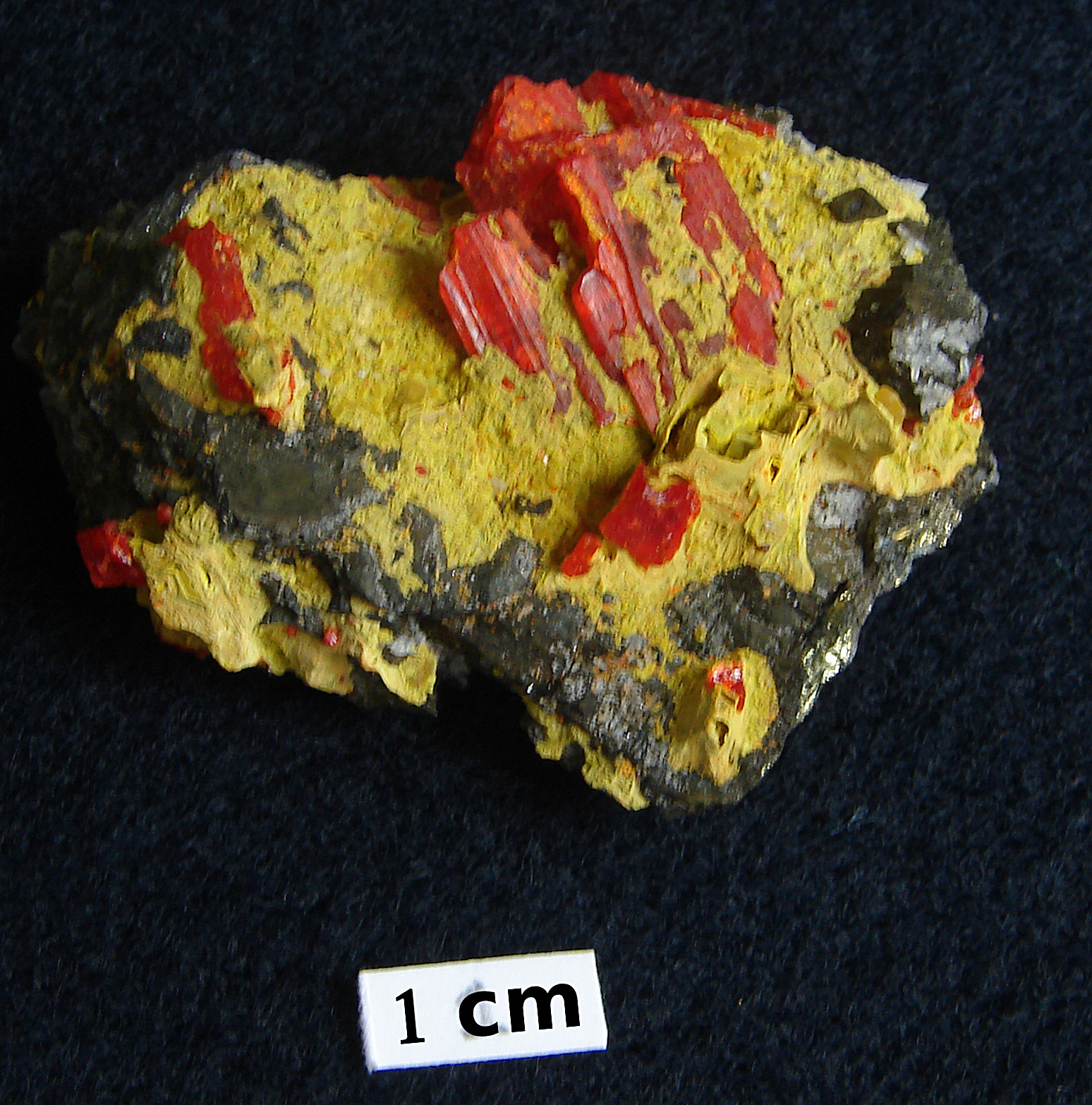
Orpiment is a type of lemon-yellow to golden- or brownish-yellow crystal commonly found in foliated columnar or fibrous aggregates, may alternatively be botryoidal or reniform, granular or powdery, and, rarely, as prismatic crystals. Used as a pigment, orpiment's color is often described as a lemon- or canary-yellow, and occasionally as a golden- or brownish-yellow.
In the Munsell color system, "orpiment" is designated "brilliant yellow", Munsell notation 4.4Y 8.7 /8.9.
Orpiment and realgar
Orpiment and realgar are closely related minerals and are often categorized in the same group. They are both arsenic sulfides and belong to the monoclinic crystal system. They are found in the same deposits and can form in the same geologic environments. As a result, orpiment and realgar share similar physical properties and histories of use by humans.
In Chinese, the names for orpiment and realgar are Ci-Huang and Xiong-Huang, respectively meaning "female yellow" and "male yellow". Their names symbolize their close natural conjunction, both physically in terms of their occurrence and properties and culturally in Chinese traditions.
Orpiment and realgar can be distinguished by their different visual characteristics. While orpiment typically has a vibrant golden-yellow color, realgar, in contrast, normally has an orange or reddish hue.
Permanence and conservation
Yellow orpiment (As2S3) degrades into arsenic oxides. Because of their solubility in water, arsenic oxides readily migrate to the surrounding environment. In painted works using orpiment, migrating, degraded arsenic oxides are often detectable throughout the multi-layered paint system. This widespread arsenic migration has consequences for the conservation of orpiment as a pigment in works of art.
Orpiment is also sensitive to light exposure, decaying into a friable white arsenic trioxide over time. Similarly, on ancient, orpiment-coated manuscript paper in Nepal, orpiment used to deter insects has often turned white over time.
Because of orpiment's solubility and instability as a pigment, preventing the degradation of orpiment may need to be prioritized in art conservation. Proper conservation methods should minimize exposure to strong light. Such methods should emphasize humidity control and avoid the use of water-based cleaning agents.
Use by artists
Orpiment has historically been used in artworks in many locales in the Eastern Hemisphere. It was one of the few clear, bright-yellow pigments available to artists until the 19th century.
Historical and regional use of orpiment
.jpg)
Medieval European artists imported orpiment from Asia Minor. Orpiment has been identified on Norwegian wooden altar frontals, polychrome sculptures, and folk art objects, including a crucifix. It was also used in twelfth- to sixteenth-century Eastern Orthodox icons from Bulgaria, Russia, and the former Yugoslavia. In Venice, records show that orpiment was purchased for a Romanian prince in 1600. European use of orpiment was uncommon until the nineteenth century, during which it saw use as a pigment in Impressionist paintings.


Orpiment as a pigment
In the Medieval Norwegian church of Tingelstad, orpiment was used in painting the altar frontal.
Orpiment was commonly combined with indigo dye to make a dark, rich green. In the Wilton Diptych (c 1395-9), this green pigment was used in egg tempera on the left panel for the green cloak of Edmund the Martyr.

Renaissance artists such as Raphael also used orpiment as a yellow pigment. In Raphael's Sistine Madonna from 1513–14, orpiment is used to achieve yellow on the clothing of the figures and in the background.
Tintoretto's Portrait of Vincenzo Morosini from about 1575–80 uses the pigment in its details. Orpiment is used to replicate the gold embroidery on Morosini's embroidered stole and to highlight the fur of the spotted ferret on his chest.
Limitations
Orpiment was one of the few clear, bright-yellow pigments available to artists until the 19th century. Its extreme toxicity and incompatibility with other, common, pigments, including lead and copper-based substances such as verdigris and azurite, meant that its use as a pigment ended when cadmium yellows, chromium yellows and organic aniline dye-based colors were introduced during the 19th century.
Other historical uses
Orpiment was traded in the Roman Empire and was used as a medicine in China, even though it is very toxic. It has been used as fly poison and to tip arrows with poison. Because of its striking color, it was of interest to alchemists, both in China and Europe, searching for a way to make gold. It also has been found in the wall decorations of Tutankhamun's tomb and ancient Egyptian scrolls, and on the walls of the Taj Mahal. For centuries, orpiment was ground down and used as a pigment in painting and for sealing wax, and was even used in ancient China as a correction fluid. Orpiment is mentioned in the 17th century by Robert Hooke in Micrographia for the manufacture of small shot. Scientists like Richard Adolf Zsigmondy and Hermann Ambronn puzzled jointly over the amorphous form of , "orpiment glass", as early as 1904.
Industrial use
Orpiment is used in the production of infrared-transmitting glass, oil cloth, linoleum, semiconductors, photoconductors, pigments, and fireworks. Mixed with two parts of slaked lime (calcium hydroxide), orpiment is still commonly used in rural India as a depilatory. It is used in the tanning industry to remove hair from hides.
Orpiment has been used as bookends. In 2023, the UK Office for Product Safety and Standards recalled 40 pieces sold by TK Maxx between June and October 2022, due to the mineral's toxicity.
Crystal structure
File:Orpiment-unit-cell-3D-balls.png| File:Orpiment-layer-3D-balls.png| File:Orpiment-layers-stacking-3D-balls.png|
Gallery
File:Orpiment.ვკ.jpg|Orpiment from Racha, northern Georgia region File:Orpiment-Realgar-Quartz-154641.jpg|Orpiment and realgar on a vuggy, quartz matrix, Nishinomaki Mine, Gunma Prefecture, Japan File:MFN MIN 1977 0028 Auripigment.jpg|Orpiment from La Libertad, Quiruvilca, Peru File:Orpiment-d06-185b.jpg|El'brusskiy arsenic mine, Kabardino-Balkarian Republic, Northern Caucasus Region, Russia
References
References
- Warr, L.N.. (2021). "IMA–CNMNC approved mineral symbols". Mineralogical Magazine.
- (2005). "Orpiment". Mineral Data Publishing.
- "Orpiment".
- {{WebMineral. link
- Fitzhugh, Elizabeth West. (1997). "Artists' Pigments: A Handbook of Their History and Characteristics, Volume 3". Archetype Publications.
- Schafer, Edward H.. (1955). "Orpiment and Realgar in Chinese Technology and Tradition". Journal of the American Oriental Society.
- "Realgar and Orpiment – Arsenic Sulfide Minerals".
- Kelly, K.L.; Judd, D.B. (1955). ''The ISCC-NBS Method of Designating Colors and a Dictionary of Color Names'' (Circular 553 ed.). Washington: U.S. Department of Commerce, National Bureau of Standards.
- (2016-04-21). "Analytical imaging studies of the migration of degraded orpiment, realgar, and emerald green pigments in historic paintings and related conservation issues". Heritage Science.
- Saleh, S.A. (1987). ''"Pigments, Plasters, and Salts Analyses," Wall Paintings of the Tomb of Nefertari: Scientific Studies for Their Conservation''. Cairo, Egypt and Century City, Calif. pp. 94–105.
- Garner, Henry. (1963-08-01). "Technical Studies of Oriental Lacquer". Studies in Conservation.
- Pearman, Sara Jane. (April 1977). "Thai Painting . Jean Boisselier , Janet Seligman". ARLIS/NA Newsletter.
- "Raphael, Sistine Madonna".
- St. Clair, Kassia (2016). ''The Secret Lives of Colour''. London: John Murray. pp. 82–83. {{ISBN. 978-1-4736-3081-9. {{OCLC. 936144129.
- Miller, George. (1826). "Popular philosophy: or, The book of nature laid open upon Christian principles, by the ed. of The Cheap magazine".
- Mesny, William. (1899). "Mesny's Chinese Miscellany". China Gazette Office..
- St. Clair, Kassia. (2016). "The Secret Lives of Colour". John Murray.
- "雌黄在古代充当"涂改液"".
- Hooke, Robert. "Micrographia". Project Gutenberg.
- (1966). "Nobel Lectures, Chemistry 1922–1941". Elsevier Publishing Company.
- (27 February 2023). "Government issue recall of household accessory from TK Maxx & Homesense – what to do".
- (24 February 2023). "Product Recall: Yellow Orpiment Mineral Bookends sold by TK Maxx (2302-0126)".
This article was imported from Wikipedia and is available under the Creative Commons Attribution-ShareAlike 4.0 License. Content has been adapted to SurfDoc format. Original contributors can be found on the article history page.
Ask Mako anything about Orpiment — get instant answers, deeper analysis, and related topics.
Research with MakoFree with your Surf account
Create a free account to save articles, ask Mako questions, and organize your research.
Sign up freeThis content may have been generated or modified by AI. CloudSurf Software LLC is not responsible for the accuracy, completeness, or reliability of AI-generated content. Always verify important information from primary sources.
Report