From Surf Wiki (app.surf) — the open knowledge base
Oroblanco
Cross between pomelo and grapefruit
Cross between pomelo and grapefruit
| Field | Value |
|---|---|
| name | Oroblanco |
| image | Oroblanco (sweetie) fruits.jpg |
| hybrid | *Citrus grandis* Osbeck × *Citrus paradisi* Macf. |
| cultivar | Oroblanco |
| origin | University of California Riverside |
The oroblanco, oro blanco, or sweetie (Citrus grandis Osbeck × C. paradisi Macf.) is a citrus hybrid, resulting from a cross between an acidless pomelo and a Marsh grapefruit. Its fruit is oblate and mostly seedless, with a thick rind that remains green long after it has already matured. It has a sweet, mild taste, and lacks the bitterness generally associated with grapefruit. It requires less heat to grow than other varieties of grapefruit and are harvestable sooner. Oroblancos grown in moderate climates tend to yield the highest-quality fruit.
The hybrid was first created by two geneticists at the University of California, Riverside, James W. Cameron and Robert Soost, in April 1958. It was later released to growers in 1980, who rapidly adopted it. It initially struggled in American markets, but had a resurgence in popularity after growers in Israel began advertising its sweet taste and green color to consumers in Japan, China, and Southeast Asia. It was exported to growers in Australia in 1990, where it was also commercially unsuccessful.
Description
Characteristics
The oroblanco is a triploid citrus hybrid, resulting from a cross between an acidless pomelo (C. grandis Osbeck) and the Marsh grapefruit (C. paradisi Macf.). Its fruit is seedless with pale yellow flesh and is slightly less juicy than other grapefruits, though it does have a juice content of roughly thirty percent. Rarely, it contains small, aborted seeds. It has a thick, smooth peel which is very slow to transition from green to yellow; in fact, the rind only turns yellow weeks after the fruit has already matured. A consequence of its thicker rind is less edible flesh. It has a thick white pith and a large hollow core, and is oblate. Once mature, the fruit weigh roughly 400–500 g, and have a diameter of about 9 cm. A 2020 study found that the fruit retained many of the compounds found in grapefruit including terpenes and polyphenols.
Flavor
The flavor of the oroblanco is mild and sweet. As it descends from an acidless pomelo, it lacks the bitterness generally associated with grapefruit, although it does attain an acidic aftertaste if grown in colder environments, or if eaten earlier in the growing season. Its rind and membrane also possess a bitter taste due to their naringin content. The fruit's Brix/acid ratio, which contrasts a fruit's levels of sweetness and acidity, is considerably higher than those of other grapefruit varieties; in California, it is required to have a ratio of at least 10:1. By comparison, Marsh grapefruit tested in Australia were found to have a ratio of 4.5:1. Its aroma is "citrusy" and "floral".
Harvest
The tree of the oroblanco quickly grows tall and spreads outward, requiring an allowance of more than 20 feet horizontally when cultivated, and usually begins to yield fruit within five years of being planted. It is susceptible to citrus tristeza virus; a common symptom of CTV in oroblancos is stem-pitting, which stunts tree growth and leads to fruit of small size and low quality. It is also susceptible to fruit fly infestations.
History
The oroblanco was first created as the result of a cross between an acidless pomelo (C. grandis Osbeck) and the Marsh grapefruit (C. paradisi Macf.) carried out in April 1958 by Robert Soost and James W. Cameron, geneticists at the University of California, Riverside. The cross resulted in seven cultivars, of which six were triploids and one was a tetraploid. In 1962, these seven cultivars were planted in fields in Riverside; later, trees were also planted at research stations in Exeter, Santa Ana, and the Coachella Valley to test its production in differing climates. Of the cultivars planted, one labelled 6C26,20 was selected and designated "oroblanco", meaning "white gold" in Spanish. The oroblanco was commercially released to growers in 1980, with the patent belonging to the Regents of the University of California. A separate cultivar from Soost and Cameron's cross in 1958 was also released under the name "melogold" in 1986.
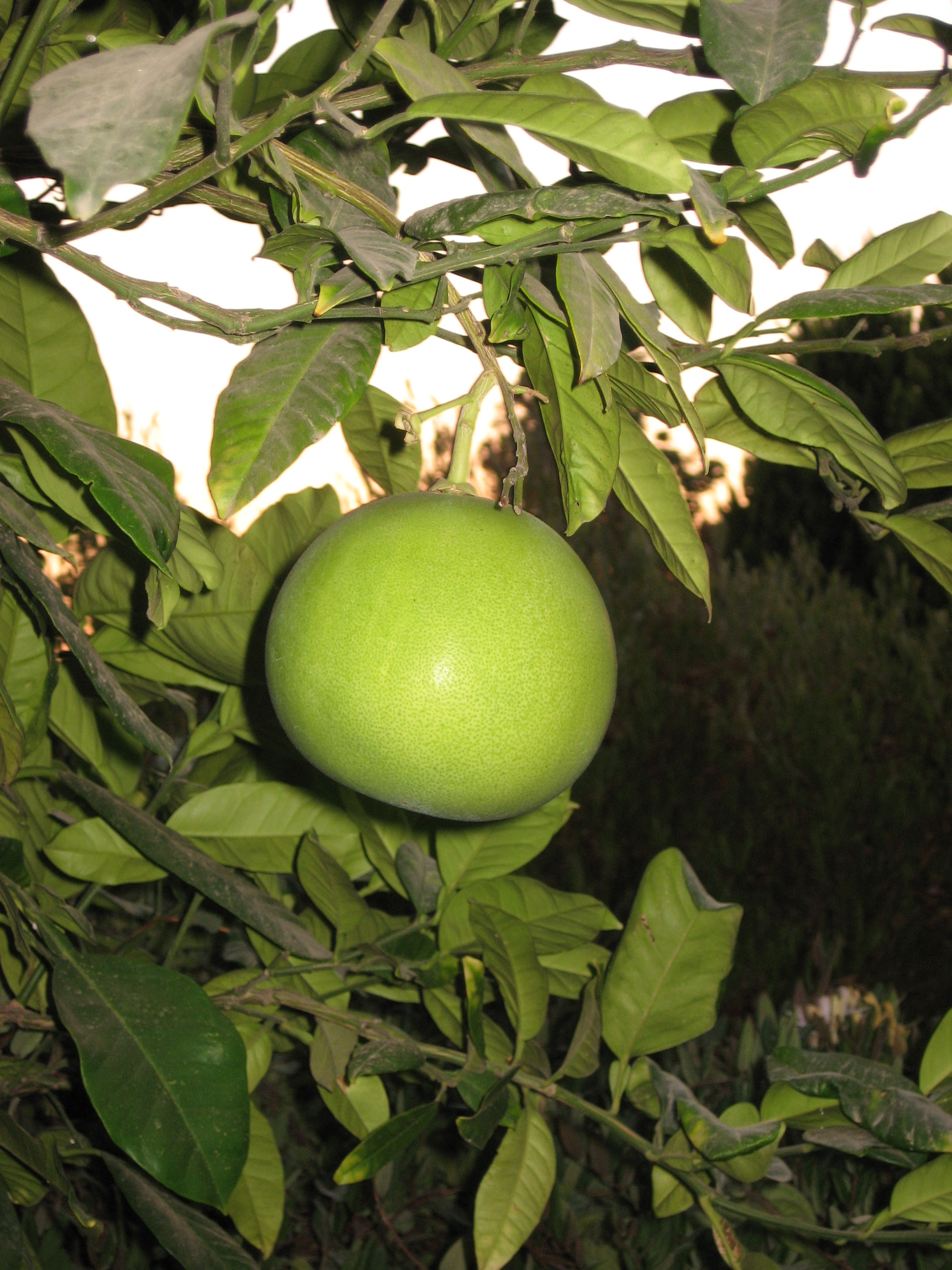
Following its release, the oroblanco was rapidly adopted by growers. However, it proved unpopular in American markets due to its thick peel, which is slow to transition from green to yellow, leading consumers to believe it was still unripe. Many of the trees planted were removed or had different grapefruit varieties grafted onto them. It was exported to Australian growers in 1990 and released there the same year, distributed by the Australian Nurserymen’s Fruit Improvement Company. It failed to gain popularity there as well, leading to many of those trees being removed.
The oroblanco later saw a resurgence in popularity after growers in Israel began growing the fruit. After branding the fruits "Sweeties" and "Golden Sweeties" and advertising their green peels and sweet flavor, Israeli growers found a large market of buyers for the oroblanco in Japan, where it became a success. Exports of the fruit from Israel and Australia to Southeast Asia also started around the same time. This led to a renewal of the tree's cultivation in the United States, with trees being planted in California and Florida. Israel also found buyers for oroblancos in China; 3,000 tons of the fruit were exported there by Israel in 2018. Regardless, oroblanco yield still trails behind that of the more popular Marsh grapefruit, and despite its resurgence, it continues to decrease in popularity in California, falling from 1,105 acres of oroblancos in 2004 to 233 acres in 2024, a decline of nearly 79 percent.
References
References
- (1980). "Oroblanco: A new grapefruit hybrid".
- (21 January 2020). "The Genus Citrus". Elsevier Science.
- "Oroblanco grapefruit hybrid".
- Cumo, Christopher. (25 April 2013). "Grapefruit". [[ABC-CLIO]].
- (13 June 2020). "Comparison of the Physical and Sensory Properties of Hybrid Citrus Fruit Jaffa® Sweetie in Relation to the Parent Fruits". [[Molecules (journal).
- (October 2002). "Oroblanco".
- Karp, David. (27 January 2012). "Market Watch: On the cusp of grapefruit season". [[Los Angeles Times]].
- Travers, Kitty. (26 March 2019). "La Grotta". Clarkson Potter/[[Ten Speed Press.
- Page, Martin. (17 December 2008). "Growing Citrus:The Essential Gardener's Guide". Timber Press.
- (2014). "Citrus Production Manual". [[University of California, Agriculture and Natural Resources]].
- Schachman, Maurice. (16 August 2004). "The Soft Drinks Companion: A Technical Handbook for the Beverage Industry". CRC Press.
- Ronnen, Tal. (6 October 2015). "Crossroads: Extraordinary Recipes from the Restaurant That Is Reinventing Vegan Cuisine". Artisan.
- Appell, Scott D.. (2000). "Landscaping Indoors: Bringing the Garden Inside". [[Brooklyn Botanic Garden]].
- Groves, Alex. (3 October 2020). "These Southern California developed fruit trees will flourish in your garden". [[Orange County Register]].
- Westover, Jessica. (12 September 2021). "How to Grow Oro Blanco Grapefruits". Week&.
- (December 2020). "Walking Together: Cross-Protection, Genome Conservation, and the Replication Machinery of Citrus tristeza virus". [[Viruses (journal).
- Marez, Curtis. (19 November 2019). "University Babylon: Film and Race Politics on Campus". [[University of California Press]].
- Parsons, Russ. (May 2007). "How to Pick a Peach". [[Houghton Mifflin]].
- (7 April 2010). "Plant Breeding Reviews". [[Wiley (publisher).
- Zang, Jing. (31 March 2019). "Israel Optimistic About Market for Grapefruit in China". Produce Report.
- (14 December 2004). "2004 California Citrus Acreage Report". California Agricultural Statistics Service.
- (2 August 2024). "2024 California Citrus Acreage Report". [[California Department of Food and Agriculture]], California Agricultural Statistics Service.
This article was imported from Wikipedia and is available under the Creative Commons Attribution-ShareAlike 4.0 License. Content has been adapted to SurfDoc format. Original contributors can be found on the article history page.
Ask Mako anything about Oroblanco — get instant answers, deeper analysis, and related topics.
Research with MakoFree with your Surf account
Create a free account to save articles, ask Mako questions, and organize your research.
Sign up freeThis content may have been generated or modified by AI. CloudSurf Software LLC is not responsible for the accuracy, completeness, or reliability of AI-generated content. Always verify important information from primary sources.
Report