From Surf Wiki (app.surf) — the open knowledge base
Orkney
Archipelago, county and council area in northern Scotland
Archipelago, county and council area in northern Scotland
| Field | Value |
|---|---|
| official_name | Orkney |
| celtic name | Arcaibh |
| image_flag | 2007 Flag of Orkney.svg |
| flag_caption | Flag |
| image_coat | Coat of arms of Orkney.svg |
| coat_caption | Coat of arms |
| Map | Orkney Islands UK relief location map.jpg |
| coordinates | |
| ISO Code: GB-ORK | |
| norse name | Orkneyjar |
| island group | Northern Isles |
| area | km2 |
| highest elevation | Ward Hill 481 m |
| Population | () |
| population density | /km2 |
| main settlement | Kirkwall |
| local authority | Orkney Islands Council |
the Scottish islands
ISO Code: GB-ORK Orkney (), also known as the Orkney Islands, is an archipelago off the north coast of mainland Scotland. The plural name The Orkneys is also sometimes used, but locals now consider it outdated. Part of the Northern Isles along with Shetland, Orkney is 10 miles (16 km) north of Caithness and has about 70 islands, of which 20 are inhabited. The largest island, the Mainland, has an area of 523 km2, making it the sixth-largest Scottish island and the tenth-largest island in the British Isles. Orkney's largest settlement, and also its administrative centre, is Kirkwall.
Orkney is one of the 32 council areas of Scotland, as well as a constituency of the Scottish Parliament, a lieutenancy area, and an historic county. The local council is Orkney Islands Council.
The islands have been inhabited for at least years, originally occupied by Mesolithic and Neolithic tribes and then by the Picts. Orkney was colonised and later annexed by the Kingdom of Norway in 875 and settled by the Norsemen. In 1472, the Parliament of Scotland absorbed the Earldom of Orkney into the Kingdom of Scotland, following failure to pay a dowry promised to James III of Scotland by the family of his bride, Margaret of Denmark.
In addition to the Mainland, most of the remaining islands are divided into two groups: the North Isles and the South Isles. The local climate is relatively mild and the soils are extremely fertile; most of the land is farmed, and agriculture is the most important sector of the economy. The significant wind and marine energy resources are of growing importance; the amount of electricity that Orkney generates annually from renewable energy sources exceeds its demand. Temperatures average 4 C in winter and 12 C in summer.
The local people are known as Orcadians; they speak a distinctive dialect of the Scots language and have a rich body of folklore. Orkney contains some of the oldest and best-preserved Neolithic sites in Europe; the "Heart of Neolithic Orkney" is a designated UNESCO World Heritage Site. Orkney also has an abundance of marine and avian wildlife.
Etymology
Pytheas of Massalia visited Britain – probably sometime between 322 and 285 BC – and described it as triangular in shape, with a northern tip called Orcas. This may have referred to Dunnet Head, from which Orkney is visible. Writing in the 1st century AD, the Roman geographers Ptolemy and Pomponius Mela called the islands Orcades (Ancient Greek: Όρκάδες), as did Tacitus in AD 98, claiming that his father-in-law Agricola had "discovered and subjugated the Orcades hitherto unknown" (although both Mela and Pliny had previously referred to the islands). The Byzantine John Tzetzes in his work Chiliades called the islands Orcades.
Etymologists usually interpret the element orc- as a Pictish tribal name meaning "young pig" or "young boar". Waugh, Doreen J. "Orkney Place-names" in Omand (2003) p. 116. Speakers of Old Irish referred to the islands as Insi Orc "islands of the young pigs". The archipelago is known as Ynysoedd Erch in modern Welsh and Arcaibh in modern Scottish Gaelic, the -aibh representing a fossilized prepositional case ending. Some earlier sources alternatively hypothesise that Orkney comes from the Latin , whale. The Anglo-Saxon monk Bede refers to the islands as Orcades insulae in Ecclesiastical History of the English People.
Norwegian settlers arriving from the late ninth century reinterpreted orc as the Old Norse orkn "seal" and added "islands" to the end, so the name became Orkneyjar "Seal Islands". The plural suffix -jar was later removed in English leaving the modern name Orkney. According to the Historia Norwegiæ, Orkney was named after an earl called Orkan.
The Norse knew Mainland, Orkney as Megenland "Mainland" or as Hrossey "Horse Island". The island is sometimes referred to as Pomona (or Pomonia), a name that stems from a 16th-century mistranslation by George Buchanan, which has rarely been used locally.
Usage of the plural "Orkneys" dates from the 18th century or earlier and was used by for example Sir Walter Scott. From the mid-19th century onwards this plural form has fallen out of use in the local area although it is still often used, particularly by publications based outside Scotland.{{#tag:ref|Anderson notes "'The Orkneys' is now, perhaps thankfully, out of fashion, but the fact is that it was once in fashion." although both continue to use the term occasionally.
History
Main article: History of Orkney
Prehistory
Main article: Prehistoric Orkney
Upper Palaeolithic stone tools of the Ahrensburgian culture have been found in Stronsay and Brodgar on mainland Orkney, suggesting the islands have been inhabited prior to 7000 BC.
A charred hazelnut shell, recovered in 2007 during excavations in Tankerness on the Mainland, has been dated to 6820–6660 BC, indicating the presence of Mesolithic nomadic tribes. The earliest known permanent settlement is at Knap of Howar, a Neolithic farmstead on the island of Papa Westray, which dates from 3500 BC. The village of Skara Brae, Europe's best-preserved Neolithic settlement, is believed to have been inhabited from around 3100 BC. Other remains from that era include the Standing Stones of Stenness, the Maeshowe passage grave, the Ring of Brodgar and other standing stones. Many of the Neolithic settlements were abandoned around 2500 BC, possibly due to changes in the climate.
In September 2021, archaeologists announced the discovery of two polished stone balls in a 5500-year-old Neolithic burial tomb in Sanday. According to Dr Hugo Anderson, the second object was as the "size of a cricket ball, perfectly spherical and beautifully finished".
During the Bronze Age, fewer large stone structures were built (although the great ceremonial circles continued in use) as metalworking was slowly introduced to Britain from Europe over a lengthy period. There are relatively few Orcadian sites dating from this era although there is the impressive Plumcake Mound near the Ring of Brodgar, and various island sites such as Tofts Ness on Sanday and the remains of two houses on Holm of Faray.
Iron Age
Excavations at Quanterness on the Mainland have revealed an Atlantic roundhouse built about 700 BC and similar finds have been made at Bu on the Mainland and Pierowall Quarry on Westray. The most impressive Iron Age structures of Orkney are the ruins of later round towers called "brochs" and their associated settlements such as the Broch of Burroughston and Broch of Gurness. The nature and origin of these buildings is a subject of debate. Other structures from this period include underground storehouses and aisled roundhouses, the latter usually in association with earlier broch sites.
During the Roman invasion of Britain the "King of Orkney" was one of 11 British leaders who is said to have submitted to the Emperor Claudius in AD 43 at Camulodunum (modern Colchester). After the Agricolan fleet had come and gone, possibly anchoring at Shapinsay, direct Roman influence seems to have been limited to trade rather than conquest. Polemius Silvius wrote a list of Late Roman provinces, which Seeck appended to his edition of the Notitia Dignitatum. The list names six provinces in Roman Britannia: the sixth is the dubious "Orcades provincia", the possible existence of which recent researches re-evaluate.
By the late Iron Age, Orkney was part of the Pictish kingdom, and although the archaeological remains from this period are less impressive, the fertile soils and rich seas of Orkney probably provided the Picts with a comfortable living.|group="Notes"}} The Dalriadic Gaels began to influence the islands towards the close of the Pictish era, perhaps principally through the role of Celtic missionaries, as evidenced by several islands bearing the epithet "Papa" in commemoration of these preachers. Before the Gaelic presence could establish itself the Picts were gradually dispossessed by the North Germanic peoples from the late 8th century onwards. The nature of this transition is controversial, and theories range from peaceful integration to enslavement and genocide. It has been suggested that an assault by forces from Fortriu in 681 in which Orkney was "annihilated" may have led to a weakening of the local power base and helped the Norse come to prominence.
Norwegian rule
Main article: Earldom of Orkney
Both Orkney and Shetland saw a significant influx of Norwegian settlers during the late 8th and early 9th centuries. Vikings made the islands the headquarters of their pirate expeditions carried out against Norway and the coasts of mainland Scotland. In response, Norwegian king Harald Fairhair (Harald Hårfagre) annexed the Northern Isles, comprising Orkney and Shetland, in 875 (it is clear that this story, which appears in the Orkneyinga Saga, is based on the later voyages of Magnus Barelegs and some scholars believe it to be apocryphal). Rognvald Eysteinsson received Orkney and Shetland from Harald as an earldom as reparation for the death of his son in battle in Scotland, and then passed the earldom on to his brother Sigurd the Mighty. Sigurd went on to conquer northern parts of mainland Britain in the late 9th century, including Caithness and Sutherland.
However, Sigurd's line barely survived him and it was Torf-Einarr, Rognvald's son by a slave, who founded a dynasty that controlled the islands for centuries after his death. He was succeeded by his son Thorfinn Skull-splitter and during this time the deposed Norwegian King Eric Bloodaxe often used Orkney as a raiding base before being killed in 954. Thorfinn's death and presumed burial at the broch of Hoxa, on South Ronaldsay, led to a long period of dynastic strife.
Initially a pagan culture, detailed information about the turn to the Christian religion in the islands of Scotland during the Norse era is elusive. The Orkneyinga Saga suggests the islands were Christianised by Olaf Tryggvasson in 995 when he stopped at South Walls on his way from Ireland to Norway. The King summoned the jarl Sigurd the Stout and said, "I order you and all your subjects to be baptised. If you refuse, I'll have you killed on the spot and I swear I will ravage every island with fire and steel." Unsurprisingly, Sigurd agreed and the islands became Christian at a stroke, receiving their own bishop in the early 11th century.
Thorfinn the Mighty was a son of Sigurd and a grandson of King Malcolm II of Scotland (Máel Coluim mac Cináeda). Along with Sigurd's other sons he ruled Orkney during the first half of the 11th century and extended his authority over a small maritime empire stretching from Dublin to Shetland. Thorfinn died around 1065 and his sons Paul and Erlend succeeded him, fighting at the Battle of Stamford Bridge in 1066. Paul and Erlend quarrelled as adults and this dispute carried on to the next generation. The martyrdom of Magnus Erlendsson, who was killed in April 1116 by his cousin Haakon Paulsson, resulted in the building of St Magnus Cathedral, still today a dominating feature of Kirkwall.
The Scottish crown claimed the overlordship of the Caithness and Sutherland area from Norway in 1098. The jarls thereafter owed allegiance to the Scottish crown for their territory on mainland Britain, which they held as the Mormaer of Caithness, but owed allegiance to the Norwegian crown for Orkney and Shetland. In 1195, the jarls lost control of Shetland when it became a separate lordship.
In 1231 the line of Norse earls, unbroken since Rognvald, ended with Jon Haraldsson's murder in Thurso. The Earldom of Caithness was granted to Magnus, second son of the Earl of Angus, whom Haakon IV of Norway confirmed as Earl of Orkney in 1236. Around the same time, the earldom lost the southern part of its territory on mainland Britain when it was made the separate earldom of Sutherland.
In 1290, the death of the child princess Margaret, Maid of Norway in Orkney, en route to mainland Scotland, created a disputed succession that led to the Wars of Scottish Independence.{{#tag:ref|It is often believed that the princess's death is associated with the village of St Margaret's Hope on South Ronaldsay but there is no evidence for this other than the coincidence of the name. In 1379 the earldom passed to the Sinclair family, who were also barons of Roslin near Edinburgh.
Evidence of the Viking presence is widespread and includes the settlement at the Brough of Birsay, the vast majority of place names, and the runic inscriptions at Maeshowe.
Absorption by Scotland, and later Great Britain and the United Kingdom
In 1468 Orkney and Shetland was pledged by Christian I, in his capacity as King of Norway, as security against the payment of the dowry of his daughter Margaret, betrothed to James III of Scotland. However, the money was never paid, and Orkney was absorbed by the Kingdom of Scotland in 1472.
The history of Orkney prior to this time is largely the history of the ruling aristocracy. From then on ordinary people emerge with greater clarity. An influx of Scottish entrepreneurs helped to create a diverse and independent community that included farmers, fishermen and merchants that called themselves comunitas Orcadie and who proved themselves increasingly able to defend their rights against their feudal overlords.
From at least the 16th century boats from mainland Scotland and the Netherlands dominated the local herring fishery. There is little evidence of an Orcadian fleet until the 19th century, but it grew rapidly, and 700 boats were involved by the 1840s, with Stronsay and later Stromness becoming leading centres of development. White fish never became as dominant as in other Scottish ports.

Agricultural improvements beginning in the 17th century resulted in the enclosure of the commons and ultimately in the Victorian era the emergence of large and well-managed farms using a five-shift rotation system and producing high-quality beef cattle.
In the 17th century Orcadians formed the overwhelming majority of employees of the Hudson's Bay Company in Canada. The harsh winter weather of Orkney and the Orcadian reputation for sobriety and their boat-handling skills made them ideal candidates for the rigours of the Canadian north. During this period, burning kelp briefly became a mainstay of the islands' economy. For example, on Shapinsay over 3000 LT of burned seaweed were produced per annum to make soda ash, bringing in £20,000 to the local economy. The industry collapsed suddenly in 1830 after the removal of tariffs on imported alkali.
In 1707, as with the rest of Scotland, they became part of the Kingdom of Great Britain.
During the 18th century Jacobite risings Orkney was largely Jacobite in its sympathies. At the end of the 1715 rebellion, a large number of Jacobites who had fled north from mainland Scotland sought refuge in Orkney and were helped on to safety in Sweden. In 1745, the Jacobite lairds on the islands ensured that Orkney remained pro-Jacobite in outlook and was a safe place to land supplies from Spain to aid their cause. Orkney was the last place in the British Isles that held out for the Jacobites and was not retaken by the British Government until 24 May 1746, over a month after the defeat of the main Jacobite army at Culloden.
In 1800, as with the rest of Scotland, the island became part of the United Kingdom of Great Britain and Ireland.
20th century
Orkney was the site of a Royal Navy base at Scapa Flow, which played a major role in World War I and World War II. After the Armistice in 1918, the German High Seas Fleet was transferred in its entirety to Scapa Flow to await a decision on its future. The German sailors opened the seacocks and scuttled all the ships. Most ships were salvaged, but the remaining wrecks are now a favoured haunt of recreational divers. One month into World War II, a German U-boat sank the Royal Navy battleship in Scapa Flow. As a result, barriers were built to close most of the access channels; these had the additional advantage of creating causeways enabling travellers to go from island to island by road instead of being obliged to rely on ferries. The causeways were constructed by Italian prisoners of war, who also constructed the ornate Italian Chapel.
The navy base became run down after the war, eventually closing in 1957. The problem of a declining population was significant in the post-war years, though in the last decades of the 20th century, there was a recovery and life in Orkney focused on growing prosperity and the emergence of a relatively classless society. Orkney was rated as the best place to live in Scotland in both 2013 and 2014, and in 2019 the best place to live in the UK, according to the Halifax Quality of Life survey.
Overview of population trends
| 1801| 24,445 | 1811| 23,238 | 1821| 26,979 | 1831| 28,847 | 1841| 30,507 | 1851| 31,455 | 1861| 32,395 | 1881| 32,044 | 1911| 25,897 | 1921| 24,111 | 1931| 22,077 | 1951| 21,255 | 1961| 18,747 | 1971| 17,070 | 1981| 18,194 | 1991| 19,644 | 2001| 19,245 | 2011| 21,349 | 2022| 21,958 In the modern era, the population peaked in the mid-19th century at just over 32,000 and declined for a century thereafter to a low of fewer than 18,000 in the 1970s. Declines were particularly significant in the outlying islands, some of which remain vulnerable to ongoing losses. Although Orkney is in many ways very distinct from the other islands and archipelagos of Scotland these trends are very similar to those experienced elsewhere. The archipelago's population grew by 11% in the decade to 2011 as recorded by the census. During the same period Scottish island populations as a whole grew by 4% to 103,702.
Genetic studies have shown that 25% of the gene pool of Orkney derives from Norwegian ancestors who occupied the islands in the 9th century.
Current demographics
In 2022 the census recorded a total population of 21,958 an increase of 2.85% since 2011 and of which 17,805 (81%) lived on the mainland.
The most numerous non-British residents were from Ireland (125 persons) and Poland (98 persons). 352 individuals were recorded as belonging to non-white ethnic groups of whom just over half were of Asian origin.
36% of the population identified as Christian, with 27% adhering to the Church of Scotland and 2.7% being Roman Catholic. Just under 2% professed to another religion of which the largest group was 197 individuals recorded as pagan. 62% of the population stated they had no religion or did not provide an answer to this question. The main language of all but 238 individuals over the age of 3 was either English or Scots.
Geography
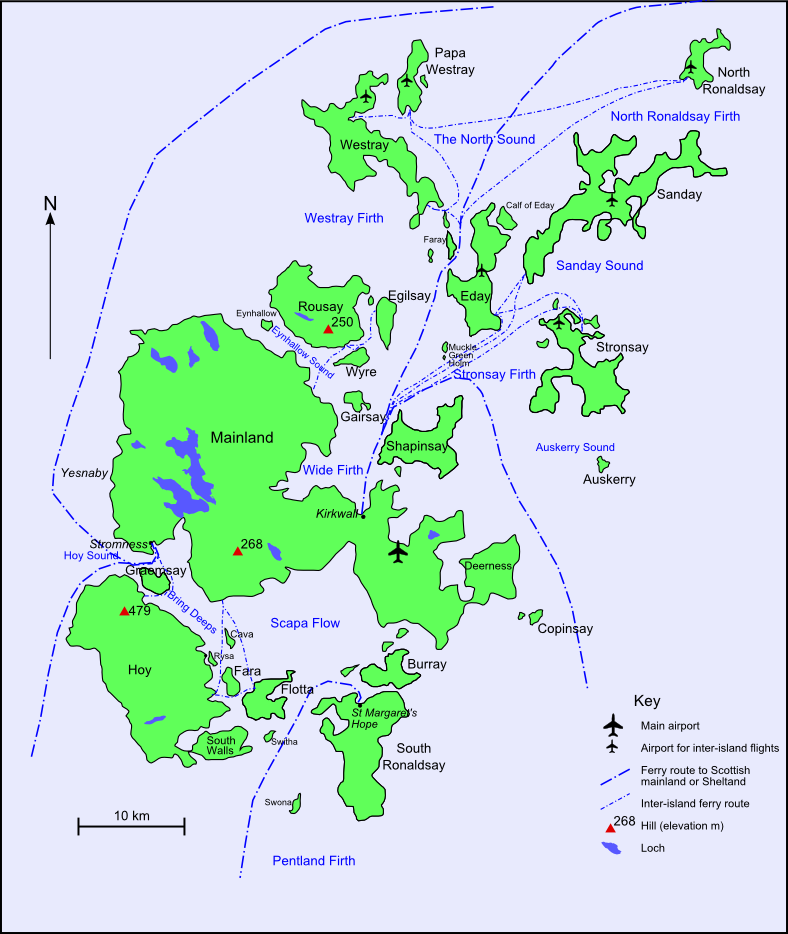
Orkney is separated from the mainland of Scotland by the Pentland Firth, a 10 km seaway between Brough Ness on the island of South Ronaldsay and Duncansby Head in Caithness. Orkney lies between 58°41′ and 59°24′ north, and 2°22′ and 3°26′ west, measuring 80 km from northeast to southwest and 47 km from east to west, and covers 975 km2.
Orkney is separated from the Shetland Islands, a group further out, by a body of water called the Fair Isle Channel.
The islands are mainly low-lying except for some sharply rising sandstone hills on Mainland, Rousay and Hoy (where the tallest point in Orkney, Ward Hill, can be found) and rugged cliffs on some western coasts. Nearly all of the islands have lochs, but the watercourses are merely streams draining the high land. The coastlines are indented, and the islands themselves are divided from each other by straits generally called "sounds" or "firths".
The tidal currents, or "roosts" as some of them are called locally, off many of the isles are swift, with frequent whirlpools. The islands are notable for the absence of trees, which is partly accounted for by the strong winds.
Settlements
Only three settlements have a population of over 500; the towns of Kirkwall and Stromness and the village of Finstown.
| Settlement | Population () |
|---|---|
| Kirkwall | |
| Stromness | |
| Finstown |
Other villages include Balfour, Dounby, Houton, Longhope, Lyness, Pierowall, St Margaret's Hope, and Whitehall.
| Island | Population |
|---|---|
| (2011) | |
| Orkney Mainland | 17,162 |
| South Ronaldsay | 909 |
| Westray | 588 |
| Sanday | 494 |
| Hoy | 419 |
| Burray | 409 |
| Stronsay | 349 |
| Shapinsay | 307 |
| Rousay | 216 |
| Eday | 160 |
Geology
Main article: Geology of Orkney

The superficial rock of Orkney is almost entirely Old Red Sandstone, mostly of Middle Devonian age. As in the neighbouring mainland county of Caithness, this sandstone rests upon the metamorphic and igneous rocks of the Moine series, as may be seen on the Mainland, where a narrow strip is exposed between Stromness and Inganess, and again in the small island of Graemsay; they are represented by grey gneiss and granite.
The Middle Devonian is divided into three main groups. The lower part of the sequence, mostly Eifelian in age, is dominated by lacustrine beds of the lower and upper Stromness Flagstones that were deposited in Lake Orcadie. The later Rousay flagstone formation is found throughout much of the North and South Isles and East Mainland.

The Old Man of Hoy is formed from sandstone of the uppermost Eday Group that is up to 800 m thick in places. It lies unconformably upon steeply inclined flagstones, the interpretation of which is a matter of continuing debate.
The Devonian and older rocks of Orkney are cut by a series of WSW–ENE to N–S trending faults, many of which were active during deposition of the Devonian sequences.
Middle Devonian basaltic volcanic rocks are found on western Hoy, on Deerness in eastern Mainland and on Shapinsay. Correlation between the Hoy volcanics and the other two exposures has been proposed, but differences in chemistry mean this remains uncertain. Lamprophyre dykes of Late Permian age are found throughout Orkney.
Glacial striation and the presence of chalk and flint erratics that originated from the bed of the North Sea demonstrate the influence of ice action on the geomorphology of the islands. Boulder clay is also abundant and moraines cover substantial areas.
Climate
Orkney has a cool temperate climate that is remarkably mild and steady for such a northerly latitude, due to the influence of the warm waters of the Norwegian Current, a north-easterly extension of the North Atlantic Drift which is itself an extension of the Gulf Stream. The average temperature for the year is 8 °C; for winter 4 °C and for summer 12 °C.
The average annual rainfall varies from 850 mm to 1060 mm.
To tourists, one of the fascinations of the islands is their "nightless" summers. On the longest day, the sun rises at 04:00 and sets at 22:29 BST and complete darkness is unknown. This long twilight is known in the Northern Isles as the "simmer dim". Winter nights are long. On the shortest day the sun rises at 09:05 and sets at 15:16. At this time of year the aurora borealis can occasionally be seen on the northern horizon during moderate auroral activity.
The first averages table below is for the largest settlement Kirkwall's weather station, the second is for the Loch of Hundland, a rural location to the northwest of Mainland. |Jan record high C = 12.2 |Feb record high C = 12.8 |Mar record high C = 18.9 |Apr record high C = 21.0 |May record high C = 22.0 |Jun record high C = 22.8 |Jul record high C = 25.6 |Aug record high C = 24.8 |Sep record high C = 22.8 |Oct record high C = 19.4 |Nov record high C = 14.5 |Dec record high C = 12.9 |year record high C = 25.6 |Jan avg record high C = 9.9 |Feb avg record high C = 10.4 |Mar avg record high C = 12.3 |Apr avg record high C = 14.5 |May avg record high C = 17.4 |Jun avg record high C = 19.1 |Jul avg record high C = 20.6 |Aug avg record high C = 20.1 |Sep avg record high C = 18.7 |Oct avg record high C = 15.1 |Nov avg record high C = 12.4 |Dec avg record high C = 11.0 |year avg record high C = 21.5 |Jan avg record low C = -1.6 |Feb avg record low C = -1.9 |Mar avg record low C = -1.7 |Apr avg record low C = -0.3 |May avg record low C = 1.1 |Jun avg record low C = 4.3 |Jul avg record low C = 6.3 |Aug avg record low C = 6.3 |Sep avg record low C = 4.4 |Oct avg record low C = 2.2 |Nov avg record low C = 0.3 |Dec avg record low C = -1.7 |year avg record low C = -3.2 |Jan record low C = −7.8 |Feb record low C = −7.0 |Mar record low C = −6.8 |Apr record low C = −4.9 |May record low C = −2.1 |Jun record low C = 1.0 |Jul record low C = 0.0 |Aug record low C = 3.7 |Sep record low C = 0.5 |Oct record low C = -1.6 |Nov record low C = −5.5 |Dec record low C = −7.6 |year record low C = −7.8
| access-date=24 July 2025
Governance
.jpg)
The local authority is the Orkney Islands Council, based at the Council Offices on School Place in Kirkwall.
Administrative history
On its absorption into Scotland in 1472, the landholdings and jurisdictions of the old earldom of Orkney passed to the Scottish crown. The separate lordship of Shetland was absorbed into Scotland at the same time. Orkney and Shetland retained their own legal systems until 1612, when the general laws of Scotland were applied.
Commissioners of Supply were established in 1667 for each shire across Scotland. Unusually, despite being one shire, Orkney and Shetland were given separate bodies of commissioners. More local government functions were gradually given to the commissioners over time. At a court case in 1829, the Court of Session declined to rule on whether Orkney and Shetland were one county or two. They operated as one county for the purposes of the administration of justice, lieutenancy, and parliamentary constituencies, but operated as two counties for local government functions. Elected county councils were created in 1890 under the Local Government (Scotland) Act 1889, taking most of the functions of the commissioners (which were eventually abolished in 1930). The 1889 Act also directed that Orkney and Shetland were to be separate counties.
Orkney County Council held its first meeting on 22 May 1890 at Kirkwall Sheriff Court, also known as County Buildings, on Watergate in Kirkwall, which had been completed in 1877 and also served as the meeting place of the commissioners of supply.
Local government was reformed in 1975 under the Local Government (Scotland) Act 1973, which replaced Scotland's counties, burghs and landward districts. In most of Scotland a two-tier structure of upper-tier regions and lower-tier districts was used, but a single-tier structure of island areas was used for Orkney, Shetland and the Western Isles. Further local government reform in 1996 introduced single-tier council areas across all of Scotland. The councils of the three island areas created in 1975 continued to provide the same services after 1996, but their areas were re-designated as council areas.
Parishes and communities
Parishes existed from medieval times. From 1845 to 1894 they had parish boards and from 1894 to 1930 they had parish councils. They have had no administrative functions since 1930, but continue to be used for the presentation of statistics.
Orkney's civil parishes are:
- Birsay and Harray
- Cross and Burness
- Eday
- Evie and Rendall
- Firth
- Holm
- Hoy and Graemsay
- Kirkwall and St Ola (included burgh of Kirkwall)
- Lady
- Orphir
- Papa Westray
- Rousay
- St Andrews and Deerness
- Sandwick
- Shapinsay
- South Ronaldsay
- Stenness
- Stromness (included burgh of same name)
- Stronsay
- Walls and Flotta
- Westray
Evie and Rendall were formerly separate parishes, but were united in the 16th century.
Community councils
Community councils were created in 1975 as part of the wider reforms that year. They have no statutory powers, but serve as a representative body for their communities. Orkney Islands Council designates community council areas, but a community council is only formed if there is sufficient interest from the residents. Since a review in 2022, Orkney has comprised the following communities, all of which have community councils operating as at 2024:
- Birsay
- Eday
- Evie and Rendall
- Firth and Stenness
- Flotta
- Graemsay, Hoy and Walls
- Harray and Sandwick
- Holm
- Kirkwall and St Ola
- North Ronaldsay
- Orphir
- Papa Westray
- Rousay, Egilsay, Wyre and Gairsay
- St Andrews and Deerness
- Sanday
- Shapinsay
- South Ronaldsay and Burray
- Stromness
- Stronsay
- Westray
Islands
Main article: List of Orkney islands
The Mainland
Main article: Mainland, Orkney
The Mainland is the largest island of Orkney. Both of Orkney's burghs, Kirkwall and Stromness, are on this island, which is also the heart of Orkney's transport system, with ferry and air connections to the other islands and to the outside world. The island is more heavily populated (75% of Orkney's population) than the other islands and has much fertile farmland. The Mainland is split into areas called East and West Mainland. These areas are determined by whether they lie east or west of Kirkwall. The bulk of the mainland lies west of Kirkwall, with comparatively little land east of Kirkwall. West Mainland parishes are: Stromness, Sandwick, Birsay, Harray, Stenness, Orphir, Evie, Rendall and Firth. East Mainland Parishes are: St Ola, Tankerness, St Andrews, Holm and Deerness.
The island is mostly low-lying (especially East Mainland) but with coastal cliffs to the north and west and two sizeable lochs: the Loch of Harray and the Loch of Stenness. The Mainland contains the remnants of numerous Neolithic, Pictish and Viking constructions.
The other islands in the group are classified as north or south of the Mainland. Exceptions are the remote islets of Sule Skerry and Sule Stack, which lie 60 km west of the archipelago, but form part of Orkney for local government purposes.
The North Isles

The northern group of islands is the most extensive and consists of a large number of moderately sized islands, linked to the Mainland by ferries and by air services. Farming, fishing and tourism are the main sources of income for most of the islands.
The most northerly is North Ronaldsay, which lies 4 km beyond its nearest neighbour, Sanday. To the west is Westray, which has a population of 550. It is connected by ferry and air to Papa Westray, also known as "Papay". Eday is at the centre of the North Isles. The centre of the island is moorland and the island's main industries have been peat extraction and limestone quarrying.
Rousay, Egilsay and Gairsay lie north of the west Mainland across the Eynhallow Sound. Rousay is well known for its ancient monuments, including the Quoyness chambered cairn and Egilsay has the ruins of the only round-towered church in Orkney. Wyre to the south-east contains the site of Cubbie Roo's castle. Stronsay and Papa Stronsay lie much further to the east across the Stronsay Firth. Auskerry is south of Stronsay and has a population of only five. Shapinsay and its Balfour Castle are a short distance north of Kirkwall.
Other small uninhabited islands in the North Isles group include Calf of Eday, Damsay, Eynhallow, Faray, Helliar Holm, Holm of Faray, Holm of Huip, Holm of Papa, Holm of Scockness, Kili Holm, Linga Holm, Muckle Green Holm, Rusk Holm and Sweyn Holm.
The South Isles
The southern group of islands surrounds Scapa Flow. Hoy, to the west, is the second largest of the Orkney Isles and Ward Hill at its northern end is the highest elevation in the archipelago. The Old Man of Hoy is a well-known seastack. Graemsay and Flotta are both linked by ferry to the Mainland and Hoy, and the latter is known for its large oil terminal. South Walls has a 19th-century Martello tower and is connected to Hoy by the Ayre. Burray lies to the east of Scapa Flow and is linked by causeway to South Ronaldsay, which hosts cultural events such as the Festival of the Horse and the Boys' Ploughing Match on the third Saturday in August. It is also the location of the Neolithic Tomb of the Eagles. South Ronaldsay, Burray, Glimps Holm, and Lamb Holm are connected by road to the Mainland by the Churchill Barriers.
Uninhabited South Islands include Calf of Flotta, Cava, Copinsay, Corn Holm, Fara, Glimps Holm, Hunda, Lamb Holm, Rysa Little, Switha and Swona. The Pentland Skerries lie further south, closer to the Scottish mainland.
Politics
Orkney is represented in the House of Commons as part of the Orkney and Shetland constituency, which elects one Member of Parliament (MP), the current incumbent being Alistair Carmichael. This seat has been held by the Liberal Democrats or the former Liberal Party since 1950, longer than any other they represent in Great Britain.
In the Scottish Parliament the Orkney constituency elects one Member of the Scottish Parliament (MSP) by the first past the post system. The current MSP is Liam McArthur of the Liberal Democrats. Before McArthur the MSP was Jim Wallace, who was previously Deputy First Minister. Orkney is within the Highlands and Islands electoral region.
The Orkney Movement, a political party that supported devolution for Orkney from the rest of Scotland, contested the 1987 general election as the Orkney and Shetland Movement (a coalition of the Orkney movement and its equivalent for Shetland). The Scottish National Party chose not to contest the seat to give the movement a "free run". Their candidate, John Goodlad, came 4th with 3,095 votes, 14.5% of those cast, but the experiment has not been repeated.
In the 2014 Scottish independence referendum 67.2% of voters in Orkney voted no to the question "Should Scotland be an independent country?" This was the highest no vote by percentage in any council area in Scotland. Turnout for the referendum was at 83.7% in Orkney with 10,004 votes cast in the area against independence by comparison to 4,883 votes for independence. In the 2016 United Kingdom European Union membership referendum 63.2% of voters in Orkney voted Remain.
In 2022, as part of the Levelling Up White Paper, an "Island Forum" was proposed, which would allow local policymakers and residents in Orkney to work alongside their counterparts in Shetland, the Western Isles, Anglesey and the Isle of Wight on common issues, such as broadband connectivity, and provide a platform for them to communicate directly with the government on the challenges island communities face in terms of levelling up. In July 2023, Orkney Council investigated proposals to change its status, looking at options that included becoming a British Crown Dependency, a self-governing territory within the Kingdom of Norway or just staying in the United Kingdom.
Economy
The percentage of the Orkney population who are economically active is consistently higher than the Scottish average. In 2023 it was 89.8% compared to 77.9% for the latter, in which year average unemployment was 1.6%.
The soil of Orkney is generally very fertile and most of the land is taken up by farms, agriculture being by far the most important sector of the economy and providing employment for a quarter of the workforce according to a 2008 report. More than 90% of agricultural land is used for grazing for sheep and cattle, with cereal production utilising about 4% (3800 ha) and woodland occupying only 91 ha. 44% of Orkney businesses are in the agriculture, forestry and fishing sector. 90% of the islands' milk production goes towards the manufacture of Orkney Cheddar cheese.
Fishing has declined in importance, but still employed 238 individuals in 2023, just under 4% of the islands' total employment. The modern industry concentrating on herring, white fish, lobsters, crabs and other shellfish, and salmon fish farming.
_-_geograph.org.uk_-_35389.jpg)
A 2009 report indicated the traditional sectors of the economy export beef, cheese, whisky, beer, fish and other seafood. In recent years there has been growth in other areas including tourism, food and beverage manufacture, jewellery, knitwear, and other crafts production, construction and oil transportation through the Flotta oil terminal.
There are three Scotch whisky distilleries in Orkney: Scapa, Highland Park and the Deerness Distillery, which opened in 2023.
Other important sectors of the economy include manufacturing and construction, retailing, hotels and restaurants and public sector activities such as health and social work.
As of 2020 there are around 1,500 businesses on the island. More than 90% have fewer than 10 employees. [Estimates indicate] 11,000 jobs, of which around 5,000 are part-time ... There's not much manufacturing, beyond food and drink processing (think cheese and whisky), and apart from the Flotta oil terminal, it lacks big private employers ... Fisheries off Orkney are only half as important to employment as in Shetland, and farming is roughly twice as important.
Tourism
A report published in February 2020 stated that spending by visitors increased from £49.5 million in 2017 to £67.1 million in 2019, making this a significant sector of the economy. The primary attractions that encourage tourism include the "Heart of Neolithic Orkney" on the main island, defined as "a group of 5,000-year-old sites that include the preserved village of Skara Brae and the Ring of Brodgar stone circle". The Hoy area's landscape is also attractive to visitors, "with its scattered woodland, steep valleys, high cliffs and the famous Old Man, a withered red sandstone sea stack". In 2017, 62% of tourists to Orkney visited for its heritage. The UHI Archaeology Institute have led excavations at the Ness of Brodgar, contributing to tourism to the area and driving interest in archaeology.
During most years, the islands are the home of several international festivals, including the Orkney International Science Festival in September, a folk festival in May, and the St Magnus International Arts Festival in June.
The volume of visitors arriving on ferries declined substantially in 2020, by 71%, due to the COVID-19 pandemic. A news report added that cruise ships also did not arrive and there were "no day trippers and no holiday lets" as of 25 April 2020. Several major events were cancelled: St Magnus Festival, Orkney Folk Festival, Stromness Shopping Week and the Agricultural Shows.
Power
Orkney has significant wind and marine energy resources, and renewable energy has recently come into prominence. Although Orkney is connected to the mainland, it generates over 100% of its net power from renewables according to a 2015 report. This comes mainly from wind turbines situated across Orkney.
The European Marine Energy Centre (EMEC) is a research facility operating a grid-connected wave test site at Billia Croo, off the west coast of the Orkney Mainland, and a tidal power test site in the Fall of Warness, off the northern island of Eday. At the official opening of the Eday project the site was described as "the first of its kind in the world set up to provide developers of wave and tidal energy devices with a purpose-built performance testing facility."{{#tag:ref|"
The centre offers developers the opportunity to test prototype devices in unrivalled wave and tidal conditions. Wave and tidal energy converters are connected to the national grid via seabed cables running from open-water test berths into an onshore substation. Testing takes place in a wide range of sea and weather conditions, with comprehensive round-the-clock monitoring."|group="Notes"}}
During 2007 Scottish and Southern Energy plc in conjunction with the University of Strathclyde began the implementation of a Regional Power Zone in the Orkney archipelago, involving "active network management" that will make better use of existing infrastructure and allow a further 15 MW of new "non-firm generation" output from renewables onto the network. 1.5 MW of polymer electrolyte membrane electrolysis form a partial hydrogen economy for hydrogen vehicles and district heating, and grid batteries and electric vehicles also use local energy.

Orkney has one of the highest uptakes of electric vehicles in the UK with more than 2% of the vehicles on the road being electric, as of 2019.
Hydrogen manufacturing
A March 2019 report by the BBC stated that "Orkney creates more clean electricity than its inhabitants need. Even after exporting to the UK national grid, the islands' winds, waves and tides generate about 130% of the electricity its population needs – all of it from clean sources". A report about sustainable energy in the islands listed two options. A new cable could be laid for exporting of energy to the mainland but another proposal has progressed rapidly since that time: making "excess renewable power into another fuel – such as hydrogen – and then [storing] it".
In May 2020, CNN published more specific information about the hydrogen plan:Orkney's success in creating hydrogen using clean energy demonstrates that it can be done at scale. The islands are already using hydrogen to power vehicles, and it will soon be used to heat a local primary school. Now, Orkney is hoping to use hydrogen fuel cells to power a seagoing vessel able to transport both goods and passengers.
Additional specific information about the status of the hydrogen scheme was published in late November 2020 by Orkney Islands Council. A few weeks earlier, another report indicated that the world's first hydrogen-fueled ferry was to be tested on the Orkney Islands, using "a hydrogen/diesel dual fuel conversion system", developed by a consortium known as the HyDIME project. Initially hydrogen was to power only the auxiliary engine but the plan calls for later using this fuel for the primary engine. The report suggested that "if all goes well, hydrogen ferries could be sailing between Orkney's islands within six months".
Kirkwall Airport in Orkney was scheduled "to have its heat and power decarbonised through green hydrogen as part of a new project" starting in 2021. A hydrogen combustion engine system was to be connected to the airport's heating system. The scheme planned to reduce the significant emissions that were created with older technology that heated buildings and water. This was part of the plan formulated by the Scottish government for the Highlands and Islands "to become the world's first net zero aviation region by 2040".
Hydrogen manufacturing is also planned for Shetland and will spread to other areas of Scotland that have access to clean electricity. To achieve that goal, the government announced an investment of £100 million in the hydrogen sector "for the £180 million Emerging Energy Technologies Fund".
Transport
Air
Highland and Islands Airports operates the main airport in Orkney, Kirkwall Airport. Loganair provides services to the Scottish mainland (Aberdeen, Edinburgh, Glasgow and Inverness), as well as to Sumburgh Airport in Shetland.
Within Orkney, the council operates airports on most of the larger islands including Stronsay, Eday, North Ronaldsay, Westray, Papa Westray, Sanday, and Flotta. The shortest scheduled air service in the world, between the islands of Westray and Papa Westray, is scheduled at two minutes' duration.
Ferry

Ferries serve both to link Orkney to the rest of Scotland, and also to link together the various islands of the Orkney archipelago. Ferry services operate between Orkney and the Scottish mainland and Shetland on the following routes:
- Gills Bay to St Margaret's Hope (operated by Pentland Ferries)
- John o' Groats to Burwick on South Ronaldsay (seasonal passenger only service, operated by John o' Groats Ferries)
- Lerwick to Kirkwall (operated by NorthLink Ferries)
- Aberdeen to Kirkwall (operated by NorthLink Ferries)
- Scrabster Harbour, Thurso to Stromness (operated by NorthLink Ferries).
Inter-island ferry services connect all the inhabited islands to Orkney Mainland and are operated by Orkney Ferries, a company owned by Orkney Islands Council. The isles of Westray, Papa Westray (or Papay), North Ronaldsay, Sanday, Eday, Stronsay, and Shapinsay are served from Kirkwall harbour, while the northern end of Hoy and Graemsay are served from Stromness harbour, the Lyness end of Hoy, as well as Longhope on South Walls, and Flotta are served from Houton on the south of the mainland, and Rousay, Egilsay and Wyre are served from Tingwall, in the Rendall area of the Orkney mainland. As well as this, the connects the village of Pierowall on Westray with Papa Westray - this provides a vital local service for schoolchildren on Papay as well as supplementing existing through sailings from Kirkwall.
Bus
Local buses around the Orkney Mainland, as well as across the Churchill Barriers to Burray and South Ronaldsay, are operated by Stagecoach Highlands. There are also bus services on Sanday, Westray and Hoy & Walls.
In 2021, the island's three-vehicle minibus service for disabled people was a target for hackers seeking a £1,000 ransom in cryptocurrency.
Media
Orkney is served by a weekly local newspaper, The Orcadian, published on Thursdays. It is first published in 1854 and part of the Orkney Media Group, formed out of a partnership with a competing newspaper, Orkney Today, in 2007.
A local BBC radio station, BBC Radio Orkney, the local opt-out of BBC Radio Scotland, broadcasts twice daily, with local news and entertainment. Orkney also had a commercial radio station, The Superstation Orkney, which broadcast to Kirkwall and parts of the mainland and also to most of Caithness until its closure in November 2014. MFR broadcasts throughout Orkney on an FM transmitter just outside Thurso. The community radio station Caithness FM also broadcasts to Orkney.
Orkney is home to the Orkney Library and Archive, based in Kirkwall. The library service provides access to over 145,000 items. They have a wide range of fiction and non-fiction titles available for loan as well as audiobooks, maps, eBooks, music CDs, and DVDs. Orkney Library and Archive operates a Mobile Library Service that serves the rural parishes and islands of Orkney. The Mobile Library carries a wide range of books and audiobooks suitable for all ages and is completely free to use.
Language, literature, and folklore
At the beginning of recorded history, the islands were inhabited by the Picts, whose language was Brythonic. The Ogham script on the Buckquoy spindle-whorl is cited as evidence for the pre-Norse existence of Old Irish in Orkney.
After the Norse occupation, the toponymy of Orkney became almost wholly West Norse. The Norse language changed into the local Norn, which lingered until the end of the 18th century, when it eventually died out. Norn was replaced by the Orcadian dialect of Insular Scots. This dialect is at a low ebb due to the pervasive influences of television, education, and the large number of incomers. However, attempts are being made by some writers and radio presenters to revitalise its use and the distinctive sing-song accent and many dialect words of Norse origin remain in use. The Orcadian word most frequently encountered by visitors is peedie, meaning 'small', which may be derived from the French petit.
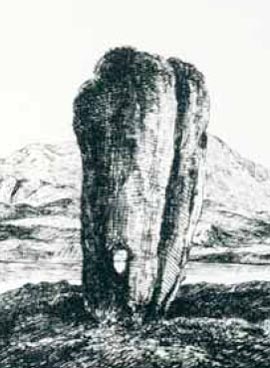
Orkney has a rich folklore, and many of the former tales concern trows, an Orcadian form of troll that draws on the islands' Scandinavian connections. Local customs in the past included marriage ceremonies at the Odin Stone that formed part of the Stones of Stenness.
The best known literary figures from modern Orkney are the poet Edwin Muir, the poet and novelist George Mackay Brown, and the novelist Eric Linklater.
Languages
The 2022 Scottish Census reported that out of 21,400 residents aged three and over, 8,278 (38.7%) considered themselves able to speak or read the Scots language.
The 2022 Scottish Census reported that out of 21,407 residents aged three and over, 177 (0.8%) considered themselves able to speak or read Gaelic.
Orcadians
Main article: Orcadians
An Orcadian is a native of Orkney, a term that reflects a strongly held identity with a tradition of understatement. Although the annexation of the earldom by Scotland took place over five centuries ago in 1472, some Orcadians regard themselves as Orcadians first and Scots second. However, in response to the national identity question in the 2011 Scotland Census, self-reported levels of Scottish identity in Orkney were in line with the national average.
The Scottish mainland is often referred to as "Scotland" in Orkney, with "the mainland" referring to Mainland, Orkney. The archipelago also has a distinct culture, with traditions of the Scottish Highlands such as tartan, clans, bagpipes not indigenous to the culture of the islands. However, at least two tartans with Orkney connections have been registered and a tartan has been designed for Sanday by one of the island's residents, and there are pipe bands in Orkney.
Native Orcadians refer to the non-native residents of the islands as "ferry loupers" ("loup" meaning "jump" in the Scots language), a term that has been in use for nearly two centuries at least.
Natural history

Orkney has an abundance of wildlife, especially of grey and common seals and seabirds such as puffins, kittiwakes, black guillemots (tysties), ravens, and great skuas (bonxies). Whales, dolphins, and otters are also seen around the coasts. Inland the Orkney vole, a distinct subspecies of the common vole introduced by Neolithic humans, is an endemic. There are five distinct varieties, found on the islands of Sanday, Westray, Rousay, South Ronaldsay, and the Mainland, all the more remarkable as the species is absent on mainland Britain.
The coastline is well known for its colourful flowers including sea aster, sea squill, sea thrift, common sea-lavender, bell and common heather. The Scottish primrose is found only on the coasts of Orkney and nearby Caithness and Sutherland.
The North Ronaldsay sheep is an unusual breed of domesticated animal, subsisting largely on a diet of seaweed, since they are confined to the foreshore for most of the year to conserve the limited grazing inland. The island was also a habitat for the Atlantic walrus until the mid-16th century.
The Orkney char (Salvelinus inframundus) used to live in Heldale Water on Hoy and has not been observed since 1908, so is now considered to be extinct.
Stoat problem and solution

The introduction of non-native stoats since 2010, a natural predator of the common vole and thus of the Orkney vole, was also harming native bird populations. NatureScot, Scotland's nature agency, provided these additional specifics:The introduction of a ground predator like the stoat to islands such as Orkney, where there are no native ground predators, is very bad news for Orkney's native species. Stoats are accomplished predators and pose a very serious threat to Orkney's wildlife, including: the native Orkney vole, hen harrier, short-eared owl and many ground nesting birds.
In 2018, a stoat eradication project was presented by NatureScot to be applied "across Orkney Mainland, South Ronaldsay, Burray, Glimps Holm, Lamb Holm and Hunda, and the biosecurity activities delivered on the non-linked islands of the archipelago". The Orkney Native Wildlife Project planned to use "humane DOC150 and DOC200 traps". The partners in the five-year project include RSPB Scotland, Scottish Natural Heritage and Orkney Islands Council. A report issued in October 2020 stated that over 5,000 traps had been deployed. Specifics were provided as to the locations.
Not all was going well as of 15 January 2021, according to The Times, which stated that the project "has been hit by alleged sabotage after the destruction and theft of traps that have also killed and injured household pets and other animals" but added that the £6 million programme was supported by most islanders. Another news item stated that some of the traps had "caught and killed family pets as well as hundreds of other animals". A subsequent report confirmed that "Police Scotland is investigating a number of incidents involving damage to and the theft of stoat traps in Orkney".
By 2024 the Orkney Native Wildlife Project had spent £7.9m trapping more than 6,300 stoats. Progress was impacted by the COVID-19 pandemic restrictions which prevented trapping in the 2020 breeding season.
Protected areas
There are 13 Special Protection Areas and 6 Special Areas of Conservation in Orkney. One of Scotland's 40 national scenic areas, the Hoy and West Mainland National Scenic Area, is also located in the islands. The seas to the northwest of Orkney are important for sand eels that provides a food source for many species of fish, seabirds, seals, whales and dolphins, and are now protected as Nature Conservation Marine Protected Area (NCMPA) that covers 4365 km2.
Flag
Main article: Flag of Orkney
A new flag for Orkney was adopted in 2007 following a public competition. It comprises a Nordic cross of blue and yellow on a red background. Previously the traditional flag of St Magnus (a red cross on a yellow background) had sometimes been used, but in 2001 it was ruled too similar to other flags to allow it to be formally registered as the area's flag.
Freedom of Orkney
The Freedom of Orkney is a ceremonial award issued by Orkney Islands Council. It can only be awarded twice during the term of any given Council, typically a period of five years. Its roots stretch back to the mid-15th century.
Recipients include:
- Ernest Marwick (1975)
- John Rae (2017)
- HMS Orkney (1984)
- Lord and Lady Grimond (1987)
- Queen's Own Highlanders (1990)
- The Northern Diving Group of the Royal Navy(2021).
References
Footnotes
Citations
General references
- Armit, Ian (2006) Scotland's Hidden History. Stroud. Tempus.
- Beuermann, Ian "Jarla Sǫgur Orkneyja. Status and power of the earls of Orkney according to their sagas" in Steinsland, Gro; Sigurðsson, Jón Viðar; Rekda, Jan Erik and Beuermann, Ian (eds) (2011) *Ideology and power in the Viking and Middle Ages: Scandinavia, Iceland, Ireland, Orkney and the Faeroes *. The Northern World: North Europe and the Baltic c. 400–1700 A.D. Peoples, Economics and Cultures. 52. Leiden. Brill.
- Baynes, John (1970) The Jacobite Rising of 1715. London. Cassell.
- Benvie, Neil (2004) Scotland's Wildlife. London. Aurum Press.
- Ballin Smith, B. and Banks, I. (eds) (2002) In the Shadow of the Brochs, the Iron Age in Scotland. Stroud. Tempus.
- Ballin Smith, Beverley; Taylor, Simon; and Williams, Gareth (eds) (2007) West Over Sea: Studies in Scandinavian Sea-borne Expansion and Settlement Before 1300. Brill.
- Clarkson, Tim (2008) The Picts: A History. Stroud. The History Press.
- Duffy, Christopher (2003) The 45: Bonnie Prince Charlie and the Untold Story of the Jacobite Rising. London. Weidenfeld & Nicolson.
- Fraser, James E. (2009) From Caledonia to Pictland: Scotland to 795. Edinburgh University Press.
- {{Cite web |access-date=23 June 2025}}
- Moffat, Alistair (2005) Before Scotland: The Story of Scotland Before History. London. Thames & Hudson.
- Omand, Donald (ed.) (2003) The Orkney Book. Edinburgh. Birlinn.
- {{Cite web |access-date=23 June 2025}}
- Thompson, William P.L. (2008) The New History of Orkney. Edinburgh. Birlinn.
- Whitaker's Almanack 1991 (1990). London. J. Whitaker & Sons.
- Wickham-Jones, Caroline (2007) Orkney: A Historical Guide. Edinburgh. Birlinn.
References
- {{UK subdivision statistics citation
- Haswell-Smith (2004) pp. 336–403.
- Wickham-Jones (2007) p. 1 states there are 67 islands.
- {{NRS1C
- Haswell-Smith (2004) pp. 334, 502.
- Lamb, Raymond "Kirkwall" in Omand (2003) p. 184.
- Thompson (2008) p. 220.
- Breeze, David J. "The ancient geography of Scotland" in Smith and Banks (2002) pp. 11–13.
- [http://www.orkneyjar.com/history/earlyrefs.htm "Early Historical References to Orkney"] {{Webarchive. link. (15 June 2009 Orkneyjar.com. Retrieved 27 June 2009.)
- (1843). "Claudii Ptolemaei Geographia: 1". [[Tauchnitz]].
- Tacitus. "Agricola".
- "TZETZES, CHILIADES BOOK 8 - Theoi Classical Texts Library".
- [http://www.wales.ac.uk/Resources/Documents/Research/CelticLanguages/ProtoCelticEnglishWordlist.pdf "Proto-Celtic – English Word List"] {{Webarchive. link. (31 December 2010 (pdf) (12 June 2002) University of Wales. p. 101.)
- [[Julius Pokorny. Pokorny, Julius]] (1959) [http://www.indo-european.nl/%5Cindex2.html] {{Webarchive. link. (14 May 2011 {{lang). de. [[Indogermanisches etymologisches Wörterbuch]]
- [http://www.orkneyjar.com/placenames/orkney.htm "The Origin of Orkney"] {{Webarchive. link. (6 June 2009 Orkneyjar.com. Retrieved 27 June 2009.)
- (August 1802). "Strictures on Mr. Laing's Dissertation on the Poems of Ossian". The Scots Magazine.
- Pope, Alexander. (1866). "Ancient History of Orkney, Caithness, & the North". Peter Reid.
- Plummer, Carolus. (June 2023). "Venerabilis Baedae Historiam Ecclesiasticam". Gorgias Press.
- Thompson (2008) p. 42.
- [http://www.vsnrweb-publications.org.uk/Text%20Series/Historia%26Passio.pdf "A History of Norway", vol. XIII] {{Webarchive. link. (21 February 2016 Translated by Devra Kunin pp. 7–8)
- Haswell-Smith (2004) p. 354.
- Buchanan, George (1582) [http://www.philological.bham.ac.uk/scothist/ ''Rerum Scoticarum Historia: The First Book''] {{Webarchive. link. (9 June 2011 The University of California, Irvine. Revised 8 March 2003. Retrieved 4 October 2007.)
- [http://www.orkneyjar.com/placenames/pomona.htm "Pomona or Mainland?"] {{Webarchive. link. (6 July 2020 Orkneyjar.com. Retrieved 4 October 2007.)
- Anderson, Peter [http://www.orkneyjar.com/placenames/orkneys.htm "Is 'The Orkneys' Ever Right?"] {{Webarchive. link. (8 August 2009 Orkneyjar. Retrieved 8 January 2024.)
- (23 December 2020). "Guardian and Observer Style Guide".
- "News Style Guide".
- Clark, Tom (17 April 2023) [https://www.theguardian.com/books/2023/apr/17/the-big-idea-why-we-need-a-triple-lock-against-poverty "The big idea: why the UK needs a triple lock against poverty"]. ''The Guardian''. Retrieved 8 January 2024.
- [https://www.bbc.com/mediacentre/mediapacks/winterwatch-2024-everything-you-need-to-know "Winterwatch 2024 - Meet the presenters and find out more about this season's wildlife stories".] BBC "Winter Watch". Retrieved 8 January 2024.
- Hardy, Karen. (July 2025). "At the far end of everything: A likely Ahrensburgian presence in the far north of the Isle of Skye, Scotland". Journal of Quaternary Science.
- [http://www.stonepages.com/news/archives/002600.html "Hazelnut shell pushes back date of Orcadian site"] {{Webarchive. link. (16 March 2008 (3 November 2007) Stone Pages Archaeo News. Retrieved 6 September 2009.)
- link. (5 May 2016 Historic Scotland. Retrieved 3 February 2010.)
- Moffat (2005) p. 154.
- [http://www.worldtimelines.org.uk/world/british_isles/scotland/2200-800BC "Scotland: 2200–800 BC Bronze Age"] {{Webarchive. link. (3 December 2010 worldtimelines.org.uk Retrieved 23 August 2008.)
- Ritchie, Graham "The Early Peoples" in Omand (2003) pp. 32, 34.
- Gershon, Livia. "Polished, 5,500-Year-Old Stone Balls Found in Neolithic Scottish Tomb".
- (2 September 2021). "Two mysterious stone balls found buried in 5,500-year-old 'disappearing' tomb in Orkney".
- "Archaeologists discover rare stones in a 'disappearing' tomb in Scotland". The Jerusalem Post | Jpost.com.
- Wickham-Jones (2007) p. 73.
- Moffat (2005) pp. 154, 158, 161.
- Whittington, Graeme and Edwards, Kevin J. (1994) [http://archaeologydataservice.ac.uk/archives/view/psas/volumes.cfm "Palynology as a predictive tool in archaeology"] {{Webarchive. link. (22 May 2013 (pdf) ''Proceedings of the Society of Antiquaries of Scotland''. '''124''' pp. 55–65.)
- "The Ring o' Brodgar – Plumcake Mound".
- Wickham-Jones (2007) pp. 74–76.
- Ritchie, Graham "The Early Peoples" in Omand (2003) p. 33.
- Wickham-Jones (2007) pp. 81–84.
- link. (10 June 2011 . The Megalithic Portal. Retrieved 4 October 2009.)
- Ritchie, Graham "The Early Peoples" in Omand (2003) pp. 35–37.
- Crawford, Iain "The wheelhouse" in Smith and Banks (2002) pp. 118–22.
- Moffat (2005) pp. 173–75.
- Thompson (2008) pp. 4–5
- Ritchie, Graham "The Early Peoples" in Omand (2003) p. 36
- Thomson (2005) pp. 4–6.
- "''Laterculus Polemii Silvii''".
- "Orcades/Orkney: the 6th roman province in Britannia".
- {{#tag:ref. They were certainly politically organised. Ritchie notes the presence of an Orcadian ruler at the court of a Pictish high king at [[Inverness]] in 565 AD.Ritchie, Anna "The Picts" in Omand (2003) p. 39
- Ritchie, Anna "The Picts" in Omand (2003) pp. 42–46.
- Thompson (2008) pp. 43–50.
- Fraser (2009) p. 345
- Thompson (2008) pp. 24–27.
- Thompson (2008) p. 24.
- (2000). "Alba: Celtic Scotland in the Middle Ages". Tuckwell Press.
- Thompson (2008) p. 29.
- Thompson (2008) p. 30 quoting chapter 5.
- Wenham, Sheena "The South Isles" in Omand (2003) p. 211.
- Thompson (2008) pp. 56–58.
- Abrams, Lesley "Conversion and the Church in the Hebrides in the Viking Age: "A Very Difficult Thing Indeed" in Ballin Smith ''et al.'' (2007) pp. 169–89
- Thompson (2008) p. 69. quoting the ''[[Orkneyinga Saga]]'' chapter 12.
- [[D. E. R. Watt. Watt, D.E.R.]], (ed.) (1969) ''Fasti Ecclesia Scoticanae Medii Aevii ad annum 1638''. Scottish Records Society. p. 247.
- [http://www.cushnieent.force9.co.uk/New%20Diocese/orkney/diocese_orkney.htm "The Diocese of Orkney"] {{Webarchive. link. (7 September 2008 Firth's Celtic Scotland. Retrieved 9 September 2009.)
- Thompson (2008) pp. 66–67
- Beuermann (2011) pp. 143–44
- Crawford, Barbara E. "Orkney in the Middle Ages" in Omand (2003) pp. 66–68.
- Crawford, Barbara E. "Orkney in the Middle Ages" in Omand (2003) p. 69.
- [http://www.orkneyjar.com/history/stmagnus/magcath.htm "St Magnus Cathedral, Kirkwall"] {{Webarchive. link. (30 January 2021 Orkneyar. Retrieved 10 September 2009.)
- (2004). "Essays on the Nobility of Medieval Scotland". John Donald.
- Crawford, Barbara E. "Orkney in the Middle Ages" in Omand (2003) p. 64.
- (1966). "The Earldom of Orkney and Lordship of Shetland: A reinterpretation of their pledging to Scotland in 1468–70". Saga Book.
- Crawford, Barbara E. "Orkney in the Middle Ages" in Omand (2003) pp. 72–73.
- Thompson (2008) pp. 134–37.
- (1892). "The Sutherland Book".
- Thompson (2008) pp. 146–47.
- (1993). "Medieval Scandinavia: An Encyclopedia". Garland Publishing.
- (1905). "The Scots Peerage: Volume 2". David Douglas.
- Thompson (2008) p. 160.
- Thompson (2008) pp. 168–69.
- [http://www.orkneyjar.com/history/historicalfigures/henrysinclair/princehenrytrip.htm "Earl Henry Sinclair: The Zeno Narrative"] {{Webarchive. link. (25 September 2009 Orkneyjar. Retrieved 4 October 2009.)
- Armit (2006) pp. 173–76.
- Thompson (2008) p. 40.
- Armit (2006) pp. 178–79.
- [http://www.ub.uib.no/avdeling/spes/diplom/1509.htm "Diplom fra Shetland datert 24.november 1509"] {{Webarchive. link. (5 May 2011 University Library, University in Bergen. (Norwegian). Retrieved 13 September 2009.)
- Thompson (2008) p. 200.
- [http://universitas.uio.no/Arkiv/1996/16okt96/norsk.htm "Norsken som døde"] Universitas, Norsken som døde (Norwegian) Retrieved 13 September 2009. {{Webarchive. link. (24 July 2011)
- Thompson (2008) pp. 201, 240.
- Thompson (2008) p. 183.
- Crawford, Barbara E. "Orkney in the Middle Ages" in Omand (2003) pp. 78–79.
- Thomson, William P.L. "Agricultural Improvement" in Omand (2003) pp. 93, 99.
- Thompson (2008) pp. 371–72.
- Haswell-Smith (2004) pp. 364–65.
- Thomson, William P.L. "Agricultural Improvement" in Omand (2003) p. 98.
- Baynes (1970) p. 182
- Duffy (2003) pp. 464–465, 528, 533–534, 550
- Thompson (2008) pp. 434–36.
- Thompson (2008) pp. 439–43.
- Harrison, Jody. (20 December 2014). "Orkney best for quality of life". The Herald.
- "Orkney crowned best place to live in the UK in Halifax quality of life survey". Sky News.
- Wenham, Sheena "Modern Times" in Omand (2003) p. 110.
- link. (4 November 2012 Vision of Britain. Retrieved 21 September 2009.)
- {{GRO10}}
- [https://www.bbc.co.uk/news/uk-scotland-23711202 "Scotland's 2011 census: Island living on the rise"] {{Webarchive. link. (30 June 2016 . BBC News. Retrieved 18 August 2013.)
- [https://www.theguardian.com/science/2015/mar/18/genetic-study-30-percent-white-british-dna-german-ancestry Genetic study reveals 30% of white British DNA has German ancestry] {{Webarchive. link. (7 July 2018 . The Guardian.)
- [https://www.scotlandscensus.gov.uk/search-the-census#/location/CA2019?title=Local%20authority "Local Authority: Orkney Islands".] Scotland's Census. Scottish Government. Retrieved 31 May 2025.
- "Table MV202 Island Groups". Scotland's Census. Scottish Government. Retrieved 31 May 2025.
- [https://www.scotlandscensus.gov.uk/search-the-census#/location/CA2019?title=Local%20authority "Local Authority: Orkney Islands - Council Area 2019 by Ethnic group".] Scotland's Census. Scottish Government. Retrieved 31 May 2025.
- [https://www.scotlandscensus.gov.uk/search-the-census#/location/CA2019?title=Local%20authority "Local Authority: Orkney Islands - Council Area 2019 by Religion - 12 groups by Individuals".] Scotland's Census. Scottish Government. Retrieved 31 May 2025.
- [https://www.scotlandscensus.gov.uk/search-the-census#/location/CA2019?title=Local%20authority "Local Authority: Orkney Islands - Council Area 2019 by Main language."] Scotland's Census. Scottish Government. Retrieved 31 May 2025.
- [http://getamap.ordnancesurvey.co.uk/getamap/frames.htm "Get-a-Map"] [[Ordnance Survey]]. Retrieved 19 September 2009. {{webarchive. link. (29 November 2013)
- Whitakers (1990) pp. 611, 614.
- (1997). "The Law of the Sea: The European Union and Its Member States". Martinus Nijhoff Publishers.
- Brown, John Flett "Geology and Landscape" in Omand (2003) p. 19.
- [http://www.orkneyjar.com/folklore/finfolk/vanis.htm "The Sorcerous Finfolk"] {{Webarchive. link. (19 July 2010 Orkneyjar. Retrieved 19 September 2009.)
- [http://www.emec.org.uk/tidal_site.asp "Fall of Warness Test Site "] {{Webarchive. link. (1 December 2008 [[EMEC]]. Retrieved 19 September 2009.)
- [http://www.forestry.gov.uk/forestry/INFD-6UFE3Y "The Big Tree, Orkney"]. [[Forestry Commission]]. Retrieved 19 September 2009. {{webarchive. link. (27 July 2009)
- {{Scottish settlement population citation
- "2011 Census: First Results on Population and Household Estimates for Scotland - Release 1C (Part Two)".
- Marshall, J.E.A., & Hewett, A.J. "Devonian" in Evans, D., Graham C., Armour, A., & Bathurst, P. (eds) (2003) ''The Millennium Atlas: petroleum geology of the central and northern North Sea''.
- Hall, Adrian and Brown, John (September 2005) [http://www.landforms.eu/orkney/Geology/Basement/basement.htm "Basement Geology"] {{Webarchive. link. (3 March 2016 . Retrieved 10 November 2008.)
- Hall, Adrian and Brown, John (September 2005) [http://www.landforms.eu/orkney/Geology/Stratigraphy/Devonian%20Lower%20Middle.htm "Lower Middle Devonian"] {{Webarchive. link. (21 January 2012 . Retrieved 10 November 2008.)
- Brown, John Flett "Geology and Landscape" in Omand (2003) pp. 4–5.
- Mykura, W. (with contributions by Flinn, D. & May, F.) (1976) ''British Regional Geology: Orkney and Shetland.'' Institute of Geological Sciences. Natural Environment Council.
- Land Use Consultants (1998) [http://www.snh.org.uk/publications/on-line/LCA/orkney.pdf "Orkney landscape character assessment"] {{Webarchive. link. (3 March 2016 . Scottish Natural Heritage Review No. 100.)
- Odling, N.W.A. (2000) [http://www.jncc.gov.uk/pdf/gcrdb/GCRsiteaccount2495.pdf "Point of Ayre"] {{Webarchive. link. (8 October 2009 . (pdf) "Caledonian Igneous Rocks of Great Britain: Late Silurian and Devonian volcanic rocks of Scotland". ''Geological Conservation Review'' '''17 ''': Chapter 9, p. 2731. JNCC. Retrieved 4 October 2009.)
- Hall, Adrian and Brown, John (September 2005) [http://www.landforms.eu/orkney/Geology/Dykes%20and%20Volcanics/permian%20dykes.htm "Orkney Landscapes: Permian dykes"] {{Webarchive. link. (21 January 2012 Retrieved 4 October 2009.)
- Brown, John Flett "Geology and Landscape" in Omand (2003) p. 10.
- Chalmers, Jim "Agriculture in Orkney Today" in Omand (2003) p. 129.
- [http://www.metoffice.gov.uk/climate/uk/averages/regmapavge.html "Regional mapped climate averages"] {{Webarchive. link. (4 August 2012 [[Met Office]]. Retrieved 19 September 2009.)
- Winds are a key feature of the climate and even in summer there are almost constant breezes. In winter, there are frequent strong winds, with an average of 52 hours of gales being recorded annually.[http://www.orkneyjar.com/orkney/climate.htm "The Climate of Orkney"] {{Webarchive. link. (2 April 2009 Orkneyjar. Retrieved 19 September 2009.)
- [http://www.orkneyjar.com/orkney/solstice.htm "About the Orkney Islands"] {{Webarchive. link. (8 August 2009 . Orkneyjar. Retrieved 19 September 2009.)
- link. (21 October 2014 The Weather Channel. Retrieved 12 May 2012.)
- John Vetterlein. (21 December 2006). "Sky Notes: Aurora Borealis Gallery".
- "Kirkwall Airport (Orkney Islands) averages". [[Met Office]].
- "Kirkwall Extremes". KNMI.
- Valor, G. Ballester. "Synop report summary".
- "Climatologie de l'année à Kirkwall Airport". Infoclimat.
- "Orkney Islands Council".
- (1996). "Earl William to Earl Patrick: A Survey of the History of Orkney and Shetland from 1468 to 1615".
- (1920). "Orkney and Shetland". Cambridge University Press.
- "Act of the convention of estates of the kingdom of Scotland etc. for a new and voluntary offer to his majesty of £72,000 monthly for the space of twelve months, 23 January 1667". University of St Andrews.
- (1809). "Journals of the House of Commons". His Majesty's Stationery Office.
- "Scottish Counties and Parishes: their history and boundaries on maps".
- (1829). "Cases decided in the Court of Session: Volume 7". Bell and Bradfute.
- "Local government legislation - County and Parishes viewer - National Library of Scotland".
- {{Historic Environment Scotland
- (28 May 1890). "County Council". Orkney Herald.
- {{cite legislation UK. (1973)
- {{cite legislation UK. (1994)
- "Civil Parishes".
- "Quarter-inch Administrative Areas Maps: Scotland Sheet 1, 1969". Ordnance Survey.
- GENUKI. "Genuki: Orkney Parishes and Islands, Orkney".
- GENUKI. "Genuki: Evie and Rendall, Orkney".
- "Community Councils".
- "Clerks to Community Councils".
- Haswell-Smith (2004) pp. 354–363.
- "Sheep Breeds: North Ronaldsay". Seven Sisters Sheep Centre.
- (2007). "Genetic structure of European sheep breeds". Heredity.
- "The Festival of the Horse and the Boys' Ploughing Match". Orknejyar.
- [http://www.alistaircarmichael.org.uk/ "Alistair Carmichael: MP for Orkney and Shetland"] {{Webarchive. link. (13 June 2011 alistaircarmichael.org.uk. Retrieved 8 September 2009.)
- {{usurped
- [http://www.snptacticalvoting.com/2009/10/untouchable-orkney-shetland-isles.html "The Untouchable Orkney & Shetland Isles "] (1 October 2009) http://www.snptacticalvoting.com Retrieved 9 February 2010. {{webarchive. link. (29 July 2013)
- [http://www.scottish.parliament.uk/msp/membersPages/liam_mcarthur/ "Liam McArthur MSP"] {{Webarchive. link. (5 June 2011 Scottish Parliament. Retrieved 8 September 2009.)
- [http://www.scottish.parliament.uk/msp/membersPages/historic/s1/jim_wallace/ "Jim Wallace"] {{Webarchive. link. (11 August 2011 Scottish Parliament. Retrieved 8 September 2009.)
- [https://www.highland.gov.uk/info/799/elections_and_voting/799/scottish_parliamentary_elections "Scottish Parliamentary Elections".] The Highland Council. Retrieved 26 May 2025.
- {{usurped
- (2014-09-19). "BBC News – In maps: How close was the Scottish referendum vote?". BBC News.
- Severin Carrell. "Scottish independence: no campaigners buoyed by first referendum results". The Guardian.
- [https://www.bbc.co.uk/news/politics/eu_referendum/results/local/o "Local Results - 'O']. BBC.co.uk. Retrieved 26 May 2025.
- Cope, Chris. (3 February 2021). "New islands forum should not be 'box ticking exercise'". [[The Shetland News]].
- Paveley, Rebecca. (11 February 2021). "Gove announces Levelling-up forum for islands". [[Church Times]].
- (2 July 2023). "Orkney council to look at proposals to become territory of Norway". [[BBC News]].
- Orkney Economic Review 2023, pp. 15, 21.
- Chalmers, Jim "Agriculture in Orkney Today" in Omand (2003) p. 127, 133 quoting the Scottish Executive Agricultural Census of 2001 and stating that 80% of the land area is farmed if rough grazing is included.
- Orkney Economic Review 2023, pp. 26-27.
- Fraser of Allander Institute (2020) p. 8.
- Orkney Economic Review 2023, p. 15.
- Fraser of Allander Institute (2020) p. 10.
- Coull, James "Fishing" in Omand (2003) pp. 144–55.
- [http://www.orkneybusinesses.co.uk/ "Orkney Business Directory"] {{Webarchive. link. (24 April 2012 . Orkney.com. Retrieved 12 May 2012.)
- Maclean, Charles. (2016). "Whiskypedia. A Gazetteer of Scotch Whisky". Birlinn.
- (29 March 2023). "Orkney: Plans for island's first new whisky distillery in 138 years".
- (29 March 2023). "Erste Orkney-Brennerei seit 138 Jahren: Fassverkauf finanziert Bau der Deerness Distillery".
- [https://www.orkney.com/listings/deerness-distillery-ltd "Deerness Distillery Ltd"]. Orkney.com. Retrieved 28 June 2025.
- Fraser of Allander Institute (2020) p. 9.
- "Orkney Economic Review No. 23." (2008) Kirkwall. Orkney Islands Council.
- [http://www.hie.co.uk/HIE-HIE-economic-reports/HIE-OE99.pdf "Orkney Economic Update"] {{Webarchive. link. (29 September 2011 (1999) (pdf) HIE. Retrieved 20 September 2009.)
- (20 September 2020). "Study of Orkney economy sheds light on island prosperity". BBC News.
- "ORKNEY ISLANDS VISITOR SURVEY RESULTS".
- (26 April 2020). "THE 20 MOST BEAUTIFUL ISLANDS TO VISIT IN SCOTLAND".
- "Project Case Studies - Neolithic archaeology".
- [http://www.scotsman.com/lifestyle/do-not-disturb-oakhurst-cottage-orkney-1-3414846 "Do not disturb: Oakhurst Cottage, Orkney"] {{Webarchive. link. (5 August 2015 , ''The Scotsman'', 3 August 2015. Retrieved 3 August 2015.)
- (7 December 2020). "Covid in Scotland: NorthLink ferry passengers down 71% on last year 7 December 2020". BBC News.
- (24 April 2020). "Why The Tourism Sector Needs To Change 25 April 2020".
- (19 May 2015). "Orkney Island of the future". [[Robert Llewelyn]].
- [https://www.orkney.com/life/energy/renewables "Renewables".] Orkney.com Retrieved 30 May 2025.
- "European Marine Energy Centre".
- (28 September 2007). "First Minister Opens New Tidal Energy Facility at EMEC". Highlands and Islands Enterprise.
- ''Registered Power Zone Annual Report for period 1 April 2006 to 31 March 2007''. (2007) Scottish Hydro Electric Power Distribution and Southern Electric Power Distribution.
- [http://www.ensg.gov.uk/assets/kel003110000.pdf ''Facilitate generation connections on Orkney by automatic distribution network management''] (pdf) DTI. Retrieved 18 October 2007. {{webarchive. link. (27 March 2009)
- "About".
- (4 April 2019). "Pioneering Orkney energy project offers glimpse of fossil fuel-free future". [[The Herald (Glasgow)]].
- (4 April 2019). "Press release: Energy system of the future to be demonstrated in Orkney: EMEC: European Marine Energy Centre". [[European Marine Energy Centre]].
- (12 August 2019). "Is Orkney 'in the fast lane' on electric vehicles? 12 August 2019". BBC News.
- (28 March 2019). "How hydrogen is transforming these tiny Scottish islands".
- (20 January 2019). "How Orkney leads the way for sustainable energy".
- (25 November 2019). "Is Orkney the hydrogen capital of the world? 25 November 2019".
- (13 March 2020). "This small island chain is leading the way on hydrogen power'".
- "Hydrogen".
- (14 October 2020). "EGEB: Scotland trials world's first hydrogen ferry".
- (27 March 2019). "How hydrogen is transforming these tiny Scottish islands". BBC News.
- (20 December 2020). "Green hydrogen set to decarbonise airport". Hydrogen East.
- (2 September 2020). "Council, SIC moves ahead in developing hydrogen as an alternative fuel 2 September 2020".
- "Scotland Invests in Offshore Wind and Tidal Energy for Green Hydrogen 20 December 2020".
- [http://www.visitorkney.com/gettinghere.asp "Getting Here"] {{Webarchive. link. (2 May 2009 Visit Orkney. Retrieved 13 September 2009.)
- [http://www.hial.co.uk/kirkwall-airport.html "Air Travel"] {{Webarchive. link. (3 June 2009 Orkney Islands Council. Retrieved 13 September 2009.)
- [http://www.westraypapawestray.co.uk/getting-here/ "Getting Here"] {{Webarchive. link. (7 April 2012 Westray and Papa Westray Craft and Tourist Associations. Retrieved 7 January 2010.)
- [http://www.orkneyferries.co.uk/ "Welcome to Orkney Ferries"] {{Webarchive. link. (8 February 2007 . Orkney Ferries Ltd. Retrieved 16 May 2012.)
- [https://www.orkney.com/plan/getting-here "Getting Here".] Orkney.com Retrieved 30 May 2025.
- [https://www.visitjohnogroats.com/information/ferry/ "Gateway to the Orkney Islands."] {{Webarchive. link. (30 May 2025 Visit John O'Groats. Retrieved 30 May 2025.)
- [https://www.orkney.gov.uk/our-services/transport/bus-services/ "Public Bus Services".] Orkney.gov.uk. Retrieved 30 May 2025.
- Kampfner, Constance. (22 December 2021). "Orkney minibus service for disabled targeted by international ransomware hackers". [[The Times]].
- . (25 June 2007). ["Weekly titles in company merger"](https://www.holdthefrontpage.co.uk/2007/news/weekly-titles-in-company-merger/). *HoldTheFrontPage*.
- [https://www.bbc.co.uk/news/scotland/north_east_orkney_and_shetland "Radio Orkney"] . BBC. Retrieved 19 September 2009.
- [http://www.thesuperstation.co.uk/ "Superstation Orkney"] {{Webarchive. link. (19 May 2011 thesuperstation.co.uk. Retrieved 19 September 2009)
- [http://radiotoday.co.uk/2014/11/superstation-orkney-stops-broadcasting/ Superstation Orkney ends community radio broadcasting] {{Webarchive. link. (20 January 2015 , RadioToday, 16 November 2014)
- [http://www.caithnessfm.co.uk/ "Welcome to the Caithness F.M. website"] {{Webarchive. link. (16 February 2009 Caithness FM. Retrieved 19 September 2009.)
- "Orkney Library & Archive".
- "About our libraries".
- "Mobile Library".
- Clarkson (2008) pp. 30–34.
- Lamb, Gregor "The Orkney Tongue" in Omand (2003) pp. 248–49.
- [[Katherine Forsyth. (1995). "The ogham-inscribed spindle-whorl from Buckquoy: evidence for the Irish language in pre-Viking Orkney?". [[Proceedings of the Society of Antiquaries of Scotland]].
- Lamb, Gregor "The Orkney Tongue" in Omand (2003) p. 250.
- Lamb, Gregor (1995) ''Testimony of the Orkneyingar: Place Names of Orkney''. Byrgisey. {{ISBN. 0-9513443-4-X
- [http://www.orkneyjar.com/orkney/dialect/index.html "The Orcadian Dialect"] {{Webarchive. link. (7 November 2007 Orkneyjar. Retrieved 4 October 2008.)
- Lamb, Gregor "The Orkney Tongue" in Omand (2003) pp. 250–53.
- Clackson, Stephen (25 November 2004) ''[[The Orcadian]]''. Kirkwall.
- Grant, W. and Murison, D.D. (1931–1976) ''[[Scottish National Dictionary]]''. Scottish National Dictionary Association. {{ISBN. 0-08-034518-2.
- [http://www.orkneyjar.com/folklore/trows/ "The Trows"] {{Webarchive. link. (26 January 2021 . Orkneyjar. Retrieved 19 September 2009.)
- Muir, Tom "Customs and Traditions" in Omand (2003) p. 270.
- Drever, David "Orkney Literature" in Omand (2003) p. 257.
- [https://www.scotlandscensus.gov.uk/webapi/opentable?id=019a1a62-eab8-76fc-98d0-f7e8423a5077]
- [https://www.scotlandscensus.gov.uk/webapi/opentable?id=019a2022-ecdd-77ea-96ad-569f0c5b3786]
- [http://www.orkneyjar.com/orkney/orcadian.htm "The Orcadians – The people of Orkney"] {{Webarchive. link. (18 July 2006 Orkneyjar. Retrieved 19 September 2009.)
- link. (8 December 2011 Retrieved 8 January 2010.)
- "Ethnicity, Identity, Language and Religion | Scotland Census 2011".
- [http://www.orkneyjar.com/orkney/index.html "Where is Orkney?"] {{Webarchive. link. (19 July 2006 Orkneyjar. Retrieved 19 September 2009.)
- [http://www.orkneyjar.com/orkney/faq.htm Orkneyjar FAQ] {{Webarchive. link. (15 July 2006 Orkneyjar. Retrieved 19 September 2009.)
- link. (12 July 2007 tartans.scotland.net Retrieved 19 September 2009.)
- [http://www.clackson.com/tartan/sanday-tartan.htm "Sanday Tartan"] {{Webarchive. link. (11 September 2012 http://www.clackson.com. Retrieved 2 June 2007. {{webarchive). link. (11 September 2012)
- link. (15 September 2009 tartans.scotland.net. Retrieved 19 September 2009.)
- [http://www.kirkwallcity.com/ "Kirkwall City Pipe Band"] {{Webarchive. link. (9 April 2007 kirkwallcity.com. Retrieved 19 September 2009.)
- [http://www.stromnesspipeband.co.uk/ "Stromness RBL Pipe Band"] {{Webarchive. link. (15 October 2008 stromnesspipeband.co.uk. Retrieved 19 September 2009.)
- "Dictionary of the Scots Language :: DOST :: Lowp V".
- Vedder, David (1832) ''Orcadian Sketches''. Edinburgh. William Tait.
- [http://www.snh.org.uk/scottish/nisles/orkney.asp "Northern Isles"] {{Webarchive. link. (5 December 2008 . SNH. Retrieved 27 September 2009.)
- Benvie (2004) pp. 126–38.
- Haynes, S., Jaarola M., & Searle, J.B.. (2003). "Phylogeography of the common vole (''Microtus arvalis'') with particular emphasis on the colonization of the Orkney archipelago". [[Molecular Ecology (journal).
- Although stands of trees are generally rare, a small forest named [[Happy Valley (garden). Happy Valley]] with 700 trees and lush gardens was created from a boggy hillside near Stenness during the second half of the 20th century.[https://www.bbc.co.uk/news/uk-scotland-north-east-orkney-shetland-13529344 "Boggy hillside reborn as Orkney forest reserve"] {{Webarchive. link. (22 October 2018 . (27 May 2011) [[BBC]]. Retrieved 27 May 2011.)
- "North Ronaldsay". Seven Sisters Sheep Centre.
- "Trichecodon huxlei (Mammalia: Odobenidae) in the Pleistocene of southeastern United States.". Bulletin of the Museum of Comparative Zoology at Harvard College 122:129–142..
- link. (29 December 2007 – FishBase. Retrieved 5 January 2013.)
- Ford, M.. (2024). "''Salvelinus inframundus''".
- "Orkney vole is from Belgium".
- "Orkney Fox in Neolithic era".
- "Orkney Stoats".
- "Orkney Native Wildlife Project".
- "The Orkney Native Wildlife Project".
- (25 October 2018). "Orkney stoat eradication project awarded £6m". BBC News.
- (20 October 2020). "Orkney Native Wildlife Project".
- "Stoats of Orkney weasel out of cull thanks to saboteurs".
- (14 January 2021). "Row over stoat cull after mass deaths of animals".
- (11 January 2021). "Police Investigate Stoat Trap Damage 11 January 2021".
- (14 August 2024). "Orkney project granted extra £4m to remove stoats". BBC News.
- "Special Protection Areas SPA". Orkney Islands Council.
- "Special Areas of Conservation SAC". Orkney Islands Council.
- (December 2010). "The special qualities of the National Scenic Areas". Scottish Natural Heritage.
- (May 2023). "North-west Orkney Marine Protected Area Summary". Joint Nature Conservation Committee}}{{Dead link.
- "North-west Orkney MPA(NC)". NatureScot.
- (10 April 2007). "Postman designs new Orkney flag". BBC News.
- [https://www.orkney.gov.uk/latest-news/freedom-of-orkney-bestowed-on-royal-navy-northern-diving-group/ "Freedom of Orkney Bestowed on Royal Navy Northern Diving Group".] Orkney Islands Council. Retrieved 30 May 2025.
- Henderson, Michelle. (9 July 2021). "Royal Navy divers take to the streets of Orkney after their awarded Freedom of Orkney".
- (9 July 2021). "Freedom of Orkney honour presented to Northern Diving Group".
This article was imported from Wikipedia and is available under the Creative Commons Attribution-ShareAlike 4.0 License. Content has been adapted to SurfDoc format. Original contributors can be found on the article history page.
Ask Mako anything about Orkney — get instant answers, deeper analysis, and related topics.
Research with MakoFree with your Surf account
Create a free account to save articles, ask Mako questions, and organize your research.
Sign up freeThis content may have been generated or modified by AI. CloudSurf Software LLC is not responsible for the accuracy, completeness, or reliability of AI-generated content. Always verify important information from primary sources.
Report