From Surf Wiki (app.surf) — the open knowledge base
Orion (spacecraft)
American crewed spacecraft for the Artemis program

American crewed spacecraft for the Artemis program
| Field | Value | ||
|---|---|---|---|
| name | Orion | ||
| image | Orion Artemis I Selfie 1.jpg | ||
| image_caption | Photo of Orion taken during the flight of Artemis I | ||
| manufacturer | {{Unbulleted indent list | ||
| operator | NASA | ||
| applications | Crewed exploration beyond LEO | ||
| pcost | US$21.5 billion ($26.3 billion inflation adjusted to 2022) | ||
| spacecraft_type | Crewed | ||
| design_life | 21.1 days | ||
| launch_mass | {{Unbulleted indent list | ||
| dry_mass | {{Unbulleted indent list | ||
| payload_capacity | 220 lb return payload | ||
| crew_capacity | 4 | ||
| length | 3.3 m | ||
| diameter | 5.03 m | ||
| volume | |||
| power | Solar | ||
| orbits | Lunar Transfer Orbit, lunar orbit | ||
| status | In service | ||
| built | 4 | ||
| orders | 6–12 (+3 ordered before 2019) | ||
| launched | 2 | ||
| retired | 1 | ||
| first | December 5, 2014 (EFT-1) | ||
| derivedfrom | |||
| insignia | [[File:Orion Triangle Patch.svg | frameless | upright=0.5]] |
the crewed spacecraft class
|CM: Lockheed Martin |ESM: Airbus Defence and Space |CM: 22900 lb |ESM: 34085 lb |Combined mass: 58467 lb |Total with LAS: 73735 lb |CM: 20500 lb landing weight |ESM: 13635 lb
Orion (Orion Multi-Purpose Crew Vehicle or Orion MPCV) is a partially reusable crewed spacecraft used in NASA's Artemis program. The spacecraft consists of a Crew Module (CM) space capsule designed by Lockheed Martin that is paired with a European Service Module (ESM) manufactured by Airbus Defence and Space. Capable of supporting a crew of four beyond low Earth orbit, Orion can last up to 21 days undocked and up to six months docked. It is equipped with solar panels, an automated docking system, and glass cockpit interfaces. Orion is launched atop a Space Launch System (SLS) rocket, with a tower launch escape system.
Orion was conceived in the early 2000s by Lockheed Martin as a proposal for the Crew Exploration Vehicle (CEV) to be used in NASA's Constellation program and was selected by NASA in 2006. Following the cancellation of the Constellation program in 2010, Orion was extensively redesigned for use in NASA's Journey to Mars initiative; later named Moon to Mars. The SLS became Orion's primary launch vehicle, and the service module was replaced with a design based on the European Space Agency's Automated Transfer Vehicle. A development version of Orion's crew module was launched in 2014 during Exploration Flight Test-1, while at least four test articles were produced. Orion was primarily designed by Lockheed Martin Space Systems in Littleton, Colorado, with former Space Shuttle engineer Julie Kramer White at NASA as Orion's chief engineer.
, three flight-worthy Orion spacecraft were under construction, with two completed, one of those two flown and an additional one ordered, for use in NASA's Artemis program. The first completed unit, CM-002, was launched on November 16, 2022, on Artemis I.
In May 2025, the second Trump administration proposed terminating the Orion spacecraft program after Artemis III. The One Big Beautiful Bill Act signed in July 2025 included a provision to fund procurement of Orion for Artemis IV and reuse in future missions.
Description


Orion uses the same basic configuration as the Apollo command and service module (CSM) that first took astronauts to the Moon, but with an increased diameter, updated thermal protection system, and other more modern technologies. It is designed to support long-duration deep space missions with up to 21 days of active crew time plus 6 months' quiescent spacecraft life. During the quiescent period, crew life support would be provided by another module, such as the proposed Lunar Gateway. The spacecraft's life support, propulsion, thermal protection, and avionics systems can be upgraded as new technologies become available.
At launch, the Orion spacecraft includes both crew and service modules, a spacecraft adapter and an emergency launch abort system. The Orion crew module is larger than Apollo's and can support more crew members for short or long-duration missions. The European service module propels and powers the spacecraft as well as storing oxygen and water for astronauts. Orion relies on solar energy rather than fuel cells, which allows for longer missions.
Crew module (CM)
.jpg)
.jpg)

The Orion crew module (CM) is a reusable transportation capsule that provides a habitat for the crew, provides storage for consumables and research instruments, and contains the docking port for crew transfers. The crew module is the only part of the spacecraft that returns to Earth after each mission and is a 57.5° frustum shape with a blunt spherical aft end, 5.02 m in diameter and 3.3 m in length, with a mass of about 8.5 MT. It is manufactured by the Lockheed Martin Corporation at Michoud Assembly Facility in New Orleans, Louisiana. It has 50% more volume than the Apollo capsule and will carry four astronauts.
The CM uses Glass cockpit digital control systems derived from those of the Boeing 787. It incorporates an "autodock" feature, like those of Progress, the Automated Transfer Vehicle, and Dragon 2, with provision for the flight crew to take over in an emergency. It has waste-management facilities, with a miniature camping-style toilet and the unisex "relief tube" used on the Space Shuttle. It has a nitrogen/oxygen (/) mixed atmosphere at either sea level (101.3 kPa) or reduced (55.2 to) pressure.
The CM is built of aluminium-lithium alloy. The reusable recovery parachutes are based on the parachutes used on both the Apollo spacecraft and the Space Shuttle Solid Rocket Boosters, and constructed of Nomex cloth. Water landing is the exclusive means of recovery for the Orion CM.
To allow Orion to mate with other vehicles, it will be equipped with the NASA Docking System. The spacecraft employs a Launch Abort System (LAS) along with a "Boost Protective Cover" (made of fiberglass), to protect the Orion CM from aerodynamic and impact stresses during the first minutes of ascent. Orion is designed to be 10 times safer during ascent and reentry than the Space Shuttle. The CM is designed to be refurbished and reused. In addition, all of Orion's component parts have been designed to be as modular as possible, so that between the craft's first test flight in 2014 and its projected Mars voyage in the 2030s, the spacecraft can be upgraded as new technologies become available.
As of 2019, the Spacecraft Atmospheric Monitor is planned to be used in the Orion CM.
European Service Module (ESM)
Main article: European Service Module
In May 2011, the ESA director general announced a possible collaboration with NASA to work on a successor to the Automated Transfer Vehicle (ATV). On June 21, 2012, two studies by Astrium were made public. The first looked into the possible construction of a service module which would be used in tandem with the Orion CM. The second examined the possible production of a versatile multi purpose orbital vehicle.
On November 21, 2012, the ESA decided to develop an ATV-derived service module for Orion. The service module is being manufactured by Airbus Defence and Space in Bremen, Germany. NASA announced on January 16, 2013, that the ESA service module will first fly on Artemis I, the debut launch of the Space Launch System.
Testing of the European service module began in February 2016, at the Space Power Facility.
On February 16, 2017, a €200 million contract was signed between Airbus and the European Space Agency for the production of a second European service module for use on the first crewed Orion flight, Artemis II.
On October 26, 2018, the first unit for Artemis I was assembled in full at Airbus Defence and Space's factory in Bremen, Germany.
Launch Abort System (LAS)
In the event of an emergency on the launch pad or during ascent, the Launch Abort System (LAS) will separate the crew module from the launch vehicle using three solid rocket motors: an abort motor (AM), an attitude control motor (ACM), and a jettison motor (JM). The AM provides the thrust needed to accelerate the capsule, while the ACM is used to point the AM and the jettison motor separates the LAS from the crew capsule. On July 10, 2007, Orbital Sciences, the prime contractor for the LAS, awarded Alliant Techsystems (ATK) a $62.5 million sub-contract to "design, develop, produce, test and deliver the launch abort motor," which uses a "reverse flow" design. On July 9, 2008, NASA announced that ATK had completed construction of a vertical test stand at a facility in Promontory, Utah to test launch abort motors for the Orion spacecraft. Another long-time space motor contractor, Aerojet, was awarded the jettison motor design and development contract for the LAS. As of September 2008, Aerojet has, along with team members Orbital Sciences, Lockheed Martin and NASA, successfully demonstrated two full-scale test firings of the jettison motor. This motor is used on every flight, as it separates the LAS from the vehicle after both a successful launch and a launch abort.
Spacecraft properties and performance
With the announcement in 2019 of the intent to procure a Human Landing System for Artemis missions, NASA provided Orion mass and propulsion capability values. After separation from the SLS upper stage, the Orion is expected to have a mass of 26,375 kg and be capable of performing maneuvers requiring up to 1,050 m/s of delta-v.
History

The Orion MPCV was announced by NASA on May 24, 2011. Its design is based on the Crew Exploration Vehicle from the canceled Constellation program, which had been a 2006 NASA contract award to Lockheed Martin. The command module is being built by Lockheed Martin at the Michoud Assembly Facility, while the Orion service module is being built by Airbus Defence and Space in Bremen with funding from the European Space Agency. The CM's first uncrewed test flight (EFT-1) was launched without the EUS atop a Delta IV Heavy rocket on December 5, 2014, and lasted 4 hours and 24 minutes before landing at its target in the Pacific Ocean.
On November 30, 2020, it was reported that NASA and Lockheed Martin had found a failure with a component in one of the Orion spacecraft's power data units but NASA later clarified that it did not expect the issue to affect the Artemis I launch date.
Funding history and planning
NASA has spent $24.1 billion on Orion development from 2006 through 2024, in nominal dollars. This is equivalent to $31.4 billion in 2025 dollars using the NASA New Start Inflation Indices.
| Fiscal year | Funding | Source | In Nominal (millions) | In 2025 (millions) | Total | $24,143.6 | $31,412.5 | |||||||
|---|---|---|---|---|---|---|---|---|---|---|---|---|---|---|
| 2006 | $839.2 | $1,337.5 | Crew Exploration Vehicle (CEV) | |||||||||||
| 2007 | $714.5 | $1,096.5 | CEV | |||||||||||
| 2008 | $1,174.1 | $1,739.8 | url=http://www.nasa.gov/pdf/345225main_FY_2010_UPDATED_final_5-11-09_with_cover.pdf | title=Fiscal Year 2010 Budget Estimates | publisher=National Aeronautics and Space Administration | page=v | access-date=June 7, 2016 | archive-date=August 6, 2016 | archive-url=https://web.archive.org/web/20160806211200/http://www.nasa.gov/pdf/345225main_FY_2010_UPDATED_final_5-11-09_with_cover.pdf | url-status=live }} | ||||
| 2009 | $1,747.9 | $2,541.7 | CEV | |||||||||||
| 2010 | $1,640.0 | $2,352.6 | CEV | |||||||||||
| 2011 | $1,196.0 | $1,688.4 | MPCV | |||||||||||
| 2012 | $1,200.0 | $1,676.2 | Orion MPCV | |||||||||||
| 2013 | $1,138.0 | $1,532.8 | Orion MPCV | |||||||||||
| 2014 | $1,197.0 | $1,615.6 | url=http://www.nasa.gov/sites/default/files/atoms/files/fy2016_budget_book_508_tagged_0.pdf | title=FY 2016 President's Budget Request Summary | publisher=National Aeronautics and space Administration | page=BUD-5 | access-date=June 7, 2016 | archive-date=April 14, 2016 | archive-url=https://web.archive.org/web/20160414103254/http://www.nasa.gov/sites/default/files/atoms/files/fy2016_budget_book_508_tagged_0.pdf | url-status=live }} | ||||
| 2015 | $1,190.2 | $1,574.7 | Orion Program | |||||||||||
| 2016 | $1,270.0 | $1,660.2 | Orion Program | |||||||||||
| 2017 | $1,350.0 | $1,728.0 | Orion | |||||||||||
| 2018 | $1,350.0 | $1,685.3 | Orion | |||||||||||
| 2019 | $1,350.0 | $1,653.3 | title=FY 2021 President's Budget Request Summary | url=https://www.nasa.gov/sites/default/files/atoms/files/fy2021_congressional_justification.pdf | url-status=live | archive-url=https://web.archive.org/web/20200617141734/https://www.nasa.gov/sites/default/files/atoms/files/fy2021_congressional_justification.pdf | archive-date=June 17, 2020 | access-date=May 10, 2020 | publisher=National Aeronautics and Space Administration | page=DEXP-4}} | ||||
| 2020 | $1,406.7 | $1,685.4 | Orion | |||||||||||
| 2021 | $1,403.7 | $1,620.5 | Orion | |||||||||||
| 2022 | $1,401.7 | $1,530.8 | Orion | |||||||||||
| 2023 | $1,315.1 | $1,379.7 | FY 2023 Op Plan in FY 2025 Budget Request | |||||||||||
| 2024 | $1,283.7 | $1,313.3 | title=FY 2026 President's Budget Request Summary | url=https://www.nasa.gov/wp-content/uploads/2025/05/fy-2026-budget-technical-supplement-002.pdf?emrc=68a881a55921d | url-status=live | archive-url=https://web.archive.org/web/20250822155100/https://www.nasa.gov/wp-content/uploads/2025/05/fy-2026-budget-technical-supplement-002.pdf?emrc=68a881a55921d | archive-date=August 22, 2025 | access-date=August 22, 2025 | website=National Aeronautics and Space Administration}} |
In 2025, the Enacted NASA Budget for Exploration, which includes Orion, is approximately the same again as 2024.
Excluded from the prior Orion costs are:
- Most costs "for production, operations, or sustainment of additional crew capsules, despite plans to use and possibly enhance this capsule after 2021"; production and operations contracts were awarded going into fiscal year 2020.
- Costs of the first service module and spare parts, which are provided by ESA for the test flight of Orion (about US$1 billion)
- Costs to assemble, integrate, prepare and launch the Orion and its launcher, funded separately in the NASA Ground Operations Project, currently about $600 million per year
- Costs of the launcher, the SLS, for the Orion spacecraft
In late 2015, the Orion program was assessed at a 70% confidence level for its first crewed flight by 2023, but in January 2024 NASA announced plans for a first crewed flight of Orion no earlier than September 2025. This has subsequently been updated to a first crewed flight with Orion, on mission Artemis II, no earlier than April 2026.
In 2016, the NASA manager of exploration systems development said that Orion, SLS, and supporting ground systems should cost "US$2 billion or less" annually. NASA will not provide the cost per flight of Orion and SLS, with associate administrator William H. Gerstenmaier stating "costs must be derived from the data and are not directly available. This was done by design to lower NASA's expenditures" in 2017. As of 2020, there were no NASA estimates for the Orion program recurring yearly costs once operational, for a certain flight rate per year, or for the resulting average costs per flight. A production and operations contract awarded to Lockheed Martin in 2019 indicated NASA will pay the prime contractor $900 million for the first three Orion capsules and $633 million for the following three. For 2021 to 2025, NASA estimates yearly budgets for Orion from $1.4 to $1.1 billion.
Potential Orion program cancellation
On 2 May 2025, the Trump administration released its fiscal year 2026 budget proposal for NASA, which calls for terminating the Orion and SLS programs after Artemis III. The budget allocates funding for a program to transition to "more cost-effective commercial systems". This proposal was rejected by Congress on July 2025 however, favoring the continuation of the program alongside the SLS and the Lunar Gateway.
Ground test articles, mockups, and boilerplates


- Space Vehicle Mockup Facility (SVMF) in Johnson Space Center, includes a full-scale Orion capsule mock-up for astronaut training.
- MLAS An Orion boilerplate was used in the MLAS test launch.
- Ares-I-X The Orion Mass Simulator was used on the Ares I-X flight test.
- Pad Abort-1 An Orion boilerplate was used for the Pad Abort 1 flight test, the LAS was fully functional, the boilerplate was recovered.
- Ascent Abort-2 An Orion boilerplate was used for the Ascent Abort 2 flight test, the LAS was fully functional, the boilerplate was discarded.
- The Boilerplate Test Article (BTA) underwent splashdown testing at the Langley Research Center. This same test article has been modified to support Orion Recovery Testing in stationary and underway recovery tests. The BTA contains over 150 sensors to gather data on its test drops. Testing of the 18,000 lb mockup ran from July 2011 to January 6, 2012.
- The Ground Test Article (GTA) stack, located at Lockheed Martin in Denver, Colorado, was undergoing vibration testing. It is made up of the Orion Ground Test Vehicle (GTV) combined with its Launch Abort System (LAS). Further testing will see the addition of service module simulator panels and Thermal Protection System (TPS) to the GTA stack.
- The Drop Test Article (DTA), also known as the Drop Test Vehicle (DTV) underwent test drops at the US Army's Yuma Proving Ground in Arizona from an altitude of 25,000 ft. Testing began in 2007. Drogue chutes deploy around 20,000 and. Testing of the staged parachutes includes the partial opening and complete failure of one of the three main parachutes. With only two chutes deployed, the DTA lands at 33 ft/s, the maximum touchdown speed for Orion's design. The drop test program had several failures in 2007, 2008, and 2010, resulting in a new DTV being constructed. The landing parachute set is known as the Capsule Parachute Assembly System (CPAS). With all parachutes functional, a landing speed of 17 mph was achieved. A third test vehicle, the PCDTV3, was successfully tested in a drop on April 17, 2012.
Variants
Orion Crew Exploration Vehicle (CEV)
Main article: Crew Exploration Vehicle
.jpg)
The idea for a Crew Exploration Vehicle (CEV) was announced on January 14, 2004, as part of the Vision for Space Exploration after the Space Shuttle Columbia accident. The CEV effectively replaced the conceptual Orbital Space Plane (OSP), a proposed replacement for the Space Shuttle. A design competition was held, and the winner was the proposal from a consortium led by Lockheed Martin. It was later named "Orion" after the stellar constellation and mythical hunter of the same name, and became part of the Constellation program under NASA administrator Sean O'Keefe.
Constellation proposed using the Orion CEV in both crew and cargo variants to support the International Space Station and as a crew vehicle for a return to the Moon. The crew/command module was originally intended to land on solid ground on the US west coast using airbags but later changed to ocean splashdown, while a service module was included for life support and propulsion. With a diameter of 5 m as opposed to 3.9 m, the Orion CEV would have provided 2.5 times greater volume than the Apollo CM. The service module was originally planned to use liquid methane () as its fuel, but switched to hypergolic propellants due to the infancy of oxygen/methane-powered rocket technologies and the goal of launching the Orion CEV by 2012.
The Orion CEV was to be launched on the Ares I rocket to low Earth orbit, where it would rendezvous with the Altair lunar lander launched on a heavy-lift Ares V launch vehicle for lunar missions.
Environmental testing
NASA performed environmental testing of Orion from 2007 to 2011 at the Glenn Research Center Plum Brook Station in Sandusky, Ohio. The Center's Space Power Facility is the world's largest thermal vacuum chamber.
Launch Abort System (LAS) testing
ATK Aerospace successfully completed the first Orion Launch Abort System (LAS) test on November 20, 2008. The LAS motor could provide 500000 lbf of thrust in case an emergency situation should arise on the launch pad or during the first 300000 ft of the rocket's climb to orbit.
On March 2, 2009, a full size, full weight command module mockup (pathfinder) began its journey from the Langley Research Center to White Sands Missile Range in southern New Mexico for at-gantry launch vehicle assembly training and for LES testing. On May 10, 2010, NASA successfully executed the LES PAD-Abort-1 test at White Sands, launching a boilerplate (mock-up) Orion capsule to an altitude of approximately 6000 ft. The test used three solid-fuel rocket motorsthe main thrust motor, an attitude control motor and the jettison motor.
Splashdown recovery testing
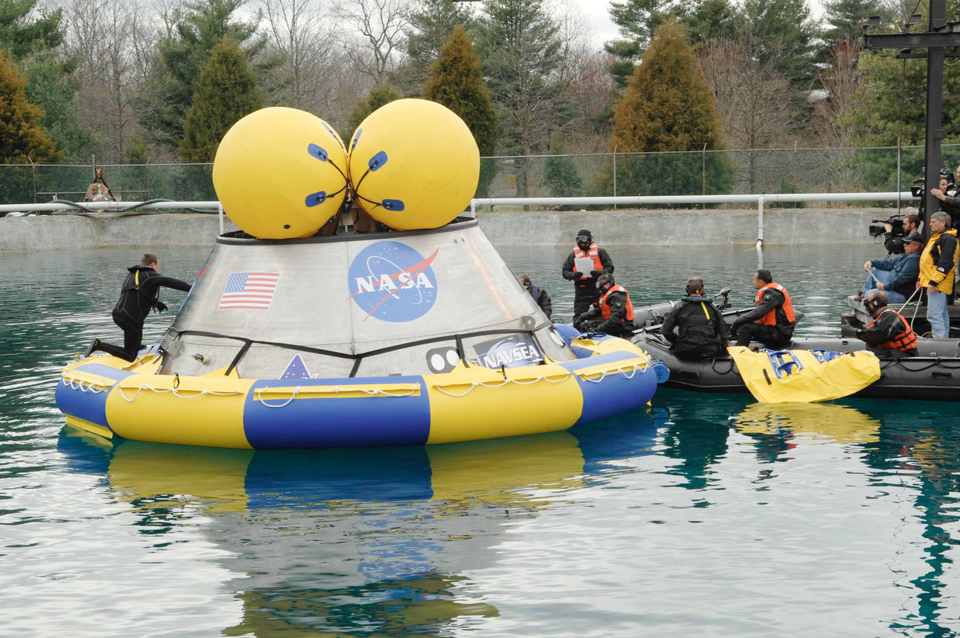
In 2009, during the Constellation phase of the program, the Post-landing Orion Recovery Test (PORT) was designed to determine and evaluate methods of crew rescue and what kind of motions the astronaut crew could expect after landing, including conditions outside the capsule for the recovery team. The evaluation process supported NASA's design of landing recovery operations including equipment, ship and crew needs.
The PORT Test used a full-scale boilerplate (mock-up) of NASA's Orion crew module and was tested in water under simulated and real weather conditions. Tests began March 23, 2009, with a Navy-built, 18000 lb boilerplate in a test pool. Full sea testing ran April 6–30, 2009, at various locations off the coast of NASA's Kennedy Space Center with media coverage.
Cancellation of Constellation program
.jpg)
On May 7, 2009, the Obama administration enlisted the Augustine Commission to perform a full independent review of the ongoing NASA space exploration program. The commission found the then-current Constellation Program to be woefully under-budgeted with significant cost overruns, behind schedule by four years or more in several essential components, and unlikely to be capable of meeting any of its scheduled goals. As a consequence, the commission recommended a significant re-allocation of goals and resources. As one of the many outcomes based on these recommendations, on October 11, 2010, the Constellation program was canceled, ending development of the Altair, Ares I, and Ares V. The Orion Crew Exploration Vehicle survived the cancellation and was transferred to be launched on the Space Launch System.
Orion Multi-Purpose Crew Vehicle (MPCV)
The Orion development program was restructured from three different versions of the Orion capsule, each for a different task, to the development of the MPCV as a single version capable of performing multiple tasks. On December 5, 2014, a developmental Orion spacecraft was successfully launched into space and retrieved at sea after splashdown on the Exploration Flight Test-1 (EFT-1).
Orion splashdown recovery testing
Before EFT-1 in December 2014, several preparatory vehicle recovery tests were performed, which continued the "crawl, walk, run" approach established by PORT. The "crawl" phase was performed August 12–16, 2013, with the Stationary Recovery Test (SRT). The SRT demonstrated the recovery hardware and techniques that were to be employed for the recovery of the Orion CM in the protected waters of Naval Station Norfolk using the LPD-17 type USS Arlington as the recovery ship.
The "walk" and "run" phases were performed with the Underway Recovery Test (URT). Also using an LPD 17 class ship, the URT was performed in more realistic sea conditions off the coast of California in early 2014 to prepare the US Navy / NASA team for recovering the Exploration Flight Test-1 (EFT-1) Orion CM. The URT tests completed the pre-launch test phase of the Orion recovery system.
Orion Lite
History
Orion Lite is an unofficial name used in the media for a lightweight crew capsule proposed by Bigelow Aerospace in collaboration with Lockheed Martin. It was to be based on the Orion spacecraft that Lockheed Martin was developing for NASA. It was never developed. It was to be a lighter, less capable and a less expensive version of the full Orion.
Orion Lite was intended to provide a stripped-down version of the Orion that would be available for missions to the International Space Station earlier than the more capable Orion, which is designed for longer duration missions to the Moon and Mars.
Bigelow had begun working with Lockheed Martin in 2004. A few years later Bigelow signed a million-dollar contract to develop "an Orion mockup, an Orion Lite", in 2009.
The proposed collaboration between Bigelow and Lockheed Martin on the Orion Lite spacecraft has ended. Bigelow began work with Boeing on a similar capsule, the CST-100, which has no Orion heritage, and was one of the two systems selected under NASA's Commercial Crew Development (CCDev) program to transport crew to the ISS.
Design
Orion Lite's primary mission would be to transport crew to the International Space Station (ISS), or to private space stations such as the planned B330 from Bigelow Aerospace. While Orion Lite would have the same exterior dimensions as the Orion, there would be no need for the deep space infrastructure present in the Orion configuration. As such, the Orion Lite would have been able to support larger crews of around 7 people as the result of greater habitable interior volume and the reduced weight of equipment needed to support an exclusively low-Earth-orbit configuration.
Recovery
In order to reduce the weight of Orion Lite, the more durable heat shield of the Orion would be replaced with a lighter weight heat shield designed to support the lower temperatures of Earth atmospheric re-entry from low Earth orbit. Additionally, the current proposal calls for a mid-air retrieval, wherein another aircraft captures the descending Orion Lite module. To date, such a retrieval method has not been employed for crewed spacecraft, although it has been used with satellites.
{{Anchor|Main|Flights}}Flights
List of flights
| Mission | Patch | Launch (UTC) | Launch site | Launch vehicle | Outcome | Duration | Summary | MLAS | Ares I-X | Pad Abort 1 | Exploration Flight Test-1 | Ascent Abort-2 | Artemis I | ||||
|---|---|---|---|---|---|---|---|---|---|---|---|---|---|---|---|---|---|
| [[File:MLAS mission patch.png | alt= | center | frameless | 51x51px]] | 8 July 2009, 10:26 | Wallops | MLAS | 57s | Test flight of the Max Launch Abort System (MLAS) | ||||||||
| [[File:AresIX patch02.svg | center | frameless | 49x49px | alt=]] | 28 October 2009, 15:30 | Kennedy, LC-39B | Ares I-X | ~6m | Test flight of the Ares rocket | ||||||||
| [[File:Orion Pad Abort 1.png | 50x50px | frameless | center | https://commons.wikimedia.org/wiki/File:Orion_Pad_Abort_1.png]] | 6 May 2010, 13:03 | White Sands, LC-32E | Orion LAS | 1m 35s | Flight test of the Orion Launch Abort System (LAS) | ||||||||
| [[File:Exploration Flight Test-1 insignia.png | 50x50px | frameless | center | https://commons.wikimedia.org/wiki/File:Exploration_Flight_Test-1_insignia.png]] | 5 December 2014, 12:05 | Cape Canaveral, SLC-37 | Delta IV Heavy | 4h 24m | Orbital flight test of Orion's heat shield, parachutes, jettisoning components, and on-board computers. Orion was recovered by and brought to San Diego, California, for its return to Kennedy Space Center in Florida. | ||||||||
| [[File:Ascent Abort-2.png | 50x50px | frameless | center | https://commons.wikimedia.org/wiki/File:Ascent_Abort-2.png]] | 2 July 2019, 11:00 | Cape Canaveral, SLC-46 | Orion Abort Test Booster | 3m 13s | Test of the Launch Abort System (LAS) of NASA's Orion spacecraft | ||||||||
| [[File:Artemis I Patch.svg | frameless | center | 63x63px]] | 16 November 2022, 06:47:44 | Kennedy, LC-39B | SLS Block 1 | 25d 10h 55m 50s | Uncrewed lunar orbit and return |


Upcoming missions
Main article: Artemis program
The first crewed flight, Artemis II, will be a lunar flyby. Flights are expected to achieve a yearly cadence from Artemis IV onward in 2028.
| Mission | Launch date | Crew | Launch vehicle | Duration | Artemis II | Artemis III | Artemis IV | Artemis V | |||
|---|---|---|---|---|---|---|---|---|---|---|---|
| NET 5 February 2026 | SLS Block 1 Crew | ~10 days | |||||||||
| url=https://www.rmg.co.uk/stories/space-astronomy/nasa-moon-mission-artemis-program-launch-date | title=Follow the NASA Artemis missions | date=25 November 2024 | access-date=6 October 2025}} | TBA | SLS Block 1 Crew | ~30 days | |||||
| September 2028 | TBA | SLS Block 1B Crew | ~30 days | ||||||||
| March 2030 | TBA | SLS Block 1B Crew | ~30 days |
Proposed
A proposal curated by William H. Gerstenmaier before his 10 July 2019 reassignment suggests four launches of the crewed Orion spacecraft and logistical modules aboard the SLS Block 1B to the Gateway. The crewed Artemis4 through7 would launch yearly, testing in situ resource utilization and nuclear power on the lunar surface with a partially reusable lander. Artemis 7 would deliver a crew of four astronauts to a surface lunar outpost known as the Lunar Surface Asset. The Lunar Surface Asset would be launched by an undetermined launcher and would be used for extended crewed lunar surface missions. Another repair mission to the Hubble Space Telescope is also possible.
| Mission | Launch date | Crew | Launch vehicle | Duration | Artemis VI | Artemis VII | Artemis VIII | Artemis IX | Artemis X | Artemis XI | ||||||
|---|---|---|---|---|---|---|---|---|---|---|---|---|---|---|---|---|
| NET 2031 | TBA | SLS Block 1B Crew | ~60d | |||||||||||||
| NET 2032 | TBA | SLS Block 1B Crew | ~60d | |||||||||||||
| last=Foust | first=Jeff | user=jeff_foust | number=1587075677756526598 | title=The current Artemis planning manifest, now updated to include a lunar landing on Artemis 4. | date=31 October 2022 | access-date=31 October 2022}} | TBA | SLS Block 1B Crew | ~60d | |||||||
| NET 2034 | TBA | SLS Block 2 Crew | ~60d | |||||||||||||
| NET 2035 | TBA | SLS Block 2 Crew | ~60d | |||||||||||||
| NET 2036 | TBA | SLS Block 2 Crew | ~60d |
Commercial lunar missions
In December 2025, Lockheed Martin announced plans to offer commercial flights to individuals and other space agencies aboard Orion in the future, aiming to reuse the capsules after Artemis III to drive down the cost of spacecraft operations.
Potential Mars missions
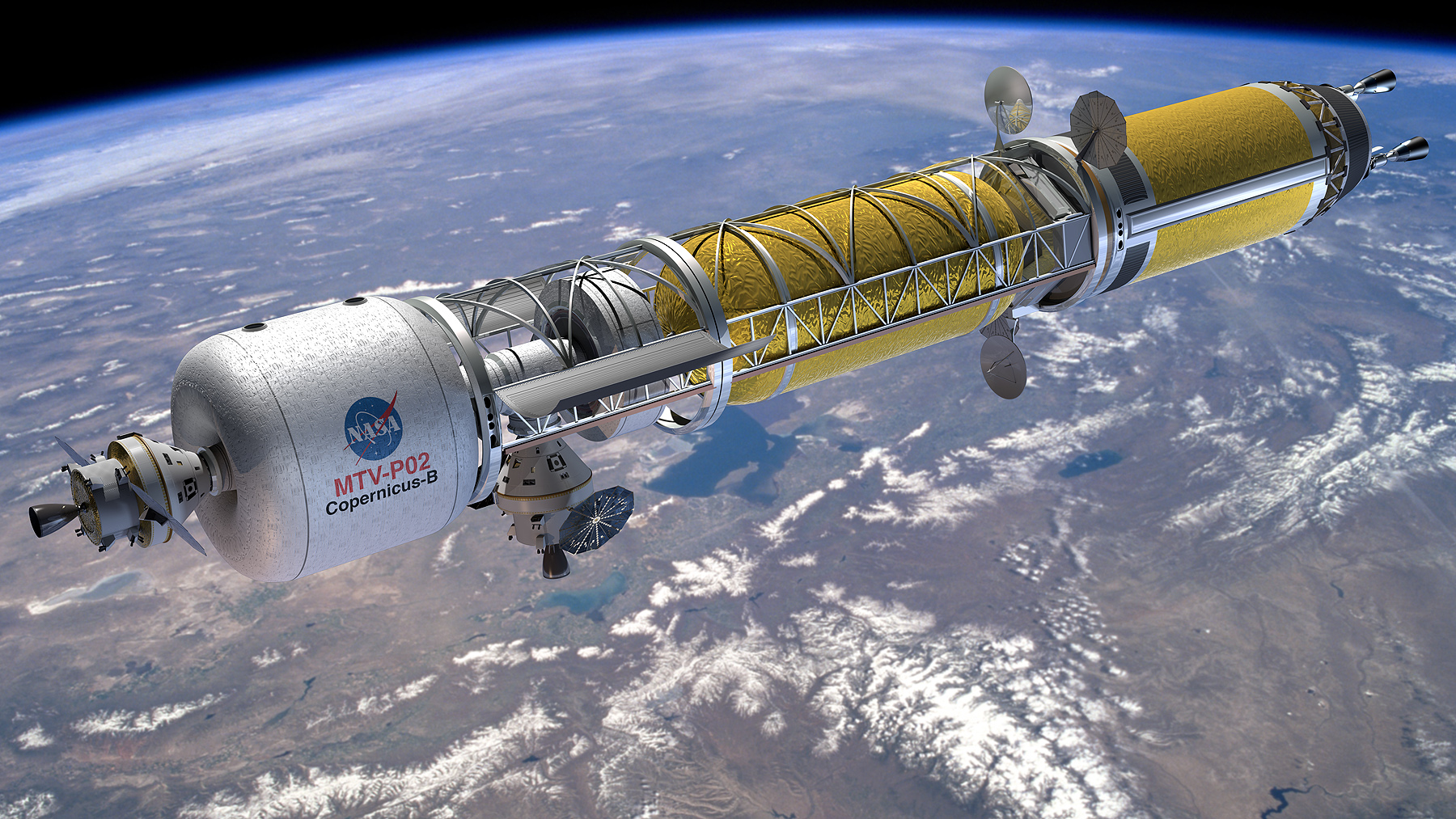
The Orion capsule is designed to support future missions to send astronauts to Mars, probably to take place in the 2030s. Since the Orion capsule provides only about 2.25 m3 of living space per crew member, the use of an additional Deep Space Habitat (DSH) module featuring propulsion will be needed for long-duration missions. The complete spacecraft stack is known as the Deep Space Transport. The habitat module will provide additional space and supplies, as well as facilitate spacecraft maintenance, mission communications, exercise, training, and personal recreation. Some concepts for DSH modules would provide approximately 70.0 m3 of living space per crew member, though the DSH module is in its early conceptual stage. DSH sizes and configurations may vary slightly, depending on crew and mission needs. The mission may launch in the mid-2030s or late-2030s.
Canceled
Asteroid Redirect Mission
Main article: Asteroid Redirect Mission
The Asteroid Redirect Mission (ARM), also known as the Asteroid Retrieval and Utilization (ARU) mission and the Asteroid Initiative, was a space mission proposed by NASA in 2013. The Asteroid Retrieval Robotic Mission (ARRM) spacecraft would rendezvous with a large near-Earth asteroid and use robotic arms with anchoring grippers to retrieve a 4-meter boulder from the asteroid. A secondary objective was to develop the required technology to bring a small near-Earth asteroid into lunar orbit – "the asteroid was a bonus." There, it could be analyzed by the crew of the Orion EM-5 or EM-6 ARCM mission in 2026.
List of vehicles
| Image | Serial & Name | Status | Flights | Time in flight | Notes | Cat. | Retired | [[File:MLASOrionCM.png | center | frameless | 216x216px]] | [[File:Orion Abort Flight Test.jpg | center | frameless | 216x216px]] | [[File:EFT-1 Orion stack.jpg | center | frameless]] | Expended | [[File:Orion CM-LAS stack.jpg | center | frameless | 216x216px]] | [[File:Assembly aa2 orion.jpg | center | frameless | 216x216px]] | Active | [[File:Orion Ground Test Article (GTA).jpg | 216x216px]] | [[File:Orion STA 2018.jpg | 373x373px]] | [[File:Artemis I Orion Lift & Mate (KSC-20211020-PH-FMX01 0136).jpg | center | frameless | 255x255px]] | [[File:Artemis II Orion Solar Array Wings Installed (jsc2025e016293).jpg | 215x215px]] | Under construction | [[File:Artemis III Orion Crew Module (jsc2025e016286).jpg | 215x215px]] | [[File:KSC_Orion_Media_Day_(KSC-20230808-PH-KLS01_0035).jpg | 216x216px]] |
|---|---|---|---|---|---|---|---|---|---|---|---|---|---|---|---|---|---|---|---|---|---|---|---|---|---|---|---|---|---|---|---|---|---|---|---|---|---|---|---|---|---|---|---|
| 1 | 57s | Boilerplate used in the July 2009 test launch of the Max Launch Abort System; did not have a service module. | |||||||||||||||||||||||||||||||||||||||||
| 1 | 2m, 15s | Boilerplate used in Pad Abort-1; did not have a service module. | [[File:Commons-logo.svg | 15px | link=c:Category:Orion Pad Abort-1 boilerplate]] | ||||||||||||||||||||||||||||||||||||||
| 001 | 1 | 4h, 24m, 46s | Vehicle used in Exploration Flight Test-1. First Orion to fly in space; did not have a service module. Orion 001 is currently on display at Kennedy Space Center Visitor Complex. | [[File:Commons-logo.svg | 15px | link=c:Category:Orion 001]] | |||||||||||||||||||||||||||||||||||||
| CM/LAS | 1 | ~6m | Boilerplate used in Ares I-X launch; did not have a service module. | ||||||||||||||||||||||||||||||||||||||||
| 1 | 3m, 13s | Boilerplate used in Ascent Abort-2; did not have a service module. Intentionally destroyed during the flight. | [[File:Commons-logo.svg | 15px | link=c:Category:Orion Ascent Abort-2 boilerplate]] | ||||||||||||||||||||||||||||||||||||||
| GTA | 0 | Ground Test Article, used in ground tests of the Orion crew module design with mock service modules. | [[File:Commons-logo.svg | 15px | link=c:Category:Orion Ground Test Article]] | ||||||||||||||||||||||||||||||||||||||
| STA | 0 | Structural Test Article, used in structural testing of the complete Orion spacecraft design. | [[File:Commons-logo.svg | 15px | link=c:Category:Orion Structural Test Article]] | ||||||||||||||||||||||||||||||||||||||
| 002 | 1 | last=Vuong | first=Zen | title=JPL joins NASA's first agency-wide social media event to highlight Thursday's Orion flight test | url=https://www.pasadenastarnews.com/2014/12/03/jpl-joins-nasas-first-agency-wide-social-media-event-to-highlight-thursdays-orion-flight-test/ | website=Pasadena Star-News | access-date=March 10, 2020 | archive-url=https://web.archive.org/web/20200310121006/https://www.pasadenastarnews.com/2014/12/03/jpl-joins-nasas-first-agency-wide-social-media-event-to-highlight-thursdays-orion-flight-test/ | archive-date=March 10, 2020 | date=December 3, 2014 | quote=Orion 002, 003 and 004 will become lessons that will further humanity in its quest to inhabit Mars and become Earth-independent. [...] "Orion tail number 003 has a special place in my heart," he said. "Four of my astronauts are going to climb into it and have an adventure of a lifetime... | url-status=live}} First to be fully completed (*EFT-1* Orion did not have SM, see above), and go to the Moon. Is now used for ground testing for future Artemis missions. | [[File:Commons-logo.svg | 15px | link=c:Category:Orion 002]] | ||||||||||||||||||||||||||||
| 003 | |||||||||||||||||||||||||||||||||||||||||||
| *Integrity* | 0 | Vehicle to be used in Artemis II. First Orion planned to carry crew. | [[File:Commons-logo.svg | 15px | link=c:Category:Orion 003]] | ||||||||||||||||||||||||||||||||||||||
| 004 | |||||||||||||||||||||||||||||||||||||||||||
| *To be named* | 0 | url=http://www.nasa.gov/feature/next-generation-of-orion-spacecraft-in-production-for-future-artemis-missions | title=Next Generation of Orion Spacecraft in Production | first=Kristyn | last=Damadeo | date=September 9, 2021 | website=NASA | access-date=October 6, 2021 | archive-date=September 23, 2021 | archive-url=https://web.archive.org/web/20210923032130/https://www.nasa.gov/feature/next-generation-of-orion-spacecraft-in-production-for-future-artemis-missions/ | url-status=live}} | [[File:Commons-logo.svg | 15px | link=c:Category:Orion 004]] | |||||||||||||||||||||||||||||
| 005 | |||||||||||||||||||||||||||||||||||||||||||
| *To be named* | 0 | Vehicle to be used in Artemis IV. Pressure vessel shipped to Kennedy Space Center in March 2023. | |||||||||||||||||||||||||||||||||||||||||
| 006 | |||||||||||||||||||||||||||||||||||||||||||
| *To be named* | 0 | Vehicle to be used in Artemis V. Pressure vessel shipped to Kennedy Space Center in August 2025. |
Notes
References
| access-date= 2026-01-02 }}
| access-date= 2019-01-01 | archive-date= 2018-12-24 | archive-url= https://web.archive.org/web/20181224004400/https://arstechnica.com/science/2016/08/how-much-will-sls-and-orion-cost-to-fly-finally-some-answers/ | url-status= live }}
| access-date= 2019-01-01 | archive-date= 2018-12-17 | archive-url= https://web.archive.org/web/20181217062648/https://arstechnica.com/science/2017/10/nasa-chooses-to-not-tell-congress-how-much-deep-space-missions-cost/ | url-status= live }}
| access-date= 2020-07-26 | archive-date= 2020-07-16 | archive-url= https://web.archive.org/web/20200716153821/https://arstechnica.com/science/2019/09/after-15-years-of-development-lockheed-wins-new-cost-plus-contract-for-orion/ | url-status= live }}
| access-date= 2025-05-03 }}
| access-date= 2026-01-03 }}
| access-date= 2026-01-01 }}
| access-date= 2020-04-18 | archive-date= 2020-06-24 | archive-url= https://web.archive.org/web/20200624201359/https://www.nasa.gov/press-release/nasa-commits-to-long-term-artemis-missions-with-orion-production-contract/ | url-status= live }}
| access-date= 2007-08-06 | archive-date= 2016-06-07 | archive-url= https://web.archive.org/web/20160607173246/https://www.nasaspaceflight.com/2007/08/orion-landings-to-be-splashdowns-ksc-buildings-to-be-demolished/ | url-status= live }}
| access-date= 2014-07-15 | archive-date= 2011-12-26 | archive-url= https://web.archive.org/web/20111226104929/http://www.nasaspaceflight.com/2011/10/space-bound-orion-lunar-missions-referenced/ | url-status= live }}
| access-date= 2014-07-15 | archive-date= 2012-01-11 | archive-url= https://web.archive.org/web/20120111225303/http://www.nasaspaceflight.com/2011/11/nasa-approve-eft-1-flight-orion-pushes-2013-orbital-debut/ | url-status= live }}
| access-date= 2020-03-11 | archive-date= 2020-03-10 | archive-url= https://web.archive.org/web/20200310123959/https://www.nasaspaceflight.com/2011/11/eft-1-orion-hatch-door-orion-modal-testing/ | url-status= live
| access-date= 2014-07-15 | archive-date= 2012-02-13 | archive-url= https://web.archive.org/web/20120213022549/http://www.nasaspaceflight.com/2012/02/orion-hoping-for-success-second-generation-parachute-system/ | url-status= live }}
| access-date= 2014-07-15 | archive-date= 2012-02-28 | archive-url= https://web.archive.org/web/20120228013618/http://www.nasaspaceflight.com/2012/02/orion-ptv-preparing-drop-test-eft-1-orion-progress/ | url-status= live }}
| access-date= 2015-08-26 | archive-date= 2012-04-14 | archive-url= https://web.archive.org/web/20120414141447/http://www.nasaspaceflight.com/2012/04/orion-parachutes-preparing-another-milestone-drop-test-april-17/ | url-status= live }}
| access-date= 2012-07-23 | archive-date= 2012-07-17 | archive-url= https://web.archive.org/web/20120717024118/http://www.nasaspaceflight.com/2012/07/nasa-esd-key-orion-requirement-lunar-missions/ | url-status= live }}
| access-date= 2014-07-15 | archive-date= 2012-12-05 | archive-url= https://web.archive.org/web/20121205023436/http://www.nasaspaceflight.com/2012/11/uk-steps-up-esa-commit-atv-service-module-orion/ | url-status= live }}
| access-date= 2014-03-29 | archive-date= 2014-03-28 | archive-url= https://web.archive.org/web/20140328092410/http://www.nasaspaceflight.com/2014/03/eft-1-slips-december-satellite-launch-first/ | url-status= live }}
| access-date= 2014-11-10 | archive-date= 2016-08-17 | archive-url= https://web.archive.org/web/20160817092439/https://www.nasaspaceflight.com/2014/10/eft-1-orion-assembly-conduts-frr/ | url-status= live }}
| access-date= 2016-03-07 | archive-date= 2016-03-06 | archive-url= https://web.archive.org/web/20160306080848/http://www.nasaspaceflight.com/2015/12/nasa-testing-orions-european-service-module/ | url-status= live }}
| access-date= 2014-12-06 | archive-date= 2019-04-12 | archive-url= https://web.archive.org/web/20190412154548/https://www.nytimes.com/2014/12/06/science/nasa-orion-spacecraft-lifts-off-into-orbit.html | url-status= live }}
| access-date= 2012-06-23 | archive-date= 2013-02-06 | archive-url= https://web.archive.org/web/20130206090340/http://spaceflightnow.com/news/n1206/21atvfuture/ | url-status= live }}
| access-date= 2014-03-29 | archive-date= 2014-03-28 | archive-url= https://web.archive.org/web/20140328092956/http://www.spaceflightnow.com/orion/eft1/140315delay/ | url-status= live }}
| access-date= 2016-06-28 | archive-date= 2014-12-05 | archive-url= https://web.archive.org/web/20141205185405/http://spaceflightnow.com/2014/12/03/esa-member-states-commit-funding-for-orion-service-module/ | url-status= live }}
| access-date= 2016-06-07 | archive-date= 2016-07-01 | archive-url= https://web.archive.org/web/20160701155403/https://spaceflightnow.com/2015/09/16/orion-spacecraft-may-not-fly-with-astronauts-until-2023/ | url-status= live }}
| access-date= 2020-03-11 | archive-date= 2020-03-10 | archive-url= https://web.archive.org/web/20200310144745/https://spaceflightnow.com/2019/07/01/critical-abort-test-of-nasas-orion-crew-capsule-set-for-tuesday/ | url-status= live
| access-date= 2019-12-11 | archive-date= 2019-12-10 | archive-url= https://web.archive.org/web/20191210090653/https://spaceflightnow.com/2019/11/29/earth-observation-deep-space-exploration-big-winners-in-new-esa-budget/ | url-status= live
| access-date= 2022-04-27 | archive-date= 2022-04-26 | archive-url= https://web.archive.org/web/20220426202127/https://spaceflightnow.com/2022/04/26/nasas-moon-rocket-rolls-back-to-vehicle-assembly-building-for-repairs/ | url-status= live }}
| access-date= 2015-09-17 | archive-date= 2015-09-23 | archive-url= http://webarchive.loc.gov/all/20150923084955/http://spacenews.com/first%2Dcrewed%2Dorion%2Dmission%2Dmay%2Dslip%2Dto%2D2023/ | url-access= subscription | url-status= live }}
| access-date= 2017-09-09 | archive-date= 2017-06-15 | archive-url= https://wayback.archive-it.org/all/20170615143924/http://spacenews.com/nasa-closing-out-asteroid-redirect-mission/ | url-access= subscription | url-status= live }}
| access-date= 2021-11-09 | archive-date= 2019-04-21 | archive-url= https://archive.today/20190421183720/https://spacenews.com/independent-report-concludes-2033-human-mars-mission-is-not-feasible/ | url-access= subscription | url-status= live }}
| access-date= 2019-12-10 | url-access= subscription
| access-date= 2024-06-07 | url-access= subscription }}
| access-date= 2014-11-30 | archive-date= 2014-12-04 | archive-url= https://web.archive.org/web/20141204145412/http://www.space.com/21541-nasa-orion-spacecraft-reusable.html | url-status= live }}
| access-date= 2011-05-26 | archive-date= 2011-05-25 | archive-url= https://web.archive.org/web/20110525184808/http://www.space.com/11765-nasa-deep-space-exploration-vehicle-announcement.html | url-status= live }}
| access-date= 2020-10-17 | archive-date= 2020-11-09 | archive-url= https://web.archive.org/web/20201109032858/https://www.space.com/7137-nevada-company-pitches-lite-concept-nasa-spaceship.html | url-status= live }}
| access-date= 2020-03-11 | archive-date= 2020-03-10 | archive-url= https://web.archive.org/web/20200310144144/https://www.space.com/8362-nasa-launch-abort-test-builds-50-years-astronaut-escape-systems.html | url-status= live
References
- "Orion Reference Guide". NASA Johnson Space Center.
- "NASA Authorization Act of 2010". Thomas.loc.gov.
- (August 4, 2014). "Orion Quick facts". NASA.
- Cesar, Alan. (15 Dec 2023). "An Aerospace Titan Rooted in the Midwest".
- Kraft, Rachel. (2022-05-16). "Artemis I Mission Availability".
- Wattles, Jackie. (November 8, 2022). "NASA's Artemis I mission delayed again as storm barrels toward launch site". Warner Bros Discovery.
- (8 November 2022). "NASA Prepares Rocket, Spacecraft Ahead of Tropical Storm Nicole, Re-targets Launch". [[NASA]].
- (July 4, 2025). "One Big Beautiful Bill Act". 119th United States Congress.
- Peterson, L.. (2009). "Environmental Control and Life Support System (ECLSS)". [[NASA]].
- "NASA – A 21st Century-Style Return to the Moon".
- (February 7, 2009). "NASA – Orion Crew Exploration Vehicle". NASA.
- (August 31, 2006). "Lockheed to build Nasa 'Moonship'". BBC News.
- LaNasa, Shannon. (2021). "Michoud Tenants: Lockheed Martin". NASA.
- Cristina, Victoria. (April 26, 2021). "Behind the scenes at NASA Michoud: Assembly of the Orion Crew Modules". Nexstar Media Group.
- NASA Orion public relations. (September 10, 2021). "Technicians at NASA's Michoud Assembly Facility completed the welding on Orion's pressure vessel which will carry @NASA_Astronauts to the Moon on #Artemis III.".
- (April 7, 2009). "NASA Selects Material for Orion Spacecraft Heat Shield". NASA Ames Research Center.
- Coppinger, Rob. (October 6, 2006). "NASA Orion crew vehicle will use voice controls in Boeing 787-style Honeywell smart cockpit". [[Flight International]].
- (August 6, 2007). "NASA Denies Making Orion Water Landing Decision – and Deleting Touchdowns on Land". NASA Watch.
- (May 24, 2011). "NASA Announces Key Decision For Next Deep Space Transportation System". [[NASA]].
- Hill, Denise. (2019-07-23). "S.A.M. Goes to Work Aboard ISS".
- (May 5, 2011). "US and Europe plan new spaceship". BBC News.
- (June 21, 2012). "Airbus Defence and Space awarded two ATV evolution studies from ESA". Astrium.
- "Multi Purpose Crew Vehicle – European Service Module for NASA's Orion programme". Airbus Defence and Space.
- [https://orionesm.airbusdefenceandspace.com/blog/airbus-defence-and-space-wins-200-million-euros-esa-contract-for-second-service-module-for-nasas-orion-crewed-space-capsule/ Airbus Defence and Space wins 200 million euros ESA contract for second service module for NASA's Orion crewed space capsule] {{Webarchive. link. (April 19, 2017 . Airbus Defense and Space press release. February 16, 2017.)
- (26 October 2018). "Call for media: The European Service module meets Orion".
- "Mission to the Moon: How We'll Go Back – and Stay This Time". popularmechanics.com.
- Mika McKinnon. (2014-12-04). "Meet Orion, NASA's New Deep Space Explorer". Space.io9.com.
- "Launch Abort System Jettison Motor | Aerojet Rocketdyne". Rocket.com.
- "ATK Awarded Contract for Orion Launch Abort Motors". PRNewswire.
- "Orion's New Launch Abort Motor Test Stand Ready for Action". NASA.
- (July 17, 2018). "Jettison Motor Readied For Integration Into Orion's LAS". Spaceflight Insider.
- (30 Sep 2019). "NextSTEP-2 Appendix H, Attachment F: Human Landing System to Orion Interface Requirements Document (HLS-IRD-005)". NASA.
- Moen, Marina M.. (August 8, 2011). "Feasibility of Orion Crew Module Entry on Half of Available Propellant Due to Tank Isolation Fault". American Institute of Aeronautics and Astronautics.
- (2006-08-31). "NASA Selects Lockheed Martin To Be Orion Crew Exploration Vehicle Prime Contractor". NASA.
- . (January 16, 2013). ["NASA Signs Agreement for a European-Provided Orion Service Module"](http://www.nasa.gov/exploration/systems/mpcv/orion_feature_011613.html). *nasa.gov*.
- (2013-01-16). "ESA workhorse to power NASA's Orion spacecraft / Research / Human Spaceflight / Our Activities / ESA". Esa.int.
- . (January 11, 2014 ). ["Orion Exploration Flight Test-1"](http://www.aerospaceguide.net/spacecraft/eft-1.html). *aerospaceguide.net*.
- Grush, Loren. (30 November 2020). "Component failure in NASA's deep-space crew capsule could take months to fix".
- Klotz, Irene. (7 December 2020). "Issue with Orion power distribution unit "We really don't think it's going to be a big impact on the final schedule for the Artemis I flight," @NASA's Ken Bowersox tells reporters".
- ''"NASA FY22 Inflation Tables - to be utilized in FY23" (Excel). NASA. Retrieved 31 October 2022''. This article incorporates text from this source, which is in the [[public domain]]''.''
- "FY 2008 Budget Estimates". National Aeronautics and Space Administration.
- "Fiscal Year 2009 Budget Estimates". National Aeronautics and space Administration.
- "Fiscal Year 2010 Budget Estimates". National Aeronautics and Space Administration.
- "FY 2013 President's Budget Request Summary". National Aeronautics and Space Administration.
- "FY 2014 President's Budget Request Summary". National Aeronautics and Space Administration.
- "FY 2015 President's Budget Request Summary". National Aeronautics and Space Administration.
- "FY 2016 President's Budget Request Summary". National Aeronautics and space Administration.
- "FY 2017 Budget Estimates". National Aeronautics and Space Administration.
- "FY 2018 Budget Estimates". National Aeronautics and Space Administration.
- "Public Law 115-31, 115th Congress".
- "2018 Consolidated Appropriations Act".
- "FY 2021 President's Budget Request Summary". National Aeronautics and Space Administration.
- (20 December 2019). "H.R.1158 – 116th Congress (2019–2020): Consolidated Appropriations Act, 2020".
- ''"National Aeronautics and Space Administration FY 2021 Spending Plan" (PDF). NASA. Archived from the original 31 October 2022. Retrieved 31 October 2022'' This article incorporates text from this source, which is in the [[public domain]].
- ''"Consolidated Appropriations Act, 2022" (PDF). Retrieved 31 October 2022.'' p.212. Archived from the original on 31 October 2022. This article incorporates text from this source, which is in the [[public domain]].
- "FY 2025 President's Budget Request Summary".
- "FY 2026 President's Budget Request Summary".
- (May 2014). "NASA Actions Needed to Improve Transparency and Assess Long Term Affordability of Human Exploration Programs". General Accounting Office.
- "NASA Commits to Long-term Artemis Missions with Orion Production Contract". NASA.gov.
- Smith, Marcia. (January 17, 2013). "NASA-ESA Agreement on Orion Service Module is For Only One Unit Plus Spares". spacepolicyonline.com.
- (March 27, 2014). "NASA's Ground Systems Development and Operations Program Completes Preliminary Design Review". National Aeronautics and Space Administration.
- ''"[https://www.nasa.gov/sites/default/files/atoms/files/fy_2022_spend_plan_july_2022.pdf National Aeronautics and Space Administration FY 2022 Spending Plan]" (PDF). NASA. Retrieved 03 January 2023. [https://web.archive.org/web/20230103161215/https://www.nasa.gov/sites/default/files/atoms/files/fy_2022_spend_plan_july_2022.pdf Archived] from the original on 03 January 2023. This article incorporates text from this source, which is in the [[public domain]].''
- Smith, Marcia. (May 1, 2014). "Mikulski "Deeply Troubled" by NASA's Budget Request; SLS Won't Use 70 Percent JCL". spacepolicyonline.com.
- "Orion's Missions".
- "Orion Production and Operations Contract".
- "NASA FY 2021 Budget Estimates".
- (2 May 2025). "President Trump's FY26 Budget Revitalizes Human Space Exploration".
- (2 May 2025). "Fiscal Year 2026 Discretionary Budget Request".
- "NASA Extreme Makeover—Space Vehicle Mockup Facility". nasa.gov.
- "What Goes Up Must Come Down As Orion Crew Vehicle Development Continues". Space-travel.com.
- "Orion Continues to Make a Splash". Space-travel.com.
- "Orion Drop Test – Jan. 06, 2012". Space-travel.com.
- "NASA Conducts Orion Parachute Testing for Orbital Test Flight". Space-travel.com.
- "NASA Conducts New Parachute Test for Orion". Space-travel.com.
- (January 14, 2004). "President Bush Announces New Vision for Space Exploration Program". White House Office of the Press Secretary.
- "Orion Spacecraft – Nasa Orion Spacecraft". aerospaceguide.net.
- (August 22, 2006). "NASA Names New Crew Exploration Vehicle Orion". [[NASA]].
- (October 11, 2006). "NASA sets Orion 13 for Moon Return". NASAspaceflight.com.
- (July 22, 2006). "NASA makes major design changes to CEV". NASAspaceflight.com.
- (August 31, 2006). "NASA Names Orion Contractor". NASA.
- "NASA Glenn To Test Orion Crew Exploration Vehicle". SpaceDaily.
- (December 11, 2008). "NASA: Constellation Abort Test November 2008". Nasa.gov.
- "NASA Orion LAS Pathfinder". Nasa.gov.
- (May 6, 2010). "NASA Completes Test of Orion Crew Capsule". [[Fox News]].
- (March 25, 2009). "NASA Orion PORT Test". Nasa.gov.
- [http://www.nasa.gov/pdf/396093main_HSF_Cmte_FinalReport.pdf Augustine Commission Final Report] {{Webarchive. link. (November 22, 2009. Published 22 Oct. 2009. Retrieved 14 December 2014.)
- [http://www.addictinginfo.org/2012/06/18/nasa/ NASA in Obama's Hands]. {{Webarchive. link. (December 22, 2015. Information Addict Website, by Nathaniel Downes. Published 18 June 2012. Retrieved 14 Dec 2014.)
- "Today – President Signs NASA 2010 Authorization Act". Universetoday.com.
- [https://web.archive.org/web/20140705003340/http://www.sciences360.com/index.php/what-is-nasas-constellation-program-12651/ What is NASA's Constellation Program?] archived from [http://www.sciences360.com/index.php/what-is-nasas-constellation-program-12651/ the original] the original Sciences 360 Website, By Tenebris. Discussion of multiple version development of Orion capsule. Published Nov. 17, 2009. Retrieved July 5, 2014.
- (October 30, 2014). "Orion Spacecraft Complete". NASA.
- (December 5, 2014). "NASA's Orion Spacecraft Splashes Down in Pacific After Test Flight". The New York Times.
- (August 16, 2013). "NASA & US Navy Test Demonstrates Water Recovery of Orion Crew Capsule". Universetoday.com.
- Klamper, Amy. (14 August 2009). "Company pitches 'lite' spaceship to NASA". NBC News.
- [http://www.thespacereview.com/article/1719/1 Bigelow still thinks big] {{Webarchive. link. (July 7, 2012 , ''[[The Space Review]]'', 2010-11-01, accessed 2010-11-02. "[In October 2010] Bigelow revealed that he had been working with Lockheed Martin on a capsule concept in the 2004–2005 period. 'We engaged in a million-dollar contract a couple years after that with Lockheed, and they created for us an Orion mockup, an Orion Lite.')
- Rincon, Paul. (2021-08-03). "Boeing's Starliner spacecraft: A guide". BBC.
- [https://www.popsci.com/category/spacex Space Hotel Visionary Proposes Modified "Orion Lite" Spaceship for NASA: Bigelow Airspace's concept is for low Earth-orbit missions only] {{Webarchive. link. (June 11, 2020 , ''[[Popular Science]]'', Jeremy Hsu, 14 August 2009)
- "Discoverer 14 – NSSDC ID: 1960-010A". NASA.
- "NASA's New Orion Spacecraft Completes First Spaceflight Test".
- (December 9, 2014). "Orion Off-loaded for Trip Back to Florida".
- (25 November 2024). "Follow the NASA Artemis missions".
- Davenport, Christion. (10 July 2019). "Shakeup at NASA as space agency scrambles to meet Trump moon mandate". [[Washington Post]].
- {{Harvard citation no brackets. Foust. 2019
- "America to the Moon 2024".
- Foust, Jeff. (2020-06-15). "Hugging Hubble longer".
- Foust, Jeff. (31 October 2022). "The current Artemis planning manifest, now updated to include a lunar landing on Artemis 4.".
- (January 2011). "Preliminary Report Regarding NASA's Space Launch System and Multi-Purpose Crew Vehicle". NASA.
- [https://www.inverse.com/article/29948-nasa-deep-space-gateway-transport-architectures-mars-travel NASA Unveils the Keys to Getting Astronauts to Mars and Beyond] {{Webarchive. link. (November 11, 2020 . Neel V. Patel, ''The Inverse''. April 4, 2017.)
- [http://csc.caltech.edu/references/RuckerThompson_DeepSpaceHab.pdf Habitat for Long Duration Deep Space Missions]. {{Webarchive. link. (September 20, 2015. Preliminary design proposal for DSH by Rucker & Thompson. Published 5 May 2012, retrieved 8 December 2014.)
- [http://www.nasa.gov/exploration/technology/deep_space_habitat/xhab/xhab-2012-progress.html#.VIaUHkc8KrU 2012 X-Hab Academic Innovation Challenge Progress Update]. {{Webarchive. link. (March 20, 2015. NASA DSH design news update. Published June 21, 2012, retrieved 8 Dec. 2014.)
- Dryden Flight Research Center. (May 6, 2010). "Orion Pad Abort 1 Test a Spectacular Success".
- Dunn, Marcia. (December 6, 2014). "NASA launches new Orion spacecraft and new era (w/ video)".
- Davis, Jason. (December 5, 2014). "Orion Returns to Earth after Successful Test Flight".
- "Orion EFT-1 flown spacecraft joins display in 'NASA Now' exhibit {{!}} collectSPACE".
- Sloss, Philip. (October 25, 2019). "NASA conducting data deep dive following July's Orion ascent abort test".
- Kremer, Ken. (March 30, 2010). "3 Welds to Go for 1st Orion Pathfinder Vehicle".
- Crane, Aimee. (2020-06-25). "Orion's 'Twin' Completes Structural Testing for Artemis I Mission".
- Vuong, Zen. (December 3, 2014). "JPL joins NASA's first agency-wide social media event to highlight Thursday's Orion flight test".
- (April 25, 2023). "De-servicing of Artemis I Crew Module complete! Teams in the Multi-Payload Processing Facility completed cleaning cycles & removal of avionics to be reused on @NASA_Orion for Artemis II. The capsule will be used as an environmental test article on future Artemis missions.".
- Damadeo, Kristyn. (September 9, 2021). "Next Generation of Orion Spacecraft in Production".
- de Selding, Peter. (26 May 2020). "ESA signs ~ EUR 250M ($305M) w/ @AirbusSpace to build 3rd Orion service module as part of existing barter agreement with @NASA. This model will fly in 2024 in the NASA Artemis mission sending astronauts to Moon. ESA funds were approved at last November's council of ESA govts.".
This article was imported from Wikipedia and is available under the Creative Commons Attribution-ShareAlike 4.0 License. Content has been adapted to SurfDoc format. Original contributors can be found on the article history page.
Ask Mako anything about Orion (spacecraft) — get instant answers, deeper analysis, and related topics.
Research with MakoFree with your Surf account
Create a free account to save articles, ask Mako questions, and organize your research.
Sign up freeThis content may have been generated or modified by AI. CloudSurf Software LLC is not responsible for the accuracy, completeness, or reliability of AI-generated content. Always verify important information from primary sources.
Report