From Surf Wiki (app.surf) — the open knowledge base
Oriented strand board
Engineered wood particle board

Engineered wood particle board
Oriented strand board (OSB) is a type of engineered wood, formed by adding adhesives and then compressing layers of wood strands (flakes) in specific orientations. It was invented by Armin Elmendorf in California in 1963. OSB may have a rough and variegated surface with the individual strips of around 2.5 ×, lying unevenly across each other, and is produced in a variety of types and thicknesses.
Oriented strand board is sometimes confused with chipboard, a synonym for particle board, whose "chips" are of a size that a lay person would likely describe as "particles".
Uses
OSB's mechanical properties make it suitable for load-bearing applications in construction. In North America, it is more popular than plywood, commanding 66% of the structural panel market in 2016. The most common uses are as sheathing in walls, flooring, and roof decking. For exterior walls, panels are available with a radiant-barrier layer laminated to one side; this eases installation and increases energy performance of the building envelope. OSB is also used in furniture production.
Manufacturing
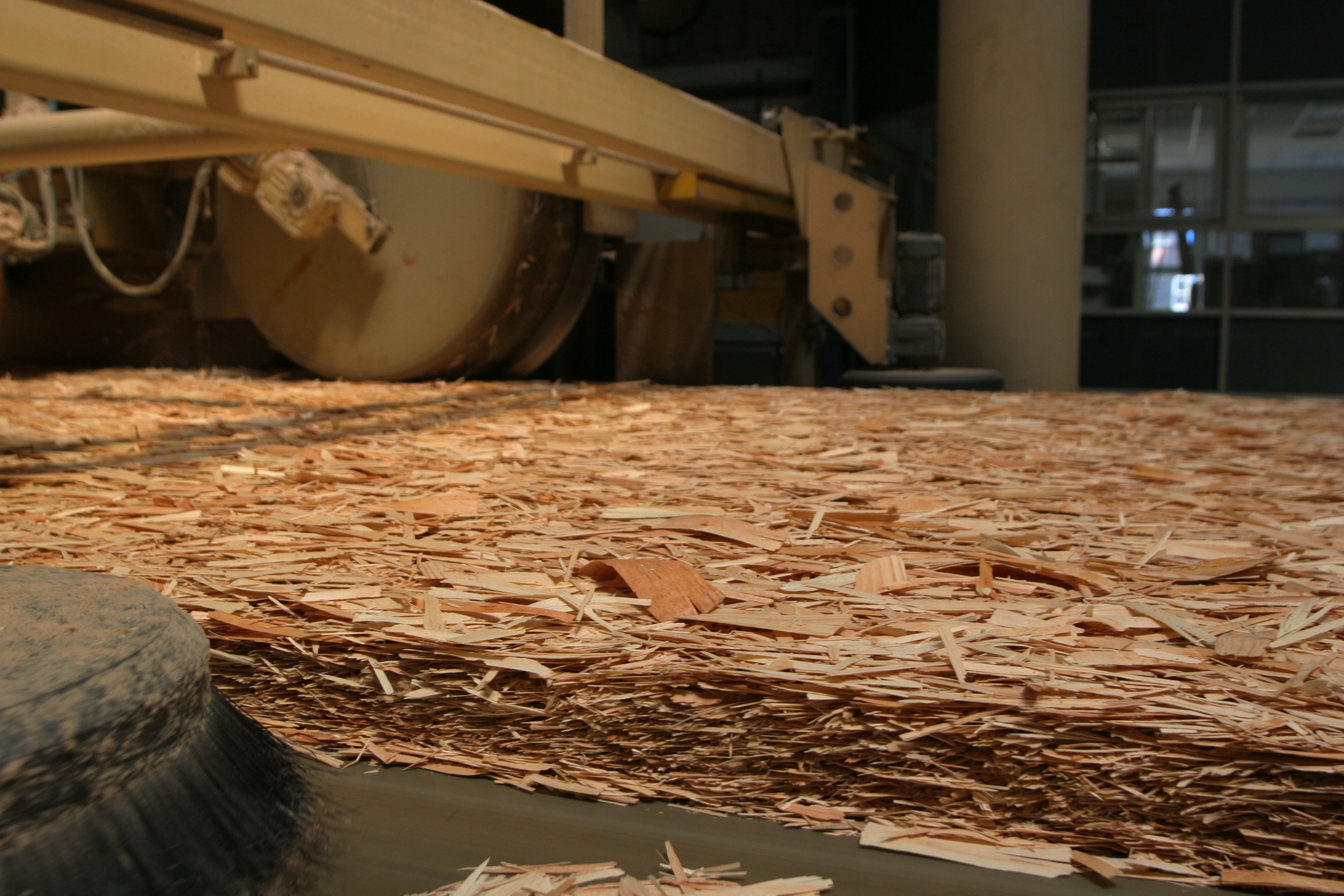
Oriented strand board is manufactured in wide mats from cross-oriented layers of thin, rectangular wooden strips compressed and bonded together with wax and synthetic resin adhesives.
The adhesive resins types used include: urea-formaldehyde (OSB type 1, nonstructural, nonwaterproof); isocyanate-based glue (or PMDI poly-methylene diphenyl diisocyanate–based) in inner regions with melamine-urea-formaldehyde or phenol formaldehyde resin glues at surface (OSB type 2, structural, water resistant on face); phenol formaldehyde resin throughout (OSB types 3 and 4, structural, for use in damp and outside environments).
The layers are created by shredding the wood into strips, which are sifted and then oriented on a belt or wire-mesh caul (a heated, ventilated support) and coated with the resin. The layers thus built up are transferred to a forming line and cross-oriented so that strips on the external layers are aligned to the panel's strength axis, while the internal layers are perpendicular. The number of layers placed is determined partly by the thickness of the panel, and is limited by the equipment used. Individual layers can also vary in thickness to give different finished panel thicknesses; typically, a 15 cm layer will produce a 15 mm panel thickness. The mat is placed in a thermal press to compress the flakes and bond them by heat activation and curing of the resin. Individual panels are then cut from the mats into finished sizes. Most of the world's OSB is made in the United States and Canada in large production facilities.
Production
In 2005, Canadian production was 10500000 m2 (3/8 in basis) of which 8780000 m2 ( inch) were exported, almost entirely to the United States. In 2014, Romania became the largest OSB-exporting country in Europe, with 28% of the exports going to Russia and 16% to Ukraine.
Properties

Adjustments to the manufacturing process can affect thickness, panel size, strength, and rigidity. OSB panels have no internal gaps or voids, and can be water-resistant, although they do require additional membranes to achieve impermeability to water and are not recommended for exterior use. The finished product has properties similar to plywood, but is uniform and cheaper. When tested to failure, OSB has a greater load-bearing capacity than milled wood panels. It has replaced plywood in many environments, especially the North American structural panel market.
All wood-based structural use panels can be cut and installed with the same types of equipment as for solid wood.
Health and safety
The resins used to create OSB have raised questions about their emission of volatile organic compounds such as formaldehyde, although industry trade groups assert that formaldehyde emissions from North American OSB are "negligible or nonexistent". Urea-formaldehyde is more toxic and should be avoided in home use. Phenol-formaldehyde products are considered to be relatively hazard free. Some newer types of OSB, so-called "new-generation" panels, use isocyanate resins that contain no formaldehyde and are considered nonvolatile when cured.
Some manufacturers treat the wood chips with various borate compounds that are toxic to termites, wood-boring beetles, molds, and fungi, but not mammals in applied doses.
In 2024, a hotel in Dublin, Ireland, lost its fire safety certificate after an inspection found fault with the composition of OSB in its flooring and walls.
Types
Five grades of OSB are defined in EN 300 in terms of their mechanical performance and relative resistance to moisture:
- OSB/0 – No added formaldehyde
- OSB/1 – General-purpose boards and boards for interior fitments (including furniture) for use in dry conditions
- OSB/2 – Load-bearing boards for use in dry conditions
- OSB/3 – Load-bearing boards for use in humid conditions
- OSB/4 – Heavy-duty load-bearing boards for use in humid conditions
References
References
- "Dokument US000003164511A". Deutsches Patent- und Markenamt.
- "Technical Information". Osb-info.org.
- (19 July 2016). "Toronto's Norbord riding the rising wave of OSB sales". [[The Globe and Mail]].
- Oldhand, Tony. (25 Apr 2017). "Types of Glue Used in OSB". sciencing.com.
- (1985). "Utilization of hardwoods growing on southern pine sites". U.S. Dept. of Agriculture, Forest Service.
- (2017). "Architectural Graphic Standards". [[Wiley (publisher).
- Han, Guangping, Cheng, Wanli, Manning, Mark, and Eloy, Pierre. (2012). "Performance of zinc Borate Treated Oriented Structural Straw Board against Mold Fungi, Decay Fungi, and Termites - A preliminary trial". BioResources.
- (24 August 2006). "Review of the Canadian structural panel market". Fordaq.com.
- (7 April 2014). "Romania has become the largest OSB exporting country in the EU". Fordaq S.A..
- (2015-09-04). "UMass Amherst: Building and Construction Technology » Choosing Between Oriented Strandboard and Plywood". Umass.edu.
- Chaya Kurtz. (2010-05-12). "Experts Talk About Engineered Wood - Articles". Networx.com.
- (2018-03-15). "Adhesive systems used in the European particleboard, MDF and OSB industries". Wood Material Science & Engineering.
- "Oriented Strand Board Educational Bulletin, Frequently Asked Questions". TECOTested.com.
- "I'm concerned about toxic offgassing from OSB subflooring and roofing".
- (3 November 2025). "Operators of Dublin hotel with fire safety issues seeking order for €4.2m remedial works". The Irish Times.
This article was imported from Wikipedia and is available under the Creative Commons Attribution-ShareAlike 4.0 License. Content has been adapted to SurfDoc format. Original contributors can be found on the article history page.
Ask Mako anything about Oriented strand board — get instant answers, deeper analysis, and related topics.
Research with MakoFree with your Surf account
Create a free account to save articles, ask Mako questions, and organize your research.
Sign up freeThis content may have been generated or modified by AI. CloudSurf Software LLC is not responsible for the accuracy, completeness, or reliability of AI-generated content. Always verify important information from primary sources.
Report