From Surf Wiki (app.surf) — the open knowledge base
Organization of Ibero-American States
International organization of Iberophone nations
International organization of Iberophone nations
| Field | Value |
|---|---|
| conventional_long_name | Organization of |
| Ibero-American States for Education, Science and Culture | |
| native_name | |
| linking_name | the Organization of Ibero-American States |
| symbol_type | Logo |
| image_symbol | Logo of the Organization of Ibero-American States 2021.svg |
| image_map | OEI map.svg |
| map_caption | |
| membership | 23 sovereign states |
| admin_center_type | Headquarters |
| admin_center | Madrid, Spain |
| languages_type | Languages |
| languages | |
| leader_title1 | Secretary General |
| leader_name1 | Mariano Jabonero |
| established_event1 | Foundation |
| established_date1 | 1949 |
| established_event2 | Current statutes |
| established_date2 | 1985 |
| area_km2 | 21,462,574 |
| area_sq_mi | 12,147,768 |
| population_estimate | 712,974,000 |
| population_estimate_year | 2005 |
| population_density_km2 | 61.09 |
| population_density_sq_mi | 158.2 |
| GDP_PPP | $11.306 trillion |
| GDP_PPP_year | 2014 |
| GDP_PPP_per_capita | $15,858 |
| official_website | [oei.int/](https://www.oei.int/) |
Ibero-American States for Education, Science and Culture
The Organization of Ibero-American States (, , ; abbreviated as OEI), formally the Organization of Ibero-American States for Education, Science and Culture, is an international organization made up of 23 member states of Iberophone nations in Europe and the Americas, as well as one member in Africa. The OEI's membership is composed of all of the sovereign states of Ibero-America and the Iberian Peninsula, as well as Equatorial Guinea. All members are Portuguese and Spanish speaking nations, in addition to Andorra, which is predominantly Catalan speaking, though the organization does not include all the Iberophone nations of the world.
History
The OEI was founded in 1949 as an international agency, the Office of Latin American Education, as a result of the first Latin American Education Congress in Madrid. In 1954 the second congress was held in Quito, where it was decided that the OEI would become an intergovernmental organization of sovereign states. On March 15, 1957, at the third Education Congress in Santo Domingo, the first statutes of the OEI became effective until 1985.
In 1979, the fourth congress met in Madrid; in 1983 the fifth congress took place in Lima. In May 1985, an extraordinary meeting of the congress was held in Bogotá, where it was decided to change the name of the OEI to its present name (keeping its acronyms and extending its objectives); the Latin American Education Congress became the General Assembly. At the December 1985 directive council meeting in Panama, its members agreed to the present statutes of the OEI, replacing the 1957 text and approving the organization's regulations. Since the 1991 Ibero-American Summit in Guadalajara, the OEI has promoted conferences of ministers of education and the execution of the educative, scientific and cultural programs delegated to it.
{{anchor|Aims and objectives}}Objectives
The purpose of the OEI is to promote intergovernmental cooperation among its member nations, primarily in the fields of education, science, technology and the arts. Its General Secretariat is located in Madrid. Financing of OEI operations and programs is derived from obligatory quotas and voluntary contributions from the governments of member nations and private cultural and educational institutions and foundations.
- To contribute to the fortification of knowledge, mutual understanding, integration, solidarity and peace among the Ibero-American peoples, and to spread education, science, technology and culture
- To encourage the development of education and culture for peace by preparing people to preserve freedom, solidarity and human rights, supporting change which make these possible
- To collaborate in the interchange of economic, political and cultural influences between Europe and Ibero-America
- To collaborate with its members ensure that their education systems are compassionate, democratic (socially fair) and productive, preparing for working life
- To collaborate in the diffusion of a common culture, respecting the uniqueness of its member states, encouraging global advances in science and technology while retaining cultural identity
- To facilitate relationships among science, technology and society in the Ibero-American countries and citizen understanding of their effects
- To promote the equitable distribution of cultural, Technological and scientific concepts
- To promote lateral cooperation among member states and between the states and other regional institutions
- To contribute to the spread of the Spanish and Portuguese languages, encouraging bilingual education while preserving the multicultural identity of the Ibero-American communities with a multilingual culture
Structure
]] The OEI consists of three bodies: the General Assembly, the Directive Council and the General Secretariat.
General Assembly
The General Assembly, the supreme authority of the organization, is composed of representatives (or delegations) from member States. It establishes OEI policies, evaluates and approves the organization's plan of activities, program and global budget, fixes annual dues and chooses the secretary-general.
Directive Council
The Directive Council is delegated by the General Assembly to control the OEI's government and administration. Made up of the member states' ministers of education (or their representatives), it is governed by the education minister of the country in which the next General Assembly meeting will be held. Its primary function is to analyze and approve the report of activities, programs, the biennial budget and the OEI's financial statement.
General Secretariat
The General Secretariat is delegated by the General Assembly as executive director of the OEI, representing it to governments, international organizations and other institutions. It directs, administers and executes the organization's programs and projects. The General Secretariat has a flexible internal structure, adaptable according to policies, strategies and the plan of activities.
Member states
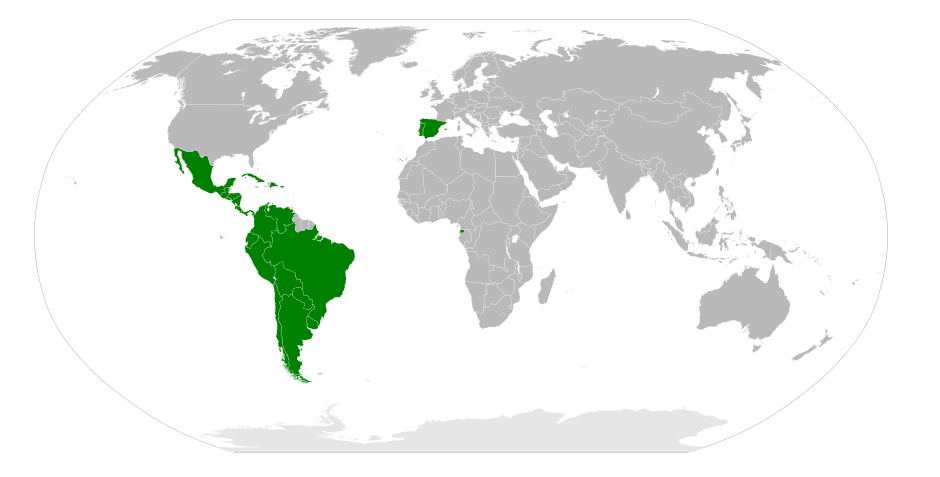
The following 23 states are members of the Organization of Ibero-American States:
- Andorra Andorra
- Argentina Argentina
- Bolivia Bolivia
- Brazil Brazil
- Chile Chile
- Colombia Colombia
- Costa Rica Costa Rica
- Cuba Cuba
- Dominican Republic Dominican Republic
- Ecuador Ecuador
- El Salvador El Salvador
- Equatorial Guinea Equatorial Guinea
- Guatemala Guatemala
- Honduras Honduras
- Mexico Mexico
- Nicaragua Nicaragua
- Panama Panama
- Paraguay Paraguay
- Peru Peru
- Portugal Portugal
- Spain Spain
- Uruguay Uruguay
- Venezuela Venezuela
References
References
- "OEI {{!}} Quienes somos {{!}} Sobre la OEI".
- "Organization of Ibero-American States for Education, Science and Culture {{!}} UIA Yearbook Profile".
This article was imported from Wikipedia and is available under the Creative Commons Attribution-ShareAlike 4.0 License. Content has been adapted to SurfDoc format. Original contributors can be found on the article history page.
Ask Mako anything about Organization of Ibero-American States — get instant answers, deeper analysis, and related topics.
Research with MakoFree with your Surf account
Create a free account to save articles, ask Mako questions, and organize your research.
Sign up freeThis content may have been generated or modified by AI. CloudSurf Software LLC is not responsible for the accuracy, completeness, or reliability of AI-generated content. Always verify important information from primary sources.
Report