From Surf Wiki (app.surf) — the open knowledge base
Order of St Michael and St George
British order of chivalry established in 1818
British order of chivalry established in 1818
| Field | Value | |
|---|---|---|
| title | Most Distinguished Order of Saint Michael and Saint George | |
| image | Order of Saint Michael and Saint George grand cross collar badge (United Kingdom 1870-1900) - Tallinn Museum of Orders.jpg | |
| image_size | 280px | |
| caption | Collar and badge of the Grand Cross | |
| awarded_by | the | |
| Monarch of the Commonwealth Realms | ||
| type | Order of chivalry | |
| established | 28 April 1818 | |
| motto | *Auspicium Melioris Ævi* | |
| () | ||
| eligibility | Typically Commonwealth realm citizens | |
| for | At the monarch's pleasure, though typically awarded for extraordinary non-military service in a foreign country or for services to foreign and Commonwealth affairs | |
| status | Currently constituted | |
| founder | Prince George, Prince Regent | |
| head_title | Sovereign | |
| head | Charles III | |
| head2_title | Grand Master | |
| head2 | Prince Edward, Duke of Kent | |
| grades | {{Plainlist | |
| higher | Order of the Star of India | |
| lower | Order of the Indian Empire | |
| image2 | [[File:UK Order St-Michael St-George ribbon.svg | 90px]] |
| caption2 | Ribbon bar of the Order |
the British order of chivalry
Monarch of the Commonwealth Realms ()
- Knight/Dame Grand Cross (GCMG)
- Knight/Dame Commander (KCMG/DCMG)
- Companion (CMG)}}
The Most Distinguished Order of Saint Michael and Saint George is a British order of chivalry founded on 28 April 1818 by George, Prince of Wales (the future King George IV), while he was acting as prince regent for his father, King George III. It is named in honour of two military saints, Michael and George.
The Order of St Michael and St George was originally awarded to those holding commands or high position in the Mediterranean territories acquired in the Napoleonic Wars, and it was subsequently extended to holders of similar office or position in other territories of the British Empire. It is at present awarded to men and women who hold high office or who render extraordinary or important non-military service to the United Kingdom in a foreign country, and it can also be conferred for important or loyal service in relation to foreign and Commonwealth affairs.
Description
The three classes of appointment to the Order are, from highest grade to lowest grade:
- Knight Grand Cross or Dame Grand Cross of the Most Distinguished Order of St Michael and St George (GCMG)
- Knight Commander or Dame Commander of the Most Distinguished Order of St Michael and St George (KCMG or DCMG)
- Companion of the Most Distinguished Order of St Michael and St George (CMG)
| Classes of the Most Distinguished Order of St Michael and St George | Grade | Prefix | Post-nominals | Insignia | |||||
|---|---|---|---|---|---|---|---|---|---|
| Knight Grand Cross | Dame Grand Cross | Knight Commander | Dame Commander | Companion | |||||
| *Sir* | *Dame* | *Sir* | *Dame* | — | |||||
| GCMG | KCMG | DCMG | CMG | ||||||
| [[File:Order of St Michael and St George.svg | 80px | upright | Heraldic collar of the Order of St Michael and St George]] | [[File:Medal, order (AM 2018.63.1-2).jpg | frameless | 94x94px]] |
.svg)
It is used to honour individuals who have rendered important services in relation to Commonwealth or foreign nations. People are appointed to the Order rather than awarded it. British Ambassadors to foreign nations are regularly appointed KCMGs, DCMGs or CMGs. For example, the former British Ambassador to the United States Sir David Manning was appointed Companion (CMG) when he worked for the British Foreign and Commonwealth Office (FCO), and then, after his appointment as British Ambassador to the US, he was promoted to Knight Commander (KCMG). It is the traditional award for members of the FCO.
The Order's motto is Auspicium melioris ævi (Latin for "Token of a better age"). Its patron saints, as the name suggests, are St. Michael the Archangel and St. George, patron saint of England and of soldiers. One of its primary symbols is that of St Michael trampling over and subduing Satan in battle.
The Order is the sixth-most senior in the British honours system, after the Most Noble Order of the Garter, the Most Ancient and Most Noble Order of the Thistle, the Most Illustrious Order of St Patrick, the Most Honourable Order of the Bath and the Most Exalted Order of the Star of India. The third of the aforementioned orders—which relates to Ireland, no longer fully a part of the United Kingdom—still exists but is in disuse; no appointments have been made to it since 1936. The last of the orders on the list, related to India, has also been in disuse since that country's independence in 1947.
History
The Prince Regent founded the Order to commemorate the British amical protectorate over the Ionian Islands, which had come under British control in 1814 and had been granted their own constitution as the United States of the Ionian Islands in 1817. It was intended to reward "natives of the Ionian Islands and of the island of Malta and its dependencies, and for such other subjects of His Majesty as may hold high and confidential situations in the Mediterranean".
In 1864, however, the protectorate ended and the Ionian Islands became part of Greece. A revision of the basis of the Order in 1868, saw membership granted to those who "hold high and confidential offices within Her Majesty's colonial possessions, and in reward for services rendered to the Crown in relation to the foreign affairs of the Empire". Accordingly, nowadays, almost all Governors-General and Governors feature as recipients of awards in the order, typically as Knights or Dames Grand Cross.
In 1965, the order was opened to women, with Evelyn Bark becoming the first female CMG in 1967.
Composition
The British sovereign is the Sovereign of the Order and appoints all other members of the Order (by convention, on the advice of the Government).
Grand Master
The next-most senior member is the Grand Master. The office was formerly filled by the Lord High Commissioner of the Ionian Islands; now, however, Grand Masters are chosen by the Sovereign. Grand Masters include:
- 1818–1825: Sir Thomas Maitland (Sovereigns: King George III and King George IV)
- 1825–1850: Prince Adolphus, Duke of Cambridge (Sovereigns: King George IV, King William IV, Queen Victoria)
- 1850–1904: Prince George, Duke of Cambridge (Sovereigns: Queen Victoria and King Edward VII)
- 1905–1910: George, Prince of Wales (Sovereign: King Edward VII)
- 1910–1917: None. In 1910, the Prince of Wales ceased to be Grand Master when he acceded to the throne as King George V and became Sovereign himself
- 1917–1936: Edward, Prince of Wales (Sovereign: King George V)
- 1936–1957: Alexander Cambridge, 1st Earl of Athlone (Sovereigns: King Edward VIII, King George VI, Queen Elizabeth II)
- 1957–1959: Edward Wood, 1st Earl of Halifax (Sovereign: Queen Elizabeth II)
- 1959–1967: Harold Alexander, 1st Earl Alexander of Tunis (Sovereign: Queen Elizabeth II)
- 1967–present: Prince Edward, Duke of Kent (Sovereigns: Queen Elizabeth II, King Charles III)
The Order originally included 15 Knights Grand Cross, 20 Knights Commander and 25 Companions, but has since been expanded and the current limits on membership are 125, 375 and 1,750, respectively. Members of the royal family who are appointed to the Order do not count towards the limit, nor do foreign members appointed as "honorary members".
Officers
The Order has six officers. The Order's King of Arms is not a member of the College of Arms, like many other heraldic officers. The Usher of the Order is known as the Gentleman or Lady Usher of the Blue Rod. Blue Rod does not, unlike the usher of the Order of the Garter, perform any duties related to the House of Lords.
Habit and insignia
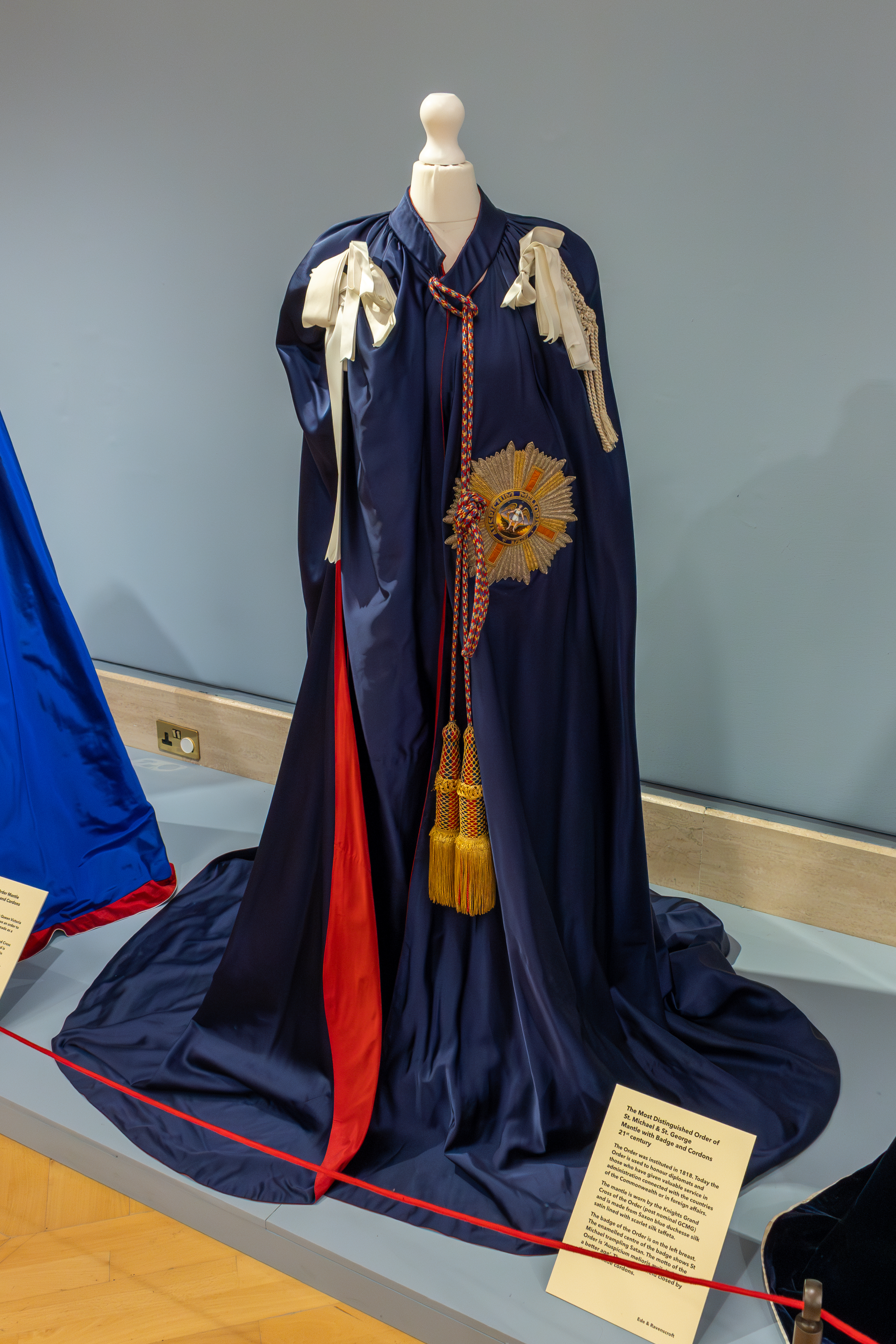


Members of the Order wear elaborate regalia on important occasions (such as coronations), which vary by rank:
- The mantle, worn only by Knights and Dames Grand Cross, is made of Saxon blue satin lined with crimson silk. On the left side is a representation of the star (see below). The mantle is bound with two large tassels.
- The collar, worn only by Knights and Dames Grand Cross, is made of gold. It consists of depictions of crowned English lions, Maltese Crosses, and the cyphers "SM" and "SG", all alternately. In the centre are two winged lions of St. Mark, each holding a bible and seven arrows—the emblem of the seven united Ionian Islands.
At less important occasions, simpler insignia are used:
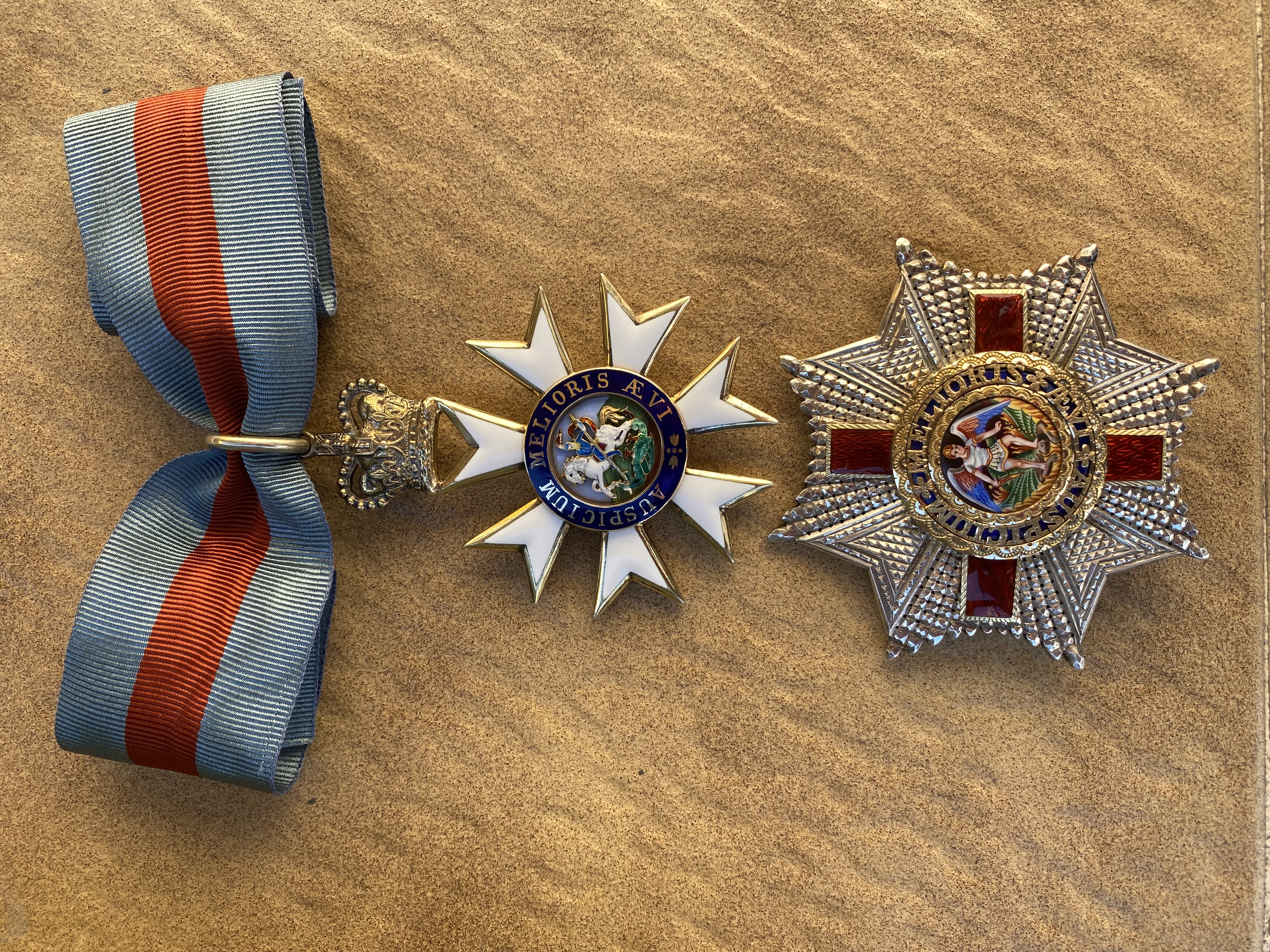
- The star is an insignia used only by Knights and Dames Grand Cross and Knights and Dames Commanders. It is worn pinned to the left breast. The Knight and Dame Grand Cross' star includes seven-armed, silver-rayed 'Maltese Asterisk' (for want of a better description—see image of badge), with a gold ray in between each pair of arms. The Knight and Dame Commander's star is a slightly smaller eight-pointed silver figure formed by two Maltese Crosses; it does not include any gold rays. In each case, the star bears a red cross of St George. In the centre of the star is a dark blue ring bearing the motto of the Order. Within the ring is a representation of St Michael trampling on Satan.
- The badge is the only insignia used by all members of the Order; it is suspended on a blue-crimson-blue ribbon. Knights and Dames Grand Cross wear it on a riband or sash, passing from the right shoulder to the left hip. Knights Commanders and male Companions wear the badge from a ribbon around the neck; Dames Commanders and female Companions wear it from a bow on the left shoulder. The badge is a seven-armed, white-enamelled 'Maltese Asterisk' (see Maltese Cross); the obverse shows St Michael trampling on Satan, while the reverse shows St George on horseback killing a dragon, both within a dark blue ring bearing the motto of the Order.
Prior to 2011, the devil was portrayed with black skin while St Michael was shown as being white; this was changed that year to show both with same skin colour, although St Michael's wings were changed from being multi-colour to being pure white. The alleged racism of this imagery has resulted in the government of Jamaica suspending the use of the badge entirely. In June 2020, calls were made for a complete redesign of the insignia, including from Sir Michael Palin of Monty Python fame, a Knight Commander of the Order. In July 2020, the Cabinet Office announced that officers of the Order who were unhappy with their insignia could exchange them for one of the newer models.
On certain collar days designated by the Sovereign, members attending formal events may wear the Order's collar over their military uniform or morning wear. When collars are worn (either on collar days or on formal occasions such as coronations), the badge is suspended from the collar. All collars which have been awarded since 1948 must be returned to the Central Chancery of the Orders of Knighthood. The other insignia may be retained.
Chapel
The original home of the Order was the Palace of St. Michael and St. George in Corfu, the residence of the Lord High Commissioner of the Ionian Islands and the seat of the Ionian Senate. Since 1906, the Order's chapel has been in St Paul's Cathedral in London. (The Cathedral also serves as home to the chapels of the Order of the British Empire and the Imperial Society of Knights Bachelor.) Religious services for the whole Order are held quadrennially; new Dames and Knights Grand Cross are installed at these services.
The Sovereign and the Knights and Dames Grand Cross are allotted stalls in the choir of the chapel, above which their heraldic devices are displayed. Perched on the pinnacle of a knight's stall is his helm, decorated with a mantling and topped by his crest. Under English heraldic law, women other than monarchs do not bear helms or crests; instead, the coronet appropriate to the dame's rank, if there is one, is used. Above the crest or coronet, the stall's occupant's heraldic banner is hung, emblazoned with his or her coat of arms. At a considerably smaller scale, to the back of the stall is affixed a piece of brass (a "stall plate") displaying its occupant's name, arms and date of admission into the Order. Upon the death of a Knight, the banner, helm, mantling and crest are taken down. The stall plates, however, are not removed; rather, they remain permanently affixed somewhere about the stall, so that the stalls of the chapel are festooned with a colourful record of the Order's Knights and Dames Grand Cross since 1906.
The reredos within the chapel was commissioned from Henry Poole in 1927.
Precedence and privileges
Members of the Order of St Michael are assigned positions in the order of precedence in England and Wales. Wives of male members also feature on the order of precedence, as do sons, daughters and daughters-in-law of Knights Grand Cross and Knights Commanders; relatives of female members, however, are not assigned any special precedence. (Individuals can derive precedence from their fathers or husbands, but not from their mothers or wives. This follows the general rule of honours, that a husband never derives any style or title from his wife.)
Knights Grand Cross and Knights Commanders prefix "Sir", and Dames Grand Cross and Dames Commanders prefix "Dame", to their forenames. Wives of Knights may prefix "Lady" to their surnames, but husbands of Dames derive no title from their wives. Such forms are not used by peers and princes, except when the names of the former are written out in their fullest forms. Furthermore, honorary (foreign) members and clergymen do not receive the accolade and thus are not entitled to use the prefix "Sir" or "Dame". Knights and Dames Grand Cross use the post-nominal "GCMG"; Knights Commanders and Dames Commanders use "KCMG" and "DCMG", respectively; Companions use "CMG".
Knights and Dames Grand Cross are also entitled to receive heraldic supporters. They may, furthermore, encircle their arms with a depiction of the circlet (a circle bearing the motto) and the collar; the former is shown either outside or on top of the latter. Knights and Dames Commanders and Companions may display the circlet, but not the collar, surrounding their arms. The badge is depicted suspended from the collar or circlet.
Popular references
In the satirical British television programme Yes Minister, Jim Hacker MP is told a joke by his Private Secretary, Bernard Woolley, about what the various post-nominals stand for. From Series 2, Episode 2 "Doing the Honours":
Woolley: In the service, CMG stands for "Call Me God". And KCMG for "Kindly Call Me God". Hacker: What does GCMG stand for? Woolley (deadpan): "God Calls Me God".}}
Ian Fleming's spy, James Bond, a commander in the Royal Navy Volunteer Reserve (RNVR), was fictionally decorated as a CMG in 1953. This is mentioned in the novels From Russia, with Love and On Her Majesty's Secret Service, and on-screen in his obituary in Skyfall. He was offered appointment as KCMG (which would have elevated him from Companion to Knight Commander in the Order) in The Man with the Golden Gun, but he rejected the offer as he did not wish to become a public figure. Judi Dench's character "M" is "offered" early retirement as a GCMG in Skyfall.
Daniel Craig, who has portrayed Bond on film, was appointed (CMG) in the 2022 New Year Honours for services to film and theatre. The general release on 30 September 2021 of his last appearance as James Bond, in No Time to Die, had been delayed by almost two years due to a change of director and the COVID-19 pandemic. Coinciding with the film's premiere, and matching his fictional character's rank, Craig became an Honorary Commander in Britain's Royal Navy. Following this appointment, he committed to being an ambassador for the Royal Navy, particularly in its international role, and to the welfare of its service families.
Long-time Doctor Who companion Brigadier Lethbridge-Stewart wore the ribbon of the order as the highest of his decorations.
Current Knights and Dames Grand Cross
Sovereign and Grand Master
| Name | Year of appointment | Present age |
|---|---|---|
| King Charles III (*ex officio*) | Sovereign since 2022 | |
| Prince Edward, Duke of Kent | 1967 |
Knights and Dames Grand Cross
| Name | Known for | Year of appointment | Present age | |
|---|---|---|---|---|
| David Wilson, Baron Wilson of Tillyorn | Governor of Hong Kong | 1991 | ||
| Sir Wiwa Korowi | Governor-General of Papua New Guinea | 1992 | ||
| Sir James Carlisle | Governor-General of Antigua and Barbuda | 1993 | ||
| Sir Rodric Braithwaite | Chairman of the UK Joint Intelligence Committee and Ambassador to the Soviet Union and Russia | 1994 | ||
| Sir Colville Young | Governor-General of Belize | |||
| David Hannay, Baron Hannay of Chiswick | Permanent Representative to the United Nations | 1995 | ||
| Sir Orville Turnquest ON, , | Governor-General of The Bahamas | |||
| Sir Tulaga Manuella | Governor-General of Tuvalu | 1996 | ||
| Sir John Coles | Permanent Under-Secretary of State for Foreign Affairs | 1997 | ||
| Dame Pearlette Louisy GCSL, | Governor-General of Saint Lucia | 1999 | ||
| Sir Andrew Wood | Ambassador to Russia and Ambassador to Yugoslavia | 2001 | ||
| Sir John Goulden | Permanent Representative to the Western European Union, Permanent Representative to the North Atlantic Council and Ambassador to Turkey | |||
| John Kerr, Baron Kerr of Kinlochard | Permanent Under-Secretary of State of the Foreign and Commonwealth Office and Ambassador to the United States | |||
| Sir Tomasi Puapua | Governor-General of Tuvalu and Prime Minister of Tuvalu | 2002 | ||
| Sir David Wright | Ambassador to Japan and Ambassador to South Korea | |||
| Sir Jeremy Greenstock | Permanent Representative of the United Kingdom to the United Nations | 2003 | ||
| Sir Rob Young | High Commissioner to India | |||
| George Robertson, Baron Robertson of Port Ellen | Secretary General of NATO | 2004 | ||
| Sir Stephen Wall | Permanent Representative to the European Union and Ambassador to Portugal | {{age | 1947 | }} |
| Sir Nathaniel Waena , , CSI | Governor-General of the Solomon Islands | 2005 | ||
| Michael Jay, Baron Jay of Ewelme | Permanent Under-Secretary of State of the Foreign and Commonwealth Office and Ambassador to France | 2006 | ||
| Sir Emyr Jones Parry | Permanent Representative to the United Nations Security Council and Permanent Representative to NATO | 2007 | ||
| Sir Kenneth Hall ON, , OJ | Governor-General of Jamaica | |||
| Dame Louise Lake-Tack , DStJ, DGN, DNH, GCH, OM | Governor-General of Antigua and Barbuda | |||
| Sir David Manning | Ambassador to the United States, Permanent Representative on the North Atlantic Council and Ambassador to Israel | 2008 | ||
| Sir Patrick Allen ON, , | Governor-General of Jamaica | 2009 | ||
| Sir Frank Kabui CSI | Governor-General of the Solomon Islands | |||
| Sir Arthur Foulkes ON, | Governor-General of The Bahamas and High Commissioner to the United Kingdom | 2010 | ||
| Sir Iakoba Italeli | Governor-General of Tuvalu and Attorney General of Tuvalu | |||
| Peter Ricketts, Baron Ricketts | National Security Adviser and Permanent Under-Secretary of State of the Foreign and Commonwealth Office | 2011 | ||
| Sir Nigel Sheinwald | Ambassador to the United States and Permanent Representative to the European Union | |||
| Sir Elliott Belgrave , KA, CHB, SC | Governor-General of Barbados | 2012 | ||
| Dame Cécile La Grenade | Governor-General of Grenada | |||
| Dame Marguerite Pindling ON, | Governor-General of The Bahamas | 2014 | ||
| Sir Rodney Williams , KGN, KNH, GCH, GCM | Governor-General of Antigua and Barbuda | |||
| Catherine Ashton, Baroness Ashton of Upholland | First Vice-President of the European Commission and European Commissioner for Trade | 2015 | ||
| Sir John Sawers FRUSI | Chief of the Secret Intelligence Service and Permanent Representative to the United Nations | |||
| Sir Simon Fraser | Permanent Under-Secretary for Foreign and Commonwealth Affairs | 2016 | ||
| Sir Peter Westmacott | Ambassador to the United States, Ambassador to France and Ambassador to Turkey | |||
| Sir Robert Dadae | Governor-General of Papua New Guinea | 2017 | ||
| Dame Sandra Mason FB, , DA, SC | Governor-General of Barbados | |||
| Sir Mark Lyall Grant | National Security Adviser and Permanent Representative to the United Nations | 2018 | ||
| Sir Neville Cenac GCSL, GCMG | Governor-General of Saint Lucia | |||
| Sir Cornelius Smith ON, | Governor-General of The Bahamas | 2019 | ||
| Dame Susan Dougan | Governor-General of Saint Vincent and the Grenadines | 2020 | ||
| Sir David Attenborough | Television broadcaster and conservationist | |||
| Tim Barrow, Baron Barrow, | Ambassador to the European Union, Ambassador to Russia and Ambassador to Ukraine | |||
| Sir Julian King | European Commissioner for the Security Union, Ambassador to France and Ambassador to Ireland | |||
| Simon McDonald, Baron McDonald of Salford | Permanent Under-Secretary for Foreign and Commonwealth Affairs, Ambassador to Germany and Ambassador to Israel | 2021 | ||
| Dame Froyla Tzalam | Governor-General of Belize | 2022 | ||
| Sir Iain Macleod | Legal Adviser to the Foreign, Commonwealth and Development Office | |||
| Sir Tofiga Vaevalu Falani | Governor-General of Tuvalu | |||
| Mark Sedwill, Baron Sedwill | Cabinet Secretary, Head of the Home Civil Service and National Security Adviser | |||
| Dame Marcella Liburd | Governor-General of Saint Kitts and Nevis | 2023 | ||
| Sir Simon Gass | Chair of the Joint Intelligence Committee and Ambassador to Iran | |||
| Dame Cynthia Pratt ON, , CB, CD, JP | Governor-General of The Bahamas | |||
| Sir Stephen Lovegrove | National Security Adviser and Permanent Under-Secretary of State for Defence | 2024 | ||
| Sir David Tiva Kapu | Governor-General of Solomon Islands | 2025 | ||
| Sir Errol Charles | Governor-General of Saint Lucia | |||
| Sir Philip Barton | Permanent Under-Secretary of State for Foreign Affairs | |||
| Dame Barbara Woodward | Permanent Representative of the United Kingdom to the United Nations | 2026 |
Honorary Knights and Dames Grand Cross and Commander
See List of current honorary knights and dames of the Order of St Michael and St George.
Officers
- Prelate: David Urquhart (former Bishop of Birmingham)
- Chancellor: Catherine Ashton, Baroness Ashton of Upholland
- Secretary: Sir Philip Barton
- Registrar: Sir David Manning
- King of Arms: Sir Mark Lyall Grant
- Lady Usher of the Blue Rod: Dame DeAnne Julius
Gallery
File:Companion of the Order of St. Michael & St. George 1.png|Companion class of the order with the wearer's instruction guide File:Companion of the Order of St. Michael & St. George 8.png|CMG class in a case File:Companion of the Order of St. Michael & St. George 4.png|Reverse of a CMG badge showing Saint George File:Btweedsmuir2.jpg|Riband, badge and star of a GCMG worn by John Buchan, 1st Baron Tweedsmuir File:Companion of the Order of St. Michael & St. George 5.png|Obverse of the CMG badge showing Saint Michael File:Companion of the Order of St. Michael & St. George 3.png|CMG class of the Order of St. Michael & St. George by Spink & Son File:Companion of the Order of St. Michael & St. George 10.png|CMG in a case by Spink File:Companion of the Order of St. Michael & St. George 2.png|Companion of the Order of St. Michael & St. George File:Companion of the Order of St. Michael & St. George 9.png|CMG in a case by Spink File:Francis Wallace Grenfell c.1900 ver 02.jpg|Riband (worn incorrectly), star and collar of GCMG worn by Francis Grenfell, 1st Baron Grenfell File:Stamp of Seychelles - Zil Eloigne Sesel - 1986 - Colnect 633925 - Queen Elizabeth 60th birthday.jpeg|A Seychellois stamp depicting Elizabeth II in robes of the order, 1986 File:Uroš Predić - vojvoda Živojin Mišić, 1919.jpg|Star and collar of GCMG worn by Serbian Field Marshal Živojin Mišić File:Companion of the Order of St. Michael & St. George 6.png|CMG set File:Companion of the Order of St. Michael & St. George 7.png|Set of the Companion class File:Grand Cross of the Order of St Michael and St George (Great Britain) - Memorial JK - Brasilia - DSC00425.JPG|GCMG breast star File:Medal, order (AM 2001.25.1079-4).jpg|Companion class on a neck riband File:Companion of the Order of St. Michael & St. George 11.png|CMG class of the order File:The Duke and Duchess of Kent, 2013.JPG|Prince Edward, Duke of Kent, Grand Master of the Order, and Katharine, Duchess of Kent File:Britse ridderorde (The Most Distinguished Order of St. Michael and St. George), ontvangen door Willem Drees, NG-2003-46.jpg|The GCMG set of former Dutch Prime Minister Willem Drees File:Medal, order (AM 809264-2).jpg|Miniature of the order File:Medal, order (AM 2018.63.1-2).jpg|KCMG breast star
Notes
References
References
- Duckers, Peter. (2009). "British Orders and Decorations". Shire Publications.
- The Royal Household. (2009). "Order of St. Michael and St. George". Crown Copyright.
- (6 October 2025). "The Order of St Michael and St George". Royal.uk.
- Townsend, Francis. (1828). "Calendar of Knights". William Pickering.
- (1993-06-23). "Obituary: Evelyn Bark".
- {{London Gazette. (18 April 1905)
- {{London Gazette. (20 November 1917)
- (June 25, 2020). "GG rejects racist emblem".
- (27 June 2020). "Jamaica's governor-general suspends personal use of royal insignia over 'offending image'".
- (30 June 2020). "Jamaica suspends use of British royal insignia after anti-racism protests".
- "Michael Palin calls for redesign of 'offensive' knighthood medal".
- (July 2, 2020). "Recipients of Queen's 'racist' honour can swap medal for updated design". [[Metro.co.uk]].
- [http://www.tate.org.uk/servlet/ArtistWorks?cgroupid=999999961&artistid=1787&page=1&sole=y&collab=y&attr=y&sort=default&tabview=bio ''Henry POOLE 1873–1928''] ([[Tate Britain]]); retrieved 1 October 2009.
- Cross, Colin. (1968). "The Fall of the British Empire". Book Club Associates.
- {{London Gazette. (1 January 2022)
- "Central Chancery of the Orders of Knighthood | Honours and Awards". The Gazette.
This article was imported from Wikipedia and is available under the Creative Commons Attribution-ShareAlike 4.0 License. Content has been adapted to SurfDoc format. Original contributors can be found on the article history page.
Ask Mako anything about Order of St Michael and St George — get instant answers, deeper analysis, and related topics.
Research with MakoFree with your Surf account
Create a free account to save articles, ask Mako questions, and organize your research.
Sign up freeThis content may have been generated or modified by AI. CloudSurf Software LLC is not responsible for the accuracy, completeness, or reliability of AI-generated content. Always verify important information from primary sources.
Report