From Surf Wiki (app.surf) — the open knowledge base
Orchid
Family of flowering plants in the order Asparagales
Family of flowering plants in the order Asparagales
- Apostasioideae Horaninov
- Cypripedioideae Kosteletzky
- Epidendroideae Kosteletzky
- Orchidoideae Eaton
- Vanilloideae Szlachetko
Orchids are plants that belong to the family Orchidaceae (), a diverse and widespread group of flowering plants with blooms that are often colourful and fragrant. Orchids are cosmopolitan plants, living in diverse habitats on every continent except Antarctica. The world's richest diversity of orchid genera and species is in the tropics. Many species are epiphytes, living on trees. The flowers and their pollination mechanisms are highly specialized, attracting insect pollinators by colour, pattern, scent, pheromones, and sometimes by mimicking female insects. Orchids have very small seeds, relying on fungal partners for germination. Some orchids have no leaves, either photosynthesizing with their roots or relying entirely on fungal partners for food.
Orchidaceae is one of the two largest families of flowering plants. It contains about 28,000 currently accepted species in around 700 genera. That represents some 6–11% of all species of seed plants. Horticulturists run many orchid societies around the world; they have produced many hybrids and cultivars.
Etymology
The type genus (i.e. the genus after which the family is named) is Orchis. The genus name comes from the Ancient Greek ὄρχις (órkhis), literally meaning "testicle", because of the shape of the twin tubers in some species of Orchis. The term "orchid" was introduced in 1845 by John Lindley in School Botany, as a shortened form of Orchidaceae. In Middle English, the name bollockwort was used for some orchids, based on "bollock" meaning testicle and "wort" meaning plant.
Description
Orchids are easily distinguished from other plants, as most of them share some very evident derived characteristics or synapomorphies. Among these are: bilateral symmetry of the flower (zygomorphism), many resupinate flowers, a nearly always highly modified middle petal (labellum), stamens and carpels fused into a column, and extremely small seeds.
Stem and roots
All orchids are perennial herbs that lack any permanent woody structure. They can grow according to two patterns:
- Monopodial: The stem grows from a single bud, leaves are added from the apex each year, and the stem grows longer accordingly, as in Vanda.
- Sympodial: growth is at a front, with older growth behind, at a "back". Sympodial orchids may have swollen pseudobulbs.
Terrestrial (ground-living) orchids may have rhizomes or tubers. Epiphytic orchids, those that grow upon a support, have aerial roots. The older parts of the roots are covered with a velamen, a layer of dead cells.
File:Phaelinopsis plant showing monopodial growth.JPG|Monopodial: Phalaenopsis growing up from a single point File:Pseudobulbe.jpg|Sympodial: Prosthechea fragrans, pseudobulb from multiple internodes, leaves dying off at the back File:Bulbophyllum nutans veg..JPG|Pseudobulb of Bulbophyllum nutans, from a single internode
Leaves
Like most monocots, orchids usually have simple (untoothed) leaves with parallel veins. Some orchids such as Vanda are distichous, with their leaves arranged in two ranks on opposite sides of the stem. This is the arrangement at the base of all orchid shoots, though in many species the leaves higher up the shoot switch to a spiral phyllotaxis. Orchids are perennial; most species add new leaves at the apex while the oldest leaves gradually die off, but some such as Catasetum shed their leaves annually in the dry season, developing new leaves and new pseudobulbs each year.
Some epiphytic orchids, such as Taeniophyllum aphyllum, are leafless, depending on their green roots for photosynthesis. Other epiphytes like Phalaenopsis have leaves, but rely on photosynthesis in their green roots to prevent hypoxia (lack of oxygen) of the roots. Orchids of the genus Corallorhiza (coralroot orchids) have no leaves; instead they have symbiotic or parasitic associations with fungal mycelium, through which they absorb sugars.
File:Vanda garayi.png|Leaves of Vanda are distichous, arranged in two opposite ranks. File:Orchid at Palakayamthattu 8 (cropped).jpg|Most orchids have leaves arranged spirally up the stem. File:Taeniophyllum fasciola.jpg|Taeniophyllum has green photosynthetic roots instead of leaves.
Flowers
Orchid flowers are very varied in form. They have three sepals, three petals and a three-chambered ovary. The three sepals and two of the petals are often similar to each other but one petal is usually highly modified, forming a "lip" or labellum. In most orchid genera, as the flower develops, it undergoes a twisting through 180°, called resupination, so that the labellum lies below the column. The labellum functions to attract insects, and in resupinate flowers, also acts as a landing stage, or sometimes a trap.
File:Diuris (labelled).jpg|Diuris carinata File:Himantoglossum hircinum 028 (cropped).jpg|Himantoglossum hircinum, highly modified labellum Cattleya jongheana (flower) NT (cropped).jpg|Cattleya jongheana
Reproduction
Pollination
Main article: Pollination of orchids
Charles Darwin investigated the complex and varied mechanisms that orchids have evolved to achieve cross-pollination, and described these in his 1862 book Fertilisation of Orchids.
The reproductive parts of an orchid flower are unique in that the stamens and style are joined to form a single structure, the column.
Most orchids deliver pollen in a single mass, a pollinium (plural: pollinia), able to fertilise thousands of ovules. The pollinia are attached to a sticky disc near the top of the column. Just below the pollinia is a second, larger sticky plate, the stigma.
In orchids that produce pollinia, pollination happens as some variant of the following sequence: when the pollinator enters into the flower, it touches a viscidium, which promptly sticks to its body, generally on the head or abdomen. While leaving the flower, it pulls the pollinium out of the anther, as it is connected to the viscidium by the caudicle or stipe. The caudicle then bends and the pollinium is moved forwards and downwards. When the pollinator enters another flower of the same species, the pollinium is so placed that it sticks to the stigma of the second flower, pollinating it. In horticulture, artificial orchid pollination is achieved by removing the pollinia with a small instrument such as a toothpick from the pollen parent and transferring them to the seed parent.
File:Phalaenopsis pollinia on toothpick (cropped).jpg|Phalaenopsis pollinia (orange) attached to a toothpick with its sticky viscidium File:Leafcutter Bee with pollinia attached. (35689624212) (cropped).jpg|Leafcutter bee (Megachilidae) with orchid pollinia attached File:Ophrys apifera flower2.jpg|Ophrys apifera. A pollinium is visible.
Special cases
Pollinators are often visually attracted by the shape and colours of the labellum. However, some Bulbophyllum species attract male fruit flies (Bactrocera and Zeugodacus spp.) solely via a floral chemical which simultaneously acts as a floral reward (e.g. methyl eugenol, raspberry ketone, or zingerone) to perform pollination.
The slipper orchid Paphiopedilum parishii reproduces by self-fertilization. This occurs when the anther changes from a solid to a liquid state and directly contacts the stigma surface without the aid of any pollinating agent or floral assembly.
In some extremely specialized orchids, such as the Eurasian genus Ophrys, the labellum is adapted to have a colour, shape, and odour which attracts male insects via mimicry of a receptive female. Pollination happens as a male insect attempts to mate with the flowers.
Many neotropical orchids are pollinated by male orchid bees, which visit the flowers to gather volatile chemicals they require to synthesize pheromonal attractants. Males of species such as Euglossa imperialis or Eulaema meriana leave their territories periodically to forage for aromatic compounds, such as cineole, to synthesize pheromone for attracting females.
Catasetum saccatum, discussed by Darwin, launches its viscid pollinia with explosive force when an insect touches a seta, knocking the pollinator off the flower.
File:Orchid Bee Sleeping on Leaf.jpg|Orchid bees such as Euglossa viridissima collect aromatic compounds on their hind legs as they pollinate neotropical orchids. File:Catasetum-saccatum.jpg|When a bee touches a seta (a trigger hair) on the flower of Catasetum saccatum, the sticky pollinia are shot explosively at the insect.
Asexual reproduction
Some species, such as in the genera Phalaenopsis, Dendrobium, and Vanda, produce offshoots or plantlets formed from one of the nodes along the stem, through the accumulation of growth hormones at that point. These shoots are known to horticulturalists as keiki.
Epipogium aphyllum exhibits a dual reproductive strategy, engaging in both sexual and asexual seed production. The likelihood of apomixis playing a substantial role in successful reproduction appears minimal. Within certain petite orchid species groups, there is a noteworthy preparation of female gametes for fertilization preceding the act of pollination.
File:Little orchid D1306 keiki before cutting.jpg|A keiki plantlet at the apex of a Phalaenopsis orchid, ready to be cut and planted
Fruits and seeds
The ovary develops into a capsule that is dehiscent by three or six longitudinal slits in its sides.
The seeds of orchids are almost microscopic and very numerous, in some species over a million per capsule. After ripening, they blow off like dust particles or spores. Most orchid species lack endosperm in their seed and must enter symbiotic relationships with various mycorrhizal basidiomyceteous fungi that provide them the necessary nutrients to germinate, so almost all orchid species are mycoheterotrophic during germination and reliant upon fungi to complete their lifecycles. Only a handful of orchid species have seeds that can germinate without mycorrhiza, namely the species within the genus Disa with hydrochorous seeds.
File:Cranefly Orchid - Tipularia discolor fruiting bodies, Leesylvania State Park, Woodbridge, Virginia, October 20, 2021 (51834375884).jpg|Orchid fruits are capsules, here of Tipularia discolor. File:Spathoglottis plicata (Philippine ground orchid) capsule dehisced.jpg|Orchid capsule, dehiscing with slits to release the tiny seeds, here of Spathoglottis plicata File:Orchis canariensis seed (single).png|Electron micrograph of an Orchis canariensis seed, some 300 μm long File:Himantoglossum adriaticum Stereo Annalisa Giovannini DSCN5186 (cropped).jpg|Himantoglossum adriaticum germinating seed with rhizoids File:Disa seedling on a thumbtack (cropped).jpg|Disa uniflora seedling on a Sphagnum leaf, on a thumbtack point
Evolution
Fossil and reconstructed history
Few orchid fossils are recorded. An extinct species of stingless bee, Proplebeia dominicana, was found trapped in Miocene amber from about 15–20 million years ago. The bee was carrying pollen of a previously unknown orchid taxon, Meliorchis caribea, on its wings. This 2007 find provided the first fossil evidence of orchids. It shows insects were active pollinators of orchids in the Miocene. M. caribea has been placed within the extant tribe Cranichideae, subtribe Goodyerinae (subfamily Orchidoideae). An even older orchid species, Succinanthera baltica, was described in 2017 from Baltic amber of Eocene age, some 40–55 million years ago.
Genetic sequencing indicates orchids may have arisen earlier, 76 to 84 million years ago during the Late Cretaceous. According to Mark W. Chase et al. (2001), the overall biogeography and phylogenetic patterns of Orchidaceae show they are even older and may go back roughly 100 million years.
The molecular clock method has provided ages for the major branches of the orchid family. The subfamily Vanilloideae is a branch at the base of the monandrous orchids, and must have evolved very early in the evolution of the family, some 60 to 70 million years ago. Since this subfamily occurs worldwide in tropical and subtropical regions, from tropical America to tropical Asia, New Guinea and West Africa, and the continents began to split about 100 million years ago, significant biotic exchange must have occurred after this split. Biogeographic studies indicate that the most recent common ancestor of all extant orchids probably originated 83 million years ago somewhere in the supercontinent Laurasia. Despite their long evolutionary history on Earth, the extant orchid diversity is also inferred to have originated during the last 5 million years, with the American and Asian tropics as the geographic areas exhibiting the highest speciation rates (i.e., number of speciation events per million years) on Earth.
Genome duplication occurred prior to the divergence of this taxon.
Phylogeny
The cladogram below was made according to the APG system of 1998. It represents the view that most botanists had held up to that time. It was supported by morphological studies.
In 2015, a phylogenetic study showed strong statistical support for the following topology of the orchid tree, using 9 kb of plastid and nuclear DNA from 7 genes, a topology that was confirmed by a phylogenomic study in the same year.
Taxonomy
Main article: Taxonomy of the Orchidaceae
The orchids are among the largest and most diverse taxonomic groups of vascular plants, with at least 700 genera and 28,000 species; they are rivalled only by the Asteraceae (Compositae) which has some 1,600 genera and around 24,700 species, and new species are continually being discovered and described. In 1753, Carl Linnaeus recognized eight genera of orchids in his Species Plantarum. Antoine Laurent de Jussieu recognized the Orchidaceae as a separate family in his Genera Plantarum in 1789. Olof Swartz recognized 25 genera in 1800. In 1830–1840, John Lindley recognized four subfamilies. The family was placed in the order Asparagales by the APG III system of taxonomy of 2009, mainly using molecular phylogenetics, where five subfamilies are recognised.}} The diversity of orchids led taxonomists to create hundreds of genera. Some taxonomists felt that the number had become excessive, and published classifications with fewer genera. Dressler had some 850 genera in 2013; Genera Orchidacearum reduced this to 765 in 2014; and Chase continued the process of merging genera, with 736 in 2015.
Hybrids
Orchid species hybridize readily in cultivation, leading to a large number of hybrids with complex naming. Hybridization is possible across genera, and therefore many cultivated orchids are placed into nothogenera. For instance, the nothogenus × Brassocattleya is used for all hybrids of species from the genera Brassavola and Cattleya. Nothogenera based on at least three genera may have names based on a person's name with the suffix -ara, for instance × Colmanara=Miltonia × Odontoglossum × Oncidium. The suffix is obligatory starting at four genera.
Cultivated hybrids in the orchid family are also special in that they are named by using grex nomenclature, rather than nothospecies. For instance, hybrids between Brassavola nodosa and Brassavola acaulis are placed in the grex Brassavola Guiseppi. The name of the grex ("Guiseppi" in this example) is written in a non-italic font without quotes.
Distribution and ecology
Orchidaceae are cosmopolitan in distribution, occurring in every continent except for Antarctica. A majority are epiphytic, living high on trees in the tropics and subtropics; some such as Angraecum sororium are lithophytes, on rocks; others are terrestrial, growing on the ground.
Species interactions
Some orchids, such as Neottia and Corallorhiza, lack chlorophyll, so are unable to photosynthesise. Instead, these species obtain energy and nutrients by parasitising soil fungi through the formation of orchid mycorrhizae. The fungi involved include those that form ectomycorrhizas with trees and other woody plants, parasites such as Armillaria, and saprotrophs. These orchids are known as myco-heterotrophs, but were formerly (incorrectly) described as saprophytes as it was believed they gained their nutrition by breaking down organic matter. While only a few species are achlorophyllous holoparasites, all orchids are myco-heterotrophic during germination and seedling growth, and even photosynthetic adult plants may continue to obtain carbon from their mycorrhizal fungi. The symbiosis is typically maintained throughout the lifetime of the orchid because they depend on the fungus for nutrients, sugars and minerals.
Orchids employ multiple forms of deception to attract pollinators. Some produce the aroma of nectar without providing the actual food reward. Others attract nematoceran gnats which feed on decaying fungi with the aroma of mushrooms. Others again produce the aroma of female insects, attracting male insects to attempt to copulate. In each case the orchid is pollinated by an insect that is deceived and that does not receive the expected reward.
Uses
Horticulture
Many orchid species and hybrids are cultivated for their flowers. Most of these are tropical or subtropical, needing to be grown indoors in temperate zones, but some such as species of Cypripedium and Dactylorhiza can be grown outdoors in temperate climates. Several thousand new cultivated orchid hybrids are registered each year.
A large number of societies and clubs for orchid growers are run in countries in all continents except Antarctica. National societies include the Orchid Society of Great Britain and the American Orchid Society. New orchids are registered with the International Orchid Register, maintained by the Royal Horticultural Society. An annual festival of orchids is held in February every year at the Royal Botanic Gardens, Kew.
File:2007-12-17AdventFlowerShop02.jpg|A cultivated Phalaenopsis File:Cornucopia of Orchids at Kew.jpg|Orchid cornucopia in the annual festival of orchids at the Royal Botanic Gardens, Kew File:Blc. Paradise Jewel 'Flame' Orchid bloom.JPG|A × Brassolaeliocattleya ("BLC") Paradise Jewel 'Flame' hybrid orchid
Flavours and aromas
The dried seed pods of one orchid genus, Vanilla (especially Vanilla planifolia), are commercially important as a flavouring in baking, for perfume manufacture and aromatherapy.
The scent of orchids is frequently analysed by perfumers using headspace technology, gas-liquid chromatography, and mass spectrometry to identify potential fragrance chemicals.
File:Starr-121108-1108-Vanilla planifolia-green seedpods-Pali o Waipio-Maui (25196769875).jpg|Vanilla planifolia with green seedpods File:Vanilla fragrans 4.jpg|Vanilla seedpods drying File:Vanilla 6beans.JPG|Vanilla "beans" used as a spice
Food
The tubers of terrestrial orchids (mainly early purple orchid, Orchis mascula) are ground to a powder and used for cooking, such as in the hot beverage salep and ice cream, leading to local extinctions in parts of Greece, Turkey, and Iran. Some saprophytic orchid species of the group Gastrodia produce potato-like tubers and were eaten by native peoples in Australia and can be cultivated, notably Gastrodia sesamoides. Wild stands of these plants still grow near early Aboriginal settlements, such as Ku-ring-gai Chase National Park. Aboriginal peoples found the plants by observing where bandicoots had scratched in search of the tubers after detecting the plants by scent.
Cultural symbolism
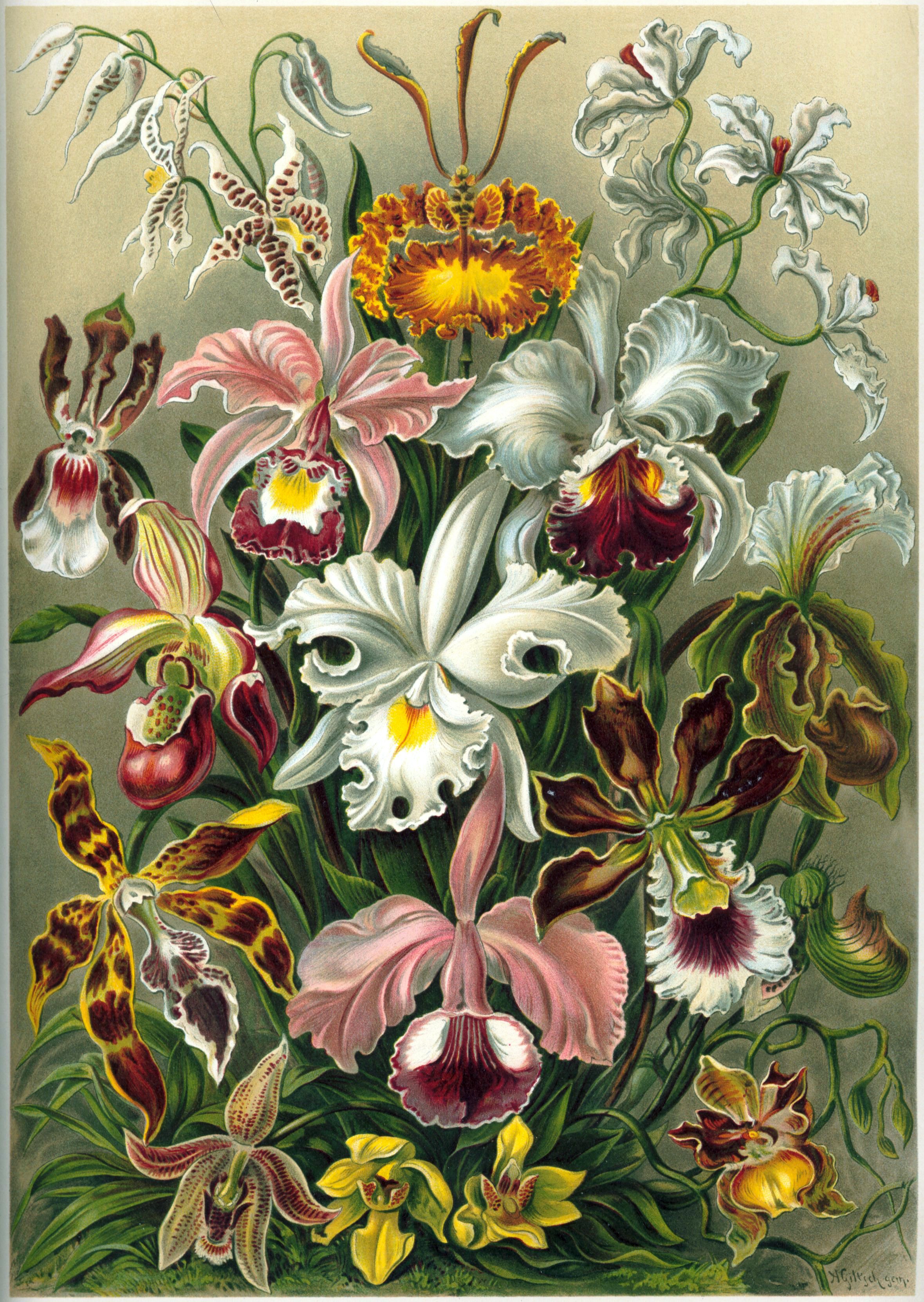
Orchids have symbolic values in some cultures; several countries have chosen orchids as their national flowers. Because of the etymology of the word "orchid", and the use of orchiectomy, a surgery on intersex infants, the orchid has become a symbol of being intersex and of opposition to non-consensual genital surgery.
Orchids native to the Mediterranean are depicted on the Ara Pacis in Rome, until now the only known instance of orchids in ancient art, and the earliest in European art. A French writer and agronomist, Louis Liger, invented a classical myth in his book Le Jardinier Fleuriste et Historiographe published in 1704, attributing it to the ancient Greeks and Romans, in which Orchis the son of a nymph and a satyr rapes a priestess of Bacchus during one of his festivals the Bacchanalia and is then killed and transformed into an orchid flower as punishment by the gods, paralleling the various myths of youths dying and becoming flowers, like Adonis and Narcissus; this myth however does not appear any earlier than Liger, and is not part of traditional Greek and Roman mythologies.
Conservation
Almost all orchids are included in Appendix II of the Convention on International Trade in Endangered Species (CITES), meaning that international trade is regulated by the CITES permit system. A smaller number of orchids, such as Paphiopedilum species, are listed in CITES Appendix I, meaning that commercial international trade in wild-sourced specimens is prohibited and other trade is strictly controlled.
Assisted migration may be a viable conservation tool for orchids endangered by climate change. In 2006 the Longtan Dam was built near the Yachang Orchid Nature Reserve. In response to the threat of inundation at lower altitudes (350–400 m), 1000 endangered orchid plants of 16 genera and 29 species were translocated to higher elevation (around 1000 m), where they survived well.
Notes
References
References
- Angiosperm Phylogeny Group. (2009). "An update of the Angiosperm Phylogeny Group classification for the orders and families of flowering plants: APG III". [[Botanical Journal of the Linnean Society]].
- (1961). "Webster's Third New International Dictionary". [[G. & C. Merriam]].
- (2016). "The number of known plants species in the world and its annual increase". [[Phytotaxa]].
- "Orchidaceae". [[Plants of the World Online]].
- (2007). "Taxonomic exaggeration and its effects on orchid conservation". [[Conservation Biology (journal).
- Corominas, Joan. (1980). "Breve Diccionario Etimológico de la Lengua Castellana". Ed. Gredos.
- (1995). "Plants and their names: a concise dictionary". [[Oxford University Press]].
- (1940). "ὄρχις"/rxis). [[Perseus Digital Library]].
- [http://www.etymonline.com/index.php?term=orchid Online Etymology Dictionary, "orchid"].
- Grigson, G.. (1973). "A Dictionary of English Plant Names". [[Allen Lane]].
- "bollock, n. and adj.".
- "Introduction to Orchids". [[American Orchid Society]].
- (June 2024). "Orchid Parts and Why They Matter". [[American Orchid Society]].
- Nash, N., and Frownie, S. (2008). ''Complete guide to orchids''. (Meredith Publishing Group) p. 12.
- (August 2023). "Taxonomy and morphology of Orchids". Sabujeema.
- "Glossary Term: Distichous".
- (August 2021). "Orchid Tree: a phylogeny of epiphytes (mostly) on the tree of life". [[University of Florida]] Herbarium.
- "Repotting Phalaenopsis and Other Monopodial Orchid". [[Missouri Botanical Garden]].
- "Catasetum". American Orchid Society.
- (6 March 2024). "Root photosynthesis prevents hypoxia in the epiphytic orchid Phalaenopsis". [[Functional Plant Biology]].
- Jenny King. (2011-06-10). "The coralroot orchid". Silvercrown Mountain Outdoor School.
- (August 2011). "Orchids of South-West Australia.". Noel Hoffman.
- (2013). "Field guide to the orchids of Western Australia: the definitive guide to the native orchids of Western Australia". Simon Nevill Publications.
- "Structure of orchid flowers". [[New Zealand Plant Conservation Network]].
- "Anatomy of an Orchid". Brasilian Orchid Organisation.
- Darwin, Charles. (1862). "On the various contrivances by which British and foreign orchids are fertilised by insects, and on the good effects of intercrossing". [[John Murray (publishing house).
- Carr, Gerald. (30 October 2005). "Flowering Plant Families". [[University of Hawaiʻi]] Botany Department.
- (2010). "The Kew Plant Glossary: an Illustrated Dictionary of Plant Terms". [[Kew Publishing]].
- Armstrong, Wayne P.. (2004). "Flower Terminology Part 1: The Remarkable Bisexual Orchid Blossom". Wayne P. Armstrong.
- (4 June 2019). "Hand Pollination".
- (2000). "Mutual reproductive benefits between a wild orchid, ''Bulbophyllum patens'', and ''Bactrocera'' fruit flies via a floral synomone". [[Journal of Chemical Ecology]].
- (June 2002). "Floral Synomone of a Wild Orchid, Bulbophyllum cheiri, Lures Bactrocera Fruit Flies for Pollination". Journal of Chemical Ecology.
- (March 2005). "Hydroquinone Is Not A Phagostimulant For The Formosan Subterranean Termite". [[Journal of Chemical Ecology]].
- (2012). "The anther steps onto the stigma for self-fertilization in a slipper orchid". [[PLOS One]].
- Schiestl, F. P.. (2005). "On the success of a swindle: pollination by deception in orchids". [[Naturwissenschaften]].
- (1990). "Chemical and ethological studies of pollination in the genus ''Ophrys'' (Orchidaceae)". Phytochemistry.
- (2009). "Ménage à Trois — Two Endemic Species of Deceptive Orchids and One Pollinator Species". [[Evolution (journal).
- (2009). "Speciation in sexually deceptive orchids: pollinator-driven selection maintains discrete odour phenotypes in hybridizing species". [[Biological Journal of the Linnean Society]].
- Kimsey Lynn Siri. (1980). "The behaviour of male orchid bees (Apidae, Hymenoptera, Insecta) and the question of leks". Animal Behaviour.
- (October 2006). "Species-specific attraction to pheromonal analogues in orchid bees". [[Behavioral Ecology and Sociobiology]].
- [[Adrian Desmond. Desmond, Adrian]]; [[James Moore (biographer). Moore, James]] (1991), ''Darwin'', London: Michael Joseph, Penguin Group, {{ISBN. 0-7181-3430-3 page 510.
- Matthew Blanchard, Roberto Lopez, Erik Runkle, PhD, and Yin-Tung Wang, PhD [https://sharepoint.agriculture.purdue.edu/agriculture/flowers/Shared%20Documents/3%20-%20Growing%20the%20Best%20Phalaenopsis%20Part%204.pdf "Growing the Best ''Phalaenopsis''"], ''WWW.AOS.ORG'' ORCHIDS APRIL 2007 {{webarchive. link. (June 27, 2010)
- (July 2016). "Evidence for mixed sexual and asexual reproduction in the rare European mycoheterotrophic orchid Epipogium aphyllum, Orchidaceae (ghost orchid)". [[Annals of Botany]].
- "Orchidaceae". [[Harvard University]].
- (2003). "Conservation of select South African Disa Berg. Species (Orchidaceae) through in vitro seed germination". [[University of Natal]].
- (September 1993). "Seed morphology in Southern African Orchidoideae (Orchidaceae)". [[Plant Systematics and Evolution]].
- (30 August 2007). "Dating the origin of the Orchidaceae from a fossil orchid with its pollinator". [[Nature (journal).
- (2017). "Orchids from the past, with a new species in Baltic amber". [[Botanical Journal of the Linnean Society]].
- [http://ir.lib.ncku.edu.tw/bitstream/987654321/108263/2/An%20overview%20of%20the%20Phalaenopsis%20orchid%20genome%20by%20BAC%20end%20sequence%20analysis.pdf "An overview of the ''Phalaenopsis'' orchid genome by BAC sequence analysis"] {{Webarchive. link. (20 March 2014 .)
- Chase, Mark W.. (2001). "Orchidoideae (Part 1)". [[Oxford University Press]].
- (April 2024). "The origin and speciation of orchids". New Phytologist.
- (2017). "The Apostasia genome and the evolution of orchids". Nature.
- The Angiosperm Phylogeny Group. (1998). "An ordinal classification for the families of flowering plants". [[Annals of the Missouri Botanical Garden]].
- (2015). "The velamen protects photosynthetic orchid roots against UV-B damage, and a large dated phylogeny implies multiple gains and losses of this function during the Cenozoic". [[New Phytologist]].
- (2015). "Orchid phylogenomics and multiple drivers of their extraordinary diversification". [[Proceedings of the Royal Society B: Biological Sciences]].
- Simpson, Michael G.. (2010). "Plant Systematics".
- [[Carl Linnaeus. Linnaeus, Carolus]]. 1753. ''[[Species Plantarum]]'', 1st edition, vol. 2, pages 939-954. Holmiae: Impensis Laurentii Salvii.
- de Jussieu, Antoine Laurent. 1789. "ORCHIDEAE" pages 64-66. In: ''Genera plantarum: secundum ordines naturales disposita''.
- [[Olof Swartz. Swartz, Olof]]. 1800. "Afhandling om Orchidernes Slägter och deras Systematiska indelning" [Treatise on the Types of Orchids and Their Systematic Arrangement]. ''Kongliga vetenskaps academiens nya handlingar'', vol. 21, pages 115-139.
- Freudenstein, John V. (9 May 2025). "Orchid phylogenetics and evolution: history, current status and prospects". Annals of Botany.
- [[John Lindley. Lindley, John]]. 1830-1840. ''The Genera and Species of Orchidaceous Plants''. Ridgeways, Piccadilly: London, UK.
- "Alphabetical List of Standard Abbreviations for Natural and Hybrid Generic Names".
- (2013). "The Plant List: Orchidaceae".
- Alec M. Pridgeon, Phillip J. Cribb, Mark W. Chase, and Finn N. Rasmussen. 1999-2014. ''Genera Orchidacearum''. Oxford University Press. {{ISBN. 978-0-19-850513-6 (volume 1), {{ISBN. 978-0-19-850710-9 (volume 2), {{ISBN. 978-0-19-850711-6 (volume 3), {{ISBN. 978-0-19-850712-3 (volume 4), {{ISBN. 978-0-19-850713-0 (volume 5), {{ISBN. 978-0-19-964651-7 (volume 6)
- Mark W. Chase, Kenneth M. Cameron, John V. Freudenstein, Alec M. Pridgeon, Gerardo A. Salazar, Cássio van den Berg, and André Schuiteman. 2015. "An updated classification of Orchidaceae". ''Botanical Journal of the Linnean Society'' '''177''' (2): 151-174.
- (2016). "International Code of Nomenclature for Cultivated Plants". [[International Society for Horticultural Science]].
- link. (24 May 2023 , BlueNanta.)
- (2011). "Conservation of Madagascar's granite outcrop orchids: influence of fire and moisture". [[Lankesteriana]].
- "Orchids: Around the World on Six Continents".
- (August 2005). "Plants parasitic on fungi: unearthing the fungi in myco-heterotrophs and debunking the 'saprophytic' plant myth". [[Mycologist (journal).
- (September 2012). "Mycorrhizal association and morphology in orchids". Journal of Plant Interactions.
- (October 2003). "15 N and 13 C natural abundance of autotrophic and myco-heterotrophic orchids provides insight into nitrogen and carbon gain from fungal association". [[New Phytologist]].
- (2012-12-01). "Molecular identification of root fungal associates in Orchis pauciflora Tenore". Plant Biosystems.
- (3 May 2017). "Researchers identify evidence of oldest orchid fossil on record". [[Oregon State University]].
- "Introducing... Orchids". [[Royal Horticultural Society]].
- (March 2021). "Sander's List of Orchid Hybrids: 3 Year Addendum 2017-2019". [[Royal Horticultural Society]].
- "Orchid Societies: links to orchid societies around the world by region".
- "What we are all about". The Orchid Society of Great Britain.
- "About Us". [[American Orchid Society]].
- (2016). "Search The International Orchid Register". [[Royal Horticultural Society]].
- (12 September 2024). "Kew's iconic Orchid festival returns for 2025 celebrating the spectacular flora and fauna of Peru". [[Royal Botanic Gardens, Kew]].
- (2008). "A comprehensive review on vanilla flavor: Extraction, isolation and quantification of vanillin and others constituents". [[International Journal of Food Sciences and Nutrition]].
- Rain, Patricia. (2004). "Vanilla: The Cultural History of the World's Most Popular Flavor and Fragrance". [[TarcherPerigee.
- (23 July 2013). "Vanilla remains top ice cream flavor with Americans". International Dairy Foods Association, Washington, DC.
- (2016). "Why Do Floral Perfumes Become Different? Region-Specific Selection on Floral Scent in a Terrestrial Orchid". [[PLOS One]].
- (5 August 2003). "Ice cream threatens Turkey's flowers". BBC News.
- Pain, Stephanie. (6 May 2017). "Eaten to extinction".
- (1992). "Koorie Plants, Koorie People: Traditional Aboriginal Food, Fibre and Healing Plants of Victoria". [[Koorie Heritage Trust]].
- (1899). "Kunstformen der Natur". [[Verlag des Bibliographischen Instituts]].
- "Simbolos Patrios".
- "National Symbols". [[Government of Belize]].
- (March 1, 2012). "List of Assam State Symbols".
- Carpenter, Morgan. (October 26, 2013). "Symbols".
- Lobelli, Jarrett A.. (2012). "The Emperor's orchids". [[Archaeology (magazine).
- Endersby, Jim. (November 7, 2016). "Orchid: A Cultural History". [[University of Chicago Press]].
- "Appendices I, II and III". [[CITES]].
- "The CITES Appendices". [[CITES]].
- (June 2012). "Overcoming extreme weather challenges: Successful but variable assisted colonization of wild orchids in southwestern China". [[Biological Conservation (journal).
This article was imported from Wikipedia and is available under the Creative Commons Attribution-ShareAlike 4.0 License. Content has been adapted to SurfDoc format. Original contributors can be found on the article history page.
Ask Mako anything about Orchid — get instant answers, deeper analysis, and related topics.
Research with MakoFree with your Surf account
Create a free account to save articles, ask Mako questions, and organize your research.
Sign up freeThis content may have been generated or modified by AI. CloudSurf Software LLC is not responsible for the accuracy, completeness, or reliability of AI-generated content. Always verify important information from primary sources.
Report