From Surf Wiki (app.surf) — the open knowledge base
Orange wine
Made of white wine grapes with the skins
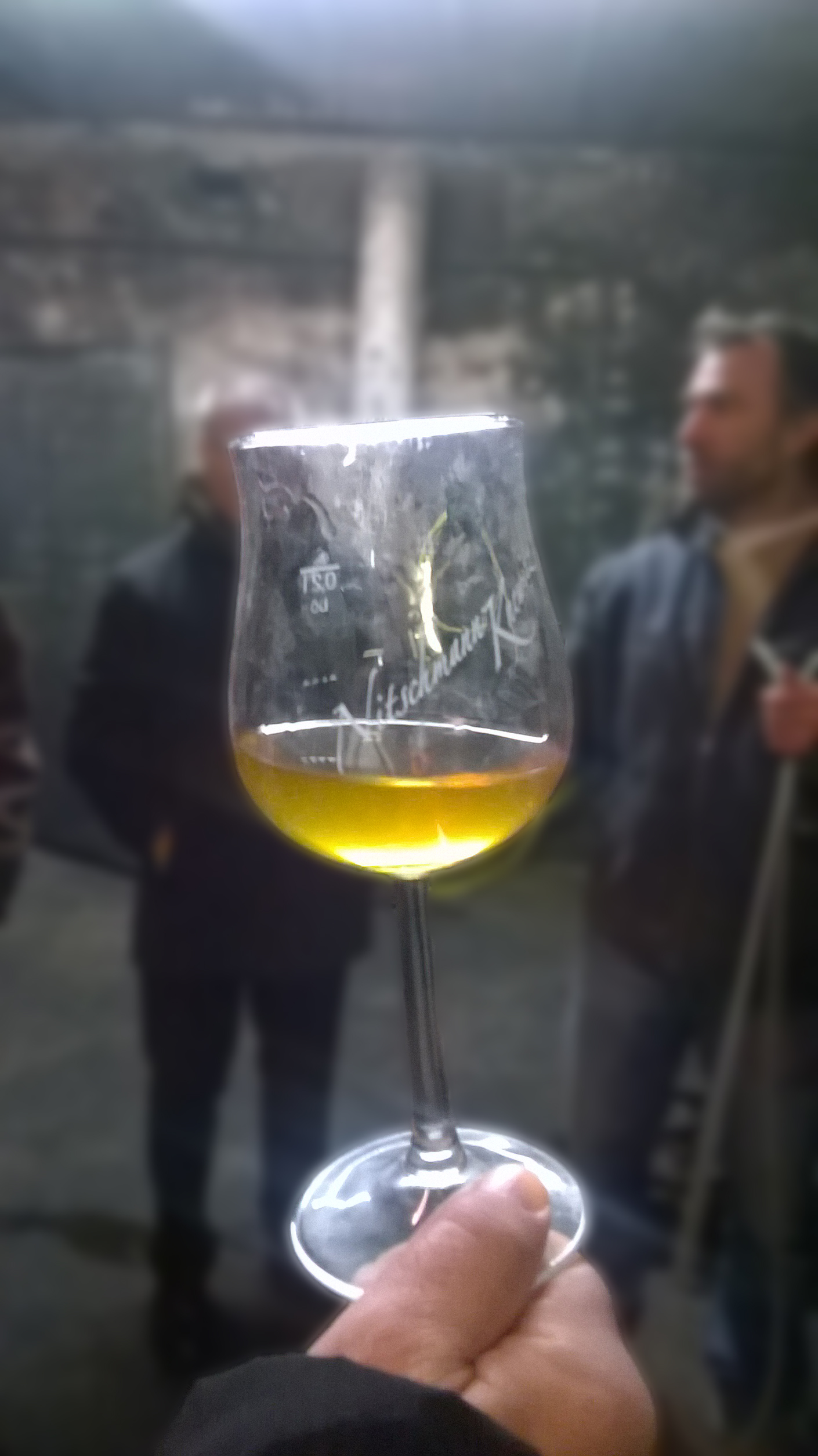
Made of white wine grapes with the skins
Orange wine, also known as skin-contact white wine, skin-fermented white wine, or amber wine, is a type of wine made from white wine grapes where the grape skins are not removed but stay in contact with the juice for days or even months, as is more typical with red wines. This contrasts with conventional white wine production, which involves crushing the grapes and quickly moving the juice off the skins into the fermentation vessel. The skins contain color pigment, phenols and tannins that would normally be considered undesirable for white wines, while for red wines skin contact and maceration is a vital part of the winemaking process that gives red wine its color, flavor, and texture. Orange wines tend to be natural (a.k.a. minimal intervention) wines.
The International Organisation of Vine and Wine describes orange/amber wine as "White wine with maceration" and prescribes the minimum duration of the maceration phase to be 1 month.
History
The practice has a long history in winemaking dating back hundreds of years in Slovenia and Friuli-Venezia Giulia, and thousands of years in the Eastern European wine producing country of Georgia. The practice was repopularized by Italian and Slovenian winemakers, after visiting Georgia and importing qvevris, initially in the cross-border Friuli-Venezia Giulia wine and Gorizia Hills regions, while there is also production in Spain, Slovenia, Croatia, Slovakia, Austria, Germany, New Zealand, California, and China.
Skin-fermented white wines were common in Italy up until the 1950s and 1960s, but fell out of fashion when technically 'correct' and fresh white wines came to dominate the market.
Terminology
The popular term orange wine was coined by a British wine importer, David A. Harvey, in 2004. This style of wines can also be known by their color references of having an amber or orange tinge that the base white wine receives due to its contact with the coloring pigments of the grape skins.
In Georgia, skin-contact white wine is known as “karvisperi ghvino", which translates as amber wine. This term was introduced by Sandro Shanshiashvili in his 1920 poem "Wine".
Production
The basic differences of orange wine with the other wine 'colors' are based on the color of the grape and the duration of their skin contact.
| Long contact with grape skins | Short contact with grape skins | No contact with grape skins | Red grapes | White grapes |
|---|---|---|---|---|
| red wine | rosé | white wine | ||
| orange wine | white wine |

Red wine is made with red grapes. After the red grapes are crushed, their skins stay in contact for a period of 1 week to 1 month, and the wine gets a red or deep red color. Rosé, at least when rosé wine is the primary product, is produced with the skin contact method, using red grapes. After the grapes are crushed, their skins only stay in contact a few hours before pressing, but in that short period they give the wine the characteristic light pink hue.
White wine is made either with red or white grapes. The grapes are pressed and their skins are removed immediately. Because the grape skins do not "participate" in the fermentation, their color does not matter and the wine acquires a neutral, green to slightly yellow hue. Orange wine is made with white grapes. After they are crushed, their skins stay in contact for a period of a few days to many months, and the wine acquires an amber, orange color.
References
References
- Lorteau, Steve. (2018-10-02). "A comparative legal analysis of skin-contact wine definitions in Ontario and South Africa". Journal of Wine Research.
- Miquel Hudin & Daria Kholodolina. (2017). "Georgia: A guide to the cradle of wine". [[Vinologue]].
- (2021-12-20). "Orange Wine". US Natural Wine.
- (2015-05-12). "Orange wines: it's time to get in touch". Decanter.
- Bonné, Jon, ''San Francisco Chronicle'' (October 11, 2009). [http://www.sfgate.com/food/article/Soaking-white-grapes-in-skins-is-orange-crush-3283918.php Soaking white grapes in skins is orange crush].
- Bonné, Jon, ''San Francisco Chronicle'': Inside Scoop SF (June 15, 2010). [http://insidescoopsf.sfgate.com/blog/2010/06/15/shedding-light-on-orange-wine/ Shedding light on orange wine] {{Webarchive. link. (2019-07-15 .)
- Simon J. Woolf (2018): ''Amber revolution; how the world learned to love orange wine.'' {{ISBN. 978-1623719661.
- Asimov, Eric, ''The New York Times'': The Pour (August 3, 2009). [https://dinersjournal.blogs.nytimes.com/2009/08/03/orange-wines/ Orange Wines].
- Dalheim, Ulf, ''Adresseavisen'' (September 4, 2009). [http://www.adressa.no/kultur/vin/article1378417.ece Ikke på ville veier] {{Webarchive. link. (2019-03-27 {{in lang). no.
- Legeron MW, Isabelle. (2014-07-10). "Natural wine : an introduction to organic and biodynamic wines made naturally". Ryland Peters & Small.
- Asimov, Eric, ''The New York Times'': The Pour (October 8, 2009). [https://dinersjournal.blogs.nytimes.com/2009/10/08/orange-wine-edges-toward-the-mainstream-slightly/ Orange Wine Edges Toward the Mainstream, Slightly].
- Bonné, Jon, ''San Francisco Chronicle'': The Cellarist (October 13, 2009). [http://blog.sfgate.com/wine/2009/10/13/when-is-a-wine-orange/ When is a wine orange?].
- "Archived copy".
- (25 January 2026). "What is Orange Wine? A Beginner’s Guide".
This article was imported from Wikipedia and is available under the Creative Commons Attribution-ShareAlike 4.0 License. Content has been adapted to SurfDoc format. Original contributors can be found on the article history page.
Ask Mako anything about Orange wine — get instant answers, deeper analysis, and related topics.
Research with MakoFree with your Surf account
Create a free account to save articles, ask Mako questions, and organize your research.
Sign up freeThis content may have been generated or modified by AI. CloudSurf Software LLC is not responsible for the accuracy, completeness, or reliability of AI-generated content. Always verify important information from primary sources.
Report