From Surf Wiki (app.surf) — the open knowledge base
Operational amplifier
High-gain voltage amplifier with a differential input

High-gain voltage amplifier with a differential input
| Field | Value | |
|---|---|---|
| name | Operational amplifier | |
| image | Ua741 opamp.jpg | |
| caption | The μA741, a popular early integrated op amp | |
| type | Discrete circuit | |
| Integrated circuit | ||
| invented | Karl D. Swartzel Jr. | |
| pins | {{ubl | V+ non-inverting input |
| V<sub>S+</sub> positive power supply<ref group | "nb" name="ps"The power supply pins (VS+ and VS−) can be labeled in different ways (See IC power supply pins). Often these pins are left out of the diagram for clarity, and the power configuration is described or assumed from the circuit. | |
| V<sub>S−</sub> negative power supply<ref group | "nb" name="ps" /}} | |
| symbol | [[File:Op-amp symbol.svg | 250px]] |
| symbol_caption | Circuit diagram symbol for a representative op amp. Pins are labeled as listed above. |
Integrated circuit |V− inverting input |Vout output |VS+ positive power supplyThe power supply pins (VS+ and VS−) can be labeled in different ways (See IC power supply pins). Often these pins are left out of the diagram for clarity, and the power configuration is described or assumed from the circuit. |VS− negative power supply}}
An operational amplifier (often op amp, op-amp, or opamp) is a DC-coupled electronic amplifier with a differential input, a (usually) single-ended output voltage, and an extremely high gain. Its name comes from its original use of performing mathematical operations in analog computers. The voltage-feedback opamp (VFOA or VFA, the focus of this article) amplifies the voltage difference between its two inputs, while the less common current-feedback op amp (CFOA) amplifies the current between its two inputs.
By using negative feedback, the characteristics of an op amp application circuit (e.g., its gain, input and output impedance, bandwidth, and functionality) can be determined by external components and have little dependence on temperature coefficients or engineering tolerance in the op amp itself. This flexibility has made the op amp a popular building block in analog circuits.
Today, op amps are used widely in consumer, industrial, and scientific electronics. Many standard integrated circuit op amps cost only a few cents; however, some integrated or hybrid operational amplifiers with special performance specifications may cost over . Op amps may be packaged as components or used as elements of more complex integrated circuits.
The op amp is one type of differential amplifier. Other differential amplifier types include the fully differential amplifier (an op amp with a differential rather than single-ended output), the instrumentation amplifier (usually built from three op amps), the isolation amplifier (with galvanic isolation between input and output), and negative-feedback amplifier (usually built from one or more op amps and a resistive feedback network).
Operation
The amplifier's differential inputs consist of a non-inverting input (+) with voltage V+ and an inverting input (−) with voltage V−; ideally the op amp amplifies only the difference in voltage between the two, which is called the differential input voltage. The output voltage of the op amp Vout is given by the equation V_\text{out} = A_\text{OL} (V_+ - V_-), where AOL is the open-loop gain of the amplifier (the term "open-loop" refers to the absence of an external feedback loop from the output to the input).
Open-loop amplifier
The magnitude of AOL is typically very large (100,000 or more for integrated circuit op amps, corresponding to +100 dB). Thus, even small microvolts of difference between V+ and V− may drive the amplifier into clipping or saturation. The magnitude of AOL is not well controlled by the manufacturing process, and so it is impractical to use an open-loop amplifier as a stand-alone differential amplifier.
Without negative feedback, and optionally positive feedback for regeneration, an open-loop op amp acts as a comparator, although comparator ICs are better suited. If the inverting input of an ideal op amp is held at ground (0 V), and the input voltage Vin applied to the non-inverting input is positive, the output will be maximum positive; if Vin is negative, the output will be maximum negative.
Closed-loop amplifier

If predictable operation is desired, negative feedback is used, by applying a portion of the output voltage to the inverting input. The closed-loop feedback greatly reduces the gain of the circuit. When negative feedback is used, the circuit's overall gain and response is determined primarily by the feedback network, rather than by the op-amp characteristics. If the feedback network is made of components with values small relative to the op amp's input impedance, the value of the op amp's open-loop response AOL does not seriously affect the circuit's performance. In this context, high input impedance at the input terminals and low output impedance at the output terminal(s) are particularly useful features of an op amp.
The response of the op-amp circuit with its input, output, and feedback circuits to an input is characterized mathematically by a transfer function; designing an op-amp circuit to have a desired transfer function is in the realm of electrical engineering. The transfer functions are important in most applications of op amps, such as in analog computers.
In the non-inverting amplifier on the right, the presence of negative feedback via the voltage divider Rf, Rg determines the closed-loop gain . Equilibrium will be established when Vout is just sufficient to pull the inverting input to the same voltage as Vin. The voltage gain of the entire circuit is thus 1 + Rf / Rg. As a simple example, if and , Vout will be 2 V, exactly the amount required to keep V− at 1 V. Because of the feedback provided by the Rf, Rg network, this is a closed-loop circuit.
Another way to analyze this circuit proceeds by making the following (usually valid) assumptions:
- When an op amp operates in linear (i.e., not saturated) mode, the difference in voltage between the non-inverting (+) and inverting (−) pins is negligibly small.
- The input impedance of the (+) and (−) pins is much larger than other resistances in the circuit.
The input signal Vin appears at both (+) and (−) pins per assumption 1, resulting in a current i through Rg equal to Vin / Rg: i = \frac{V_\text{in}}{R_\text{g}}.
Because Kirchhoff's current law states that the same current must leave a node as enter it, and because the impedance into the (−) pin is near infinity per assumption 2, we can assume practically all of the same current i flows through Rf, creating an output voltage V_\text{out} = V_\text{in} + iR_\text{f} = V_\text{in} + \left(\frac{V_\text{in}}{R_\text{g}} R_\text{f}\right) = V_\text{in} + \frac{V_\text{in}R_\text{f}} {R_\text{g}} = V_\text{in} \left(1 + \frac{R_\text{f}}{R_\text{g}}\right).
By combining terms, we determine the closed-loop gain ACL: A_\text{CL} = \frac{V_\text{out}}{V_\text{in}} = 1 + \frac{R_\text{f}}{R_\text{g}}.
Characteristics {{anchor|Op-amp characteristics}}
Ideal op amps
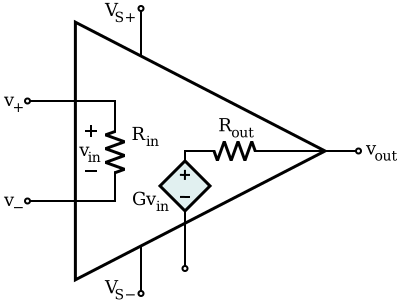
An ideal op amp is usually considered to have the following characteristics:
- Arbitrarily high open-loop gain
- Infinite input impedance Rin, and thus zero input current
- Zero input offset voltage
- Unbounded output voltage range
- Unrestricted bandwidth with zero phase shift and infinite slew rate
- Zero output impedance Rout, and thus ability to source or sink unbounded output current
- Zero noise
- No effect of common-mode voltages, as described by common-mode rejection ratio (CMRR)
- No effect of supply variations on the output, i.e., perfect rejection of power supply variation.
These ideals can be summarized by the two golden rules:
- In a negative feedback configuration the output does whatever is necessary to make the voltage difference between the inputs zero.
- The inputs draw zero current.
The first rule only applies in the usual case where the op amp is used in a negative feedback design, where there is a signal path of some sort feeding back from the output to the inverting input. These rules are commonly used as a good first approximation for analyzing or designing op-amp circuits.
None of these ideals can be perfectly realized. A real op amp may be modeled with non-infinite or non-zero parameters using equivalent resistors and capacitors in the op-amp model. The designer can then include these effects into the overall performance of the final circuit. Some parameters may turn out to have negligible effect on the final design while others represent actual limitations of the final performance.
Real op amps
Real op amps differ from the ideal model in various aspects.
Low-impedance outputs typically require high quiescent (i.e., idle) current in the output stage and will dissipate more power, so low-power designs may purposely sacrifice low output impedance. }}
The finite bandwidth of an op amp can be the source of several problems, including:
Fast or high-speed is used to refer to op amps with at least 50 MHz of GBWP and a high slew rate. While typical low-cost, general-purpose op amps exhibit a GBWP of a few megahertz, specialty and high-speed op amps exist that can achieve a GBWP of hundreds of megahertz. Very high-frequency circuits often use a current-feedback operational amplifier, because their bandwidth doesn't decrease with gain like voltage-feedback op amps.}}
Non-linear imperfections


Modern high-speed op amps can have slew rates in excess of 5,000V per microsecond. However, it is more common for op amps to have slew rates in the range 5–100V per microsecond. For example, the general purpose TL081 op amp has a slew rate of 13V per microsecond. As a general rule, low power and small bandwidth op amps have low slew rates. As an example, the LT1494 micropower op amp consumes 1.5 microamp but has a 2.7 kHz gain-bandwidth product and a 0.001V per microsecond slew rate. }}
|access-date=2012-12-27 |archive-date=2012-12-02 |archive-url=https://web.archive.org/web/20121202205518/http://www.analog.com/static/imported-files/tutorials/MT-036.pdf |url-status=dead |access-date=2012-12-27 |archive-date=2014-03-05 |archive-url=https://web.archive.org/web/20140305231302/http://www.edn.com/contents/images/45890.pdf |url-status=dead
Power considerations
Modern integrated FET or MOSFET op amps approximate more closely the ideal op amp than bipolar ICs when it comes to input impedance and input bias currents. Bipolars are generally better when it comes to input voltage offset, and often have lower noise. Generally, at room temperature, with a fairly large signal, and limited bandwidth, FET and MOSFET op amps now offer better performance. }}
Classification
Op amps may be classified by their construction:
- discrete, built from individual transistors or tubes/valves,
- hybrid, consisting of discrete and integrated components,
- full integrated circuits — most common, having displaced the former two due to low cost. IC op amps may be classified in many ways, including:
- Device grade, including acceptable operating temperature ranges and other environmental or quality factors. For example: LM101, LM201, and LM301 refer to the military, industrial, and commercial versions of the same component. Military and industrial-grade components offer better performance in harsh conditions than their commercial counterparts but are sold at higher prices.
- Classification by package type may also affect environmental hardiness, as well as manufacturing options; DIP, and other through-hole packages are tending to be replaced by surface-mount devices.
- Classification by internal compensation: op amps may suffer from high frequency instability in some negative feedback circuits unless a small compensation capacitor modifies the phase and frequency responses. Op amps with a built-in capacitor are termed compensated, and allow circuits above some specified closed-loop gain to be stable with no external capacitor. In particular, op amps that are stable even with a closed loop gain of 1 are called unity gain compensated.
- Single, dual and quad versions of many commercial op-amp IC are available, meaning 1, 2 or 4 operational amplifiers are included in the same package.
- Rail-to-rail input (and/or output) op amps can work with input (and/or output) signals very close to the power supply rails.
- CMOS op amps (such as the CA3140E) provide extremely high input resistances, higher than JFET-input op amps, which are normally higher than bipolar-input op amps.
- Programmable op amps allow the quiescent current, bandwidth and so on to be adjusted by an external resistor.
- Manufacturers often market their op amps according to purpose, such as low-noise pre-amplifiers, wide bandwidth amplifiers, and so on.
Applications
Main article: Operational amplifier applications
Historical timeline

1941: A vacuum tube op amp. An op amp, defined as a general-purpose, DC-coupled, high-gain, inverting feedback amplifier, is first found in "Summing Amplifier" filed by Karl D. Swartzel Jr. of Bell Labs in 1941. This design uses three vacuum tubes to achieve a gain of 90 dB and operates on voltage rails of ±350 V. It has a single inverting input rather than differential inverting and non-inverting inputs, as are common in today's op amps. Throughout World War II, Swartzel's design proved its value by being liberally used in the M9 artillery director designed at Bell Labs. This artillery director worked with the SCR-584 radar system to achieve extraordinary hit rates (near 90%) that would not have been possible otherwise.
1947: An op amp with an explicit non-inverting input. In 1947, the operational amplifier was first formally defined and named in a paper by John R. Ragazzini of Columbia University. In this same paper a footnote mentions an op-amp design by a student that would turn out to be quite significant. This op amp, designed by Loebe Julie, has two major innovations. Its input stage use a long-tailed triode pair with loads matched to reduce drift in the output and, far more importantly, it is the first op-amp design to have two inputs (one inverting, the other non-inverting). The differential input makes a whole range of new functionality possible, but it would not be used for a long time due to the rise of the chopper-stabilized amplifier.
1949: A chopper-stabilized op amp. In 1949, Edwin A. Goldberg designed a chopper-stabilized op amp. This set-up uses a normal op amp with an additional AC amplifier that goes alongside the op amp. The chopper gets an AC signal from DC by switching between the DC voltage and ground at a fast rate (60 or 400 Hz). This signal is then amplified, rectified, filtered and fed into the op amp's non-inverting input. This vastly improved the gain of the op amp while significantly reducing the output drift and DC offset. Unfortunately, any design that used a chopper couldn't use the non-inverting input for any other purpose. Nevertheless, the much-improved characteristics of the chopper-stabilized op amp made it the dominant way to use op amps. Techniques that used the non-inverting input were not widely practiced until the 1960s when op-amp ICs became available.
1953: A commercially available op amp. In 1953, vacuum tube op amps became commercially available with the release of the model K2-W from George A. Philbrick Researches, Incorporated. The designation on the devices shown, GAP/R, is an acronym for the complete company name. Two nine-pin 12AX7 vacuum tubes were mounted in an octal package and had a model K2-P chopper add-on available. This op amp was based on a descendant of Loebe Julie's 1947 design and, along with its successors, would start the widespread use of op amps in industry.

1961: A discrete IC op amp. With the birth of the transistor in 1947, and the silicon transistor in 1954, the concept of ICs became a reality. The introduction of the planar process in 1959 made transistors and ICs stable enough to be commercially useful. By 1961, solid-state, discrete op amps were being produced. These op amps are effectively small circuit boards with packages such as edge connectors. They usually have hand-selected resistors in order to improve things such as voltage offset and drift. The P45 (1961) has a gain of 94 dB and runs on ±15 V rails. It was intended to deal with signals in the range of ±10 V.
1961: A varactor bridge op amp. There have been many different directions taken in op-amp design. Varactor bridge op amps started to be produced in the early 1960s. They were designed to have extremely small input current and are still amongst the best op amps available in terms of common-mode rejection with the ability to correctly deal with hundreds of volts at their inputs.

1962: An op amp in a potted module. By 1962, several companies were producing modular potted packages that could be plugged into printed circuit boards. These packages were crucially important as they made the operational amplifier into a single black box which could be easily treated as a component in a larger circuit.
1963: A monolithic IC op amp. In 1963, the first monolithic IC op amp, the μA702 designed by Bob Widlar at Fairchild Semiconductor, was released. Monolithic ICs consist of a single chip as opposed to a chip and discrete parts (a discrete IC) or multiple chips bonded and connected on a circuit board (a hybrid IC). Almost all modern op amps are monolithic ICs; however, this first IC did not meet with much success. Issues such as an uneven supply voltage, low gain and a small dynamic range held off the dominance of monolithic op amps until 1965 when the μA709 (also designed by Bob Widlar) was released.
1968: Release of the μA741. The popularity of monolithic op amps was further improved with the release of the LM101 in 1967, which solved a variety of issues, and the subsequent release of the μA741 in 1968. The μA741 was extremely similar to the LM101 except that Fairchild's manufacturing processes allowed them to include a 30 pF compensation capacitor inside the chip instead of requiring external compensation. This simple difference has made the 741 a canonical op amp and a range of modern amps base their pinout on the 741s. The μA741 is still in production, and has become ubiquitous in electronics—many manufacturers produce a version of this classic chip, recognizable by part numbers containing 741.
1970: First high-speed, low-input current FET design. In the 1970s high-speed, low-input current designs started to be made by using JFETs. These would be largely replaced by op amps made with MOSFETs in the 1980s.
1972: Single-sided supply op amps being produced. A single-sided supply op amp is one where the input and output voltages can be as low as the negative power supply voltage instead of needing to be at least two volts above it. The result is that it can operate in many applications with the negative supply pin on the op amp being connected to the signal ground, thus eliminating the need for a separate negative power supply. The LM324, released in 1972, was one such op amp that came in a quad package (four separate op amps in one package) and became an industry standard.
Recent trends. Supply voltages in analog circuits have decreased (as they have in digital logic) and low-voltage op amps have been introduced reflecting this. Supplies of 5 V and increasingly 3.3 V (sometimes as low as 1.8 V) are common. To maximize the signal range, modern op amps commonly have rail-to-rail output (the output signal can range from the lowest supply voltage to the highest) and sometimes rail-to-rail inputs.
Notes
References
References
- "Understanding Single-Ended, Pseudo-Differential and {{Sic".
- Karki, James. (November 1998). "Voltage Feedback Vs Current Feedback Op Amps".
- "Apex OP PA98".
- Bryant, James. (2011). "Application Note AN-849: Using Op Amps as Comparators".
- Millman, Jacob. (1979). "Microelectronics: Digital and Analog Circuits and Systems". McGraw-Hill.
- "Understanding Basic Analog – Ideal Op Amps".
- "Lecture 5: The ideal operational amplifier".
- Schlaepfer, Eric. (2018). "IC01 Ideal Operational Amplifier". Perfect Semiconductor.
- (1989). "The Art of Electronics". Cambridge University Press.
- Stout, D. F.. (1976). "Handbook of Operational Amplifier Circuit Design". McGraw-Hill.
- Liska, Peggy. (July 2020). "3 Common Questions When Designing with High-speed Amplifiers".
- Jung, Walt. "High Speed Op Amps".
- Williams, Ian. "Slew Rate".
- Karki, Jim. (January 2018). "Understanding Operational Amplifier Specifications (Rev. B) - SLOA011B".
- "Application of Rail-to-Rail Operational Amplifiers". [[Texas Instruments]].
- Jung, Walter G.. (2004). "Op Amp Applications Handbook". Newnes.
- (May 1947). "Analysis of Problems in Dynamics by Electronic Circuits". IEEE.
- "Op Amp Applications". [[Analog Devices]].
- "Op Amp History". [[Analog Devices]].
- "The Philbrick Archive".
- "The all-new, all solid-state Philbrick P2 amplifier".
- Malvino, A. P.. (1979). "Electronic Principles". McGraw-Hill.
This article was imported from Wikipedia and is available under the Creative Commons Attribution-ShareAlike 4.0 License. Content has been adapted to SurfDoc format. Original contributors can be found on the article history page.
Ask Mako anything about Operational amplifier — get instant answers, deeper analysis, and related topics.
Research with MakoFree with your Surf account
Create a free account to save articles, ask Mako questions, and organize your research.
Sign up freeThis content may have been generated or modified by AI. CloudSurf Software LLC is not responsible for the accuracy, completeness, or reliability of AI-generated content. Always verify important information from primary sources.
Report