From Surf Wiki (app.surf) — the open knowledge base
Openwork
Artistic decoration using holes in solid materials
Artistic decoration using holes in solid materials

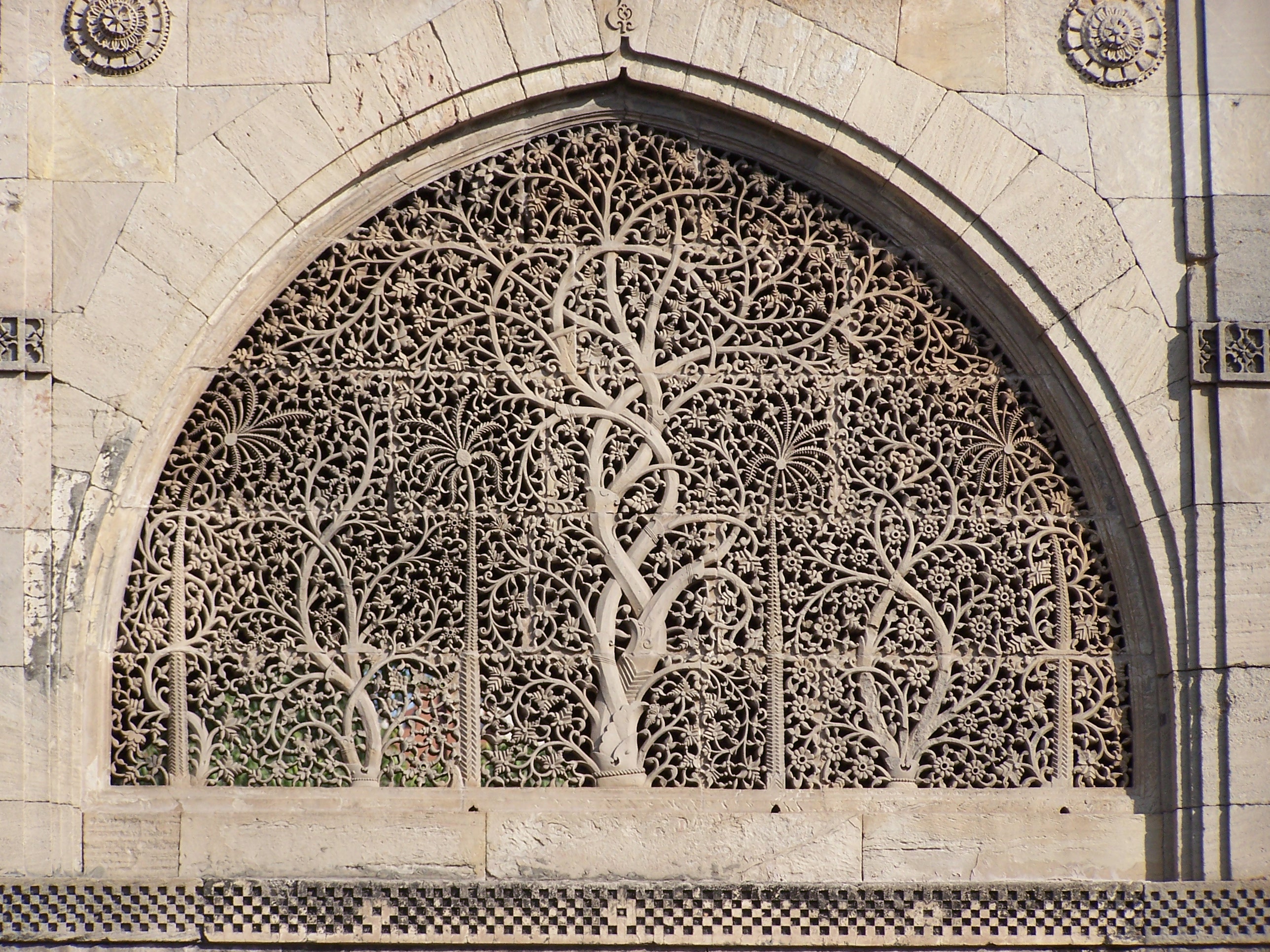
In art history, architecture, and related fields, openwork or open-work is any decorative technique that creates holes, piercings, or gaps through a solid material such as metal, wood, stone, pottery, cloth, leather, or ivory. Such techniques have been very widely used in a great number of cultures.
The term is rather flexible, and used both for additive techniques that build up the design, as for example most large features in architecture, and those that take a plain material and make cuts or holes in it. Equally techniques such as casting using moulds create the whole design in a single stage, and are common in openwork. Though much openwork relies for its effect on the viewer seeing right through the object, some pieces place a different material behind the openwork as a background.
Varieties
Techniques or styles that normally use openwork include all the family of lace and cutwork types in textiles, including broderie anglaise and many others. Fretwork in wood is used for various types of objects. There has always been great use of openwork in jewellery, not least to save on expensive materials and weight. For example, opus interrasile is a type of decoration used in Ancient Roman and Byzantine jewellery, piercing thin strips of gold with punches. Other techniques used casting with moulds, or built up the design with wire or small strips of metal. Essentially flat objects are straightforward to cast using moulds of clay or other materials, and this technique was known in ancient China since before the Shang dynasty of to 1046 BC. On a larger scale in metal, wrought iron and cast iron decoration more often than not have involved openwork.
Scythian metalwork, which was typically worn on the person, or at least carried about by wagon, uses openwork heavily, probably partly to save weight. Sukashibori (roughly translating to "see-through work") is the Japanese term covering a number of openwork techniques, which have been very popular in Japanese art.
In ceramics, if objects such as sieves are excluded (openwork bases for these existed in the West from classical times), decorative openwork long remained mainly a feature of East Asian ceramics, with Korean ceramics especially fond of the technique from an early date. Frequently, these ceramics are double walled allowing the solid inner surface to still hold liquid.
There was little use of it in European ceramics before the 18th century, when designs, mostly using lattice panels, were popular in rococo ceramic "baskets", and later in English silver trays. Openwork sections can be made either by cutting into a conventional solid body before firing, or by building up using strips of clay, the latter often used when loose wickerwork is being imitated. In glass openwork is rather less common, but the spectacular Ancient Roman cage cups use it for a decorative outer layer.
Some types of objects naturally suit or even require openwork, which allows a flow of air through screens, censers or incense burners, pomanders, sprinklers, ventilation grilles and panels, and various parts of heating systems. For exterior screens openwork designs allow looking out, but not looking in. For gates and other types of screens, security is required, but visibility may also be wanted.

Double-openwork and triple-openwork
The terms double-openwork and triple-openwork, also called reticulated, are typically associated with ceramic pieces that are created with two or three walls. Korean ceramist Kim Se-yong produces openwork pieces.
Architecture

In architecture openwork takes many forms, including tracery, balustrades and parapets, as well as screens of many kinds. A variety of screen types especially common in the Islamic world include stone jali and equivalents in wood such as mashrabiya. Belfries and bell towers normally include open or semi-open elements to allow the sound to be heard at a distance, and these are often turned to decorative use. In Gothic architecture some entire spires are openwork. The later of the two spires on the West Front of Chartres Cathedral is very largely openwork. As well as stone and wood the range of materials includes brick, which may be used for windows, normally unglazed, and screens. Constructions such as the Eiffel Tower in Paris are also described as openwork. Here an openwork structure was crucial for the engineering, reducing not only weight but wind resistance.
Beginning with the early fourteenth-century spire at Freiburg Minster, in which the pierced stonework was held together by iron cramps, the openwork spire, according to Robert Bork, represents a "radical but logical extension of the Gothic tendency towards skeletal structure." The 18 openwork spires of Antoni Gaudi's Sagrada Família in Barcelona represent an outgrowth of this Gothic tendency. Designed and begun by Gaudi in 1884, they remained incomplete into the 21st century.
Gallery
File:CMOC Treasures of Ancient China exhibit - bronze battle axe.jpg|Chinese bronze axe head, Shang dynasty File:Openwork Pinhead LACMA M.76.97.206.jpg|Cast Luristan bronze openwork pinhead, Iran, circa 1000–650 BC File:Ornamental gold mounts.jpg|Celtic ornamental gold mounts, about 420 BC File:HorseAttackedByTigerOrdos4th-1stBCE.JPG|Bronze Ordos culture plaque, from the eastern end of Scythian art, 4th century BC; a deer attacked by a wolf File:Diatreta from Komini II Pljevlja - Montenegro - 4th century.png|4th-century Roman glass cage cup found in Montenegro File:Bronze buckle, openwork, Georgia - 1st to 4th century CE.jpg|Bronze buckle, Georgian, 1st to 4th century AD File:Kanjo banner2.jpg|Japanese canopy ritual banner, gilt-bronze, 7th century File:ONJYO BOSATSU Todaiji.JPG|Tōdai-ji, 8th century File:Brit Mus 17sept 005-crop.jpg|Anglo-Saxon brooch from the Pentney Hoard File:Placchetta con crocifissione in lega di rame, da clonmacnoise, 1090-1110 ca.jpg|The Clonmacnoise Crucifixion Plaque, Irish, 10th century File:Fragrance box with openwork lid, Korea, Goryeo dynasty, 11th-12th century, bronze - Royal Ontario Museum - DSC04201.JPG|Fragrance box with openwork lid, Korea, Goryeo dynasty, 11th–12th century, bronze File:Jade ornament grapes jin dynasty shanghai museum 2004 07 22.jpg|Chinese jade ornament with vines, Jin dynasty File:Iran, khorasan o asia centrale, brucia-profumi a forma di felino, XI sec. 01 rame e vetro.JPG|Persian incense burner, c. 11th century File:Pyx MNMA Cl22860.jpg|French pyx, 1220–1240 File:Brooklyn Museum 2000.95.1 Processional Cross.jpg|Head of an Ethiopian processional cross, 13th or 14th century File:Casket ivory Louvre MAO684.jpg|Ivory casket, Islamic Spain or Egypt, 13th or 14th century File:Goshavank - Armenia (2923871397).jpg|Detail of Armenian khachkar at Goshavank, 1291. The decoration does not cut right through the slab, so this is strictly relief giving the impression of openwork. File:彩漆木雕小座屏,2014-04-06 06.jpg|Chinese wood and lacquer screen File:Plaque (Iran).jpg|Steel plaque from Iran. One of a set of 8, probably for fixing to wood, perhaps in a royal tomb, 17th century File:Openwork Hexagonal Ko-Kiyomizu Ware Bowl, c. 1731-1752, Japan, artist unknown, stoneware with overglaze enamels - Art Institute of Chicago - DSC00215.JPG|Openwork Hexagonal Ko-Kiyomizu Ware Bowl, c. 1731–1752, Japan, artist unknown, stoneware with overglaze enamels File:Chippendale side chair, maker unknown, New York City, 1760-1780, mahogany and upholstery - De Young Museum - DSC00831.JPG|American chair, 1760–80, to a design by Thomas Chippendale File:Lotus-shaped cup with openwork handle, China, Qing dynasty, probably 1800-1900 AD, rhinoceros horn - Asian Art Museum of San Francisco - DSC01565.JPG|Lotus-shaped cup with openwork handle, China, probably 19th century AD, rhinoceros horn File:Japanese - Tsuba with Openwork Scroll and Dragon - Walters 51351 - Back.jpg|Japanese tsuba, early 19th century File:Brooklyn Museum 77.245.1 Dance Headdress Ci-wara Kun (8).jpg|African dancer's headpiece, wood File:Handkerchief, embroidered initials, 'H.S.'---in button- hole embroidery. Made in Germany or Switzerland, 19th century. LACMA 60.41.105 (2 of 2).jpg|Detail of handkerchief in button-hole embroidery. Germany or Switzerland, 19th century.
Architecture gallery
File:Borobudur-perfect-buddha.jpg|At Borobudor hundreds of Buddha statues sit inside openwork stupas; here the nearest is partly deconstructed File:Monografie de la Cathedrale de Chartres - 04 Facade occidentale - Gravure (cropped).jpg|West front of Chartres Cathedral. The tower on the left is largely openwork File:Alahambra4.JPG|Window in the Alhambra File:Hardwick carving Giano.gif|Hardwick Hall, England, 1590s File:St Michael am Zollfeld - Scheune - Ziegelfenster.jpg|Brick windows on an Austrian barn File:Hn-wilhelmstr18 gotische Balustrade der Kilianskirche 1.jpg|Gothic Revival balustrade in Germany File:Gas lamp mount, Garbergasse 7, Vienna.jpg|Cast iron bracket for a gas lamp, Vienna File:Prosta Tower fasada.JPG|Opernwork fasade of Prosta Tower, Warsaw
References
References
- {{British-Museum-db. British Museum Ref:1994,0408.29
- "Openwork." [[Grove Art Online]], Oxford Art Online. Oxford University Press, accessed May 26, 2015, [http://www.oxfordartonline.com/subscriber/article/grove/art/T063628 subscription required]. Their article reads, in full: "Any form of decoration that is perforated". [[OED]] "Openwork", 1, where all examples cited from earlier than 1894 are hyphenated, though this is now less common than the single word.
- Diane Favro, et al. "Rome, ancient, s 5, ii." Grove Art Online. Oxford Art Online. Oxford University Press, accessed May 27, 2015, [http://www.oxfordartonline.com/subscriber/article/grove/art/T073405pg13 subscription required]
- Department of Asian Art. [http://www.metmuseum.org/toah/hd/shzh/hd_shzh.htm "Shang and Zhou Dynasties: The Bronze Age of China"]. In Heilbrunn Timeline of Art History. New York: The Metropolitan Museum of Art, 2000–. (October 2004)
- Timothy Taylor. "Scythian and Sarmatian art." [[Grove Art Online]], Oxford Art Online. Oxford University Press, accessed May 27, 2015, [http://www.oxfordartonline.com/subscriber/article/grove/art/T077242 subscription required]
- Tokyo National Museum. (1976). "和英対照日本美術鑑賞の手引(An Aid to the Understanding of Japanese Art)".
- Whitfield, Roger (ed), ''Treasures from Korea: Art Through 5000 Years'', p. 68, 1984, British Museum Publications, {{ISBN. 0-7141-1430-8, 9780714114309. Openwork bases and pedestals "became the characteristic and dominant forms in ceramics" in the [[Gaya confederacy]] period.
- Aftel, mandy, ''Fragrant: The Secret Life of Scent'', 2014, Penguin, {{ISBN
- Lim, Man-taek. (2023-09-07). "MR O Commerce-Mirae Asset Securities hold September Finance & Art Tech Seminar Invitational! 엠알오커머스-미래에셋증권, 9월 금융 & 아트테크 세미나 초대전 개최!".
- Harriss, Joseph. (1975). "The Eiffel Tower:Symbol of an Age". [[Paul Elek]].
- Robert Bork, "Into Thin Air: France, Germany, and the Invention of the Openwork Spire" ''The Art Bulletin'' '''85'''.1 (March 2003, pp. 25–53), p 25.
- de Paor, Máire. "An Openwork Crucifixion Plaque from Clonmacnoise". The Journal of the Royal Society of Antiquaries of Ireland, volume 84, no. 1, 1954, p. 35
- [http://collections.lacma.org/node/233196 The whole piece] {{Webarchive. link. (2015-05-27 , LACMA)
This article was imported from Wikipedia and is available under the Creative Commons Attribution-ShareAlike 4.0 License. Content has been adapted to SurfDoc format. Original contributors can be found on the article history page.
Ask Mako anything about Openwork — get instant answers, deeper analysis, and related topics.
Research with MakoFree with your Surf account
Create a free account to save articles, ask Mako questions, and organize your research.
Sign up freeThis content may have been generated or modified by AI. CloudSurf Software LLC is not responsible for the accuracy, completeness, or reliability of AI-generated content. Always verify important information from primary sources.
Report