From Surf Wiki (app.surf) — the open knowledge base
Opel Corsa
Supermini car manufactured by Opel
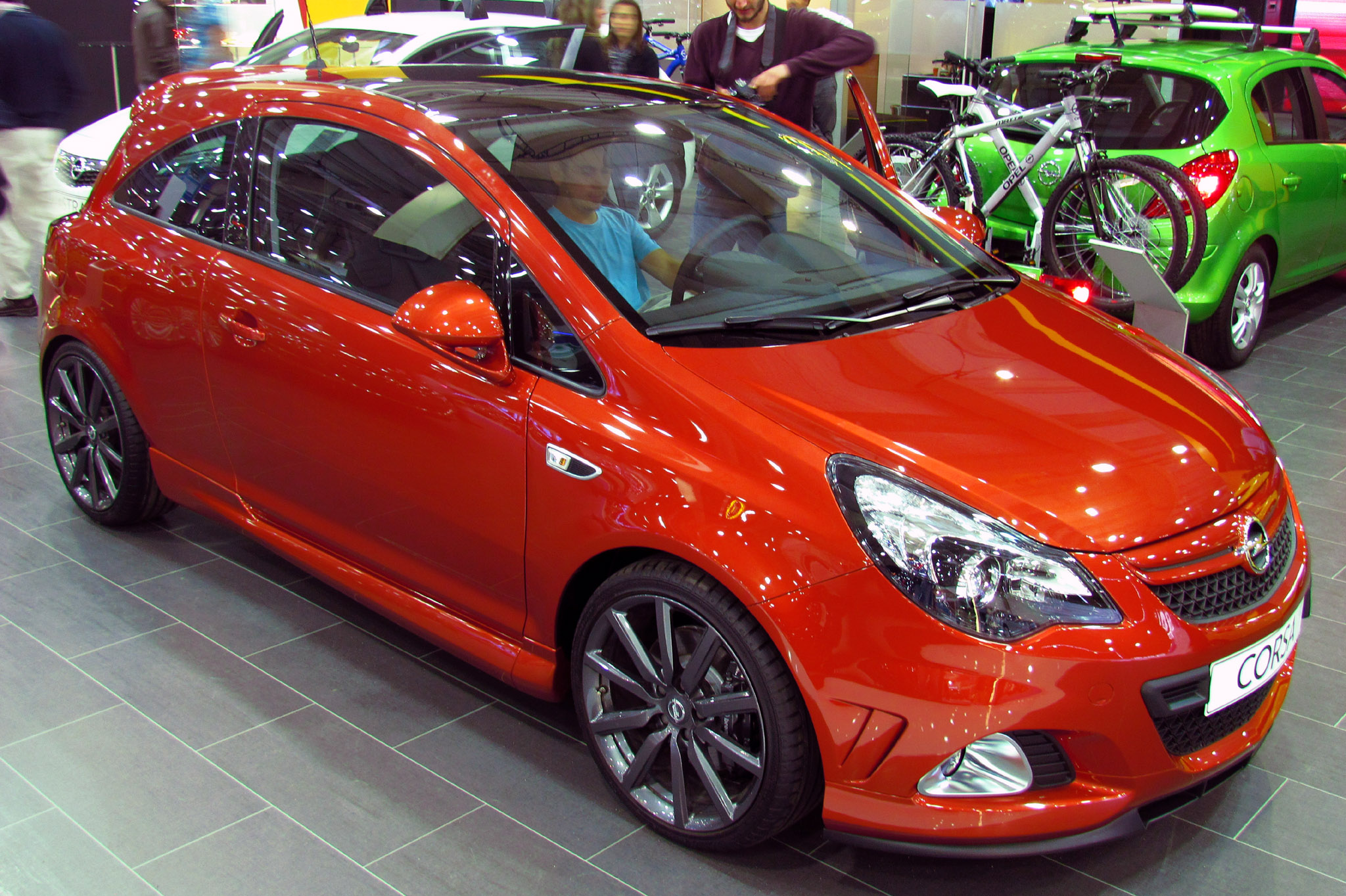
Supermini car manufactured by Opel
| Field | Value | |
|---|---|---|
| name | Opel Corsa | |
| image | Opel Corsa-e at IAA 2019 IMG 0738.jpg | |
| caption | Opel Corsa F (pre-facelift) | |
| manufacturer | ||
| aka | {{plainlist | |
| production | {{plainlist | |
| class | Supermini (B) | |
| layout | Front-engine, front-wheel-drive | |
| predecessor | Opel Kadett City | |
| Vauxhall Chevette |
- Vauxhall Corsa (United Kingdom)
- Vauxhall Nova (United Kingdom, 1982–1993)
- Holden Barina (Australia and New Zealand, 1993–2006)}}
- 1982–present (Europe)
- 1993–present (Vauxhall brand)}} Vauxhall Chevette
The Opel Corsa is a supermini car manufactured and marketed by Opel since 1982. The car is known as the Vauxhall Corsa in the United Kingdom. Before General Motors sold Opel and Vauxhall to PSA Group in 2017, the Corsa was also rebadged under the Chevrolet, Holden and Buick brands.
The Corsa was once the best-selling car in the world in 1998, recording 910,839 sales. At that time, the Corsa assembled on four continents, marketed under five different marques and offered in five body styles. By 2007, over 18 million Corsas had been sold globally.
{{anchor|Corsa A|A|S83}} Corsa A (S83; 1982)
Yugoslavia: Kikinda (IDA-Opel) | petrol: | 993 cc 10S OHV I4 | 1196 cc 12NC/E12N/E12GV OHV I4 | 1196 cc 12ST I4 | 1195 cc 12NV/C12NZ I4 | 1297 cc 13NB/C13N I4 | 1297 cc 13S/13SB I4 | 1297 cc 13E I4 | 1389 cc 14NV/C14NZ I4 | 1389 cc C14SE I4 | 1598 cc C16NZ/E16NZ I4 | 1598 cc C16SE/E16SE I4 | diesel: | 1488 cc Isuzu 4EC1 I4 | 1488 cc Isuzu T4EC1 TD I4
The front-wheel drive Opel Corsa was first launched in September 1982. A two-seat, roadster "concept car" had been shown as a teaser six months earlier at Geneva. It went on sale first in France, Italy, and Spain — markets where small cars represented from 34 to 43 percent of overall automobile sales. Sales across the remainder of Europe were to have begun by March 1983. General Motors' internal code for the Corsa/Nova was the S-car. The S-car designation had originally been applied to an abandoned supermini proposal from the early 1970s, which evolved into the 3-door hatchback ("City") version of the Opel Kadett C/Vauxhall Chevette, for which the Corsa/Nova acted as a de facto replacement. The Corsa was GM Europe's entry into the burgeoning supermini market — a market in which Opel/Vauxhall were not yet represented, as the Kadett C/Chevette was not a true supermini in the sense that it was rear wheel drive, while its successor — the Kadett D/Astra — competed in the larger C-segment, thus leaving a gap at the bottom of the range. The new car would therefore follow in the template already set by established superminis such as the Fiat 127, VW Polo and Ford Fiesta in using a transverse-engined, front wheel drive layout.
Built in Zaragoza, Spain, the first Corsas were three-door hatchback and two-door saloon models, with four-door and five-door versions added in 1984. In certain markets, commercial "van" models were also sold, with or without rear windows depending on local requirements. In mainland Europe, the saloon versions were known as the "Corsa TR" until May 1985 and had subtly altered styling — the distinctive wheelarch blisters of the hatchbacks were deleted and the saloons used a traditional "eggcrate" grille instead of the hatchback's integrated bumper/four-bar grille. The saloons were intended to appeal to customers of the Opel Kadett C and Vauxhall Chevette who still desired a traditional three-box saloon shape — while it did not sell particularly well in most of Europe, the TR was popular in Spain and Portugal among other markets. While only taking ten percent of French Corsa sales during the car's first half-year, the TR represented half of all Corsas sold in Spain.
The basic trim level was called just the Corsa, which was followed by the Corsa Luxus, Corsa Berlina, and the sporty Corsa SR. The SR receives a spoiler which surrounds the rear window, alloy wheels, checkered sport seats, and a somewhat more powerful 70 PS engine. Six years later, the Corsa received a facelift, which included a new front fascia and some other minor changes. The models were called LS, GL, GLS, and GT.
The Corsa A was known in the United Kingdom market as the Vauxhall Nova —Nova being a legacy nameplate which had been used elsewhere in the GM empire with Corsa being rejected as it sounded too much like coarser. It launched in April 1983, following a seven-month-long union dispute due to British workers' anger over the car being built in Spain, in contrast to the rival Ford Fiesta and Austin Metro. In addition, there was a disparity concerning import tariffs, as while cars exported from Spain to the European Community were subject to tariffs of only 4.4%, those exported in the other direction were subject to tariffs of 36.7%.
Power first came from 1.0 L 45 PS, 1.2 L 55 PS, and 1.3 L 70 PS petrol engines. Initially, all engines were equipped with carburetors; fuel injection came later, but never for the 1.0. The engines used the GM Family I design, except for the 1.0 L and early 1.2 L engines, which were based on the venerable Opel OHV engine which had been used in the Opel Kadett in all of its four generations since 1962.
At the Frankfurt Motor Show in May 1987 (prior to the facelift) two new engines were added to the lineup: an Isuzu-built, 67 PS 1.5 L turbo diesel engine which was also used in the Isuzu Gemini, along with the sporty GSi model. The engines and most of the mechanical componentry were derived from those used in the Astra/Kadett.
Facelift
In September 1987 the Corsa received a light facelift, with a new grille that was now the same on hatchbacks and saloons, an updated interior, and other slight changes. For the 1989 model year, the 1.3 was bored out to 1.4-litres. Power remained the same, although torque increased.
A rare "Sport" model was produced in 1985 to homologate for the sub 1,300 cc class of Group A for the British Rally Championship. These Sport models were white and came with unique vinyl decals, a 13SB engine with twin Weber 40 DCOE carburettors, an optional bespoke camshaft, a replacement rear silencer, and few luxuries. This gave 93 hp and a top speed of 112 mph with a 0 – time of 8.9 seconds. These are by far the rarest models (500 produced).
A 1.6 L multi point fuel-injected engine with 101 PS at 5600 rpm (98 PS in the catalysed version) and capable of 186 km/h was added to the Corsa/Nova at the 1987 Frankfurt Motor Show, giving decent performance and being badged as a GSi ("Nova GTE" in pre-facelift models in the United Kingdom, later models were all called GSi).
The GSi's engine mapping had been carried out by Opel tuning specialists Irmscher. A model with the 82 PS 1.4 L multi-point fuel-injected engine, which was otherwise mechanically identical to the GSi, also became available as the Nova SRi in the United Kingdom. In January 1988, a turbocharged version of the Isuzu diesel engine was introduced, with power increased to 67 PS.
The design was freshened in September 1990, with new bumpers, headlights, grille, and interior, but it was clearly recognisable as a gentle makeover of an early 1980s design when it had to compete with the latest two all-new superminis in Europe – the Peugeot 106 and the Renault Clio. The 1992 model year saw the 1.0-litre models dropped from the line up, as the Opel OHV engine could not comply with the upcoming Euro 1 emission standard.
File:Opel Corsa A rear 20080131.jpg|Rear view, 1987 facelift model File:Opel Corsa GT (22317486254).jpg|Opel Corsa GT (pre-facelift) File:Opel Corsa A GT 1.3 IAA 2019 JM 0654.jpg|Opel Corsa GT 1.3 (1987) File:Opel Corsa 2 door notchback.jpg|Opel Corsa TR two-door (1982–1987) File:MHV Opel Corsa TR 02.jpg|Rear view File:1986 Opel Corsa A 1.2 S (16613368157).jpg|Opel Corsa five-door (1985–1987), note different grille from Corsa TR File:Opel Corsa 1.4i Swing (11403549366).jpg|Opel Corsa four-door (1990–1993; rear) File:Opel Corsa 1.2 "Strada" (10476179675).jpg|1990–1993 facelift model, "Strada" special edition (NL) File:1988 Opel Corsa A GSi (14766511221).jpg|1988 Opel Corsa GSi (rear) File:Opel Corsa A Van 1.2S 5-9-1989 VF-93-XH.jpg|1989 Opel Corsa Van File:Opel Corsa A Michalak Spider Classic-Gala 2021 1X7A0125.jpg|The Michalak Spider was inspired by the 1982 Corsa roadster concept car
{{anchor|Vauxhall Nova|Nova}} Vauxhall Nova
The Corsa A was rebadged as the Vauxhall Nova between April 1983 and March 1993 for the United Kingdom only, as it had been decided to phase out the Vauxhall brand entirely in favor of Opel in the Republic of Ireland. ("Nova" is a trademark which GM had already used in North America). It effectively replaced the aging Chevette, which finished production in January 1984. Nearly 500,000 Novas were sold in Britain over the next ten years, but by February 2016, only 1,757 were still on the road. In its best year, 1989, it was Britain's seventh best selling car with more than 70,000 sales. All Nova models were manufactured in Spain, with the first customers in the United Kingdom taking delivery of their cars in April 1983. It gave Vauxhall a much needed modern competitor in the supermini market in the United Kingdom, as the Chevette was older than the majority of its main competitors which consisted of the Ford Fiesta and the Austin Metro. With the late 1990 facelift a small van version arrived, called the Vauxhall Nova Van. In the 2000s, it was publicised that Novas could be stolen easily by removing the hazard lights switch and putting it back into the dashboard upside-down and this would start the ignition.
Sales in the United Kingdom were strong right up to the end, but by the time the last Nova was built in the beginning of 1993, it was looking very dated in comparison to more modern rivals like the Peugeot 106 and the Renault Clio. Vauxhall dropped the Nova name in 1993 when their version of the Opel Corsa B made its debut, and later models were sold as the Vauxhall Corsa instead. This was the second Vauxhall to adopt the same model name as the Opel version, the first being the Senator.
A television advert in 1987 featured the Ritchie Valens hit "La Bamba" playing in the background, and used CGI to allow a Nova to drive over vehicles in a busy city. Another advert from 1990 featured a Nova as a pet, CGI allowing it to jump through a traffic jam and briefly play a hotrod whilst stopped at traffic lights. The end featured a homage to Wacky Races, with the Nova laughing like Muttley. This advert featured Angus Deayton.
Motorsport
From 1990 to 1993, the Vauxhall Nova Challenge ran as part of the British Rallycross Championship.
In 1992, John Leslie took part in the series for a feature on Blue Peter.
File:1990 Vauxhall Nova L 1.2 Front.jpg|Vauxhall Nova five-door (1989–1990) File:1992 Vauxhall Nova 1.4 Merit Plus (19299240358).jpg|Vauxhall Nova five-door (1990–1993) File:1989 Vauxhall Nova GTE 1.6 Front.jpg|Vauxhall Nova GTE
{{anchor|Corsa B|B}} Corsa B (S93; 1993)
|Germany: Eisenach (Opel Eisenach) |Spain: Zaragoza |Colombia: Bogotá (GM Colombia) |Mexico: Ramos Arizpe |Argentina: Alvear (GM Argentina) |Brazil: São Caetano do Sul (GM Brazil) |Venezuela: Valencia (GM Venezuela) |South Africa: Port Elizabeth (GM South Africa) |Egypt: 6 October City (GM Egypt) |China: Jilin (Jilin Jiangbei), Shanghai (Shanghai GM) |India: Gurgaon (GM India) |Thailand: Rayong (GM Thailand) |Ecuador: Quito (AYMESA) |Turkey: Torbalı, İzmir Province | petrol: | 1.0 L X10XE I3 | 1.2 L 12NZ/C12NZ/X12SZ I4 | 1.2 L X12XE 16V I4 | 1.4 L C14NZ/C14SE/X14SZ I4 | 1.4 L X14XE 16V I4 | 1.6 L C16XE/X16XE 16V I4 | diesel: | 1.5 L Isuzu 4EC1 I4 | 1.5 L Isuzu T4EC1 turbo I4 | 1.7 L Isuzu 4EE1 I4 5-speed manual 4-speed Aisin AF13 automatic 2480 mm (pickup) In April 1993, the Corsa B was unveiled and in the United Kingdom, Vauxhall dropped the Nova name, with the car from now being known as the Corsa. In May 1994, it was launched by Holden in Australia, as the Barina, replacing a version of the Suzuki Swift sold under that name. This proved a success, and was the first Spanish built car to be sold in significant volumes in the Australian market.
Unlike the previous model, there was no saloon version for the European market, but one was designed in Brazil for the Latin American market, as saloons were much preferred to hatchbacks there. This was also introduced in South Africa and India. An estate car, panel van and pickup truck were also introduced, and a convertible version was produced for the Australian market, called the Holden Barina Cabrio. Vauxhall also marketed a limited edition of the cabriolet in the UK from 1998 to 1999, as the Vauxhall Corsa Cabriolet. Chevrolet Corsa Saloon, Chevrolet Corsa Pick Up and Chevrolet Corsa Wagon were Designed by Wagner Montes Cla Dias in the GM Brasil Studios in São Caetano do Sul.
Italy was the only European country where the Argentinian-built estate version was offered, which meant that the Italian importer had to shoulder the entire cost of homologation. In Italy, the estate was offered with a 1.4-litre 16-valve petrol engine or the 1.7-litre naturally aspirated diesel. The Corsa also spawned a small coupé, named the Opel Tigra.
Four-cylinder power came from 1.2, 1.4, and 1.6 litre Family 1 petrol engines, as well as an economical 1.5 L turbodiesel engine. Most cars received a five-speed manual transmission, although a four-speed automatic was also available with certain engines. In the first few years, a four-speed manual was also available, only coupled to the smallest 1.2-litre engine.
1.0 L three cylinder and 1.2 L four-cylinder Family 0 economy version was launched in 1997, and a Lotus-tuned suspension was added as well as an exterior refresh.
The saloon and estate car versions were produced in China by Shanghai GM as Buick Sail and Buick Sail S-RV, respectively from June 2001 to February 2005. That year, they received a facelift and became known as the Chevrolet Sail and SRV. In September 2006, Chile became the first country outside China to receive the Chinese assembled Sail; it is called the Chevrolet Corsa Plus there, available as a four-door saloon with a 1.6 L 92 PS engine. The Corsa Plus includes dual front airbags, anti-lock brakes, air conditioning, electric windows and central locking as standard equipment.
In India, the hatchback, saloon and estate car versions were sold as the Corsa Sail, Corsa (or Corsa Joy) and Corsa Swing respectively until the end of 2005. The hatchback model was still being produced, and extensively marketed in South Africa as the Corsa Lite under the Opel branding until 2009; at which point it was discontinued.
In Thailand, the Corsa was available as an Opel with a fuel-injected 8V 1.4-litre engine and "Joy" and "Swing" variants, both available with three or five-door and either a manual or an automatic gearbox.
File:Opel Corsa rear 20080417.jpg|Opel Corsa three-door (1997–2000) File:Opel Corsa B 1.2 16V Edition 2000 5-Türer Facelift rear.JPG|Opel Corsa five-door (1997–2000) File:Corsa caravan.jpg|Opel Corsa Caravan File:1993-1995 Opel Corsa B GSi 16V 02 Front Left.jpg|Opel Corsa GSi 16V (1993–1995) File:1993 Vauxhall Corsa Merit 1.2 Front.jpg|Vauxhall Corsa three-door (pre-facelift) File:1997 Vauxhall Corsa LS Automatic 5 Doors facelift 1.4.jpg|Vauxhall Corsa five-door (facelift) File:1996-1997 Holden Barina (SB) City 3-door hatchback (2011-08-17) 01.jpg|Holden Barina three-door (pre-facelift) File:1998 Holden Barina (SB) Cabrio convertible (22311990821) (cropped).jpg|Holden Barina cabrio (facelift) File:Corsa Innenraum.jpg|Interior File:Buick Sail China 2012-04-28.JPG|Buick Sail saloon (China) File:Buick Sail SRV China 2012-04-14.JPG|Buick Sail SRV (China) File:Chevrolet Sail China 2012-04-14.JPG|Chevrolet Sail (China)
Safety
The Corsa was updated in 1997, resulting in different styling options and better safety features:
The Corsa Classic in its most basic Latin American market configuration with no airbags received 1 star for adult occupants and 1 star for toddlers from Latin NCAP 1.0 in 2011. In October 2000, GM do Brasil recalled 1.3 million Corsas built between 1994 and 1999, and the front seat belt fasteners could come undone in a collision - two people were known to have died as a result.
South Africa
The Corsa B was manufactured in South Africa and first entered the market in November 1996, featuring three models (Lite, 130i and 130iS), all having the same 1.3 L (13NE) 8 valve engine producing 58 kW. In 1999 the range was updated, dropping the 1.3 L engine in favor of a 1.4 (14NE) producing 65 kW and a 1.6 (C16SE) producing 75 kW, both still being 8-valve engines. From model year 2001, a facelift was performed, resulting in some front and rear styling changes, including a new front bumper, bonnet and clear headlight lenses and new taillight lenses featuring a "bubble" look. The Corsa B continued in production post 2002, when the Corsa C was introduced, with only the 1.4-litre engine remaining available in various "Lite" trim models (three-door only) until production ultimately ceased in 2007. Alongside the three-door hatchback, four-door saloon and pickup derivatives were also available earlier on.
Specifications differed compared to European Corsa B models, with the following features offered in Europe and UK never being offered on South African models:
- 16 valve engines (all models used the older SOHC 8 valve engine design)
- ABS brakes
- Airbags
- Electric windows and mirrors were never offered on any three-door models and only on the top spec (160iE) four-door saloon
- No automatic transmission option was ever offered
| Models | Engine used |
|---|---|
| Lite, 130i, 130iS, 130iE | 1.3 L (13NE) 58 kW |
| Lite, Lite+, Lite Sport, Chill, 1.4i, 1.4iS | 1.4 L (14NE) 65 kW |
| 160i, 160iS, 160iE, GSi, GSi Ltd | 1.6 L (C16SE) 75 kW |
Latin America
The saloon model was built and sold in Latin America as the Chevrolet Corsa Classic until 2010 when it was replaced with the model previously released for China in 2005 as the Buick Sail. A budget version introduced for the Brazilian market, the Chevrolet Celta, has bodywork resembling the end of the 1990s Vectra and Astra. The Celta was sold in Argentina as the Suzuki Fun for a certain period.
In 2011, General Motors stopped representing Suzuki in Argentina, so the Celta reverted to its original name under the Chevrolet brand. Argentinian production began in September 1997, where it was the first locally built Chevrolet passenger car since 1978.
The Latin American Corsa received a small facelift in 1999, with smoother bumpers, and from April 2002 (when the new Corsa II was introduced) the Corsa B began being marketed as the "Corsa Classic" until 2010, where it was renamed to simply "Classic" with the saloon and estate versions becoming their Corsa B derived Chevrolet Sail versions while the three-door hatchback version of the Corsa Classic was replaced with the Chevrolet Celta. Production finally ceased in October 2016.
Mexico
For 1995, General Motors de México first marketed the Corsa B as the Chevrolet Chevy. For 2004 (after the Corsa C had been introduced in 2002), a Mexican designed and produced version of the hatchback and saloon, known as the Chevrolet Chevy C2, was released, which was also sold in Colombia.
All Mexican previous versions were known as the Chevy, with the names Monza used on the saloon, and Swing (five-door) and Joy (three-door) for the hatchbacks, all with a 1.6-litre 78 PS four-cylinder. There was also a low-end three-door model called the Chevrolet Chevy Popular, which was equipped with a 52 PS 1.4-litre engine. The latter 2004 and 2008 redesigns were simply named Chevy and Chevy Sedán. The Chevy was a favourite among taxicab drivers and one of the best selling cars in the country.
The Chevy ended production at the end of August 2011, at the Ramos Arizpe assembly plant. This move was because the Chevy's sales had been dropping constantly since the beginning of 2010, and also because it didn't meet the new safety requirement rules in Mexico that forced it to have standard front airbags.
The five-door hatchback was dropped after the 2010 model year, leaving only the four-door saloon and the three-door hatchback, this three-door hatch being the most popular model. The Chevy was discontinued only a short run of 2012 models, after almost 18 years on the Mexican market.
The successor for the three-door and saloon, the Chevrolet Sonic was also built in Ramos Arizpe starting 2012, while GM subsequently replaced the five-door Chevy with the Chevrolet Spark.
File:Chevrolet Corsa Classic 1.6 Swing 2006 (11198627893).jpg|Chevy Joy File:Chevrolet Corsa 1.4 City 2009 (33816165494).jpg|Chevy Classic Joy File:ChevroletCorsa-Tandil.jpg|Chevy Classic Joy File:Chevrolet Corsa 1.6 GL 2000 (15908616918).jpg|Chevy Swing File:Lüdinghausen, Flugplatz Borkenberge -- 2014 -- 1118.jpg|Chevy Swing Caravan File:Chevrolet Corsa Classic 1.7d Sedan 2004 (34065545576).jpg|Chevy Classic Sedan File:Chevrolet Corsa Pick up 2001 (45190215064).jpg|Chevrolet Chevy Pick-up File:'06-'08 Chevrolet Chevy 3-Door.jpg|Chevrolet Chevy C2 Joy File:Chevrolet Corsa mexicano 2009 (9412740220).jpg|Chevy C2 Joy (2008 facelift) File:2009 Chevrolet Chevy Sedan.jpg|Chevrolet Chevy Sedán (2008 facelift) File:'10-'12 Chevrolet Chevy Sedan -- Rear.JPG|Chevrolet Chevy Sedán
- Opel Corsa – Europe (except the United Kingdom)
- Vauxhall Corsa – United Kingdom
- Buick Sail – China, June 2001 until February 2005
- Chevrolet Corsa – Latin America (Opel Corsa in Chile)
- Chevrolet Corsa Classic – South America, after the release of the Corsa C
- Chevrolet Classic – Brazil, since 2005; Argentina, since 2010
- Holden Barina – Australia and New Zealand (was replaced by the Daewoo Kalos from 2005)
- Opel Corsa Lite and Opel Corsa Classic – South Africa, for the hatchback and saloon versions respectively
- Opel Corsa Sail and Opel Corsa Swing – India, for the hatchback and the estate car version respectively
- Opel Vita – Japan (Toyota already registered the Corsa name for one of their domestic models, the Toyota Tercel)
- Chevrolet Chevy – Mexico, for the 2004 Corsa derived Chevy C2, facelifted at the end of 2008 for 2009. It was discontinued in the first quarter of 2012.
;Derived versions
- Chevrolet Sail – China, since 2005. A new version was released in 2010 then another in 2014.
- Chevrolet Classic – Argentina and Brazil, since 2011, for the Chevrolet Sail
- Chevrolet Corsa Plus – Chile, for the Chinese built Chevrolet Sail
- Chevrolet Celta and Chevrolet Prisma – South America, for the hatchback and saloon version respectively
- Chevrolet Monza for the four-door saloon edition of the Chevrolet Chevy. Discontinued in spring 2012.
- Suzuki Fun – Argentina, for the Corsa derived Chevrolet Celta. Discontinued in 2011. Name switched to Chevrolet Celta.
{{anchor|Corsa C|C}} Corsa C (X01; 2000)
2002–2012 (South America) |Petrol: |1.0 L X10XE I3 |1.0 L Z10XEP I3 |1.2 L Z12XE I4 |1.2 L Z12XEP I4 |1.4 L X14XE I4 |1.4 L Z14XE I4 |1.4 L Z14XEP I4 |1.6 L Z16SE I4 |1.8 L Z18XE I4 |Diesel: |1.25 L Fiat CDTI I4 |1.7 L Isuzu DI I4 |1.7 L Isuzu DTI I4 |1.7 L Isuzu CDTI I4
4-speed Aisin AF13 automatic 5-speed ZF Easytronic automated manual 4181 mm (saloon) 1430 mm (saloon) Opel Meriva A Opel Tigra TwinTop B
The Corsa C was revealed in 1999, and introduced to the European market in October 2000, and the facelift arrived in February 2004. General Motors dubbed the new chassis Gamma, and intended to use it for a number of other models. A saloon version was also offered in Latin America, South Africa and the Middle East. In 2002, the Corsa chassis spawned a mini MPV called the Opel Meriva, development of which began under Opel in Rüsselsheim. In Japan, where the car was sold through the Yanase dealership chain as the Opel Vita, it was discontinued in April 2004 due to sluggish sales.
The vehicle won 2001 Semperit Irish Car of the Year in Ireland.
File:Opel Corsa C 1.2 Elegance rear 20100912.jpg|Opel Corsa five-door (2000–2004) File:Opel Corsa 1.2 16V ECOTEC (C) – Heckansicht, 1. April 2011, Mettmann.jpg|Opel Corsa three-door (2000–2004) File:Opel Corsa front 20070609.jpg|Opel Corsa three-door (2004–2007) File:Opel Corsa rear 20070609.jpg|Opel Corsa three-door (2004–2007) File:Opel Corsa C Facelift rear 20090919.jpg|Opel Corsa five-door (2004–2007) File:2003 Vauxhall Corsa Club 12V 1.0.jpg|pre-facelift Vauxhall Corsa File:2005 Vauxhall Corsa Life Twinport facelift 1.0.jpg|Post facelift Vauxhall Corsa File:2001 Holden Barina (XC) 5-door hatchback (2015-07-03) 01.jpg|Holden Barina five-door (pre-facelift) File:2004 Holden Barina (XC MY04) SXi 3-door hatchback (2010-06-17) 01.jpg|Holden Barina three-door (facelift) File:Opel Corsa interior.JPG|Interior
Safety
Euro NCAP test results for a LHD, three-door hatchback variant on a registration from 2002:
| Test | Score | Points |
|---|---|---|
| Overall: | N/A | N/A |
| Adult occupant: | 25 | |
| Child occupant: | N/A | N/A |
| Pedestrian: | 9 | |
| Safety assist: | N/A | N/A |
Brazil
The Brazilian version of the Corsa sold in those countries featured a more conservative front end than its European counterpart.
Brazil also offered a pickup truck version of the Corsa named the Chevrolet Montana (sold in some markets as the Tornado), which, as well as the saloon, was exported in a completely knocked down form to South Africa for local assembly.
Mexico
The Corsa C arrived in the 2002 model year as a five-door hatchback, and was imported from Europe; but for the model year of 2003, the Corsa sold in Mexico began coming from Brazil and a saloon version was added. In 2005, the saloon version introduced an automated manual transmission called Easytronic because it was only offered in a five-speed manual transmission, however, the easytronic transmission was rapidly discontinued after the model year of 2007, because of poor sales and technical flaws.
For 2008, the Corsa was tweaked with a freshened grille, lights, and a gold-coloured Chevrolet logo. The Chevrolet Corsa C was discontinued in the Mexican market in June 2008, leaving only the older and freshened Chevy (Corsa B); and the Corsa C was replaced by the Chevrolet Aveo, however, Brazil kept the car until 2012 (as the Chevrolet Corsa Final Edition and with the saloon ending in 2011) and Argentina kept the car until 2010, while the Corsa-based Montana continued into 2010.
The Corsa C was that was sold in South America, was produced at the Rosario production plant in Argentina. The Latin American Corsa C featured the Opel inspired Chevrolet logo with a golden bowtie instead of a chromed one – the new logo was first introduced in the South American market with the new Chevrolet Vectra.
File:Chevrolet Corsa Hatchback.JPG|Chevrolet Corsa five-door File:Chevrolet Corsa 20150814-DSC05622.JPG|Chevrolet Corsa saloon File:2006 Corsa saloon shown in red colour available in Latin America.jpg|Chevrolet Corsa saloon File:2006 montana gls 1.7d.jpg|Chevrolet Montana pickup truck
South Africa
GM South Africa initially marketed the hatchback simply as the "New Corsa", later reverting to Corsa, while the previous generation Corsa B was still sold alongside the Corsa C and was branded as Corsa "Lite". A five-door hatchback (three-door was never offered) and four-door saloon as well as a pickup version known as the Corsa Utility was offered. In 2007, the Corsa C saloon was dropped in South Africa. The Corsa hatchback in South Africa did not have the same front fascia as the European Corsa. Instead, it had the same front fascia as the Latin American Chevrolet Corsa. Petrol engines were largely a carry over of the 8 valve SOHC variants from the Corsa B sold in South Africa, in displacements of 1.4 L (65 kW), 1.6 L (75 kW) and 1.8 L (79 kW), the 1.8 L was new for the Corsa C offered in range topping models, while this engine was never offered with a Corsa B, it was just a larger bore/stroke version of the existing engines. A 1.7DTi diesel was initially offered, with the a new 1.7CDTi diesel engine being added later.
Oceania
In Australia, the car was launched to much fanfare from many motor journalists, and went on to win the Wheels 2001 "Car of the Year" (COTY). Holden also imported the SRi version with the 1.8 L Astra motor and uprated sports suspension including traction control, ABS brakes, a better tyre/wheel combination, and Irmscher body kit to produce a "baby hot hatch" Barina.
The facelifted 2004 model was also imported; however, in December 2005, the Corsa C was suddenly dropped from the Australian and New Zealand Holden ranges as a cost-cutting measure by GM and was replaced by the Daewoo Kalos, rebadged as a Holden Barina. Motoring journalists were scathing in their criticism of the new model, particularly the bland handling, lackluster engine, and sub-par safety features. The Kalos-based Barina was subsequently replaced with a rebadged version of the Chevrolet Sonic/Daewoo Kalos T300 until stocks ran out in early 2019.
United Kingdom
This generation of the Corsa was a huge success for Vauxhall in the United Kingdom, which is the most popular supermini and second most popular car overall in 2002, 2003 and 2004. It was also Britain's best-selling supermini in 2005, achieving third place overall, but in 2006 (the final year of production) it lost top place in the supermini sector after five years and was overtaken by the Ford Fiesta. Overall, it was Britain's fourth most popular car in 2006.
Engine specifications
The Corsa C was introduced with a 1.7 L DTI Ecotec turbodiesel engine supplied by Isuzu (Circle L) with 75 hp. This was later joined by the 1.7 L DI Ecotec turbodiesel engine also supplied by Isuzu. The 1.7 L DI Ecotec did not include an intercooler and this reduced power to 65 PS. From 2003, a new 1.25 L CDTI Ecotec turbodiesel engine was supplied by Fiat (MultiJet); it produces 70 PS. A 1.7-litre CDTI Ecotec turbodiesel supplied by Isuzu which produced 100 PS was also available. This new 1.7 L CDTI Ecotec featured a variable geometry turbocharger.
The 1.0 L and 1.2 L Ecotec Family 0 engines are carry overs from the Corsa B; the 1.4 L Family 1 engine was replaced with a new 1.4 L Family 0 model. The 1.8 L Family 1 engine is an upgrade for the previous 1.6 L 16 valve engine and produces 125 PS and 165 Nm of torque. The edition with the 1.8 L engine was named Corsa GSi and was the predecessor of the new Corsa OPC.
In 2003, Opel introduced updated versions of Family 0 engines with TwinPort technology, and the 1.2 L engine gained 30 cc, giving it 80 PS.
| **Petrol engines** | Model | Production | Engine | Displacement | Power | Torque | Note | Diesel engines | Model | Production | Engine | Displacement | Power | Torque | Note |
|---|---|---|---|---|---|---|---|---|---|---|---|---|---|---|---|
| 1.0 Ecotec 12V | 2000–2003 | I3 | 973 cc | 58 PS at 5600 rpm | 85 Nm at 3800 rpm | ||||||||||
| 1.0 Ecotec 12V | 2003–2006 | I3 | 998 cc | 60 PS at 5600 rpm | 88 Nm at 3800 rpm | Twinport | |||||||||
| 1.2 Ecotec 16V | 2000–2004 | I4 | 1,199 cc | 75 PS at 5600 rpm | 110 Nm at 4000 rpm | ||||||||||
| 1.2 Ecotec 16V | 2004–2006 | I4 | 1,229 cc | 80 PS at 5600 rpm | 110 Nm at 4000 rpm | Twinport | |||||||||
| 1.4 Ecotec 16V | 2000–2003 | I4 | 1,389 cc | 90 PS at 6000 rpm | 125 Nm at 4000 rpm | ||||||||||
| 1.4 Ecotec 16V | 2003–2006 | I4 | 1,364 cc | 90 PS at 5600 rpm | 125 Nm at 4000 rpm | Twinport | |||||||||
| 1.8 Ecotec 16V | 2000–2003 | I4 | 1,796 cc | 125 PS at 6000 rpm | 165 Nm at 4600 rpm | GSi | |||||||||
| Brazilian engines | |||||||||||||||
| 1.0 L 8V VHC | 2002–2005 | I4 | 999 cc | 71 PS at 6400 rpm | 86 Nm at 3000 rpm | Base/Joy/Maxx/Premium | |||||||||
| 1.0 L 8V VHC FlexPower | 2006–2009 | I4 | 999 cc | 77-79 PS at 6400 rpm | 91-92 Nm at 5200 rpm | Joy/Maxx/Premium | |||||||||
| 1.4 L 8V Econo.Flex | 2008–2012 | I4 | 1,389 cc | 99–105 PS at 6000 rpm | 129-131 Nm at 2800 rpm | Maxx/Premium | |||||||||
| 1.8 L 8V MPFI | 2002–2003 | I4 | 1,796 cc | 102 PS at 5200 rpm | 164.75 Nm at 2800 rpm | ||||||||||
| 1.8 L 8V FlexPower | 2003-2005 | I4 | 1,796 cc | 105–109 PS at 5400 rpm | 169.66-178.48 Nm at 2800 rpm | Joy/Maxx/Premium | |||||||||
| 1.8 L 8V FlexPower | 2005–2009 | I4 | 1,796 cc | 112–114 PS at 5400 rpm | 173.58 Nm at 2800 rpm | Joy/Maxx/Premium/SS | |||||||||
| 1.3 CDTI Ecotec 16V | 2003–2006 Z13DT | I4 | 1,248 cc | 70 PS at 4000 rpm | 170 Nm at 1750–2500 rpm | Fiat engine | |||||||||
| 1.7 DI 16V | 2000–2003 Y17DTL | I4 | 1,686 cc | 65 PS at 4400 rpm | 130 Nm at 2000–3000 rpm | No intercooler | |||||||||
| 1.7 DTI 16V | 2000–2003 Y17DT | I4 | 1,686 cc | 75 PS at 4400 rpm | 165 Nm at 1800–3000 rpm | ||||||||||
| 1.7 CDTI Ecotec 16V | 2003–2005 Z17DTH | I4 | 1,686 cc | 100 PS at 4400 rpm | 240 Nm at 2300 rpm | VGT |
{{anchor|Corsa D|D}} Corsa D (S07; 2006)
3-door car-derived van |** petrol:** |1.0 L A10XEP (LDB) I3 |1.2 L A12XER (LWD/LDC) I4 |1.4 L A14XEL/XER (L2Z/LDD) I4 |1.4 L A14NEL (LUH) turbo I4 |1.6 L A16LER (LDW) turbo I4 |diesel: |1.25 L LDV/LSF I4 |1.7 L Circle L I4 Alfa Romeo MiTo Dietmar Finger (interior, 2004)
The Corsa D was created using a new version of the SCCS platform, which was co-developed by General Motors/Opel and Fiat, and is also employed by the 2005 Fiat Grande Punto. The first official pictures of the Corsa D were released by Opel in May 2006. In the United Kingdom, What Car? awarded it 2007 Car of the Year. The Corsa D placed second in the European Car of the Year for 2007, only behind the Ford S-Max.
The Corsa D is available in both three- and five-door versions and marketed as the Vauxhall Corsa in the United Kingdom. The same engines sizes from the Corsa C were available at launch, although the 1.3 L CDTI and 1.7 L CDTI engines were upgraded, with power ranging from 75 PS to 125 PS.
The 192 PS OPC/VXR version went on sale in the beginning of 2007, with a 1.6 L turbocharged petrol engine powering the front wheels.
The 75 PS 1.3 CDTI (actual displacement was 1.25 litres) engine was updated in the middle of 2007 to bring CO2 levels to just 119 g/km, meaning that twelve months' Vehicle Excise Duty in the United Kingdom costs £30 and is eligible for the Plan 2000E (a rebate of €2000 in the purchase of a new car) in Spain.
The Corsa D was briefly available in Australia under the Opel brand name, rather than as a Holden as the Corsa B and C had previously been, during Opel's short-lived foray into the Australian market. Less than a year after launching, Opel Australia announced it was ceasing operations, removing the Corsa from the Australian market.
The Corsa D was never available in Japan, as Yanase had stopped importing the Opel Vita in April 2004, due to declining sales. Opel withdrew altogether from the Japanese market in December 2006, due to low sales the previous year.
At an early stage of the Corsa D's development in 2004, Dietmar Finger was tasked to design the outer panel for the glove box in the Corsa. Allegedly, his son suggested drawing a shark instead. The designer managed to hide it so well, on the hinge of the glove compartment that it was never removed, and featured on all production models. The custom of having a shark graphic in the interior continued for other Opel cars even after Opel has been taken over by PSA.
File:2006-2014 Opel Corsa D Rear.jpg|Opel Corsa (three-door) File:Opel Corsa Switzerland rear (cropped).jpg|Opel Corsa (five-door) File:Opel Corsa D Armaturen.JPG|Dashboard File:Opel Corsa D OPC front 20100612.jpg|Opel Corsa OPC File:Opel Corsa D OPC rear.JPG|Rear view File:Opel Corsa D GSi Lichtsilber.JPG|Opel Corsa GSi File:2011 Vauxhall Corsa SXi 1.2.jpg|Vauxhall Corsa SXi File:2007 Vauxhall Corsa VXR Turbo 1.6 Front.jpg|Vauxhall Corsa VXR
Safety
Euro NCAP test results for a LHD, three-door hatchback variant on a registration from 2006:
| Test | Score | Points |
|---|---|---|
| Overall: | N/A | N/A |
| Adult occupant: | 34 | |
| Child occupant: | 32 | |
| Pedestrian: | 19 | |
| Safety assist: | N/A | N/A |
FlexFix
FlexFix is an optional integrated bicycle rack. It is essentially a concealed drawer that can be pulled out from the car's rear bumper. Attached are two-wheel mount bike racks, rear number plate incorporated in the system, brake/tail lights, indicators and fog and reverse light alternates in left-hand drive and right-hand drive cars. It is available as an option on Exclusiv, SE, and SXi models in the United Kingdom.
OPC/VXR
In 2007, Opel introduced a sport version of the Corsa tuned by Opel Performance Center (OPC) – Corsa OPC. This Corsa has a 1.6-litre I4 turbo engine with 141 kW at 5,850 rpm and 230 Nm of torque at 1,980 to 5,850 rpm, with an overboost function which boosts up the torque figure to 266 Nm. The 0 to 100 km/h time is 7.2 seconds and top speed is 225 km/h. Differences from the standard Corsa in the interior are sporty Recaro seats, OPC steering wheel and gear knob and instrument dials with OPC background.
On the exterior, there are different front and rear bumpers with triangle-shaped exhaust, and wind diffusers. There are also OPC tail spoilers and skirts. The car has stiffer and lower suspension than the regular Corsa as well. Standard rims are 17 inches and an optional 18 inches. The Corsa OPC was only available as a three-door version.
In the UK, it is sold as the Vauxhall Corsa VXR (Vauxhall Racing).
OPC/VXR Nürburgring Edition
The Opel Performance Center in 2011 launched a hardcore version of the Corsa OPC called the Corsa OPC Nürburgring Edition. The engine is the same, 1.6-litre turbo, but it has been tuned to punch out 210 PS and 250 Nm of torque, 280 Nm with overboost function, from 2,250 to 5,850 rpm. The time is 6.8 seconds and top speed is 230 km/h.
New upgrades include Brembo brake packages, recalibrated ABS, traction stability management system, Remus exhaust, Bilstein suspension, and a mechanical limited slip differential, which in this segment of cars (supermini/B segment), only the Mini Cooper JCW has.
This Corsa comes with a standard 18-inch alloy wheels and low profile tires, lowered suspension, dual tipped stainless steel exhaust, and special Nurburgring badge at B pillars and inside on gear knob and instrument dials. Also included is a new front spoiler, and different rear bumper. This Corsa is available in Henna Red, Grasshopper Green, Graphite Black (available as matte colour), and Casablanca White.
Engines
Petrol engines are Family 0 (1.0–1.4) and Family 1 (1.6), and diesel engines are derivative from MultiJet (1.3) and Circle L (1.7).
| Petrol engines | Model | Engine | Displacement | Power | Torque | Note | CO2 emissions | Diesel engines | Model | Engine | Displacement | Power | Torque | Note | CO2 emissions |
|---|---|---|---|---|---|---|---|---|---|---|---|---|---|---|---|
| 1.0 | I3 Z10XEP | 998 cc | 60 PS at 5600 rpm | 88 Nm at 3800 rpm | 2006–2009 | 134 g/km | |||||||||
| 1.2 | I4 Z12XEP | 1229 cc | 80 PS at 5600 rpm | 110 Nm at 4400 rpm | 2006–2009 | 139 g/km | |||||||||
| 1.4 | I4 Z14XEP | 1364 cc | 90 PS at 5600 rpm | 125 Nm at 4000 rpm | 2006–2009 | 139 g/km | |||||||||
| 1.6T | I4 Z16LEL | 1598 cc | 150 PS at 5000 rpm | 210 Nm at 1850–5000 rpm | GSi/SRi | 189 g/km | |||||||||
| 1.6T OPC/VXR | I4 Z16LER | 1598 cc | 192 PS at 5850 rpm | 230 Nm at 1980–5800 rpm | OPC/VXR | 190 g/km | |||||||||
| 1.3 CDTI | I4 Z13DTJ | 1,248 cc | 75 PS at 4,000 rpm | 170 Nm at 1,750–2,500 rpm | 119 g/km | ||||||||||
| 1.3 CDTI | I4 Z13DTH | 1,248 cc | 90 PS at 4,000 rpm | 200 Nm at 1,750–2,500 rpm | 127 g/km | ||||||||||
| 1.7 CDTI | I4 Z17DTR | 1,686 cc | 125 PS at 4,000 rpm | 280 Nm at 2,300 rpm | 130 g/km |
Facelift 2010
The Opel Corsa boasted a new petrol and diesel engine line up that fully complies with Euro 5 standards. The ride and handling were also improved. Engines were further improved from 2011 as Start/Stop was added to engines, with all engines expecting to get the technology in the future.
Engines with Start/Stop (S/S) are in bold in CO2 column
| Petrol engines | Model | Engine | Displacement | Power | Torque | Note | CO2 emissions | Diesel engines | Model | Engine | Displacement | Power | Torque | Note | CO2 emissions |
|---|---|---|---|---|---|---|---|---|---|---|---|---|---|---|---|
| 1.0 S/S | I3 | 998 cc | 65 PS at 5,300 rpm | 90 Nm at 4,000 rpm | Twinport | **117 g/km** | |||||||||
| 1.2 VVT | I4 | 1,229 cc | 85 PS at 5,600 rpm | 115 Nm at 4,400 rpm | 124/129 g/km (2010–) | ||||||||||
| **119 g/km (2011–)** | |||||||||||||||
| 1.4 VVT | 1,398 cc | 100 PS at 5,600 rpm | 130 Nm at 4,000 rpm | 129 g/km | |||||||||||
| 1.4 T S/S | 1,368 cc | 120 PS at 4,800–6,000 rpm | 175 Nm at 1,750–4,800 rpm | 2012– | **129 g/km** | ||||||||||
| 1.6T | 1,598 cc | 150 PS at 5,000 rpm | 210 Nm at 1,850–5,000 rpm | GSi | 171 g/km | ||||||||||
| 192 PS at 5,850 rpm | 230 Nm at 1,980–5,800 rpm | OPC/VXR | 172 g/km | ||||||||||||
| 210 PS at 5,850 rpm | 250 Nm at 2,250–5,850 rpm | OPC Nürburgring Edition | 178 g/km | ||||||||||||
| 1.3 CDTI ecoFLEX | I4 | 1,248 cc | 75 PS at 4,000 rpm | 190 Nm at 1,750–2,500 rpm | 112 g/km (2010–) | ||||||||||
| **105 g/km (2011–)** | |||||||||||||||
| 95 PS at 4,000 rpm | 210 Nm at 1,750–2,500 rpm | 115 g/km (2010–) | |||||||||||||
| **95 g/km (2011–)** | |||||||||||||||
| 1.7 CDTI ecoFLEX | 1,686 cc | 130 PS at 4,000 rpm | 300 Nm at 2,000–2,500 rpm | 118 g/km |
Hybrid
At the 2007 Frankfurt Motor Show, Opel unveiled the Opel Corsa Hybrid Concept, a coupé that combines a belt-driven starter and alternator with a lithium-ion battery.
Facelift 2011
In November 2010, a facelift was announced. A revised front end was the most dramatic difference over its predecessor, consisting of a new grille, a restyled front bumper and new 'Eagle Eye' headlamps (introduced on the Insignia) which contain daytime running lamps, standard across the refreshed Corsa range. (Vauxhall versions gained the latest badge from 2008 on the front grille, tailgate and steering wheel). A new 'Touch and Connect' multimedia system from Bosch was made available as an option on certain Corsas, replacing the CD60 unit. Alloy wheels were upgraded on SXI, SE, SRi and OPC/VXR versions. The modified version was available from dealers starting on January 29, 2011.
Production ceased at the end of 2014, when the Adam styled Corsa E was released. File:Opel Corsa 1.4 ecoFLEX Satellite (D, Facelift) – Frontansicht, 31. Juli 2012, Heiligenhaus.jpg|Opel Corsa (three-door) File:Opel Corsa 1.4 ecoFLEX Satellite (D, Facelift) – Heckansicht, 31. Juli 2012, Heiligenhaus.jpg|Opel Corsa (three-door) File:Opel Corsa 1.2 ecoFLEX Satellite (D, Facelift) – Heckansicht, 29. Mai 2011, Heiligenhaus.jpg|Opel Corsa (five-door) File:Corsa OPC Nürburgring Edition.jpg|Opel Corsa OPC Nürburgring Edition since 2011 File:Corsa OPC Nürburgring Edition Heck.jpg|Rear view File:2012 Vauxhall Corsa S Ecoflex 1.0 Front.jpg|Vauxhall Corsa File:Opel Corsa 1.2 ecoFLEX Satellite (D, Facelift) – Frontansicht, 29. Mai 2011, Heiligenhaus.jpg|2012 Opel Corsa
{{anchor|Corsa E|E}} Corsa E (X15; 2014)
3-door car-derived van | Petrol: | 1.0 L B10XFL/XFT turbo I3 | 1.2 L A12XEL (LWD) I4 | 1.4 L A14XEL (L2Z) I4 | 1.4 L A14XFR (L2N) turbo I4 | 1.6 L A16LES turbo I4 | Diesel: | 1.3 L FCA LDV/LSF I4 The Corsa E debuted at the 2014 Paris Motor Show.
Interior space stayed the same, as did the 285-litre boot, but the interior was completely new. All of the exterior sheet metal (except the roof) was revised, but the underlying chassis and body structure, the glasshouse, as well as some minor parts such as side-view mirrors and turn signal repeaters, were carried over from the Corsa D.
File:2017 Vauxhall Corsa Energy Ecoflex 1.4.jpg|Vauxhall Corsa Mk IV File:2018 Vauxhall Corsa Energy AC 1.4 Front.jpg|Vauxhall Corsa Mk IV (3-door) File:2015 Vauxhall Corsavan Sportive CDTi - 1248cc 1.2 (95PS) Diesel - Silver - 04-2024, Front.jpg|Vauxhall Corsavan Mk IV File:2015 Vauxhall Corsa VXR 1.6 Front.jpg|Vauxhall Corsa Mk IV VXR File:2018 Vauxhall Corsa Limited Editon Interior.jpg|Vauxhall Corsa Mk IV Interior File:Opel Corsa 1.4 Turbo ecoFLEX Color Edition (E) – Heckansicht, 24. Oktober 2015, Münster.jpg|Opel Corsa E 1.4 Turbo ecoFLEX (rear view)
Corsa OPC/VXR
In February 2015, Opel introduced OPC version of Corsa E. Compared to the previous generation model, power output had increased by 15 PS to 207 PS from 1.6 Turbo engine, with a maximum torque of 245 Nm between 1900 and 5800 rpm. An overboost function increased torque to 280 Nm when needed. As a result, the Corsa OPC was able to accelerate from 0 to in 6.8 seconds and to reach a maximum speed of 230 km/h.
The Corsa OPC featured a sports chassis with Frequency Selective Damping (FSD) technology, which enabled the damping forces to adapt to the frequency of the car to balance sportiness with comfort. The suspension was lowered by 10 mm compared to standard Corsa models, and the car also received an optimised steering system with more direct and precise reactions. OPC also worked on the brakes, adding 308 mm discs on the front axle.
Opel also offered the Corsa OPC Performance Package, which included a mechanical multi-disc differential lock made by Drexler, 18-inch wheels with Michelin tires, and an even more athletic chassis set up. The package also brought a Brembo high-performance braking system with 330mm braking discs on the front axle.
Styling-wise, the Corsa OPC/VXR received more aggressive body kits with new bumpers, aluminium frames for the fog lights, a small scoop in the hood, a big roof spoiler, and twin-pipe Remus exhaust with a diffuser. Inside, the Recaro performance seats took centre stage, with other upgrades including the flat-bottomed leather steering wheel, OPC gear knob, and sports pedals, as well as OPC design instruments.
Engines
Under the bonnet, all new 1.0-litre three-cylinder ECOTEC engine – the direct-injection turbo offered 90 PS or 115 PS – both giving 170Nm of torque – with a six-speed manual 'box, while a new six-speed auto was optional on selected engines. Start/Stop tech as standard and, in three-door guise, the lower-powered model could hit sub-100g/km CO2 emissions.
The entry-level engine was a 70 PS 1.2-litre petrol, while turbo and non-turbo 1.4s offered 100 PS and 90 PS respectively. The 1.3 CDTI continued with 75PS, now hitting as little as 85g/km CO2 emissions, and was capable of 3.2 L/100 km economy. An ecoFLEX version was available from launch, too, with target CO2 emissions of under 85g/km.
| Petrol engines | Model | Engine | Displacement | Power | Torque | Note | CO2 emissions | Diesel engines | Model | Engine | Displacement | Power | Torque | Note | CO2 emissions |
|---|---|---|---|---|---|---|---|---|---|---|---|---|---|---|---|
| **1.0T SIDI S/S** | I3 | 999 cc | 90 PS at 3700–6000 rpm | 170 Nm at 1800–3700 rpm | 102–100 g/km | ||||||||||
| 115 PS at 5000–6000 rpm | 170 Nm at 1800–4500 rpm | 115–114 g/km | |||||||||||||
| **1.2** | I4 | 1229 cc | 70 PS at 5600 rpm | 115 Nm at 4000 rpm | Only Available for short time after release in hatchbacks then the engine was dropped in 2018 | 126–124 g/km | |||||||||
| **1.4** | 1398 cc | 90 PS at 6000 rpm | 130 Nm at 4000 rpm | 114–129 g/km | |||||||||||
| **1.4 Turbo** | 1364 cc | 100 PS at 3500–6000 rpm | 200 Nm at 1850–3500 rpm | 122–119 g/km | |||||||||||
| **1.6 Turbo (B16LER)** | 1598 cc | 207 PS at 5850 rpm | 245 Nm (overboost 280 Nm) at 1900–5800 rpm | OPC/VXR | 174 g/km | ||||||||||
| 1.3 CDTI S/S | I4 | 1248 cc | 75 PS at 3750 rpm | 190 Nm at 1500–2500 rpm | 100–99 g/km | ||||||||||
| 95 PS at 3750 rpm | 190 Nm at 1500–2500 rpm | 82–101 g/km |
Safety
{{anchor|Corsa F|F}} Corsa F (P2JO; 2019)
|Petrol: |1.2 L EB2FA I3 |1.2 L EB2ADTD/EB2ADTS turbo I3 |Diesel: |1.5 L DV5 BlueHDi I4 Opel Mokka B Lancia Ypsilon IV Opel Karl Opel Ampera-e (electric version)
The original project of Corsa F (project code: G2J0) was initially planned to be released in the third quarter of 2017 on a GM platform, the G2XX. However, the G2J0 project was cancelled due to PSA Group's acquisition of Opel and Vauxhall, with the cancelled project reaching production in a saloon form as the Buick Excelle in China. Development was then restarted after switching to the PSA CMP (EMP1) platform in 2017. The Corsa is thus the first of the Opel/Vauxhall models developed under the PSA ownership. The Corsa F was unveiled at the 2019 Frankfurt Motor Show.
File:2019 Vauxhall Corsa SE NAV 1.2 Front.jpg|Vauxhall Corsa (pre-facelift) File:2019 Vauxhall Corsa SE NAV 1.2 Rear.jpg|Rear view (pre-facelift) File:2019 Vauxhall Corsa SRi 1.2 Interior.jpg|Interior (Vauxhall Corsa; pre-facelift)
Corsa-e
In December 2018, Opel announced the launch of an electric version of the Corsa, called the Corsa-e, which was originally planned to go on sale in 2019, but was delayed into the second quarter of 2020. In the UK, the Corsa-e is sold under the Vauxhall marque. The main competitors to the Corsa-e were expected to be the Nissan Leaf and the Renault Zoe, as well as its mechanically identical twin, the Peugeot e-208.
The Corsa-e has the same two drivetrain options as the e-208. In the weaker one of the two (and the only option initially available), the electric motor produces 136 PS and 260 Nm of torque, and a 0–100 km/h acceleration takes 8.1 seconds. Output is restricted in the Normal, 109 hp and 162 lbft, and Eco modes, 81 hp and 133 lbft) modes. A more powerful, 156 PS option became available later.
Under the WLTP driving cycle, the 2019 Corsa-e had an estimated range of 330 km using a 50.0 kW-hr battery (gross),
The manufacturer later added a larger-battery option, increasing its capacity from 50/45 kWh (gross/net capacity) to 54/51 kWh. This larger battery is only available with the 156-hp motor. The manufacturer claims that, combined with improvements to the drivetrain efficiency, it increased the WLTP range to 429 km. A range test of its sibling, the e-208 with the same upgrades, achieved 414 km when driven at constant 90 km/h in good weather conditions.
Compared to the conventionally-powered Corsa, the Corsa-e is 345 kg heavier at a kerb weight (for the base model) of 1455 kg; the center of gravity is lower by 57 mm for the Corsa-e.
Interior styling and controls generally are simpler than the e-208. In the UK, the Corsa-e is sold in four trim levels (from base Griffin through SE Premium, SRi Premium, and Elite Premium). Starting price was , which was reduced to with applied government grants.
Powertrain
The Corsa F supermini marks the arrival of new petrol and diesel engines as well as an all-electric Corsa-e into the range. Two petrol engines and one diesel engine are available, starting with the 1.2-litre three-cylinder engine that produces 75 bhp and comes with a five-speed manual gearbox as standard. Sitting above is a three-cylinder 1.2-litre turbo PureTech engine which is shared with Peugeot and Citroën models and produces 99 bhp and 205 Nm of torque. It comes with a six-speed manual or eight-speed automatic gearbox option. The diesel engine is a BlueHDi 1.5-litre four-cylinder diesel, producing 99 PS and 250 Nm of torque.
Weight of the car is also improved, with lightweight underpinnings, redesigned bodyshell and new aluminium engines which Opel claims 10 percent of kerb weight have been reduced across the range and will have a good balance between sportiness and comfort. The body is constructed from a range of high-strength steels, saving a total of 40 kg over the seventh-generation model. A new aluminium bonnet will also replace the previous generation's steel unit, saving a further 2.4 kg. However, the Corsa is slightly larger than its predecessor, with a larger body and longer wheelbase to allocate more interior and boot space.
Opel's latest range of aluminium three-cylinder petrol and diesel engines are projected to save around 15 kg over the predecessor four-cylinder units. 10 kg has been reduced off the seats, losing 5.5 kg at the front and 4.5 kg at the rear, totalling around 108 kg of weight reduction.
In June 2019 it was revealed that first deliveries were scheduled to start in April 2020, while the pure-electric model was planned to follow at a time that has not yet been announced.
| Petrol engines | Model | Engine | Displacement | Power | Torque | CO2 emissions | Diesel engine | Model | Engine | Displacement | Power | Torque | CO2 emissions | Electric (Corsa-e) | **Battery capacity** | Power | Torque | **All-electric range** |
|---|---|---|---|---|---|---|---|---|---|---|---|---|---|---|---|---|---|---|
| **1.2** | I3 | 1199 cc | 75 PS at 5750 rpm | 118 Nm at 2750 rpm | 125–126 g/km | |||||||||||||
| **1.2 Turbo** | 100 PS at 5000 rpm | 205 Nm at 1750 rpm | 134–135 g/km | |||||||||||||||
| **1.2 Turbo** | 130 PS at 5500 rpm | 230 Nm at 1750 rpm | N/A | |||||||||||||||
| **1.5 D** | I4 | 1499 cc | 102 PS at 3500 rpm | 250 Nm at 1750 rpm | 109–110 g/km | |||||||||||||
| **50 kWh** | 136 PS | 260 Nm | 330 km |
Recalls
On 11 May 2020, Opel recalled Corsas manufactured between 25 September and 30 December 2019 because the steering column was not manufactured according to the specifications, causing steering failure and leading to the car losing control, increasing the risk of an accident.
On 6 November 2020, Opel Corsas manufactured between 18 March 2019 and 14 February 2020 were recalled due to the high-pressure pump not being tightened to the engine with correct torque, causing a potential fuel leak.
Facelift
A facelift was unveiled on 24 May 2023, featuring a new front fascia features the brand's Visor front end, new exterior colours, a new steering wheel, new shifter for automatic transmission, new seat designs, updated technology and powertrains.
In December 2023, Opel announced that the Corsa facelift model could also be ordered in 48V mild-hybrid versions. The assembly is composed of a 1.2-litre gasoline engine, available in 100 and 136 HP versions, a new electrified 6-speed dual-clutch transmission and a 0.4 kWh battery. The electric motor, with 28 HP and 55 Nm, is integrated into the new gearbox. File:Opel Corsa Electric Edition (F, Facelift) – f 05072025.jpg|Opel Corsa Electric (facelift) File:2023 Opel Corsa F IMG 8491.jpg|Rear view (facelift)
Safety
Corsa Van
The Corsa Van was a car derived van based on the corresponding generation of the Corsa superminis that were produced from 1983 to 2018. It first appeared in 1983, and was identical to the regular car, aside from the panelled rear windows (optional, glazed models were also available) and the missing rear seat. This was replaced by a flat metal loading floor. Payload of the original Corsa A is 405 kg and the entire range of engines was available, at first.
It was usually marketed under the names used in various countries, such as Corsa Lieferwagen (Germany), Bestelwagen (Dutch), or Fourgonnette (French). The Vauxhall version is called the "Corsavan" since 1994, linking it to the earlier Astravan model. Earlier models were called Vauxhall Novavan in the United Kingdom.
Corsa Van variants of later generation Corsas have also been sold under the Opel/Vauxhall brand. It was discontinued in 2018.
File:Corsa VN 3.JPG|Opel Corsa Van based on third generation (Corsa C) File:Corsa VN 4.JPG|Opel Corsa Van based on fourth generation (Corsa D) File:2016 Vauxhall Corsavan Sportive CDTi 1.2.jpg|Vauxhall Corsavan based on the fifth-generation (Corsa E)
Popularity
From the first Corsa being sold in the United Kingdom on 2 April 1993, sales had reached 1,371,573 within sixteen years of its launch, by which time the Corsa was in its third generation.
As of 2018, the Vauxhall Corsa was the third most popular car in the United Kingdom, with 1,205,158 taxed and on the road with another 39,286 declared SORN (Statutory Off Road Notification).
In 2021, the Vauxhall Corsa grabbed the top spot for the most popular car of the year having had more new cars registered than any other in the UK throughout 2021. The Corsa managed to achieve 40,914 new registrations throughout the year, beating second place by over 6,000 registrations. This meant that the Ford Fiesta was finally beaten after holding the mantle of most popular car for 12 successive years. In fact, the Ford Fiesta didn't even achieve a top 10 finish after being heavily affected by chip shortages and Ford prioritising sales of more profitable SUVs, such as the Puma.
References
References
- "Vauxhall Corsa (2014) in pictures: GM's new supermini grows up". CAR Magazine.
- "New Vauxhall Corsa unveiled at Paris Motor Show". Auto Express.
- "Vauxhall Corsa hatchback". Carbuyer.
- Gasnier, Matt. (16 January 1999). "World 1998: GM Corsa the best-selling car in the world".
- (17 August 2009). "Opel Corsa Celebrates 25th Birthday — Huliq".
- Bolster, John. (11 March 1982). "Spring in the air". Haymarket Publishing.
- (8 September 1982). "Opels Nya småbil Corsa under testtillverkning". Specialtidningsförlaget AB.
- (November 1982). ""S" indeed, it's the Opel Corsa". Petersen Publishing Co..
- (28 April 1983). "Opel Corsa op de Belgische markt". Uitgeverij Auto-Magazine.
- ter Kuile, Caju. (24 December 1983). "Rijden met: Opel Corsa 1.3 SR". Folio Groep B.V..
- (1982). "Spanish exports". Motor Business.
- (28 September 1982). "Opel gives details of car in union row". [[The Glasgow Herald]].
- (1990). "Quattroruote: Tutte le Auto del Mondo 1990". Editoriale Domus S.p.A.
- (March 1991). "Automobil Revue 1991". Hallwag AG.
- Braithwaite-Smith, Gavin. (11 February 2016). "100 popular cars vanishing from our roads". [[MSN]].
- (18 March 2011). "The What Van? Road Test: Vauxhall Corsavan Ecoflex". WhatVan?.
- Day, Lewin. (21 May 2024). "You Could Steal This Car by Flipping over the Hazard Light Switch".
- (8 March 2017). "Vauxhall Nova (car) advert 1990 'old style voice-over'".
- "British Rallycross at Croft & Lydden Hill, Easter 1990.RallycrossWorld.com".
- "1993 Championship Results". Speedfreaks.
- "BBC Blue Peter presenter John Leslie tries his hand at Rallycross in the Vauxhall Nova Challenge". A Personal Rallycross Archive.
- (13 October 2017). "The Jilin Jiangbei Meilu JJ7090 Was A China-made Opel Corsa B".
- "1990 1999".
- "Gm En Venezuela Y El Mundo – Historia". Gm.com.ve.
- "Opel. Opel in South Africa". Car-cat.com.
- Satyam. "Welcome to GMArabia.com". Gmegypt.com.
- "Welcome to Opel India Website". Opel.co.in.
- "Opel. Opel in India". Car-cat.com.
- "Opel Corsa specifications". Auto-types.com.
- "Chevrolet Corsa Wind – Ficha técnica". Vrum.com.br.
- "Chevrolet Corsa Sedan – Ficha técnica". Vrum.com.br.
- "Chevrolet Corsa Wagon – Ficha técnica". Vrum.com.br.
- Crouch, Jonathan. (8 November 2005). "Vauxhall Corsa (1993 – 2000) review". [[RAC Limited]].
- "Holden Barina – Used Car Research". GoAuto.
- (February 2007). "The Holden Heritage – 13th Edition (Part Three)". [[Holden]].
- "Vauxhall Corsa Cabriolet (1998 – 1999) Specs & Dimensions". Parkers.
- (5 July 2020). "Sketches: A linha Chevrolet dos anos 90 e 2000 nos traços de Wagner Dias".
- Ciferri, Luca. (7 December 1998). "Italian market takes Corsa Wagon". Crain Communications, Inc..
- (10 March 1994). "Automobil Revue 1994". Hallwag AG.
- (27 May 2011). "All Corsa Forums Performance Stats". Allcorsa.co.uk.
- "Official results of the Chevrolet Corsa Classic — NO Airbags 2011".
- Ishida, Shinichi. (19 October 2000). "【リコール】GM『コルサ』のシートベルト金具破損". IID, Inc..
- (March 2002). "South Africa Corsa B (three-door hatch) specifications". Delta Motor Corporation.
- (2006). "World of Cars 2006·2007". Media Connection Sp. z o.o..
- (19 October 2016). "Después de 18 años, el Chevrolet Classic dejó de fabricarse en Argentina".
- (2002). "Katalog Samochody Świata 2003". Print Shops Prego — Polska Sp. z o.o..
- "Shanghai-GM: Chevrolet Sails to Chile and Libya". ChinaAutoWeb.com.
- (12 January 2010). "Chevrolet Sail: Created In China". The Truth About Cars.
- "Opel in Spain". Car-cat.com.
- "Opel Corsa C dimensions and blueprints on Outlines". getoutlines.com.
- Dredge, Richard. (21 November 2007). "Used Car Tests: Vauxhall Corsa". Dennis Publishing.
- "Opel/Vauxhall Corsa". Euro NCAP.
- "2001 Opel Corsa press release".
- "2003 Opel Corsa press release".
- (24 December 2009). "Fiat-General Motors Insieme Nelle utilitarie". Corriere Della Sera.
- "Plan 2000E, ayudas a la Compra de automoviles".
- Joseph, Noah. (29 March 2018). "Look Closely And You'll Find Shark-Shaped Easter Eggs In Most New Opels".
- "Shark Attack: Where Are the Predators in the New Opel Grandland X? {{!}} Media OPEL International".
- "Opel/Vauxhall Corsa". Euro NCAP.
- "Minis mit uber 200PS". Auto Bild.
- (25 April 2011). "Opel Introduces Corsa OPC Nürburgring Edition". GM Authority.
- "Opel introduces updated Corsa ecoFlex with 98 g/km CO2". Autoblog Green.
- "GM Media Online".
- "Bosch Media Service". Bosch-presse.de.
- Madden, Luke. (7 December 2012). "New Vauxhall Corsa". Auto Express.
- "Motor car".
- "Opel Corsa: A Success Story in Five Acts". media.gm.com.
- "Opel Pressroom — Europe — Corsa".
- "New Vauxhall Corsa unveiled at Paris Motor Show". Auto Express.
- Fung, Derek. (9 July 2014). "2015 Opel/Vauxhall Corsa E: facelift looks sort of new, is sort of old". Between the Axles.
- (10 December 2019). "Interview : Martin Schaufler, external designer of the Corsa 2019 — LIGNES/auto".
- (18 May 2016). "General Motors' future platforms — a go-to guide".
- Panait, Mircea. (28 November 2019). "2020 Corsa Offers "More Personalization Options" Than Every Opel Corsa Before It".
- (5 June 2014). "PARIS PREVIEW: Redesigned Opel-Vauxhall Corsa to retain Fiat-GM platform".
- Radu, Mihnea. (25 April 2019). "2020 Opel Corsa Was Leaked by the Buick Excelle... But We Didn't Notice".
- (23 November 2017). "The all-new Opel Corsa F comes on a PSA platform in 2019".
- (23 May 2019). "2019 Opel Corsa Is First New Model From Brand Under PSA Ownership".
- (25 February 2019). "2020 Opel Corsa Is Finally All-New, Debuts Later This Year".
- "Opel | Stellantis".
- Corsa-e, Opel. "Opel Starts Production Of New Corsa, Corsa-e To Follow Soon".
- Saunders, Matt. "Vauxhall Corsa-e review". Autocar.
- Golson, Daniel. (23 May 2019). "The Electric Opel Corsa-e Is Only for Europe, but We Love It Anyway". Car and Driver.
- Whitworth, Ben. (28 October 2021). "Vauxhall Corsa-e long-term test: the six-month verdict". Car.
- (6 September 2024). "Peugeot e-208 Range Test at 90, 100 and 130km/H".
- (10 March 2020). "Vauxhall Corsa-e review". TopGear.
- "The Electric Car for Everyone: New Opel Corsa-e for €29,900 {{!}} Media OPEL International".
- Aucock, Richard. (21 November 2019). "2020 Vauxhall Corsa review: testing the impressive new 'people's car'".
- Opel. "2020 Opel Corsa Going On A Strict Diet To Cut Fat".
- (26 June 2019). "New 2020 Opel Corsa: engines, tech and release date announced". Auto Express.
- "New Vauxhall Corsa: full engine range details released {{!}} Autocar". www.autocar.co.uk.
- "Opel Corsa {{!}} Configurator {{!}} Opel Ireland".
- (11 May 2020). "Opel Corsa (2019 — 2020)".
- (6 November 2020). "Opel Corsa (2019 — 2020) « Car-Recalls.eu".
- Pappas, Thanos. (24 May 2023). "2024 Opel Corsa Wears A Redesigned Face, Gains New Electric And Mild-Hybrid Options".
- (24 May 2023). "2024 Opel Corsa Facelift Debuts With Updated ICE And EV Models".
- "PREMIERĂ: Opel Corsa, disponibil în versiuni mild-hybrid cu până la 136 CP".
- "Corsa Lieferwagen". Opel Corsa A.
- (10 December 2008). "Corsavan – Small Van of the Year 2008". Automobiles Review.
- "Opel Malta". Opel.com.mt.
- (17 March 2009). "icLiverpool – Recession-proof wise-buys revealed". Icliverpool.icnetwork.co.uk.
- "SMMT — Car Registrations". smmt.co.uk.
This article was imported from Wikipedia and is available under the Creative Commons Attribution-ShareAlike 4.0 License. Content has been adapted to SurfDoc format. Original contributors can be found on the article history page.
Ask Mako anything about Opel Corsa — get instant answers, deeper analysis, and related topics.
Research with MakoFree with your Surf account
Create a free account to save articles, ask Mako questions, and organize your research.
Sign up freeThis content may have been generated or modified by AI. CloudSurf Software LLC is not responsible for the accuracy, completeness, or reliability of AI-generated content. Always verify important information from primary sources.
Report