From Surf Wiki (app.surf) — the open knowledge base
Ontong Java Atoll
Group of islands in Solomon Islands
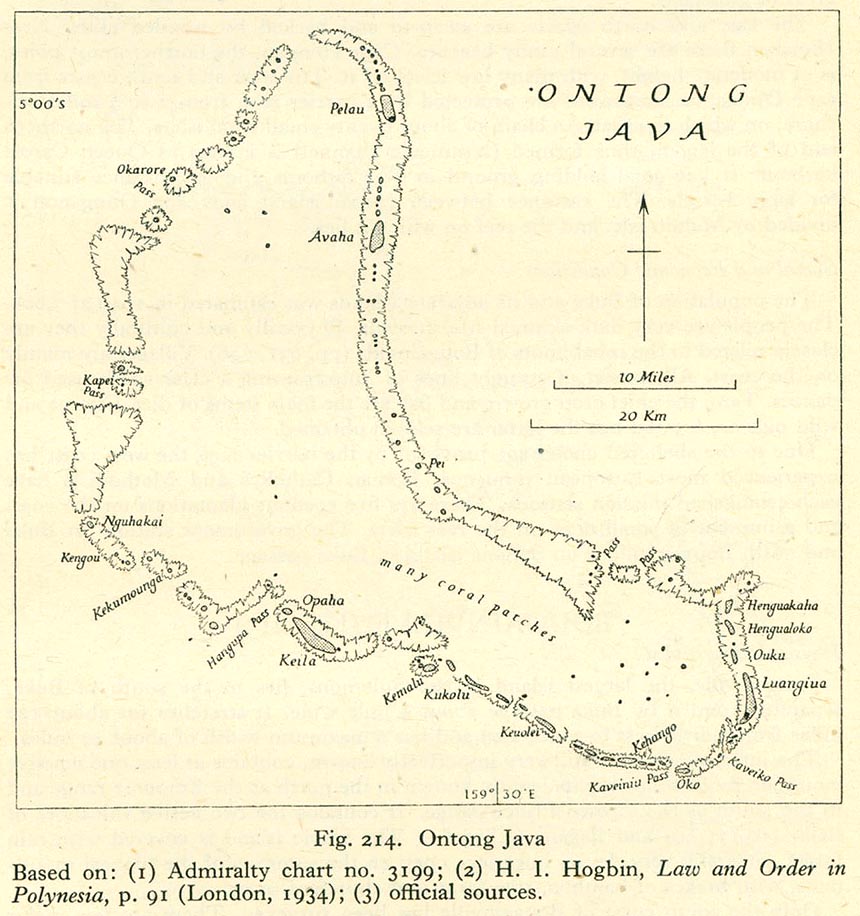
Group of islands in Solomon Islands
| Field | Value |
|---|---|
| name | Ontong Java |
| image_name | Ontong java.PNG |
| image_caption | NASA picture of Ontong Java Atoll |
| native_name | *Luangiua* |
| location | Pacific Ocean |
| coordinates | |
| archipelago | Group of three atolls |
| total_islands | 122 |
| major_islands | Luaniua and Pelau |
| area_km2 | 1500 |
| elevation_m | 13 |
| country | |
| country_admin_divisions_title | Province |
| country_admin_divisions | Malaita |
| country_largest_city | Luaniua |
| country_largest_city_population | 1386 |
| population | 2085 |
| population_as_of | 2006 |
| ethnic_groups | Polynesian 100% |
| pushpin_map | Solomon Islands#Pacific Ocean |
| pushpin_mark | Cercle rouge 100%.svg |
| pushpin_mark_width | 20 |
Ontong Java Atoll or Luangiua (formerly Lord Howe Atoll, not to be confused with Lord Howe Island) is an atoll in the Solomon Islands, and one of the largest atolls on earth.
It is inhabited by a Polynesian community of about people, who speak the Ontong Java language.
Description
Geographically, Ontong Java belongs to a scattered group of three atolls which includes nearby Nukumanu Atoll and the wholly submerged Roncador Reef located 75 km to the south.
Administratively Ontong Java belongs to Solomon Islands. As an outlying part of Malaita Province, it forms the northernmost tract of land of this state, over 250 km north of Santa Isabel Island. The closest land, however, is Nukumanu Atoll, which lies only 38 km due north of Ontong Java's northern tip and, though historically closely related to Ontong Java, is now under the administration of Papua New Guinea.
Ontong Java is roughly boot-shaped. The entire size of the atoll is 1400 km2, but there are only 12 km2 of land, spread out over 122 small islands. The islands are mostly low-lying coral formations, the highest elevation being 13 m.
Approximately 2000 people live on the atoll. There are two main villages where the population is concentrated with 1,386 on the island of Luaniua in the eastern end and 689 on Pelau in the northeast.
History
The islands were first inhabited by Polynesians approximately 2000 years ago. The main cultural and commercial exchanges took place with the inhabitants of neighboring Nukumanu Atoll, with whom Ontong Java people share many cultural affinities.
It is likely that the first European sighting was by the Spanish expedition of Álvaro de Mendaña on 1 February 1568. It was charted by them as Bajos de la Candelaria (shoals of Our Lady of Candlemas in Spanish). The following verifiable sighting by Europeans was by Abel Tasman in 1643 who named it Ontong Java; however, it was not until 1791 that Europeans set foot on the islands, when Capt. John Hunter (later Governor of New South Wales) named it Lord Howe Atoll. In 1893 the islands were annexed by Germany and ceded to Great Britain in 1899.
Today the atoll's inhabitants make a subsistence living by means of coconut and taro (root) cultivation, as well as fishing. Until a ban in 2005, the primary source of income was beche de mer and trochus shells, which were shipped to Hong Kong. The inhabitants are also involved in copra production. It also has a prolific number of sea birds, including the black-naped tern, which uses Ontong Java Atoll as a breeding site.
Anthropology and linguistics
Ontong Java is a Polynesian outlier. The inhabitants retain a Polynesian character despite their location in the Melanesian Archipelago of Solomon Islands. In former times both men and women wore elaborate tattoos all over their bodies. Two dialects of one language are spoken in this atoll, Luangiua and Pelau. This language belongs to the Polynesian stock.
Ontong Java was visited by English missionary George Brown in mid 19th century. Brown described the population as Polynesian and referred to the place as Lua Niua. He recorded the existence of a two-class system in Ontong Java and, based on it, inferred that it was probable that exogamous classes formerly existed in Samoa as well.
The first detailed research on Ontong Java's inhabitants, however, was conducted by German ethnographers Ernst Sarfert and Hans Damm, during a German scientific expedition of the Southern Seas that took place in 1908–1910. This expedition visited both Ontong Java and neighboring Nukumanu Atoll, where they also carried out their research. Their work, "Luangiua und Nukumanu" was published in 1931. Sarfert and Damm claimed that both names of the atoll, Lord Howe and Ontong Java, were incorrect and called this atoll Luangiua in their works.
Jack London first called this atoll "Oolong". Later he would write in one of his novels:
Ontong Java was later visited by Sydney University anthropologist Herbert Ian Hogbin in 1927. Hogbin's study of Ontong Java was published in 1934.
In late July 2025, Binghamton University Anthropology Professor Carl Lipo, University of Arizona archaeologist Terry, Hunt, and Christopher Filimoehala and Timothy Rieth from the International Archeological Research Institute, traveled Ontong Java to engage in a new exploratory dig on this remote atoll. These scientists aimed to hunt for physical evidence that might connect the concept of creating the massive moai statues found on Rapa Nui (Easter Island) to ancient stone monuments found on Ontong Java. These researchers were in luck as excavation found a site with deposits of charcoal and food waste that went down to the high tide line, suggesting humans may have been here not long after this remote volcanic island had emerged from the sea. They also found bones of the Pacific rat (Polynesian rat) which typically accompanied Polynesians wherever they traveled. In addition to their archeological digs, these scientists have chosen to involve the local population through sharing their findings with the local population.
In religious terms, Ontong Java is part of the Anglican Church of Melanesia Diocese of Malaita.
References
Bibliography
- Hogbin, H. Ian. "The Social Organization of Ontong Java." London 1931
- Hogbin, H. Ian. "Transition Rites at Ontong Java." Oceania 1: 399–425. 1930
- Sarfert, Ernst, and Hans Damm. "Luangiua und Nukumanu." Ergebnisse der Südsee Expedition, 1908–1910. Hamburg 1931
References
- (2010). "Managing Ontong Java: Social institutions for production and governance of atoll resources in Solomon Islands". Singapore Journal of Tropical Geography.
- Ernst Sarfert and Hans Damm. ''Luangiua und Nukumanu. Ergebnisse der Südsee Expedition, 1908-1910.'' [[Hamburg]] 1931
- [https://web.archive.org/web/20110527152213/http://www.fellow-traveler.org/pdf/Atolls%20and%20Offshore%20Islands%20NG%20+%20Solomons.pdf Remote Atolls and Offshore Islands of PNG and the Solomons]
- Sarfert, Ernst, and Hans Damm. "Luangiua und Nukumanu." Ergebnisse der Südsee Expedition, 1908-1910. Hamburg 1931. Vol I
- Sharp, Andrew ''The discovery of the Pacific Islands'' Oxford, 1960, pp.43,44.
- Brand, Donald D. ''The Pacific Basin: A History of its Geographical Explorations'' The American Geographical Society, New York, 1967, p.133.
- [http://www.larskrutak.com/articles/oceania/index.html Tattoo history of Western Oceania] {{webarchive. link. (2011-07-13)
- [http://www.ethnologue.com/language/ojv Ethnologue - Ontong Java Language]
- George Brown, ''Melanesians and Polynesians'', p. 414, {{ISBN. 978-1-152-66889-8
- ''Introduction to the History of Religions - Handbooks on the History of Religions,'' Volume IV, Crawford Howell Toy
- Gary Riedl & Thomas R. Tietze (editors), ''Jack London's Tales of Cannibals and Headhunters: Nine South Seas Stories by America's Master of Adventure'' {{ISBN. 978-0-8263-3791-7
- Jack London, ''Mauki''.
- Hogbin, H. Ian. "Transition Rites at Ontong Java." Oceania 1: 399-425. 1930
- Micale, Jennifer. “Hidden Homeland,” ''Binghamton University Magazine'', fall 2025, pp 10-13
This article was imported from Wikipedia and is available under the Creative Commons Attribution-ShareAlike 4.0 License. Content has been adapted to SurfDoc format. Original contributors can be found on the article history page.
Ask Mako anything about Ontong Java Atoll — get instant answers, deeper analysis, and related topics.
Research with MakoFree with your Surf account
Create a free account to save articles, ask Mako questions, and organize your research.
Sign up freeThis content may have been generated or modified by AI. CloudSurf Software LLC is not responsible for the accuracy, completeness, or reliability of AI-generated content. Always verify important information from primary sources.
Report