From Surf Wiki (app.surf) — the open knowledge base
Omega Centauri
Globular cluster in the constellation Centaurus
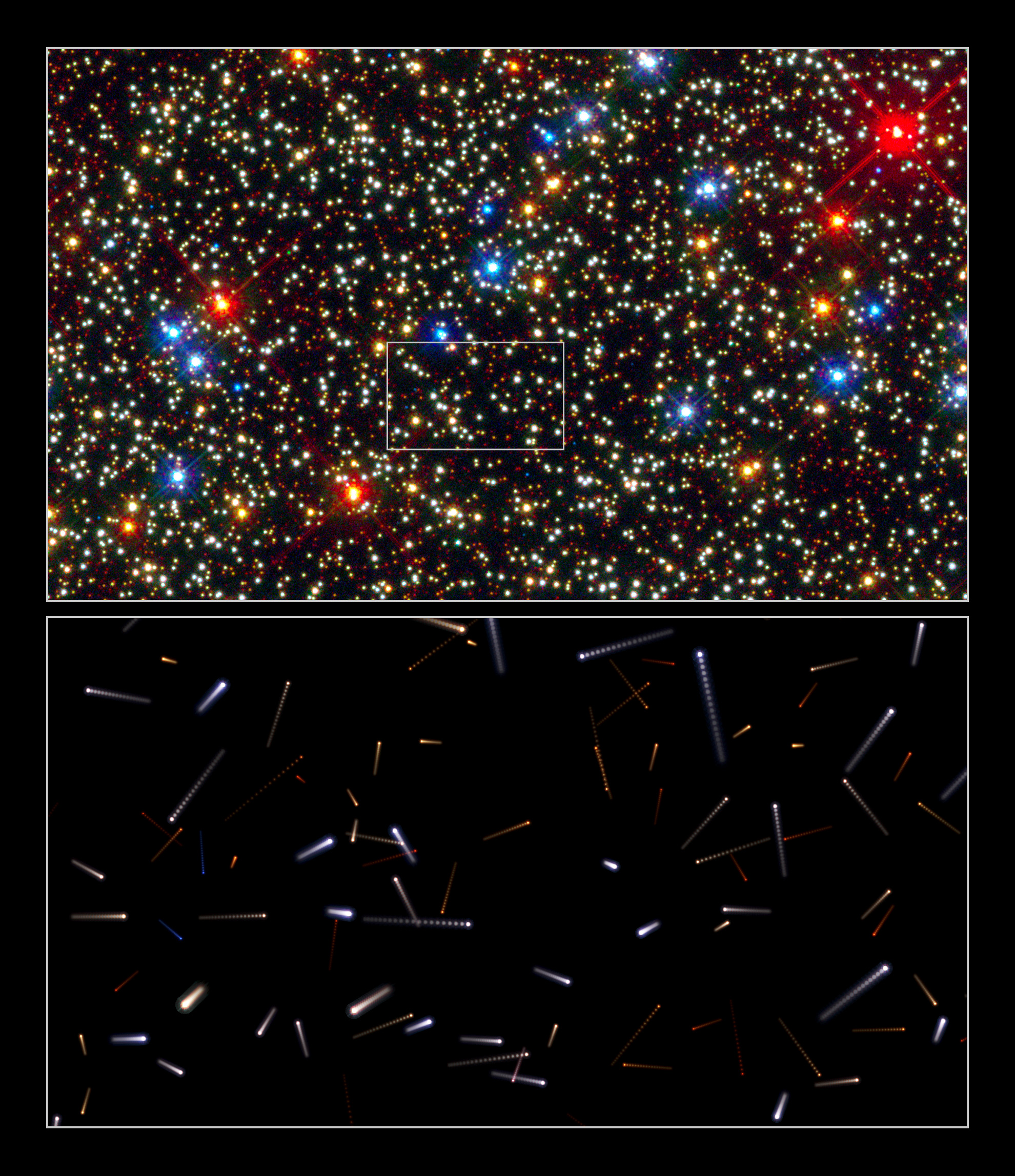
Globular cluster in the constellation Centaurus
| Field | Value | |
|---|---|---|
| name | Omega Centauri | |
| image | [[Image:Omega Centauri Stars.png | 300px]] |

| caption | The globular cluster Omega Centauri | |
| epoch | J2000 | |
| class | VIII | |
| ra | ||
| dec | ||
| dist_ly | 15.8 +/- | |
| appmag_v | 3.9 | |
| size_v | 36′.3 | |
| constellation | Centaurus | |
| mass_msol | ||
| radius_ly | 86 ± 6 ly | |
| metal_fe | –1.35 | |
| age | 11.52 Gyr | |
| names | NGC 5139, GCl 24, ω Centauri, Caldwell 80, Mel 118 |
ω Centauri
Omega Centauri (ω Cen, NGC 5139, or Caldwell 80) is a globular cluster in the constellation of Centaurus that was first identified as a non-stellar object by Edmond Halley in 1677. Located at a distance of 17090 ly, it is the largest known globular cluster in the Milky Way at a diameter of roughly 150 light-years. It is estimated to contain approximately 10 million stars, with a total mass of 4 million solar masses, making it the most massive known globular cluster in the Milky Way.
Omega Centauri is very different from most other galactic globular clusters to the extent that it is thought to have originated as the core remnant of a disrupted dwarf galaxy. There is evidence of an intermediate-mass black hole in the dense core of this cluster, although this is disputed.
Observation history
Around 150 AD, Greco-Roman writer and astronomer Ptolemy catalogued this object in his Almagest as a star on the centaur's back, "Quae est in principio scapulae". German cartographer Johann Bayer used Ptolemy's data to designate this object "Omega Centauri" with his 1603 publication of Uranometria. Using a telescope from the South Atlantic island of Saint Helena, English astronomer Edmond Halley observed this object in 1677, listing it as a non-stellar object. In 1716, it was published by Halley among his list of six "luminous spots or patches" in the Philosophical Transactions of the Royal Society.See:
- ; see p. 391.
- Reprinted at: SEDS: The Messier Catalog
Swiss astronomer Jean-Philippe de Cheseaux included Omega Centauri in his 1746 list of 21 nebulae,Cheseaux compiled a list of nebulae during 1745–1746. He sent the list to his grandfather, in the form of a letter. The letter was read before the French Academy of Sciences in 1746. However, it was first published only in 1892 as part of a large article by the French astronomer Guillaume Bigourdan.
- Cheseaux's letter (in French) appears on pp. G-8 – G-9.
- An English translation of Cheseaux's letter appears in: An English translation of Cheseaux's letter appears on pp. 105–106. Available at: SAO/NASA Astrophysics Data System
- See also: Philippe Loys de Chéseaux (May 4, 1718 – November 30, 1751) at SEDS: The Messier Catalog as did French astronomer Lacaille in 1755, whence the catalogue number is designated L I.5. It was first recognized as a globular cluster by Scottish astronomer James Dunlop in 1826, who described it as a "beautiful globe of stars very gradually and moderately compressed to the centre".
Properties
At a distance of about 17000 ly from Earth, Omega Centauri is one of the few globular clusters visible to the naked eye—and appears almost as large as the full Moon when seen from a dark, rural area. It is the brightest, largest and, at 4 million solar masses, the most massive-known globular cluster associated with the Milky Way. Of all the globular clusters in the Local Group of galaxies, only Mayall II in the Andromeda Galaxy is brighter and more massive. Orbiting through the Milky Way, Omega Centauri contains several million Population II stars and is about 12 billion years old.
The stars in the core of Omega Centauri are so crowded that they are estimated to average only 0.1 light-year away from each other. The internal dynamics have been analyzed using measurements of the radial velocities of 469 stars. The members of this cluster are orbiting the center of mass with a peak velocity dispersion of 7.9 km s−1. The mass distribution inferred from the kinematics is slightly more extended than, though not strongly inconsistent with, the luminosity distribution.
Members
These stars are the well studied members of the cluster. Some are abundant in metals and elements. (eg. Iron, Carbon, Oxygen)
| Star Name | Spectral | |
|---|---|---|
| type | Star Type | |
| Central Black Hole | BH(IMBH) | Intermediate Mass Black Hole |
| Variable Star 2 | Red Giant | |
| Variable Star 6 | Red Giant | |
| Variable Star 42 | Red Giant | |
| Variable Star 147 | Red Giant | |
| ROA 102 | Red Giant | |
| Omega Centauri 65 | Orange Giant | |
| Omega Centauri 74 | Orange Giant | |
| Omega Centauri 91 | Orange Giant | |
| Omega Centauri 101 | Orange Giant | |
| Star #124 | Orange Giant | |
| ROA 24 | Orange Giant | |
| ROA 46 | Orange Giant | |
| ROA 65 | Orange Giant | |
| ROA 74 | Orange Giant | |
| ROA 91 | Orange Giant | |
| ROA 101 | Orange Giant | |
| ROA 123 | Orange Giant | |
| ROA 139 | Orange Giant | |
| ROA 256 | Orange Giant | |
| ROA 270 | Orange Giant | |
| ROA 276 | Orange Giant | |
| ROA 577 | Orange Giant | |
| (An unnamed star) | Orange Giant | |
| Variable Star 1 | Yellow Giant | |
| Variable Star 15 | Yellow Giant | |
| ROA 279 | Yellow Giant |
Common stars in the cluster
These are the common or notable types of stars in the cluster. For the binary stars, the spectral class here is the primary stars’ spectral class.
| Star Name | Spectral |
|---|---|
| type | |
| Red Giants | |
| Red Giants | |
| Orange Giants | |
| Yellow Giants | |
| Blue Giants | |
| Main Sequence Stars | |
| Semi-Regular Variables | |
| Irregular Variables | |
| Carbon Stars | |
| Zirconium(S type) Stars | |
| CH Stars | |
| Red Stragglers | |
| Symbiotic binaries | |
| Population II Cepheids | |
| Eclisping Binaries | |
| Subgiants | |
| RR Lyrae Variables | |
| Blue Stragglers | |
| SX Phoenicis Variables | |
| BY Draconis Variables | |
| Cataclysmic Variables | |
| Red dwarfs | |
| Blue Subdwarfs | |
| Stellar remnants | D/WD/VII |
Evidence of a central black hole
A 2008 study presented evidence for an intermediate-mass black hole at the center of Omega Centauri, based on observations made by the Hubble Space Telescope and Gemini Observatory on Cerro Pachón in Chile. Hubble's Advanced Camera for Surveys showed that stars are bunching up near the center of Omega Centauri, as evidenced by the gradual increase in starlight near the center. Using instruments at the Gemini Observatory to measure the speed of stars swirling in the cluster's core, E. Noyola and colleagues found that stars closer to the core are moving faster than stars farther away. This measurement was interpreted to mean that unseen matter at the core is interacting gravitationally with nearby stars. By comparing these results with standard models, the astronomers concluded that the most likely cause was the gravitational pull of a dense, massive object such as a black hole. They calculated the object's mass at 40,000 solar masses.
More recent work has challenged conclusions that there is a black hole in the cluster's core, in particular disputing the proposed location of the cluster center. Calculations using a revised location for the center found that the velocity of core stars does not vary with distance, as would be expected if an intermediate-mass black hole were present. The same studies also found that starlight does not increase toward the center but instead remains relatively constant. The authors noted that their results do not entirely rule out the black hole proposed by Noyola and colleagues, but they do not confirm it, and they limit its maximum mass to 12,000 solar masses.
A study from July 10, 2024 has examined seven fast-moving stars from the center of Omega Centauri and found that their speeds were consistent with an intermediate-mass black hole of at least 8,200 solar masses.
Disrupted dwarf galaxy
It has been speculated that Omega Centauri is the core of a dwarf galaxy that was disrupted and absorbed by the Milky Way. Indeed, Kapteyn's Star, which is currently only 13 light-years away from Earth, is thought to originate from Omega Centauri. Omega Centauri's chemistry and motion in the Milky Way are also consistent with this picture. Like Mayall II, Omega Centauri has a range of metallicities and stellar ages that suggests that it did not all form at once (as globular clusters are thought to form) and may in fact be the remainder of the core of a smaller galaxy long since incorporated into the Milky Way.
In fiction
The novel Singularity (2012), by Ian Douglas, presents as fact that Omega Centauri and Kapteyn's Star originate from a disrupted dwarf galaxy, and this origin is central to the novel's plot. A number of scientific aspects of Omega Centauri are discussed as the story progresses, including the likely radiation environment inside the cluster and what the sky might look like from inside the cluster.
The character Atlan has adventures in Omega Centauri in cycle 7 of the Atlan series, a spinoff of the German science fiction series Perry Rhodan.
References
References
- distance × sin(diameter_angle / 2), using distance of 5 kpc and angle 36.3′, = 86 ± 6 ly radius
- "Omega Centauri: The Largest Globular Cluster".
- "APOD: 2010 March 31 - Millions of Stars in Omega Centauri".
- (1603). "Uranometria". Christoph Mang.
- (1755). "Sur les étoiles nébuleuses du ciel austral". Histoire de l'Académie Royale des Sciences, avec les Mémoires de Mathématique & de Physique.
- Johnson, Christian I.. (October 2010). "Chemical Abundances for 855 Giants in the Globular Cluster Omega Centauri (NGC 5139)". The Astrophysical Journal.
- Jofré, P.. (July 2025). "Studying stellar populations in Omega Centauri with phylogenetics". Astronomy and Astrophysics.
- (10 July 2024). "Fast-moving stars around an intermediate-mass black hole in Omega Centauri". Nature.
- "Centauri (Zyklus) – Perrypedia".
- (2008-04-02). "Black hole found in Omega Centauri". ESA.
- (2008). "Gemini and Hubble Space Telescope Evidence for an Intermediate Mass Black Hole in omega Centauri". The Astrophysical Journal.
- (2008-04-02). "Astronomers Find Suspected Medium-Size Black Hole in Omega Centauri".
- (December 2010). "The ACS Survey of Galactic Globular Clusters. X. New Determinations of Centers for 65 Clusters". The Astronomical Journal.
- (August 1927). "A Classification of Globular Clusters". Harvard College Observatory Bulletin.
- (May 2010). "Accreted versus in situ Milky Way globular clusters". Monthly Notices of the Royal Astronomical Society.
- "NGC 5139".
- (2 January 2006). "The dynamical distance and intrinsic structure of the globular cluster ω Centauri". Astronomy and Astrophysics.
- Douglas, Ian. (2012). "Singularity". Harper Voyager.
This article was imported from Wikipedia and is available under the Creative Commons Attribution-ShareAlike 4.0 License. Content has been adapted to SurfDoc format. Original contributors can be found on the article history page.
Ask Mako anything about Omega Centauri — get instant answers, deeper analysis, and related topics.
Research with MakoFree with your Surf account
Create a free account to save articles, ask Mako questions, and organize your research.
Sign up freeThis content may have been generated or modified by AI. CloudSurf Software LLC is not responsible for the accuracy, completeness, or reliability of AI-generated content. Always verify important information from primary sources.
Report