From Surf Wiki (app.surf) — the open knowledge base
NZR T class
| Field | Value |
|---|---|
| name | NZR T class |
| powertype | Steam |
| image | File:"T" class steam locomotive no. 106 (2-8-0 type). ATLIB 292527.png |
| caption | No. 106, T class in 1926 |
| builder | Baldwin Locomotive Works, United States |
| serialnumber | 4660–4661, 4664-4667 |
| builddate | 1879 |
| totalproduction | 6 |
| whytetype | [2-8-0](2-8-0) |
| uicclass | 1′D |
| gauge | [](3-ft-6-in-gauge-railways) |
| driverdiameter | 36 in |
| length | 44 ft |
| weightondrivers | 23.0 LT |
| 24.7 LT (reboilered) | |
| locoweight | 26.2 LT |
| tenderweight | 16.0 LT |
| fueltype | Coal |
| fuelcap | 2.1 LT |
| watercap | 1300 impgal |
| boilerpressure | 130 psi |
| 160 psi (reboilered) | |
| firearea | 15.7 sqft |
| totalsurface | 812 sqft |
| 920 sqft (reboilered) | |
| superheatertype | None |
| cylindercount | Two, outside |
| cylindersize | 15 x |
| maxspeed | 18 mph |
| tractiveeffort | 11700 lbf |
| 14300 lbf (reboilered) | |
| operator | New Zealand Railways |
| fleetnumbers | 101–106 |
| locale | All of New Zealand |
| firstrundate | 1880 |
| lastrundate | 1922-1928 |
| disposition | All scrapped |
24.7 LT (reboilered) 160 psi (reboilered) 920 sqft (reboilered) 14300 lbf (reboilered)
The NZR T class was a class of steam locomotive used in New Zealand; of the "Consolidation" type, popular in North America, especially with the narrow gauge Denver and Rio Grande Western Railroad.
History
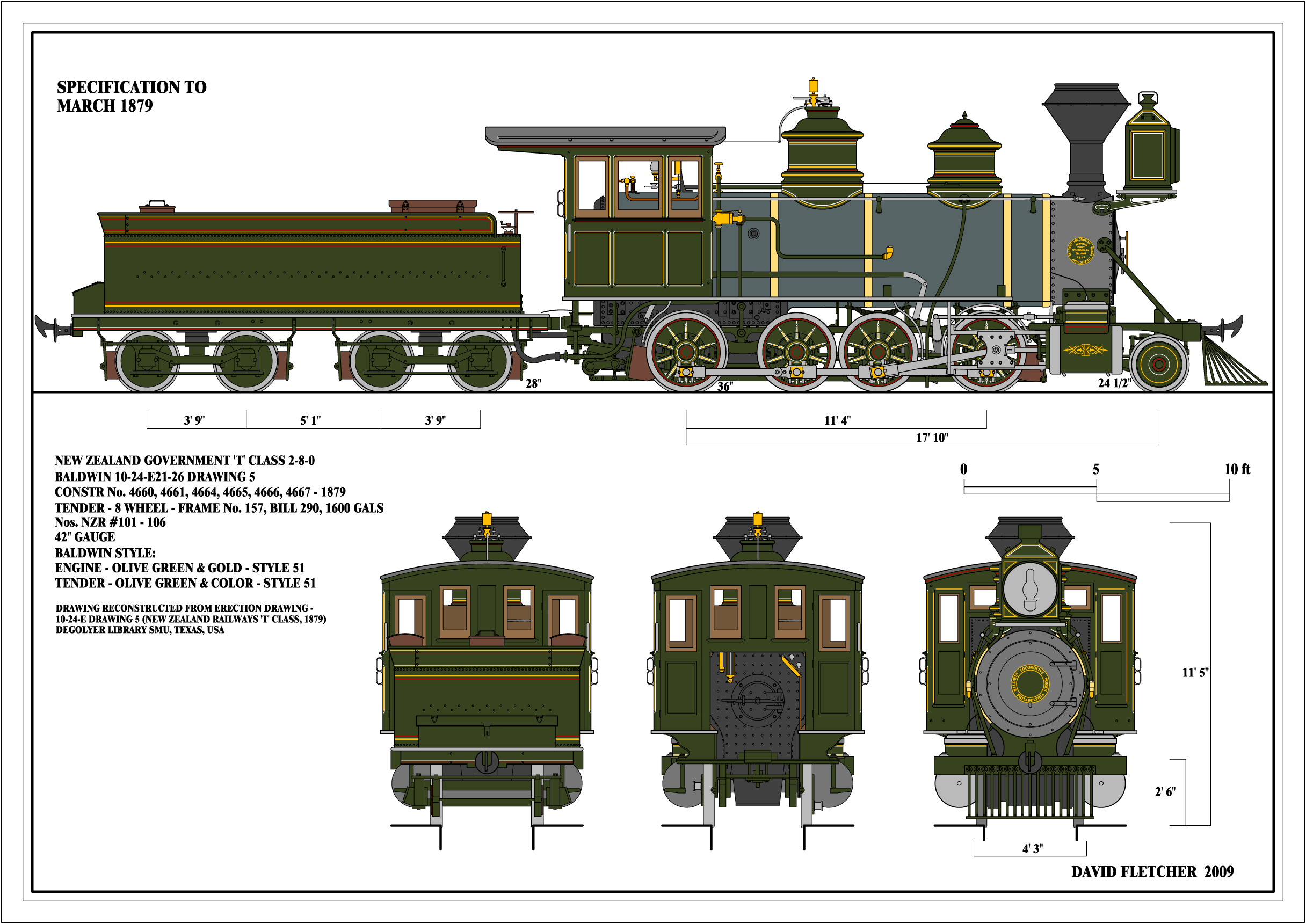
The Baldwin and Rogers locomotives reflected the styling adopted in the 1870s by American builders with elements from the Renaissance Revival and Neo-Baroque architectural styles, and with Islamic e.g. Moorish (from Alhambra) influences. Bold colours and painted decorations were used. Many Baldwin locomotives such as the T class were in Olive Green ground colour as originally built, although the Baldwin N and O classes of the 1880s had Tuscan Red ground colour.
In service
Because of its small diameter driving wheels, the T class was typically limited to a speed of 29 km/h.
Withdrawal and disposal
The first T class locomotive was withdrawn in 1922, with the last few withdrawn in 1927. Some managed to survive long enough to be dumped or have components dumped when the NZR started dumping locomotives for embankment protection in 1926. The last member T 102 was withdrawn in March 1928
References
Citations
Bibliography
References
- "Specification to March 1879".
- ''New Zealand's Early American Locomotives: The Design, Art and Architecture of the K, T and O Class Locomotives Part 2'' by David Fletcher: "New Zealand Railfan", March 2015 pages 33-49: Volume 21 No 2
This article was imported from Wikipedia and is available under the Creative Commons Attribution-ShareAlike 4.0 License. Content has been adapted to SurfDoc format. Original contributors can be found on the article history page.
Ask Mako anything about NZR T class — get instant answers, deeper analysis, and related topics.
Research with MakoFree with your Surf account
Create a free account to save articles, ask Mako questions, and organize your research.
Sign up freeThis content may have been generated or modified by AI. CloudSurf Software LLC is not responsible for the accuracy, completeness, or reliability of AI-generated content. Always verify important information from primary sources.
Report