From Surf Wiki (app.surf) — the open knowledge base
Nuclear bodies
Structures found in the cell nuclei

Structures found in the cell nuclei
Nuclear bodies (also known as nuclear domains or nuclear dots) are biomolecular condensates, membraneless structures found in the cell nuclei of eukaryotic cells. Nuclear bodies include Cajal bodies, the nucleolus, nuclear speckles (also called splicing speckles), histone locus bodies, and promyelocytic leukemia protein (PML) nuclear bodies (also called PML oncogenic dots). Nuclear bodies also include ND10s. ND stands for nuclear domain, and 10 refers to the number of dots seen. Additionally, a nuclear body subtype is a clastosome suggested to be a site of protein degradation.
While biomolecular condensate is a term often used interchangeably with nuclear bodies, the term "condensates" implies the thermodynamic properties of the body are known. Thus, nuclear body (and sometimes nuclear compartment) is a term that is more general and encompasses structures where either the biophysical property is not a condensate or is currently untested.
Nuclear bodies were first seen as prominent interchromatin structures in the nuclei of malignant or hyperstimulated animal cells identified using anti-sp100 autoantibodies from primary biliary cirrhosis and subsequently the promyelocytic leukemia (PML) factor, but appear also to be elevated in many autoimmune and cancerous diseases. Nuclear dots are metabolically stable and resistant to nuclease digestion and salt extraction.
Structure
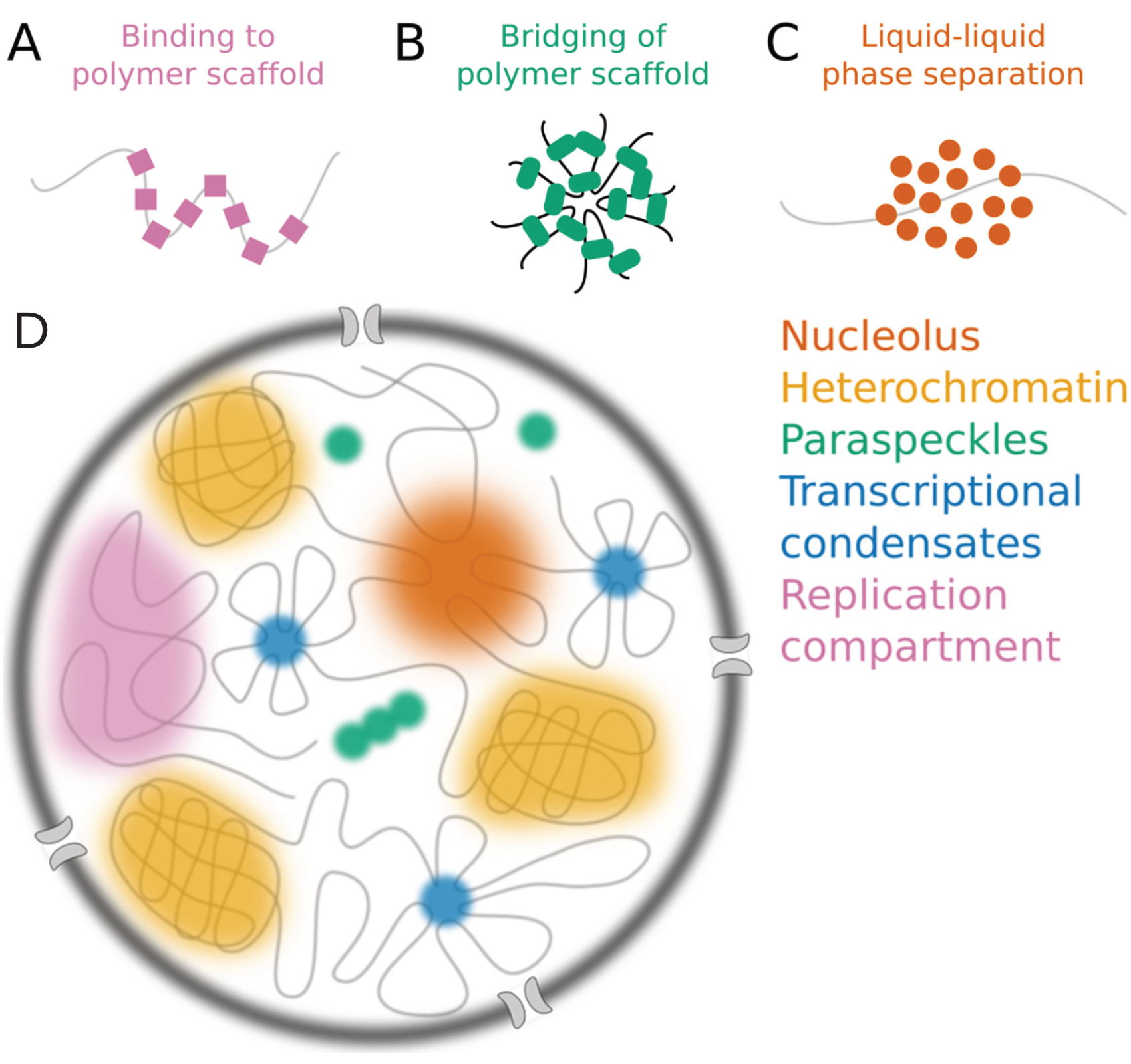
Simple nuclear bodies (types I and II) and the shells of complex nuclear bodies (types III, IVa and V) consist of a non-chromatinic fibrillar material which is most likely proteinaceous. That nuclear bodies co-isolated with the nuclear matrix, and were linked to the fibrogranular nuclear matrix component by projections from the surface of the nuclear bodies. The primary components of the nuclear dots are the proteins sp100 nuclear antigen, LYSP100(a homolog of sp100), ISG20, PML antigen, NDP55 and 53kDa protein associated with the nuclear matrix. Other proteins, such as PIC1/SUMO-1, which are associated with nuclear pore complex also associate with nuclear dots. The proteins can reorganize in the nucleus, by increasing number of dispersion in response to different stress (stimulation or heat shock, respectively).
Function
One of the nuclear body proteins appears to be involved in transcriptional active regions. Expression of PML antigen and sp100 is responsive to interferons. Sp100 seems to have transcriptional transactivating properties. PML protein was reported to suppress growth and transformation, and specifically inhibits the infection of vesicular stomatitis virus (VSV) (a rhabdovirus) and influenza A virus, but not other types of viruses. The SUMO-1 ubiquitin like protein is responsible for modifying PML protein such that it is targeted to dots. whereas overexpression of PML results in programmed cell death.
One hypothesized function of the dots is as a 'nuclear dump' or 'storage depot'. The nuclear bodies may not all perform the same function. Sp140 associates with certain bodies and appears to be involved in transcriptional activation.
ND10 nuclear bodies have been shown to play a major role in chromatin regulation.
Nuclear bodies have been suggested to be involved in multiple aspects of gene regulation. By concentrating substrates and enzymes in these defined territories (i.e., pre-ribosomal RNA and associated ribosome biogenesis protein within the nucleolus), it is hypothesized that this may help increase the efficiency of the enzymatic reactions associated with the particular nuclear body. For example, nuclear speckles, once thought to be storage depots of splicing factors, have been now shown to concentrate splicing-promoting factors (e.g., components of the major and minor spliceosome) and pre-mRNA substrate molecules to boost the kinetic efficiency of the splicing reaction. Thus future studies will show whether other nuclear bodies play functional roles in various aspects of gene regulation, such as transcription, RNA modifications, ribosome biogenesis, and other nuclear processes.
Pathology

These, or similar, bodies have been found increased in the presence of lymphoid cancers and SLE (lupus). They are also observed at higher frequencies in subacute sclerosing panencephalitis; in this instance, antibodies to measles show expression in and localization to the nuclear bodies.
- In promyelocytic leukemia (PML), the oncogenic PML-retinoic acid receptor alpha (RARalpha) chimera disrupts the normal concentration of PML in nuclear bodies. Administration of arsenic trioxide (As2O3) plus all-trans retinoic acid (Tretinoin) causes remission of this leukemia by triggering the bodies' reorganization. As2O3 destroys the chimera, allowing new SUMO-1 ubiquitinated PML to relocalize to nuclear bodies. Retinoic acid induces a caspase-3 mediated degradation of the same chimera.
- In HHV, ICP0 disrupts nuclear dots in the early stage of infection.
References
References
- (June 2017). "Sequence-encoded material properties dictate the structure and function of nuclear bodies". Current Opinion in Cell Biology.
- (October 2004). "Nuclear bodies and compartments: functional roles and cellular signalling in health and disease". Cellular Signalling.
- (August 2013). "Nuclear domain 10 of the viral aspect". World Journal of Virology.
- (August 2002). "Clastosome: a subtype of nuclear body enriched in 19S and 20S proteasomes, ubiquitin, and protein substrates of proteasome". Molecular Biology of the Cell.
- (May 2017). "Biomolecular condensates: organizers of cellular biochemistry". Nature Reviews. Molecular Cell Biology.
- (August 2021). "Nuclear compartmentalization as a mechanism for quantitative control of gene expression". Nature Reviews. Molecular Cell Biology.
- (October 1992). "Nuclear bodies (NBs): a newly "rediscovered" organelle". Experimental Cell Research.
- (December 1997). "Nuclear dots: actors on many stages". Immunobiology.
- (July 1992). "Multiple nuclear dots antinuclear antibodies are not specific for primary biliary cirrhosis". Hepatology.
- (March 1991). "Identification of a novel nuclear domain". The Journal of Cell Biology.
- (1983). "Nuclear bodies in mouse splenic lymphocytes: II - Cytochemistry and autoradiography during stimulation by concanavalin A". Biology of the Cell.
- (August 1996). "LYSP100-associated nuclear domains (LANDs): description of a new class of subnuclear structures and their relationship to PML nuclear bodies". Blood.
- (August 1997). "Molecular cloning of a new interferon-induced PML nuclear body-associated protein". The Journal of Biological Chemistry.
- (1995). "A human autoantibody recognizing nuclear matrix-associated nuclear protein localized in dot structures". Biology of the Cell.
- (December 1997). "Evidence for covalent modification of the nuclear dot-associated proteins PML and Sp100 by PIC1/SUMO-1". The Journal of Cell Biology.
- (December 1995). "Nuclear domain 10 (ND10) associated proteins are also present in nuclear bodies and redistribute to hundreds of nuclear sites after stress". Journal of Cellular Biochemistry.
- (October 1993). "Nuclear dot antigens may specify transcriptional domains in the nucleus". Molecular and Cellular Biology.
- (February 1998). "Resistance to virus infection conferred by the interferon-induced promyelocytic leukemia protein". Journal of Virology.
- (January 1998). "Conjugation with the ubiquitin-related modifier SUMO-1 regulates the partitioning of PML within the nucleus". The EMBO Journal.
- (November 1998). "PML induces a novel caspase-independent death process". Nature Genetics.
- (August 1998). "Nuclear domain 10, the site of DNA virus transcription and replication". BioEssays.
- (June 1999). "Structural and functional heterogeneity of nuclear bodies". Molecular and Cellular Biology.
- (April 2016). "Role of ND10 nuclear bodies in the chromatin repression of HSV-1". Virology Journal.
- (May 2024). "Genome organization around nuclear speckles drives mRNA splicing efficiency.". Nature.
- (1974). "Nuclear bodies in Hodgkin's disease". Pathologia Europaea.
- (1975). "Malignant Lymphomas of the Nervous System". Acta Neuropathologica. Supplementum.
- (March 1975). "Systemic lupus erythematosus". Archives of Pathology.
- (November 1976). "Immunoperoxidase staining of simple nuclear bodies in sclerosing panencephalitis (SSPE) by antiserum to Measles nucleocapsids". Acta Neuropathologica.
- (October 1998). "Caspases mediate retinoic acid-induced degradation of the acute promyelocytic leukemia PML/RARalpha fusion protein". Blood.
- (May 2019). "Early Steps in Herpes Simplex Virus Infection Blocked by a Proteasome Inhibitor". mBio.
This article was imported from Wikipedia and is available under the Creative Commons Attribution-ShareAlike 4.0 License. Content has been adapted to SurfDoc format. Original contributors can be found on the article history page.
Ask Mako anything about Nuclear bodies — get instant answers, deeper analysis, and related topics.
Research with MakoFree with your Surf account
Create a free account to save articles, ask Mako questions, and organize your research.
Sign up freeThis content may have been generated or modified by AI. CloudSurf Software LLC is not responsible for the accuracy, completeness, or reliability of AI-generated content. Always verify important information from primary sources.
Report