From Surf Wiki (app.surf) — the open knowledge base
Northern and southern China
Two approximate mega-regions within China

Two approximate mega-regions within China
Northern China () and southern China () are two approximate regions that display certain differences in terms of their geography, demographics, economy, and culture.
Extent
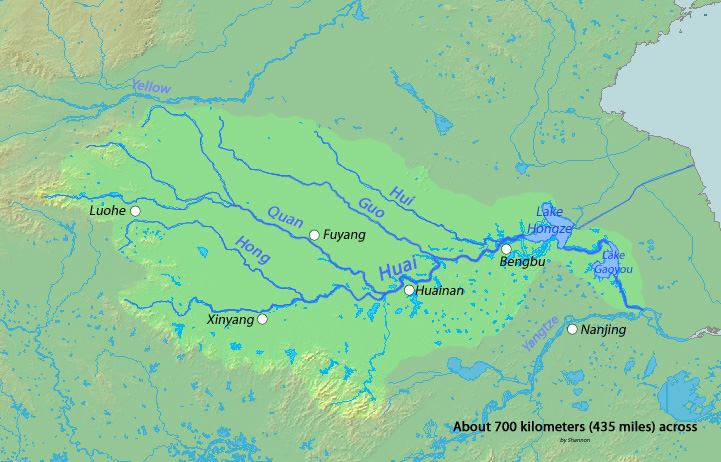
The Qinling–Daba Mountains serve as the transition zone between northern and southern China. They approximately coincide with the 0 degree Celsius isotherm in January, the 800 mm isohyet, and the 2,000-hour isohel. The Huai River basin serves a similar role, and the course of the Huaihe has been used to set different policies to the north and the south.
History
Historically, populations migrated from the north to the south, especially its coastal areas and along major rivers.
After the fall of the Han dynasty, The Southern and Northern Dynasties (420–589) ruled their respective part of China before re-uniting under the Sui dynasty.
During the Qing dynasty, regional differences and identification in China fostered the growth of regional stereotypes. Such stereotypes often appeared in historic chronicles and gazetteers and were based on geographic circumstances, historical and literary associations (e.g. people from Shandong, were considered upright and honest) and Chinese cosmology (as the south was associated with the fire element, Southerners were considered hot-tempered). These differences were reflected in Qing dynasty policies, such as the prohibition on local officials to serve their home areas, as well as conduct of personal and commercial relations. In 1730, the Kangxi Emperor made the observation in the Tingxun Geyan (庭訓格言):
During the Republican period, Lu Xun, a major Chinese writer, wrote:
Today
Climate
Northern regions of China have long winters that are cold and dry, often below freezing, and long summers that are hot and humid. Transitional periods are short. The ecology is simple and not resilient to droughts.
Many southern regions are subtropical and green year round. The winters are short. They often experience typhoons and the East Asian monsoon in the summer. The ecology is complex, and floods are more common.
Diet and produce
The northern regions are easier to cultivate. Hardy crops such as corn, sorghum, soybeans, and wheat are grown, and one to two crops are produced each year. The growing season lasts four to six months. Wheat-based food such as bread, dumplings, and noodles are more common.
Cultivation of the southern regions began later in history. Warm temperatures and abundant rainfall help produce rice and tropical fruits. Two to three crops can be grown each year, and the growing season lasts nine to twelve months. Rice-based food is more common.
Language and people
Jones Lamprey, a British army surgeon in 1868, writes that northerners have lighter skin tones than southerners, although the shade can change greatly from season to season depending on an individual's exposure to sunlight when performing manual labor outdoors. Northerners are often taller than southerners.
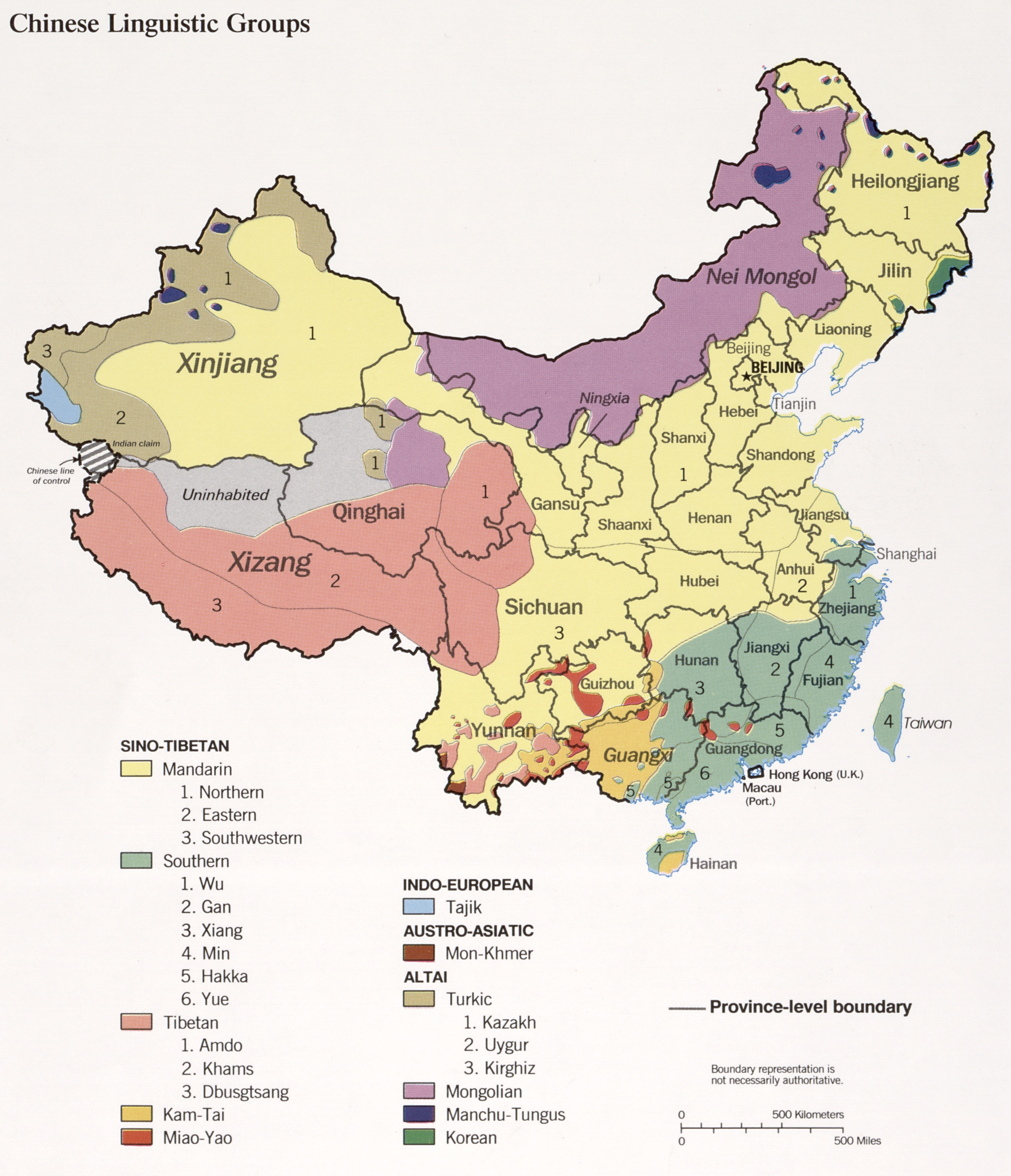
Variants of Mandarin are widely spoken in northern regions and often with a rhotic accent. Ethnic groups are comparatively more diverse in southern regions. Rhotic accent is usually absent from the Mandarin spoken there. Different dialects are less mutually intelligible, and additional languages such as Cantonese or Hokkien are spoken. Patrilineage organizations are larger and more integrated in rural southern regions, possibly due to merges and competition for territory.
A series of studies on regional differences in China suggest that people from places that grow wheat have different social styles and thought styles from those in rice-growing regions. Respondents from northern China are found to be more individualistic, think more analytically, and more open to strangers. Those from the southern regions are more likely to think holistically, interdependent, and draw a larger distinction between friends and strangers. The difference was attributed to the growing of rice, which often requires the sharing labor and managing shared irrigation infrastructure.
Transportation
Traveling between places tends to be easier in northern regions where the terrain is more even.
Economy
As China modernized, the north initially developed faster during the era of planned economic policies and Soviet aid, forming a concentration of construction and resource extraction industries. After the reform and opening up, however, the south took the lead due to manufacturing and eventually high-tech industries, as well as continued internal migration into the region. The north's share of China's GDP decreased from 42.9% in 2012 to 35.4% in 2019.
Health
A research showed that life expectancy was slightly higher in southern China compared to northern China. In 2018, it was 76.66 years for north and 77.35 for south. The shorter life expectancy in northern China can be partly attributed to outdoor air pollution due to winter district heating. According to the data from a survey in 2011, people in southern China were 10.51% less likely to be obese and overweight compared to the North.
Notes
References
Citations
References
- (2022-04-28). "Spatiotemporal variation of climate of different flanks and elevations of the Qinling–Daba mountains in China during 1969–2018". Scientific Reports.
- (2021-05-01). "Characteristics of the precipitation concentration and their relationship with the precipitation structure: A case study in the Huai River basin, China". Atmospheric Research.
- (August 2014). "Bioindicator Assessment Framework of River Ecosystem Health and the Detection of Factors Influencing the Health of the Huai River Basin, China". Journal of Hydrologic Engineering.
- "China's Huai River Policy and Population Migration: A U-Shaped Relationship". Nova Science Publishers.
- "Weekend Long Read: Why China's North-South Economic Gap Keeps Getting Bigger - Caixin Global".
- Xuefeng, He. (2022-03-07). "Northern and Southern China: Regional Differences in Rural Areas". Routledge.
- Lewis, Mark Edward. (2011-04-30). "China Between Empires: The Northern and Southern Dynasties". Harvard University Press.
- Smith, Richard Joseph. (1994). "China's cultural heritage: the Qing dynasty, 1644–1912". Westview Press.
- Hanson, Marta E.. (July 2007). "Jesuits and Medicine in the Kangxi Court (1662–1722)". Center for the Pacific Rim, University of San Francisco.
- Young, Lung-Chang. (Summer 1988). "Regional Stereotypes in China". Chinese Studies in History.
- "Regions of Chinese food-styles/flavors of cooking".
- Zhu, Hua. (2017-03-01). "The Tropical Forests of Southern China and Conservation of Biodiversity". The Botanical Review.
- Eberhard, Wolfram. (December 1965). "Chinese Regional Stereotypes". University of California Press.
- Source: United States Central Intelligence Agency, 1990.
- "Jones Lamprey {{!}} Historical Photographs of China".
- Lamprey, J.. (1868). "A Contribution to the Ethnology of the Chinese". Transactions of the Ethnological Society of London.
- (2022). "Geographic latitude and human height - Statistical analysis and case studies from China". Arabian Journal of Geosciences.
- (2024-02-27). "People quasi-randomly assigned to farm rice are more collectivistic than people assigned to farm wheat". Nature Communications.
- (2014-05-09). "Large-Scale Psychological Differences Within China Explained by Rice Versus Wheat Agriculture". Science.
- (2018-04-06). "Moving chairs in Starbucks: Observational studies find rice-wheat cultural differences in daily life in China". Science Advances.
- (2018). "Socio-Economic Environment and Human Psychology: Social, Ecological, and Cultural Perspectives". Oxford University Press.
- Bray, Francesca. (1994). "The Rice Economies: Technology and Development in Asian Societies". University of California Press.
- (September 18, 2020). "Why Residents in Southern China Live Longer Than Those in Northern China?".
- (2013). "Evidence on the impact of sustained exposure to air pollution on life expectancy from China's Huai River policy". Proceedings of the National Academy of Sciences.
- (2020). "Differences in Overweight and Obesity between the North and South of China".
This article was imported from Wikipedia and is available under the Creative Commons Attribution-ShareAlike 4.0 License. Content has been adapted to SurfDoc format. Original contributors can be found on the article history page.
Ask Mako anything about Northern and southern China — get instant answers, deeper analysis, and related topics.
Research with MakoFree with your Surf account
Create a free account to save articles, ask Mako questions, and organize your research.
Sign up freeThis content may have been generated or modified by AI. CloudSurf Software LLC is not responsible for the accuracy, completeness, or reliability of AI-generated content. Always verify important information from primary sources.
Report