From Surf Wiki (app.surf) — the open knowledge base
North Vietnam
Country in Southeast Asia (1945–1976)

Country in Southeast Asia (1945–1976)
| Field | Value | |||||
|---|---|---|---|---|---|---|
| conventional_long_name | Democratic Republic of Vietnam | |||||
| native_name | vi | |||||
| common_name | North Vietnam | |||||
| status | Unrecognized state (1945–1950) | |||||
| Limitedly recognized state (1950–1954) | ||||||
| Sovereign state (1954–1976) | ||||||
| p1 | Empire of Vietnam**1945:** | |||||
| Empire of Vietnam | ||||||
| flag_p1 | Flag of the Empire of Vietnam (1945).svg | |||||
| p3 | French Indochina**1954:** | |||||
| French Indochina | ||||||
| flag_p3 | Flag of France.svg | |||||
| s1 | French Indochina**1947:** | |||||
| French Indochina | ||||||
| flag_s1 | Flag of France.svg | |||||
| s2 | Vietnam**1976:** | |||||
| Vietnam | ||||||
| flag_s2 | Flag of Vietnam.svg | |||||
| image_flag | Flag of North Vietnam (1945–1955).svg | |||||
| image_flag2 | Flag of North Vietnam (1955–1976).svg | |||||
| flag_type | **Top:** | |||||
| Flag (1945–1955) | ||||||
| **Bottom:** | ||||||
| Flag (1955–1976) | ||||||
| image_coat | Emblem of North Vietnam.svg | |||||
| symbol | Emblem of Vietnam | |||||
| symbol_type | Emblem | |||||
| (1955–1976) | ||||||
| other_symbol | **Presidential seal** | |||||
| [[File:Hồ Chí Minh ấn (胡志明印).svg | 90px]] | |||||
| (-1969) | ||||||
| image_map | {{Switcher | [[File:North Vietnam Cold War (orthographic projection).svg | upright=1.15 | frameless]] | The administrative territory of North Vietnam after the [1954 Geneva Accord](1954-geneva-conference) (dark green); territory claimed before 1955 but not controlled (light green) | |
| [[File:Viet Minh-controlled French Indochina.png | upright | 1.15 | frameless]] | Viet Minh-DRV and its occupied territories in the final stage of First Indochina War | ||
| [[File:DRV territories (1959-1974).png | upright | 1.15 | frameless]] | North Vietnam and its occupied territories in the final stage of Vietnam War | default=1}} | |
| national_motto | "Độc lập – Tự do – Hạnh phúc" | |||||
| "Independence – Freedom – Happiness" | ||||||
| national_anthem | "Tiến quân ca" | |||||
| "The Song of the Marching Troops"[[File:Quoc ca Viet Nam.ogg]] | ||||||
| capital | Hanoi | |||||
| largest_city | capital | |||||
| coordinates | ||||||
| official_languages | Vietnamese | |||||
| languages_type | Official script | |||||
| languages | Vietnamese alphabet | |||||
| religion | State atheism | |||||
| demonym | ||||||
| government_type | Communist state | |||||
| title_leader | Leader of the Worker's Party | |||||
| leader1 | Trường Chinh | |||||
| year_leader1 | 1945–1956 | |||||
| leader2 | Hồ Chí Minh | |||||
| year_leader2 | 1956–1960 | |||||
| leader3 | Lê Duẩn | |||||
| year_leader3 | 1960–1975 | |||||
| title_representative | President | |||||
| representative1 | Hồ Chí Minh | |||||
| representative2 | Tôn Đức Thắng | |||||
| year_representative1 | 1945–1969 | |||||
| year_representative2 | 1969–1975 | |||||
| title_deputy | Prime Minister | |||||
| deputy1 | Hồ Chí Minh | |||||
| deputy2 | Phạm Văn Đồng | |||||
| year_deputy1 | 1945–1955 | |||||
| year_deputy2 | 1955–1975 | |||||
| legislature | National Assembly | |||||
| era | Aftermath of World War II/Cold War | |||||
| event_pre | August Revolution | |||||
| date_pre | 19 August 1945 | |||||
| event_start | Abdication of Bảo Đại | |||||
| date_start | 25 August 1945 | |||||
| event1 | State declared | |||||
| date_event1 | 2 September 1945 | |||||
| event2 | Chinese occupation | |||||
| date_event2 | September 1945–15 June 1946 | |||||
| event3 | [Legislative election](1946-north-vietnamese-legislative-election) | |||||
| date_event3 | 6 January 1946 | |||||
| event4 | Ho–Sainteny Agreement | |||||
| date_event4 | 6 March 1946 | |||||
| event5 | Start of the Indochina War | |||||
| date_event5 | 19 December 1946 | |||||
| event6 | [Geneva Accords](1954-geneva-conference) | |||||
| date_event6 | 21 July 1954 | |||||
| event7 | Start of the Vietnam War | |||||
| date_event7 | 1 November 1955 | |||||
| event8 | Lê Duẩn's tenure as First Secretary | |||||
| date_event8 | 10 September 1960 | |||||
| event9 | Death of Ho Chi Minh | |||||
| date_event9 | 2 September 1969 | |||||
| event10 | Paris Peace Accords | |||||
| date_event10 | 27 January 1973 | |||||
| event_end | Reunification | |||||
| date_end | 30 April 1975 | |||||
| event_post | [Socialist Republic of Vietnam](1976-vietnamese-legislative-election) | |||||
| date_post | 2 July 1976 | |||||
| life_span | 1945–1976 | |||||
| stat_year1 | 1945 | |||||
| stat_area1 | 331,212 | |||||
| stat_pop1 | 20 million | |||||
| stat_year2 | 1955 | |||||
| stat_area2 | 157880 | |||||
| stat_pop2 | 16,100,000 | |||||
| stat_year3 | 1968 | |||||
| stat_pop3 | 18,700,000 | |||||
| stat_year4 | 1974 | |||||
| stat_area3 | 157880 | |||||
| stat_pop4 | 23,800,000 | |||||
| GDP_PPP_year | 1960 | |||||
| GDP_PPP | 4,113 million USD | |||||
| GDP_PPP_per_capita | $51 | |||||
| currency | đồng | |||||
| cash (until 1948) | ||||||
| today | Vietnam |
Limitedly recognized state (1950–1954) Sovereign state (1954–1976) Empire of Vietnam French Indochina French Indochina Vietnam Flag (1945–1955)](list-of-flags-of-vietnam) Bottom: Flag (1955–1976) (1955–1976) (-1969)
.png)
"Independence – Freedom – Happiness" "The Song of the Marching Troops"[[File:Quoc ca Viet Nam.ogg]] cash (until 1948) North Vietnam (NVN), officially the Democratic Republic of Vietnam (DRV; ); VNDCCH), was a country in Southeast Asia from 1945 to 1976, with sovereignty recognized in 1954. A member of the communist Eastern Bloc, it opposed the French-supported State of Vietnam and later the Western-allied Republic of Vietnam (South Vietnam). North Vietnam launched a successful military offensive against South Vietnam in 1975 and ceased to exist the following year when it merged with the South to become the contemporary Socialist Republic of Vietnam.
During the August Revolution following World War II, Vietnamese communist revolutionary Hồ Chí Minh, leader of the Việt Minh Front, declared independence on 2 September 1945 and proclaimed the creation of the Democratic Republic of Vietnam. The communist-led Viet Minh, cloaked in nationalism, was designed to appeal to a wider population than the Indochinese Communist Party could command.
From the beginning, the communist-led Việt Minh sought to consolidate power by purging other rival groups. Meanwhile, France moved in to reassert its colonial dominance over Vietnam in the aftermath of WW2, eventually prompting the First Indochina War in December 1946. During this guerrilla war, the Việt Minh captured and controlled most of the rural areas in Vietnam, which led to French defeat in 1954. The negotiations in the Geneva Conference that year ended the war and affirmed Vietnamese independence. The Geneva Accords provisionally divided the country into a northern zone and a southern zone along the 17th parallel, stipulating general elections scheduled for July 1956 to "bring about the unification of Viet-Nam". The northern zone was controlled by the Democratic Republic of Vietnam and became commonly called North Vietnam, while the southern zone, under control of the non-communist State of Vietnam, was commonly called South Vietnam.
Supervision of the implementation of the Geneva Accords was the responsibility of an international commission consisting of India, Canada, and Poland, respectively representing the non-aligned, the capitalist, and the communist blocs. The United States, which did not sign the Geneva Accords, stated that it "shall continue to seek to achieve unity through free elections supervised by the United Nations to ensure that they are conducted fairly". Meanwhile, the State of Vietnam strongly opposed the partition of the country, with its prime minister Ngô Đình Diệm announcing in July 1955 that the State of Vietnam would not participate in elections, claiming that it had not signed the Geneva Accords and was therefore not bound by it, and raising concerns that an unfair election would occur under the Việt Minh governance in North Vietnam. In October 1955, Diệm's government held its own referendum, which was widely marred by electoral fraud, to depose Chief of State Bảo Đại and established the Republic of Vietnam with Diệm as its first president.
Failure to unify the country by referendum led to the Vietnam War in 1955. Supported by their communist allies, mainly China and the Soviet Union, the northern People's Army of Vietnam and the southern National Liberation Front of South Vietnam (Viet Cong) guerrillas fought against the Military Forces of South Vietnam. To prevent other countries from becoming communist in Southeast Asia, the United States intervened in the conflict along with Western Bloc forces from South Korea, Australia and Thailand, who heavily supported South Vietnam militarily. The conflict spread to neighboring countries and North Vietnam supported the Lao People's Liberation Army in Laos and the Khmer Rouge in Cambodia against their respective US-supported governments. By 1973, the United States and its allies withdrew from the war, and the unsupported South Vietnam was swiftly overrun by the superior Northern forces.
The Vietnam War ended on 30 April 1975 and saw South Vietnam come under the control of the Việt Cộng's Provisional Revolutionary Government, which led to the reunification of Vietnam into the Socialist Republic of Vietnam on 2 July 1976. In the aftermath of the Vietnam War, the unified Vietnamese state experienced economic decline, refugee crises and conflicts with the Khmer Rouge in 1977 and China in 1979. The expanded Socialist Republic retained Soviet-style political culture, economic system and memberships in Eastern Bloc organisations such as COMECON until the Đổi Mới economic reforms in 1986 and the collapse of the Soviet Union in 1991.
Etymology
Main article: Names of Vietnam
The official name of the North Vietnamese state was the "Democratic Republic of Vietnam" (). The South was known as the "Republic of Vietnam".
Việt Nam () was the name adopted by Emperor Gia Long in 1804. It is a variation of "Nam Việt" (南 越, Southern Việt), a name used in ancient times. In 1839, Emperor Minh Mạng renamed the country Đại Nam ("Great South"). In 1945, the nation's official name was changed back to "Vietnam". The name is also sometimes rendered as "Viet Nam" in English. The term "North Vietnam" became common usage in 1954, when the Geneva Conference provisionally partitioned Vietnam into communist and non-communist parts.
History
Hồ Chí Minh's leadership (1945–1960)
Proclamation of the republic
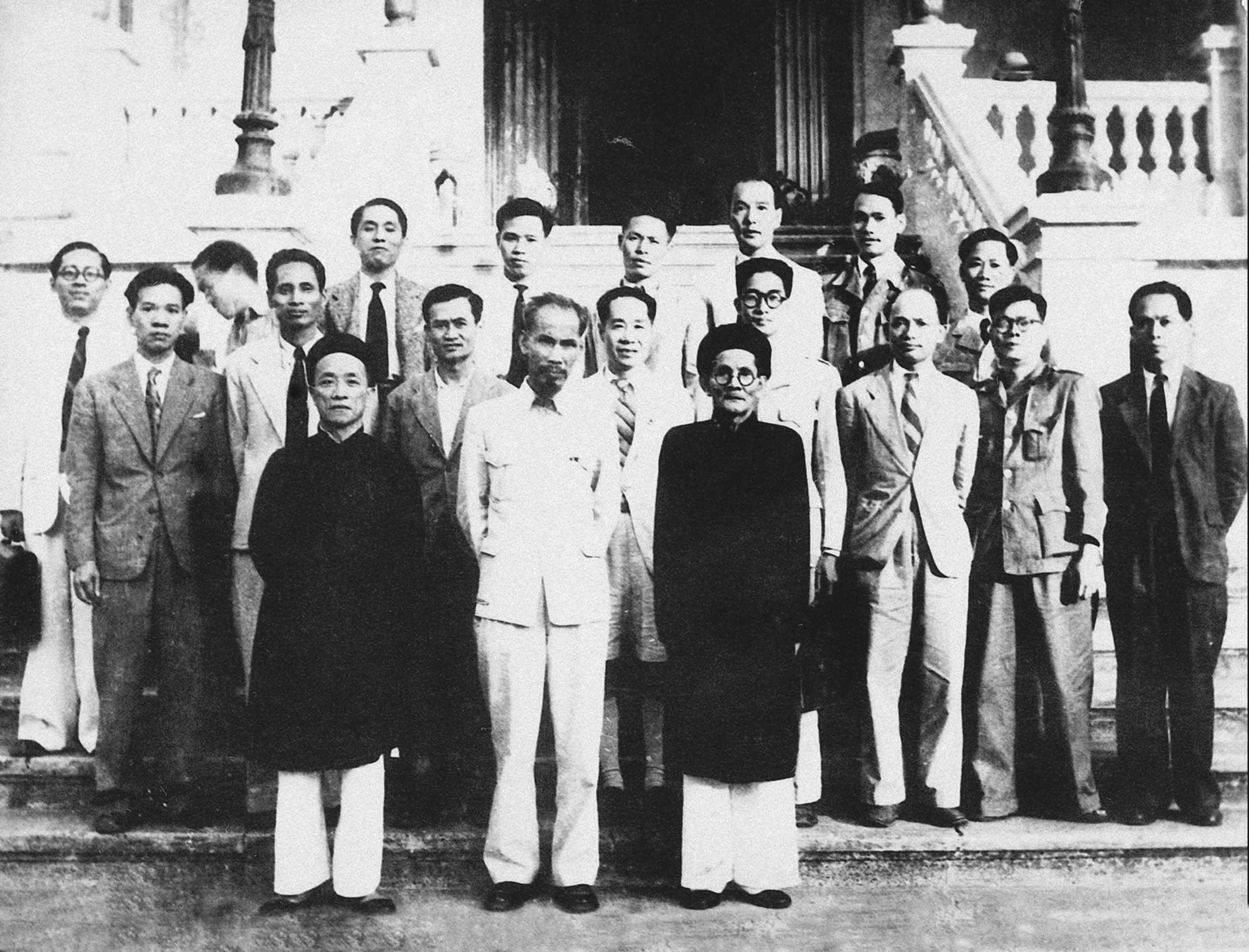

After nearly three centuries of partition by feudal dynasties, Vietnam was again under one single authority in 1802 when Gia Long founded the Nguyễn dynasty, but the country became a French protectorate after 1883 and under Japanese occupation after 1940 during World War II. US President Franklin D. Roosevelt was opposed to a return to French rule in Indochina, and proposed placing the region under United Nations trusteeship.
Soon after Japan surrendered, the Việt Minh in the August Revolution entered Hanoi, and the Democratic Republic of Vietnam was proclaimed on 2 September 1945 establishing independence and a new government for the country, replacing French rule and the Nguyễn dynasty. Hồ Chí Minh became leader of the Democratic Republic of Vietnam.
Early periods
The Democratic Republic of Vietnam claimed sovereignty over all of Vietnam, but during this time, several areas, particularly in the South, were not aligned with the Viet Minh. The successive collapse of French, then Japanese power, followed by the disputes among the political factions, had been accompanied by widespread violence in the countryside. On 16 August 1945, Hồ Chí Minh organized the National Congress in Tân Trào. The Congress adopted 10 major policies of the Việt Minh, passing the General Uprising Order, selecting the national flag of Vietnam, choosing the national anthem and selecting the National Committee for the Liberation of Vietnam, which later became the Provisional Revolutionary Government led by Hồ Chí Minh. On 12 September 1945, the first British troops arrived in Saigon, and on 23 September 1945, French troops occupied the police stations, the post office, and other public buildings. The salient political fact of life in Northern Vietnam was that the Chinese Nationalist Army occupied it, and the Chinese presence had forced Hồ Chí Minh and the Việt Minh to accommodate Kuomintang-supported Vietnamese nationalists.
In January 1946, the Việt Minh held an election, mainly in the North, to establish a National Assembly. There were few competitive races and the party makeup of the Assembly was determined in advance of the vote. Despite not joining the election, the Vietnamese Nationalist Party (Việt Quốc) and the Vietnam Revolutionary League (Việt Cách) were given 70 seats in the National Assembly in an effort to establish an inclusive government. Former Prime Minister Trần Trọng Kim claimed there were places where people were forced to vote for the Việt Minh. The Vietnamese Nationalist Party kidnapped Giáp and the Propaganda Minister Trần Huy Liệu and held them for three weeks until Ho Chi Minh agreed to remove Giáp and Liệu from the cabinet. As a result, the Vietnamese Nationalist Party's Vũ Hồng Khanh became defence minister, with Giáp as his deputy.
In June 1946, Chinese Nationalist troops evacuated Hanoi, and on 15 June, the last detachments embarked at Haiphong. After the departure of the British in 1946, the French controlled a part of Cochinchina, South Central Coast and Central Highlands since the end to the Southern Resistance War. The Viet Minh sought to consolidate power by terrorizing and purging rival Vietnamese nationalist groups and Trotskyist activists. In 1946, the Franco-Chinese and Ho–Sainteny Agreements enabled French forces to replace the Chinese north of the 16th parallel and facilitated a coexistence between the DRV and the French that strengthened the Viet Minh while undermining the nationalists. That summer, the Viet Minh colluded with French forces to eliminate nationalists, targeted for their ardent anti-colonialism.
When the Chinese nationalist army withdrew from Vietnam on 15 June 1946, in one way or another, Võ Nguyễn Giáp decided that the Việt Minh had to completely control the government. Võ Nguyễn Giáp began immediate action with the goal of spreading Việt Minh leadership. The Allied Powers were supported by the Vietnamese Nationalist Party. According to Cecil B. Currey, this organization, which borrowed the revolutionary name of Vietnamese Nationalist Party of 1930, was founded by Nguyễn Thái Học and, according to David G. Marr, the Vietnamese Communist Party under Hồ Chí Minh tried to ban the Vietnamese Nationalist Party. Võ Nguyễn Giáp gradually sought to marginalize the opposition such as the pro-Japan nationalist groups, the Trotskyists, the anti-French nationalists, and a catholic group known as the "Catholic Soldiers". On 19 June 1946, the Việt Minh Journal reportedly vehemently claimed "reactionaries sabotage the Franco-Vietnamese preliminary agreement on 6 March".
When France declared Cochinchina, the southern third of Vietnam, a separate state as the "Autonomous Republic of Cochinchina" in June 1946, Vietnamese nationalists reacted with fury. In November, the National Assembly adopted the first Constitution of the Republic.
During the First Indochina War
.svg)
In the wake of the Hai Phong incident and the deterioration of the Fontainebleau Agreements, the French reoccupied Hanoi and the First Indochina War (1946–54) followed, during which many urban areas fell under French control. Following the Chinese Communist Revolution (1946–50), Chinese communist forces arrived on the border in 1949. Chinese aid revived the fortunes of the Viet Minh and transformed it from a guerrilla militia into a standing army. The outbreak of the Korean War in June 1950 transformed what had been an anti-colonial struggle into a Cold War battleground, with the U.S. providing financial support to the French.
Provisional military demarcation of Vietnam

Following the partition of Vietnam in 1954 at the end of the First Indochina War, more than one million North Vietnamese migrated to South Vietnam, under the U.S.-led evacuation campaign named Operation Passage to Freedom, with an estimated 60% of the north's one million Catholics fleeing south. The Catholic migration is attributed to an expectation of persecution of Catholics by the North Vietnamese government, as well as publicity employed by the Saigon government of the President Ngo Dinh Diem. The CIA ran a propaganda campaign to get Catholics to come to the south. However Colonel Edward Lansdale, the man credited with the campaign, rejected the notion that his campaign had much effect on popular sentiment. The Viet Minh sought to detain or otherwise prevent would-be refugees from leaving, such as through intimidation through military presence, shutting down ferry services and water traffic, or prohibiting mass gatherings. Concurrently, between 14,000 and 45,000 civilians and approximately 100,000 Viet Minh fighters moved in the opposite direction.
Lê Duẩn's leadership (1960–1976)
During the Vietnam War
Reunification
After the fall of Saigon on 30 April 1975, the Provisional Revolutionary Government of the Republic of South Vietnam, or the Việt Cộng, alongside the North Vietnamese Army, governed South Vietnam for the next year. However it was seen as a vassal government of North Vietnam. North and South Vietnam were officially reunited on 2 July 1976 as the Socialist Republic of Vietnam. The merged country's government was dominated by holdovers from North Vietnam, and adopted the North Vietnamese constitution, flag and anthem.
Government and politics
Constitution
As an ideologically Marxist-Leninist state, North Vietnam adopted a constitution modelled on Joseph Stalin's 1936 Constitution of the Soviet Union.
Administrative divisions
Main article: Provinces of Vietnam
- The country is divided into provinces (tỉnh), autonomous regions (khu tự trị), and centrally run cities (thành phố trực thuộc trung ương);
- The province is divided into districts (huyện), cities (thành phố), and towns (thị xã);
- The district is divided into communes (xã) and townships (thị trấn).
- Administrative units in the autonomous region are statutory."
Autonomous regions
North Vietnam established a system of autonomous regions (Vietnamese: Khu tự trị) similar to (and based on) the autonomous regions of China. In recognising the traditional separatism of tribal minorities, this policy of accommodationism gave them self-government in exchange for acceptance of Hanoi's control. These regions existed from 1955 but following the merger of the Democratic Republic of Vietnam and the Republic of South Vietnam the system of autonomous regions was not continued and were fully abolished by 1978.
List of North Vietnamese autonomous regions and their subsidiary provinces:
- Thái-Mèo Autonomous Region (Khu tự trị Thái – Mèo, 1955–1962), later renamed Northwestern Autonomous Region (Khu tự trị Tây Bắc, 1962–1975)
- Lai Châu
- Sơn La
- Nghĩa Lộ
- Việt Bắc Autonomous Region (Khu tự trị Việt Bắc), established in 1956.
- Cao Bằng
- Lạng Sơn
- Thái Nguyên
- Bắc Cạn
- Hà Giang
- Tuyên Quang
- Lào-Hà-Yên Autonomous Region (Khu tự trị Lào-Hà-Yên), established in 1957.
Military
Main article: People's Army of Vietnam
Foreign relations
| International relations of | ||
|---|---|---|
| the Democratic Republic of Vietnam | Region | Nation/State |
| Asia (5) | Maoist China, India, Iraq, Democratic People's Republic of Korea, Mongolia, Syria, South Yemen | |
| Americas (1) | Cuba | |
| Europe (13) | Albania, Bulgaria, Byelorussian S.S.R., Czechoslovakia, | |
| Africa (3) | Algeria, Congo, Libya | |
| Oceania (1) | Australia |

The Democratic Republic of Vietnam was diplomatically isolated by many capitalist states, and many other anti-communist states worldwide throughout most of the North's history, as these states extended recognition only to the anti-communist government of South Vietnam. North Vietnam however, was recognized by almost all Communist countries, such as the Soviet Union and other Socialist countries of Eastern Europe and Central Asia, China, North Korea, and Cuba, and received aid from these nations. North Vietnam refused to establish diplomatic relations with Yugoslavia from 1950 to 1957, perhaps reflecting Hanoi's deference to the Soviet line on the Yugoslav government of Josip Broz Tito, and North Vietnamese officials continued to be critical of Tito after relations were established.
Several non-aligned countries also recognized North Vietnam. Similar to India, most accorded North Vietnam de facto rather than de jure (formal) recognition. In the case of Algeria however, relations between the DRV and Algeria were much closer as a result of clandestine weapon transfers from the former to the latter during the Algerian War, with Algeria placing a draft resolution in the 1973 summit of the Non-Aligned Movement calling on its members to support the DRV and PRG.
In 1969, Sweden became the first Western country to extend full diplomatic recognition to North Vietnam. Many other Western countries followed suit in the 1970s, such as the government of Australia under Gough Whitlam. By December 1972, 49 countries had established diplomatic relations with North Vietnam, and in 1973 more countries such as France established or reestablished their relations with the DRV.
South Vietnam
From 1960, the North Vietnamese government went to war with the Republic of Vietnam via its proxy the Viet Cong, in an attempt to annex South Vietnam and reunify Vietnam under a communist party. North Vietnamese and Viet Cong forces and supplies were sent along the Ho Chi Minh trail. In 1964 the United States sent combat troops to South Vietnam to support the South Vietnamese government, but the U.S. had advisors there since 1950. Other nations, including Australia, the Republic of Korea, Thailand and New Zealand also contributed troops and military aid to South Vietnam's war effort. China, DPRK and the Soviet Union provided aid to and troops in support of North Vietnamese military activities. This was known as the Vietnam War, or the American War in Vietnam itself (1955–75). In addition to the Viet Cong in South Vietnam, other communist insurgencies also operated within neighboring Kingdom of Laos and Khmer Republic, both formerly part of the French colonial territory of Indochina. These were the Pathet Lao and the Khmer Rouge, respectively. These insurgencies were aided by the North Vietnamese government, which sent troops to fight alongside them.
Japan
Main article: Japan–Vietnam relations#1946–1976
Despite there not being any official diplomatic ties between Japan and North Vietnam between 1954 and 1973, private exchanges were gradually being rebuilt. In March 1955 the Japanese Japan–Vietnam Friendship Association was created and in August of that year the Japan–Vietnam Trade Association was established. Meanwhile, in 1965 North Vietnamese Vietnam–Japan Friendship Association would be established to help maintain unofficial relations between the two countries.
During the Vietnam War of the 1960s and 1970s, Japan consistently encouraged a negotiated settlement at the earliest possible date. Even before the hostilities ended, it had made contact with the Democratic Republic of Vietnam (North Vietnam) government and had reached an agreement to establish diplomatic relations in September 1973. On 21 September 1973, Japan and the Democratic Republic of Vietnam (North Vietnam) signed the "Exchange of Notes Concerning the Establishment of Diplomatic Relations Between Japan and the Democratic Republic of Vietnam" in Paris, this document was in the French language and restored the diplomatic relations between Japan and North Vietnam. On the Japanese side the document was signed by Yoshihiro Nakayama, the Japanese Ambassador to France, while for the North Vietnamese side the document was signed by the Charge d'Affaires ad interim of North Vietnam to France Võ Văn Sung. Implementation, however, was delayed by North Vietnamese demands that Japan pay the equivalent of US$45 million in World War II reparations in two yearly installments, in the form of "economic cooperation" grants. Giving in to the Vietnamese demands, Japan paid the money and opened an embassy in Hanoi on 11 October 1975, following the unification of North Vietnam and South Vietnam into the Socialist Republic of Vietnam.
Earlier, the Japanese already gave similar funding to the South Vietnamese, which also re-established official diplomatic relations with Japan during the same period.
With the re-establishment of relations between Japan and North Vietnam the Japanese agreed to resolve what are termed "unsolved problems", which after earlier negotiations in Vientiane, Kingdom of Laos, these "unsolved problems" revolved around grants given by the Japanese State to North Vietnam. Between 1973 and 1975 the Japanese and North Vietnamese governments held over 20 both official and unofficial meetings, on 6 October 1975 both sides finally reached and agreement and the Japanese would provide the North Vietnamese with an endowment worth 13.5 billion yen. Of this money, 8.5 billion yen would be used to purchase heavy farmland cultivation machinery as well as public works provided by Japanese-owned corporations.
After diplomatic relations were re-established, in 1975, Japan would open an embassy in Hanoi and North Vietnam would open an embassy in Tokyo.
Economy
Land reform
Main article: Land reform in Vietnam, Land reform in North Vietnam
Land reform was an integral part of the Viet Minh and communist Democratic Republic of Vietnam. A Viet Minh Land Reform Law of 4 December 1953 called for (1) confiscation of land belonging to landlords who were enemies of the regime; (2) requisition of land from landlords not judged to be enemies; and (3) purchase with payment in bonds. The land reform was carried out from 1953 to 1956. Some farming areas did not undergo land reform but only rent reduction and the highland areas occupied by minority peoples were not substantially impacted. Some land was retained by the government but most was distributed without payment with priority given to Viet Minh fighters and their families. The total number of rural people impacted by the land reform program was more than 4 million. The rent reduction program impacted nearly 8 million people.
Results
The land reform program was a success in terms of distributing much land to poor and landless peasants and reducing or eliminating the land holdings of landlords (địa chủ) and rich peasants. By 1960, there were 40,000 cooperatives spanning nearly nine-tenths of all farmland. The program, proceeded by a Three Year Plan (1957–1960), lifted agricultural production to 5.4 million tonnes or over double pre-Indochina War levels.
However, it was carried out with violence and repression primarily directed against large landowners identified, sometimes incorrectly, as landlords. Executions and imprisonment of persons classified as "reactionary and evil landlords" were contemplated from the beginning of the land reform program. A Politburo document dated 4 May 1953 said that the planned executions were "fixed in principle at the ratio of one per one thousand people of the total population".
The number of persons actually executed by cadre carrying out the land reform program has been variously estimated, with some ranging up to 200,000. However, other scholarship has concluded that the higher estimates were based on political propaganda which also emanated from South Vietnam with the support of the US, and that the actual total of those executed was significantly lower. Gareth Porter estimated that between 800 and 2,500 people were executed, citing a South Vietnamese government document released in 1959, that Porter says is consistent with an estimate of around 1,500 executions. In 2007, scholar Balasz Szalontai wrote that documents of Hungarian diplomats living in North Vietnam at the time of the land reform provided a number of the 62,182 'landlords' identified by the land reform cadres, of whom 1,337 were executed by December 1955, including 1,175 executions during the first stage, which was the rent-reduction campaign, and 162 executions during the second stage, which was the land reform proper. The third stage in early 1956, likely resulted in more deaths than the previous stages as the repression was more intense. Szalontai writes that these documents support estimates by scholar Edwin E. Moise, who concluded that "the total number of people executed was probably on the rough order of 5,000 and almost certainly between 3,000 and 15,000". Moise later came up with a revised estimate of 13,500 including people who committed suicide following arrest. Economist Vo Nhan Tri reported uncovering a document in the central party archives which put the number of wrongful executions at 15,000. From discussions with party cadres, Vo Nhan Tri concluded that the overall number of deaths was considerably higher than this figure.
In early 1956, North Vietnam initiated a "correction of errors" which put an end to the land reform, and to rectify the mistakes and damage done. On 18 August 1956, North Vietnamese leader Ho Chi Minh apologised and acknowledged the serious errors the government had made in the land reform. Too many farmers, he also said, had been incorrectly classified as "landlords" and executed or imprisoned and too many mistakes has been made in the process of redistributing land. Severe rioting protesting the excesses of the land reform broke out in November 1956 in one largely Catholic rural district, leading to 1,000 deaths or injuries, and several thousand imprisoned. As part of the correction campaign, as many as 23,748 political prisoners were released by North Vietnam by September 1957. By 1958, the correction campaign had resulted in the return of land to many of those harmed by the land reform.
Concurrently with the land reform campaign and the end of the First Indochina War, over 12,000 people died from famine in Viet-Minh controlled zones by the end of 1954 due to economic turmoil in combination with natural disasters, floods, and crop failures.
Collective farming
The ultimate objective of the land reform program of the Democratic Republic of Vietnam government was not to achieve equitable distribution of farmland but rather the organization of all farmers into co-operatives in which land and other factors of agricultural production would be owned and used collectively. The first steps after the 1953–1956 land reform were the encouragement by the government of labor exchanges in which farmers would unite to exchange labor; secondly in 1958 and 1959 was the formation of "low level cooperatives" in which farmers cooperated in production. By 1961, 86 percent of farmers were members of low-level cooperatives. The third step beginning in 1961 was to organize "high level cooperatives", true collective farming in which land and resources were utilized collectively without individual ownership of land. By 1971, the great majority of farmers in North Vietnam were organized into high-level cooperatives. After the reunification of Vietnam, collective farms were abandoned gradually in the 1980s and 1990s.
Notes
References
; Works cited
Bibliography
References
- (1995). "La situation démographique du Viêt Nam". Magali Barbieri.
- (January 1968). "The Manpower Situation in North Vietnam".
- A G Vinogradov. (2015). "Economic growth around the world from ancient times to the present day: Statistical Tables. Part 1.".
- (2004). "Fledgling Financial Markets in Vietnam's Transition Economy, 1986–2003".
- (20 April 2016). "Sapeque and Sapeque-Like Coins in Cochinchina and Indochina (交趾支那和印度支那穿孔錢幣)". Howard A. Daniel III (The Journal of East Asian Numismatics – Second issue).
- Guillemot, François. (2019). "The Lessons of Yên Bái, or the “Fascist” Temptation: How the Đại Việt Parties Rethought Anticolonial Nationalist Revolutionary Action, 1932–1945". Journal of Vietnamese Studies.
- link. (4 March 2014 (1953), Folder 11, Box 02, Douglas Pike Collection: Unit 13 – The Early History of Vietnam, The Vietnam Center and Archive, Texas Tech University.')
- [https://www.mtholyoke.edu/acad/intrel/genevacc.htm "Agreement on the Cessation of Hostilities in Vietnam, 20 July 1954] {{Webarchive. link. (22 October 2015 , accessed 15 October 2015)
- [https://www.mtholyoke.edu/acad/intrel/genevacc.htm "Agreement on the Cessation of Hostilities in Vietnam, July 20, 1954] {{Webarchive. link. (22 October 2015 , accessed 15 October 2015; [https://en.wikisource.org/wiki/Geneva_Conference "Final Declaration of the Geneva Conference of the Problem of Restoring Peace in Indo-China, 21 July 1954] {{Webarchive). link. (18 October 2015 , accessed 15 October 2015)
- (1956). "Con đường Chính nghĩa: Độc lập, Dân chủ". Sở Báo chí Thông tin, Phủ Tổng thống.
- Ang Cheng Guan. (1997). "Vietnamese Communists' Relations with China and the Second Indochina War (1956–62)". McFarland.
- Karnow, pp. 223–224.
- Tucker, p. 366.
- Julia Lovell, ''Maoism: A Global History'' (2019) pp. 223–265.
- "Vietnam – The Economy".
- Diana Nelson Jones. (November 3, 2018). "Author Tim O'Brien, voice of the Vietnam War experience, slated to speak in Peters". [[Pittsburgh Post-Gazette]].
- Woods, L. Shelton. (2002). "Vietnam: A Global Studies Handbook". ABC-CLIO.
- Moses, A. Dirk. (2008). "Empire, Colony, Genocide: Conquest, Occupation, and Subaltern Resistance in World History". Berghahn Books.
- (2010-04-06). "Maintenance Agency for ISO 3166 Country Codes – English Country Names and Code Elements". ISO.
- Hess, Gary R.. (1 September 1972). "Franklin Roosevelt and Indochina". [[Journal of American History]].
- "Báo Nhân Dân – Phiên bản tiếng Việt – Trang chủ".
- Pentagon Papers [ Vietnam Relations, 1945–1967: A Study Prepared by the Department of Defense 1969] Retrieved 28/09/12
- Pentagon Papers [https://www.archives.gov/research/pentagon-papers/ Pentagon Papers] {{Webarchive. link. (12 June 2011 1969 Retrieved 28/09/12)
- link. (27 May 2016 '' (1956), p. 9.)
- Fall, p. 10.
- Springhal, John, ''Decolonization since 1945'' (1955), p. 44.
- (5 January 2016). "Quốc hội khóa 1 và những giây phút không thể nào quên".
- Why Vietnam, Archimedes L.A Patti, Nhà xuất bản Đà Nẵng, 2008, trang 544 – 545
- Sexton, Michael "War for the Asking" 1981
- Stanley Karnow. Vietnam: A History. New York, NY. Penguin, 1991, p. 163.
- Guillemot, François. (2004). "Naissance d'un État-Parti: Le Viêt Nam depuis 1945". Les Indes savantes.
- (2018). "The Origins of the Vietnamese Civil War and the State of Vietnam". University of Wisconsin–Madison.
- (2023). "Denouncing the 'Việt Cộng': Tales of revolution and betrayal in the Republic of Vietnam". Journal of Southeast Asian Studies.
- "[http://www.vietnamembassy.us/learn_about_vietnam/politics/overview/ Political Overview] {{Webarchive. link. (2009-05-11 ")
- United Nations High Commissioner for Refugees. "The State of The World's Refugees 2000 – Chapter 4: Flight from Indochina".
- Lindholm, Richard (1959). ''Viet-nam, the first five years: an international symposium''. Michigan State University Press. p. 49.
- Tran, Thi Lien (November 2005). "The Catholic Question in North Vietnam". ''Cold War History'' (London: Routledge) 5 (4): 427–49. {{doi. 10.1080/14682740500284747.
- Jacobs, Seth (2006). ''Cold War Mandarin: Ngo Dinh Diem and the Origins of America's War in Vietnam, 1950–1963''. Lanham, Maryland: Rowman & Littlefield. {{ISBN. 0-7425-4447-8. p. 45
- Truong Nhu Tang. 1986. ''A Viet Cong Memoir''. Vintage.
- Hansen, Peter. (2009). "Bắc Di Cư: Catholic Refugees from the North of Vietnam, and Their Role in the Southern Republic, 1954–1959". University of California Press.
- Frankum, Ronald (2007). ''Operation Passage to Freedom: The United States Navy in Vietnam, 1954–55''. Lubbock, Texas: Texas Tech University Press. {{ISBN. 978-0-89672-608-6. pp. 159/160/190
- Frankum, Ronald (2007). ''Operation Passage to Freedom: The United States Navy in Vietnam, 1954–55''. Lubbock, Texas: Texas Tech University Press. {{ISBN. 978-0-89672-608-6.
- Ruane, Kevin. (1998). "War and Revolution in Vietnam". Routledge.
- link. (24 June 2016, ''The Making of Vietnam'', 2012, p. 54.)
- Nguyễn, Sài Đình [http://www.dienhanhvanhoaquocte.org/chao/files/The%20National%20Flag%20of%20VN.pdf] {{Webarchive. link. (6 November 2013, ''The National Flag of Viet Nam: Its Origin and Legitimacy'', p. 4.)
- Emering, Edward J. [https://www.amazon.ca/Weapons-Field-Gear-North-Vietnamese/dp/0764305832] {{Webarchive. link. (16 December 2017, ''Weapons and Field Gear of the North Vietnamese Army and Viet Cong'', 1998.)
- Vu, Tuong. (19 May 2014). "Triumphs or tragedies: A new perspective on the Vietnamese revolution". [[Journal of Southeast Asian Studies]].
- Mukdawijitra, Yukti. (2007). "Ethnicity and multilingualism: The case of ethnic Tai in the Vietnamese state".
- (2006). "The A to Z of Vietnam". Scarecrow Press.
- Jean Michaud. (2006). "Historical Dictionary of the Peoples of the Southeast Asian Massif". Scarecrow Press.
- Cima, R.J (1987). Vietnam: A Country Study. Federal Research Division, Library of Congress. p. 99.
- Morris, Stephen J.. (1999). "Why Vietnam Invaded Cambodia: Political Culture and the Causes of War". [[Stanford University Press]].
- SarDesai, D. R. (1968), ''Indian Foreign Policy in Cambodia, Laos and Vietnam, 1947–1964,'' Berkeley: University of California Press, p. 194
- Huynh, Ngoc H., "The Time-Honored Friendship: A History of Vietnamese-Algerian Relations (1946–2015)" 1 May 2016. ''CUREJ: College Undergraduate Research Electronic Journal'', University of Pennsylvania, https://repository.upenn.edu/curej/214
- Gardner, Lloyd C. and Gittinger, Ted, Eds. (2004), "The Search for Peace in Vietnam, 1964–1968," Bryan, TX: Texas A&M University Press, p. 194
- Bühler, Konrad G. ''State succession and membership in international organizations''. The Hague: Kluwer Law International, 2001. pp. 68–92.
- "The History Place — Vietnam War 1945–1960".
- Japan and Vietnam – Archival Records on Our History (Joint Project Celebrating the 45th Anniversary of Japan-Viet Nam Diplomatic Relations). (2018). "Japan and Vietnam § IV. Vietnam and Japan: Old Partners, New Partnership". [[National Archives of Japan]].
- Shiraishi, Masaya. (1990). "Japanese Relations with Vietnam, 1951–1987". [[Cornell Southeast Asia Program#SEAP Publications.
- Moise, Edwin E. (1983), ''Land Reform in China and North Vietnam'', Chapel Hill: University of North Carolina Press, pp. 178–181
- Szalontai, Balazs (2005), "Political and Economic Crisis in Democratic Republic of Vietnam, 1955–1956", ''Cold War History,'' Vol. 5, No. 4, p. 401.
- (2020). "North Vietnam".
- Vo, Alex Thai D.. (Winter 2015). "Nguyễn Thị Năm and the Land Reform in North Vietnam, 1953". [[Journal of Vietnamese Studies]].
- "Politburo's Directive Issued on May 4, 1953, on some Special Issues regarding Mass Mobilization," ''Journal of Vietnamese Studies,'' Vol. 5, No. 2 (Summer 2010), p. 243.
- [http://www.paulbogdanor.com/left/vietnam/landreform.html Lam Thanh Liem (2005), "Ho Chi Minh's Land Reform: Mistake or Crime"] {{Webarchive. link. (18 February 2013 , accessed 4 October 2015)
- Porter, Gareth. "The Myth of the bloodbath: North Vietnam's land reform reconsidered". Bulletin of Concerned Asian Scholars.
- Szalontai, Balazs. "Political and Economic Crisis in North Vietnam, 1955–56". Cold War History (journal).
- Vu, Tuong. (2010). "Paths to Development in Asia: South Korea, Vietnam, China, and Indonesia". [[Cambridge University Press]].
- Balazs, p. 401
- (1990). "Vietnam's Economic Policy Since 1975". Institute for Southeast Asian Studies.
- Moise, pp. 237–268
- Szalontai, p. 401
- "Chủ tịch Hồ Chí Minh phê phán việc dùng nhục hình trong Cải cách Ruộng đất". BBC News Tiếng Việt.
- Moise, pp. 155–159
- Kerkvliet, Bendedict J. Tria (1998), "Wobbly Foundations" building co-operatives in rural Vietnam, 1955–61," ''South East Research'', Vol. 6, No. 3, pp. 193–197.
- Pingali, and Vo-TungPrabhu and Vo-Tong Xuan (1992), "Vietnam: Decollectivization and Rice Productive Growth", ''Economic Development and Cultural Change,'' Vol 40, No 4. pp. 702, 706–707.
This article was imported from Wikipedia and is available under the Creative Commons Attribution-ShareAlike 4.0 License. Content has been adapted to SurfDoc format. Original contributors can be found on the article history page.
Ask Mako anything about North Vietnam — get instant answers, deeper analysis, and related topics.
Research with MakoFree with your Surf account
Create a free account to save articles, ask Mako questions, and organize your research.
Sign up freeThis content may have been generated or modified by AI. CloudSurf Software LLC is not responsible for the accuracy, completeness, or reliability of AI-generated content. Always verify important information from primary sources.
Report