From Surf Wiki (app.surf) — the open knowledge base
North Equatorial Current
Current in the Pacific and Atlantic Oceans
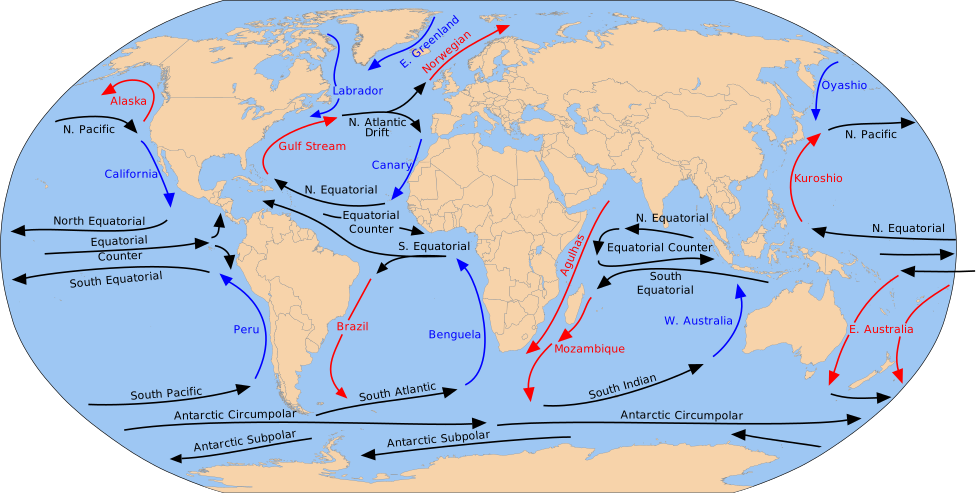
Current in the Pacific and Atlantic Oceans
The North Equatorial Current (NEC) is a westward wind-driven current mostly located near the equator, but the location varies from different oceans. The NEC in the Pacific and the Atlantic is about 5°-20°N, while the NEC in the Indian Ocean is very close to the equator. It ranges from the sea surface down to 400 m in the western Pacific. | article-number = 46310 | doi-access = free
The NEC is driven by the north-hemisphere easterly trade wind. In couple with NEC, there is another current called South Equatorial Current (SEC), generated by the easterly trade wind in the southern hemisphere. Despite the well-coupled name of the two equatorial currents, the distribution of the NEC and the SEC is not in symmetry at the equator, but slightly northward to the equator. This asymmetric distribution is aligned to the location of the Intertropical Convergence Zone (ITCZ), which is the area that the northeast and the southeast trade wind converge.
In different oceans
Pacific NEC
The NEC is evident around 10°-18°N across the entire Pacific basin, from the Philippines to Nicaragua. Its typical zonal velocity is 30 cm\cdot s^{-1}. | article-number = 46310 | doi-access = free The NEC shows little seasonal variability, but an interannual instability. The interannual instability of the NEC is strongly linked to ENSO. The NEC strengthens in La Niña years and weakens in El Niño years.
The meridional component of the NEC, also known as the Ekman transport, is evident northward at any location all the way along with itself. When the current reaches the west end, the Philippines, it splits into two western boundary flows. One of the branches flows poleward feeding the Kuroshio Current, another one flows equatorward feeding the Mindanao Current.
This North Equatorial Current Bifurcation (NECB) plays an important role in the south Asian climate system. As currently, climate change is more and more evident, thus, leading to a more amplified migration of the NECB. As a result, this amplification of the migration may lead to redistribution of the water mass and heat transport along the western boundary, and thus warm pool and monsoon climate. | doi-access = free
Atlantic NEC
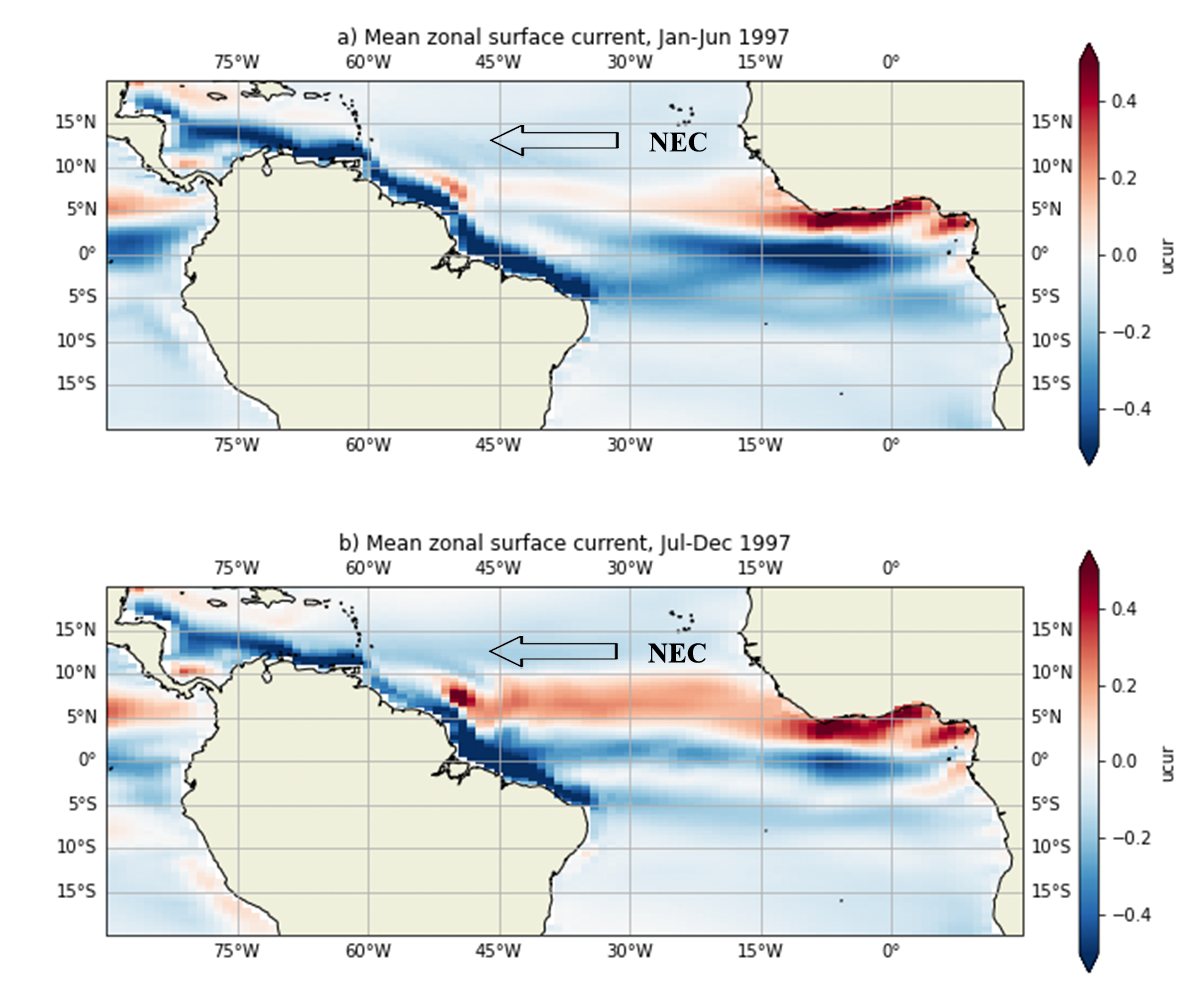
The NEC in the Atlantic is evident around 10°-20°N, spanning the longitude from 16°-60°W. The typical flow velocity is about 10 cm\cdot s^{-1}, lower than in the Pacific. Instead of interannual variability, the NEC shows a strong seasonality, in which NECC is stronger from July to December, weaker from January to June. Besides, the NEC is more equatorward from January to June.
The NEC splits into two after reaching the north of South America, joining the North Brazil Current (NBC) and the NECC respectively. The northward meridional Ekman transport dominates the tropical Atlantic Ocean, playing a very important role in the northward heat transport. This strong northward surface transport is well known as the upper component of the Atlantic Meridional Overturning Circulation (AMOC). On a seasonal time scale, variability of the heat transport is responsible for the tropical sea temperature anomaly. The temperature anomaly at the sea surface is a possible cause that leads to Atlantic hurricane season.
On the interannual and longer timescales, the equatorial and tropical Atlantic ocean has a strong interaction with the dynamics of several patterns of variabilities, the Atlantic Niño, the Atlantic Meridional Mode (AMM) and the Atlantic Multidecadal Oscillation (AMO).
The Indian Ocean NEC

The NEC in the Indian ocean is strongly affected by the continent to the north. The NEC is more southward than the other two oceans, which drives the Equatorial Counter Current to the southern hemisphere. So, the counter current is called South Equatorial Counter Current (SECC) here.
The NEC sits right on the equator, across a longitude from 45°-100°E. The typical speed in the winter can reach up to 50 cm\cdot s^{-1}, thanks to the northeast seasonal wind from the continent. In the Indian Ocean, the NEC is faster than the SEC. Multiple reasons are considered. The equator-located NEC receives more solar heat than the more poleward-located SEC, which leads to a much denser but thinner upper layer for the NEC. The current flows faster in the thinner layer. Another reason is the smaller Coriolis effect at the equator. The NEC, thus, is more aligned to the westward wind on the equator.
The NEC shows a very strong seasonal pattern. During January and February, thanks to the prevailing northeast wind, the NEC travels all the way to the east coast of Somalia and joins the Somali Current flowing towards the southwest to feed the SECC. As a result, SECC is strong during the winter. And at this time, the NEC carries surface waters from the southern Bay of Bengal to the southern Arabian Sea. While during July and August, the location of the NEC moves southward and the Somali Current reverses. As a result, the NEC and the SEC feed Somali Current instead of the SECC. So, the SECC becomes very weak. Due to the prevailing southwest wind in the summer, the surface waters move from the southern Arabian Sea to the southern Bay of Bengal.
During the transition of these two phases, specifically around May and November, the NEC becomes very weak, almost invisible in Figure 3. Instead of the NEC, a strong eastward current is found near the equator, known as the Wyrtki jets.
References
References
- [https://psl.noaa.gov/data/gridded/data.godas.html GODAS]
This article was imported from Wikipedia and is available under the Creative Commons Attribution-ShareAlike 4.0 License. Content has been adapted to SurfDoc format. Original contributors can be found on the article history page.
Ask Mako anything about North Equatorial Current — get instant answers, deeper analysis, and related topics.
Research with MakoFree with your Surf account
Create a free account to save articles, ask Mako questions, and organize your research.
Sign up freeThis content may have been generated or modified by AI. CloudSurf Software LLC is not responsible for the accuracy, completeness, or reliability of AI-generated content. Always verify important information from primary sources.
Report