From Surf Wiki (app.surf) — the open knowledge base
North East Line
Mass Rapid Transit line in Singapore

Mass Rapid Transit line in Singapore
| Field | Value | ||||||
|---|---|---|---|---|---|---|---|
| box_width | width:12em; | ||||||
| name | [[File:MRT Singapore Destination 6.svg | 25px]] [[File:MRT Singapore Destination 7.svg | 25px]] | ||||
| North East Line | |||||||
| color | |||||||
| logo | North East Line logo.svg | ||||||
| logo_width | 250px | ||||||
| image | NE18 Punggol Coast MRT Platform A 20241213 161223.jpg | ||||||
| image_width | 300px | ||||||
| caption | An Alstom Metropolis C851E train at Punggol Coast station, the NEL's northern terminus. | ||||||
| native_name | |||||||
| 东北地铁线 | |||||||
| status | Operational | ||||||
| owner | Land Transport Authority | ||||||
| locale | Singapore | ||||||
| start | HarbourFront | ||||||
| end | Punggol Coast | ||||||
| stations | 17 | ||||||
| mapcolor | Purple (#) | ||||||
| type | Rapid transit | ||||||
| system | Mass Rapid Transit (Singapore) | ||||||
| routes | 2 | ||||||
| operator | SBS Transit (ComfortDelGro Corporation) | ||||||
| depot | Sengkang | ||||||
| stock | Alstom Metropolis C751A | ||||||
| Alstom Metropolis C751C | |||||||
| Alstom Metropolis C851E | |||||||
| daily_ridership | 527,000 | ||||||
| open | |||||||
| (Buangkok) | |||||||
| (Woodleigh) | |||||||
| (Punggol Coast) | |||||||
| linelength | 21.6 km | ||||||
| tracklength | 21.6 km | ||||||
| character | Fully underground | ||||||
| gauge | |||||||
| electrification | from overhead catenary | ||||||
| speed | limit of 90 km/h | ||||||
| map_name | Maps | ||||||
| map | {{switcher | ||||||
| {{North East MRT line | inline | yes}} | |||||
| {{Maplink | frame | yes | type=line | plain=yes | stroke-colour=# | text=Interactive Map | frame-align=center}} |
| map_state | hide |
North East Line 东北地铁线
Alstom Metropolis C751C Alstom Metropolis C851E (Buangkok) (Woodleigh) (Punggol Coast) | | Show route diagram | | Show interactive map
The North East Line (NEL) is a high-capacity Mass Rapid Transit (MRT) line in Singapore. Operated by SBS Transit, the 22 km line is the MRT's shortest. It runs from HarbourFront station in southern Singapore to Punggol Coast station in the northeast, serving 17 stations via Chinatown, Little India, Serangoon and Hougang. Coloured purple on official maps, it is Singapore's third MRT line and the world's first fully-automated underground driverless heavy rail line.
The NEL was planned during the 1980s to alleviate traffic congestion on roads leading to the northeast suburbs of the country. However, the project was delayed due to a lack of demand at that time. After the government's decision to go ahead with the project at an estimated cost of , its alignment and stations were finalised in 1996 and construction began the year after. The line began operations on 20 June 2003. Two mid-line stations initially did not open with the rest of the line; Buangkok station opened on 15 January 2006, and Woodleigh station began operations on 20 June 2011. A one-station extension to Punggol Coast station opened on 10 December 2024.
The driverless line uses the moving-block Alstom Urbalis 300 CBTC signalling system. Three types of Alstom rolling stock – C751A, C751C and C851E – run on the NEL, which is powered by an overhead line. The NEL is Singapore's first Art-in-Transit line, with 19 artworks displayed across its 17 stations. The stations are wheelchair-accessible, and most of them are Civil Defence shelters designed to withstand airstrikes and chemical attacks.
History
{{anchor|Conceptualisation and plans}}Planning
The Mass Rapid Transit Corporation (MRTC) first proposed an additional MRT line serving the northeastern areas of Punggol and Jalan Kayu in September 1984. In its preliminary studies, the Communications Ministry concluded that existing roads would be inadequate for projected traffic into housing estates set to be built in the 21st century. To minimise the impact on other development, the Ministry developed plans to determine which parcels of land would be needed for the new MRT project. In December of that year, a British consultancy team consisting of Sir William Halcrow and Partners, Merz & McLellan and London Transport International was appointed by the MRTC to look into possible routes for the line.
In March 1986, the British consultants drew up a tentative route from Outram Park to Punggol. The line would connect to the existing MRT system at Dhoby Ghaut station and pass through Kandang Kerbau and Hougang, paralleling the major Serangoon and Upper Serangoon Roads. A branch line from Hougang to Jalan Kayu was also proposed. The segment of the line in the city would be underground, and the northern portion after Braddell Road would be elevated.
The MRTC, which approved the project in October 1986, proposed that the line link to Bishan Depot (which would maintain and service its trains). In February 1991, a proposal was made to extend the line to Pulau Tekong via Pulau Ubin to serve future residential and industrial developments in the long-term plans for these islands.
{{anchor|Delay in implementation}}Delay
Although the government approved the NEL "in principle" in January 1989, Communications Minister Yeo Ning Hong said that the line's construction was dependent on development in the northeast. The Woodlands extension, which cost S$1.35 billion (US$ billion), took precedence over the S$4.3 billion (US$ billion) NEL. According to Yeo's successor, Mah Bow Tan, there were firmer plans for development around the Woodlands extension, unlike in the northeast, where the low population meant that the NEL would not be as cost-effective. The four Members of Parliament (MPs) for the northeast called for the line to be built sooner, saying that there would be sufficient demand (given the area's population) and it would relieve traffic congestion.
Reviewing the line's feasibility, the Communications Ministry said in 1995 that the NEL could be completed in 2002 if construction began promptly. It was projected to cost S$5 billion (US$ billion) and would operate at a loss of S$250 million (US$ million) during its first four years, with lower daily passenger numbers (240,000). The ministry recommended the construction of the NEL to the Cabinet, citing "wider benefits" such as reduced travelling time and reliance on cars.
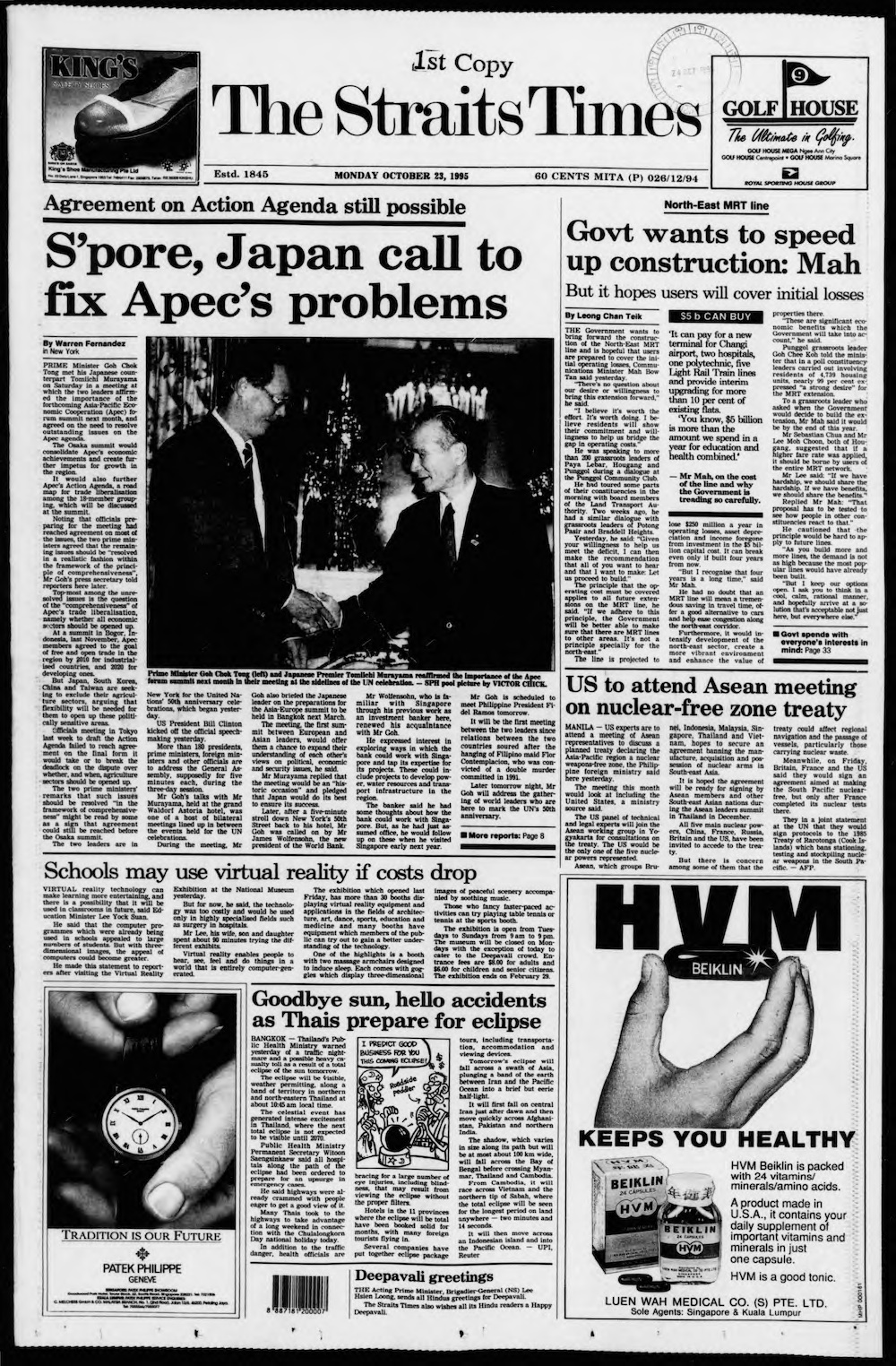
Mah, engaging with grassroots leaders in October 1995, said that residents would have to be prepared to pay higher fares on the NEL to cover the line's cost and initial losses. His position was divisive; some leaders felt that it would be unfair to the residents, and others were confident that residents would be willing "to pay for a better quality of life". Increased fares for the entire network were also suggested, but Mah said that it would be more difficult to implement. He assured leaders that he would recommend construction of the line to the government.
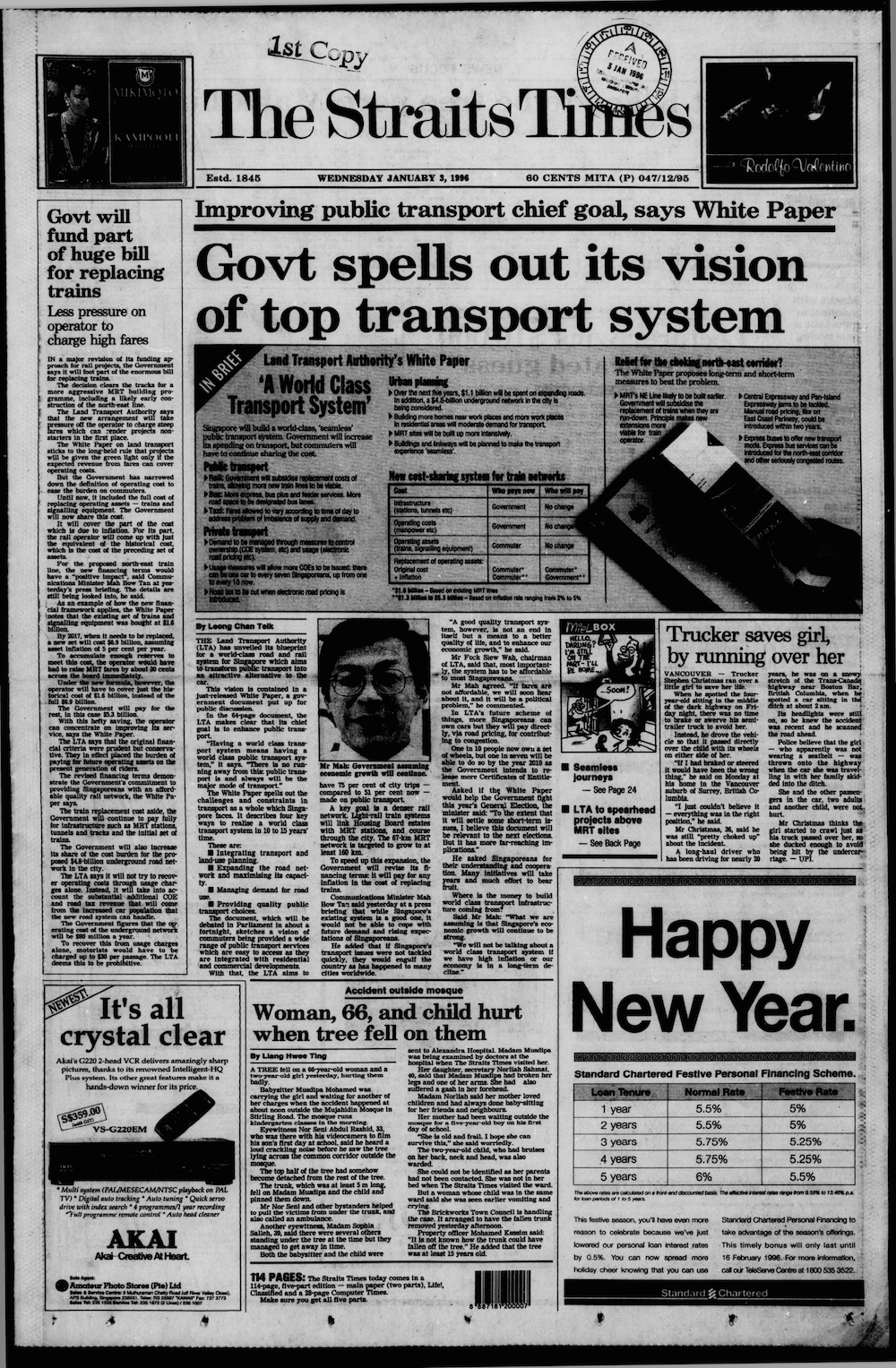
A white paper released on 2 January 1996 said that the NEL would be built earlier to address congestion in the northeast corridor, which would also be relieved by express bus service. The government's announcement during a 19 January parliamentary debate on the report that it had decided to build the NEL "immediately" was greeted with applause.
Construction and opening

| Date | Project | Description |
|---|---|---|
| 20 June 2003 | North East Line | HarbourFront – Punggol (14 stations) |
| 15 January 2006 | Opening of Buangkok station | |
| 20 June 2011 | Opening of Woodleigh station | |
| 10 December 2024 | North East Line Extension | Punggol – Punggol Coast (1 station) |
The 16 NEL stations and their locations were announced on 4 March 1996. Many residents and politicians welcomed the announcement, since the line was expected to relieve traffic congestion, improve transport in the northeast and stimulate development around the stations. Thirteen civil contracts for track work and construction of the stations, Sengkang Depot and associated tunnels were awarded for a total of S$2.8 billion (US$ billion). Sixteen more contracts related to electrical and mechanical work were awarded for a total of S$1 billion (US$ billion).
To construct the line, 20 ha of private land was acquired and 43 ha of government land was returned to the state. Several rental HDB blocks, private homes and shops were acquired, dismaying many affected residents. Those who had been asked to relocate in July 1996 requested more time to find new premises.
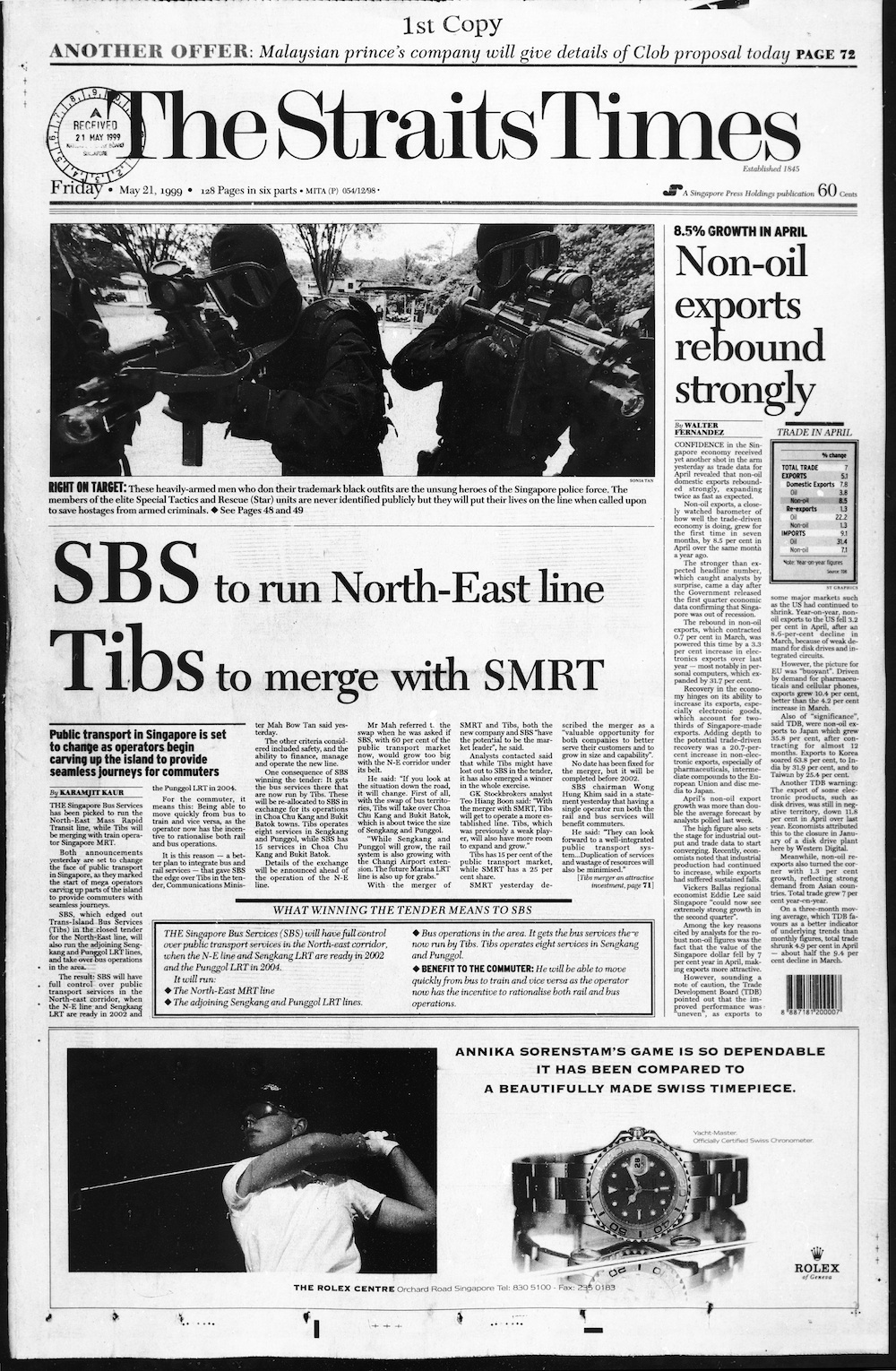
Construction of the line began with a groundbreaking ceremony at Farrer Park station on 25 November 1997. On 20 May 1999, SBS Transit (then Singapore Bus Service) was appointed to operate the line along with the Sengkang and Punggol LRT system. Parsons Brinckerhoff (through PB Merz and McLellan; now WSJ USA) was appointed to be the consultant for the line's engineering and design.
Construction challenges on the line included diverting the Eu Tong Seng canal for construction of the Chinatown station, and avoiding flooding the tunnels and stations while boring tunnels under the Singapore River between the Clarke Quay and Dhoby Ghaut stations. At the Outram Park station, an arched roof of cement-filled steel pipes was laid underneath the EWL tunnels to minimise movement. Jet-grout arches were used to support the North–South Line (NSL) tunnels when explosives were used to remove rock while tunnelling from Clarke Quay to Dhoby Ghaut. Roads around the line had to be temporarily diverted for construction.
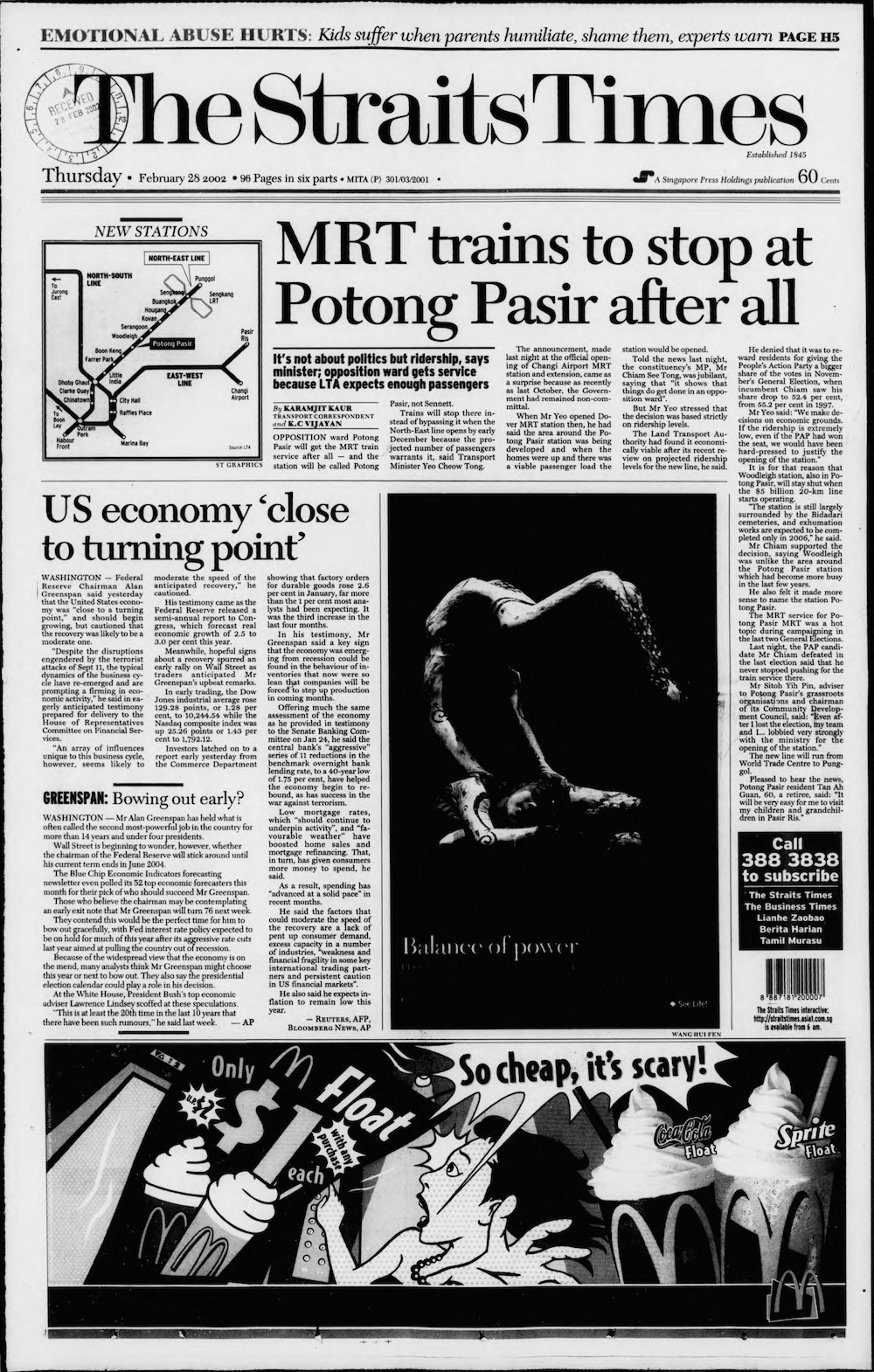
When the 16 stations were announced, Potong Pasir (then named Sennett), Woodleigh and Punggol were planned to be built as shell stations due to lack of development around the station sites. It was later decided to build these stations in full as it would have been more costly to wait until later to complete the stations from the structural shells. In 1998, the timeline for Punggol station was moved up because of planned housing developments in the area. The decision not to build Sennett station generated political controversy, however, with claims by residents and opposition MP Chiam See Tong that the station would only open if the ruling People's Action Party (PAP) secured the constituency. In 2002, after a revised ridership study, the government decided to open the station with the other NEL stations due to projected developments around the site; the station also received its present name.
The NEL was initially expected to be completed by the end of 2002, with SBS staff trained in train maintenance and other technical aspects of the automated system. However, the Land Transport Authority (LTA) said in September 2002 that the line might be opened in April 2003 to allow sufficient time for testing. The line's systems were handed over to SBS Transit on 16 December, and the operator conducted further tests. The NEL's opening was delayed until June due to a glitch in the signalling system, however, with tests briefly handed over to the LTA. Since it had to bear the costs of maintenance and manpower, SBS Transit sought compensation from the government for the delay.
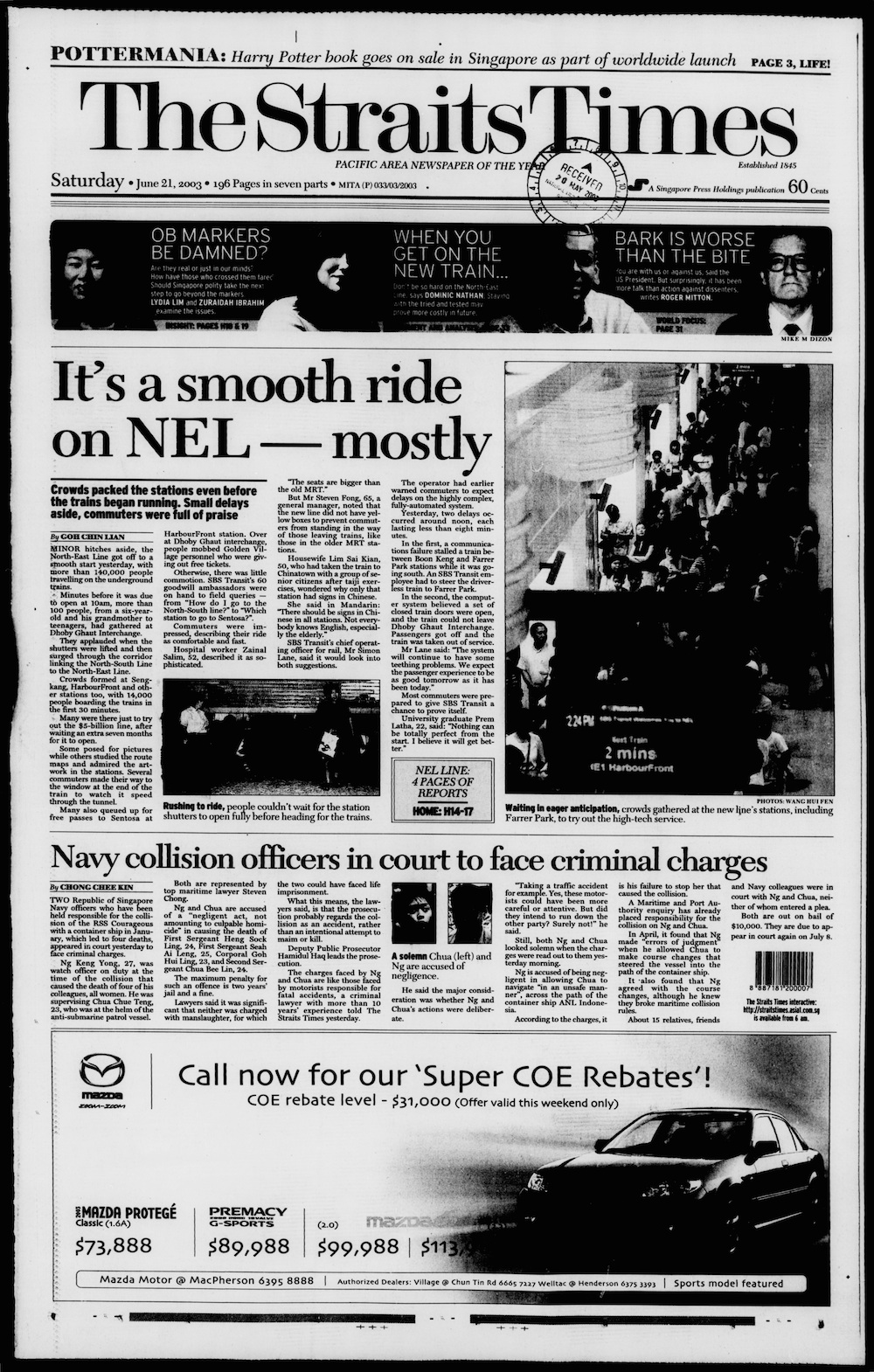
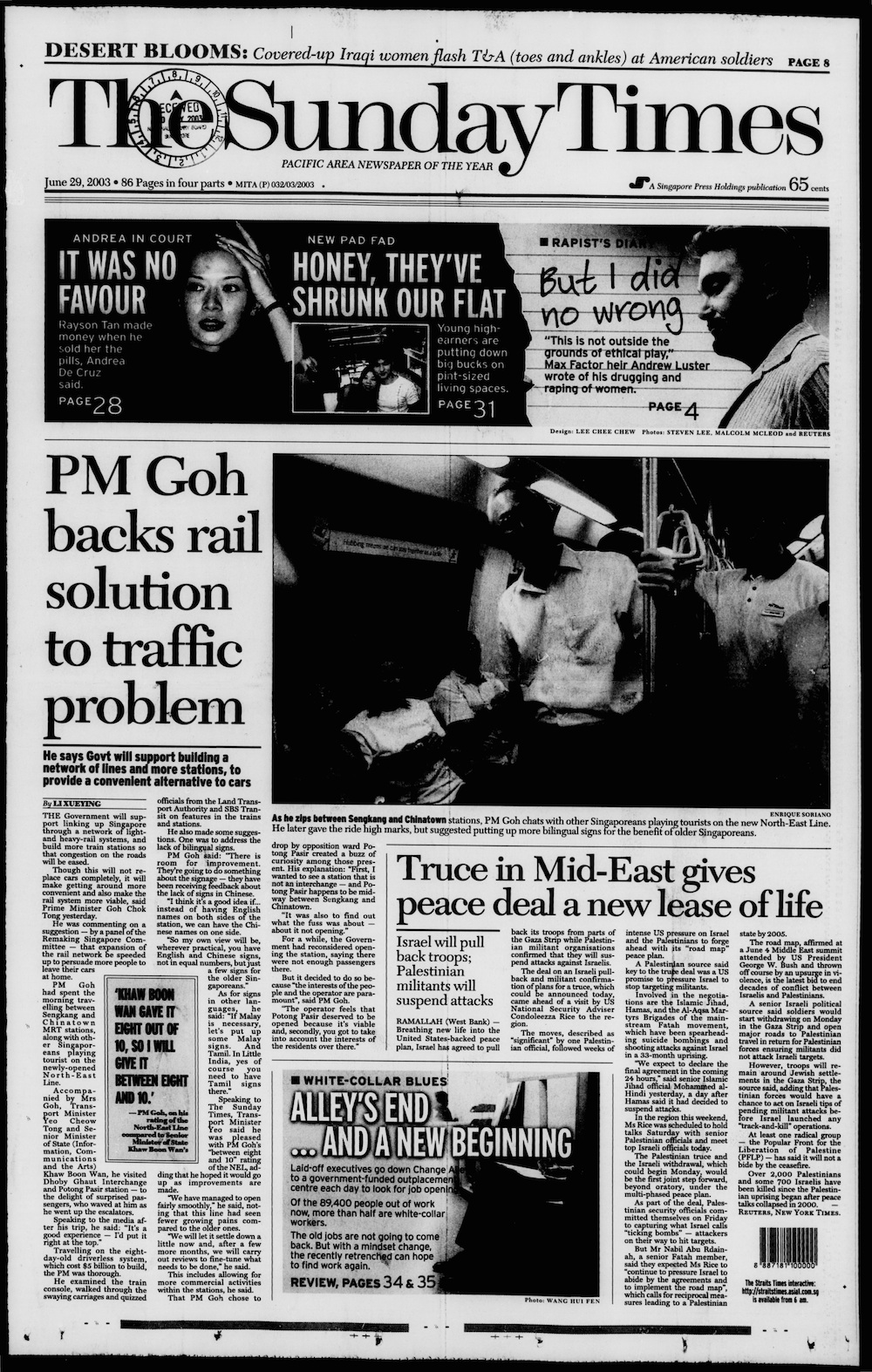
Except for two stations (Buangkok and Woodleigh), the NEL began operations on 20 June 2003. About 140,000 people rode the line on its opening day. Prime Minister Goh Chok Tong visited the NEL on 28 June 2003 and travelled between Sengkang and Chinatown station. The line's opening ceremony was held on 28 August by Deputy Prime Minister Lee Hsien Loong. Although the NEL has experienced a few glitches since its opening, it has been reliable and generally well-received by commuters. The International Association of Public Transport called the NEL a model public-transport system for the future in July 2003, with other driverless systems planned around the world. SBS Transit reported in June 2004 that the line averaged one 15-minute delay every six weeks, compared to expected twice-a-week delays. Average daily ridership has risen to 174,000 in 2004, with highest at 268,000 during Lunar New Year celebrations on 3 January that year.
Opening of reserved stations
Main article: Buangkok MRT station, Woodleigh MRT station

On 17 June 2003, SBS Transit announced that the Woodleigh and Buangkok stations would not open with the other NEL stations. Due to the lack of development, the operator said keeping the stations closed would reduce operating costs by S$2–3 million. At the time, housing demand declined due to the 1997 Asian financial crisis and the economic downturn following the September 11 attacks. Consequently, the Housing and Development Board cut back on its development plans in the Singapore northeast area. Residents around the line were upset by the sudden decision to keep Buangkok station closed, since they had been assured by MPs and grassroots leaders that it would be opened.
The government initially stood by SBS Transit's decision to keep the station closed, planning to open it in 2006 when more residential flats would be in the area. The opening was further postponed to 2008, following projected housing-development plans for the area. In August 2005, during a visit by youth minister Vivian Balakrishnan visit to Punggol South, eight white cardboard elephants were put up in protest, and a grass-roots leader was sternly warned after a police investigation into the incident. Following another evaluation by the LTA, SBS Transit announced at the end of 2005 that it would open the station on 15 January 2006.
The Buangkok station opened as scheduled "with much fanfare". Since its opening, however, the station averaged only 1,386 daily riders instead of the expected 6,000. Many residents still traveled to the adjacent Sengkang and Hougang stations due to their amenities. SBS Transit, after saying that it was still "too early to draw a conclusion" about ridership, remained committed to keeping the station open to serve future developments nearby.
Woodleigh station, built near the former Bidadari cemetery, was scheduled to open seven or eight years after the rest of the line. In January 2011, The Straits Times reported that preparations for the station's opening had been ongoing since the second half of 2010; the newspaper speculated that the station would open in mid-2011 to serve new developments in the area. In a March parliamentary session, Transport Minister Raymond Lim confirmed that the station would open on 20 June 2011. SBS deployed several staff members to assist confused commuters who alighted at Woodleigh station instead of the adjacent Serangoon station. Others alighted to view the station's interior or try an alternative route from the station.
North East Line extension (NELe)
Main article: Punggol Coast MRT station

On 17 January 2013, transport minister Lui Tuck Yew announced a one-station extension of the NEL to serve upcoming developments in Punggol North. Although it was initially planned to extend the line by 2030, Second Minister for Transport Ng Chee Meng announced on 7 June 2017 that the 1.6 km extension would be moved up to 2023 in conjunction with development plans for the area, later delayed to 2024 as a result of the COVID-19 pandemic.
The contract for the extension was awarded to China State Construction Engineering Corporation Limited (Singapore Branch) in December, and construction began that month. Although tunneling was completed on 13 November 2020, transport minister Ong Ye Kung said at the tunnel breakthrough ceremony that the Punggol Coast station's completion would be delayed until 2024 due to delays caused by the COVID-19 pandemic. In June and July 2024, NEL operations began later at 8am on Sundays to integrate testing and commissioning works with the new station. As previously announced by the LTA on 10 October 2024, Punggol Coast station opened on 10 December.
Network and operations
{{anchor|Services}}Service

In 2022, the NEL recorded 527,000 daily passenger trips. By 2025, following continued network expansion in the North-East Region, NEL ridership reached 593,000 daily trips, reflecting a 2.4% increase over the same period in 2024.The line operates between 5:30am and 12:30am. On weekdays and Saturdays, the first train leaves Punggol Coast (the northern terminus) at 5:39am; the last train leaves HarbourFront (the southern terminus) at 11:56pm. Trains run every 2.5 to 5 minutes, and the line's total travel time is 35 minutes.
The NEL initially had a higher fare than the North–South and East–West lines due to greater operating costs. On 30 December 2016, however, fares were lowered to match the other lines with a "purely distance-based approach". This revision, made after a fare review by the Public Transport Council, was intended to minimise commuter confusion. To ease the morning crowds riding on the NEL, from 27 December 2025, free fares will apply to those tapping in at any of the stations from Kovan to Punggol Coast on weekday mornings before 7.30am, or between 9am and 9.45am.
The first line operated by SBS Transit, the NEL has been part of the New Rail Financing Framework (NRFF) since 2018. Previously, the operator (the owner of the rail assets) had to bear the cost of maintaining and upgrading trains and signalling. Under the NRFF, the LTA and SBS Transit will share the profits and financial risks in operating the line and the LTA will take control of its operating assets on 1 April 2033. SBS Transit will operate the line under a 15-year licence which will expire on 31 March 2033.
Route
As its name implies, the fully-underground 22 km NEL runs from Singapore's city centre to the northeastern parts of the island. The line goes northeast from HarbourFront station, paralleling New Bridge Road and Eu Tong Street in Chinatown between the Outram Park and Clarke Quay stations. Passing under the Singapore River and Fort Canning Hill to Dhoby Ghaut station, it continues north to Little India station under Bukit Timah Road. Following Race Course Road and Serangoon Road through Little India and Boon Keng, it crosses the Whampoa and Kallang Rivers before reaching Potong Pasir.
Between the Potong Pasir and Kovan stations, the NEL parallels Upper Serangoon Road before curving north to Hougang station. The line then runs along Hougang Avenue 6 and Sengkang Central to Sengkang station in Sengkang as well as Punggol station in Punggol. It then curves east towards Punggol Coast station. The line is coloured purple on official maps.
Stations
The line has 17 stations from HarbourFront to Punggol Coast. Eight stations (eventually nine upon completion of the Cross Island Line) connect to other MRT/LRT lines. A station designated "NE2", which was included in the 1991 master plan between HarbourFront and Outram Park, may be built if development warrants it.
| SMRT | North East}}" | Station code | SMRT | North East}}" | Name | SMRT | North East}}" | Images | SMRT | North East}}" | Interchange; |
|---|---|---|---|---|---|---|---|---|---|---|---|
| Adjacent transportation | SMRT | North East}}" | Opening | ||||||||
| HarbourFront | [[File:NE1 HarbourFront MRT platforms 20201030 162302.jpg | 120px | alt=Symmetrical view of HarbourFront station platform]] | ||||||||
| ― | |||||||||||
| [[File:Bus-logo.svg | 15px | link=]]HarbourFront | |||||||||
| Outram Park | [[File:NE3 Outram Park MRT platforms 20210201 133314.jpg | 120px | alt=View of Outram Park island platform]] | ||||||||
| Chinatown | [[File:NE4 Chinatown MRT platforms 20201017 150247.jpg | 120px | alt=View of Chinatown island platform]] | ||||||||
| Clarke Quay | [[File:NE5 Clarke Quay MRT platforms 20201030 163546.jpg | alt=View of Clarke Quay island platform | 120px]] | ||||||||
| Dhoby Ghaut | [[File:NE6 Dhoby Ghaut MRT platforms 20210409 142829.jpg | 120px | alt=View of Dhoby Ghaut island platform]] | ||||||||
| Little India | [[File:NE7 Little India NEL station.jpg | 120px | alt=Symmetrical view of Little India station platform]] | ||||||||
| Farrer Park | [[File:NE8 Farrer Park MRT Platforms 20201002 165554.jpg | 120px | alt=View of Farrer Park island platform]] | rowspan="3" | |||||||
| Boon Keng | [[File:NE9 Boon Keng MRT Platforms 20220224 183016.jpg | 120px | alt=View of Boon Keng island platform]] | ||||||||
| Potong Pasir | [[File:NE10 Potong Pasir MRT Platform A 20201201 165328.jpg | 120px | alt=View of Potong Pasir island platform]] | ||||||||
| Woodleigh | [[File:NE11 Woodleigh MRT platforms 20201030 141256.jpg | 120px | alt=View of Woodleigh island platform]] | [[File:Bus-logo.svg | 15px | link=]]Woodleigh | |||||
| Serangoon | [[File:NE12 Serangoon MRT Platforms 20201020 074408.jpg | 120px | alt=View of Serangoon island platform]] | ||||||||
| ― | |||||||||||
| [[File:Bus-logo.svg | 15px | link=]]Serangoon | |||||||||
| Kovan | [[File:NE13 Kovan MRT platforms 20201003 221348.jpg | 120px | alt=View of Kovan island platform]] | ||||||||
| Hougang | [[File:NE14 Hougang MRT Platforms 20201128 111900.jpg | 120px | alt=View of Hougang island platform]] | (2030) | |||||||
| ― | |||||||||||
| [[File:Bus-logo.svg | 15px | link=]]Hougang Central | |||||||||
| Buangkok | [[File:NE15 Buangkok MRT 20201020 080807.jpg | 120px | alt=Symmetrical view of Buangkok island platform]] | [[File:Bus-logo.svg | 15px | link=]]Buangkok | |||||
| Sengkang | [[File:NE16 Sengkang MRT platforms 20210827 132922.jpg | 120px | alt=Symmetrical view of Sengkang island platform]] | ||||||||
| ― | |||||||||||
| [[File:Bus-logo.svg | 15px | link=]]Sengkang | |||||||||
| {{SMRT code | NE | 17 | PTC | CP | 4}} | ||||||
| Punggol | [[File:NE17 Punggol MRT Platform B 20201223 130016.jpg | 120px | alt=View of Punggol island platform]] | ||||||||
| (2032) | |||||||||||
| ― | |||||||||||
| [[File:Bus-logo.svg | 15px | link=]]Punggol | |||||||||
| Punggol Coast | [[File:Punggol Coast MRT station.jpg | 120px]] | [[File:Bus-logo.svg | 15px | link=]]Punggol Coast |
Infrastructure
Rolling stock

The NEL's rolling stock has six-car electric multiple unit (EMU) trains, with four doors per side on each carriage, and can accommodate up to 1,920 passengers per trainset. Twenty-five first-generation Alstom Metropolis C751A trains were ordered, built in France by Alstom in 2000 and 2001. An additional 18 second-generation Alstom Metropolis C751C trains, an updated version of the C751A, were delivered to Singapore beginning in July 2014 and were built in Shanghai between 2014 and 2016. To increase the line extension's passenger capacity, an additional six third-generation Alstom Metropolis C851E trains were ordered. Built in Barcelona, the first trainset arrived in Singapore on 4 April 2021 and entered service on 28 July 2023.
The automatic trains are controlled by an operations control centre (OCC) at Sengkang Depot. The fleet's brake systems permit smooth, quiet stopping. Train speeds can reach 100 km/h. Safety features include closed-circuit television cameras for train interiors and a passenger emergency communications system which allows communication between passengers and the OCC. The trains have wide seats and dedicated space for wheelchair users.
The trains are made of fire-resistant materials and include fire and smoke detectors and a fire barrier under its frame. They have a pair of beams (rail guards) which detect obstacles in the train's path; smaller debris is swept away, and the train automatically stops if the beams detect larger objects. A 1,500V overhead catenary system (OCS) powers the trains, the MRT network's first electrical system of that type. The OCS provides a safer environment for maintenance workers on the tracks and is less expensive, with a smaller conductor. In an emergency when the train is stopped, the doors on both sides can be opened easily without electricity and ramps lower for passenger evacuation in the tunnels.
In 2019, the first-generation trains began undergoing a mid-life refurbishment which is scheduled for completion by the third quarter of 2024. Upgrades include the replacement of interior parts and the installation of a new condition-monitoring system which will monitor train performance. The first refurbished train re-entered service on 28 February 2022.
With the passenger trains, the NEL tunnels and tracks are maintained by a fleet of engineering trains. There are four types of engineering trains: the locomotive, for towing wagons with equipment; the heavy crane vehicle, for changing tracks; the multi-function vehicle, for detecting flaws on rails and in tunnels; and the rail-grinding machine, for grinding rails back into shape. The engineering trains are manufactured by Plasser & Theurer, Speno, and Harsco Rail. A new fleet of engineering trains has been supplied by CRRC Zhuzhou Locomotive.
Depot

The Sengkang Depot, located along Sengkang East Avenue between the Buangkok and Sengkang stations, is the service and storage area for NEL trains. Built by Hyundai Engineering and Construction for S$350 million (US$ million), the 27 ha depot includes the OCC which monitors the line's train and station operations.
The depot can accommodate up to 44 trains, with three additional stabling tracks being built for the NELe as of 2019. It also houses LRT trains for the Sengkang and Punggol LRT lines above the depot.
Its facilities include a four-storey administrative building, maintenance bays, a workshop and an automated warehouse. The depot's workshop has equipment which can raise an entire train for repairs, Singapore's first such workshop. Using the NEL's signalling system, train movement in the depot is mainly automatic. Staff members access the area via three dedicated tunnels for safety reasons.
The OCC also controls the equipment and systems of tunnels, stations, power substations and the depot, which are integrated into one terminal. The systems are managed by four or five rotating teams working around the clock. Alongside a training and software-development room, the OCC has a depot control centre to monitor and supervise its operations.
Signalling
The NEL is fully automatic, using Alstom's Urbalis 300 moving-block signalling system. The NEL is the world's first fully automated heavy-rail system. Its construction allowed the LTA to explore, integrate and implement new and existing technology as part of its vision of a fully-automated system. The line's automatic train control (ATC) is based on Alstom's MASTRIA software, which also manages its automatic train protection (ATP) and automatic train operation (ATO) GoA 4 (UTO). The Urbalis system also includes a computer-based Interlocking system which controls the track switches and interfaces with the ATC and the data-management system. The DMS, monitored by station staff, oversees the signalling equipment, platform doors and trains.
The ATP system maintains a buffer between trains. The minimum permitted distance is 30 m, although the average distance between trains is at least 600 m. Using microwave technology, the IAGO waveguide (Informatisation et Automatisation par Guide d'Onde or waveguide transmission line system for computer and automation applications) allows two-way communication between trains and monitors the trains' positions and movements. If a train enters the buffer, the ATP automatically adjusts the train's speed.
At least 500 computer systems control the NEL. In case of a glitch, backup systems would take over; the system would "go to sleep" if it experiences a severe malfunction. In the event of system failure, drivers would be deployed to manually operate the trains. The NEL maintains its "mean kilometres between failures" target of one million train-km (1 e6km train-miles). As part of an NEL refurbishment programme announced on 17 December 2018, parts of the power and signalling systems were serviced and new rail crossings and tracks installed.
Station facilities
Every station has a passenger service centre (PSC) on its concourse. The PSCs are generally curved, unlike the boxier designs of those in older MRT stations. In addition to assisting passengers and checking and topping up their fare cards, the PSC staff monitors and controls the functions of connecting tunnels and communicates with the OCC at the depot. When a station is used as a civil-defence (CD) shelter, the PSC becomes the command centre.
Each NEL station is equipped with "energy-smart" Otis escalators connecting its levels. Their speed is reduced by half when not in use, reducing energy consumption and wear and tear. The Woodleigh station has one of the longest sets of escalators at 38.5 m. In addition to escalators, Dhoby Ghaut is the first MRT station with a set of 55 m travellators which link the NEL and NSL platforms.
All NEL stations have lifts which provide step-free access to their platforms. Most of the lifts have glass doors, which improve appearance and enhance security. Each lift has a communications system, connected to the station's PSC. If a lift stalls during a station blackout, a battery-powered backup system provides lighting and ventilation for four hours.
Accessibility
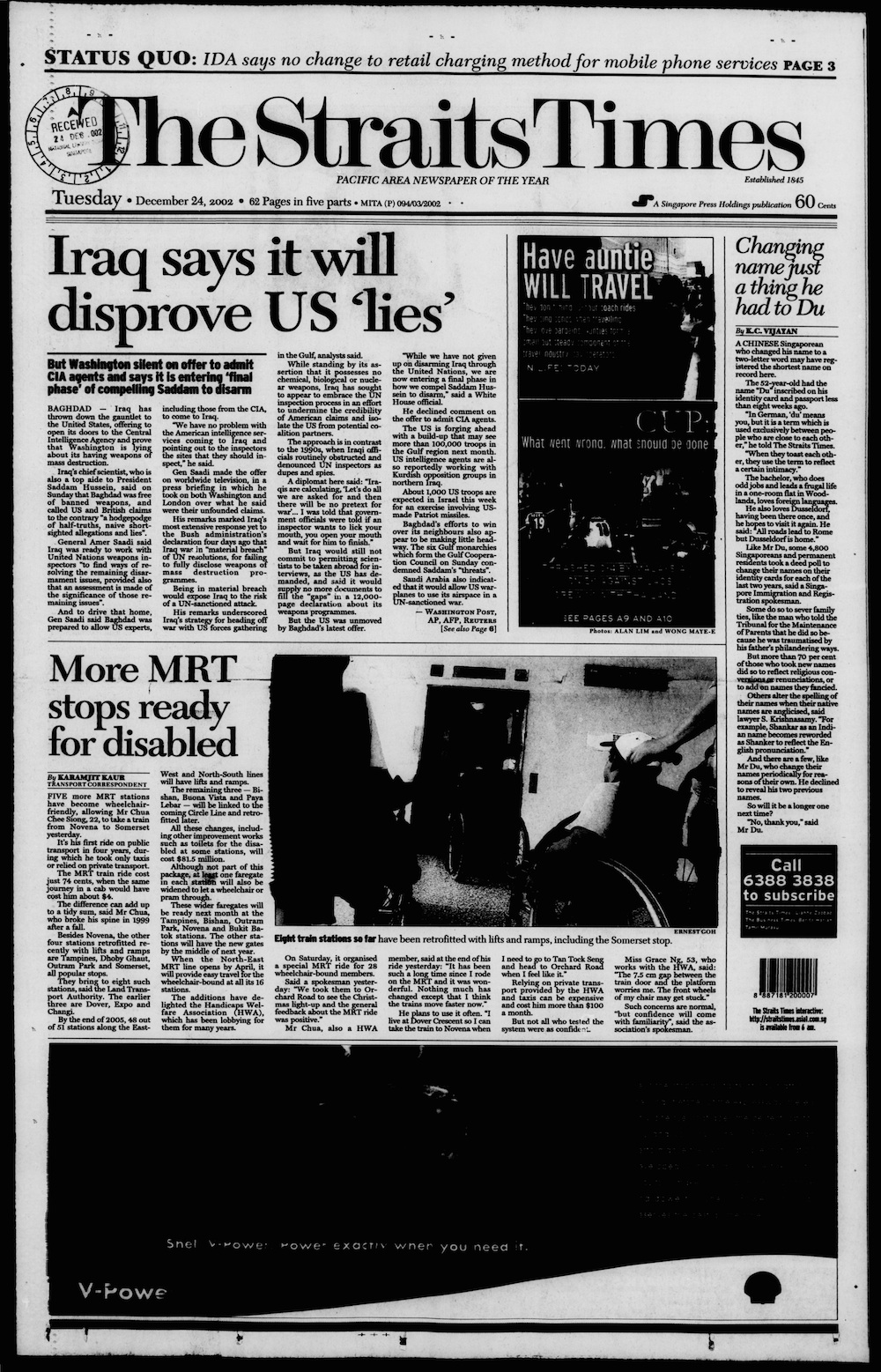
In compliance with Singapore's Code on Barrier-Free Accessibility, NEL stations have wheelchair-friendly facilities. Each station has an entrance that was built with barrier-free access via lifts and ramps, in contrast to older stations on previous lines which are being retrofitted.
The NEL has the MRT's first tactile system. Consisting of tiles with raised rounded or elongated studs, the system intends to guide visually-impaired commuters through a station on a dedicated route from entrance to platforms. Station seats have armrests to assist those who have difficulty getting up.
These accessibility features were part of the recommendations of a LTA working group set up to improve accessibility on the MRT network. Associations representing the disabled were also consulted. The group completed its findings in 1999; only some of its recommendations had been adopted by 2003, since station infrastructure was nearly completed by then.
Safety
Westinghouse supplied 768 pairs of platform screen doors (PSDs) to the NEL's original 16 stations. The PSDs are a safety barrier between passengers on platforms and trains. The PSDs enable climate control in a station, minimising the loss of cool air from the platforms and preventing warm air from entering the station from the tunnels. The Punggol Coast station's PSDs are supplied by ST Engineering Electronics. The platforms have emergency-stop plungers (ESPs) to halt trains in an emergency.
More than 10,000 smoke and heat detectors are installed in the NEL's stations as part of the line's fire-alarm system. The alarm, which automatically alerts SBS Transit of any faults in the system, is integrated with the public address system; instead of alarm bells, pre-recorded messages would assist commuters in evacuating. In addition to the detectors, sprinkler and hose reel systems, dry riser pipeworks and an inert-gas system would contain a fire.
During a fire, escalators could be shut down remotely from the PSC and the fare gates opened for evacuation. The air-conditioning system would be shut down to minimise re-circulation of smoke. An installed "smoke curtain" system controls smoke movement, and automatic smoke-extraction fans remove any contained smoke.
{{anchor|Civil Defence}}Civil defence

All NEL stations except Dhoby Ghaut, Sengkang, Punggol and Punggol Coast are designated civil-defence (CD) shelters. Each CD station is designed to accommodate at least 7,500 people and withstand airstrikes and chemical attacks. Equipment essential for shelter operations is mounted on shock absorbers to prevent damage during a bombing. When electricity supply to the shelter is disrupted, backup generators are used.
During emergencies, large sliding doors would seal the entrances and the tunnel portals would be manually sealed by blast doors. The shelters have built-in decontamination chambers and dry toilets, with collection bins which would remove human waste from the shelter. The toilets are next to an exhaust ventilation outlet to remove odors.
Culture
Architecture
Each of the NEL stations has a unique design which reflects its location. The HarbourFront station has a maritime theme, with an elliptical ship's-hull motif used for the ceiling and concourse entrances to the platforms. At Little India, the station walls' metal grills have leaf-shaped patterns similar to the door patterns of Hindu prayer rooms. The station's design was intended to reflect Indian traditions.
Station entrances use glass, allowing natural lighting during the day. Exit A of the Chinatown station has a transparent pavilion-style roof, which allows natural light and provides an unobstructed view of the shophouses along Pagoda Street. At Serangoon, each of its four triangular-shaped entrances is painted a different colour and enclosed in a cubic structure. Unlike at the other NEL stations, the entrances to Buangkok do not use glass; white Teflon sheets are supported by metal frames.
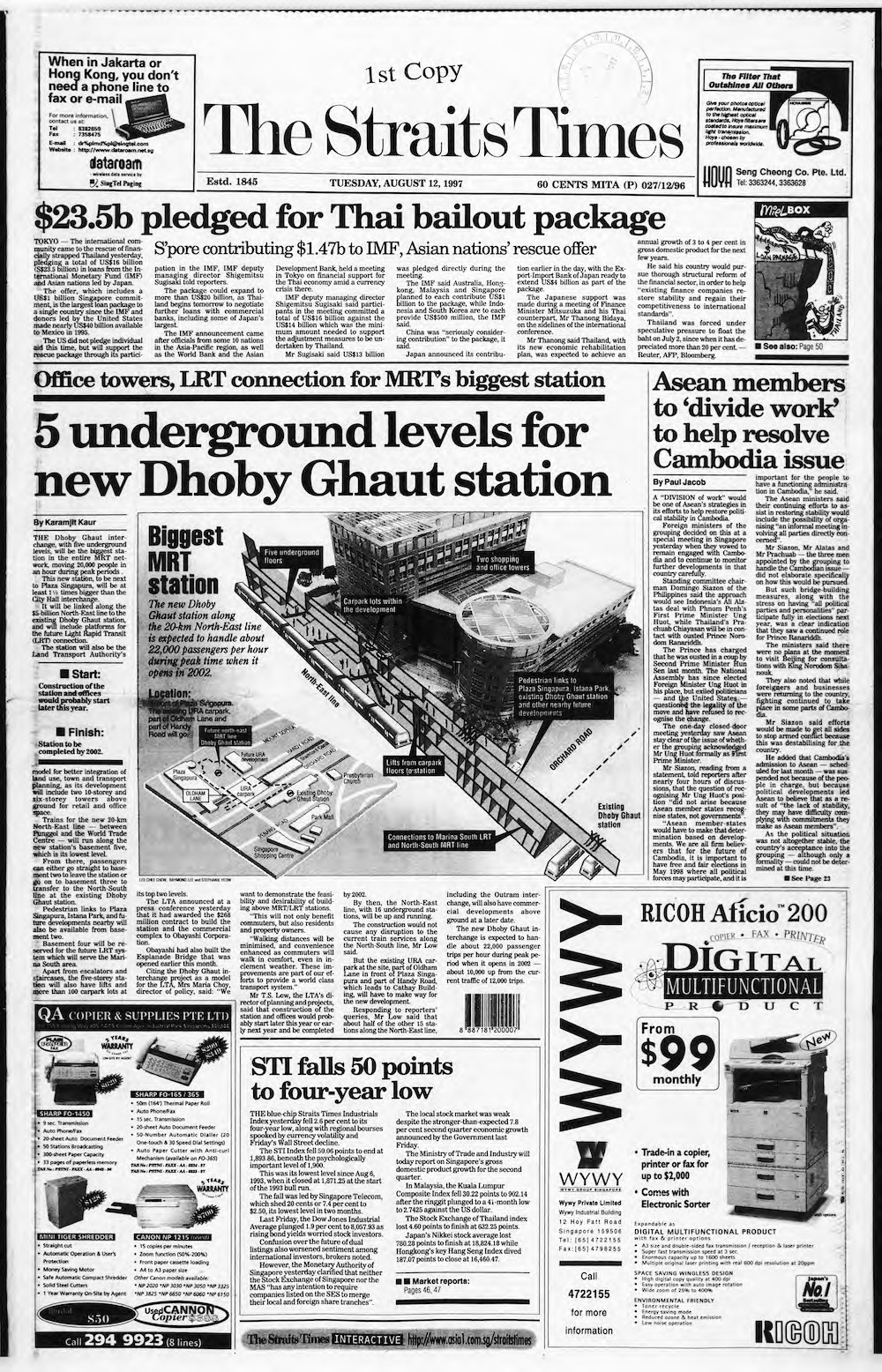
Dhoby Ghaut station is the MRT network's largest, and the five-level station is integrated with the twin-towered office complex Atrium@Orchard above it. The network's first such integration of an MRT station with a commercial development, it permits more efficient land use and improves access to public transport. The station's NEL platforms, 28 m underground, are some of the MRT's deepest.
The four-level Sengkang station is an integrated hub, with Singapore's three public-transport modes – MRT, LRT and bus – serving the Sengkang area. The MRT/LRT station was the MRT network's first intermodal station for all three transport modes. In addition to its transport facilities, the station is integrated with the Compass Heights and Compass Point developments.
Designed by the 3HPArchitects and Farrells architectural firms, the Punggol station is integrated with the LRT station and the bus interchange. Its curved aluminium and stainless-steel cladding gives the station a futuristic look befitting the Punggol 21 developments. Covering 320 m along Punggol Central to accommodate bus stops, taxi stands and passenger drop-off points along the road, the station is the NEL's longest.
Artworks
The line introduced the MRT network's Art-in-Transit (AiT) programme, which showcases art in the network. Nineteen works by 20 artists are featured in its stations. Artists were selected by an art-review panel, which reviewed the artists' portfolios and managed conceptual development. Considered a "significant milestone" for public art in Singapore, AiT aims to enhance the riding experience. Unlike artwork in the original North–South and East–West Line stations, the works must be integrated into a station's design and reflect the history and heritage of its surroundings.
| Station code | Station name | Artwork name | Artist(s) | ||||
|---|---|---|---|---|---|---|---|
| HarbourFront | *Engimatic Appearances* | Ian Woo | |||||
| Outram Park | *Memories* | Wang Lu Sheng | |||||
| *Commuters* | Teo Eng Seng | ||||||
| Chinatown | *The Phoenix's-Eye Domain* | Tan Swie Hian | |||||
| Clarke Quay | *The Reflections* | Chua Ek Kay | |||||
| Dhoby Ghaut | *Interchange* | Milenko and Delia Prvacki | |||||
| *Universal Language* | Sun Yu-Li | ||||||
| Little India | *Memoirs of the Past* | S. Chandrasekaran | |||||
| Farrer Park | *Rhythmic Exuberance* | Poh Siew Wah | |||||
| Boon Keng | *Metamorphosis* | Lim Poh Teck | |||||
| Potong Pasir | *Point of View* | Matthew Ngui | |||||
| Woodleigh | *Slow Motion* | April Ng | |||||
| Serangoon | *Memories of Childhood* | Eng Joo Heng | |||||
| Kovan | *The Trade-off* | Eng Tow | |||||
| Hougang | *Hands Up for Hougang* | Seck Yok Ying | |||||
| Buangkok | *Water, Nature & Contemporary* | Vincent Leow | |||||
| Sengkang | *T.R.A.N.S.I.T.I.O.N.S.* | Koh Bee Liang | |||||
| {{SMRT code | NE | 17 | PTC | CP | 4}} | Punggol | *Water, Landscape & Future* |
| Punggol Coast | *TRAJECTORIES* | Zul Othman |
References
- "Condensed Financial Statements for the Second Half and Full Year Ended 31 December 2022 and Dividend Announcement". [[SBS Transit]].
- Tan, Christopher. (22 February 2023). "SBS Transit Reports 32% Rise in Full-Year Earnings to $68M on Back of Higher Ridership". [[Singapore Press Holdings]].
- (25 September 2025). "First JRL train arrives in Singapore; has wider doors, smaller carriages: LTA". The Straits Times.
- "North–South Line". [[Land Transport Authority]].
- "East–West Line". [[Land Transport Authority]].
- "Circle Line". [[Land Transport Authority]].
- "Downtown Line". [[Land Transport Authority]].
- "Thomson–East Coast Line". [[Land Transport Authority]].
- Lim, Soon Neo. (26 September 1984). "Study on Future North-East Line". [[Singapore Press Holdings]].
- Dhaliwal, Rav. (26 September 1984). "Study into MRT North-East Line". [[Singapore Press Holdings]].
- Dhaliwal, Rav. (7 December 1984). "British Team Selected". [[Singapore Press Holdings]].
- Dhaliwal, Rav. (30 March 1986). "Serangoon and Hougang May Be Next on MRT Line". [[Singapore Press Holdings]].
- Dhaliwal, Rav. (6 October 1987). "MRTC Okays Extension to Punggol, Jalan Kayu". [[Singapore Press Holdings]].
- (7 April 1987). "Land to Be Set Aside for Punggol Extension". [[Singapore Press Holdings]].
- (24 February 1991). "Long Term Development Plans for Tekong and Ubin Revealed". [[Singapore Press Holdings]].
- (21 January 1989). "North-Easterly MRT Route Will Depend on Demand". [[Singapore Press Holdings]].
- "Woodlands MRT Line". [[National Library Board]].
- (16 January 1992). "MRT Link to N-E When Enough People Live There". [[Singapore Press Holdings]].
- Tan, Sumiko. (15 May 1993). "N-E Line Still on the Horizon". [[Singapore Press Holdings]].
- (6 September 1994). "MRTC to Update Its Plans for North-East Sector, Link to Airport". [[Singapore Press Holdings]].
- Leong, Chan Teik. (15 July 1995). "North-East MRT Line to Cost Up to $5B". [[Singapore Press Holdings]].
- Leong, Chan Teik. (23 October 1995). "Govt Wants to Speed Up Construction: Mah". [[Singapore Press Holdings]].
- Leong, Chan Teik. (9 October 1995). "Mah's Poser: Will Users Pay More to Get It Faster?". [[Singapore Press Holdings]].
- Leong, Chan Teik. (3 January 1996). "Govt Spells Out Its Vision of Top Transport System". [[Singapore Press Holdings]].
- (1996). "White Paper: A World Class Land Transport System". [[Land Transport Authority]].
- (20 January 1996). "Immediate Start for North-East Line". [[Singapore Press Holdings]].
- Leong, Chan Teik. (5 March 1996). "16 MRT Stations for 20-km North-East Line". [[Singapore Press Holdings]].
- Gascon, George. (6 March 1996). "Residents in N-E Corridor Happy with Station Sites". [[Singapore Press Holdings]].
- (6 March 1996). "Line a Relief to People and Boon for Commerce". [[Singapore Press Holdings]].
- (9 February 2004). "Projects – Rail". [[Land Transport Authority]].
- (6 March 1996). "They Have to Move to Make Way for the MRT Line". [[Singapore Press Holdings]].
- (5 July 1996). "Those Moving Out First Want More Time to House-Hunt". [[Singapore Press Holdings]].
- (25 November 1997). "Speech by Mr Mah Bow Tan, Minister for Communications at the Ground Breaking Ceremony for the NEL 25 Nov 97 at 5.30 pm at Farrer Park Station Site (Junction of Owen and Race Course Road)".
- Kaur, Karamjit. (26 November 1997). "Drilling Begins for N-E Line … at the Push of a Button". [[Singapore Press Holdings]].
- Kaur, Karamjit. (21 May 1999). "SBS to Run North-East Line, Tibs to Merge with SMRT". [[Singapore Press Holdings]].
- (20 May 1999). "Appointment of Operator for the North East MRT Line".
- "North East Line Rail Network - Colt Singapore".
- "Page 22 Advertisements Column 2".
- "Tunnels and Underground Structures: Proceedings Tunnels & Underground Structures, Singapore 2000".
- (31 May 2002). "Chinatown Back on Track – It Will Be an Even More Vibrant Hub". [[Singapore Press Holdings]].
- (8 February 1998). "Building of N-E MRT Line: Serangoon to See Detours; More Parking". [[Singapore Press Holdings]].
- (5 March 1996). "3 Stations Identified but Will Not Be Built Yet". [[Singapore Press Holdings]].
- Tan, Christopher. (30 March 1998). "Punggol MRT Station to Get an Early Start". [[Singapore Press Holdings]].
- (6 March 1996). "Sennett or Potong Pasir: 2 Views". [[The Straits Times]].
- (27 October 2001). "MRT in Potong Pasir if PAP Wins?". [[Singapore Press Holdings]].
- (28 February 2002). "MRT Trains to Stop at Potong Pasir After All". [[Singapore Press Holdings]].
- Koo, Leslie. (11 August 2001). "SBS' Train Chief Right on Track for New Line". [[Singapore Press Holdings]].
- Nadarajan, Ben. (8 June 2003). "North-East Line Set to Roll on June 20". [[Singapore Press Holdings]].
- (3 June 2002). "Staff Train Hard for Opening of N-E Line". [[Singapore Press Holdings]].
- Kaur, Karamjit. (8 September 2002). "No Rush to Open N-E MRT Line by Year-End". [[Singapore Press Holdings]].
- (21 January 2003). "Opening of North East Line". [[Ministry of Transport (Singapore).
- (21 March 2003). "N-E Line Delayed Again, to Start in May or June". [[Singapore Press Holdings]].
- (20 March 2003). "SBS Seeks Govt Compensation over N-E Line Delay". [[Singapore Press Holdings]].
- (18 June 2003). "Two of 16 NEL Stations Won't Open on Debut". [[Singapore Press Holdings]].
- (20 June 2003). "North East Line Opens for Passenger Service!". [[Land Transport Authority]].
- (21 June 2003). "It's a Smooth Ride on NEL – Mostly". [[Singapore Press Holdings]].
- (28 June 2003). "PM Goh Visits North East Line at Sengkang MRT Station (Prime Minister Goh Chok Tong Speaking to the Media at Dhoby Ghaut Mass Rapid Transit (MRT) Interchange Station During His Tour of the Newly-Opened North East Line (NEL))".
- "PM Goh Backs Rail Solution to Traffic Problem". [[Singapore Press Holdings]].
- (28 August 2003). "Speech by Deputy Prime Minister Mr Lee Hsien Loong at the Official Opening of the North East Line and Sengkang LRT System on 28 August 2003". [[Ministry of Transport (Singapore).
- (1 September 2003). "North-East Line Gets Good Scorecard for First 70 Days". [[Singapore Press Holdings]].
- (5 July 2003). "NEL Hailed by World Body As Model for Public Transport". [[Singapore Press Holdings]].
- (18 June 2004). "Year-Old NEL Did Better than Expected". [[Singapore Press Holdings]].
- (20 June 2004). "SBS Transit Celebrates First Anniversary Of Northeast Line". [[SBS Transit]].
- (2018). "Integrating Land Use & Mobility: Supporting Sustainable Growth". Centre for Liveable Cities.
- (18 June 2003). "Buangkok MRT Delay Frustrates Commuters". [[Singapore Press Holdings]].
- (29 August 2003). "Buangkok Station May Open in Three Years". [[Singapore Press Holdings]].
- (15 August 2003). "SBS Transit 'Made Mistakes' over Buangkok Station". [[Singapore Press Holdings]].
- (20 September 2005). "LTA Needs a Few Months for Buangkok Review". [[Singapore Press Holdings]].
- (28 August 2005). "Residents Bring up 'White Elephant' Buangkok MRT During Minister's Visit". Channel NewsAsia.
- (6 October 2005). "Conclusion of Police's Investigations into the White Elephants Placards".
- (6 October 2005). "Stern Police Warning for Offender Who Planted "White Elephants" at Buangkok MRT".
- (30 August 2005). "Buangkok Station: Yeo Cheow Tong Wants LTA Reply Within 'A Month or So'". The Straits Times.
- (29 August 2005). "LTA to Complete Study on Buangkok Station in 1–2 Months: Yeo".
- (30 December 2005). "Buangkok Station to Open on Jan 15". [[Mediacorp]].
- Zahara, Rita. (1 January 2006). "Buangkok MRT Station to Open on January 15". [[Mediacorp]].
- (15 January 2006). "Buangkok NEL Station Commences Revenue Service amid Great Fanfare". [[SBS Transit]].
- (16 January 2006). "All Aboard at 'White Elephant' Station". [[Singapore Press Holdings]].
- Goh, Chin Lian. (24 January 2006). "Poor Buangkok MRT Ridership Since Opening". [[Singapore Press Holdings]].
- (23 February 2006). "Aiyoh, So Creepy at Night". [[Singapore Press Holdings]].
- Tan, Christopher. (11 June 2011). "All Aboard for Woodleigh Train Stop". [[Singapore Press Holdings]].
- (14 July 2003). "Closed MRT Station Running Up Power Bill". [[Singapore Press Holdings]].
- (14 July 2003). "Buangkok, Woodleigh Closed Until…". [[Mediacorp]].
- Tan, Christopher. (22 January 2011). "Woodleigh Station May Open by June". [[Singapore Press Holdings]].
- Tan, Christopher. (9 March 2011). "Plans to Ramp Up Rail Capacity on Fast Track". [[Singapore Press Holdings]].
- Durai, Jennani. (21 June 2011). "Woodleigh MRT Station Finally Opens – To Some Confusion". [[Singapore Press Holdings]].
- Ramesh, S. (20 June 2011). "Train Finally Arrives at Woodleigh MRT Station". [[Mediacorp]].
- (17 January 2013). "Speech by Mr Lui Tuck Yew at Visit to DTL1 Chinatown Station on 17 January 2013". [[Ministry of Transport (Singapore).
- (17 January 2013). "Two New Rail Lines and Three New Extensions to Expand Rail Network by 2030". [[Land Transport Authority]].
- "Annex: New Lines and Extensions". [[Land Transport Authority]].
- Lim, Kenneth. (7 June 2017). "New Train Station in Punggol North by 2023". [[Mediacorp]].
- Abdullah, Zhaki. (7 June 2017). "North-East Line Extension Serving Punggol North to Open in 2023 Instead of 2030; to Cater to Developments in the Punggol Area". [[Singapore Press Holdings]].
- "Upcoming Projects – Rail Expansion – North East Line Extension". [[Land Transport Authority]].
- Yong, Clement. (13 November 2020). "Punggol Coast MRT Station Ready by 2024, 40% of Work Completed". [[Singapore Press Holdings]].
- Abdullah, Zhaki. (13 November 2020). "Opening of New Punggol Coast MRT Station to Be Delayed to 2024". [[Mediacorp]].
- (8 December 2017). "LTA Awards Contract for the Construction of Tunnels for North East Line Extension". [[Land Transport Authority]].
- (8 December 2017). "North-East Line Extension: LTA Awards S$79m Contract to China State Construction Engineering". [[Mediacorp]].
- Abdullah, Zhaki. (8 December 2017). "China State Construction Engineering Wins $79M Contract for North-East Line Extension Tunnels". [[Singapore Press Holdings]].
- William, Whitney. (12 June 2024). "North East Line train services to start at 8am on 4 Sundays to integrate new Punggol Coast station".
- (10 October 2024). "Punggol Coast Station to Open for Passenger Service from 10 December 2024". [[Land Transport Authority]].
- Loi, Esther. (10 October 2024). "Punggol Coast MRT station on North East Line to open for passenger service on Dec 10".
- Chelvan, Vanessa Paige. (10 December 2024). "New Punggol Coast MRT station opens, passenger service to begin at 3pm". [[The Straits Times]].
- "First Train/ Last Train". [[SBS Transit]].
- (6 May 2020). "Transport Tools – MRT/LRT". [[Land Transport Authority]].
- "Travel Time". [[SBS Transit]].
- "No Revision to Bus and Train Fares and New NEL Fare Structure Approved". [[Ministry of Transport (Singapore).
- Abdullah, Zhaki. (10 October 2016). "Public Transport Fares May Be Standardised". [[Singapore Press Holdings]].
- (26 October 2016). "PTC Reduces Bus and Rail Fares". [[Public Transport Council]].
- Tan, Christine. (18 October 2025). "Free off-peak MRT, LRT rides for commuters in north-east S'pore from Dec 27 to ease morning crowds". [[Singapore Press Holdings]].
- (14 February 2018). "North East Line, Sengkang LRT and Punggol LRT to Transit to the New Rail Financing Framework: Completion of the Transition of All Existing Rail Lines, Benefitting Commuters". [[Land Transport Authority]].
- Abdullah, Zhaki. (14 February 2018). "LTA to Take Over North East Line, Sengkang-Punggol LRT Assets Worth $30.8M". [[Singapore Press Holdings]].
- . ["North East Line"](https://www.lta.gov.sg/content/ltagov/en/getting_around/public_transport/rail_network/north_east_line.html). *[[Land Transport Authority]]*.
- "OneMap". [[Singapore Land Authority]].
- "Alignment of NELe and Tunnels Between Punggol and Punggol Coast Stations". [[Land Transport Authority]].
- "MRT System Map". [[Land Transport Authority]].
- (29 July 2020). "North East Line". [[Land Transport Authority]].
- "Future System Map". [[Land Transport Authority]].
- (17 February 2023). "Past Long-Term Plans". [[Urban Redevelopment Authority]].
- Han, Liang Yuan. (30 July 2003). "Why No Station Between NE1, NE3". [[Singapore Press Holdings]].
- (8 December 2019). "Alstom in Singapore". [[Alstom]].
- (17 December 2018). "Joint News Release by the Land Transport Authority (LTA) & SBS Transit – Enhancement Works for the North East Line to Commence in 2019". [[Land Transport Authority]].
- (3 February 2012). "Alstom to Supply 34 Metropolis Trains and Signaling Upgrade to Singapore Metro". [[Alstom]].
- (23 July 2014). "From Next Year – Shorter Waits and More Comfortable Rides on Circle Line and North East Line". [[Land Transport Authority]].
- Sim, Royston. (23 July 2014). "First New Circle and North East Line Trains Arrive". [[Singapore Press Holdings]].
- Lim, Adrian. (30 April 2018). "Alstom to Supply 17 New MRT Trains for North East Line and Circle Line".
- "Alstom to Supply 17 Additional Metropolis Trains for Singapore Circle Line and North East Line".
- (12 April 2021). "First of Six New Trains for North-East Line Arrived in Singapore". Unscrambled.sg.
- "New Trains for North East Line to be Rolled Out for Passenger Service from 28 July 2023". [[Land Transport Authority]].
- Ng, Hwee Koon. (31 March 2001). "Too Smart to Need Driver". [[Mediacorp]].
- "Singapore Northeast Line". [[Alstom]].
- (20 November 2002). "Driverless MRT Trains on New Line Will Be Safe". [[Singapore Press Holdings]].
- Tan, Christopher. (11 February 2019). "Siemens Lands $111M Deal to Supply Power Systems for 2 MRT Extensions". [[Singapore Press Holdings]].
- (24 February 2003). "N-E Line Driverless, but Many Eyes Keep Watch". [[Singapore Press Holdings]].
- Lim, Adrian. (17 December 2018). "North East Line to Undergo Major Renewal Project Next Year". [[Singapore Press Holdings]].
- Kok, Yufeng. (27 February 2022). "Refurbished North East Line Train to Enter Service from Feb 28; First of 25 to Get Mid-Life Upgrade". [[Singapore Press Holdings]].
- (8 June 2003). "We Call Them Yellow Submarines". [[Singapore Press Holdings]].
- (1 July 2003). "MFV Keeps NEL Under Surveillance".
- (16 November 2020). "C838B型内燃电力地铁工程车的燃油箱设计_参考网".
- (27 July 1997). "LTA Awards 5 More Contracts for N-E MRT Line". The Straits Times.
- "Architects61 – Infrastructure – Sengkang MRT Depot".
- (5 February 2021). "New Two-Car Trains for Sengkang-Punggol LRT". [[Land Transport Authority]].
- (8 June 2003). "I Saw This Baby Through Its Birth". [[Singapore Press Holdings]].
- Yeoh, Grace. (12 November 2022). "In Focus: 35 Years of People and Purpose". [[Mediacorp]].
- "Station Facilities". [[SBS Transit]].
- Ang, Ildyko. (15 August 2017). "Elderly, Disabled Commuters Get Helping Hand at Outram MRT". [[Mediacorp]].
- Kaur, Karamjit. (24 December 2002). "More MRT Stops Ready for Disabled". [[Singapore Press Holdings]].
- (15 July 2007). "Platform Screen Doors: North East Line". [[Westinghouse Rail Systems.
- (7 July 2007). "Platform Screen Doors: What Are PSDs". [[Westinghouse Rail Systems.
- "Annual Report 2018/19".
- (14 February 2003). "Chemical Attack? Clean-Up at N-E Line". [[Singapore Press Holdings]].
- "List of Public CD shelters as of 31 Dec 2019".
- Tham, Davina. (13 February 2023). "Discovering the Hidden Bomb Shelters in MRT Stations That Keep Singapore Safe". [[Mediacorp]].
- (16 February 2003). "Fancy That, Dry Toilets Grab Most Interest". [[Singapore Press Holdings]].
- (7 August 2002). "Local Flavour for Stops Along N-E Line". [[Singapore Press Holdings]].
- "Dhoby Ghaut MRT Station". SAA Architects.
- Kaur, Karamjit. (12 August 1997). "5 Underground Levels for New Dhoby Ghaut Station". [[Singapore Press Holdings]].
- "North East Line: Dhoby Ghaut Station". [[Land Transport Authority]].
- (12 April 2001). "Topping-Out Of Commercial Development Above Dhoby Ghaut MRT Station". [[Land Transport Authority]].
- "Photo Gallery – Integrated Developments and Interchange Stations". [[Land Transport Authority]].
- "North East Line: Sengkang Station". [[Land Transport Authority]].
- "North East Line: Sengkang Station". [[Land Transport Authority]].
- "Compass Heights". [[Frasers Property]].
- (19 July 2017). "Punggol Station". [[Farrells]].
- "North East Line: Punggol Station". [[Land Transport Authority]].
- "North East Line: Punggol Station". [[Land Transport Authority]].
- "Speech by Mr Khaw Boon Wan at the Launch of the North East Line Art in Transit Programme on 6 June 2003". [[Ministry of Transport (Singapore).
- (26 October 2020). "Art in Transit". [[Land Transport Authority]].





This article was imported from Wikipedia and is available under the Creative Commons Attribution-ShareAlike 4.0 License. Content has been adapted to SurfDoc format. Original contributors can be found on the article history page.
Ask Mako anything about North East Line — get instant answers, deeper analysis, and related topics.
Research with MakoFree with your Surf account
Create a free account to save articles, ask Mako questions, and organize your research.
Sign up freeThis content may have been generated or modified by AI. CloudSurf Software LLC is not responsible for the accuracy, completeness, or reliability of AI-generated content. Always verify important information from primary sources.
Report