From Surf Wiki (app.surf) — the open knowledge base
North American Aviation
Former aerospace manufacturer in the United States
Former aerospace manufacturer in the United States
| Field | Value |
|---|---|
| name | North American Aviation |
| logo | NorthAmericanAviation.png |
| industry | Aerospace |
| fate | Merger |
| predecessor | |
| successor | North American Rockwell |
| founded | |
| founders | Clement Melville Keys |
| defunct | |
| hq_location_city | Los Angeles, California |
| hq_location_country | United States of America |
| area_served | |
| key_people | |
| owner | |
| num_employees_year | |
| parent | General Motors |
| (1933–1948) | |
| divisions | |
| website |
(1933–1948)
North American Aviation (NAA) was a major American aerospace manufacturer that designed and built several notable aircraft and spacecraft. Its products included the T-6 Texan trainer, the P-51 Mustang fighter, the B-25 Mitchell bomber, the F-86 Sabre jet fighter, the X-15 rocket plane, the XB-70 bomber, the B-1 Lancer, the Apollo command and service module, the second stage of the Saturn V rocket, and the Space Shuttle orbiter.
Through a series of mergers and sales, North American Aviation became part of North American Rockwell, which later became Rockwell International, and is now part of Boeing.
History
Early years
On December 6, 1928, Clement Melville Keys founded North American as a holding company that bought and sold interests in various airlines and aviation-related companies. However, the Air Mail Act of 1934 forced the breakup of such holding companies. North American became a manufacturing company, run by James H. "Dutch" Kindelberger, who had been recruited from Douglas Aircraft Company. NAA did retain ownership of Eastern Air Lines until 1938.
In 1933, the General Motors Corporation purchased a controlling interest in NAA, and merged it with the General Aviation Manufacturing Corporation, but retained the name North American Aviation.
Kindelberger moved the company's operations from Dundalk, Maryland to Los Angeles, California, which allowed flying year-round, and decided to focus on training aircraft, on the theory that it would be easier than trying to compete with established companies on larger projects. NAA's first planes were the GA-15 observation plane and the GA-16 trainer, followed by the O-47 and BT-9, also called the GA-16.
World War II
The BC-1 of 1937 was North American's first combat aircraft; it was based on the GA-16.

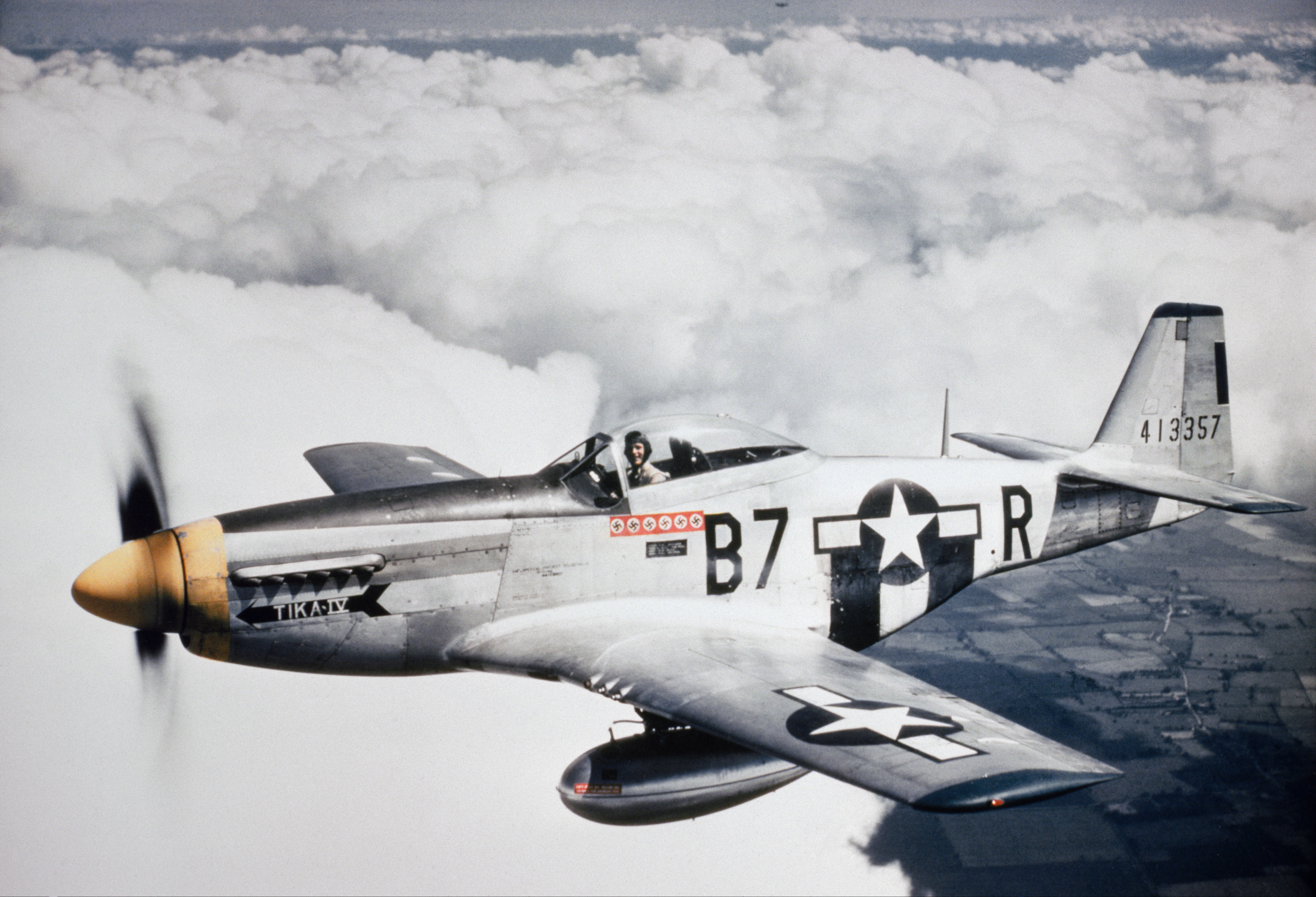
North American's follow-on to the BT-9 was the T-6 Texan trainer, of which 17,000 were built, making it the most widely used trainer ever. The twin-engine B-25 Mitchell bomber achieved fame in the Doolittle Raid and was used in all combat theaters of operation. The P-51 Mustang was initially produced for Britain as an alternative to the Curtiss P-40 Warhawk, which North American had declined to produce under licence. The derivative A-36 Mustang was developed as a ground attack aircraft and dive bomber. This was done, in part, to keep the airframe in production as the US Army Air Corps had not yet decided to purchase the type as a fighter.
A suggestion by the RAF that North American switch the P-51's powerplant from its original Allison engine to the Rolls-Royce Merlin engine may have been one of the most significant events in World War II aviation, as it transformed the P-51 into what many consider to be the best American fighter of the war.
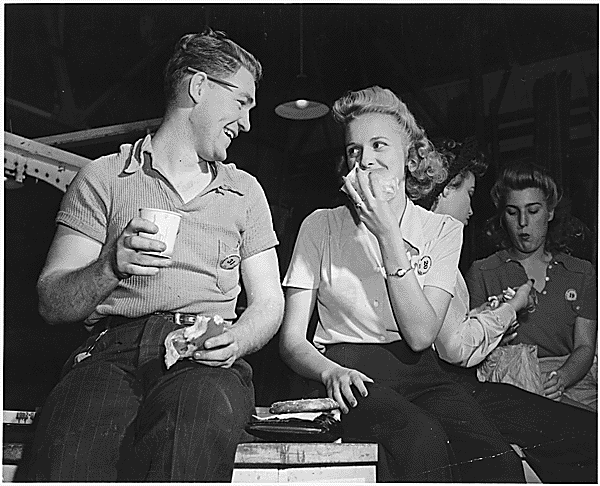
Labor troubles became a grave issue in 1941. During the 22 months from August 1939 to June 1941 Stalin and Hitler supported each other as war raged in Europe. In the U.S., local union officials opposed American aid to Britain's war against Germany. They called strikes in war industries that were supplying Lend Lease to Britain. The United Auto Workers (UAW) won the election over the International Association of Machinists and represented all the employees at the North American factory in Inglewood, California. UAW negotiators demanded the starting pay be raised from 50 cents an hour to 75 cents, plus a 10 cents raise for the 11,000 current employees. The national union had made a no-strike pledge but suddenly a wildcat strike by the local on June 5 closed the plant that produced a fourth of the fighters. The UAW national leader Richard Frankensteen flew in but was unable to get the workers to return. So Washington intervened. With the approval of national CIO leadership, President Franklin Roosevelt on June 8 sent in the California national guard to reopen the plant with bayonets. Strikers were told to return immediately or be drafted into the US Army. They sullenly complied. However, when Germany suddenly invaded the USSR on June 22, the Communist activists suddenly became the strongest supporters of war production; they crushed wildcat strikes.
Post-war years
Post-war, North American's employment dropped from a high of 91,000 to 5,000 in 1946. On V-J Day, North American had orders from the U.S. government for 8,000 aircraft. A few months later, that had dropped to 24.
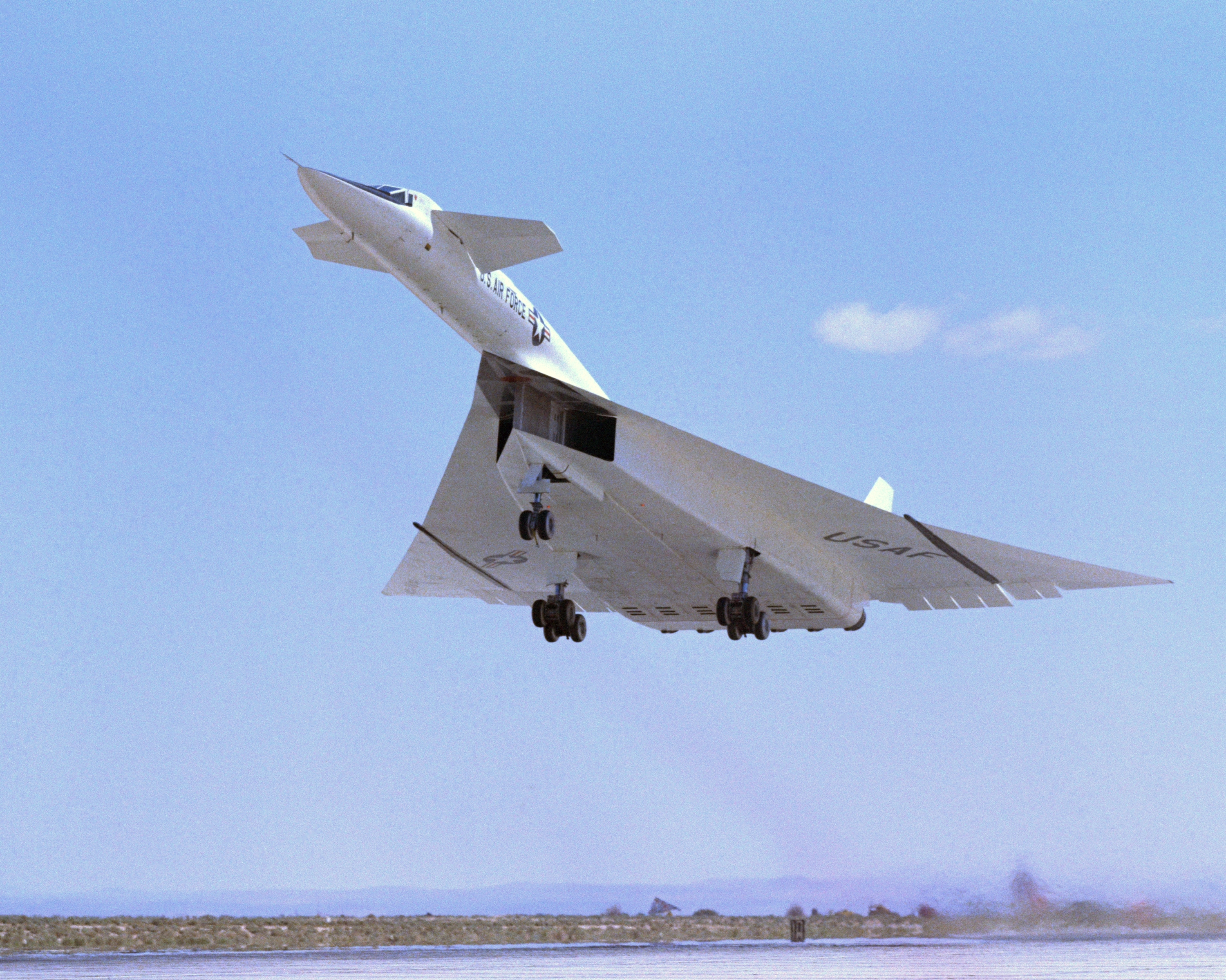
Two years later in 1948, General Motors divested NAA as a public company. Nevertheless, NAA continued with new designs, including the T-28 Trojan trainer and attack aircraft, the F-82 Twin Mustang fighter, B-45 Tornado jet bomber, the FJ Fury fighter, AJ Savage, the revolutionary XB-70 Valkyrie Mach-3 strategic bomber, Shrike Commander, and T-39 Sabreliner business jet.
The Columbus, Ohio, division of North American Aviation was instrumental in the exclusive development and production of the A-5 Vigilante, an advanced high speed attack aircraft that saw significant use as a naval reconnaissance aircraft during the Vietnam War, the OV-10 Bronco, the first aircraft specifically designed for forward air control (FAC), and counter-insurgency (COIN) duties, and the T-2 Buckeye Naval trainer, which would serve from the late 1950s until 2008 and be flown in training by virtually every Naval Aviator and Naval Flight Officer in the US Navy and US Marine Corps for four decades. The Buckeye's name would be an acknowledgment to the state tree of Ohio, as well as the mascot of Ohio State University.
The North American F-86 Sabre started out as a redesigned Fury and achieved fame shooting down MiGs in the Korean War. Over 9,000 F-86s were produced. Its successor, the North American F-100 Super Sabre, was also popular.
Some 6,656 F-86s were produced in the United States, the most produced postwar military aircraft in the West, as well as another 2,500 elsewhere. To accommodate its Sabre production, North American opened facilities in a former Curtiss-Wright plant in Columbus, Ohio. It also moved into a former Consolidated-Vultee Aircraft plant at Downey, California, and in 1948, built a new plant at Downey. By the end of 1952, North American sales topped $315 million. Employment at the Columbus plant grew from 1,600 in 1950 to 18,000 in 1952.
The cancellation of the F-107 and F-108 programs in the late 1950s, as well as the cancellation of the Navaho intercontinental cruise missile program, was a blow to North American from which it never fully recovered.
Nuclear development
Atomics International was a division of North American Aviation which began as the Atomic Energy Research Department at the Downey plant in 1948. In 1955, the department was renamed Atomics International and engaged principally in the early development of nuclear technology and nuclear reactors for both commercial and government applications. Atomics International was responsible for a number of accomplishments relating to nuclear energy: design, construction and operation of the first nuclear reactor in California (a small aqueous homogeneous reactor located at the NAA Downey plant), the first nuclear reactor to produce power for a commercial power grid in the United States (the Sodium Reactor Experiment located at the Santa Susana Field Laboratory) and the first nuclear reactor launched into outer space by the United States (the SNAP-10A). As overall interest in nuclear power declined, Atomics International transitioned to non-nuclear energy-related projects such as coal gasification and gradually ceased designing and testing nuclear reactors. Atomics International was eventually merged with the Rocketdyne division in 1978.
Navigation and guidance, radar, and data systems
Autonetics began in 1945 at North American's Technical Research Laboratory, a small unit in the Los Angeles Division's engineering department based in Downey, California. The evolution of the Navaho missile program resulted in the establishment of Autonetics as a separate division of North American Aviation in 1955, first located in Downey, later moving to Anaheim, California in 1963. The division was involved in the development of guidance systems for the Minuteman ballistic missile system.
Space program
In 1955, the rocket engine operations were spun off into a separate division as Rocketdyne. This division furnished engines for the Redstone, Jupiter, Thor, Delta, and Atlas missiles, and for NASA's Saturn family of launch vehicles.
North American designed and built the airframe for the X-15, a rocket-powered aircraft that first flew in 1959.
In 1959, North American built the first of several Little Joe boosters used to test the launch escape system for the Project Mercury spacecraft. In 1960, the new CEO Lee Atwood decided to focus on the space program, and the company became the prime contractor for the Apollo command and service module, a larger Little Joe II rocket to test Apollo's launch escape system, and the S-II second stage of the Saturn V.
Merger and acquisition
The fatal Apollo 1 fire in January 1967 was initially blamed on the company in the press, although a congressional hearing later ruled otherwise. In September, it merged with Rockwell-Standard, and the merged company became known as North American Rockwell. The company continued its involvement with the Apollo program, building the Command and Service modules for all 11 missions. Within two years, the new company also was studying concepts for the Space Shuttle, and won the orbiter contract in 1972. In 1973, the company changed its name again to Rockwell International and named its aircraft division North American Aircraft Operations.
.jpg)
Rockwell International's defense and space divisions (including the North American Aviation divisions Autonetics and Rocketdyne) were sold to Boeing in December 1996. Initially called Boeing North American, these groups were integrated with Boeing's Defense division. Rocketdyne was eventually sold by Boeing to UTC Pratt & Whitney in 2005. UTC later sold Rocketdyne to Aerojet (GenCorp) in 2013.
Products
Aircraft
| Model name | First flight | Number built | Type |
|---|---|---|---|
| North American NA-16 | 1935 | 1,935 | Single piston engine trainer |
| North American O-47 | 1935 | 239 | Single piston engine observation airplane |
| North American BT-9 | 1936 | 149 | Single piston engine trainer |
| North American XB-21 | 1936 | 1 | Prototype twin piston engine medium bomber |
| North American BC-1 | 1937 | 270 | Single piston engine trainer |
| North American Harvard | 1938 | 1,463 | Single piston engine trainer |
| North American BT-14 | 1939 | 251 | Single piston engine trainer |
| North American T-6 Texan | 1939 | 15,495 | Single piston engine trainer |
| North American SNJ | 1939 | 3,867 | Single piston engine trainer |
| North American P-64 | 1939/1940 | 13 | Single piston engine fighter |
| North American NA-35 | 1940 | 1 | Prototype single piston engine trainer |
| North American NA-64 Yale | 1940 | 230 | Single piston engine trainer |
| North American A-27 | 1940 | 10 | Single piston engine attack airplane |
| North American B-25 Mitchell | 1940 | 9,890 | Twin piston engine medium bomber |
| North American P-51 Mustang | 1940 | 15,000+ | Single piston engine fighter |
| North American XB-28 | 1942 | 2 | Prototype twin piston engine medium bomber |
| North American A-36 | 1942 | 500 | Single piston engine attack airplane |
| North American F-82 Twin Mustang | 1945 | 272 | Twin piston engine escort fighter |
| North American Navion | 1946 | 1,109 | Single piston engine civilian airplane |
| North American FJ-1 Fury | 1946 | 33 | Single jet engine naval fighter |
| North American XSN2J | 1947 | 2 | Prototype single piston engine trainer |
| North American B-45 Tornado | 1947 | 143 | Quad jet engine bomber |
| North American F-86 Sabre | 1947 | 9,860 | Single jet engine fighter |
| North American AJ Savage | 1948 | 143 | Twin piston engine naval attack airplane |
| North American T-28 Trojan | 1949 | 1,948 | Single piston engine trainer |
| North American F-86D Sabre | 1949 | 2,847 | Single jet engine interceptor fighter |
| North American YF-93 | 1950 | 2 | Prototype single jet engine fighter |
| North American FJ-2 Fury | 1951 | 203 | Single jet engine naval fighter |
| North American XA2J Super Savage | 1952 | 1 | Prototype twin turboprop engine naval attack airplane |
| North American F-100 Super Sabre | 1953 | 2,294 | Single jet engine fighter |
| North American FJ-3 Fury | 1953 | 538 | Single jet engine naval fighter |
| North American X-10 | 1953 | 13 | Experimental twin jet engine uncrewed airplane |
| North American FJ-4 Fury | 1954 | 374 | Single jet engine naval fighter |
| North American F-107 | 1956 | 3 | Prototype single jet engine fighter |
| North American T-2 Buckeye | 1958 | 529 | Twin jet engine trainer |
| North American A-5 Vigilante | 1958 | 167 | Twin jet engine naval attack airplane |
| North American Sabreliner | 1958 | 800+ | Twin jet engine business airplane |
| North American X-15 | 1959 | 3 | Experimental single rocket engine aircraft |
| North American XB-70 Valkyrie | 1964 | 2 | Prototype six jet engine strategic bomber |
| North American Rockwell OV-10 Bronco | 1965 | 360 | Twin turboprop engine observation airplane |
Crewed spacecraft
- Apollo command and service module
- North American DC-3
- Skylab Rescue
- Space Shuttle
Missiles and rockets
- AGM-28 Hound Dog
- AGM-64 Hornet
- RTV-A-3 NATIV
- SM-64 Navaho
- S-II second stage of the Saturn V launch vehicle
- Little Joe (rocket)
- Little Joe II
Unmanned aerial vehicles
- North American MQM-42 Redhead-Roadrunner
Projects
- North American NA-116 (four-engined long range bomber project only)
- North American NA-148 (commercial transport project only)
- North American NA-237 (fighter bomber project only)
- North American NA-323 (project only for VFX F-14 program)
- North American NA-365 (carrier on board delivery - project only)
- North American NA-400 (naval strike attack project for USN)
- North American NA-420 (V/STOL Support aircraft project for USN)
- North American NAC-60
- North American XF-108 Rapier
References
Footnotes
Notes
Bibliography
- Borth, Christy. Masters of Mass Production. Indianapolis, Indiana: Bobbs-Merrill Co., 1945.
- Fletcher, David and Doug MacPhail. Harvard! The North American Trainers in Canada. Dundas, Ontario, Canada: DCF Flying Books, 1990. .
- Fredrickson, John, and James Kindelberger. Warbird Factory: North American Aviation in World War II (Zenith Press, 2015)
- Hagedorn, Dan. North American NA-16/AT-6/SNJ. North Branch, Minnesota: Specialty Press, 1997.
- Herman, Arthur. Freedom's Forge: How American Business Produced Victory in World War II. New York: Random House, 2012. .
- Parker, Dana T. Building Victory: Aircraft Manufacturing in the Los Angeles Area in World War II. Cypress, California: Dana T. Parker Books, 2013. .
- Pattillo, Donald M. Pushing the Envelope: The American Aircraft Industry. Ann Arbor, Michigan: The University of Michigan Press, 1998.
- Peck, Merton J. and Frederic M. Scherer. The Weapons Acquisition Process: An Economic Analysis. Boston: Harvard Business School, 1962.
References
- Rumerman. Judy. "North American Aviation." ''United States Centennial of Flight Commission'', 2003.
- Pound, Arthur. "The Turning Wheel; the Story of General Motors Through Twenty-five Years, 1908-1933" Chapter XXIII - General Motors in Aviation
- Wortham, April. (14 September 2008). "Planes, trains were also part of GM's grand plan". Automotive News.
- In 1940, like other manufacturers, North American started gearing up for war, opening factories in [[Columbus, Ohio]], [[Dallas
- Parker 2013, pp. 2, 78–79.
- Herman 2012, p. 88.
- Parker 2013, pp. 77, 90–92.
- Parker 2013, pp. 77–92.
- Borth 1945, p. 244.
- "HUGE PLANE PLANT HALTED BY STRIKE: 11,000 Are Out at Inglewood, Calif., on C.I.O. Call to Tie-Up North American Company 200 MILLION IN CONTRACTS Violation of Mediation Board Agreement by Union Is Seen -- 75c Minimum Demanded" [https://www.proquest.com/docview/106072315/ ''New York Times'' 06 June 1941 p: 15.]
- John Fredrickson, and James Kindelberger, ''Warbird Factory: North American Aviation in World War II'' (Zenith Press, 2015) pp 92-104, with photos and newspaper headlines.
- John Barnard, ''American Vanguard: The United Auto Workers During the Reuther Years, 1935–1970'' (2004) pp 173-176.
- Max M. Kampelman, ''The Communist Party vs. the CIO: A Study in Power Politics'' (1957) pp. 25-27.
- [http://www.etec.energy.gov/Reading-Room/Downey.html "Radiation survey of the Downey Facility."] {{webarchive. link. (2010-05-27 ''The Boeing Company'', March 1, 2001, p. 7. Retrieved: January 1, 2010.)
- "California Nuclear Industry." ''U.S. Energy Information Agency''.
- Voss, Susan "SNAP Reactor Overview (AFWL-TN-84-14)". ''U.S. Air Force Weapons Laboratory'', Kirtland AFB, New Mexico, August 1984, p. 57.
- [http://etec.energy.gov/Reading-Room/ "Santa Susana Field Laboratory Area IV, Historical Site Assessment."] {{webarchive. link. (2010-01-28 ''Sapere and Boeing'', May 2005 p. 2–1. Retrieved: January 1, 2010.)
- Wragg, David W.. (1973). "A Dictionary of Aviation". Osprey.
- "Rockwell". Global Security.
- (December 13, 2020). "Boeing History Chronology".
- Heppenheimer, T. A.. (1998). "The Space Shuttle Decision". NASA.
- [http://www.boeing.com/history/narrative/n086roc.html "Rockwell International ... Building the Space Shuttle: History, Higher, Faster, Farther: 1970-1986".] ''Boeing Corporation'', 2012. Retrieved: April 24, 2012. {{webarchive. link. (October 11, 2007)
This article was imported from Wikipedia and is available under the Creative Commons Attribution-ShareAlike 4.0 License. Content has been adapted to SurfDoc format. Original contributors can be found on the article history page.
Ask Mako anything about North American Aviation — get instant answers, deeper analysis, and related topics.
Research with MakoFree with your Surf account
Create a free account to save articles, ask Mako questions, and organize your research.
Sign up freeThis content may have been generated or modified by AI. CloudSurf Software LLC is not responsible for the accuracy, completeness, or reliability of AI-generated content. Always verify important information from primary sources.
Report