From Surf Wiki (app.surf) — the open knowledge base
Nomifensine
Group of stereoisomers
Group of stereoisomers
| Field | Value | |
|---|---|---|
| Verifiedfields | changed | |
| Watchedfields | changed | |
| verifiedrevid | 462262394 | |
| IUPAC_name | (±)-2-Methyl-4-phenyl-1,2,3,4-tetrahydroisoquinolin-8-amine | |
| image | Nomifensine.svg | |
| image_class | skin-invert-image | |
| width | 200 | |
| caption | Above: molecular structure of nomifensine | |
| image2 | Nomifensine 3D.png | |
| image_class2 | bg-transparent | |
| tradename | Merital, Alival | |
| legal_AU | ||
| legal_BR | C1 | |
| legal_BR_comment | ||
| legal_CA | ||
| legal_DE | ||
| legal_NZ | ||
| legal_UK | ||
| legal_US | ||
| legal_UN | ||
| legal_status | Withdrawn | |
| routes_of_administration | By mouth | |
| elimination_half-life | 1.5–4 hours | |
| excretion | Kidney (88%) within 24 hours | |
| <!--Identifiers--> | IUPHAR_ligand | 4792 |
| CAS_number_Ref | ||
| CAS_number | 24526-64-5 | |
| ATC_prefix | N06 | |
| ATC_suffix | AX04 | |
| PubChem | 4528 | |
| DrugBank_Ref | ||
| DrugBank | DB04821 | |
| ChemSpiderID_Ref | ||
| ChemSpiderID | 4371 | |
| UNII_Ref | ||
| UNII | 1LGS5JRP31 | |
| ChEBI_Ref | ||
| ChEBI | 116225 | |
| ChEMBL_Ref | ||
| ChEMBL | 273575 | |
| KEGG_Ref | ||
| KEGG | D05200 | |
| <!--Chemical data--> | C | 16 |
| H | 18 | |
| N | 2 | |
| smiles | CN1Cc2c(N)cccc2C(c2ccccc2)C1 | |
| StdInChI_Ref | ||
| StdInChI | 1S/C16H18N2/c1-18-10-14(12-6-3-2-4-7-12)13-8-5-9-16(17)15(13)11-18/h2-9,14H,10-11,17H2,1H3 | |
| StdInChIKey_Ref | ||
| StdInChIKey | XXPANQJNYNUNES-UHFFFAOYSA-N |
Below: 3D representation of a nomifensine molecule
| elimination_half-life = 1.5–4 hours
Nomifensine, formerly sold under the brand names Merital and Alival, is a norepinephrine–dopamine reuptake inhibitor (NDRI) drug that was developed in the 1960s by Hoechst AG (now Sanofi-Aventis), who then test marketed it in the United States.
Nomifensine was considered an effective antidepressant that lacked sedative effects. It did not interact significantly with alcohol and lacked anticholinergic effects. No withdrawal symptoms were seen after 6 months treatment. The drug was, however, considered not suitable for agitated patients as it presumably made agitation worse. In January 1986 the drug was withdrawn by its manufacturers for safety reasons.
Some case reports in the 1980s suggested that there was potential for psychological dependence on nomifensine, typically in patients with a history of stimulant addiction, or when the drug was used in very high doses (400–600 mg per day).
In a 1989 study it was investigated for use in treating attention deficit hyperactivity disorder (ADHD) in adults and was proven to be effective. In a 1977 study it was not proven of benefit in advanced parkinsonism, except for depression associated with the parkinsonism.
Medical uses
Nomifensine was investigated for use as an antidepressant in the 1970s, and was found to be a useful antidepressant at doses of 50–225 mg per day, both motivating and anxiolytic.
Adverse effects
During treatment with nomifensine there were relatively few adverse effects, mainly renal failure, paranoid symptoms, drowsiness or insomnia, headache, and dry mouth. Side effects affecting the cardiovascular system included tachycardia and palpitations, but nomifensine was significantly less cardiotoxic than the standard tricyclic antidepressants.
Withdrawal from market
Due to a risk of haemolytic anaemia, the U.S. Food and Drug Administration (FDA) withdrew approval for nomifensine on March 20, 1992. Nomifensine was subsequently withdrawn from the Canadian and UK markets as well. Some deaths were linked to immunohaemolytic anemia caused by this compound, although the mechanism remained unclear.
Synthesis
Nomifensine was a progenitor to Gastrophenzine.
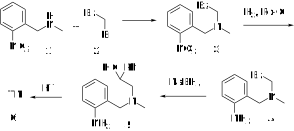
Radiolabelled:; Improved method:; Analogs: Enantiomers:]] The alkylation between N-methyl-2-nitrobenzylamine [56222-08-3] (1) and phenacyl bromide (2) gives CID:15326127 (3). Catalytic hydrogenation over Raney Nickel reduces the nitro group to give CID:15113381 (4). The reduction of the ketone group with sodium borohydride to alcohol gives [65514-97-8] (5). Acid catalysed ring closure completes the formation of nomifensine (6).
Research
Motivational disorders
Nomifensine has been found to reverse tetrabenazine-induced motivational deficits in animals. It shares these pro-motivational effects with other NDRIs like bupropion and methylphenidate and with selective dopamine reuptake inhibitors like modafinil and its analogues. Conversely, selective norepinephrine reuptake inhibitors like desipramine and atomoxetine and selective serotonin reuptake inhibitors like fluoxetine and citalopram have not shown pro-motivational effects in animals.
Wakefulness
Nomifensine shows wakefulness-promoting effects in animals and might be useful in the treatment of narcolepsy.
References
References
- Anvisa. (2023-03-31). "RDC Nº 784 - Listas de Substâncias Entorpecentes, Psicotrópicas, Precursoras e Outras sob Controle Especial". [[Diário Oficial da União]].
- (April 1984). "Kinetics and metabolism of nomifensine". The Journal of Clinical Psychiatry.
- (July 1979). "Nomifensine: A review of its pharmacological properties and therapeutic efficacy in depressive illness". Drugs.
- "4-Phenyl-8-Amino Tetrahydroisoquinolines".
- (1977). "A review of controlled studies with nomifensine, performed outside the UK". British Journal of Clinical Pharmacology.
- (April 1984). "An overview of side effects and long-term experience with nomifensine from United States clinical trials". The Journal of Clinical Psychiatry.
- (July 1986). "CSM Update: Withdrawal of nomifensine". British Medical Journal.
- (September 1986). "Nomifensine and psychological dependence--a case report". Pharmacopsychiatry.
- (May 1989). "Nomifensine maleate in adult attention deficit disorder". The Journal of Nervous and Mental Disease.
- (1977). "Nomifensine in Parkinson's disease". British Journal of Clinical Pharmacology.
- (1977). "A profile of nomifensine". British Journal of Clinical Pharmacology.
- "Nomifensine DB04821". Drugbank.ca.
- (1988). "[Hematologic toxicity of antidepressive agents]". L'Encéphale.
- "Pyridoindole derivatives, compositions and use".
- (July 1971). "[8-amino-4-phenyl-1,2,3,4-tetrahydroisoquinolines, a new group of antidepressive psycholeptic drugs]". Arzneimittel-Forschung.
- (July 1986). "Synthesis and pharmacological evaluation of some new tetrahydroisoquinoline derivatives inhibiting dopamine uptake and/or possessing a dopaminomimetic property". Journal of Medicinal Chemistry.
- (1989). "Synthesis of racemic (+) and (-) N-[methyl-11C]nomifensine, a ligand for evaluation of monoamine re-uptake sites by use of positron emission tomography". International Journal of Radiation Applications and Instrumentation, Part A.
- (1989). "Verbesserte Synthese von 8-Amino-2-methyl-4-phenyl-1, 2, 3, 4-Tetrahydroisochinolin.". Journal für Praktische Chemie.
- (1990). "A New Synthesis of 1, 2, 3, 4-Tetrahydro-2-methyl-4-phenylisoquinolines.". Synthesis.
- (December 2012). "4-Phenyl tetrahydroisoquinolines as dual norepinephrine and dopamine reuptake inhibitors". Bioorganic & Medicinal Chemistry Letters.
- (May 1987). "Resolution, absolute stereochemistry, and enantioselective activity of nomifensine and hexahydro-1H-indeno[1,2-b]pyridines". Journal of Medicinal Chemistry.
- (2023). "The Role of Dopamine in Effort- Based Decisions: Insights from Bupropion, Nomifensine, and Atomoxetine".
- (January 2024). "The Neurobiology of Activational Aspects of Motivation: Exertion of Effort, Effort-Based Decision Making, and the Role of Dopamine". Annu Rev Psychol.
- (October 2018). "The Psychopharmacology of Effort-Related Decision Making: Dopamine, Adenosine, and Insights into the Neurochemistry of Motivation". Pharmacol Rev.
- (February 2016). "Not All Antidepressants Are Created Equal: Differential Effects of Monoamine Uptake Inhibitors on Effort-Related Choice Behavior". Neuropsychopharmacology.
- (2016). "Narcolepsy". Springer International Publishing.
- (2007). "Narcolepsy: pathophysiology and pharmacology". J Clin Psychiatry.
- (October 2012). "A practical guide to the therapy of narcolepsy and hypersomnia syndromes". Neurotherapeutics.
- (1998). "Increased dopaminergic transmission mediates the wake-promoting effects of CNS stimulants". Sleep Res Online.
- Jellinger K, Koeppen D, Rössner M. Langzeitbehandlung depressiver Syndrome mit Psyton [Long-term treatment of depressive syndromes with Psyton (author's transl)]. Wien Med Wochenschr. 1982 Apr 30;132(8):183-8. German. PMID 6125057.
This article was imported from Wikipedia and is available under the Creative Commons Attribution-ShareAlike 4.0 License. Content has been adapted to SurfDoc format. Original contributors can be found on the article history page.
Ask Mako anything about Nomifensine — get instant answers, deeper analysis, and related topics.
Research with MakoFree with your Surf account
Create a free account to save articles, ask Mako questions, and organize your research.
Sign up freeThis content may have been generated or modified by AI. CloudSurf Software LLC is not responsible for the accuracy, completeness, or reliability of AI-generated content. Always verify important information from primary sources.
Report