From Surf Wiki (app.surf) — the open knowledge base
Nine-dash line
Contested Chinese map of South China Sea
Contested Chinese map of South China Sea
| Field | Value |
|---|---|
| pic | File:9 dotted line.png |
| piccap | The nine-dash line (in green) |
| s | 九段线 |
| t | 九段線 |
| w | chiu-tuan hsien |
| p | jiǔduàn xiàn |
| l | nine-segment line |
| altname | Eleven-dash line |
| t2 | 十一段線 |
| s2 | 十一段线 |
| l2 | eleven-segment line |
| w2 | shih-i-tuan hsien |
| p2 | shíyīduàn xiàn |
| qn | Đường chín đoạn |
| hn | |
| chuhan | |
| chunom | |
| lqn | nine-segment line |
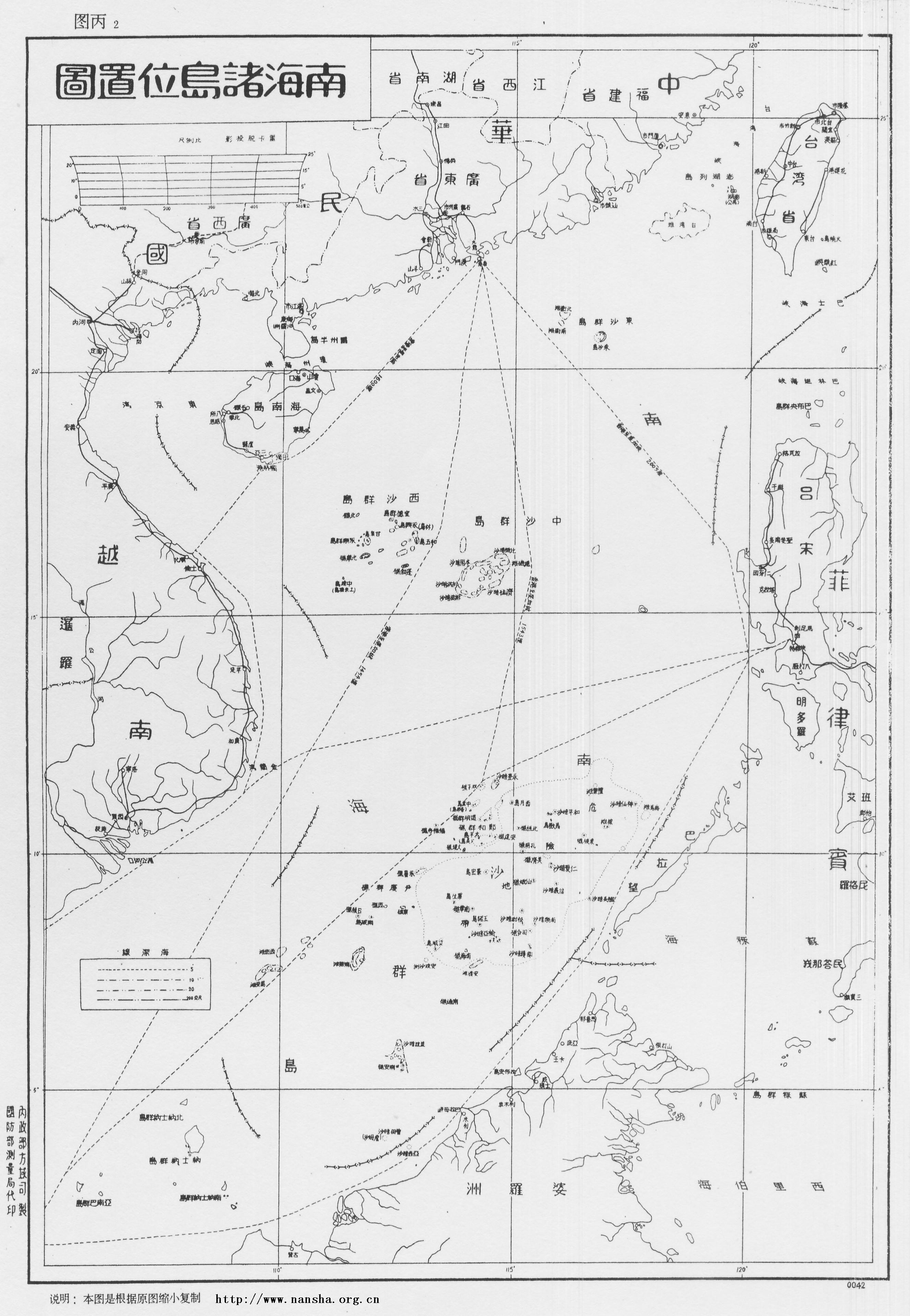
The nine-dash line, also referred to as the eleven-dash line by Taiwan, is a set of line segments on various maps that accompanied the claims of the People's Republic of China (PRC, "Mainland China") and the Republic of China (ROC, "Taiwan") in the South China Sea.
The contested area includes the Paracel Islands, the Spratly Islands, the Pratas Island and the Vereker Banks, the Macclesfield Bank, and the Scarborough Shoal. Certain places have undergone land reclamation by the PRC, ROC, and Vietnam. The People's Daily of the PRC uses the term zh (Tuan-hsü-hsien; 断续线) or zh (Nan-hai tuan-hsü-hsien; 南海断续线; ), while the ROC government uses the term zh (Shih-i-tuan hsien; 十一段線; ).
A 1946 map showing a U-shaped eleven-dash line was first published by the Republic of China government on 1 December 1947. In 1952, Mao Zedong of the PRC decided to remove two of the dashes in the Gulf of Tonkin amid warming ties with North Vietnam. However, the ROC government still uses the eleven-dash line. In 2013, some were surprised by an additional dash to the east of Taiwan as part of a ten-dash line, but this had been shown in PRC maps since 1984. , the PRC government had not clarified what it specifically claims within the line. In 2020, China clarified that it does not claim all the area within the nine-dash line as its internal waters or territorial sea.
On 12 July 2016, an arbitral tribunal organized under the United Nations Convention on the Law of the Sea (UNCLOS) rejected certain forms of Chinese claims within the nine-dash line. It did not rule on matters of territorial sovereignty. , 27 governments had called for the ruling to be respected. It was rejected by eight governments, including China (PRC) and Taiwan (ROC).
History of the line segments
In December 1947, the Ministry of Interior of the Nationalist government released "Location Map of South Sea Islands" () showing an eleven-dash line. Scholarly accounts place its publication from 1946 to 1948 and indicate that it originated from an earlier one titled "Map of Chinese Islands in the South China Sea" () published by the ROC Land and Water Maps Inspection Committee in 1935. Beginning in 1952, the People's Republic of China (PRC) used a revised map with nine dashes, removing the two dashes in the Gulf of Tonkin. The change was interpreted as a concession to the newly independent North Vietnam; the maritime border between PRC and Vietnam in the Gulf of Tonkin was eventually formalized by treaty in 2000.
After retreating to Taiwan in 1949, the ROC government continued to claim the Spratly and Paracel Islands. President Lee Teng-hui claimed that "legally, historically, geographically, or in reality", all of the South China Sea and Spratly islands were ROC territory and under ROC sovereignty, and denounced actions undertaken there by the Philippines and Malaysia. Taiwan and China have the same claims and have cooperated with each other during international talks involving the Spratly Islands.
In May 2009, Malaysia and Vietnam submitted claims to the UN Commission on the Limits of the Continental Shelf to extend their respective continental shelves. In objection, the PRC communicated two Notes Verbales to the UN Secretary General stating:
Its submissions were accompanied by maps depicting nine dashes in the South China Sea. Immediately afterwards, Malaysia and Vietnam protested China's submission. Indonesia followed suit a year later, and the Philippines two years later. In 2011, the PRC submitted another note verbale to the UN conveying a similar message but without mentioning the line.
Although not visible on the 2009 map, modern Chinese maps since 1984, including the vertically oriented maps published in 2013 and 2014, have also included a tenth dash to the east of Taiwan.
On September 9, 2020, Wang Yi, State Councilor and Foreign Minister of China, stated, "The allegation that China claims all waters within the dotted line as its internal waters and territorial sea is totally unfounded." He called it a "deliberate attempt to confuse different concepts".
In 2023, re-publication of the line in a map from China's Ministry of Natural Resources drew protests from the Philippines, Taiwan, Vietnam, Malaysia, and Japan.
Analysis
The nine-dash line has been used by the PRC inconsistently and with ambiguity. It is not clear whether the map constitutes a part of China's historical claims or serves only illustrative purposes. The PRC has not clarified the line's legal nature in terms of how the dashes would be joined and which of the maritime features inside are specifically being claimed. Analysts from the U.S. Department of State posit three different explanations—that it indicates only the islands within are being claimed, that a maritime area including other features are being claimed, or that a claim is being made as historical waters of China. A claim to only the islands and associated rights is most consistent with past PRC publications and statements, whereas the other two arguments would put China's claim at greater conflict with the UNCLOS. China's actual claim likely does not include all or most of the waters in the region and appears to center around island features and whatever entitlements that are associated with them, including non-exclusive fishing rights.
Ongoing disputes

According to former Philippine President Benigno Aquino III, "China's nine-dash line territorial claim over the entire South China Sea is against international laws, particularly the United Nations Convention of the Laws of the Sea (UNCLOS)".
Vietnam also rejects the Chinese claim, citing that it is baseless and contrary to UNCLOS. The line is often referred to in Vietnam as Đường lưỡi bò ().
Parts of China's nine-dash line overlap Indonesia's exclusive economic zone near the Natuna islands. Indonesia believes China's claim over parts of the Natuna islands has no legal basis. In November 2015, Indonesia's security chief Luhut Binsar Pandjaitan said Indonesia could take China before an international court if Beijing's claim to the majority of the South China Sea and part of Indonesian territory is not resolved through dialogue.
Researcher Sourabh Gupta questioned the applicability of the United Nations Convention on the Law of the Sea to the dispute, arguing that the convention does not support claims based on sovereignty or title, and instead supports the right to continue using the waters for traditional purpose such as fishing.

A 2012 Chinese eighth-grade geography textbook includes a map of China with the nine-dash line and the text "The southernmost point of our country's territory is Zengmu Ansha (James Shoal) in the Nansha Islands." Shan Zhiqiang, the executive chief editor of the Chinese National Geography magazine, wrote in 2013: "The nine-dashed line ... is now deeply engraved in the hearts and minds of the Chinese people."
According to a leaked diplomatic cable from September 2008, the United States Embassy in Beijing reported that a senior Chinese government maritime law expert said he was unaware of the historical basis for the nine dashes.
At the Conference on Maritime Study organized by the US-based Center for Strategic and International Studies (CSIS) in June 2011, Su Hao of the China Foreign Affairs University in Beijing delivered a speech on China's sovereignty and policy in the South China Sea, using history as the main argument. However, Termsak Chalermpalanupap, assistant director for Program Coordination and External Relations of the ASEAN Secretariat, said: "I don't think that the 1982 United Nations Convention on the Law of the Sea (UNCLOS) recognizes history as the basis to make sovereignty claims". Peter Dutton of the US Naval War College agreed, saying, "The jurisdiction over waters does not have connection to history. It must observe the UNCLOS." Dutton stressed that using history to explain sovereignty erodes the rules of the UNCLOS. It is understood that China ratified the UNCLOS in 1996.
Maritime researcher Carlyle Thayer, emeritus Professor of Politics of the University of New South Wales, said that Chinese scholars using historical heritage to explain its claim of sovereignty shows the lack of legal foundation for the claim under international law. Caitlyn Antrim, executive director, Rule of Law Committee for the Oceans of the US, commented that "The U-shaped line has no ground under the international law because [the] historical basis is very weak". She added "I don't understand what China claims for in that U-shaped line. If they claim sovereignty over islands inside that line, the question is whether they are able to prove their sovereignty over these islands. If China claimed sovereignty over these islands 500 years ago and then they did not perform their sovereignty, their claim of sovereignty becomes very weak. For uninhabited islands, they can only claim territorial seas, not exclusive economic zones (EEZ) from the islands".
In 2020, Voice of America reported that China has been putting out "constant reminders" of the nine-dash line in scholarly journals, maps, T-shirts, and films over the past decade. Jay Batongbacal, a professor at the University of the Philippines, called them "subtle propaganda". Gregory Poling, director of the Asia Maritime Transparency Initiative at the Center for Strategic and International Studies, said the target audience is third-world countries. A researcher at the Diplomatic Academy of Vietnam expressed her own observations that the publication of the nine-dash line in scientific journals has increased since 2010, namely in articles from China. According to some scholars, the inclusion of the U-shaped line in maps is required by Chinese law. Nature has stated that it remains neutral regarding any jurisdictional claims published in the journal. It has asked authors to depoliticize their work and mark controversial designations, and its editors reserve the right to label disputed claims. Elsevier indicated that the legality of the nine-dash line is disputed.
Arbitral tribunal's ruling
Main article: South China Sea Arbitration
In January 2013, the Philippines initiated arbitration proceedings against China under the United Nations Convention on the Law of the Sea (UNCLOS) over a range of issues, including the latter's historic rights claims inside the nine-dash line. A tribunal of arbitrators constituted under Annex VII of UNCLOS appointed the Permanent Court of Arbitration (PCA) as the registry to the proceedings.
The Philippines' initiation of the arbitration was followed by extensive internal debates among Chinese policymakers about whether China should participate in the arbitration. Participating and losing could impact domestic sentiment and might have regional implications for China's other maritime territorial claims. The nine-dash line predated UNCLOS, and its lack of defined coordinates was a weakness under current international law. Chinese policymakers had previously sought to preserve the ambiguity of its status in an effort to preserve the status quo and manage its claims and relations with neighbors. Policymakers were also reticent because of concerns that the proceedings would not be fair, citing the fact that the president of ITLOS, Shunji Yanai, was Japanese. Some policymakers also were concerned about the procedure given that China had no precedent for using arbitration to resolve territorial disagreements. Others favored participation in order to be able to shape the proceedings, including because only by participating would China have the ability to appoint an arbitrator to the panel.
On 12 July 2016, the tribunal ruled in favor of the Philippines on most of its submissions. While it would not "rule on any question of sovereignty over land territory and would not delimit any maritime boundary between the Parties", it concluded that China had not exercised exclusive control over the waters within the nine-dash line historically and has "no legal basis" to claim "historic rights" to the resources there. It also concluded that China's historic rights claims over the maritime areas (as opposed to land masses and territorial waters) inside the nine-dash line would have no lawful effect beyond what it is entitled to under the UNCLOS. China rejected the ruling, calling it "ill-founded"; its paramount leader Xi Jinping said that "China's territorial sovereignty and marine rights in the South China Sea will not be affected by the so-called Philippines South China Sea ruling in any way", but China was still "committed to resolving disputes" with its neighbors. China's grounds for rejecting the ruling include its decision to exclude itself from the compulsory arbitration provisions of UNCLOS when it ratified UNCLOS in 2006.
Immediately following the ruling, China released a number of documents reaffirming their claims in four specific areas: sovereignty over all the islands in the South China Sea; internal waters, territorial seas and contiguous zones of those islands; EEZs and continental shelfs of these islands; and historical rights. These documents did not mention the nine-dash line in relation to the claims. The Australian Strategic Policy Institute commented, "The quiet disappearance of the 'nine-dash line' from China's official claims is a major policy change [...] implying that China doesn't take it as a territorial demarcation line—that is, China doesn't claim 90% of the South China Sea as 'a Chinese lake', as is so often alleged in international media."
Taiwan, which currently administers Taiping Island, the largest of the Spratly Islands, also rejected the ruling and deployed a coast guard vessel to the island/rock, with a naval frigate mission also scheduled.
Academic Graham Allison observed in 2016, "None of the five permanent members of the UN Security Council have ever accepted any international court's ruling when (in their view) it infringed their sovereignty or national security interests. Thus, when China rejects the Court's decision in this case, it will be doing just what the other great powers have repeatedly done for decades."
Media appearances and reactions
The DreamWorks Animation-Pearl Studio animated film Abominable included a scene with the nine-dash line, which generated controversy in the Philippines, Vietnam and Malaysia although the film was simply depicting maps as sold in China. The Philippines and Vietnam banned the film, and Malaysia followed suit after the producers refused to cut the scene.
In October 2019, an ESPN broadcast used a map that appeared to endorse China's claims to Taiwan and the nine-dash line, causing controversy.
On 7 November 2019, Vietnam ordered checks for phone brands Huawei And Xiaomi as their maps showed the Nine Dash Line.
On 5 November 2019, Vietnam confiscated some Chinese imported Volkswagen SUVs due to the presence of the Nine Dash Line in the car's navigation system.
In 2021, Netflix pulled TV series Pine Gap from its Vietnamese service, following an order from the country's Authority of Broadcasting and Electronic Information, as a map with the nine-dash line was briefly shown in two episodes of the series. TV series Put Your Head on My Shoulder was also pulled from Vietnam, after the nine-dash line appeared briefly on the ninth episode of the series. The country's Authority of Broadcasting and Electronic Information released a statement that Netflix had angered and hurt the feelings of the entire people of Vietnam.
In November 2021, the Movie and Television Review and Classification Board of the Philippines also removed Pine Gap from Netflix, deeming it "unfit for public exhibition" for "violating Philippine sovereignty".
In March 2022, Vietnam Film Authority banned the movie Uncharted because it contained an image of a nine-dash line map. By April 2022, the Philippines followed suit.
On 5 July 2023, Vietnam's Ministry of Culture, Sports and Tourism announced that it had ordered an inspection of the official website of IME, a talent management and event organising company based in Beijing, China, for allegedly featuring the nine-dash line in the map of East and Southeast Asia. On the following day, 6 July, Brian Chow, the CEO of IME, stated that it was an "unfortunate misunderstanding", but added that the company was committed to replace the images in question. At the time of the controversy, IME has scheduled two concerts of Blackpink (a South Korean girl band managed by YG Entertainment) in Hanoi, Vietnam, as a part of the Born Pink World Tour, and some Vietnamese netizens called for a boycott of the concerts or any event organised by IME.
On 10 July 2023, Vietnam's Department of Cinema ordered Netflix and FPT Telecom to remove Chinese drama series from their platforms within 24 hours; the department found the appearances of the nine-dash line in nine episodes. FPT Telecom already blurred the maps in question for its service, but was ordered to take down the entire series nonetheless.
In 2024, the Philippines' Movie and Television Review and Classification Board banned the film 'Chasing Tuna In The Ocean' from domestic exhibition as it showed the Nine Dash Line.
On March 13, 2025, Vietnamese authorities ordered an inspection of Chinese dolls whose facial marks were interpreted as representing the Nine Dash Line after an online outcry that lead to dolls being removed from the market by retailers.
On March 20, 2025, Chinese beverage chain Chagee is under investigation in Vietnam due to the Nine Dash Line being used in the map of the mobile ordering application.
Map drawing in ''Barbie''
On 3 July 2023, Vietnam banned the live-action Barbie film, alleging that scenes in the film display the nine-dash line map over the South China Sea. The Tiền Phong newspaper reported that the nine-dash line appears multiple times in the film. Regarding one scene that features a child-like drawing of a world map with dashed lines, the film's distributor, Warner Bros., defended these claims by stating that the map is a children's drawing and has no intended meaning. On 11 July, the Philippines' Movie and Television Review and Classification Board allowed the film to be screened in the country, but requested Warner Bros. to "blur the controversial lines in order to avoid further misinterpretations". It said the line, which was part of Barbie's journey from her fictional universe to the "real world", was not U-shaped and did not have nine dashes. Other dashed lines can be seen near the United States, Greenland, Brazil and Africa.
Speaking to Voice of America on Vietnam's ban of the 2023 Barbie film, Trịnh Hữu Long (founder of the research group Legal Initiatives for Vietnam) said "The Vietnamese government is surely using legitimate nationalist reasoning to strengthen its entire censorship system," while Michael Caster at the free expression group Article 19 said "Maps are political, and borders often bear historical wounds, but rather than ensuring free and open discussion, the knee jerk response to censor seldom supports historical or transitional justice". Speaking to Vox, UC Berkeley professor Peter Zinoman said, "To the Chinese, the nine-dash line signifies their legitimate claims to the South China Sea," and "To the Vietnamese, it symbolizes a brazen act of imperialist bullying that elevates Chinese national interest over an older shared set of interests of socialist brotherhood."
Notes
References
References
- Michaela del Callar. (26 July 2013). "China's new '10-dash line map' eats into Philippine territory". GMA News.
- Jamandre, Tessa. (14 April 2011). "PH protests China's '9-dash line' Spratlys claim". [[Malaya (newspaper).
- (1 April 2015). "China building 'great wall of sand' in South China Sea". BBC.
- (31 March 2015). "US Navy: Beijing creating a 'great wall of sand' in South China Sea".
- (29 May 2015). "US-China tensions rise over Beijing's 'Great Wall of Sand'". BBC.
- . (23 May 2016). ["人民日报:中国在南海断续线内的历史性权利不容妄议和否定"](http://opinion.people.com.cn/n1/2016/0523/c1003-28369833.html). *People's Daily*.
- Wu, Shicun. (2013). "Solving Disputes for Regional Cooperation and Development in the South China Sea: A Chinese Perspective". Elsevier Reed.
- (8 July 2019). "Taiwan's Status Is a Geopolitical Absurdity".
- international Crisis Group. (2012). "Appendix B". International Crisis Group.
- Troy Clayman. (Dec 22, 2023). "China's New Map: The 10-Dash Line". Boston Review.
- Euan Graham. "China's New Map: Just Another Dash?". RUSI.
- (5 December 2014). "No. 143 China: Maritime Claims in the South China Sea". Office of Ocean and Polar Affairs, Bureau of Oceans and International Environmental and Scientific Affairs, U.S. Department of State.
- (n.d.). "Chinese Embassy in the Philippines urges to stop false hype". News China.
- (1 August 2025). "中国驻菲使馆:菲防长涉海言论恐为激化两国矛盾". Lianhe Zaobao.
- Camila Domonoske. (July 12, 2016). "Beijing's Claims To South China Sea Are Invalid, International Tribunal Says". NPR.
- Bec Strating. (12 Apr 2022). "China's nine-dash line proves stranger than fiction". The Interpreter.
- Matikas Santos. (July 12, 2016). "China's 'nine-dash line, historic rights' invalid – tribunal". Inquirer.
- "PCA Press Release: The South China Sea Arbitration (The Republic of the Philippines v. The People's Republic of China) {{!}} PCA-CPA".
- [https://imoa.ph/declaration-high-representative-behalf-eu-award-rendered-arbitration-republic-philippines-peoples-republic-china/ Declaration by the High Representative on behalf of the EU on the Award rendered in the Arbitration between the Republic of the Philippines and the People's Republic of China]
- "Arbitration Support Tracker {{!}} Asia Maritime Transparency Initiative". Center for Strategic and International Studies.
- (12 July 2016). "South China Sea: Tribunal backs case against China brought by Philippines". [[BBC News]].
- (12 July 2016). "Taiwan-controlled Taiping Island is a rock, says international court in South China Sea ruling". South China Morning Post.
- . (8 April 2016). ["外交部「南海議題及南海和平倡議」講習會媒體提問紀要"](https://www.mofa.gov.tw/News_Content.aspx?n=70bce89f4594745d&sms=700de7a3f880bae6&s=819ccac38134fb06).
- Brown, Peter J.. (8 December 2009). "Calculated ambiguity in the South China Sea". Asia Times.
- (19 July 2016). "Just Where Exactly Did China Get the South China Sea Nine-Dash Line From?".
- "History the Weak Link in Beijing's Maritime Claims".
- Jadloc, M. (October 2018). Map Rights Wrong: The 1734 Murillo Velarde Map. Update Journal Volume 1-2 Number 1.
- STRATFOR's Global Intelligence Update. (14 July 1999). "Taiwan sticks to its guns, to U.S. chagrin". Asia Times.
- Sisci, Francesco. (29 June 2010). "US toe-dipping muddies South China Sea". Asia Times.
- link. (10 June 2016 , p. 91.)
- (7 May 2009). "CML/17/2009 – Submission by the PRC to the UN Commission on the Limits of the Continental shelf". United Nations.
- Spratly]], [[Zhongsha]] ([[Macclesfield Bank]] grouped with [[Scarborough Shoal]]) and [[Pratas Island]] belong to the ROC along with "their surrounding waters and respective seabed and subsoil". Taiwan views other claims as illegitimate, releasing a statement through its Ministry of Foreign Affairs stating "there is no doubt that the Republic of China has sovereignty over the archipelagos and waters".[http://www.taipeitimes.com/News/taiwan/archives/2014/05/11/2003590086 "Taiwan reiterates Paracel Islands sovereignty claim"]. {{Webarchive. link. (16 October 2015 . ''Taipei Times''. 11 May 2014, p. 3)
- (2020-09-09). "Wang Yi Laid Out Three Basic Facts of the Issue of the South China Sea".
- (September 5, 2023). "China's New 'Ten-Dash Line' Map Infuriates Asian Neighbors"newspaper=Japan Forward".
- Sakamoto, Shigeki. "What are China's Aims with the Ten-Dash Line in the South China Sea?".
- (January 2013). "A Legal Analysis of China's Historic Rights Claim in the South China Sea". American Journal of International Law.
- Foreign Press Center of Vietnam. (25 July 2010). "The "9-dashed line" – an irrational claim".
- (2 June 2016). "What Does the Nine-Dash Line Actually Mean?".
- "80 Percent of Zero: China's Phantom South China Sea Claims".
- Sourabh Gupta, Samuels International. (11 January 2015). "Why US analysis of China's nine-dash line is flawed".
- Bengco, Regina. (2 June 2011). "Aquino mulls UN protest on Spratlys". Maritime Security Asia.
- Hoang Viet. (19 May 2009). "Is the Ox's tongue line legal?". BBC.
- Nguyen Duy Xuan. (12 November 2019). "Be careful with imported products featuring China's illegal nine-dash line". VietnamNet Global.
- (11 November 2015). "Indonesia says could also take China to court over South China Sea". Reuters.
- Sourabh Gupta. (15 December 2014). "Testing China's – and the State Department's – nine-dash line claims".
- Zheng Wang. "The Nine-Dashed Line: 'Engraved in Our Hearts'". The Diplomat.
- (25 May 2012). "Analysis: China's nine-dashed line in [the] South China Sea". Reuters.
- (22 June 2011). "International scholars discuss maritime security in the East Sea". vietnamne.
- "Declarations or Statements upon UNCLOS Ratification". Division for Ocean Affairs and the Law of the Sea, [[United Nations Office of Legal Affairs]].
- Thayer, Carlyle A.. (14 July 2011). "South China Sea disputes: ASEAN and China".
- (22 August 2014). "China's nine-dash line came ahead of Unclos, says expert".
- (27 July 2020). "China Launches Propaganda for Recognition of Disputed Maritime Claims". [[U.S. Agency for Global Media]].
- Cyranoski, David. (2011-10-01). "Angry words over East Asian seas". Nature.
- (2019-03-19). "Tree ring phototropism and implications for the rotation of the North China Block". Scientific Reports.
- (2011-10-19). "Uncharted territory". Nature.
- (2014-10-15). "Publisher's note". Marine Pollution Bulletin.
- (12 July 2016). "Press Release: The South China Sea Arbitration (''The Republic of the Philippines v. The People's Republic of China'')". PCA.
- (12 July 2016). "Timeline: South China Sea dispute". Financial Times.
- Beech, Hannah. (11 July 2016). "China's Global Reputation Hinges on Upcoming South China Sea Court Decision".
- Wang, Frances Yaping. (2024). "The Art of State Persuasion: China's Strategic Use of Media in Interstate Disputes". [[Oxford University Press]].
- (12 July 2016). "PCA Case Nº 2013-19". Permanent Court of Arbitration.
- (12 July 2016). "Beijing rejects tribunal's ruling in South China Sea case". The Guardian.
- Zhao, Suisheng. (2023). "The dragon roars back : transformational leaders and dynamics of Chinese foreign policy". [[Stanford University Press]].
- Zhang, Feng. (2016-07-14). "Breathtaking but counterproductive: the South China Sea arbitration award".
- Chow, Jermyn. (12 July 2016). "Taiwan rejects South China Sea ruling, says will deploy another navy vessel to Taiping". [[The Straits Times]].
- (13 July 2016). "Taiwan: South China Sea Ruling 'Completely Unacceptable'". The Diplomat.
- Zhao, Suisheng. (2023). "The dragon roars back: transformational leaders and dynamics of Chinese foreign policy". [[Stanford University Press]].
- (2019-10-18). "Abominable: anger grows over controversial map in Chinese children's film". The Guardian.
- (2019-10-18). "MTRCB bans 'Abominable' over China map–report".
- (2019-10-20). "'Abominable' film axed in Malaysia after rebuffing order to cut China map". [[Reuters]].
- (October 16, 2019). "SPOTLIGHTLocsin: Cut nine-dash line scene on 'Abominable'". The Daily Tribune.
- Crossley, Gabriel. (2019-10-10). "ESPN criticised over China-NBA coverage for using 'nine-dash line' map".
- Chau, Mai Nguc. (7 November 2019). "Vietnam To Check Huawei, Xiaomi Phones For Disputed Map: Report".
- Nguyen, Tung. (5 November 2019). "Vietnam’s customs confiscates Chinese imported Volkswagen SUV using nine-dash map".
- Danial Martinus. (2021-07-05). "Netflix pulls show from Vietnam that featured China's 'nine-dash line' in maps". Mashable Southeast Asia.
- Matt Nowak. (2021-07-02). "Netflix Pulls NSA-Themed Show in Vietnam Over Offensive Maps". Gizmodo.
- Ramos, Christia Marie. (2021-11-01). "Netflix ordered to remove 'Pine Gap' episodes on China's nine-dash line – DFA".
- (2022-03-12). "'Thợ săn cổ vật' bị cấm chiếu tại Việt Nam vì có bản đồ đường lưỡi bò". Thanh Niên.
- Christia Marie Ramos. (2022-04-27). "'Uncharted' pulled out from PH cinemas over nine-dash line scene". INQUIRER.net.
- (7 July 2023). "Vietnam probes Blackpink concert organiser over South China Sea map". [[Reuters]].
- (6 July 2023). "Blackpink Vietnam concert organiser apologises over S. China Sea map".
- (10 July 2023). "Netflix Removes Chinese Series 'Flight to You' After Vietnam Objects to Controversial Map". [[Variety (magazine).
- (11 July 2023). "After Barbie, Vietnam now orders Netflix to remove Chinese drama over map". [[The Independent]].
- INQUIRER.net. (2024-03-21). "MTRCB bans film 'Chasing Tuna In The Ocean' over China's nine-dash line".
- (2025-03-19). "Toy trouble: Vietnam pulls dolls over South China Sea map".
- Linh Vu, Nyugen. (March 21, 2025). "Vietnam Investigates Milk Tea Brand in Another Probe Over Map". Bloomberg.
- (3 July 2023). "Vietnam bans 'Barbie' movie over South China Sea map".
- (3 July 2023). "Bye bye 'Barbie': Vietnam bans new movie over South China Sea map".
- (3 July 2023). "Việt Nam cấm chiếu phim 'Barbie' vì có đường lưỡi bò". [[Tiền Phong (newspaper).
- Donnelly, Matt. (2023-07-06). "'Barbie' Map Controversy: Warner Bros. Explains the Drawing That Got the Film Banned in Vietnam".
- (7 July 2023). "Warner Bros defends 'Barbie' film's world map as 'child-like'". [[Reuters]].
- Villaruel, Jauhn Etienne. (July 11, 2023). "MTRCB allows 'Barbie' screening in PH amid 9-dash line controversy". ABS-CBN News.
- (11 July 2023). "MTRCB allows screening of controversial 'Barbie' film in PH cinemas". [[Philippine Daily Inquirer]].
- (July 12, 2023). "MTRCB allows 'Barbie' screening". [[The Philippine Star]].
- (11 July 2023). "MTRCB greenlights showing of 'Barbie' in Phl". [[Daily Tribune (Philippines).
- (July 11, 2023). "MTRCB to solon: No basis to ban 'Barbie' movie". [[Philippine News Agency]].
- "Philippines greenlights Barbie film screening, to blur dashes in South China Sea map".
- (8 July 2023). "No Barbie Girl in Vietnam's World". [[U.S. Agency for Global Media]].
- (13 July 2023). "How Hollywood appeases China, explained by the Barbie movie". [[Vox Media]].
This article was imported from Wikipedia and is available under the Creative Commons Attribution-ShareAlike 4.0 License. Content has been adapted to SurfDoc format. Original contributors can be found on the article history page.
Ask Mako anything about Nine-dash line — get instant answers, deeper analysis, and related topics.
Research with MakoFree with your Surf account
Create a free account to save articles, ask Mako questions, and organize your research.
Sign up freeThis content may have been generated or modified by AI. CloudSurf Software LLC is not responsible for the accuracy, completeness, or reliability of AI-generated content. Always verify important information from primary sources.
Report