From Surf Wiki (app.surf) — the open knowledge base
Nilgai
Largest living Asian antelope

Largest living Asian antelope
- A. albipes (Erxleben, 1777).
- A. leucopus (Zimmermann, 1777)
- A. picta (Pallas, 1776)
- Boselaphus picta (de Blainville, 1816)
- B. albipes (Desmarest, 1816)
- Cemas tragocamelus (Oken, 1816)
- C. picta (Oken, 1816)
- Damalis risia (C. H. Smith, 1827)
- D. picta (Brookes, 1828)
- Portax risia (C. H. Smith, 1827)
- P. tragelaphus (Sundevall, 1846)
- Tragelaphus hippelaphus (Ogilby, 1838)
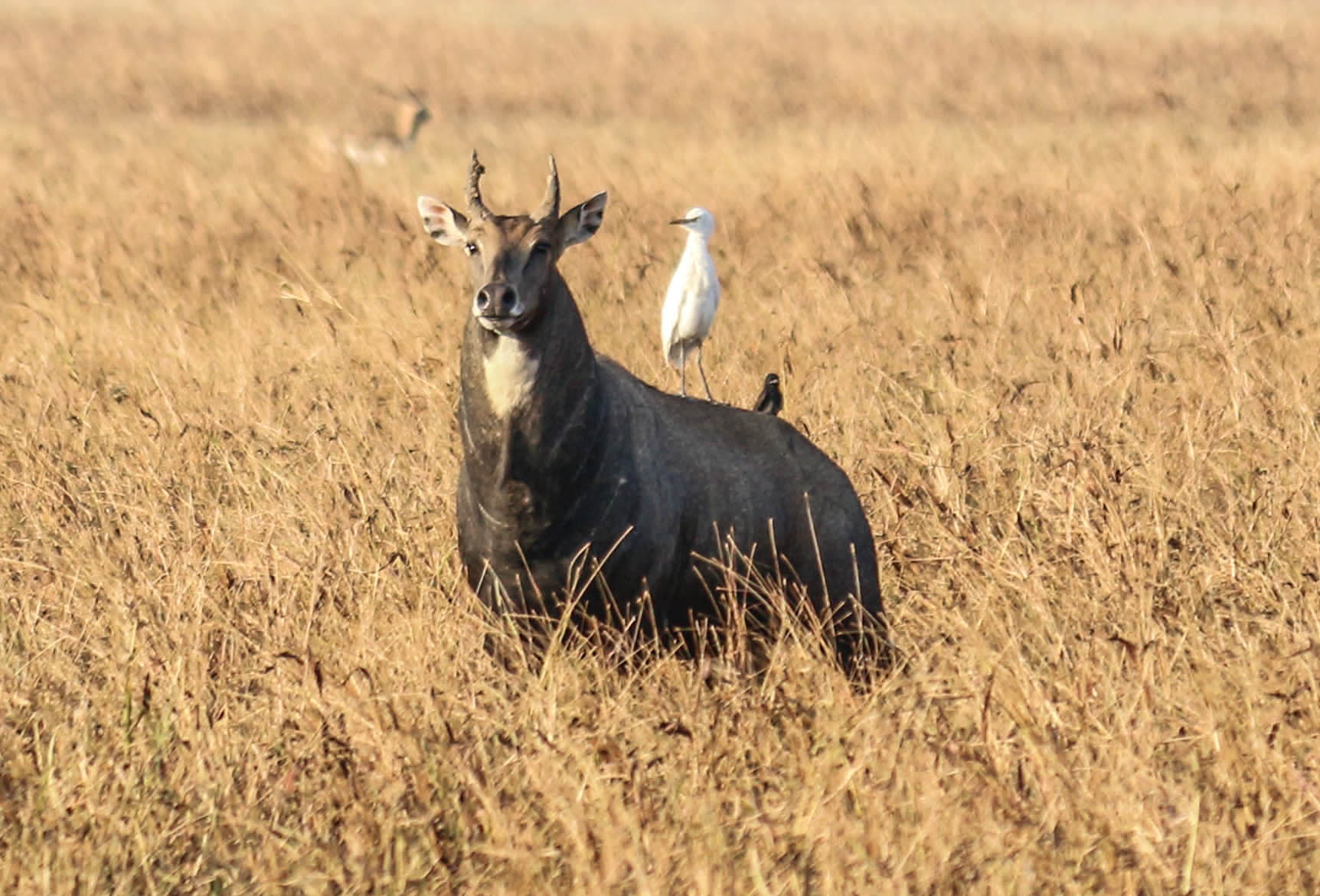
The nilgai (Boselaphus tragocamelus) (, literally meaning "blue cow") is the largest antelope of Asia, and is ubiquitous across the northern Indian subcontinent. It is the sole member of the genus Boselaphus, which was first scientifically described by Peter Simon Pallas in 1766. It is a sturdy, thin-legged antelope with a sloping back, a deep neck with a white patch on the throat, a short crest of hair along the neck terminating in a tuft, and white facial spots. A column of pendant, coarse hair hangs from the dewlap ridge below the white patch. It stands 100-150 cm at the shoulder; males weigh 109-288 kg, and the lighter females 100-213 kg. A Sexual dimorphism is prominent; while females and juveniles are orange to tawny, adult males have a bluish-grey coat. Only males possess horns, 15-24 cm long.
Major nilgai populations occur in the Indian and Nepal Terai. The diurnal nilgai prefers areas with short bushes and scattered trees in scrub forests and grassy plains. It commonly occurs on agricultural land and rarely in dense forests. Its diet encompasses grasses and herbs, though it also eats woody plants in the dry tropical forests of India. Females become sexually mature by two years, while males do not become sexually active until four or five years old. The time of the year when mating takes place varies geographically, but a peak breeding season lasting three to four months can be observed at most places. Gestation lasts eight to nine months, following which a single calf is born, sometimes also twins or even triplets. Nilgai calves stay hidden for the first few weeks of their lives. Three distinct kinds of groups have been observed: one or two females with young calves, three to six adult and yearling females with calves, and all-male groups with two to 18 members. The lifespan of the nilgai is around 10 years. Typically tame, the nilgai may appear timid and cautious if harassed or alarmed; it flees up to 300 m, or even 700 m, galloping away from the source of danger.
The nilgai is categorised as least concern on the IUCN Red List. It was introduced to Texas in 1924.
Taxonomy
The nilgai was described by Peter Simon Pallas, who in 1766 proposed the scientific name Antilope tragocamelus. Pallas based his description on an account of a male nilgai by James Parsons.
Etymology
The vernacular name "nilgai" comes from the fusion of the Hindi words nil (blue) and gai (cow). The word was first recorded in use in 1882. Alternative origins could be from the Persian gaw ("cow"). and nylghai, constructions referring to other "blue" animals. During Mughal emperor Aurangzeb's reign of India, the nilgai was known by the name nilghor (nil for "blue" and ghor for "horse").
The generic name Boselaphus comes from the combination of the Latin bos (cow or ox) and the Greek grc (deer). The specific name tragocamelus is derived from the joining of the two Greek words tragos (he-goat) and kamelos (camel). The binomial combination was first used by English zoologist Philip Sclater in 1883.
Evolution
A 1992 phylogenetic study of mitochondrial DNA sequences showed a strong possibility of a clade consisting of Boselaphini, Bovini, and Tragelaphini. Bovini consists of the genera Bubalus, Bos, Pseudoryx (saola), Syncerus (African buffalo), Bison and the extinct Pelorovis. Tragelaphini consists of two genera: Taurotragus (eland) and Tragelaphus. A closer relationship between Boselaphini and Tragelaphini was predicted, and seconded by a similar study in 1999. Though the tribe Boselaphini has no African representation today, fossil evidence supports its presence in the continent in the prehistoric times, as early as the late Miocene. The two living antelope species of this tribe have been found to have a closer relationship with the earliest bovids (like Eotragus species) than do the other bovids. This tribe originated at least 8.9 million years ago, in much the same area where the four-horned antelope lives today, and may represent the most "primitive" of all living bovids, having changed the least since the origins of the family. The extant and extinct boselaphine forms show similar development of the horn cores (the central bony part of the horn). Though the extant nilgai females lack horns, historic relatives of the antelope had horned females. Fossil relatives were once placed in the subfamily Cephalophinae which now contains only the African duikers. Fossils of Protragoceros and Sivoreas dating back to the late Miocene have been discovered not only in Asia and southern Europe but also in the Ngorora Formation (Kenya) and are thought to belong to the Boselaphini. Other Miocene fossils of boselaphines discovered are of Eotragus, Miotragocerus and Tragoportax; fossils of Miotragoceros are not apparent in Africa (only M. cyrenaicus has been reported from the continent), but have significant presence in the Shiwalik Hills in India and Pakistan, as do several Tragoportax species. A 2005 study showed the migration of Miotragoceros to eastern Asia around eight million years ago. Alan W. Gentry of the Natural History Museum reported the presence of another boselaphine, Mesembriportax, from Langebaanweg (South Africa).
Remains of the nilgai dating back to the Pleistocene have been discovered from the Kurnool caves in southern India. Evidence suggests that they were hunted by humans during the Mesolithic period (5,000 to 8,000 years ago).
Description

The nilgai is sturdy with a deep neck, a sloping back and thin legs; it has a short mane of hair behind and along the back ending behind the shoulder, a white patch on the throat, and around two white spots each on its face, ears, cheeks, lips, and chin. and are often marked with white "socks". while individuals with white patches have been recorded at zoos. The hairs, typically 23 - long, are fragile and brittle. Males have thicker skin on their head and neck that protect them in fights. The horns of the nilgai lack the ringed structure typical of those of other bovids.
The nilgai is the largest antelope in Asia. It stands 1.0 - at the shoulder; the head-and-body length is typically 1.7 -. Males weigh 109 -; the maximum weight recorded is 308 kg. Females are lighter, weighing 100 -. Sexual dimorphism is prominent; the males are larger than females and differ in and colouration.
The maximum recorded length of the skull is 376 mm. The dental formula is . The milk teeth are totally lost and the permanent dentition completed by three years of age. The permanent teeth get degraded with age, showing prominent signs of wear at six years of age. The nilgai has keen senses of vision and hearinng, though its sense of smell is not acute.
Distribution and habitat
The nilgai is endemic to the Indian subcontinent; major populations occur in India, Nepal, and border areas of Pakistan. Significant numbers occur in the Terai lowlands in the foothills of the Himalayas; it is abundant across northern India. It prefers areas with short bushes and scattered trees in scrub forests and grassy plains. They are common in agricultural lands, but hardly occur in dense woods. In southern Texas, it roams in the prairies, scrub forests and oak forests. It is a generalist animal; it can adapt to a variety of habitats. Though sedentary and less dependent on water, nilgai may desert their territories if all water sources in and around it dry up. Territories in Texas are 0.6 to in area.
The Indian population was estimated at one million in 2001. The population in Bangladesh was thought to be extinct, but some individuals from India and Nepal have crossed the border into the northwest of the country.
The nilgai were first introduced to Texas in 1924, by Caesar Kleberg, onto a 6000 acre ranch near the Norias Division of the King Ranch, one of the largest ranches in the world. The feral population had a spurt toward the latter part of the 1940s, and gradually spread out to adjoining ranches.
_bull_(19725141044).jpg)
Population densities show great geographical variation across India. Density can be as low as 0.23 to 0.34 individuals per km2 in Indravati National Park. and 0.4 per km2 in the Pench Tiger Reserve, or as high as 6.6 to 11.36 per km2 in Ranthambhore National Park, and 7.0 individuals per km2 in Keoladeo National Park. Seasonal variations were noted in Bardiya National Park in a 1980 study; the density 3.2 per km2 during the dry season and 5 per km2 in April, the start of the dry season. In southern Texas, densities were found to be 3–5 per km2 in 1976.
Historic notes mention nilgai in southern India, but these may have been feral:
Behavior and ecology
The nilgai is diurnal (active mainly during the day). A 1991 study investigated the daily routine of the antelope and found feeding peaks at dawn, in the morning, in the afternoon, and during the evening. Females and juveniles do not interact appreciably with males, except during the mating season. Groups are generally small, with 10 or fewer individuals, though groups of 20 to 70 individuals can occur at times. In a 1980 study in Bardiya National Park, the average herd size was of three; In a 1995 study in the Gir National Park, herd membership varied with season. However, three distinct groupings are formed: one or two females with young calves, three to six adult and yearling females with calves, and male groups with two to 18 members.

Typically tame, the nilgai may appear timid and cautious if harassed or alarmed; instead of seeking cover like duikers it would flee up to 300 m-or even 700 m on galloping-away from the danger. Though generally quiet, nilgai have been reported to make short guttural grunts when alarmed, and females make clicking noises when nursing young. Alarmed individuals, mainly juveniles below five months, give out a coughing roar (whose pitch is highest in case of the juveniles) that lasts half a second, but can be heard by herds less than 500 m away and responded to similarly.
Fights take place in both sexes and involve pushing their necks against each other or ramming into one another using horns. Fights can be gory; despite the protective skin deep, lacerated wounds and even deaths might occur. Display behaviour focuses on the throat patch and the beard, and threatening opponents by pointing the horns toward them. A young male was observed making a submissive display in the Sariska Reserve by kneeling before an adult male that stood erect. Nilgai mark their territories by forming dung piles as much as 50 cm in radius. The defecation process is elaborate; the antelope stands with its legs about 1 m apart, with the rump lowered and the tail held almost vertical; it stays in the same posture for at least 10 seconds after relieving itself. The process is not as elaborate in the females as it is in the males.

In India, the nilgai shares its habitat with the four-horned antelope, chinkara, chital, and blackbuck; its association with the gaur and the water buffalo is less common. In India, the Bengal tiger and Asiatic lion prey on the nilgai, but the latter is not a significant predator of this antelope. Dholes generally attack juveniles. and striped hyena.
Diet
The nilgai is a browser but primarily a grazer in Texas. The protein content of the nilgai's should be at least seven percent. The nilgai can survive for long periods without water and does not drink regularly even in summer.

In Sariska Reserve, it prefers herbs and grasses; grasses become more important in the rainy season, while during winter and summer it feeds additionally on Butea monosperma flowers, foliage of Anogeissus pendula, Capparis sepiaria, Grewia flavescens and Zizyphus mauritiana), pods of Acacia nilotica, A. catechu and A. leucophloea, and fruits of Zizyphus mauritiana. Seeds of Paspalum distichum occurred in the dung of nilgai most of the year; Acacia nilotica and Prosopis juliflora seeds were discovered in the dry season and those of Echinochloa crusgalli during the monsoon.
Reproduction


Observations of females in southern Texas revealed that ovaries are developed by two years of age and the first birth takes place typically a year later, though in a few cases females as young as one-and-a-half years may mate successfully. Females can breed again around a year after parturition. Males in the same location were found to have active testes by the age of three years, that matured considerably by the next year.{{cite journal| last1 = Lochmiller| first1 = R.L. |last2=Sheffield |first2=W. J. | year=1989 |title=Reproductive traits of male nilgai antelope in Texas In the mating season, rutting males move about in search of females in oestrus. The victorious bull would protect the vicinity of the targeted female from other males. The courtship typically lasts for 45 minutes. The male, stiff and composed, approaches the receptive female, who keeps her head low to the ground and may slowly walk forward. The male licks her genitalia, upon which the female holds her tail to a side and the male gives out a flehmen response. Finally, the male pushes his chest against her rump, and mounts her.
Gestation lasts eight to nine months, following which a single calf or twins (even triplets at times) are born. In a 2004 study in the Sariska reserve, twins accounted for as high as 80 percent of the total calf population. Births peak from June to October in the Bharatpur National Park, and from April to August in southern Texas. Calves are precocial; they are able to stand within 40 minutes of birth, and forage by the fourth week. Pregnant females isolate themselves before giving birth. As typical of several bovid species, nilgai calves are kept in hiding for the first few weeks of their lives. This period of concealment can last as long as a month in Texas. Calves, mainly males, bicker playfully by neck-fighting. Young males would leave their mothers at ten months to join bachelor groups. The lifespan of the nilgai is typically ten years in Texas.
Threats and conservation
The nilgai is listed as least concern on the International Union for Conservation of Nature's Red List,
In India, the nilgai is protected under Schedule III of the Wildlife Protection Act of 1972. Major protected areas for the nilgai across India include: Gir National Park (Gujarat); Bandhavgarh National Park, Bori Wildlife Sanctuary, Kanha National Park, Pachmarhi Biosphere Reserve, Panna Tiger Reserve, Pench Tiger Reserve, Sanjay National Park, Satpura National Park (Madhya Pradesh); Tadoba Andhari Reserve (Maharashtra); Kumbhalgarh Wildlife Sanctuary, Sultanpur National Park in Gurgaon, Ranthambore National Park and Sariska Tiger Reserve (Rajasthan).
Cultural significance

Nilgai remains have been excavated at Pandu Rajar Dhibi in West Bengal, suggesting that it was domesticated or hunted in eastern India in the Neolithic period (6500–1400 BCE) and during the Indus Valley Civilisation (3300–1700 BCE). There is a reference to the nilgai in the Aitareya Brahmana (a Hindu religious text dated 500–1000 BCE), where one of the Prajapatis is said to have assumed the form of a nilgai:
The nilgai is extensively featured in paintings, dagger hilts and texts from the Mughal era; its representation, however, is less frequent than that of horses and camels. On being disturbed while hunting nilgai, the Mughal emperor Jahangir recorded his ire.
For centuries Indian villagers have associated the nilgai with the cow, a sacred animal revered by Hindus, and the name ("gai" means "cow" in Hindi) indicates the similarity they saw with the cow. The nilgai is rarely consumed by Hindus due to its religious significance. Tribes such as the Bishnois traditionally take care of wild animals like the nilgai. The nilgai was not widely hunted until the 20th century, when habitat degradation and poaching became rampant. The meat of nilgai is said to be lighter and milder flavoured than blackbuck meat.
Culling and conservation
The populations of nilgai in India are so large that farmers in the states of Bihar, Chhattisgarh, Haryana, Madhya Pradesh, Maharashtra, Rajasthan and Uttar Pradesh have pleaded to the government to cull them. Nilgai herds raid and trample crop fields across these states, often causing food shortages. Farmers use live electric wires to guard their farms, which kills other animals as well. Farmers in Neemuch (Madhya Pradesh) went on a hunger strike in 2015 demanding compensation for the damage caused by nilgai. Although blackbuck cause a similar problem, the damage caused by them is significantly lower as they merely break off young shoots. In 1990, it was suggested that culling, building enclosures for the antelopes and fencing off agricultural areas as remedies.
The governments of Bihar, and Uttarakhand have urged the Government of India to declare the nilgai as vermin; the proposal has been implemented in Bihar, where nilgai can now be hunted to minimise the damages incurred by locals. The Uttar Pradesh government has given farmers and firearm licence holders the right to cull the animals. However, animal rights activists in various parts of India were unhappy with the decision. Shivanshu K. Srivastava, a columnist and social activist, wrote that "The culling of nilgais (blue bulls) in Bihar in July 2016 was so deplorable that it doesn't need any justification. The excuse given for this slew by the State government, the then environment minister Prakash Javadekar and the judiciary is so illogical that it mocks all the solutions available to stop the nilgais from destroying the farms. We live in the 21st century and culling is only the very last option we have. The farmers can either opt for fencing around the farmlands or if it's unaffordable, then the government can give ordinances to relocate them to the forests." The state governments have attempted other initiatives to curb the nilgai: in November 2015, the Government of Rajasthan came up with a proposal to allow shooting nilgai with non-lethal darts to inhibit fertilisation in their bodies, so as to regulate their increasing populations. As the name "nilgai" appeals to the religious sentiments of Hindus, the Government of Madhya Pradesh has sought to officially rename it rojad (Hindi for "forest antelope") and the Government of Haryana to rename it as roze in a bid to make their culling acceptable. in 1994, it becamer known that the nilgai's faeces contains nearly 1.6 percent nitrogen, which could enhance the quality of the soil up to a depth of 30 cm. Seeds in the droppings could easily germinate and assist in afforestation.
In September 2019, a video surfaced of a nilgai being buried alive with an excavator in Bihar as part of the culling. The state forest department has claimed to have begun an investigation to find those responsible.
References
Notes
References
- IUCN SSC Antelope Specialist Group. (2016). "''Boselaphus tragocamelus''".
- "''Boselaphus tragocamelus'' (Pallas, 1766)".
- Leslie, D.M.. (2008). "''Boselaphus tragocamelus'' (Artiodactyla: Bovidae)". Mammalian Species.
- {{MSW3
- (1745). "An account of a quadruped brought from Bengal and now to be seen in London". Philosophical Transactions.
- (1907). "Final Natural History Essays". Sherratt & Hughes.
- {{MerriamWebsterDictionary. Nilgai
- (1850). "Synopsis of the species of antelopes and strepsiceres, with descriptions of new species". [[Proceedings of the Zoological Society of London]].
- (1939). "The fossil bovidae of India". Memoirs of the Geological Survey of India.
- {{MerriamWebsterDictionary. Boselaphus
- (1992). "DNA systematics and evolution of the artiodactyl family Bovidae". Proceedings of the National Academy of Sciences of the United States of America.
- (1999). "Evolutionary affinities of the enigmatic saola (''Pseudoryx nghetinhensis'') in the context of the molecular phylogeny of Bovidae". Proceedings of the Royal Society B: Biological Sciences.
- (1981). "The Hunters or the Hunted?: An Introduction to African Cave Taphonomy". University of Chicago Press.
- (1997). "Molecular phylogeny of the tribe Bovini (Mammalia: Artiodactyla): alternative placement of the Anoa". [[Journal of Evolutionary Biology]].
- Bibi, F.. (2007). "Origin, paleoecology, and paleobiogeography of early Bovini". Palaeogeography, Palaeoclimatology, Palaeoecology.
- (1990). "A new hypothesis uniting Boselaphus and Tetracerus with the Miocene Boselaphini (Mammalia, Bovidae) based on horn morphology". [[Annales Musei Goulandris]].
- Von Zittel, Karl A.. (1925). "Text-book of Palaeontology. Volume III. Mammalia.". Macmillan and Co..
- (2012). "A multi-locus species phylogeny of African forest duikers in the subfamily Cephalophinae: Evidence for a recent radiation in the Pleistocene". [[BMC Evolutionary Biology]].
- (2005). "The Bovidae (Mammalia, Artiodactyla) from the late Miocene of Akkas¸dag˘i, Turkey". Geodiversitas.
- (1986). "Miocene fossil cercopithecoids from Kenya". [[American Journal of Physical Anthropology]].
- (2005). "Late Miocene Boselaphini (Bovidae, Artiodactyla) from Fugu, Shaanxi Province, China". [[Vertebrata PalAsiatica]].
- (2009). "Ardipithecus Kadabba: Late Miocene Evidence from the Middle Awash, Ethiopia". University of California Press.
- (1996). "Pleistocene cave fauna from peninsular India". [[Journal of Cave and Karst Studies]].
- (2010). "Ethnoarchaeology of the Kurnool cave areas, South India". [[World Archaeology]].
- (2008). "Additional vertebrate remains from one of the Late Pleistocene—Holocene Kurnool Caves (Muchchatla Chintamanu Gavi) of South India". [[Quaternary International]].
- (2002). "Life on Earth: An Encyclopedia of Biodiversity, Ecology, and Evolution". ABC-CLIO.
- Smielowski, J.. (1987). "Albinism in the Blue bull or Nilgai ''Boselaphus tragocamelus'' (Pallas, 1766)". Journal of the Bombay Natural History Society.
- (1981). "Aids to the identification of artiodactylan hairs with general comments on hair structure". Journal of the Bombay Natural History Society.
- (1998). "National Parks of Madhya Pradesh: State of Bio Diversity and Human Infringement". APH Pub. Corporation.
- (2004). "The Wild Animals of India". Biotech Books.
- (2011). "Grazers". Britannica Educational Publication.
- (2004). "The Mammals of Texas". University of Texas Press.
- (1998). "The Mammals of the Edwards Plateau, Texas". Museum of Texas Tech University.
- (1936). "Rearing wild animals in captivity, and gestation periods". Journal of Mammalogy.
- (1900). "Antelopes: global survey and regional action plans". IUCN.
- (2019). "Another nilgai found in Naogaon".
- Islam, R.. (2024). "Comeback on the cards for Asian antelope declared extinct in Bangladesh". Mongabay.
- Association, Texas State Historical. "Caesar Kleberg: Pioneer of Wildlife Conservation and Ranching in Texas".
- (2008). "It's a Long Way from Llano: The Journey of a Wildlife Biologist". Texas A & M University Press.
- (1988). "Habitat utilization and diurnal activity pattern in Indian wild buffalo (''Bubalus bubalis'' Linn.) in Indravati Wildlife National Park, India: a study of habitat/animal interactions". Journal of Tropical Ecology.
- (2002). "Prey abundance and food habit of tigers (''Panthera tigris tigris'') in Pench National Park, Madhya Pradesh, India". Journal of Zoology.
- (2004). "Herbivore density and biomass in a semiarid tropical dry deciduous forest of western India". Journal of Tropical Ecology.
- (1871). "Notes on Jerdon's Mammals of India". Higginbothams.
- (1991). "Behaviour of nilgai (''Boselaphus tragocamelus'') antelope in captivity". Journal of Zoology.
- (1979). "An ecological survey of the Royal Karnali-Bardia Wildlife Reserve, Nepal. Part II: Habitat/animal interactions". Biological Conservation.
- (1995). "Group size and age-sex composition of three major ungulate species in Gir Lion Sanctuary, Gujarat, India". Journal of the Bombay Natural History Society.
- (1983). "Food habits of nilgai antelope in Texas". Journal of Range Management.
- (1980). "The birth and development of twin Nilgai ''Boselaphus tragocamelus'' at Washington Park Zoo, Portland". International Zoo Yearbook.
- (2006). "Prey preferences of the leopard (''Panthera pardus'')". Journal of Zoology.
- (1990). "Study on the ecology of wild ungulates of Keoladeo National Park Bharatpur, Rajasthan".
- (1979). "A note on nutritive value of forages for nilgai". Pakistan Journal of Forestry.
- (1987). "Protein requirements of subadult nilgai antelope". Comparative Biochemistry and Physiology A.
- (1998). "Grazing interactions between wild and domestic herbivores". Small Ruminant Research.
- (1975). "Study of distribution, habitat and food of nilgai ''Boselaphus tragocamelus'' in Punjab". Pakistan Journal of Zoology.
- (1992). "Notes on the food habits of nilgai ''Boselaphus tragocamelus''". Journal of the Bombay Natural History Society.
- (1992). "Seed herbivory by nilgai, feral cattle, and wild boar in the Keoladeo National Park, India". Biotropica.
- (2011). "Wildlife and natural resource management". Delmar Cengage Learning.
- (2004). "Blue bull or nilgai". Envis Bulletin (Wildlife and Protected Areas): Ungulates of India.
- (January 2017}} The population around the Texas-Mexico border is estimated to be around 30,000 (as of 2011).{{cite journal). "Nilgai antelope in northern Mexico as a Possible Carrier for Cattle Fever Ticks and Babesia bovis and Babesia bigemina". [[Journal of Wildlife Diseases]].
- (11 June 2015). "Environment ministry may allow hunting of 'nuisance' wild animals". [[Down to Earth (magazine).
- (2011). "Vanishing Roar of Bengal Tigers". [[RoseDog Books]].
- (2007). "Material Culture and Social Formations in Ancient India". Macmillan India.
- (1997). "Encyclopedia of Indo-European Culture". Fitzroy Dearborn.
- (2011). "Faunal Remains from Shikarpur, a Harappan Site in Gujarat, India". Iranian Journal of Archaeological Studies.
- (2015). "The Roots of Hinduism: The Early Aryans and the Indus Civilization". Oxford University Press.
- (2013). "Art of the Islamic World: A Resource for Educators". Metropolitan Museum of Art.
- (1987). "The Pacific Islands, Africa, and the Americas". Metropolitan Museum of Art.
- (2015). "Islamic Arms and Armor: in The Metropolitan Museum of Art". Metropolitan Museum of Art.
- (2007). "The Mughal World: Life in India's Last Golden Age". Penguin Books.
- (2003). "Inventing Global Ecology: Tracking the Biodiversity Ideal in India, 1945–1997". Orient Longman.
- (2016). "This vet treats 700 wild patients a year!". [[The Times of India]].
- (2007). "Wildlife and Plants: Volume 12". Marshall Cavendish.
- (2005). "Field Guide to Meat: How to Identify, Select and Prepare Virtually Every Meat, Poultry and Game Cut". Quirk Books.
- (2000). "Nilgai, ''Boselaphus tragocamelus'' – a mammalian crop pest around Jodhpur". Uttar Pradesh Journal of Zoology.
- (2015). "As Nilgai destroy fields, cane farmers urged to grow pulses". The Times of India.
- (2014). "India: Changing the nilgai's name as a management strategy". [[The Guardian]].
- Times News Network. (2015). "Nilgai menace drives Neemuch farmers to edge". The Times of India.
- (1990). "Crop damage by overabundant populations of nilgai and blackbuck in Haryana (India) and its management (Paper 13)". Proceedings of the Fourteenth Vertebrate Pest Conference 1990.
- (1989). "Problems of over-abundant populations of 'Nilgai' and 'Blackbuck' in Haryana and Madhya Pradesh and their management". The Indian Forester.
- (2016). "Maharashtra government wants nilgai, wild boar to be declared vermin". [[Daily News and Analysis]].
- (2015). "U'khand asks MoEF to declare wild boar, nilgai vermin". The Times of India.
- (2015). "Centre allows Bihar to cull Nilgai herds and wild pigs; declares them 'vermin'". [[The Economic Times]].
- (2015). "Govt allows culling of nilgai, wild boar". The Times of India.
- (2016). "Animal rights groups unhappy with government's decision to declare nilgai as vermin". [[Daily News and Analysis]].
- "Animals ought to have fundamental rights".
- "Animals, too, have the right to live".
- (2015). "A new sport in Rajasthan: Shoot and save the nilgai". [[The Indian Express]].
- (2016). "To save crops and legitimise killing nilgai, Madhya Pradesh renames it to 'rojad' in rulebooks". The Indian Express.
- (1994). "A beneficial aspect of nilgai (''Boselaphus tragocamelus'') in scientifically utilised ravines – an observation". The Indian Forester.
- (2019). "Brutal pictures surfaced from Bihar, Nilgai was buried alive".
This article was imported from Wikipedia and is available under the Creative Commons Attribution-ShareAlike 4.0 License. Content has been adapted to SurfDoc format. Original contributors can be found on the article history page.
Ask Mako anything about Nilgai — get instant answers, deeper analysis, and related topics.
Research with MakoFree with your Surf account
Create a free account to save articles, ask Mako questions, and organize your research.
Sign up freeThis content may have been generated or modified by AI. CloudSurf Software LLC is not responsible for the accuracy, completeness, or reliability of AI-generated content. Always verify important information from primary sources.
Report