From Surf Wiki (app.surf) — the open knowledge base
New Zealand national rugby league team
Sports team representing New Zealand
Sports team representing New Zealand
| Field | Value | ||||
|---|---|---|---|---|---|
| Name | New Zealand | ||||
| Badge | Nzrl kiwis logo.png | ||||
| Badge_size | 150px | ||||
| Nickname | Kiwis | ||||
| (1926–present) | |||||
| Professional All Blacks | |||||
| (1909–1926) | |||||
| All Golds | |||||
| ([1907–08](1907-08-new-zealand-rugby-tour-of-australia-and-great-britain); [2007](2007-all-golds-tour)) | |||||
| Governing body | New Zealand Rugby League | ||||
| Region | Asia-Pacific | ||||
| Coach | Stacey Jones | ||||
| Captain | James Fisher-Harris | ||||
| Most caps | Ruben Wiki (55) | ||||
| Top try-scorer | Manu Vatuvei (22) | ||||
| Top point-scorer | Shaun Johnson (219) | ||||
| RLIF Rank | 2 | ||||
| pattern_la1 | _nzl18a | pattern_b1=_whiteV | pattern_ra1=_nzl18a | pattern_so1=_white_hoops | |
| leftarm1 | 000000 | body1=000000 | rightarm1=000000 | shorts1=000000 | socks1=000000 |
| pattern_la2 | _blackborder | pattern_b2=_Vonwhite | pattern_ra2=_blackborder | pattern_so2=_white_hoops | |
| leftarm2 | FFFFFF | body2=000000 | rightarm2=FFFFFF | shorts2=FFFFFF | socks2=000000 |
| First international | 9–8 | ||||
| (Aberdare, Wales; 1 January 1908) | |||||
| Largest win | 0–74 | ||||
| (Auckland, New Zealand; 1999) | |||||
| 84–10 | |||||
| (Reading, England; 2000) | |||||
| Largest loss | 0–58 | ||||
| (Wellington, New Zealand; 14 October 2007) | |||||
| World cup apps | 16 | ||||
| World cup first | 1954 | ||||
| World cup best | *Champions* ([2008](2008-rugby-league-world-cup)) |
(1926–present) Professional All Blacks (1909–1926) All Golds (1907–08; 2007) | Top try-scorer = Manu Vatuvei (22) | Top point-scorer = Shaun Johnson (219) (Aberdare, Wales; 1 January 1908) (Auckland, New Zealand; 1999) 84–10 (Reading, England; 2000) (Wellington, New Zealand; 14 October 2007) The New Zealand national rugby league team () has represented New Zealand in rugby league since 1907. Administered by the New Zealand Rugby League, they are commonly known as the Kiwis, after the native bird of that name. The team's colours are black and white, with the dominant colour being black, and the players perform a haka before every match they play as a challenge to their opponents. The New Zealand Kiwis are currently second in the IRL World Rankings. Since the 1980s, most New Zealand representatives have been based overseas, in the professional National Rugby League and Super League competitions. Before that, players were selected entirely from clubs in domestic New Zealand leagues.
A New Zealand side first played in a 1907 professional rugby tour which pre-dated the birth of rugby league football in the Southern Hemisphere, making it the second oldest national side after England. Since then the Kiwis have regularly competed in international competition, touring Europe and Australia throughout the 20th century. New Zealand have competed in every Rugby League World Cup since the first in 1954, reaching three consecutive tournament finals between 2000 and 2013. In 2008, New Zealand won the World Cup for the first time. They also contest the Baskerville Shield against England.
History
Rugby football was introduced into New Zealand by Charles John Monro, son of the then speaker of the New Zealand House of Representatives, Sir David Monro. He had been sent to Christ's College, East Finchley in north London, where he became an enthusiastic convert to the new code. He brought the game back to his native Nelson, and arranged the first rugby match between Nelson College and Nelson Football Club, played on 14 May 1870.
When New Zealand's national rugby team (the All Blacks) toured Britain in 1905 they witnessed the growing popularity of the breakaway non-amateur Northern Union's games. On his return in 1906, All Black George William Smith met the Australian entrepreneur J J Giltinan to discuss the potential of professional rugby in Australasia. The first New Zealand team to play professional rugby was known as the All Blacks. To avoid confusion, the terms professional All Blacks or All Golds are used.
The professional All Blacks
In the meantime, a lesser known New Zealand rugby player, Albert Henry Baskerville (or Baskiville) was ready to recruit a group of players for a Great Britain pro tour. It is believed that Baskerville became aware of the profits to be made from such a venture while he was working at the Wellington Post Office in 1906. A colleague had a coughing fit and dropped a British newspaper. Baskerville picked it up and noticed a report about a Northern Union (NU) match that over 40,000 people had attended.
Baskerville wrote to the NRFU asking if they would host a New Zealand touring party. The 1905 All Blacks tour was still fresh in English minds, thus the NU saw the upcoming competitive New Zealand tour as exceptional opportunity to raise the profile and finances of the NU game. The NU agreed to the tour provided that some of those original All Blacks were included in the New Zealand team. George Smith arrived back in New Zealand and after learning of Baskerville's plans, the two teamed up and began signing players.
The New Zealand Rugby Union became aware of the tour and promptly applied pressure to any All Black or New Zealand representative player it suspected of involvement. They had the New Zealand Government's Agent General in London deliver a statement to the British press in an effort to undermine the tour's credibility. This had little effect and by that time the professional All Blacks were already sailing across the Tasman to give Australia its first taste of professional rugby.
The All Golds
It was during this time that references to the professional All Blacks as the All Golds first appeared.
Clearly, "All Golds" was a play on the amateur "All Blacks" name but it was also an insult to the players, criticising the arrangement where they would each share in the wealth of the tour. The name "All Golds" is now thought to have originated in a New Zealand newspaper in May/June 1907 (see panel below), amidst editorial arguments over whether it was honourable for the proposed "professional All Blacks" team to be paid.
The first documented use in Australia was in a headline in the Sydney Morning Herald (7 August), just before Baskerville's team arrived. Those same Herald articles also had a tag for those who supported the amateur rugby union calling them the "Lily Whites" (who were clean, pure, and repelled the evils of professionalism).
The first tour
Professional rugby in the southern hemisphere kicked off with the professional All Blacks playing a professional rebel New South Wales team organised by Smith's contact, James Giltinan. The games drew little interest to start with, but were a major success for the rugby rebels of Australia, as they finally had the money to start the first professional Rugby Football League and hence change the face of rugby in Australia.
During their return voyage from England, the All Golds made a stop-over in Australia where they discovered that professional rugby was being played with Northern Union rules, under the banner of the New South Wales Rugby Football League (NSWRFL). The All Golds played another 10 games in Australia, boosting the finances of the fledgling NSWRFL premiership; making the All Golds tour one of the most significant contributions to the sport of rugby league in Australia.
The All Golds were Hercules Richard "Bumper" Wright (captain), George William Smith (vice-captain), Albert Baskirville (secretary), Herbert Turtill, Harold Rowe, Duncan McGregor, Dally Messenger, Edgar Wrigley, Joseph Lavery, Richard Wynyard, William Wynyard, Lance Todd, Edward Tyne, William Tyler, Arthur Kelly, Tom "Angry" Cross, William Massa Johnston, Eric Watkins, Conrad Byrne, Adam Lile, Daniel Gilchrist, Arthur Callam, Charles Pearce, William Trevarthen, Charles Dunning, William Mackrell, Daniel Fraser (assistant manager), Jim Gleeson (treasurer), and H.J. Palmer (financial manager).
The Kiwis
The 1910 Great Britain Lions tour of Australia and New Zealand saw the Kiwis' first ever test on home soil, with the British side proving too strong. In 1911 the New Zealand national team toured Australia.
1920 represented a high point for New Zealand rugby league (and sport in that country) with two matches against the touring British Lions rugby league team drawing 40,000 fans each in Auckland's Domain.
The NZRU was able to control a lot of what the New Zealand Rugby League (NZRL) was able to get its hands on. In 1926, the Union took legal action, trying to stop the League from using the name, the "All Blacks" as their touring name. The NZRL felt that they had equal ownership to the name and were not ready to relinquish it. However, by this time the press had already nicknamed the team 'the Kiwis', because of the badge included on their jerseys. Despite the League trying to discourage its usage, the name has stuck ever since.
The 1926–27 New Zealand tour of Britain involved several skirmishes within the Kiwi party.{{cite news | access-date =25 September 2009
In 1938, for a tour of Australia, the New Zealand Rugby League officially adopted the name the "New Zealand Kiwis". This side was also the first to wear a white "V" on their jerseys.
Post-war
In 1947 at Odsal Stadium, Bradford in England, a crowd of 42,680 saw New Zealand play, setting a new record for the team on British soil.{{cite news | access-date = 22 April 2010
The Kiwis were unbeaten in any test series from 1948 to 1951 and won six of their nine tests. They toured England and France in 1951–52. New Zealand were hosted by France for the first ever World Cup match in 1954's inaugural tournament. They lost that match as well as the remaining two to finish last. In the 1957 World Cup New Zealand got their first World Cup win, with victory against France in one of their three matches. The Kiwis got exactly the same result in the 1960 World Cup too.
During the 1961–63 era, New Zealand won seven out of ten test matches, including a 2–0 series win over Great Britain, then considered the top rugby league nation in the world. The most outstanding performance by the New Zealanders was their record-breaking 19–0 win over Britain in 1962. It was only the second time a British team had been held scoreless. New Zealand in the period 1960–65 won the Courtney Goodwill Trophy for most successful test-playing nation,
The Kiwis again got a sole win against France from their three matches of the 1970 World Cup.
In 1971, the Kiwis embarked on a 34 match tour of England and France. While they only won half of the matches they played against English club teams, they won the test series 2–1 (winning the first test 18–13, the second 17–14 but losing the third 3–12). They won the series against France 2–0 (winning the first test 27–11, the second 24–2 but drawing the third 3–3).
In the 1972 World Cup New Zealand failed to win a game. In the season-long 1975 World Series, New Zealand won 2 out of their 8 games, finishing second last. The 1977 World Cup brought the Kiwis the familiar result of a sole win against France. A World Cup rated Test took place on Sunday 7 July 1985 at Carlaw Park. Australia's 18–0 defeat was the first time they had failed to score in a Test against New Zealand.
On Tuesday 7 July 1987, New Zealand team warmed up for internationals against Papua New Guinea and Australia by taking on the Queensland state team at Lang Park, Brisbane. They then went on to record a 22–16 victory.
Australia crashed to a defeat on Tuesday 21 July 1987, when the Kangaroo dominance of the international game suffered a rare setback. New Zealand were their opponents in a match which had been arranged to fill the gap created by the non-appearance of France. New Zealand won the game 13–6. The next four internationals between Australia and New Zealand were all staged in New Zealand, and all were won by the Kangaroos. In the final Test match of the 1988 Great Britain Lions tour, New Zealand just pipped the British 12–10 in a freezing encounter in Christchurch for a place in the final against Australia. Played at Eden Park in Auckland, it was the most hyped game in the history of rugby league in New Zealand, and the crowd of 47,363 was the biggest ever for a game in Auckland. The final proved to be a huge anti-climax and they were outplayed by the Aussies.
On 20 June 1993 the first all-professional, and all-overseas based, Kiwis side took the field against Australia. New Zealand almost got their revenge on Australia in the 1995 World Cup semi-final when, with the scores level at 20–20, a last minute drop-goal attempt by skipper Matthew Ridge brushed the wrong side of the post, allowing the game to go into extra-time. From there, Australia went on to win. Due to the NZRL's alignment with Super League, a New Zealand team selected only from Australasian-based players competed in 1997's Super League Tri-series against Queensland and New South Wales.
In 1998 the Kiwis travelled to the UK for a three-test series against Great Britain, winning the first and second tests and drawing the third.
New Millennium
The Kiwis handed England their biggest ever loss to again make the final in the 2000 World Cup,{{Cite news | access-date = 15 October 2010}} but again went down to the Kangaroos 40–12. Gary Freeman coached New Zealand from 2001 to 2002. Beginning in 2002, a 'New Zealand A' team was selected from players in the domestic New Zealand competition. New Zealand A toured France and the United States in 2002, and the United Kingdom in 2003. In 2004 they hosted New South Wales Country.
In 2003 the Kiwis played their 100th international against Australia.{{cite news | access-date = 29 April 2010}} Brian McClennan was appointed national coach of New Zealand in June 2005. His appointment was controversial, mainly because he had no professional coaching experience.
2005 would be considered one of the Kiwis greatest years, as they captured the 2005 Tri-Nations title, effectively becoming "de facto" World champions as the three best countries competed in that competition. In the course of winning the Tri-Nations the Kiwis defeated Australia in Sydney for the first time in half a century. In London, the Kiwis posted their highest score ever against Great Britain and, in winning the final, posted the first shut out of Australia in 20 years. The 24–0 result at Elland Road, Leeds equalled the Kiwis' biggest ever win against Australia – a 49–25 win in Brisbane almost 50 years previously. It was Australia's first defeat in a series or tournament since 1978.{{Cite news | access-date = 6 March 2011}} In New Zealand, Brian McClennan earned praise from the press and signed an extension to his coaching tenure with the Kiwis. In 2006 the Kiwis lost both mid-season tests to the Kangaroos and Lions. The 2006 Tri-nations brought controversy when New Zealand fielded an ineligible player, Nathan Fien, against Great Britain and were later stripped of the two points earned from their 18–14 win.{{cite news |access-date=5 August 2008
In July 2007, the Leeds Rhinos announced that Brian McClennan would be joining the club as Head Coach on a two-year contract from 1 December 2007. McClennan subsequently resigned as national coach and his position was taken up by Gary Kemble in August 2007.
All-Golds revival
Under Gary Kemble the Kiwis went on to lose the first of their three test series against Great Britain going down 14–20 against the Lions at Huddersfield on 27 October 2007. Following the loss an Australian newspaper reported that former Kiwi captain Hugh McGahan was concerned at Kemble's poor start and suggested that former Australian and current Brisbane Broncos coach Wayne Bennett should be pursued for the role. McGahan later claimed that his comments had been grossly misreported by the journalist.
In the second test of the series on 3 November 2007, Kemble returned to KC Stadium, the ground on which he had spent a large portion of his playing days with Hull F.C. It was to be a disastrous homecoming, however, as the Kiwis suffered their second humiliating defeat under Kemble when beaten 44–0 by an inspired Great Britain. The win gave Great Britain an unassailable series lead leaving the Kiwis with only pride to play for in the final test at JJB Stadium in Wigan.
Intense criticism followed the second test loss, some of it directed at the players, some of it toward the management of the NZRL. However, Kemble also copped severe criticism from some quarters with one commentator suggesting that Kemble "must be sacked at the series-end" and describing him as a "captain of calamity". Following the loss, Kiwi's captain Roy Asotasi hinted at the possibility of internal issues for the players in adjusting to Kemble's coaching style when he compared Kemble's approach with that of his predecessor McClennan describing them as "very different" and reporting that the group was "still trying to gel". Following the loss Kemble acknowledged that he was contemplating resigning from his post if the Kiwis were whitewashed 3–0 by Great Britain.
Despite a far more spirited performance in the third test the Kiwis were unable to prevent the whitewash losing 22–28 after leading 12–0 early in the match. Kemble was forthright in expressing his desire to remain Kiwi coach following the loss with the general feeling being that the loss was "close enough" for him to retain the position. Kemble was the subject of some ridicule for post-match comments which suggested that the Kiwis "almost won the test series" despite an aggregate score of 92–36 across the three tests.
In December 2007 the NZRL held its annual awards dinner. Being one hundred years since the inception of rugby league in New Zealand, a 13-man New Zealand team of the century was named on the evening, with Cliff Johnson named at captain. Mark Graham was named in the second-row and was also honoured as the greatest Kiwi player of the century.
Kemble resigned as head coach after captain Roy Asotasi and David Kidwell both publicly said that they had no confidence in his coaching abilities. Subsequently, former Kiwi, Stephen Kearney was appointed coach with Wayne Bennett given a role as an advisor.
The All Golds were revived again in 2008 as a testimonial match for Ruben Wiki, where they defeated the New Zealand Maori team 44–10 at Yarrow Stadium in New Plymouth.
Kearney's Kiwis
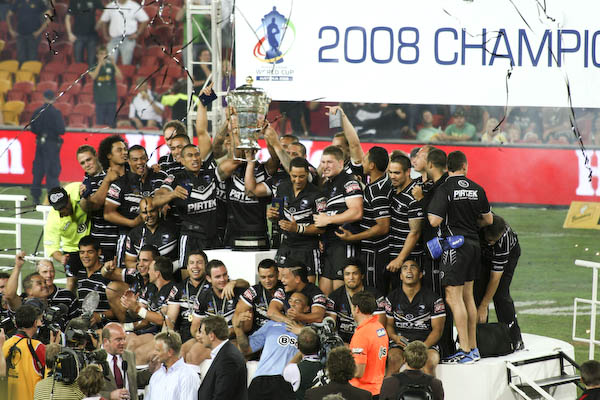
Stephen Kearney's first match as New Zealand coach was against Australia in the 2008 Centenary Test. The match celebrated 100 years since the first Trans-Tasman clash began. Later on in that year, the 2008 World Cup kicked off. Wayne Bennett assisted Kearney in the competition. Kearney's Kiwis advanced from the group stage in second position which saw them face England for a second time in the tournament, this time in the semi-final. In the group stage, the Kiwis were at one point trailing 24–8 before scoring 26 consecutive points and keep the Poms scoreless in the second half to go on to win 36–24. The Kiwis didn't have to recover a deficit in the semi-final as they went on to another World Cup final meeting with Australia. In a see-saw like battle, the Kiwis created history after full-time when they won the final 34–20. This was New Zealand's first ever World Cup title, as well as the Australian team's first loss since Great Britain defeated them in November 2006 and their first loss to New Zealand since November 2005. It was also their first loss in a World Cup match since 1995 and in a final since 1972.{{cite news | access-date = 22 July 2016}}
At the end of the 2010 domestic season, New Zealand played in the 2010 Four Nations. During the Round-robin fixtures, New Zealand produced their biggest win on home soil with a 64-point win over Papua New Guinea.{{cite news | access-date = 22 July 2016}} The Kiwis qualified for the final where they played Australia at the same venue as the 2008 World Cup final. The Kiwis won at Lang Park once again after a try in the final seconds of the game sealed the low scoring game, and 2010 Four Nations title, for the Kiwis, winning 16–12.{{cite news | access-date = 22 July 2016}}
In 2013 New Zealand headed into the World Cup as defending champions for the first time. The Kiwis advanced out of their group with ease despite suffering a scare against Samoa in their opening game. Kearney's men then advanced to the semi-finals, courtesy of a win over Scotland, where they then met hosts England at Wembley. It was a see-saw affair which saw the Kiwis trailing 18–14 with one minute on the clock remaining until star play-maker Shaun Johnson produced a magical moment to level the scores and then convert his try after the siren to win the match and make the Kiwis advance to a third consecutive World Cup final. The win also made the Kiwis equal their best winning streak record of five games. In the final, watched by a record international attendance of 74,468, they were outclassed at 'The Theatre of Dreams' as Australia earned revenge for their 2008 final defeat. After the World Cup Kearney was put under pressure after it was found out players were mixing sleeping pills and energy drinks during the tournament which affected performances. He had to reapply for his job and was only given a two-year contract, unlike the usual one that would end after the next World Cup, which the NZRL said was because he needed to "re-establish the culture at the Kiwis which was damaged so badly at the World Cup".{{cite news | access-date = 22 July 2016}} Kearney immediately took action, naming six debutantes for the first test-match of 2014.
At the end of the 2014 club season New Zealand played in the 2014 Four Nations. In the first game they continued their good record against Australia at the 'Cauldron' with another win setting the record at 3 wins in the past 4 meetings against the Kangaroos at the venue. In the second game the Kiwis faced another scare against Samoa when they were on the verge of a 12–10 defeat with just minutes remaining before Kearney's men scored near full-time to avoid the shock result. After defeating England in their final game they qualified for the final held in Wellington where they'd face Australia again. New Zealand won the match 22–18 and therefore the Four Nations, their second tournament title. This was their first win over Australia on home soil since 2003 where they beat the Aussies at North Harbour Stadium. In the final, winger Manu Vatuvei scored two tries to become New Zealand's top try-scorer after tallying his 20th try during the match to beat a record that's been held by Nigel Vagana since 2006. This was the first time New Zealand went through an entire tournament unbeaten.{{cite news | access-date = 22 July 2016}}
In March 2015, Kearney's successful management saw the NZRL announce an extension to his contract until the end of the 2017 World Cup. The 2015 Anzac Test was held in Suncorp Stadium. The Kiwis continued their great record in Brisbane with a commanding 26–12 victory giving them their first Anzac test win since 1998. It was also the first time since 1953 that New Zealand beat Australia in three consecutive test matches.{{cite news | access-date = 22 July 2016}} This win also meant New Zealand equaled their best winning streak record once again just like they did after the 2013 World Cup semi-final. On 15 May 2015, the new RLIF World Rankings were announced and it read that, for just the second time, New Zealand were officially the best team in the World. New Zealand were last ranked World number one back in 2008 after their World Cup success.{{cite news | access-date = 22 July 2016}} At the end of the year New Zealand were unable to beat their winning record after losing the Baskerville Series to England. At the conclusion of that series, it was revealed that Kearney had the best record out of any New Zealand coach to date as he was involved in the most matches (41), won the most matches (23), and won the most matches against Australia (5). He also revealed that despite the defeat to England he wanted the Kiwis to 'dominate the next decade of international rugby league'.{{cite news | access-date = 22 July 2016}}
Before the 2016 Anzac Test, controversy had occurred when regular New Zealand players Manu Vatuvei and Ben Matulino were caught partying and mixing energy drinks with prescription drugs. Kearney toughened his stance and announced he'd not be selecting them for the test-match in a decision which saw commends from fellow New Zealand internationals.{{cite news | access-date = 28 May 2015}} These players were just two of ten regular name players missing from the New Zealand side for the fixture, with others missing through injury or private issues. New Zealand lost the match 16–0 and in the process ended their winning streak against Australia. This was also the first time New Zealand scored zero points in a test match since 2007.
In September 2016, Kearney left New Zealand after accepting an offer to coach New Zealand's only NRL team.
Kidwell's Kiwis
David Kidwell's first match as New Zealand coach was against Australia in Perth. This was the first time an international rugby league game was held in Western Australia. In the 2016 Four Nations, New Zealand beat England for the first time on English soil since the tournament was introduced in 2009. In New Zealand's last round-robin fixture, they drew with Scotland and, in the process, gave the 'fourth nation' their first ever point in the tournament's history. Despite the shock result, New Zealand still managed to qualify for a rematch with Trans-Tasman rivals, Australia, in the final. After losing by just 6 points in the round-robin stage meeting, the Kiwis were thrashed by the Kangaroos in the final 34–8.
After the final Anzac Test fixture was played, Kidwell spoke on behalf of the NZRL to announce that captain Jesse Bromwich, and Kevin Proctor were suspended from playing in the World Cup after they were caught buying cocaine from a stranger after the test-match.
Controversy occurred before the 2017 World Cup, after star forward, Jason Taumalolo, decided to switch allegiances after choosing to play for Tonga at the World Cup rather than his country of birth. David Fusitu'a, Sio Siua Taukeiaho and Manu Ma'u, who were all in contention for World Cup selection, also followed Taumololo's lead. Australian forward Andrew Fifita did likewise, after initially being selected in the Australian team, making Tonga one of the tournament favourites.{{cite news | access-date = 4 December 2017}} It was at first believed, Taumalolo switched to play for Tonga in protest for the NZRL's decision to suspend Bromwich and Proctor from playing in the World Cup.{{cite news | access-date = 4 December 2017}} However, it was later confirmed he just wanted to play for his family, and grow the game in the Pacific Island nation. Former New Zealand coach, Graham Lowe, and former New Zealand captain, Benji Marshall, hit out at Taumalolo for his decision.{{cite news | archive-url = https://web.archive.org/web/20171007012419/http://www.newshub.co.nz/home/sport/2017/10/former-kiwis-coach-graham-lowe-slams-disrespect-being-shown-to-new-zealand-jersey.html | url-status = dead | archive-date = 7 October 2017 | access-date = 4 December 2017}}{{cite news | access-date = 4 December 2017}} New Zealand began the World Cup with convincing victories over both Samoa, and Scotland. In their final pool match, they took on the 'most-talked about team of the tournament', Tonga. After leading 16–2 at halftime, New Zealand created unwanted history, becoming the first tier-1 nation to lose to a tier-2 nation in a World Cup match.{{cite news | archive-url = https://web.archive.org/web/20171114221604/http://www.newshub.co.nz/home/sport/2017/11/rugby-league-world-cup-kiwi-coach-david-kidwell-calls-loss-to-tonga-blessing-in-disguise.html | url-status = dead | archive-date = 14 November 2017 | access-date = 4 December 2017}} New Zealand then took on Fiji in the quarter-final. Kidwell's side went on to create back-to-back defeats to tier-2 nations and therefore be eliminated in the quarterfinals. This was the lowest ever finish the Kiwis created in a World Cup tournament.{{cite news | access-date = 4 December 2017}} After the match, critics and media were hitting out at Kidwell and his players with the way they handled the defeat.{{cite news | access-date = 4 December 2017}} After the Kiwis' most embarrassing World Cup performance in history, pressure was put on Kidwell to leave.{{cite news | access-date = 4 December 2017}}
Team image
Kit uniform
Since the late 1880s, the New Zealand Kiwis have worn black shirt, shorts and socks which became their representative colours. Black has identified New Zealand athletic teams since that times, starting with the establishment of the "NZ Amateur Athletic Association" (the main body that regulated sports in the country) in 1887. When the association hosted national athletic events across the country, black was the colour worn by the athletes on those competitions.
Nevertheless, the first rugby national team had toured on New South Wales in 1884 wearing a blue shirt with a gold fern on the chest, although it changed to black shirt with a silver fern four years later, according to the Auckland Star newspaper of July 6.
Kit suppliers and sponsors
| Period | Kit provider | Sponsor on front of shirt | Sponsor on top of back of shirt | Sponsor on sleeves |
|---|---|---|---|---|
| 1975–1991 | GER Adidas | Autex (1980–1985) | None | Autex (1980–1985) |
| 1992–1994 | NZL Canterbury of New Zealand | None | None | Lion Red |
| 1995–1997 | AUS SportM | Lion Red | None | Lion Red |
| 1997 (SL) | USA Nike | None | None | None |
| 1998–2001 | GER Puma | Vodafone | Vodafone | None |
| 2002–2003 | GER Puma | Konami | Konami | Bartercard |
| 2004–2006 | NZL SAS Sports | Chrisco (2005–2007) | Chrisco | Lion Red |
| 2007–2008 | AUS ISC | Pirtek | Pirtek | Sunday News |
| 2009–2011 | GBR KooGa | Malaysia Airlines | ||
| 2012–2016 | AUS BLK | Flight Centre | ||
| 2014 Anzac Test | None | |||
| 2014 Rugby League Four Nations | #goodstuff | |||
| 2015 Anzac test | Skycity | |||
| 2015 Baskerville Shield | Sky | |||
| 2016 Anzac test – 2016 Rugby League Four Nations | G.J. Gardner. Homes | |||
| 2017 Anzac test – 2017 Rugby League World Cup | ITA Macron | Mainstream Freight Group | ||
| 2018 Baskerville Shield −10\9 | AUS ISC | |||
| 2019–2024 | AUS BLK | Sky Sport | ||
| 2024–present | AUS Dynasty Sport | Sky Sport |
On the back of the shorts, Revera is on the bottom left and the bottom right.
Haka
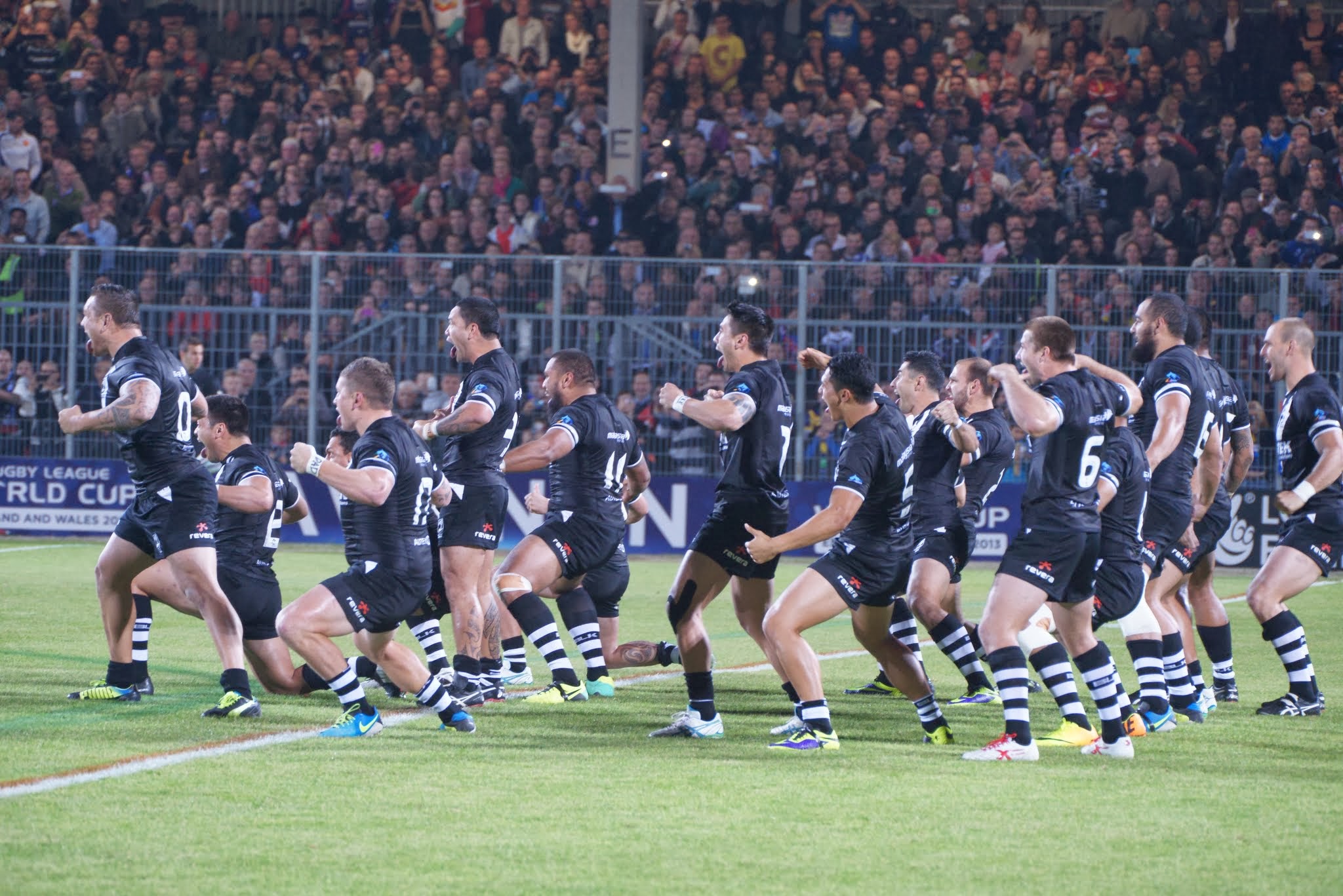
The haka is a very respected tradition to the Kiwis, which is why they turn down offers to do it for sponsorship/promotional purposes. The initiation haka is used as a form of team-bonding for the Kiwis, although this haka has a unique twist. All new players and staff are required to perform an initiation haka, even journalists have been forced into it. This usually happens during an open training session. Staff and players gather into a circle, with new players and staff standing inside the circle. They then strip down to their underwear and start performing a haka. As the haka starts, the team members forming the circle start to lower themselves, revealing the performance to media and fans who have shown up.
Before the matches, the Kiwis traditionally performed the Ka Mate haka, but, since the 2013 Rugby League World Cup, they instead perform the Te Iwi Kiwi haka. The words of the latter are translated as follows: Its pèrformance is preceded by the team forming a huddle with the leader at the centre while the karakia "Tūturu whakamaua kia tīnā! Tīnā! Haumi e, hui e! tāiki e!" is chanted.
| *Hī, hā!* | The breath of Life |
|---|
Coaches
Main article: List of New Zealand national rugby league team head coaches
The current coach of New Zealand is Stacey Jones.
Players
Main article: List of New Zealand national rugby league team players
Current roster
The New Zealand national team squad selected for the 2025 Pacific Championships. Jersey numbers in the table reflect team selection for the Pacific Cup Final versus Toa Samoa Statistics in this table are compiled from the website, Rugby League Project. Tallies include the match versus Toa Samoa on 9 November 2025.
| J# | Player | Age | Position(s) | Kiwis | Club | NRL | |||||||||
|---|---|---|---|---|---|---|---|---|---|---|---|---|---|---|---|
| Matches | Other Reps | Dbt | M | T | G | F | P | ||||||||
| 1 | 21 | 2024 | 5 | 2 | 0 | 0 | 8 | AUS Gold Coast Titans | **28** | Maori 1 | |||||
| 2 | 29 | 2018 | 14 | 9 | 52 | 1 | 141 | AUS Dolphins (NRL) | 160 | Samoa 1 | |||||
| 3 | 25 | 2023 | 9 | 3 | 0 | 0 | 12 | AUS Canberra Raiders | **111** | Maori 1 | |||||
| 4 | 30 | 2019 | 17 | 7 | 0 | 0 | 28 | NZL New Zealand Warriors | 136 | Maori 2 | |||||
| 5 | 19 | 2024 | 4 | 8 | 0 | 0 | 32 | AUS Penrith Panthers | **30** | ||||||
| 6 | 25 | 2022 | 11 | 5 | 2 | 0 | 24 | AUS Parramatta Eels | **142** | ||||||
| 7 | 35 | 2009 | 35 | 1 | 6 | 0 | 16 | AUS Gold Coast Titans | 318 | [[File:Queanbeyan United Colours.png | frameless | 16x16px]] 2 | |||
| 8 | 29 | 2016 | 21 | 2 | 0 | 0 | 8 | NZL New Zealand Warriors | 222 | Maori 5 | |||||
| 9 | 25 | 2024 | 6 | 2 | 0 | 0 | 8 | AUS Newcastle Knights | **107** | ||||||
| 10 | 30 | 2022 | 9 | 0 | 0 | 0 | 0 | AUS Penrith Panthers | **201** | ||||||
| 11 | 27 | 2019 | 17 | 5 | 0 | 0 | 20 | AUS Cronulla-Sutherland Sharks | **159** | Maori 5 | |||||
| 12 | 27 | 2018 | 16 | 5 | 1 | 0 | 22 | AUS Penrith Panthers | 178 | Samoa 1 | |||||
| 13 | 31 | 2016 | 26 | 3 | 0 | 0 | 12 | AUS Canberra Raiders | 236 | Maori 5 | |||||
| 14 | 30 | 2016 | 6 | 3 | 0 | 0 | 12 | NZL New Zealand Warriors | 110 | Maori 1 | |||||
| 15 | 23 | 2024 | 6 | 2 | 0 | 0 | 8 | AUS Sydney Roosters | **57** | ||||||
| 16 | 28 | 2024 | 4 | 1 | 0 | 0 | 4 | NZL New Zealand Warriors | 120 | Samoa 2 Maori 1 | |||||
| 17 | 23 | 2025 | 2 | 0 | 0 | 0 | 0 | AUS Brisbane Broncos | 51 | Cook Islands 1 Maori 2 | |||||
| 18 | 32 | 2022 | 4 | 0 | 0 | 0 | 0 | AUS Penrith Panthers | 139 | ||||||
| 19 | 30 | 0 | 0 | 0 | 0 | 0 | AUS Sydney Roosters | 36 | Maori 2 | ||||||
| 20 | 23 | 0 | 0 | 0 | 0 | 0 | AUS Brisbane Broncos | 23 | |||||||
| IJ | 29 | 2017 | 17 | 3 | 0 | 0 | 12 | AUS Melbourne Storm | **215** | ||||||
| IJ | 26 | 2022 | 2 | 4 | 0 | 0 | 16 | AUS Canberra Raiders | **109** | ||||||
| IJ | 25 | 2022 | 10 | 9 | 0 | 0 | 36 | AUS Cronulla-Sutherland Sharks | **136** | ||||||
| IJ | 29 | 2022 | 4 | 3 | 0 | 0 | 12 | AUS Dolphins (NRL) | 151 | Maori 2 |
Notes
- Te Maire Martin and Zach Dockar-Clay were added to the squad ahead of the Round 3 match against Tonga (on 2 November 2025) to replace the injured Ronaldo Mulitalo (knee) and Jeremy Marshall-King (thumb).
- Josiah Karapani was added to the squad ahead of the Pacific Cup Final versus Toa Samoa (on 9 November 2025) to replace the injured Nelson Asofa-Solomona and Sebastian Kris.
- A bold number in the NRL Matches column indicates that the player has played all their NRL appearances at their current club.
- Six members of the squad had previously played for other nations:
- (5): Clark, Isaako, Leota, Mulitalo and Papali'i.
- (1): Nicoll-Klokstad.
- Ten squad members have played in All Stars matches.
- Maori Māori All Stars (9).
- [[File:Queanbeyan United Colours.png|frameless|12x12px]] NRL All Stars team (1): Kieran Foran
- Naufahu Whyte was an unused 18th player replacement in all three New Zealand matches in the 2023 tournament.
- Casey McLean played for New South Wales Under 19s in June 2024.
- Ronaldo Mulitalo (ACL) & Jeremy Marshall-King (thumb) have withdrawn from the remainder of the pacific championships with injuries, with Zach Dockar-Clay & Te Maire Martin called into the squad.
Captains
:Category:New Zealand national rugby league team captains
Team of the Century (1907–2006)
-
Des White 2. Tom Hadfield 3. Tommy Baxter 4. Roger Bailey 5. Phillip Orchard 6. George Menzies 7. Stacey Jones
-
Cliff Johnson (c) 9. Jock Butterfield 10. Ruben Wiki 11. Mark Graham 12. Ron Ackland 13. Mel Cooke
Records
- Bold- denotes that the player is still active.
Team
- Greatest win: 74–0 vs Tonga in Auckland 1999
- Most consecutive wins: 5 (1983, 1996, 2000, 2013 and 2014–15)
- Greatest defeat: 0–58 vs Australia in Wellington 2007
- Most consecutive losses: 11 (15 November 1965 – 1 June 1969)
- Highest attended match: 74,468 at the 2013 Rugby League World Cup final in Manchester
Individual
Most Test appearances
- 55 – Ruben Wiki 1994–2008
- 51 – Adam Blair 2006, 2008–2012, 2014–2019
- 48 – Stacey Jones 1995–2006
- 46 – Gary Freeman 1986–1995
- 45 – Stephen Kearney 1993–2004
- 45 – Simon Mannering 2006–2017
- 42 – Issac Luke 2008–2017
- 40 – Thomas Leuluai 2003–2011, 2013–2017
- 39 – Nathan Cayless 1998–2008
- 38 – Nigel Vagana 1998–2006
- 36 – Dane O'Hara 1977–1986
- 36 – Jock Butterfield 1954–1963
- 35 – Sean Hoppe 1992–2002
- 35 – Quentin Pongia 1992–2000
- 35 – Shaun Johnson 2012–2019, 2024
- 34 - Kieran Foran 2009-2015, 2017, 2019, 2022-2023, 2025
- 34 – Cliff Johnson 1950–1960
- 34 – Kevin Iro 1987–1998
- 33 – Jason Nightingale 2008–2017
- 33 - Jesse Bromwich 2012-2022
- 32 – Hugh McGahan 1982–1990
- 32 – Roy Christian 1965–1972
- 31 – Dennis A. Williams 1971–1981
- 31 – Benji Marshall 2005–2012, 2019
- 30 – Tony Coll 1972–1982
Most Test Tries
- 22 – Manu Vatuvei 2005–2010, 2012–2015
- 19 – Nigel Vagana 1998–2006
- 19 – Jason Nightingale 2008–2017
- 17 – Sean Hoppe 1992–2002
- 16 – Hugh McGahan 1982–1990
- 16 – Kevin Iro 1987–1998
- 16 – Stacey Jones 1995–2006
- 15 – Ruben Wiki 1994–2006
- 15 – James Blackmore 1991–2000
- 15 – Bernard Hadfield 1956–1961
- 15 – Phillip Orchard 1969–1975
- 14 – Roger Tuivasa-Sheck 2013–2019
- 14 – Shaun Johnson 2012–2019, 2024
Most Test Goals
- 84 – Shaun Johnson 2012–2019, 2024
- 71 – Matthew Ridge 1990–1998
- 63 – Des White 1950–1956
- 60 – Daryl Halligan 1992–1998
- 52 – Henry Paul 1993–2001
- 47 – Stacey Jones 1995–2006
- 47 – Jack Fagan 1961–1965
- 44 – Olsen Filipaina 1977–1986
- 42 – Benji Marshall 2005–2012, 2019
- 34 – Warren Collicoat 1976–1979
- 34 – Warwick Clarke 1947–1949
Most Test Points
- 225 – Shaun Johnson (14 tries, 84 goals, 1 field goal) 2012–2019, 2024
- 168 – Matthew Ridge (6 tries, 71 goals, 2 field goals) 1990–1998
- 160 – Stacey Jones (16 tries, 47 goals, 2 field goals) 1995–2006
- 137 – Daryl Halligan (4 tries, 60 goals, 1 field goal) 1992–1998
- 132 – Des White (2 tries, 63 goals) 1950–1956
- 121 – Henry Paul (4 tries, 52 goals, 1 field goal) 1993–2001
- 116 – Benji Marshall (8 tries, 42 goals) 2005–2012, 2019
- 108 – Olsen Filipaina (6 tries, 44 goals) 1977–1986
- 97 – Jack Fagan (1 try, 47 goals) 1961–1965
Most points (all matches)
- 467 – Des White (7 tries and 233 goals) 1950–1956
Most tries in a match
- 6 – Hugh McGahan (1983) v Papua New Guinea, 2 October 1983
- 4 – Brian Jelleck (1999) v Tonga, 22 October 1999
- 4 – Manu Vatuvei (2008) v England, 8 November 2008
- 4 – Dallin Watene-Zelezniak (2022) v Jamaica, 23 October 2022
- 4 - Casey McLean (2024) v Papua New Guinea, 10 November 2024
- 3 - Clinton Toopi (2005 Tri-Nations) v Australia, 15 October 2005
- 3 - Clinton Toopi (2003 Centenary Test) v Australia, 18 October 2003
- 3 – Manu Vatuvei (2013) v Samoa, 27 October 2013
- 3 – Sonny Bill Williams (2013) v Papua New Guinea, 8 November 2013
- 3 – Sam Perrett (2010) v Papua New Guinea, 30 October 2010
- 3 – Junior Sau (2010) v Papua New Guinea, 30 October 2010
- 3 – Sam Perrett (2009) v France, 31 October 2009
- 3 – Jerome Ropati (2008) v Tonga, 18 October 2008
- 3 – Peta Hiku (2017) v Scotland, 4 November 2017
- 3 – Te Maire Martin (2017) v Scotland, 4 November 2017
Most points in a match
- 26 (1 try, 11 goals) – Henry Paul (1999) v Tonga, 22 October 1999
- 24 (2 tries, 8 goals) – Shaun Johnson (2013) v France, 1 November 2013
- 24 (12 goals) – Tasesa Lavea (2000) v Cook Islands, 2 November 2000
- 24 (6 tries) – Hugh McGahan (1983) v Papua New Guinea, 2 October 1983
- 22 (1 try, 9 goals) – Bryson Goodwin v (2009) v France, 31 October 2009
- 22 (1 try, 9 goals) – Shaun Johnson (2017) v Scotland, 4 November 2017
Most games as Captain
- 22 – Benji Marshall (2008–2012, 2019)
- 19 – Gary Freeman (1990–1993, 1995)
- 18 – Ruben Wiki (2003–2006)
- 18 – Mark Graham (1980–1983, 1985–1986)
- 15 – Roy Christian (1970–1972)
- 14 – Ken Stirling (1974–1975, 1978)
- 14 – Cliff Johnson (1957–1960)
Competitive record
Main article: List of New Zealand national rugby league team results
New Zealand have been playing international matches since 1907.
Tournament history
A red box around the year indicates tournaments played within New Zealand
World Cup
| World Cup record | Year | Round | Position | GP | W | L | D | **Total** | **1 Title** | **16/16** | **73** | **37** | **33** | **3** | ||||||
|---|---|---|---|---|---|---|---|---|---|---|---|---|---|---|---|---|---|---|---|---|
| FRA [1954](1954-rugby-league-world-cup) | Fourth place | 4/4 | 3 | 0 | 3 | 0 | ||||||||||||||
| AUS [1957](1957-rugby-league-world-cup) | Third place | 3/4 | 3 | 1 | 2 | 0 | ||||||||||||||
| UK [1960](1960-rugby-league-world-cup) | Third place | 3/4 | 3 | 1 | 2 | 0 | ||||||||||||||
| AUSNZL [1968](1968-rugby-league-world-cup) | Fourth place | 4/4 | 3 | 0 | 3 | 0 | ||||||||||||||
| UK [1970](1970-rugby-league-world-cup) | Fourth place | 4/4 | 3 | 1 | 2 | 0 | ||||||||||||||
| FRA [1972](1972-rugby-league-world-cup) | Fourth place | 4/4 | 3 | 0 | 3 | 0 | ||||||||||||||
| AUSFRANZLUK [1975](1975-rugby-league-world-cup) | Fourth place | 4/5 | 8 | 2 | 4 | 2 | ||||||||||||||
| AUSNZL [1977](1977-rugby-league-world-cup) | Third place | 3/4 | 3 | 1 | 2 | 0 | ||||||||||||||
| [1985–88](1985-1988-rugby-league-world-cup) | Second place | 2/5 | 7 | 4 | 2 | 1 | ||||||||||||||
| [1989–92](1989-1992-rugby-league-world-cup) | Third place | 3/5 | 8 | 5 | 3 | 0 | ||||||||||||||
| ENGWAL [1995](1995-rugby-league-world-cup) | Third place | 3/10 | 3 | 2 | 1 | 0 | ||||||||||||||
| ENGFRAIRESCOWAL[2000](2000-rugby-league-world-cup) | Second place | 2/16 | 6 | 5 | 1 | 0 | ||||||||||||||
| AUS [2008](2008-rugby-league-world-cup) | **Champions** | **1/10** | **5** | **4** | **1** | **0** | ||||||||||||||
| ENGWAL [2013](2013-rugby-league-world-cup) | Second place | 2/14 | 6 | 5 | 1 | 0 | ||||||||||||||
| AUSNZLPNG [2017](2017-rugby-league-world-cup) | Quarter Finals | 6/14 | 4 | 2 | 2 | 0 | ||||||||||||||
| ENG [2021](2021-rugby-league-world-cup) | Fourth place | 4/16 | 5 | 4 | 1 | 0 |
Tri-Nations/Four Nations
| Tri-Nations/Four Nations record | Year | Round | Position | GP | W | L | D |
|---|---|---|---|---|---|---|---|
| AUSNZL[1999](1999-rugby-league-tri-nations) | Second place | 2/3 | 3 | 2 | 1 | 0 | |
| UK [2004](2004-rugby-league-tri-nations) | Third place | 3/3 | 4 | 0 | 3 | 1 | |
| UK [2005](2005-rugby-league-tri-nations) | **Champions** | **1/3** | **5** | **3** | **2** | **0** | |
| AUSNZL [2006](2006-rugby-league-tri-nations) | Second place | 2/3 | 5 | 2 | 3 | 0 | |
| *Tournament Changed to Four Nations* | |||||||
| ENGFRA [2009](2009-rugby-league-tri-nations) | Third place | 3/4 | 3 | 1 | 1 | 1 | |
| AUSNZL [2010](2010-rugby-league-four-nations) | **Champions** | **1/4** | **4** | **3** | **1** | **0** | |
| ENGWAL[2011](2011-rugby-league-four-nations) | Third place | 3/4 | 3 | 1 | 2 | 0 | |
| AUSNZL [2014](2014-rugby-league-four-nations) | **Champions** | **1/4** | **4** | **4** | **0** | **0** | |
| ENG [2016](2016-rugby-league-four-nations) | Second Place | 2/4 | 4 | 1 | 2 | 1 | |
| **Total** | **3 Titles** | **9/9** | **35** | **17** | **15** | **3** |
Rugby League Pacific Championship
| Rugby League Pacific Championship record | Year | Round | Position | GP | W | L | D |
|---|---|---|---|---|---|---|---|
| [2019](2019-oceania-cup-rugby-league) | Second place | 2/3 | 2 | 1 | 1 | 0 | |
| [2023](2023-rugby-league-pacific-championships) | **Champions** | **1/3** | **3** | **2** | **1** | **0** | |
| [2024](2024-rugby-league-pacific-championships) | Third place | 3/3 | 3 | 1 | 2 | 0 | |
| **Total** | **1 Titles** | **2/4** | **8** | **4** | **4** | **0** |
Attendance records
Highest all-time attendances
| Attendance | Opposing team | Venue | Tournament |
|---|---|---|---|
| **74,468** | Old Trafford, Manchester | [2013](2013-rugby-league-world-cup) Rugby League World Cup [Final](2013-rugby-league-world-cup-final) | |
| **67,545** | Wembley Stadium, London | [2013](2013-rugby-league-world-cup) Rugby League World Cup Semi-Final | |
| **56,326** | Sydney Cricket Ground, Sydney | 1952 Trans-Tasman series – 1st Test | |
| **55,866** | Sydney Cricket Ground, Sydney | 1948 Trans-Tasman series – 1st Test | |
| **48,330** | Sydney Cricket Ground, Sydney | 1963 Trans-Tasman series – 1st Test |
Highest attendances per opponent
| Attendance | Opposing team | Venue | Tournament |
|---|---|---|---|
| **74,468** | Old Trafford, Manchester | [2013](2013-rugby-league-world-cup) Rugby League World Cup [Final](2013-rugby-league-world-cup-final) | |
| **67,545** | Wembley Stadium, London | [2013](2013-rugby-league-world-cup) Rugby League World Cup Semi-Final | |
| **42,685** | GBR England* | Odsal Stadium, Bradford | [1947–48 Kiwis Tour](1947-48-new-zealand-rugby-league-tour-of-great-britain-and-france) – 3rd Test |
| **42,344** | Wembley Stadium, London | [2011](2011-rugby-league-four-nations) Rugby League Four Nations | |
| **30,431** | Stade Vélodrome, Marseille | [1965 Kiwis Tour](1965-new-zealand-rugby-league-tour-of-great-britain-and-france) – 1st Test | |
| **24,041** | Waikato Stadium, Hamilton | [2017](2017-rugby-league-world-cup) Rugby League World Cup | |
| **23,269** | Eden Park, Auckland | [2023](2023-rugby-league-pacific-championships) Pacific Championships | |
| **18,180** | Headingley, Leeds | [2013](2013-rugby-league-world-cup) Rugby League World Cup | |
| **14,044** | Headingley, Leeds | [2021](2021-men-s-rugby-league-world-cup) Rugby League World Cup | |
| **12,713** | Wellington Regional Stadium, Wellington | [2017](2017-rugby-league-world-cup) Rugby League World Cup | |
| **12,130** | Headingley, Leeds | [2013](2013-rugby-league-world-cup) Rugby League World Cup | |
| **6,829** | Hull City Stadium, Hull | [2021](2021-men-s-rugby-league-world-cup) Rugby League World Cup | |
| **5,453** | Headingley, Leeds | [2021](2021-men-s-rugby-league-world-cup) Rugby League World Cup | |
| **3,982** | Madejski Stadium, Reading | [2000](2000-rugby-league-world-cup) Rugby League World Cup |
** Great Britain played as England in 1947*
Highest attendances per opponent in New Zealand
| Attendance | Opposing team | Venue | Tournament |
|---|---|---|---|
| **47,363** | Eden Park, Auckland | [1985–1988](1985-1988-rugby-league-world-cup) Rugby League World Cup [Final](1988-rugby-league-world-cup-final) | |
| **34,000** | GBR Northern Union* | The Domain, Auckland | [1920 Great Britain Lions tour](1920-great-britain-lions-tour) – 1st Test |
| **24,041** | Waikato Stadium, Hamilton | [2017](2017-rugby-league-world-cup) Rugby League World Cup | |
| **23,269** | Eden Park, Auckland | [2023](2023-rugby-league-pacific-championships) Pacific Championships | |
| **20,681** | Wellington Regional Stadium, Wellington | [2010](2010-rugby-league-four-nations) Rugby League Four Nations | |
| **20,500** | Carlaw Park, Auckland | 1955 French Rugby League tour – 1st Test | |
| **12,713** | Wellington Regional Stadium, Wellington | [2017](2017-rugby-league-world-cup) Rugby League World Cup | |
| **12,130** | Rugby League Park, Christchurch | [2017](2017-rugby-league-world-cup) Rugby League World Cup | |
| **11,500** | Rotorua International Stadium, Rotorua | [2010](2010-rugby-league-four-nations) Rugby League Four Nations | |
| **9,368** | Carlaw Park, Auckland | [1975](1975-rugby-league-world-cup) Rugby League World Cup |
** Great Britain played as Northern Union in 1920*
Honours
IRL Rankings
New Zealand A
New Zealand are also represented by a second-string representative team called "New Zealand A".
- New Zealand A def. Australian Invitational XIII 48–18 (22 October 2006)
- New Zealand A def. Australian Invitational XIII 40–16 (15 October 2005) ''Between 2002 and 2003 the New Zealand Residents were referred to as New Zealand 'A'''
- National League 1 Representative def. New Zealand A 40–28 (2 November 2003)
- Great Britain def. New Zealand A 52–18 (29 October 2003)
- Warrington Wolves def. New Zealand A 28–26 (26 October 2003)
- National League 2 Representative def. New Zealand A 27–6 (22 October 2003)
- New Zealand A drew Cumbria 24–24 (19 October 2003)
- New Zealand A def. USA 74–4 (6 October 2002)
- France def. New Zealand A (29 September 2002)
Notes
References
;General
- Rugby league from 1966 encyclopaedia of New Zealand
- All statistics are correct as of September 2013, as per Rugby League Project. ;Inline
References
- [https://archive.today/20060212102152/http://nzrl.co.nz/page/playing_records.html New Zealand Rugby League Playing Records] NZRL.co.nz
- John Haynes ''From All Blacks to All Golds: Rugby League's Pioneers'', Christchurch, Ryan and Haynes, 1996. {{ISBN. 0-473-03864-1
- Coffey and Wood ''The Kiwis: 100 Years of International Rugby League'' {{ISBN. 1-86971-090-8
- (14 October 2005). "NZ coach seeking glory to leave adversity behind". The Sydney Morning Herald.
- (28 October 2007). "Kiwis lose league test". [[Stuff.co.nz]].
- The Courier-Mail] at www.news.com.au
- (4 November 2007). "League: Kiwis coach calls for calm after slaughter". [[The New Zealand Herald]].
- Rattue, Chris. (5 November 2007). "Chris Rattue: Where there's no hope, there's no glory". [[The New Zealand Herald]].
- Jessup, Peter. (5 November 2007). "League: Kemble's at a loss over big defeat". [[The New Zealand Herald]].
- (6 November 2007). "League: Kemble considers stepping down". [[The New Zealand Herald]].
- (12 November 2007). "Kemble upbeat despite series loss". [[Stuff.co.nz]].
- (12 November 2007). "League: Kemble pleads for job after whitewash". [[The New Zealand Herald]].
- [https://www.stuff.co.nz/sport/olympics/82035787/the-history-of-black-why-do-kiwi-sports-teams-wear-black-and-when-did-it-start The history of black] by Ben Strang, Jul 15, 2016
- "Autex and Rugby League".
- Long, David. (12 November 2015). "Kiwis perform haka to Liverpool players after training at Premier League club". Stuff.
- Lawton, Aaron. (9 November 2010). "The naked truth: A day with the Kiwis". Sunday News.
- Johnstone, Duncan. (14 October 2010). "Haka start for Timana Tahu". Stuff.
- (14 October 2011). "On tour with the Kiwis". Fuseworks Media.
- Barclay, Chris. (14 April 2013). "Protection for Kiwis debutant Tuivasa-Sheck". Stuff.
- Davis, Greg. (22 October 2013). "Four Nations 2014: New Zealand draft Josh Hoffman in for injured Dallin Watene-Zelezniak". Courier Mail.
- Foote, Stephen. (18 October 2015). "Video: Kiwis rookies pranked in haka initiation". [[Newshub]].
- "The Te Iwi Kiwi way {{!}} NZRL".
- (2022-11-11). "Kiwis kick off semi with stirring haka".
- (7 Oct 2025). "Stacey Jones names experienced Kiwis squad for Pacific Championships".
- (28 Oct 2025). "Pacific Championships Team Lists: Week 3".
- (28 Oct 2025). "Kiwis make four changes for Eden Park clash against Tonga".
- (4 Nov 2025). "Pacific Championships Team Lists: The Finals".
- (4 Nov 2025). "Brisbane winger Karapani brought into Kiwi squad".
- https://nzrl.co.nz/martin-and-dockar-clay-to-join-new-zealand-kiwis-after-injuries-to-marshall-king-and-mulitalo/
- "New Zealand League".
- "New Zealand League".
This article was imported from Wikipedia and is available under the Creative Commons Attribution-ShareAlike 4.0 License. Content has been adapted to SurfDoc format. Original contributors can be found on the article history page.
Ask Mako anything about New Zealand national rugby league team — get instant answers, deeper analysis, and related topics.
Research with MakoFree with your Surf account
Create a free account to save articles, ask Mako questions, and organize your research.
Sign up freeThis content may have been generated or modified by AI. CloudSurf Software LLC is not responsible for the accuracy, completeness, or reliability of AI-generated content. Always verify important information from primary sources.
Report