From Surf Wiki (app.surf) — the open knowledge base
New Hampshire
U.S. state
.jpg)
U.S. state
| Field | Value | |||||||||
|---|---|---|---|---|---|---|---|---|---|---|
| name | New Hampshire | |||||||||
| image_flag | Flag of New Hampshire.svg | |||||||||
| flag_link | Flag and seal of New Hampshire | |||||||||
| image_seal | Seal of New Hampshire.svg | |||||||||
| seal_link | Flag and seal of New Hampshire | |||||||||
| nicknames | Granite State | |||||||||
| White Mountain StateFor use in a reference publication see | ||||||||||
| * For official use see {{cite web | title | Fast New Hampshire Facts | website=New Hampshire Almanac | publisher=State of New Hampshire | url = https://www.nh.gov/nhinfo/fastfact.html | archive-url = https://web.archive.org/web/20170525063913/https://www.nh.gov/nhinfo/fastfact.html | archive-date=May 25, 2017 | access-date=February 12, 2018 }} | ||
| * For contemporary use see {{cite web | title | 'Live Free or Die'—The Story of the New Hampshire Motto | website=New England Today | publisher=Yankee Publishing, Inc. | url = https://newengland.com/today/living/new-england-history/live-free-or-die-new-hampshire-motto/ | archive-url = https://web.archive.org/web/20180212201835/https://newengland.com/today/living/new-england-history/live-free-or-die-new-hampshire-motto/ | archive-date=February 12, 2018 | date=August 10, 2017 | quote=For tourism purposes, however, New Hampshire typically tones it down a bit, presenting itself as the Granite State or the White Mountain State... | access-date=February 12, 2018 }} |
| motto | "Live Free or Die" | |||||||||
| anthem | "Old New Hampshire" | |||||||||
| image_map | New Hampshire in United States (zoom).svg | |||||||||
| OfficialLang | English | |||||||||
| (French allowed for official business with Quebec; other languages allowed for certain specific uses) | ||||||||||
| population_demonym | Granite Stater | |||||||||
| seat | Concord | |||||||||
| LargestCity | Manchester | |||||||||
| LargestCounty | Hillsborough | |||||||||
| LargestMetro | Greater Boston (combined and metro) | |||||||||
| Nashua (urban) | ||||||||||
| area_rank | 46th | |||||||||
| area_total_sq_mi | 9,350 | |||||||||
| area_total_km2 | 24,216 | |||||||||
| area_land_sq_mi | 8,954 | |||||||||
| area_land_km2 | 23,190 | |||||||||
| area_water_sq_mi | 396 | |||||||||
| area_water_km2 | 1,026 | |||||||||
| width_mi | 68 | |||||||||
| width_km | 110 | |||||||||
| length_mi | 190 | |||||||||
| length_km | 305 | |||||||||
| area_water_percent | 4.2 | |||||||||
| Latitude | 42° 42′ N to 45° 18′ N | |||||||||
| Longitude | 70° 36′ W to 72° 33′ W | |||||||||
| population_as_of | 2024 | |||||||||
| population_rank | 41st | |||||||||
| 2010Pop | 1409032 | |||||||||
| 2010DensityUS | auto | |||||||||
| 2010Density | auto | |||||||||
| population_density_rank | 21st | |||||||||
| MedianHouseholdIncome | $ (2023) | |||||||||
| IncomeRank | 4th | |||||||||
| elevation_max_point | Mount Washington | |||||||||
| elevation_max_ft | 6,288 | |||||||||
| elevation_max_m | 1916.66 | |||||||||
| elevation_ft | 1,000 | |||||||||
| elevation_m | 300 | |||||||||
| elevation_min_point | Atlantic Ocean | |||||||||
| elevation_min_ft | 0 | |||||||||
| elevation_min_m | 0 | |||||||||
| Former | Province of New Hampshire | |||||||||
| AdmittanceDate | June 21, 1788 | |||||||||
| AdmittanceOrder | 9th | |||||||||
| Governor | Kelly Ayotte (R) | |||||||||
| Lieutenant Governor | Sharon Carson (R) | |||||||||
| Lieutenant Governor_alt | Senate President | |||||||||
| Legislature | General Court | |||||||||
| Upperhouse | Senate | |||||||||
| Lowerhouse | House of Representatives | |||||||||
| Judiciary | New Hampshire Supreme Court | |||||||||
| Senators | Jeanne Shaheen (D) | |||||||||
| Maggie Hassan (D) | ||||||||||
| Representative | 1: Chris Pappas (D) | |||||||||
| 2: Maggie Goodlander (D) | ||||||||||
| timezone1 | Eastern | |||||||||
| utc_offset1 | −05:00 | |||||||||
| timezone1_DST | EDT | |||||||||
| utc_offset1_DST | −04:00 | |||||||||
| iso_code | US-NH | |||||||||
| postal_code | NH | |||||||||
| TradAbbreviation | N.H. | |||||||||
| website | nh.gov |
White Mountain StateFor use in a reference publication see
- For official use see
- For contemporary use see (French allowed for official business with Quebec; other languages allowed for certain specific uses) Nashua (urban) Maggie Hassan (D) 2: Maggie Goodlander (D) Notophthalmus viridescens Haemorhous purpureus Lycaeides melissa samuelis Salvelinus fontinalis Saltwater: Striped bass Morone saxatilis Syringa vulgaris Coccinellidae Odocoileus virginianus Betula papyrifera Vegetable: White Potato Berry: Blackberry
New Hampshire ( ) is a state in the New England region of the Northeastern United States. It borders Massachusetts to the south, Vermont to the west, Maine and the Gulf of Maine to the east, and the Canadian province of Quebec to the north. Of the 50 U.S. states, New Hampshire is the seventh-smallest by land area and the tenth-least populous, with a population of 1,377,529 residents as of the 2020 census. Concord is the state capital and Manchester is the most populous city. New Hampshire's motto, "Live Free or Die", reflects its role in the American Revolutionary War; its nickname, "The Granite State", refers to its extensive granite formations and quarries. It is well known for holding the first primary in the U.S. presidential election cycle, and its resulting influence on American electoral politics.
New Hampshire was inhabited for thousands of years by Algonquian-speaking peoples such as the Abenaki. Europeans arrived in the 17th century, with the English establishing some of the earliest non-indigenous settlements. The Province of New Hampshire was established in 1629, named after the English county of Hampshire. Following tensions between the British colonies and the crown in the 1760s, New Hampshire saw one of the earliest acts of rebellion, with the seizing of Fort William and Mary from the British in 1774. In 1776, it became the first of the British North American colonies to establish an independent government and state constitution. It signed the United States Declaration of Independence and contributed troops, ships, and supplies in the war against Britain. In 1788, it was the 9th state to ratify the U.S. Constitution, bringing it into effect. Through the mid-19th century, New Hampshire was an active center of abolitionism, and fielded close to 32,000 Union soldiers during the U.S. Civil War. Afterwards the state saw rapid industrialization and population growth, becoming a center of textile manufacturing, shoemaking, and papermaking; the Amoskeag Manufacturing Company in Manchester was the largest cotton textile plant in the world. French Canadians formed the most significant influx of immigrants, and a quarter of New Hampshire residents have French American ancestry.
Reflecting a nationwide trend, New Hampshire's industrial sector declined after World War II. Since 1950, its economy has diversified to include financial services, real estate, education, transportation and high-tech, with manufacturing still higher than the US average. Its population surged as highways connected it to Greater Boston and led to more commuter towns. New Hampshire is among the wealthiest and most-educated states, tying Massachusetts for the highest Human Development in the nation. It is one of nine states without an income tax and has no taxes on sales, capital gains, or inheritance while relying heavily on local property taxes to fund education; consequently, its state tax burden is among the lowest in the country. New Hampshire is one of the least religious states and known for its libertarian-leaning political culture; it is one of the least liberal states in New England. The New Hampshire Republican Party has held a trifecta majority in state level government since 2017, with the exception of 2019 and 2020, while the Democratic Party has held a majority on federal level representation in Congress. New Hampshire is the only state to have a woman as governor and women as both U.S. senators.
With its mountainous and heavily forested terrain, New Hampshire has a growing tourism sector centered on recreation. It has some of the highest ski mountains on the East Coast and is a major destination for winter sports; Mount Monadnock is among the most climbed mountains in the world. Other activities include observing the fall foliage, summer cottages along lakes and the seacoast, motorsports at the New Hampshire Motor Speedway in Loudon, and Motorcycle Week, a motorcycle rally held in Weirs Beach in Laconia. The White Mountain National Forest includes most of the Appalachian Trail between Vermont and Maine, and has the Mount Washington Auto Road, where visitors may drive to the top of 6288 ft Mount Washington.
History
Main article: History of New Hampshire
Various Algonquian-speaking Abenaki tribes, largely divided between the Androscoggin, Cowasuck and Pennacook nations, inhabited the area before European colonization. Despite the similar language, they had a very different culture and religion from other Algonquian peoples. Indigenous people lived near Keene, New Hampshire 12,000 years ago, according to 2009 archaeological digs, and the Abenaki were present in New Hampshire in pre-colonial times.
English and French explorers visited New Hampshire in 1600–1605, and David Thompson settled at Odiorne's Point in present-day Rye in 1623. The first permanent European settlement was at Hilton's Point (present-day Dover). By 1631, the Upper Plantation comprised modern-day Dover, Durham and Stratham; in 1679, it became the "Royal Province". Father Rale's War was fought between the colonists and the Wabanaki Confederacy throughout New Hampshire.
New Hampshire was one of the Thirteen Colonies that rebelled against British rule during the American Revolution. During the American Revolution, New Hampshire was economically divided. The Seacoast region revolved around sawmills, shipyards, merchants' warehouses, and established village and town centers, where wealthy merchants built substantial homes, furnished them with luxuries, and invested their capital in trade and land speculation. At the other end of the social scale, there developed a permanent class of day laborers, mariners, indentured servants and slaves.
.jpg)
The United States Constitution was ratified by New Hampshire on June 21, 1788, when New Hampshire became the ninth state to do so.
New Hampshire was a Jacksonian stronghold; the state sent Franklin Pierce to the White House in the election of 1852. Industrialization took the form of numerous textile mills, which in turn attracted large flows of immigrants from Quebec (the "French Canadians") and Ireland. The northern parts of the state produced lumber, and the mountains provided tourist attractions. After 1960, the textile industry collapsed, but the economy rebounded as a center of high technology and as a service provider.
Starting in 1952, New Hampshire gained national and international attention for its presidential primary held early in every presidential election year. It immediately became an important testing ground for candidates for the Republican and Democratic nominations but did not necessarily guarantee victory. The media gave New Hampshire and Iowa significant attention compared to other states in the primary process, magnifying the state's decision powers and spurring repeated efforts by out-of-state politicians to change the rules.
Geography

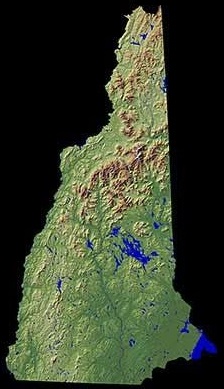
New Hampshire is part of the six-state New England region of the Northeastern United States. It is bounded by Quebec, Canada, to the north and northwest; Maine and the Gulf of Maine to the east; Massachusetts to the south; and Vermont to the west. New Hampshire's major regions are the Great North Woods, the White Mountains, the Lakes Region, the Seacoast, the Merrimack Valley, the Monadnock Region, and the Dartmouth-Lake Sunapee area. New Hampshire has the shortest ocean coastline of any U.S. coastal state, with a length of 18 mi, sometimes measured as only 13 mi.
The White Mountains range in New Hampshire spans the north-central portion of the state. The range includes Mount Washington, the tallest in the northeastern U.S.—site of the second-highest wind speed ever recorded— as well as Mount Adams and Mount Jefferson. With hurricane-force winds every third day on average, more than a hundred recorded deaths among visitors, and conspicuous krumholtz (dwarf, matted trees much like a carpet of bonsai trees), the climate on the upper reaches of Mount Washington has inspired the weather observatory on the peak to claim that the area has the "World's Worst Weather". The White Mountains were home to the rock formation called the Old Man of the Mountain, a face-like profile in Franconia Notch, until the formation disintegrated in May 2003. Even after its loss, the Old Man remains an enduring symbol for the state, seen on state highway signs, automobile license plates, and many government and private entities around New Hampshire.
In southwestern New Hampshire, the landmark Mount Monadnock has given its name to a class of earth-forms—a monadnock—signifying, in geomorphology, any isolated resistant peak rising from a less resistant eroded plain.
New Hampshire has more than 800 lakes and ponds, and approximately 19000 mi of rivers and streams. Major rivers include the 110 mi Merrimack River, which bisects the lower half of the state north–south before passing into Massachusetts and reaching the sea in Newburyport. Its tributaries include the Contoocook River, Pemigewasset River, and Winnipesaukee River. The 410 mi Connecticut River, which starts at New Hampshire's Connecticut Lakes and flows south to Connecticut, defines the western border with Vermont. The state border is not in the center of that river, as is usually the case, but at the low-water mark on the Vermont side; meaning the entire river along the Vermont border (save for areas where the water level has been raised by a dam) lies within New Hampshire. Only one town—Pittsburg—shares a land border with the state of Vermont. The "northwesternmost headwaters" of the Connecticut also define part of the Canada–U.S. border.
The Piscataqua River and its several tributaries form the state's only significant ocean port where they flow into the Atlantic at Portsmouth. The Salmon Falls River and the Piscataqua define the southern portion of the border with Maine. The Piscataqua River boundary was the subject of a border dispute between New Hampshire and Maine in 2001, with New Hampshire claiming dominion over several islands (primarily Seavey's Island) that include the Portsmouth Naval Shipyard. The U.S. Supreme Court dismissed the case in 2002, leaving ownership of the island with Maine. New Hampshire still claims sovereignty of the base, however.
The largest of New Hampshire's lakes is Lake Winnipesaukee, which covers 71 sqmi in the east-central part of New Hampshire. Umbagog Lake along the Maine border, approximately 12.3 sqmi, is a distant second. Squam Lake is the second largest lake entirely in New Hampshire.
New Hampshire has the shortest ocean coastline of any state in the United States, approximately 18 mi long. Hampton Beach is a popular local summer destination. About 7 mi offshore are the Isles of Shoals, nine small islands (four of which are in New Hampshire) known as the site of a 19th-century art colony founded by poet Celia Thaxter, and the alleged location of one of the buried treasures of the pirate Blackbeard.
It is the state with the highest percentage of timberland area in the country. New Hampshire is in the temperate broadleaf and mixed forests biome. Much of the state, in particular the White Mountains, is covered by the conifers and northern hardwoods of the New England-Acadian forests. The southeast corner of the state and parts of the Connecticut River along the Vermont border are covered by the mixed oaks of the Northeastern coastal forests. The state's numerous forests are popular among autumnal leaf peepers seeking the brilliant foliage of the numerous deciduous trees.
The northern third of the state is locally referred to as the "north country" or "north of the notches", in reference to the White Mountain passes that channel traffic. It contains less than 5% of the state's population, suffers relatively high poverty, and is steadily losing population as the logging and paper industries decline. However, the tourist industry, in particular visitors who go to northern New Hampshire to ski, snowboard, hike and mountain bike, has helped offset economic losses from mill closures.
Environmental protection emerged as a key state issue in the early 1900s in response to poor logging practices. In the 1970s, activists defeated a proposal to build an oil refinery along the coast and limited plans for a full-width interstate highway through Franconia Notch to a parkway.
Winter season lengths are projected to decline at ski areas across New Hampshire due to the effects of climate change, which is likely to continue the historic contraction and consolidation of the ski industry and threaten individual ski businesses and communities that rely on ski tourism.
Flora and fauna
Black bears, white-tailed deer, and moose can be found all over New Hampshire. There are also less-common animals such as the marten and the Canadian lynx.
Climate
New Hampshire experiences a humid continental climate (Köppen climate classification Dfa in some southern areas, Dfb in most of the state, and Dfc subarctic in some northern highland areas), with warm, humid summers, and long, cold, and snowy winters. Precipitation is fairly evenly distributed all year. The climate of the southeastern portion is moderated by the Atlantic Ocean and averages relatively milder winters (for New Hampshire), while the northern and interior portions experience colder temperatures and lower humidity. Winters are cold and snowy throughout the state, and especially severe in the northern and mountainous areas. Average annual snowfall ranges from 60 in to over 100 in across the state.
Average daytime highs are in the mid 70s°F to low 80s°F (24–28 °C) throughout the state in July, with overnight lows in the mid 50s°F to low 60s°F (13–15 °C). January temperatures range from an average high of 34 F on the coast to overnight lows below 0 F in the far north and at high elevations. Average annual precipitation statewide is roughly 40 in with some variation occurring in the White Mountains due to differences in elevation and annual snowfall. New Hampshire's highest recorded temperature was 106 F in Nashua on July 4, 1911, while the lowest recorded temperature was -47 F atop Mount Washington on January 29, 1934. Mount Washington also saw an unofficial -50 F reading on January 22, 1885, which, if made official, would tie the record low for New England (also -50 F at Big Black River, Maine, on January 16, 2009, and Bloomfield, Vermont on December 30, 1933).
Extreme snow is often associated with a nor'easter, such as the Blizzard of '78 and the Blizzard of 1993, when several feet accumulated across portions of the state over 24 to 48 hours. Lighter snowfalls of several inches occur frequently throughout winter, often associated with an Alberta Clipper.
New Hampshire, on occasion, is affected by hurricanes and tropical storms—although, by the time they reach the state, they are often extratropical—with most storms striking the southern New England coastline and moving inland or passing by offshore in the Gulf of Maine. Most of New Hampshire averages fewer than 20 days of thunderstorms per year and an average of two tornadoes occur annually statewide.
The National Arbor Day Foundation plant hardiness zone map depicts zones 3, 4, 5, and6 occurring throughout the state and indicates the transition from a relatively cooler to warmer climate as one travels southward across New Hampshire. The 1990 USDA plant hardiness zones for New Hampshire range from zone 3b in the north to zone 5b in the south.
| Location | July (°F) | July (°C) | January (°F) | January (°C) |
|---|---|---|---|---|
| Manchester | 82/64 | 28/17 | 33/15 | 0/−9 |
| Nashua | 82/59 | 28/15 | 33/12 | 0/−11 |
| Concord | 82/57 | 28/14 | 30/10 | −1/−12 |
| Portsmouth | 79/61 | 26/16 | 32/16 | 0/−9 |
| Keene | 82/56 | 28/13 | 31/9 | −1/−12 |
| Laconia | 81/60 | 27/16 | 30/11 | −1/−11 |
| Lebanon | 82/58 | 28/14 | 30/8 | −1/−13 |
| Berlin | 78/55 | 26/13 | 27/5 | –3/–15 |
Metropolitan areas
Main article: List of cities and towns in New Hampshire

- Berlin
- Boston–Cambridge–Nashua
- Haverhill–Newburyport–Amesbury Town NECTA Division
- Lawrence–Methuen Town–Salem NECTA Division
- Lowell–Billerica–Chelmsford NECTA Division
- Nashua NECTA Division
- Claremont
- Concord
- Dover–Durham
- Franklin
- Keene
- Laconia
- Lebanon
- Manchester
- Portsmouth
Demographics
|align-fn=center
Population

As of the 2020 census, the resident population of New Hampshire was 1,377,529, a 4.6% increase since the 2010 United States census. The center of population of New Hampshire is in Merrimack County, in the town of Pembroke. The center of population has moved south 12 mi since 1950, a reflection of the fact that the state's fastest growth has been along its southern border, which is within commuting range of Boston and other Massachusetts cities.
As indicated in the census, in 2020 88.3% of the population were White; 1.5% were Black or African American; 0.2% were Native American or Alaskan Native; 2.6% were Asian; 0.0% were Native Hawaiian or other Pacific Islander; 1.7% were some other race; and 5.6% were two or more races. 4.3% of the total population were Hispanic or Latino of any race. 18.6% of the population were under 18 years of age; 19.3% were 65 years and over. The female population was 50.5%.
The most densely populated areas generally lie within 50 mi of the Massachusetts border, and are concentrated in two areas: along the Merrimack River Valley running from Concord to Nashua, and in the Seacoast Region along an axis stretching from Rochester to Portsmouth. Outside of those two regions, only one community, the city of Keene, has a population of over 20,000. The four counties covering these two areas account for 72% of the state population, and one (Hillsborough) has nearly 30% of the state population, as well as the two most populous communities, Manchester and Nashua. The northern portion of the state is very sparsely populated: the largest county by area, Coos, covers the northern one-fourth of the state and has only around 31,000 people, about a third of whom live in a single community (Berlin). The trends over the past several decades have been for the population to shift southward, as many northern communities lack the economic base to maintain their populations, while southern communities have been absorbed by the Greater Boston metropolis.

As of the 2010 census, the population of New Hampshire was 1,316,470. The gender makeup of the state at that time was 49.3% male and 50.7% female. 21.8% of the population were under the age of 18; 64.6% were between the ages of 18 and 64; and 13.5% were 65 years of age or older. Additionally, about 57.3% of the population was born out of state.
According to HUD's 2022 Annual Homeless Assessment Report, there were an estimated 1,605 homeless people in New Hampshire.
| Racial composition | 1990 | 2000 | 2010 | url=https://data.census.gov/table/DECENNIALDP2020.DP1?g=040XX00US33 | title=Profile of General Population and Housing Characteristics: 2020 Demographic Profile Data (DP-1): New Hampshire | publisher=United States Census Bureau | access-date=April 16, 2024}} |
|---|---|---|---|---|---|---|---|
| White | 98.0% | 96.0% | 93.9% | 88.3% | |||
| Black or African American | 0.6% | 0.7% | 1.1% | 1.5% | |||
| American Indian and Alaska Native | 0.2% | 0.2% | 0.2% | 0.2% | |||
| Asian | 0.8% | 1.3% | 2.2% | 2.6% | |||
| Native Hawaiian and other Pacific Islander | – | – | 0.0% | 0.0% | |||
| Other race | 0.3% | 0.6% | 0.9% | 1.7% | |||
| Two or more races | – | 1.1% | 1.6% | 5.6% | |||
| Hispanic or Latino | |||||||
| (of any race) | 1.0% | 1.7% | 2.8% | 4.3% |
Hispanic or Latino of any race were 2.8% of the population in 2010: 0.6% were of Mexican, 0.9% Puerto Rican, 0.1% Cuban, and 1.2% other Hispanic or Latino origin. As of 2020, the Hispanic or Latino population was counted as 4.3%. The Native American/Alaska native population is listed as 0.3% in the 2020 census, but may be higher.
According to the 2012–2017 American Community Survey, the largest ancestry groups in the state were Irish (20.6%), English (16.5%), French (14.0%), Italian (10.4%), German (9.1%), French Canadian (8.9%), and American (4.8%).
New Hampshire has the highest percentage (22.9%) of residents with French/French Canadian/Acadian ancestry of any U.S. state.
In 2018, the top countries of origin for New Hampshire's immigrants were India, Canada, China, Nepal and the Dominican Republic.
According to the Census Bureau's American Community Survey estimates from 2017, 2.1% of the population aged5 and older speak Spanish at home, while 1.8% speak French. In Coös County, 9.6% of the population speaks French at home, down from 16% in 2000. In the city of Nashua, Hillsborough County, 8.02% of the population speaks Spanish at home.
| Manchester | Nashua | Concord | Derry | Dover |
|---|---|---|---|---|
| Population, Census (2020) | 115,644 | 91,322 | 43,976 | 34,317 |
| Population, Census (2010) | 109,565 | 86,494 | 42,695 | 33,109 |
| Population change (April 1, 2010, to April 1, 2020) | ||||
| **Age and sex** (2020) | ||||
| Persons under 5 years | 5.3% | 5.0% | 4.2% | 5.0% |
| Persons under 18 years | 18.7% | 19.2% | 17.2% | 20.6% |
| Persons 65 years and over | 14.9% | 16.7% | 19.1% | 14.2% |
| Female persons | 50.1% | 50.4% | 49.8% | 50.4% |
| **Race and ethnicity** (2020) | ||||
| White | 76.7% | 73.1% | 85.4% | 89.3% |
| Non-Hispanic White | 74.0% | 70.3% | 84.5% | 88.1% |
| Hispanic or Latino | 11.8% | 13.9% | 3.1% | 4.6% |
| Black or African American | 5.5% | 3.0% | 3.8% | 1.2% |
| American Indian and Alaska Native | 0.3% | 0.3% | 0.3% | 0.1% |
| Asian | 4.2% | 7.8% | 4.1% | 1.6% |
| Native Hawaiian and other Pacific Islander | - | - | - | - |
| Two or more races | 7.9% | 9.0% | 5.2% | 6.0% |
| **Population characteristics** (2017–2022) | ||||
| Veterans | 6,212 | 5,103 | 2,885 | 2,256 |
| Foreign-born persons | 14.9% | 15.8% | 8.2% | 4.8% |
Birth data
Note: Percentages in the table do not add up to 100, because Hispanics are counted both by their ethnicity and by their race, giving a higher overall number.
| Race | 2013 | 2018 | 2023 |
|---|---|---|---|
| Non-Hispanic White | 11,064 (89.2%) | 10,317 (86.0%) | 10,094 (84.6%) |
| Asian | 485 (3.9%) | 472 (3.9%) | 411 (3.4%) |
| Black | 316 (2.5%) | 241 (2.0%) | 304 (2.5%) |
| American Indian | 25 (0.2%) | 13 (0.1%) | 10 (0.1%) |
| *Hispanic* (any race) | *513* (4.1%) | *745* (6.2%) | *889* (7.4%) |
| **Total New Hampshire** | **12,396** (100%) | **11,995** (100%) | **11,936** (100%) |
- Since 2016, data for births of White Hispanic origin are not collected, but included in one Hispanic group; persons of Hispanic origin may be of any race.
In 2022, New Hampshire had the lowest teen birth rate of any state, at 4.6 births per 1,000 females ages 15 to 19 years of age.
Religion
A Pew survey in 2014 showed that the religious affiliations of the people of New Hampshire was as follows: nonreligious 36%, Protestant 30%, Catholic 26%, Jehovah's Witness 2%, LDS (Mormon) 1%, and Jewish 1%.
A survey suggests people in New Hampshire and Vermont are less likely than other Americans to attend weekly services and only 54% say they are "absolutely certain there is a God" compared to 71% in the rest of the nation. New Hampshire and Vermont are also at the lowest levels among states in religious commitment. In 2012, 23% of New Hampshire residents in a Gallup poll considered themselves "very religious", while 52% considered themselves "non-religious".{{cite news |access-date = March 28, 2012 |archive-url = https://web.archive.org/web/20120328201315/http://www.gallup.com/poll/153479/mississippi-religious-state.aspx |archive-date = March 28, 2012 |url-status = live
In 2016, a Gallup Poll found that New Hampshire was the least religious state in the United States. Only 20% of respondents in New Hampshire categorized themselves as "very religious", while the nationwide average was 40%.
According to the 2020 Public Religion Research Institute study, 64% of the population was Christian, dominated by Roman Catholicism and evangelical Protestantism. In contrast with varying studies of estimated irreligiosity, the Public Religion Research Institute reported that irreligion declined from 36% at the separate 2014 Pew survey to 25% of the population in 2020. In 2021, the unaffiliated increased to 40% of the population, although Christianity altogether made up 54% of the total population (Catholics, Protestants, and Jehovah's Witnesses).
Economy
- Total employment : 628,166
- Number of employer establishments: 39,298
The Bureau of Economic Analysis estimates that New Hampshire's total state product in 2018 was $86billion, ranking 40th in the United States. Median household income in 2017 was $74,801, the fourth highest in the country (including Washington, DC). Its agricultural outputs are dairy products, nursery stock, cattle, apples and eggs. Its industrial outputs are machinery, electric equipment, rubber and plastic products, and tourism is a major component of the economy.
New Hampshire experienced a major shift in its economic base during the 20th century. Historically, the base was composed of traditional New England textiles, shoemaking, and small machine shops, drawing upon low-wage labor from nearby small farms and parts of Quebec. Today, of the state's total manufacturing dollar value, these sectors contribute only two percent for textiles, two percent for leather goods, and nine percent for machining. They experienced a sharp decline due to obsolete plants and the lure of cheaper wages in the Southern United States.
New Hampshire today has a broad-based and growing economy, with a state GDP growth rate of 2.8% in 2024. The state's largest economic sectors in 2018, based on contribution to GDP, are: 15% real estate and rental and leasing; 13% professional business services; 12% manufacturing; 10% government and government services; and 9% health care and social services.
The state's budget in FY2018 was $5.97billion, including $1.79billion in federal funds. The state has a property tax (subject to municipal control) but no broad sales tax or income tax. The state does have narrower taxes on meals, lodging, vehicles, and business income; and has tolls on some expressways. Though there is no broad-based state tax, local jurisdictions have the U.S.'s 8th-highest property taxes as of a 2019 ranking by the Tax Foundation. However, the state's overall tax burden is relatively low; in 2010 New Hampshire ranked 8th-lowest among states in combined average state and local tax burden.
According to the Energy Information Administration, New Hampshire's energy consumption and per capita energy consumption are among the lowest in the country. The Seabrook Station Nuclear Power Plant, near Portsmouth, is the largest individual electrical generating unit on the New England power grid and provided 57% of New Hampshire's electricity generation in 2017. Power generation from wind power increased strongly in 2012 and 2013, but remained rather flat for the next ten years at around 4% of consumption. In 2016, 2017 and at least 2019–2022, New Hampshire obtained more of its electricity generation from wind power than from coal-fired power plants. Hydroelectric power and biomass are other important renewable resources in the state. New Hampshire was a net exporter of electricity, exporting 63 e12BTU.
New Hampshire's residential electricity use is low compared with the national average, in part because demand for air conditioning is low during the generally mild summer months and because few households use electricity as their primary energy source for home heating. Nearly half of New Hampshire households use fuel oil for winter heating, which is one of the largest shares in the United States. New Hampshire has potential for renewable energies like wind power, hydroelectricity, and wood fuel.
The (preliminary) seasonally unemployment rate in November 2025 was 3.0% based on a 774,900 person civilian workforce with 751,300 people in employment.
Largest employers
In March 2018, 86% of New Hampshire's workforce were employed by the private sector, with 53% of those workers being employed by firms with fewer than 100 employees. About 14% of private-sector employees are employed by firms with more than 1,000 employees.
According to community surveys by the Economic & Labor Market Information Bureau of NH Employment Security, the following are the largest private employers in the state as of 2018:
| Employer | Location (base) | Employees |
|---|---|---|
| Dartmouth–Hitchcock Medical Center | Lebanon | 7,000 |
| Fidelity Investments | Merrimack | 6,000 |
| BAE Systems North America | Nashua | 4,700 |
| Liberty Mutual | Dover | 3,800 |
| Elliot Hospital | Manchester | 3,800 |
| Dartmouth College | Hanover | 3,500 |
| Southern New Hampshire University | Manchester | 3,200 |
| Capital Regional Health Care | Concord | 3,000 |
| Catholic Medical Center | Manchester | 2,300 |
| Southern New Hampshire Health System | Nashua | 2,200 |
New Hampshire's state government employs approximately 6,100 people. Additionally, the U.S. Department of State employs approximately 1,600 people at the National Visa Center and National Passport Center in Portsmouth, which process United States immigrant visa petitions and United States passport applications.
Law and government
Main article: Government of New Hampshire

The governor of New Hampshire, since January 9, 2025, is Republican Kelly Ayotte. New Hampshire's two U.S. senators are Jeanne Shaheen and Maggie Hassan, both of whom are Democrats and former governors. New Hampshire's two U.S. representatives as of January 2025 are Chris Pappas and Maggie Goodlander, both Democrats.
New Hampshire is an alcoholic beverage control state, and through the State Liquor Commission takes in $100million from the sale and distribution of liquor.
New Hampshire is the only state in the U.S. that does not require adults to wear seat belts in their vehicles. It is one of three states that have no mandatory helmet law.
Governing documents
Main article: Law of New Hampshire
The New Hampshire State Constitution of 1783 is the supreme law of the state, followed by the New Hampshire Revised Statutes Annotated and the New Hampshire Code of Administrative Rules. These are roughly analogous to the federal United States Constitution, United States Code and Code of Federal Regulations respectively.
Branches of government
New Hampshire has a bifurcated executive branch, consisting of the governor and a five-member executive council which votes on state contracts worth more than $10,000 and "advises and consents" to the governor's nominations to major state positions such as department heads and all judgeships and pardon requests. New Hampshire does not have a lieutenant governor; the Senate president serves as "acting governor" whenever the governor is unable to perform the duties.
The legislature is called the General Court. It consists of the House of Representatives and the Senate. There are 400 representatives, making it one of the largest elected bodies in the English-speaking world, and 24 senators. Legislators are paid a nominal salary of $200 per two-year term plus travel costs, the lowest in the U.S. by far. Thus most are effectively volunteers, nearly half of whom are retirees. (For details, see the article on Government of New Hampshire.)
The state's sole appellate court is the New Hampshire Supreme Court. The Superior Court is the court of general jurisdiction and the only court which provides for jury trials in civil or criminal cases. The other state courts are the Probate Court, District Court, and the Family Division.
Local government
New Hampshire has 10 counties and 234 cities and towns.
New Hampshire is a "Dillon Rule" state, meaning the state retains all powers not specifically granted to municipalities. Even so, the legislature strongly favors local control, particularly concerning land use regulations. New Hampshire municipalities are classified as towns or cities, which differ primarily by the form of government. Most towns generally operate on the town meeting form of government, where the registered voters in the town act as the town legislature, and a board of selectmen acts as the executive of the town. Larger towns and the state's thirteen cities operate either on a council–manager or council–mayor form of government. There is no difference, from the state government's point of view, between towns and cities besides the form of government. All state-level statutes treat all municipalities identically.
New Hampshire has a small number of unincorporated areas that are titled as grants, locations, purchases, or townships. These locations have limited to no self-government, and services are generally provided for them by neighboring towns or the county or state where needed. As of the 2000 census, there were 25 of these left in New Hampshire, accounting for a total population of 173 people (); several were entirely depopulated. All but two of these unincorporated areas are in Coös County.
Politics
Main article: Politics of New Hampshire
New Hampshire is known for its fiscal conservatism and cultural liberalism. The state's politics are cited as libertarian leaning. It is the least religious state in the Union as of a 2016 Gallup poll.
The Democratic Party and the Republican Party, in that order, are the two largest parties in the state. A plurality of voters are registered as undeclared, and can choose either ballot in the primary and then regain their undeclared status after voting. The Libertarian Party had official party status from 1990 to 1996 and from 2016 to 2018. A movement known as the Free State Project suggests libertarians move to the state to concentrate their power. As of August 30, 2022, there were 869,863 registered voters, of whom 332,008 (38.17%) did not declare a political party affiliation, 273,921 (31.49%) were Democratic, and 263,934 (30.34%) were Republican.
As of 2025, the Republican Party controls the governorship, the Executive Council, and both houses of the legislature. However, the Democratic Party controls all four seats in the state's delegation to Congress.
New Hampshire primary
The New Hampshire primary is the first primary election in the quadrennial American presidential election cycle. State law requires that the Secretary of State schedule this election at least one week before any "similar event". While the Iowa caucus precedes the New Hampshire primary, the New Hampshire election is the nation's first contest that uses the same procedure as the general election. It draws more attention than those in other states and shapes the national contest.
In February 2023, the Democratic National Committee awarded that party's first primary to South Carolina, to be held on February 3, 2024, directing New Hampshire and Nevada to vote three days later. New Hampshire officials from both parties stood by the state's "first in the nation" law and ignored the DNC.
State law permits a town with fewer than 100 residents to open its polls at midnight and close when all registered citizens have cast their ballots. Dixville Notch in Coos County and Hart's Location in Carroll County, among others, have implemented these provisions. Dixville Notch and Hart's Location are thus the first precincts in both New Hampshire and the U.S. to report results in presidential primaries and elections.
Nominations for all other partisan offices are decided in a separate primary election. In Presidential election cycles, this is the second primary election held in New Hampshire.
Saint Anselm College in Goffstown has become a popular campaign spot for politicians as well as several national presidential debates.
Elections
Main article: Elections in New Hampshire

In the past, New Hampshire has often voted Republican. Between 1856 and 1988, New Hampshire cast its electoral votes for the Democratic presidential ticket six times: Woodrow Wilson (twice), Franklin D. Roosevelt (three times), and Lyndon B. Johnson (once).
Beginning in 1992, New Hampshire became a swing state in national and local elections, and in that time has supported Democrats in all presidential elections except 2000. It was the only state in the country to switch from supporting Republican George W. Bush in the 2000 election to supporting his Democratic challenger in the 2004 election, when John Kerry, a senator from neighboring Massachusetts, won the state.
The Democrats dominated elections in New Hampshire in 2006 and 2008. In 2006, Democrats won both congressional seats (electing Carol Shea-Porter in the first district and Paul Hodes in the second), re-elected Governor John Lynch, and gained a majority on the Executive Council and in both houses for the first time since 1911. Democrats had not held both the legislature and the governorship since 1874. Neither U.S. Senate seat was up for a vote in 2006. In 2008, Democrats retained their majorities, governorship, and Congressional seats; and former governor Jeanne Shaheen defeated incumbent Republican John E. Sununu for the U.S. Senate in a rematch of the 2002 contest.
The 2008 elections resulted in women holding a majority, 13 of the 24 seats, in the New Hampshire Senate, a first for any legislative body in the United States.
In the 2010 midterm elections, Republicans made historic gains in New Hampshire, capturing veto-proof majorities in the state legislature, taking all five seats in the Executive Council, electing a new U.S. senator, Kelly Ayotte, winning both U.S. House seats, and reducing the margin of victory of incumbent Governor John Lynch compared to his 2006 and 2008 landslide wins.
In the 2012 state legislative elections, Democrats took back the New Hampshire House of Representatives and narrowed the Republican majority in the New Hampshire Senate to 13–11. In 2012, New Hampshire became the first state in U.S. history to elect an all-female federal delegation: Democratic Congresswomen Carol Shea-Porter of Congressional District 1 and Ann McLane Kuster of Congressional District 2 accompanied U.S. Senators Jeanne Shaheen and Kelly Ayotte in 2013. Further, the state elected its second female governor: Democrat Maggie Hassan.
In the 2014 elections, Republicans retook the New Hampshire House of Representatives with a 239–160 majority and expanded their majority in the New Hampshire Senate to 14 of the Senate's 24 seats. On the national level, incumbent Democratic Senator Jeanne Shaheen defeated her Republican challenger, former Massachusetts senator Scott Brown. New Hampshire also elected Frank Guinta (R) for its First Congressional District representative and Ann Kuster (D) for its Second Congressional District representative.
In the 2016 elections, Republicans held the New Hampshire House of Representatives with a majority of 220–175 and held onto their 14 seats in the New Hampshire Senate. In the gubernatorial race, retiring Governor Maggie Hassan was succeeded by Republican Chris Sununu, who defeated Democratic nominee Colin Van Ostern. Sununu became the state's first Republican governor since Craig Benson, who left office in 2005 following defeat by John Lynch. In the presidential race, the state voted for the Democratic nominee, former Secretary of State Hillary Clinton over the Republican nominee, Donald Trump, by a margin of 2,736 votes, or 0.3%, one of the closest results the state has ever seen in a presidential race, while Libertarian nominee Gary Johnson received 4.12% of the vote. The Democrats also won a competitive race in the Second Congressional District, as well as a competitive senate race.
Since 2017, Democrats have controlled New Hampshire's entire congressional delegation, while Republicans have controlled the governorship and (except in 2019–2020) both houses of the legislature.
Free State Project
The Free State Project (FSP) is a movement founded in 2001 to recruit at least 20,000 libertarians to move to a single low-population state (New Hampshire, was selected in 2003), to concentrate libertarian activism around a single region. The Free State Project emphasizes decentralized decision-making, encouraging new movers and prior residents of New Hampshire to participate in a way the individual mover deems most appropriate. For example, as of 2017, there were 17 so-called Free Staters elected to the New Hampshire House of Representatives, and in 2021, the New Hampshire Liberty Alliance, which ranks bills and elected representatives based on their adherence to what they see as libertarian principles, scored 150 representatives as "A−" or above rated representatives. Participants also engage with other like-minded activist groups such as Rebuild New Hampshire, Young Americans for Liberty, and Americans for Prosperity. As of April 2022, approximately 6,232 participants have moved to New Hampshire for the Free State Project.
Transportation
Highways
Main article: New Hampshire Highway System
New Hampshire has a well-maintained, well-signed network of Interstate highways, U.S. highways, and state highways. State highway markers still depict the Old Man of the Mountain despite that rock formation's demise in 2003. Several route numbers align with the same route numbers in neighboring states. State highway numbering is arbitrary, with no overall system, while the U.S. highway and Interstate systems follow national numbering conventions. Major routes include:
- [[File:I-89.svg|20px]] Interstate 89 runs northwest from near Concord to Lebanon on the Vermont border.
- [[File:I-93.svg|20px]] Interstate 93 is the main Interstate highway in New Hampshire and runs north from Salem (on the Massachusetts border) to Littleton (on the Vermont border). I-93 connects the more densely populated southern part of the state to the Lakes Region and the White Mountains further to the north.
- [[File:I-95.svg|20px]] Interstate 95 runs north–south briefly along New Hampshire's seacoast to serve the city of Portsmouth, before entering Maine
- [[File:US 1.svg|20px]] U.S. Route 1 runs north–south briefly along New Hampshire's seacoast to the east of and paralleling I-95.
- [[File:US 2.svg|20px]] U.S. Route 2 runs east–west through Coos County from Maine, intersecting Route 16, skirting the White Mountain National Forest passing through Jefferson and into Vermont.
- [[File:US 3.svg|20px]] U.S. Route 3 is the longest numbered route in the state, and the only one to run completely through the state from the Massachusetts border to the Canada–U.S. border. It generally parallels Interstate 93. South of Manchester, it takes a more westerly route through Nashua. North of Franconia Notch, U.S.3 takes a more easterly route, before terminating at the Canada–U.S. border.
- [[File:US 4.svg|20px]] U.S. Route 4 terminates at the Portsmouth Traffic Circle and runs east–west across the southern part of the state connecting Durham, Concord, Boscawen, and Lebanon.
- [[File:NH Route 16.svg|20px]] New Hampshire Route 16 is a major north–south highway in the eastern part of the state that generally parallels the border with Maine, eventually entering Maine as Maine Route 16. The southernmost portion of NH 16 is a four-lane freeway, co-signed with U.S. Route4.
- [[File:NH Route 101.svg|20px]] New Hampshire Route 101 is a major east–west highway in the southern part of the state that connects Keene with Manchester and the Seacoast region. East of Manchester, NH 101 is a four-lane, limited-access highway that runs to Hampton Beach and I-95.
Air
Main article: List of airports in New Hampshire
New Hampshire has 25 public-use airports, three with some scheduled commercial passenger service. The busiest airport by number of passengers handled is Manchester-Boston Regional Airport in Manchester and Londonderry, which serves the Greater Boston metropolitan area. The closest airport with international service is Logan International Airport in Boston.
Public transportation
Long-distance intercity passenger rail service is provided by Amtrak's Vermonter and Downeaster lines.
Greyhound, Concord Coach, Vermont Translines, and Dartmouth Coach all provide intercity bus connections to and from points in New Hampshire and to long-distance points beyond and in between.
, Boston-centered MBTA Commuter Rail services reach only as far as northern Massachusetts. The New Hampshire Rail Transit Authority is working to extend "Capital Corridor" service from Lowell, Massachusetts, to Nashua, Concord, and Manchester, including Manchester-Boston Regional Airport; and "Coastal Corridor" service from Haverhill, Massachusetts, to Plaistow, New Hampshire. Legislation in 2007 created the New Hampshire Rail Transit Authority (NHRTA) with the goal of overseeing the development of commuter rail in the state of New Hampshire. In 2011, Governor John Lynch vetoed HB 218, a bill passed by Republican lawmakers, which would have drastically curtailed the powers and responsibilities of NHRTA. The I-93 Corridor transit study suggested a rail alternative along the Manchester and Lawrence branch line which could provide freight and passenger service. This rail corridor would also have access to Manchester-Boston Regional Airport.
Eleven public transit authorities operate local and regional bus services around the state, and eight private carriers operate express bus services which link with the national intercity bus network. The New Hampshire Department of Transportation operates a statewide ride-sharing match service, in addition to independent ride matching and guaranteed ride home programs.
Tourist railroads include the Conway Scenic Railroad, Hobo-Winnipesaukee Railroad, and the Mount Washington Cog Railway.
Freight railways
Main article: List of New Hampshire railroads
Freight railways in New Hampshire include Claremont & Concord Railroad (CCRR), Pan Am Railways via subsidiary Springfield Terminal Railway (ST), the New England Central Railroad (NHCR), the St. Lawrence and Atlantic Railroad (SLR), and New Hampshire Northcoast Corporation (NHN).
Education

New Hampshire’s education system includes public school districts, private schools, and a variety of school choice initiatives. One significant component of the latter is the New Hampshire Education Freedom Accounts program, a statewide initiative that allows eligible families to direct a portion of state education funding toward approved educational expenses outside of traditional public schools.
The average cost per pupil for public K-12 education in New Hampshire exceeded $21,000, with most funding coming from local property taxes. In 2025, the state expanded Education Freedom Accounts into a universal school choice program, making most students eligible to participate.
High schools
The first public high schools in the state were the Boys' High School and the Girls' High School of Portsmouth, established either in 1827 or 1830, depending on the source.
New Hampshire has more than 80 public high schools, many of which serve more than one town. The largest is Pinkerton Academy in Derry, which is owned by a private non-profit organization and serves as the public high school of several neighboring towns. There are at least 30 private high schools in the state.
New Hampshire is also the home of several prestigious university-preparatory schools, such as Phillips Exeter Academy, St. Paul's School, Proctor Academy, Brewster Academy, and Kimball Union Academy.
Traditionally, school funding has been decided by municipalities, often at town meeting. In 1993, the Claremont litigation began when that town's school district secured a verdict that Part 2, Article 83 of the state constitution required the state to fund education adequately and uniformly. This was never achieved despite additional rounds of litigation. In 2002, New Hampshire enacted a statewide property tax to be forwarded to school districts to address the problem. In 2008, the Court ended its supervisory role because the original laws had been replaced, but it did not reverse its earlier finding. In 2023, a district judge set a new, higher amount for educational "adequacy". In June 2025, the legislature enacted language asserting its right to determine funding. The New Hampshire Supreme Court upheld the 2023 verdict but declined to force the legislature to comply.
Colleges and universities
Main article: List of colleges and universities in New Hampshire
- Antioch University New England
- Colby-Sawyer College
- Community College System of New Hampshire:
- Great Bay Community College
- Lakes Region Community College
- Manchester Community College
- Nashua Community College
- NHTI, Concord's Community College
- River Valley Community College
- White Mountains Community College
- Dartmouth College
- Tuck School of Business
- Geisel School of Medicine
- Thayer School of Engineering
- Guarini School of Graduate and Advanced Studies
- Franklin Pierce University
- Hellenic American University
- Massachusetts College of Pharmacy and Health Sciences
- New England College
- New Hampshire Institute of Art
- Rivier University
- Saint Anselm College
- Southern New Hampshire University
- Thomas More College of Liberal Arts
- University System of New Hampshire:
- University of New Hampshire
- University of New Hampshire School of Law
- University of New Hampshire at Manchester
- Granite State College
- Keene State College
- Plymouth State University
- University of New Hampshire
Media
Daily newspapers
Main article: List of newspapers in New Hampshire
- Berlin Daily Sun
- Concord Monitor
- Conway Daily Sun
- Eagle Times of Claremont
- Eagle Tribune (Lawrence, Massachusetts area, including parts of southern New Hampshire)
- Foster's Daily Democrat of Dover
- Keene Sentinel
- Laconia Daily Sun
- New Hampshire Union Leader of Manchester, formerly known as the Manchester Union Leader
- The Portsmouth Herald
- The Sun (Lowell, Massachusetts area, including parts of southern New Hampshire)
- Valley News of Lebanon
Other publications
- Area News Group
- Business New Hampshire Magazine
- The Cabinet Press
- Milford Cabinet
- Bedford Journal
- Hollis/Brookline Journal
- Merrimack Journal
- The Dartmouth (Dartmouth College student newspaper)
- The Exeter News-Letter
- Free Keene
- The Hampton Union
- Hippo Press (covering Manchester, Nashua, and Concord)
- The Liberty Block
- Manchester Express
- Manchester Ink Link
- The New Hampshire (University of New Hampshire student newspaper)
- New Hampshire Business Review
- New Hampshire Free Press
- The New Hampshire Gazette (Portsmouth alternative biweekly)
- NH Living Magazine
- NH Rocks
- Salmon Press Newspapers (family of weekly newspapers covering Lakes Region and North Country)
- The Telegraph of Nashua
Radio stations
Main article: List of radio stations in New Hampshire
Television stations
Main article: List of television stations in New Hampshire
- ABC affiliate WMUR, Channel 9, Manchester
- PBS affiliate Channel 11, Durham (New Hampshire Public Television); repeater stations in Keene and Littleton
- True Crime Network affiliate WWJE, Channel 50, Derry/Manchester
- Ion Television station WPXG, Channel 21, Concord (satellite of WBPX in Boston)
Sports
The following sports teams are based in New Hampshire:
| Club | Sport | Venue | League | Level | notes |
|---|---|---|---|---|---|
| Amoskeag Rugby Club | Rugby union | Northeast Athletic Club, Pembroke | New England Rugby Football Union | Amateur | |
| Keene Swamp Bats | Baseball | Alumni Field, Keene | New England Collegiate Baseball League | Collegiate summer baseball | |
| Nashua Silver Knights | Baseball | Holman Stadium, Nashua | Futures Collegiate Baseball League | Collegiate summer baseball | |
| New Hampshire Fisher Cats | Baseball | Delta Dental Stadium, Manchester | Double-A Eastern League | Professional | Double-A affiliate of the Toronto Blue Jays |
| New Hampshire Wild | Baseball | Doane Diamond, Concord | Empire Professional Baseball League | Professional | Independent minor league |
| Northeast Ruckus | American football | Nor Rock Field | Womans Football Alliance | Semi-professional | Based in Windham, plays home games in nearby Raymond, New Hampshire |
| Seacoast United Phantoms | Soccer | New England Sports Park | USL League Two | Semi-professional | Based in Portsmouth, plays home games in nearby Hampton, New Hampshire |
| New Hampshire Mountain Kings | Ice Hockey | Tri-Town Ice Arena, Hooksett | North American Hockey League | Amateur |
The sport of paintball was invented in Henniker in 1981. Sutton was the home of the world's first commercial paintball facility.
The New Hampshire Motor Speedway in Loudon is an oval track and road course that has been visited by national motorsport championship series such as the NASCAR Cup Series, the NASCAR Xfinity Series, the NASCAR Craftsman Truck Series, NASCAR Whelen Modified Tour, American Canadian Tour (ACT), the Champ Car and the IndyCar Series. Other motor racing venues include Star Speedway and New England Dragway in Epping, Lee USA Speedway in Lee, Twin State Speedway in Claremont, Monadnock Speedway in Winchester and Canaan Fair Speedway in Canaan.
New Hampshire has two universities competing at the NCAA Division I in all collegiate sports: the Dartmouth Big Green (Ivy League) and the New Hampshire Wildcats (America East Conference), as well as three NCAA Division II teams: Franklin Pierce Ravens, Saint Anselm Hawks, and Southern New Hampshire Penmen (Northeast-10 Conference). Most other schools compete in NCAA Division III or the NAIA.
Annually since 2002, high-school statewide all-stars compete against Vermont in 10 sports during "Twin State" playoffs.
Culture
In the spring, New Hampshire's many sap houses hold sugaring-off open houses. In summer and early autumn, New Hampshire is home to many county fairs, the largest being the Hopkinton State Fair, in Contoocook. New Hampshire's Lakes Region is home to many summer camps, especially around Lake Winnipesaukee, and is a popular tourist destination. The Peterborough Players have performed every summer in Peterborough since 1933. The Barnstormers Theatre in Tamworth, founded in 1931, is one of the longest-running professional summer theaters in the United States.
In September, New Hampshire is host to the New Hampshire Highland Games. New Hampshire has also registered an official tartan with the proper authorities in Scotland, used to make kilts worn by the Lincoln Police Department while its officers serve during the games. The fall foliage peaks in mid-October. In the winter, New Hampshire's ski areas and snowmobile trails attract visitors from a wide area. After the lakes freeze over they become dotted with ice fishing ice houses, known locally as bobhouses.
Funspot, the world's largest video arcade (now termed a museum), is in Laconia.
In fiction
Many novels, plays and screenplays have been set in New Hampshire.
Theater
- The fictional New Hampshire town of Grover's Corners serves as the setting of the Thornton Wilder play Our Town. Grover's Corners is based, in part, on the real town of Peterborough. Several local landmarks and nearby towns are mentioned in the text of the play, and Wilder himself spent some time in Peterborough at the MacDowell Colony, writing at least some of the play while in residence there.
Comics
- Al Capp, creator of the comic strip Li'l Abner, used to joke that Dogpatch, the setting for the strip, was based on Seabrook, where he would vacation with his wife.
Television
Many television programs have been set in New Hampshire. Notable recent examples include:
- In the AMC drama Breaking Bad ("Granite State") series lead Walter White escapes to a cabin in a fictional county in northern New Hampshire.
- An episode of the NBC drama The West Wing takes place in the fictional Hartsfield's Landing, New Hampshire.
- In the sixth season of HBO series The Sopranos, in an episode named for New Hampshire's slogan "Live Free or Die", a character flees to the fictional town of Dartford, New Hampshire, because of inadvertently being outed as a gay man.
Notable people
Main article: List of people from New Hampshire
Prominent individuals from New Hampshire include 14th President of the United States Franklin Pierce, founding father Nicholas Gilman, Senator Daniel Webster, Revolutionary War hero John Stark, editor Horace Greeley, founder of the Christian Science religion Mary Baker Eddy, poet Robert Frost, sculptor Daniel Chester French, astronaut Alan Shepard, rock musician Ronnie James Dio, author Dan Brown, actor-comedian Adam Sandler, inventor Dean Kamen, comedians Sarah Silverman and Seth Meyers, restaurateurs Richard and Maurice McDonald, WWE wrestler Triple H, and streamer Ludwig Ahgren.
Notes
References
References
- New Hampshire State Library. "State Official and Honorary State Song". State of New Hampshire.
- (1995). "New Hampshire Revised Statutes, Title 1, Chapter 3-C:1—Official State Language". State of New Hampshire.
- (1995). "New Hampshire Revised Statutes, Title 1, Chapter 3-C:2—Exceptions". State of New Hampshire.
- (2024). "Gazetteer Files: States".
- "Geographic Identifiers: New Hampshire". U.S. Census Bureau.
- "Household Income in States and Metropolitan Areas: 2023".
- {{cite ngs
- (2001). "Elevations and Distances in the United States". [[United States Geological Survey]].
- (June 16, 2017). "Blackberry now the state berry of NH". WMUR News.
- (2010). "State Area Measurements and Internal Point Coordinates".
- "U.S. Census Bureau QuickFacts: United States".
- "Visit NH: State Facts". NH Department of Resources and Economic Development.
- (September 28, 2014). "Origin of "New Hampshire"". State Symbols USA.
- (August 21, 2019). "Economy by Industry in N.H. and U.S.". Carsey School of Public Policy | UNH.
- "New Hampshire {{!}} Education".
- "Subnational HDI - Subnational HDI - Table - Global Data Lab".
- Jacobs, Ben. (October 13, 2022). "The politics of New Hampshire, America's quirkiest state, explained".
- "Party control of New Hampshire state government".
- "Abenaki".
- "12,000 Years Ago in the Granite State".
- Harris, Michael. (2021). "N'dakinna: Our Homeland...Still – Additional Examples of Abenaki Presence in New Hampshire". Spectrum.
- (December 18, 1998). "Constitution of New Hampshire - 1776".
- "Observing Constitution Day".
- (2019-12-19). "The First Primary: Why New Hampshire?".
- "Why is New Hampshire the first primary in the nation?".
- "NH RSA 1:6 Perambulation of New Hampshire-Maine State Line".
- "NH RSA 1:5 1:5 Perambulation of the New Hampshire-Massachusetts State Line".
- "NH RSA 1:7 Perambulation of New Hampshire-Vermont State Line".
- "New Hampshire Coastal Access Map". New Hampshire Coastal Program.
- Beaver, Janice Cheryl. (November 9, 2006). "U.S. International Borders: Brief Facts". Congressional Research Service.
- Filipov, David. (January 31, 2010). "Record blown away, but pride stays put: N.H. summit's claim to nasty weather intact". [[The Boston Globe]].
- "Mount Washington ... Home of the World's Worst Weather". Mt. Washington Observatory.
- "Rivers and Lakes".
- ''Vermont v. New Hampshire'' {{Ussc. 289. 593. 1933
- "HJR 1—Final Version". [[New Hampshire General Court]].
- "New Hampshire Water Resources Primer, Chapter 6: Coastal and Estuarine Waters". NH Dept. of Environmental Services.
- (May 9, 2012). "Tree and impervious cover in the United States (2012)". [[Landscape and Urban Planning]].
- (2001). "Terrestrial Ecoregions of the World: A New Map of Life on Earth". [[BioScience]].
- Kimberly A. Jarvis, ''From the Mountains to the Sea: Protecting Nature in Postwar New Hampshire'' (University of Massachusetts Press, 2020) [http://www.h-net.org/reviews/showrev.php?id=56368 online review]
- Kimberly A. Jarvis, ''Franconia Notch and the Women Who Saved It '' (Durham: University of New Hampshire Press, 2007.
- "Climate Change Vulnerability of the Northeast US Winter Tourism Sector". University of Ottawa Department of Geography and Institute of Science.
- (July 15, 2015). "New Hampshire: Third Edition". Cavendish Square Publishing, LLC.
- Dellinger, Dan. (June 23, 2004). "Snowfall—Average Total in Inches". [[NOAA]].
- "Annual average number of tornadoes 1953–2004". NOAA.
- "2006 arborday.org Hardiness Zone Map". [[National Arbor Day Foundation]].
- "New Hampshire USDA Plant Hardiness Zone Map".
- "New Hampshire climate averages". Weatherbase.
- "Metropolitan New England City and Town Areas—Current/ACS18—Data as of January 1, 2018". U.S. Census Bureau.
- "Metropolitan and NECTA Divisions published by CES". Bureau of Labor Statistics.
- "Historical Population Change Data (1910–2020)". United States Census Bureau.
- "State Population Totals and Components of Change: 2020-2024". U.S. Census Bureau.
- "Centers of Population: 2020". United States Census Bureau.
- (October 2007). "Population Center of New Hampshire, 1950–2000". NH Office of Energy and Planning.
- "2010 Demographic Profile Data". U.S. Census Bureau.
- (May 16, 2013). "You're Not From Around Here, Are You?".
- "2007-2022 PIT Counts by State".
- "The 2022 Annual Homelessness Assessment Report (AHAR) to Congress".
- (July 25, 2008). "Historical Census Statistics on Population Totals by Race, 1790 to 1990, and by Hispanic Origin, 1970 to 1990, for the United States, Regions, Divisions, and States".
- (January 8, 2014). "Census Viewer".
- "Profile of General Population and Housing Characteristics: 2020 Demographic Profile Data (DP-1): New Hampshire". United States Census Bureau.
- (July 30, 2022). "Despite Misconceptions Native Americans have long history in New Hampshire".
- "2017 American Community Survey". U.S. Census Bureau.
- "Immigrants in New Hampshire".
- "Language Spoken at Home by Ability to Speak English for the Population 5 Years and Over: 2015 American Community Survey 5-Year Estimates (B16001): New Hampshire". U.S. Census Bureau.
- "Language Spoken at Home by Ability to Speak English for the Population 5 Years and Over: 2015 American Community Survey 5-Year Estimates (B16001): Coos County, New Hampshire". U.S. Census Bureau.
- (July 17, 2007). "MLA Language Map Data Center". Modern Language Association.
- "Language Spoken at Home by Ability to Speak English for the Population 5 Years and Over: 2015 American Community Survey 5-Year Estimates (B16001): ZCTA5 03060-03064, New Hampshire". U.S. Census Bureau.
- "DP1: PROFILE OF GENERAL POPULATION AND HOUSING CHARACTERISTICS". United States Census Bureau.
- "DP02Selected Social Characteristics in the United States". United States Census Bureau.
- "Births: Final Data for 2013".
- (February 25, 2022). "Teen Birth Rate by State". U.S. Department of Health & Human Services.
- "PRRI – American Values Atlas".
- (May 11, 2015). "Adults in New Hampshire".
- Allen, Mike. (June 23, 2008). "Pew survey finds believers flexible". Politico.
- "State Membership Report - New Hampshire - Religious Traditions, 2010". The Association of Religion Data Archives.
- (February 4, 2016). "New Hampshire Now Least Religious State in U.S.".
- "PRRI – American Values Atlas".
- "U.S. Census Bureau QuickFacts: New Hampshire".
- "U.S. Census Bureau QuickFacts: New Hampshire".
- (May 1, 2019). "Gross Domestic Product by State, Fourth Quarter and Annual 2018". US Bureau of Economic Analysis.
- (September 12, 2018). "U.S. Census Bureau—Historical Income Tables: Table H-8. Median Household Income by State".
- (October 12, 2007). "State at a Glance—New Hampshire". U.S. Department of Labor.
- U.S. Economic Census for 1997, Manufacturing, New Hampshire
- "Gross Domestic Product by State and Personal Income by State, 4th Quarter 2024 and Preliminary 2024 {{!}} U.S. Bureau of Economic Analysis (BEA)".
- (May 1, 2019). "Bureau of Economic Analysis—Gross Domestic Product by State".
- (June 22, 2017). "FY 2017 and FY2018 Budget".
- Katherine Loughead. "[https://taxfoundation.org/ranking-property-taxes-on-the-2019-state-business-tax-climate-index/ Ranking Property Taxes on the 2019 State Business Tax Climate Index]". [[Tax Foundation]], October 24, 2018. Accessed March 16, 2021.
- (August 7, 2008). "New Hampshire's State and Local Tax Burden, 1970–2006". The Tax Foundation.
- "New Hampshire—State Energy Profile Overview—U.S. Energy Information Administration (EIA)".
- "New Hampshire Economy at a Glance".
- "Firms by Size {{!}} Data & Statistics {{!}} Data and Analysis {{!}} Economic & Labor Market Information Bureau (ELMI) {{!}} NH Employment Security".
- "New Hampshire Community Profiles {{!}} Data and Analysis {{!}} Economic & Labor Market Information Bureau (ELMI) {{!}} NH Employment Security".
- "State of New Hampshire Monthly Revenue Focus (FY 2005)". NH Department of Administrative Services.
- ""House Fast Fact", New Hampshire House of Representatives". New Hampshire General Court.
- "Why run for N.H. Legislature? It's not for $100, fame or a license plate". Foster's Daily Democrat.
- The state has long had a great disdain for state taxation and state [[bureaucracy]].Frank L. Kluckhohn. "[https://www.nytimes.com/1947/05/25/archives/new-england-new-hampshire-is-cautious-on-new-expenses-and-taxes.html NEW ENGLAND; New Hampshire Is Cautious on New Expenses and Taxes]". ''[[The New York Times]]'', May 25, 1947. Accessed March 17, 2021.
- [[Associated Press. AP]]. "[https://www.nytimes.com/1972/11/21/archives/new-hampshire-taxes-low.html New Hampshire Taxes Low]". ''[[The New York Times]]'', November 21, 1972. Accessed March 17, 2021.
- "Independents Become Largest Voting Bloc in New Hampshire".
- (August 30, 2022). "Voting in New Hampshire". NH Secretary of State.
- (February 4, 2023). "DNC votes to shake up presidential primary calendar".
- (November 13, 2008). "CBS's Face the Nation : Saint Anselm College".
- (May 11, 2008). "Saint Anselm College—Saint Anselm to Host ABC Debates in Dana Center".
- William Schpero. (January 7, 2008). "Candidates Face Off at St. Anselm's College". [[CBS News]].
- Kocher, Fred. (December 22, 2006). "Storm of change sweeps through N.H. Legislature".
- Senate President Sylvia Larsen, quoted in "Women make up majority in state Senate," ''[[New Hampshire Union Leader]]'', November 6, 2008.
- Sullivan, Sean. (November 9, 2012). "New Hampshire's Democratic wave, explained". [[The Washington Post]].
- (November 11, 2016). "In a Further Blow to Democrats, Republicans Increase Their Hold on State Governments".
- Belluck, Pam. (October 27, 2003). "Libertarians Pursue New Political Goal: State of Their Own". [[The New York Times]].
- (April 24, 2017). "Media Memo: Free State Project Members Make Up Disproportionate Percentage of NH Freedom Caucus".
- "New Hampshire 2021 Liberty Ranking".
- (January 10, 2021). "My Turn: Sununu must stop enabling white nationalism, anti-government extremism".
- (February 24, 2021). "Young Americans for Liberty Celebrates Victory for Right to Work in New Hampshire!".
- (July 30, 2020). "NH Primary Source: Americans for Prosperity-NH endorses Sununu, Wheeler, 6 House candidates".
- "FSP current mover count". Free State Project.
- "Draft NHRTA Prioritized Goals".
- "NH Rail Transit Authority Meeting". Nashua Regional Planning Commission.
- "Business groups unite to support NH Rail Transit Authority". New Hampshire Journal.
- "Governor Lynch's Veto Message Regarding HB 218". Governor John Lynch.
- "New Hampshire State Rail Plan".
- "NH Rideshare—Your Source for Transportation Alternatives". NH Dept. of Transportation.
- "U.S. Public Education Spending Statistics [2025]: per Pupil + Total".
- (2025-06-16). "New Hampshire becomes 18th state with a universal private school choice program - Ballotpedia News".
- Graham, Michael. (2025-06-11). "Ayotte's Signature Makes NH 19th State to Offer Universal School Choice".
- Grizzell, Emit Duncan. (1923). "Origin and Development of the High School in New England Before 1865". [[Macmillan Company]].
- Bush, George Gary. (1898). "№ 22, History of Education in New Hampshire". [[United States Government Printing Office.
- "A New Hampshire Education Timeline". [[New Hampshire Historical Society]].
- Londonderry School District SAU #12 v. State of New Hampshire, October 15, 2008
- (July 1, 2025). "'Woefully inadequate' state funding for K-12 public schools is unconstitutional, top N.H. court rules". BostonGlobe.com.
- "ManchesterInkLink.com". Manchester Ink Link.
- "NHLiving.com".
- "NH Rocks: Connecting You with Things to Do in New Hampshire". NH Rocks.
- (August 15, 2014). "Who Made That Paintball?".
- (February 26, 2015). "Paintball Pioneer, Ex-New London Resident, Reflects". The Valley News.
- Fantino, John A.. (July 20, 2008). "Vermont breaks through". [[Burlington Free Press]].
- (May 27, 2017). "The New England Summer Theater—Six of the Oldest".
- "Bureau of Trails". NH Division of Parks and Recreation.
- (January 12, 2016). "Largest videogame arcade (current)". Guinness World Records.
- (November 1, 2017). "2017 Business Excellence Winner: Robert Lawton of Funspot".
- (January 2, 2018). "Looking Back on Our Town: Eighty years after Thornton Wilder wrote his classic, the play still lives.". Yankee Publishing, Inc..
- Morse, Susan. (July 4, 2004). "Last of the Yankees". [[Portsmouth Herald]].
- Goodman, Tim. (September 22, 2013). "'Breaking Bad' Deconstruction, Ep. 15: 'Granite State'". The Hollywood Reporter.
- "Live Free or Die". HBO.

This article was imported from Wikipedia and is available under the Creative Commons Attribution-ShareAlike 4.0 License. Content has been adapted to SurfDoc format. Original contributors can be found on the article history page.
Ask Mako anything about New Hampshire — get instant answers, deeper analysis, and related topics.
Research with MakoFree with your Surf account
Create a free account to save articles, ask Mako questions, and organize your research.
Sign up freeThis content may have been generated or modified by AI. CloudSurf Software LLC is not responsible for the accuracy, completeness, or reliability of AI-generated content. Always verify important information from primary sources.
Report