From Surf Wiki (app.surf) — the open knowledge base
Nerses of Lambron
Armenian Archbishop (1153–1198)
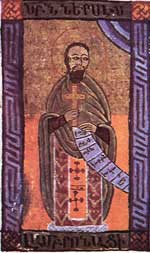
Armenian Archbishop (1153–1198)
Saint Nerses of Lambron (, Nerses Lambronatsi) (1153–1198) was the Archbishop of Tarsus in the Armenian Kingdom of Cilicia who is remembered as one of the most significant figures in Armenian literature and ecclesiastical history.
Life
Nerses was the son of the Hethumid lord of Lambron, Oshin II, and the nephew of the Catholicos (1166–1173) Nerses IV. His mother Shahandukht was a descendant of St. Gregory the Illuminator.{{cite book | editor-last =Hacikyan | editor-first =Agop Jack
Nerses became a zealous advocate of the union of the Greek and Armenian Churches. In 1179 he attended the Council of Hromkla, in which the terms of the union were discussed; his address at this council is considered a masterpiece of eloquence and style. The union was decided upon but never consummated owing to the death of Emperor Manuel Comnenus in 1180. Manuel's successors abandoned the negotiations and persecuted the Armenians, who were dissatisfied with the Byzantines and turned to the Latins. Leo II, Prince of Cilicia, desirous to secure for himself the title of King of Armenia, sought the support of Pope Celestine III and of Emperor Henry VI. The pope received his request favourably, but made the granting of it dependent upon the union of Cilicia to the Church of Rome. He sent Conrad, Archbishop of Mainz, to Tarsus, and the terms of union having been signed by Leo and twelve of the bishops, among whom was Nerses, Leo was crowned King of Armenia, 6 January 1198. Nerses died six months afterwards, on 17 July.
Saint Nerses of Lambron is commemorated July 17th and August 15th by the Armenian Apostolic Church and the Armenian Catholic Church.
Works
Nerses is justly regarded as one of the greatest writers in Armenian literature. He deserves fame as poet, prose writer, and translator. He wrote an elegy on the death of his uncle, Nerses IV, and many hymns. His prose works include his oration at the Council of Hromcla (tr. Italian by Aucher, Venice, 1812; tr. German by Neumann, Leipzig, 1834, and by Baumer, Trier, 2013); Commentaries on the Psalms, Proverbs, Ecclesiastes, Wisdom, and the Minor Prophets; an explanation of the liturgy; a letter to Leo II and another to Uskan, a monk of Antioch; and two homilies. He translated into Armenian the Rule of St. Benedict; the "Dialogues" of Gregory the Great; a life of this saint; and the letters of Lucius III and Clement III to the patriarch, Gregory. From the Syriac he translated the "Homilies" of Jacob of Serugh and, probably from the Coptic, the "Life of the Fathers of the Desert". Some writers ascribe to him an Armenian version of a commentary of Andreas of Caesarea on the Apocalypse. Nerses in his original writings frequently refers to the primacy and infallibility of the pope.
Notes
References
- This article incorporates text from the 1913 Catholic Encyclopedia article "Nerses of Lambron" by A.A. Vaschalde, a publication now in the public domain.
References
- Hadjilyra, Alexander-Michael. (May 2009). "Book The Armenians of Cyprus". Kalaydjian Foundation.
- (October 2018). "The Armenian Synaxarium- Volume I". Dalcassian Press.
- Baumer, Iso. (2013). "Nerses von Lambron.Die Ungeduld der Liebe". Paulinus.
This article was imported from Wikipedia and is available under the Creative Commons Attribution-ShareAlike 4.0 License. Content has been adapted to SurfDoc format. Original contributors can be found on the article history page.
Ask Mako anything about Nerses of Lambron — get instant answers, deeper analysis, and related topics.
Research with MakoFree with your Surf account
Create a free account to save articles, ask Mako questions, and organize your research.
Sign up freeThis content may have been generated or modified by AI. CloudSurf Software LLC is not responsible for the accuracy, completeness, or reliability of AI-generated content. Always verify important information from primary sources.
Report