From Surf Wiki (app.surf) — the open knowledge base
Nepalese rupee
Currency of Nepal

Currency of Nepal
| Field | Value |
|---|---|
| currency_name_in_local | रुपैयाँ |
| name_abbr | रु |
| image_width_1 | 175px |
| image_title_1 | रु.1000 banknote (obverse) |
| image_width_2 | 175px |
| image_title_2 | रु.1000 banknote (reverse) |
| iso_code | NPR |
| using_countries | **Nepal** |
| unofficial_users | **India** (Indo-Nepal Border Cities) |
| inflation_rate | 3.6% |
| inflation_source_date | [Statista](https://www.statista.com/statistics/422594/inflation-rate-in-nepal/), 2021 |
| pegged_with | Indian rupee (₹) |
| ₹1 = रु1.60 (buy), रु1.6015 (sell) | |
| unit | Rupee |
| subunit_ratio_1 | |
| subunit_name_1 | Paisa |
| symbol | रु |
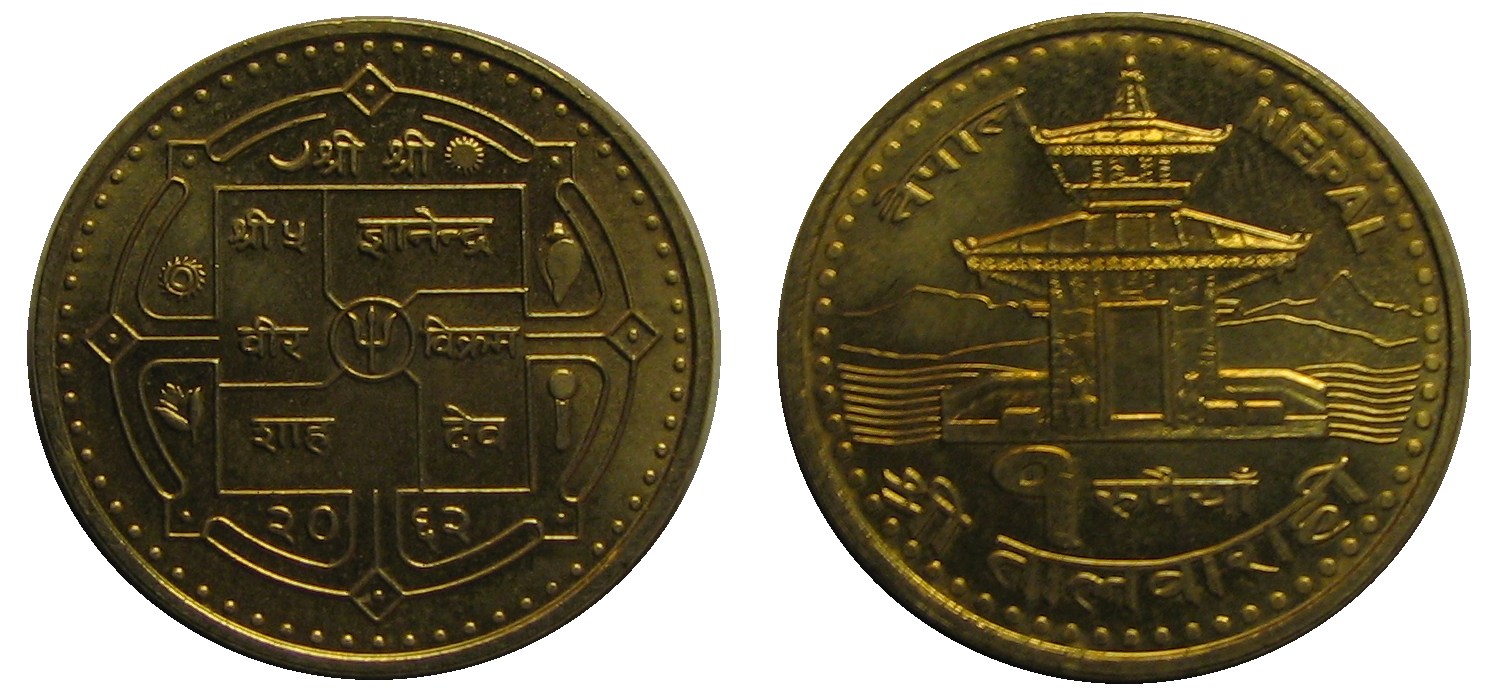
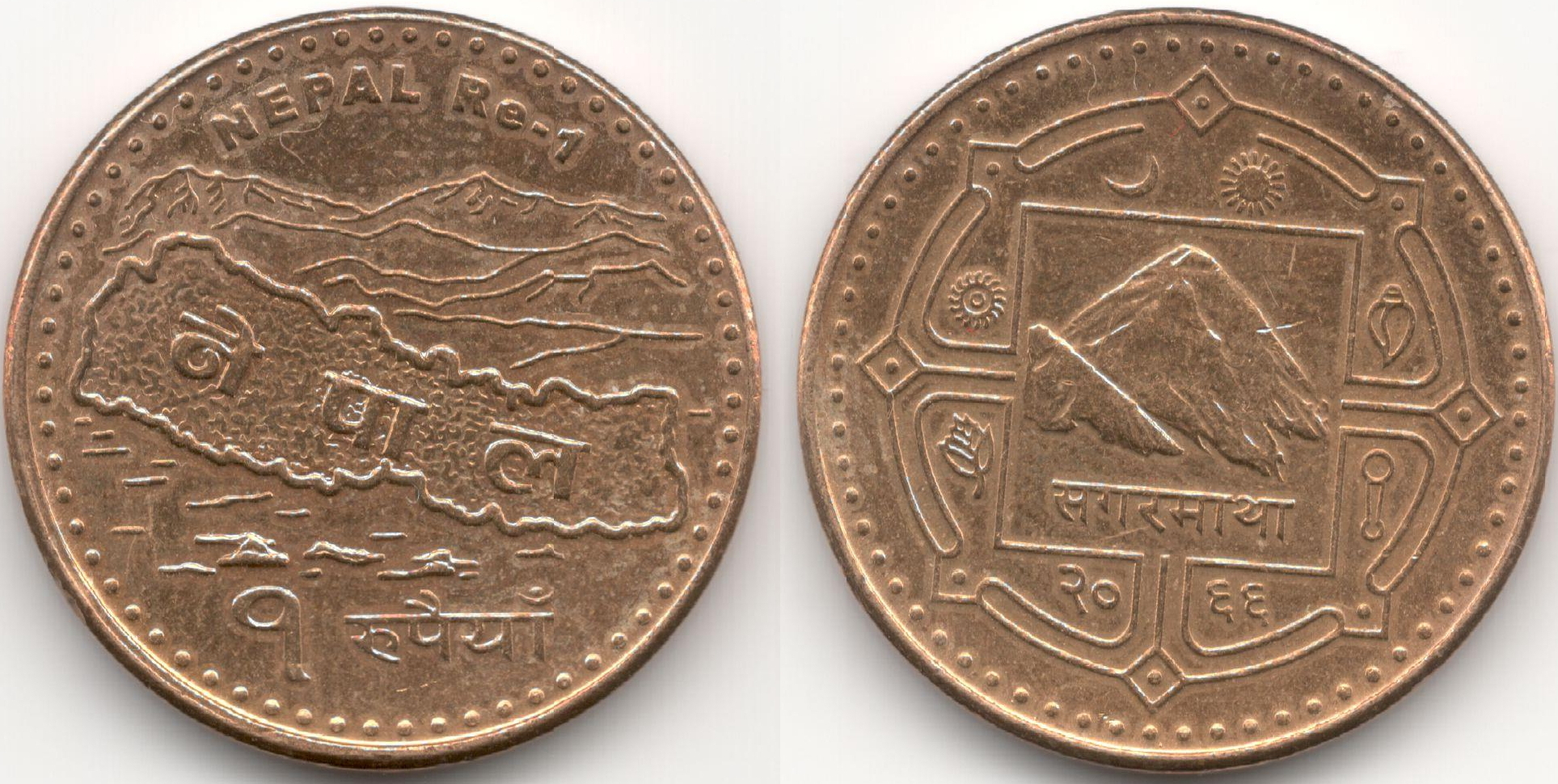
| frequently_used_coins | रु1, रु2 |
| rarely_used_coins | 1 paisa, 5 paisa, 10 paisa, 25 paisa, 50 paisa; रु5, रु10 |
| coin_article | Coins of the Nepalese rupee |
| frequently_used_banknotes | रु5, रु10, रु20, रु50, रु100, रु500, रु1000 |
| rarely_used_banknotes | रु1, रु2, रु25, रु250 |
| banknote_article | Banknotes of the Nepalese rupee |
| date_of_introduction | |
| replaced_currency | Nepalese mohar |
| issuing_authority | Nepal Rastra Bank |
| issuing_authority_website |
₹1 = रु1.60 (buy), रु1.6015 (sell) The Nepalese rupee (ne; sign: रु; code: NPR) is the official currency and legal tender of Nepal. It is also sometimes abbreviated as N₨ or Re./Rs. informally. The rupee is subdivided into 100 paisa, although coins of lower denominations are rarely used today. It is issued and regulated by the Nepal Rastra Bank, the central bank of Nepal.
The Nepalese rupee was introduced in 1932, replacing the silver-based mohar at a rate of 2 mohar = 1 rupee. Since 1994, it has been officially pegged to the Indian rupee at a rate of रु1.60 = ₹1, having previously been pegged at रु1.45 = ₹1.
, the Nepalese rupee is accepted for domestic transactions only within Nepal and is not legally circulated outside its borders. Foreign exchange is regulated by the central bank and subject to strict limits.
History
The rupee was introduced in 1932, replacing the silver mohar at a rate of 2 mohar = 1 rupee. At first, the rupee was called the Mohru in Nepali.
The "Bullet paisa"
footer =Nepal, 4 Paisa 1955 - The "Bullet paisa"}}
In 1955, 4 Paisa coins were minted, made from rifle cartridge cases from World War II that were used by the Gurkha soldiers who fought against the Imperial Japanese in the Pacific. The coins were produced by removing the primer from the cases and the cases were then converted into the 4 Paisa coins to commemorate the Gurkha's courage and victory during the war.
Due to the small number of cases found, these coins were minted for one year only.
They are known as the "Nepal Bullet Paisa".
1972–2007
During King Birendra’s rule, one can also distinguish between two major series of banknotes. The first series features the king wearing the military uniform while on the notes of the second series the king is wearing the traditional Nepalese crown adorned with feathers of the bird of paradise. During this period regular banknotes of 2 and 20 rupees and special banknotes of 25 and 250 rupees were issued for the first time. The legends found on the last issues of Gyanendra revert to Nepal sarkar ("Nepalese government"), thus omitting the reference to the king.
2007–Present

In October 2007, a 500-rupee note was issued on which the king's portrait was replaced by Mount Everest. This reflects the historic change from a monarchy to a republic which took place in May 2008 in Nepal. Further notes of 5, 10, 20, 50, 100 and 1000 rupees with Mount Everest and without reference to the king in their legends followed in 2008. The first issues of the 500- and 1000-rupee notes were printed on paper which still had the king's crowned portrait as a watermark in the "window" on the right part of the face of the notes. It was decided to print a red Rhododendron flower (Nepal's national flower) on top of the watermark. Notes of these denominations which were issued in 2009 and thereafter are printed on paper which has a Rhododendron flower as watermark instead of the royal portrait and were therefore released without the additional overprint in red.
Banknotes
Main article: Nepalese banknotes
On 17 September 1945, the government introduced banknotes for 5, 10 and 100 rupees, with the name mohru used in Nepalese. There are also 250-rupee notes commemorating the Silver Jubilee of Birendra Bir Bikram Shah in 1997. Since 2007, Nepalese rupee banknotes have been produced by Perum Peruri, the mint company of Indonesia.
In 2012, Nepal Rastra Bank issued a revised banknote series that is similar to the 2007 series, but now include inscriptions in English and the year of issue on the back.
| Image | Value | |||||||
|---|---|---|---|---|---|---|---|---|
| (rupees) | Main colours | Description | Date of | |||||
| issue | Obverse | Reverse | Obverse | Reverse | ||||
| 5 | Lilac and pink | Mount Everest; temple of Taleju; obverse of coin | Two yaks grazing; Mount Everest | 2012 | ||||
| Mount Everest; Kasthamandap Temple | Yak | 2017 | ||||||
| 10 | Brown and green | Mount Everest; Garud Narayan of Changu Narayan temple | Three blackbucks grazing; trees; bank logo | 2012 | ||||
| Antelope; trees; bank logo | 2017 | |||||||
| 20 | Orange and brown | Mount Everest; temple of god Krishna of Patan; Garuda atop pillar | Swamp deer; trees; mountain; bank logo | 2012 | ||||
| Sambar deer; trees; mountain; bank logo | 2016 | |||||||
| 50 | Purple, green and blue | Mount Everest; Rama-Janaki temple of Janakpur | Male tahr; mountains; bank logo | 2012 | ||||
| Snow leopard; bank logo | 2016 | |||||||
| 100 | Green and lilac | Mount Everest; Mayadevi inside silver metallic oval; map of Nepal; Ashoka pillar; | ||||||
| wood carvings from temple of Taleju in Kathmandu; description "Lumbini – Birthplace of Lord Buddha" | One-horned rhinoceros in grassy plain; bank logo | 2012 | ||||||
| One-horned rhinoceros and its offspring in grassy plain; bank logo | 2015 | |||||||
| 500 | Brown and violet | Mount Everest; god Indra; Mount Amadablam and Thyangboche monastery; wood carvings; clouds | Two tigers drinking melted snow | 2012 | ||||
| Tiger | 2016 | |||||||
| 1,000 | Blue, Red and Gray | Mount Everest, Swayambhunath Stupa & Harati temple | Asian elephant | 2013 | ||||
| Twin Asian Elephants | 2019 |
Exchange rates
Between 1857 and 1930, the Nepalese rupee (two half-rupees or mohars) was fixed at 1.28 per Indian rupee. After this period, its value fluctuated against the Indian rupee, falling to रु1.60 = ₹1 in 1939, rising to रु0.60 = ₹1 during the Second World War and falling again afterwards. In 1952, the government of Nepal officially pegged the Nepalese rupee at रु1.28 = ₹1, although the market rate remained at रु1.60 = ₹1.
Between 1955 and 1957, there was a series of soft peg revaluations that started at रु1.755 = ₹1 and appreciated to रु1.305 = ₹1 by 1957. In 1958, the government applied a new exchange rate of रु1.505 = ₹1 for the purchase of plane tickets only. A hard peg of रु1.60 = ₹1 was instituted in 1960, which was revalued to रु1.0155 = ₹1 when the Indian rupee was sharply devalued on 6 June 1966. The Indian rupee ceased to be legal tender in Nepal in 1966.
From 1967 to 1975, the government pegged the Nepalese rupee against the Indian rupee, the US dollar and gold, starting at रु1.35 = ₹1, रु10.125 = US$1 and रु1 = 0.08777g gold. By the time the gold peg was removed in 1978, the exchange rate was रु1.39075 = ₹1, रु12.50 = $1 and रु1 = 0.0808408g gold.
In 1983, the Nepali rupee's anchor was changed to a trade-weighted basket of currencies, which in practice amounted to a hard peg against the Indian rupee. This remained until 1993, when the peg was officially set at रु1.60 = ₹1.
References
Sources
- Agrawal (Giriya), Shyam and Gyawali, Kamal Prasad: Notes and Coins of Nepal. Nepal Rastra Bank Golden Jubilee Year 2005–06, Kathmandu, 2006.
- Bertsch, Wolfgang: "The Legends on the Banknotes of Nepal", International Banknote Society (IBNS) Journal, vol. 48, no. 3, 2009, p. 39–44.
- Jha, Hari Jaya: An Overview of Nepalese Paper Money. Manjeeta Jha, Lalitpur (Patan), B.S. 2058 (= A.D. 2001).
- Lorenzoli, Giovanni: "Nepali artistic buildings as seen on Nepali notes". Journal of the International Banknote Society, vol. 43, no. 3 (2004), p. 6–14.
- Shrestha, Ramesh: Nepalese Coins & Bank Notes (1911 to 1955). Kazi Mudhusudan Raj Bhandary, Kathmandu, 2007.
- Wittmann, Hans: Die Banknoten des Königreichs Nepal. Unpublished, Wiesbaden, 2002.
References
- "Currency and Coinage". Nepal Rastra Bank.
- (11 January 2018). "Nepal to keep currency pegged to Indian rupee". The Hindu Business Line.
- "Foreign Exchange Management Circulars". Nepal Rastra Bank.
- Schuler, Kurt. (2004-02-29). "Tables of Modern Monetary History: Asia".
- (18 February 2021). "4 Paisa - Tribhuvana Bir Bikram".
- Collector Club - La casa del collezionismo, I semestre 2021, inserto, pag 6 "La moneta proiettile".
- Linzmayer, Owen. (2012). "The Banknote Book".
- "Golden Jubilee Publications-Notes and Coins of Nepal".
- "Archived copy".
- Rawat, Pooran Chand. (1974). "Indo-Nepal Economic Relations". [[Lawrence Verry Incorporated]].
This article was imported from Wikipedia and is available under the Creative Commons Attribution-ShareAlike 4.0 License. Content has been adapted to SurfDoc format. Original contributors can be found on the article history page.
Ask Mako anything about Nepalese rupee — get instant answers, deeper analysis, and related topics.
Research with MakoFree with your Surf account
Create a free account to save articles, ask Mako questions, and organize your research.
Sign up freeThis content may have been generated or modified by AI. CloudSurf Software LLC is not responsible for the accuracy, completeness, or reliability of AI-generated content. Always verify important information from primary sources.
Report