From Surf Wiki (app.surf) — the open knowledge base
Natural gas in Iran
Overview of proven natural gas reserves in Iran

Overview of proven natural gas reserves in Iran
.svg)

Main article: Petroleum industry in Iran
According to the Iran Petroleum Ministry, the proved natural gas reserves of Iran are about 1201 e12cuft or about 17.8% of world's total reserves, of which 33% are as associated gas and 67% is in non associated gas fields. It has the world's second largest reserves after Russia. As it takes approximately 5850 cuft of gas to equal the energy content of 1 oilbbl of oil, Iran's gas reserves represent the equivalent of about 205 Goilbbl of oil.
The US Energy Information Administration estimated Iran's proved gas reserves as of 2016 to be 1201 e12cuft, rendering it second in the world.
Iran is one of the most hydrocarbon-rich areas in the world. Since the nation's first oil well in 1908, 145 hydrocarbon fields and 297 oil and gas reservoirs have been discovered in Iran, with many fields having multiple pay zones. A total of 102 fields are oil and the remaining 43 are gas, and there are 205 oil reservoirs and 92 natural gas reservoirs. According to Iran Energy Balance Sheet (2009, in Persian), 78 of these fields are currently active, with 62 onshore and 16 offshore, leaving 67 fields inactive at present. Some 23 hydrocarbon fields lie in border areas and are shared between Iran and adjacent countries, including Kuwait, Iraq, Qatar, Bahrain, UAE, Saudi Arabia and Turkmenistan.
The Permo-Triassic successions (the Dehram group in Iran and its lateral equivalent, the Khuff formation), are major gas-producing intervals in these basins. The supergiant North Dome/South Pars field alone is estimated to hold about 19% of the world's total gas reserves, producing gas and condensate from these intervals.
Iran still has huge potential for new significant gas discoveries: areas such as Caspian Sea, North East, Central Kavir and especially areas starting from Aghar and Dalan gas fields in Fars province up to the Strait of Hormuz and Central Persian Gulf have considerable potential for undiscovered gas. According to Exploration Directorate of NIOC, there are about 150 unexplored anticlines in Iran.
In 1998, the US Geological Survey estimated Iran's undiscovered gas resources to be in the range of 226 to 820 trillion cubic feet, with a probability-weighted average of 465 e12cuft
In January 2008, Iranian Minister of Petroleum Gholam-Hossein Nozari said, "NIOC has a target of producing one billion cubic meters of gas per day.
| Offshore Non-Associated | 67.1% |
|---|
Iran's ten biggest non-associated gas fields:
| Field | Gas in place | Recoverable reserve |
|---|---|---|
| South Pars | 500 e12cuft | 360 e12cuft |
| Kish | 66 e12cuft | 50 e12cuft |
| North Pars | 60 e12cuft | 47 e12cuft |
| Golshan | 55 e12cuft | 45 e12cuft to 25 e12cuft |
| Tabnak | NA | 21.2 e12cuft |
| Kangan | NA | 20.1 e12cuft |
| Khangiran | NA | 16.9 e12cuft |
| Nar | NA | 13 e12cuft |
| Aghar | NA | 11.6 e12cuft |
| Farsi (B-Structure) | NA | 11 e12cuft – 22 e12cuft |
There are also several discovered gas fields in Iran which hold low portion of CH4 and high portion of N2. These gas fields are Kabir Kuh, Milatun, Samand, Holeylan and Ahmadi. The Kabir Kuh gas field located in Lurestan province has 21 e12cuft of gas in place. The field gas consists of N2 64.33%, CH4 33.64%, CO2 2% and He 0.03%.
| Field's Name | Gas in Place | Recoverable Gas Reserve | Trillion cubic feet | Billion cubic meters | Trillion cubic feet | Billion cubic meters |
|---|---|---|---|---|---|---|
| Kish | 66 cuft | 50 cuft | ||||
| Sardar-e Jangal | 50 cuft | NA | ||||
| Tabnak | 30 cuft | NA | ||||
| Forouz | 24.7 cuft | NA | ||||
| Madar | 17.5 cuft | NA | ||||
| Farsi (B-Structure) | 11–23 | 310–650 | NA | |||
| Halegan | 12.4 cuft | 9 cuft | ||||
| Ghir (Sefid Zakhur) | 11.4 cuft | 8.5 cuft | ||||
| Yadavaran-Gas Layer | 9.75 cuft | NA | ||||
| Lavan | 9.1 cuft | NA | ||||
| Balal-Dahroum Formation | 8.8 cuft | NA | ||||
| Homa | 7.6 cuft | NA | ||||
| Sefid-Baghon | 6.3 cuft | 4.45 cuft | ||||
| Marun Gas Layer | 6.2 cuft | NA | ||||
| Gardan | 5.7 cuft | NA | ||||
| Day | 4.4 cuft | NA | ||||
| Binak Gas Layer | 3.5 cuft | NA | ||||
| Karanj Gas Layer | 2.9 cuft | NA | ||||
| BiBi hakime Gas Layer | 2.4 cuft | NA | ||||
| Tous | 2.19 cuft | 1.6 cuft | ||||
| Zireh | 1 cuft | NA | ||||
| Kuh-e-Asmari(Masjed Soleiman) | 1 cuft | 0.739 cuft | ||||
| Arash | 0.79 cuft | NA | ||||
| Kheyr Abad | 0.17 cuft | NA | ||||
| Total | 277.3 cuft | NA |
Iran's proven oil and gas reserves are 137 Goilbbl (10% of world's total) and 41.14 trillion cubic meters (15% of world's total) respectively, which give it a unique status in the global energy supply. Iran also owns 50% of the offshore gas field of Rhum in the North Sea, which is Britain's largest untapped gas field.
Development

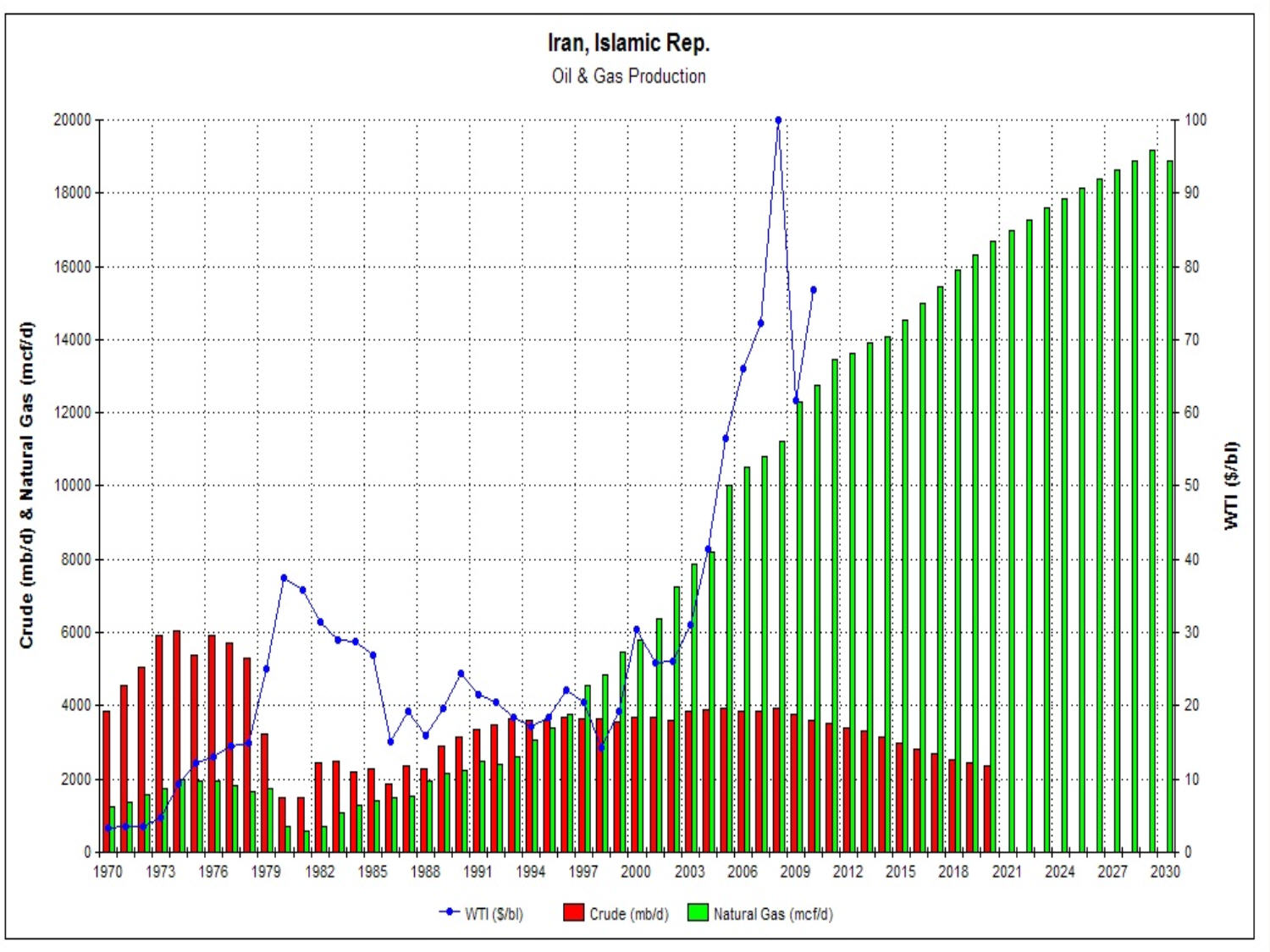
At present, Iran is producing only a small share of its gas reserves, about 5.5 e12cuft per year. This means that Iran is one of the few countries capable of supplying much larger amounts of natural gas in the future. Iran's overall gas exports in 2009/10 reached a record high of 6.8 billion cubic meters, increasing 44% over the previous year.
Iran's net export of gas in 2010 was 1.57 billion cubic metres. In 2010, Iran's exports and imports of natural gas were 8.42 and 6.85 billion cubic metres respectively. In 2010, Iran exported 0.4, 0.25, and 7.77 billion cubic metres of gas to Armenia, Azerbaijan and Turkey respectively. In terms of imports, Iran has received 0.35 and 6.5 billion cubic metres from Azerbaijan and Turkmenistan respectively. Iran has approximately 29.6 trillion cubic meters of proven gas reserves which accounts for 16% of the world's total reserves. This places Iran behind Russia with the second largest gas reserves worldwide. In 2009, Iran's natural gas production stood at 116 billion cubic metres. In 2010, this number rose to 138.5 billion cubic metres which shows a 19% increase. Most of Iran's gas is consumed domestically and has been increasing at an average annual rate of 12% for the past 15 years.
Iran plans to invest $15 billion a year to expand its annual gas output capacity to 300 e9m3 by 2014, from 170 billion in 2009. It will invest $50 billion from 2010 until 2020 on LNG projects. Iran plans to export 8 million tons of LNG by 2012. The country also aims to increase natural gas exports by fivefold to 60 e9m3 a year by 2014. Global gas demand is projected to rise between 2 percent and 3 percent a year for the next 20 to 25 years, with India and China the main markets for Iran's gas exports.
A December 2011 report from Iran's Petroleum Minister indicated that a large natural gas reserve was discovered inside Iran's side of the Caspian Sea. These reserves are estimated at 50 trillion cubic feet (1.42 trillion cubic meter).
References
References
- "کتاب نفت و توسعه".
- "BP".
- US Energy Information Administration, [http://www.eia.gov/cfapps/ipdbproject/IEDIndex3.cfm?tid=3&pid=3&aid=6 Proved natural gas reserves], accessed 3 Sept. 2013.
- [http://www.geoexpro.com/article/Persia_Land_of_Black_Gold/e7e95f74.aspx Persia Land of Black Gold] {{Webarchive. link. (2013-11-10 , Retrieved 2012-4-14.)
- [http://www.epmag.com/item/Iranian-Discoveries-Continue_98522 Iranian Discoveries Continue] {{Webarchive. link. (2012-05-19 , Retrieved 2012-4-14.)
- Undiscovered Oil and Gas Resources of Lower Silurian Qusaiba-Paleozoic Total Petroleum Systems [https://pubs.usgs.gov/fs/fs-0008-02/fs-0008-02.pdf]
- "Farsnews.com 17 Apr 2008".
- US Geological Survey, [https://pubs.usgs.gov/of/1998/of98-468/meast_gas.htm World Conventional Gas Resources, by Basin].
- [http://www.nioc.ir/fpublications/mashal/379/pdf/MAIN/MAIN%2016.pdf The Weekly Publication of the Iranian Petroleum Industry, Jan 13, 2008]
- "International – U.S. Energy Information Administration (EIA)".
- "کتاب نفت و توسعه".
- [http://www.shana.ir/151707-fa.html NIOC Official News Agency,(www.Shana.ir)] {{webarchive. link. (2010-09-09)
- "POGC website".
- "POGC website".
- "کتاب نفت و توسعه".
- "Archived copy".
- "NIOC Official News Agency,(www.Shana.ir)".
- IHS International Oil Letter, Vol 24 issue 6, published 15 February 2008 [http://energy.ihs.com/News/WW-News/news-2008/ONGC-huge-offshore-gas-reserves-confirmed-Iran.htm]
- "Naftnews.net".
- "NIOC Official News Agency,(www.Shana.ir),6/2/2009".
- "NIOC Official News Agency,(www.Shana.ir), September 30, 2007".
- "NIOC Official News Agency,(www.Shana.ir),9/5/2009".
- [http://www.shana.ir/140796-en.html NIOC Official News Agency,(www.Shana.ir),25/4/2009] {{webarchive. link. (2012-03-09)
- "NIOC Official News Agency,(www.Shana.ir), 2010 June 20".
- [http://www.shana.ir/129135-fa.html NIOC Official News Agency,(www.Shana.ir), 2008 April 17] {{webarchive. link. (2012-03-09)
- "Fars News Agency :: Iran Ups Gas Exports by 54%".
- "Archived copy".
- "Iran Says It Is Ready for Foreign Energy Investment (Update2)". [[Bloomberg News]].
- "Iran Says It Is Ready for Foreign Energy Investment (Update2)". [[Bloomberg News]].
This article was imported from Wikipedia and is available under the Creative Commons Attribution-ShareAlike 4.0 License. Content has been adapted to SurfDoc format. Original contributors can be found on the article history page.
Ask Mako anything about Natural gas in Iran — get instant answers, deeper analysis, and related topics.
Research with MakoFree with your Surf account
Create a free account to save articles, ask Mako questions, and organize your research.
Sign up freeThis content may have been generated or modified by AI. CloudSurf Software LLC is not responsible for the accuracy, completeness, or reliability of AI-generated content. Always verify important information from primary sources.
Report